Baliao Cavities Eight Bone Holes: Sacral Foraminal Fascial Decompression, Pelvic Parasympathetic Entrainment, and Posterior Kinetic Rooting in Classical Neigong
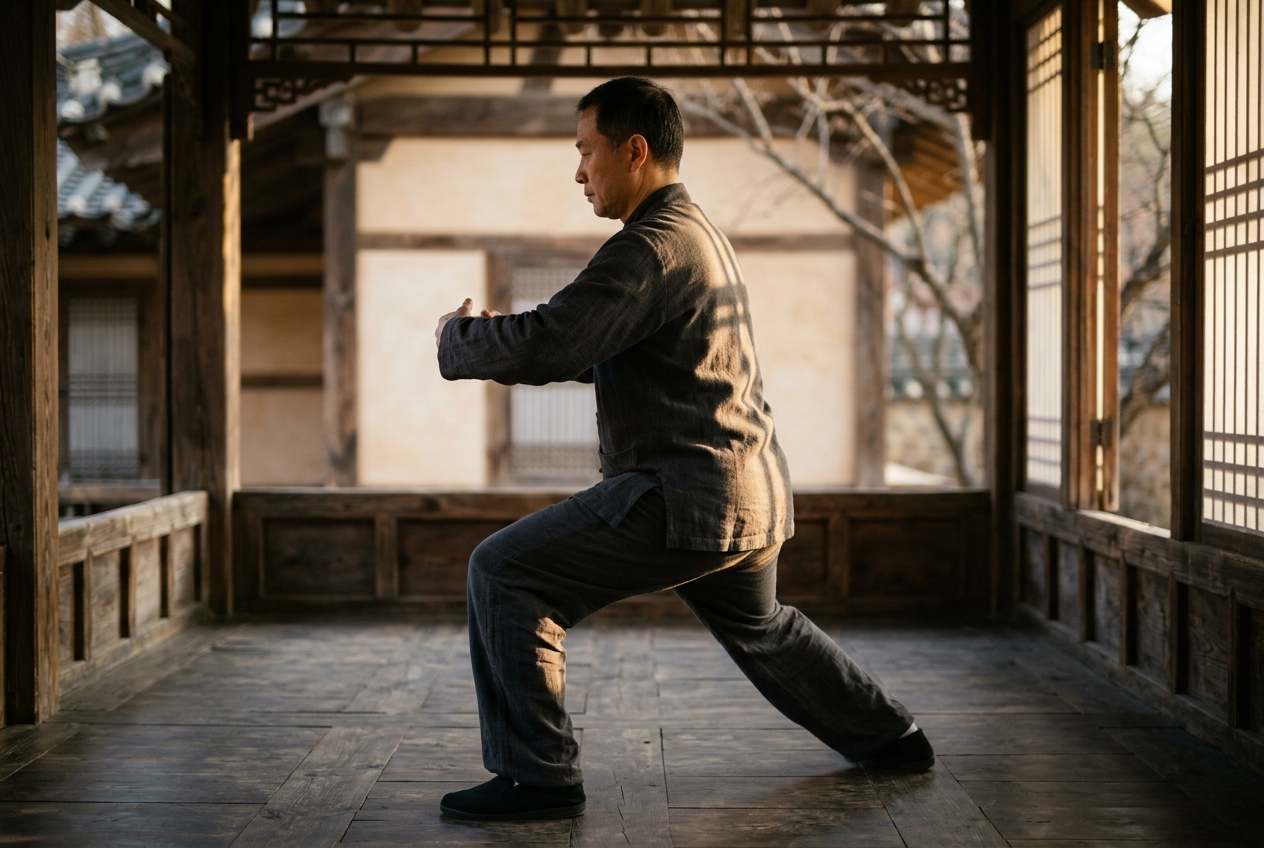
Before exploring the complex physiological and energetic layers of this practice, we can understand its purpose through a simple physical image: the sacrum functions as the hydraulic foundation of the entire vertebral column. When the muscles and dense connective tissues surrounding the lower back and tailbone remain chronically contracted, these eight bone holes become compressed, pinching local nerve pathways, restricting pelvic circulation, and halting the natural fluid wave that should travel up the spinal cord to the brain with every breath. By learning to soften the pelvic floor (Huiyin, CV1), relax the deep hip rotators, and coordinate the breath with minute movements of the sacrum, a practitioner restores elasticity to the base of the spine, initiating a full-body state of neurological calm and buoyant structural support.
Step-by-Step Practice Guide
The cultivation of sacral foraminal respiration requires no external equipment, but demands rigorous somatic awareness and millimeter-level precision. Practice this sequence barefoot or in flat-soled shoes on a stable surface.
1. The Neutral Wuji Stance Setup
Begin by positioning your feet parallel to one another, precisely hip-to-shoulder width apart, with your weight distributed evenly across the tripod of each foot: the base of the big toe, the base of the little toe, and the center of the calcaneus (heel). * Unlock your knees, allowing them to remain supple without collapsing inward or bowing outward. * Rest your hands lightly upon your lower abdomen, or place the dorsal surfaces of your hands against the sacral plate to provide tactile feedback. * Allow the vertex of your skull (Baihui, GV20) to float upward toward the ceiling, creating an axial elongation through the cervical and thoracic spine. * Release your lower back (Mingmen, GV4) backward, avoiding the impulse to aggressively tuck your pelvis. Let the tailbone hang freely under gravity like a plumb line suspended between your heels.
2. Establishing Huiyin–Baliao Reciprocal Tensegrity
Before moving the breath, establish the muscular and fascial suspension system between the front and back of the pelvic bowl: * Bring your attention to the anatomical center of your pelvic floor (Huiyin, perineum). * On a gentle, unhurried inhalation through the nose, initiate an extremely delicate, 5-percent upward tonal lift of the perineum—analogous to gently drawing a silk handkerchief upward from a table. * Simultaneously, direct your internal awareness to the sacral plate (Baliao), intending for the four pairs of bone holes to expand laterally and backward, countering the upward pull of the pelvic floor with a broad, downward, and outward relaxation of the sacrum.
3. Sacral Foraminal Respiration (Reverse Abdominal Dynamics)
- The Inhalation Phase (Expansion & Counternutation): Inhale smoothly through your nasal passages over a count of four to five seconds. Draw the breath down past the chest, allowing the lower abdominal wall below the navel to draw slightly inward and upward while the true lower back and sacrum expand outward. Feel the physical sensation of the thoracolumbar fascia stretching horizontally across the four pairs of foramina:
- Upper pair: Shangliao (BL31, first sacral foramen)
- Second pair: Ciliao (BL32, second sacral foramen)
- Third pair: Zhongliao (BL33, third sacral foramen)
- Lower pair: Xialiao (BL34, fourth sacral foramen)
- The Exhalation Phase (Nutation & Release): Exhale naturally without blowing or forcing the air, over a five-to-six-second count. As the breath leaves the body, relax the subtle lift at the perineum and allow the sacral apex (the lower tip above the coccyx) to tilt minutely backward while the sacral base settles forward and downward into its resting joint seat. Feel the deep tissues around the sacrum soften, warming the skin over the lower back.
4. Micro-Nutation and the Sacral Pump Activation
Once breathing cadence is established, introduce the internal micro-nutation: * During inhalation, allow the top of the sacrum (sacral base) to move infinitesimally posterior (counternutation), which opens the dorsal foramina to their maximum spatial diameter. * During exhalation, allow the top of the sacrum to glide infinitesimally anterior (nutation), gently compressing the anterior pelvic space and sending a hydraulic pulse through the central spinal canal toward the upper back and occiput. * This motion is internal and macroscopic: an observer looking at you should see virtually no external movement of your hips or spine.
Common Beginner Mistakes and Precise Corrections
- The Tailbone-Tucking Trap: The most pervasive biomechanical error in modern internal arts is aggressively clenching the buttocks and curling the tailbone forward under the pelvis. This excessive posterior pelvic tilt flattens the natural lumbar lordosis, locks the sacroiliac joint, and crushes the lower two pairs of foramina (Zhongliao and Xialiao) under compressive shear. Correction: Keep the pelvis neutral. Imagine the sacrum hanging downward like a heavy, water-soaked curtain rather than an iron scoop being tucked under your torso.
- Gluteal and Piriformis Gripping: Practitioners often mistake the muscular tension of the gluteus medius, gluteus maximus, or deep piriformis for structural stability. Gripping these muscles tightens the sacrotuberous and sacrospinous ligaments, clamping the posterior sacral nerves. Correction: Actively monitor your hips during exhalation. Ensure that your buttock muscles remain soft to the touch throughout the entire cycle.
- Thoracic and Clavicular Compensation: Lifting the ribs or shrugging the shoulders during the inhalation disconnects the respiratory diaphragm from the pelvic diaphragm, neutralizing intra-abdominal pressure. Correction: Anchor the breath below the level of the solar plexus; keep the chest hollowed and relaxed (Hanxiong Babei).
Sensory Signposts and Diagnostic Feedback
As the Baliao cavities begin to decompress, expect a sequence of distinct somatic landmarks: * Initial Stage (Heaviness and Density): A sensation of heavy, magnetic downward sinking through the thighs and heels, accompanied by the release of chronic dull aching in the lumbosacral junction. * Intermediate Stage (Warmth and Liquid Throbbing): A distinct vascular blooming—often described as warm water or mild electrical tingling spreading across the sacral triangular plate and descending through the sciatic pathways into the calves. * Advanced Stage (Spinal Hydraulic Wave): A rhythmic, upward-traveling pulse along the midline of the spine (Du Mai) synchronized with the breath, culminating in a clear, cool, or luminous sensation at the base of the skull (Yuzhen / Jade Pillow gate) and the cranial vault.
Why It Works: The Body Science
The anatomical and neurophysiological foundations of the Baliao cavities reveal why this ancient practice yields profound systemic down-regulation and musculoskeletal restoration. The sacrum is composed of five fused vertebrae (S1–S5), forming the posterior keystone of the pelvic ring. On its dorsal aspect, four pairs of apertures—the posterior sacral foramina—give passage to the dorsal primary rami of the first four sacral spinal nerves, alongside accompanying branches of the lateral sacral arteries and veins.
Neurophysiology of the S2–S4 Parasympathetic Outflow
Emerging directly through the sacral complex are the pelvic splanchnic nerves, derived from the anterior rami of S2, S3, and S4. These fibers represent the entire sacral division of the parasympathetic nervous system (the craniosacral autonomic axis). While the vagus nerve (Cranial Nerve X) supplies parasympathetic innervation to the thoracic and abdominal viscera up to the distal third of the transverse colon, the S2–S4 sacral outflow innervates the pelvic organs: the descending colon, rectum, urinary bladder, prostate, uterus, and erectile tissues via the inferior hypogastric plexus.
When the posterior sacral architecture is compressed by chronic pelvic tilt, ligamentous fibrosis, or hypertonic piriformis musculature, mechanical traction and localized ischemia irritate the sacral plexus. Practicing foraminal decompression releases the mechanical tethering on the sacral nerve roots. This induces rapid parasympathetic tone upregulation, shifting the body out of sympathetic fight-or-flight dominance into autonomic homeostasis. Clinical research published across neuro-urology and somatic medicine demonstrates that targeted stimulation of these pathways reduces pelvic congestion, alleviates chronic pelvic pain syndrome, and enhances systemic heart rate variability.
+-------------------------------------------------------------------------------+
|                       KEY NEURO-SOMATIC CORRELATIONS                          |
+-------------------------------------------------------------------------------+
| Classical Acupoint | Anatomical Aperture | Primary Neural & Visceral Impact   |
+--------------------+---------------------+------------------------------------+
| Shangliao (BL31)   | 1st Sacral Foramen  | S1 nerve ramus; SI joint stability |
| Ciliao (BL32)      | 2nd Sacral Foramen  | S2 splanchnic root; pelvic viscera |
| Zhongliao (BL33)   | 3rd Sacral Foramen  | S3 parasympathetic trunk; bladder  |
| Xialiao (BL34)     | 4th Sacral Foramen  | S4 pudendal/perineal nerve branch  |
+-------------------------------------------------------------------------------+
Fascial Tensegrity and Ligamentous Mechanics
The sacrum does not hang isolated in space; it is suspended within an intricate continuous web of dense connective tissue. The posterior sacroiliac ligaments, sacrotuberous ligaments, and sacrospinous ligaments connect the bone to the ischial tuberosities and the ilium. Overlying this structural foundation is the trilaminar thoracolumbar fascia, whose posterior layer acts as a mechanical distributor between the latissimus dorsi, the gluteus maximus, and the contralateral kinetic chains.
When an individual initiates sacral foraminal respiration, the contraction of the respiratory diaphragm increases intra-abdominal pressure against the pelvic diaphragm (levator ani and coccygeus). This piston-like mechanic tensions the sacrotuberous ligament, creating a lateral pulling force that expands the functional space across the dorsal foraminal apertures. The deep piriformis muscle—originating on the anterior surface of the sacrum between the foramina—relaxes through reciprocal inhibition, abolishing sciatic nerve entrapment and promoting unobstructed venous return from the internal iliac vascular beds.
The Sacral-Cranial Hydraulic Pump and Cerebrospinal Fluid Flow
In classical internal alchemy, Baliao is considered the primary posterior hydraulic pump (Weilu Guan or the "Tailbone Pass") that propels fluid up the Governing Vessel (Du Mai). Modern biomechanics verifies this phenomenon through the craniosacral mechanism. The spinal cord is enveloped by the durable dural sheath, which anchors firmly to the foramen magnum and upper cervical vertebrae (C1–C2) at its cranial pole, and attaches directly to the second sacral segment (S2) at its caudal pole.
With every cycle of diaphragmatic inhalation and sacral micro-counternutation, mechanical tension is transmitted along this dural tube. This rhythmic micro-mobility acts as a biological hydraulic pump, propelling cerebrospinal fluid (CSF) through the subarachnoid space toward the ventricular system of the brain. Decompressing the Baliao cavities removes structural resistance at the caudal terminus of this system, optimizing CSF turnover, enhancing metabolic clearance along the central nervous axis, and generating the distinct subjective state of clarity, calm, and alertness known in classical texts as illuminating the Upper Dantian (Niwan Gong).
Classical Lineage & Context
The systematic study of the sacral cavities spans more than two millennia of documented Chinese medical and Daoist history. The earliest comprehensive anatomical classification of these points appears in the foundational canonical text of East Asian medicine, the Huangdi Neijing (The Yellow Emperor's Inner Classic), composed between the Han and Warring States eras. In the Ling Shu (The Spiritual Pivot), Chapter 10, the Baliao are categorized as vital control nodes along the Foot Taiyang Bladder Channel, which governs the entire posterior myofascial kinetic chain of the body.
The naming taxonomy of these eight points reflects their hierarchical spatial architecture: * Shangliao (上髎, Upper Bone Seam): Governs the integration of the lumbar spine with the sacral base. * Ciliao (次髎, Second Bone Seam): Traditionally considered the most potent clinical point for clearing blood stasis in the lower abdomen and regulating reproductive vigor. * Zhongliao (中髎, Middle Bone Seam): Dedicated to the harmonious operation of the bladder, urinary system, and lower bowel. * Xialiao (下髎, Lower Bone Seam): Anchors the energetic and fascial transition into the coccyx and pelvic floor.
During the Tang Dynasty, the legendary physician-hermit Sun Simiao expanded upon the therapeutic utility of the Baliao in his work Qianjin Yaofang (Essential Formulas Worth a Thousand Pieces of Gold), noting that deep, needle-free palpation and breath directed into these bone seams could relieve intractable pelvic stagnation, menstrual irregularity, and lumbar weakness.
Simultaneously, within the esoteric Daoist Neidan (Internal Alchemy) lineages that flourished in the sacred mountains of Wudang and Huashan, the sacral foramina were recognized as the mechanical key to unlocking the Hou San Guan—the "Three Rear Passes" of the spine. The lowest pass, the Weilu Guan (Tailbone/Sacral Gate), was universally acknowledged as the most challenging barrier to penetrate. The ancient adepts understood that unless the Baliao cavities were physically decompressed and structurally aligned, the internal vital substance (Jing) could never transform into functional bio-electrical movement (Qi) to ascend the spinal conduit (Du Mai) into the higher neurological centers.
+-------------------------------------------------------------------------------+
|                       THE THREE SPINAL GATES (HOU SAN GUAN)                   |
+-------------------------------------------------------------------------------+
| Gate Name         | Somatic / Anatomical Location   | Alchemical Function     |
+-------------------+---------------------------------+-------------------------+
| 1. Weilu Guan     | Baliao / Sacral Foramina (S1-S4)| Caudal Hydraulic Pump   |
| 2. Jiaji Guan     | Thoracic Spine (T5-T6 / Mingmen)| Middle Emotive Engine   |
| 3. Yuzhen Guan    | Occiput / Foramen Magnum (C1-C2)| Cranial Vault Expansion |
+-------------------------------------------------------------------------------+
In the late Ming and early Qing dynasties, these monastic methods were integrated into the internal martial arts traditions—Taijiquan, Baguazhang, and Xingyiquan. Masters recognized that true martial power (Fajin) and absolute structural rooting (Dangen) did not originate from muscular strength in the legs, but from the elasticity and mobility of the Kua (the inguinal-pelvic complex) and the freedom of the sacral joint. A practitioner whose Baliao was frozen could never transmit ground reaction force efficiently through the spine. Thus, sacral foraminal decompression shifted from a purely medical treatment into a foundational requirement for internal martial mastery and longevity cultivation, as maintained today by organizations such as the National Qigong Association and documented in integrative health research via the National Center for Complementary and Integrative Health.
Today's Practice Commitment
To transform this intellectual understanding into direct somatic experience, commit to the following seven-minute protocol tomorrow morning immediately upon waking, before consuming food or coffee:
- Stand in a quiet room in the Neutral Wuji Stance with your feet bare on the floor.
- Place both palms firmly against your sacral plate (Baliao) to maintain direct tactile biofeedback.
- Perform twenty-four full, unhurried cycles of Sacral Foraminal Respiration: * Five seconds of smooth inhalation, feeling the sacral plate widen horizontally into your palms as you maintain a 5-percent micro-lift at the perineum. * Six seconds of effortless exhalation, feeling the deep gluteal tissues and lower back melt downward toward the earth.
- Conclude by standing silently for two minutes with your arms resting naturally at your sides.
Observe the physical sensations in your body: the temperature across your lower back, the steadiness of your breath, and the sensation of stability in your legs. Practiced daily, this simple engagement with the eight bone cavities unbinds the structural foundation of your spine, decongests the deep pelvic networks, and restores the natural fluid rhythm connecting your body and mind.