Baduanjin Qigong (Ba Duan Jin) Meridian Dynamics: Governing Eight Section Brocade Postural Alignments, Visceral Organ Traction, San Jiao Regulation, and Kinetic Qi Circulation in Traditional Chinese Medicine
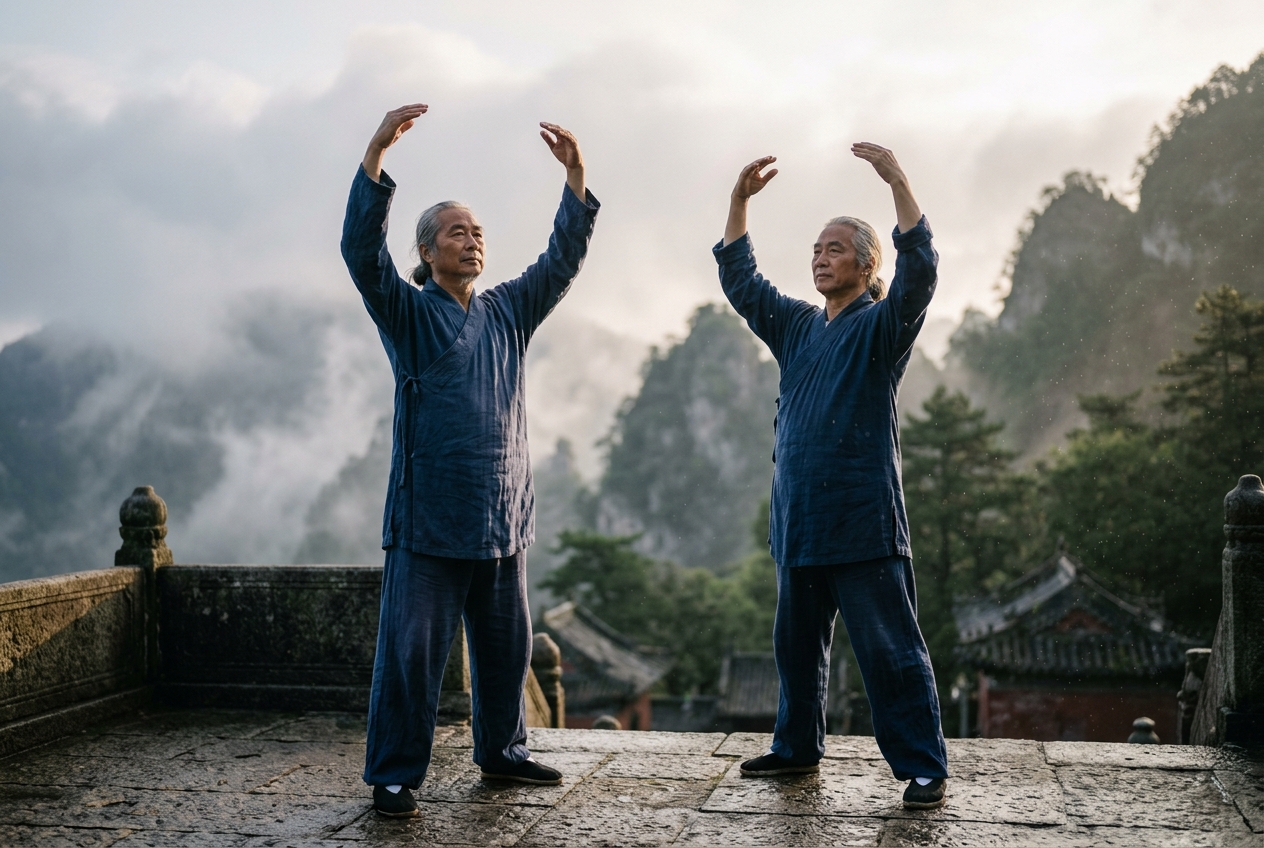
1. OPENING SCENE — A Moment You’ll Recognise
You sit at your desk in the late afternoon, weighed down by an insidious, creeping lethargy. Your thoracic spine is subtly kyphotic, your neck craned forward toward an illuminated screen, and your breathing has devolved into shallow, clavicular gasps. There is a dull ache between your scapulae, a subtle distension across your epigastrium, and a fuzzy, clouded inertia clinging to your cognitive faculties. In modern biomechanical parlance, your axial skeleton has surrendered to gravitational compressive deformation, while your parasympathetic tone has plummeted under unremitting, low-grade sympathetic vigilance.
In the conceptual lexicon of Traditional Chinese Medicine (TCM), this familiar state represents a systemic failure of San Jiao (the Triple Burner) fluid metabolism and the stasis of Qi (bioelectrical and metabolic vitality) across the twelve primary conduits. The interstitial fluids have stagnated; the metabolic mist of the Upper Burner is suffocated, the digestive cauldron of the Middle Burner is compressed, and the foundational fire of the Lower Burner lies dormant.
Long before modern physiology documented how continuous fascial compression diminishes microvascular perfusion and impairs lymphatic return, twelfth-century Daoist physicians and martial strategists engineered a kinetic remedy: Baduanjin (八段錦), or the Eight Section Brocade. By weaving together eight discrete, non-strenuous somatic geometries, Baduanjin does not merely stretch muscle tissue; it mechanically tensions the body's continuous fascial web, decompresses the neurovascular bundles passing through anatomical apertures, induces rhythmic trans-diaphragmatic pressure gradients, and systematically recalibrates the autonomic nervous system.
+----------------------------------------------------------------------------------------------------+
|                                    THE TRI-LAYERED SOMATIC BRIDGE                                  |
|                                                                                                    |
|  [ CLASSICAL CHINESE MEDICINE ]         [ FASCIAL BIOTENSEGRITY ]      [ MODERN NEUROPHYSIOLOGY ]  |
|  - San Jiao (Triple Burner)             - Interstitial Matrix Hydration- Lymphatic/Thoracic Pumping|
|  - Twelve Meridian Conduits (Jing Luo)  - Myofascial Kinetic Chains    - Neurovascular Decompression|
|  - Zang-Fu Organ Balance (Yin/Yang)     - Reciprocal Tensile Shearing  - Vagal Parasympathetic Tone|
+----------------------------------------------------------------------------------------------------+
2. WHAT THIS ORGAN SYSTEM DOES: The San Jiao and the Twelve Meridian Matrix
To comprehend the therapeutic mechanism of Baduanjin, one must demystify its primary target: the San Jiao (Triple Burner / 三焦), alongside the twelve primary meridian networks (Jing Luo). While Western anatomy historically struggled to correlate the Triple Burner with an isolated parenchymal organ, modern interstitial histology and the paradigm of biotensegrity reveal that the San Jiao is conceptually isomorphic with the body-wide fascial interstitium and the fluid-circulating lymphatic-microvascular apparatus.
                          =============================================
                                THE SAN JIAO (TRIPLE BURNER) MATRIX
                          =============================================
                                                |
            +-----------------------------------+-----------------------------------+
            |                                   |                                   |
            v                                   v                                   v
   [ UPPER BURNER (Shang Jiao) ]       [ MIDDLE BURNER (Zhong Jiao) ]      [ LOWER BURNER (Xia Jiao) ]
   Anatomy: Thoracic Cavity            Anatomy: Epigastrium / Sub-diaphragm Anatomy: Hypogastrium / Pelvis
   Organs: Heart, Lungs                Organs: Spleen, Stomach             Organs: Kidneys, Bladder, Intestines
   Function: "A Dispersing Mist"       Function: "A Macerating Cauldron"   Function: "A Drainage Sluice"
   Physiology: Cardiopulmonary Perfusion Physiology: Chyme & Microvascular Motility Physiology: Urogenital/Lymphatic Clearance
The Upper Burner (Shang Jiao): The Dispersing Mist
Encompassing the thoracic cavity above the diaphragm, the Upper Burner houses the Zang organs of the Heart (Xin) and Lungs (Fei). It governs the intake of environmental air (Qing Qi) and its fusion with nutritive essence (Gu Qi) to synthesize Zong Qi (Pectoral/Gathering Qi). Classical texts describe its physiological manifestation as Ru Wu (如霧)—"like a mist"—diffusing oxygenated blood, thermal energy, and defensive Wei Qi through the vascular and cutaneous micro-networks.
The Middle Burner (Zhong Jiao): The Macerating Cauldron
Occupying the region between the diaphragm and the umbilicus, the Middle Burner contains the Spleen (Pi) and Stomach (Wei). Functioning as Ru Ou (如漚)—"like a fermentation vat or maceration cauldron"—it orchestrates the mechanical breakdown and enzymatic transformation of nutrients, separating the clear nutritive essence (Qing) from the turbid residue (Zhuo), propelling clear vitality upward while guiding metabolic waste downward.
The Lower Burner (Xia Jiao): The Drainage Sluice
Spanning the hypogastric and pelvic basins, the Lower Burner encompasses the Kidneys (Shen), Urinary Bladder (Pangguang), Liver (Gan), and Intestines. Described as Ru Du (如瀆)—"like a drainage ditch or sluice gate"—it governs the filtration, excretion, and reclamation of fluids, anchoring the primordial Yuan Qi (Original Qi) within the renal and adrenocortical axis.
The Twelve Conduits as Myofascial Meridians
In parallel with the San Jiao, the twelve regular meridians trace specific longitudinal pathways traversing the extremities and deep visceral compartments. In modern functional anatomy, these pathways correlate with the myofascial meridians documented by researchers such as Thomas Myers in Anatomy Trains. When a meridian is "stagnant," myofascial densification, hyaluronic acid dehydration, and restricted sliding between fascial planes compress local unmyelinated nerve endings and capillary beds. Baduanjin operates as a precise sequence of kinetic levers designed to introduce tension and torsional shearing along these specific myofascial pathways, restoring fluid exchange and bioelectrical conductivity.
3. HOW YOU CAN FEEL IT: Signs of Balance and Somatosensory Imbalance
Meridian obstruction and San Jiao dysregulation do not manifest instantly as overt anatomical pathology; rather, they incubate as insidious functional disturbances across sensory, digestive, and psychological domains.
+---------------------------------------------------------------------------------------------------+
|                               SOMATOSENSORY & CLINICAL ASSESSMENT MATRIX                          |
+------------------------------------+--------------------------------------------------------------+
| SYSTEMIC STATE                     | PATHOGNOMONIC SIGNS & SOMATIC MANIFESTATIONS                 |
+------------------------------------+--------------------------------------------------------------+
| San Jiao & Upper Burner Stagnation | - Constricted thoracic excursion; shallow apical breathing   |
|                                    | - Cervicothoracic stiffness; cold distal extremities         |
|                                    | - Occipital headaches; mid-afternoon brain fog (Shen clouding)|
+------------------------------------+--------------------------------------------------------------+
| Middle Burner (Spleen/Stomach)     | - Postprandial somnolence and abdominal distension           |
| Dysregulation                      | - Epigastric heaviness; erratic transit time; loose stool     |
|                                    | - Muscle hypotonia; chronic low-grade fluid retention        |
+------------------------------------+--------------------------------------------------------------+
| Lower Burner (Kidney/Mingmen)      | - Lumbar soreness; weak knee joints; nocturnal pollakiuria   |
| Exhaustion                         | - Diurnal fatigue unrelieved by sleep; cold gluteal tissues  |
|                                    | - Heightened acoustic startle response; persistent anxiety   |
+------------------------------------+--------------------------------------------------------------+
| Dynamic Equilibrium                | - Effortless diaphragmatic expansion (abdominal-perineal)    |
| (Homeodynamic Vitality)            | - Supple, spring-like fascial recoil; balanced core warmth   |
|                                    | - Crisp visual clarity; stable, sustained daytime focus      |
+------------------------------------+--------------------------------------------------------------+
Self-Assessment: Evaluating Your Tensegrity and Visceral Motility
Readers can immediately evaluate their energetic and biomechanical integrity through a rapid three-step somatic screen: 1. The Cervicothoracic Rotation Test: Rotate your head smoothly toward the left shoulder, then the right. Observe if the movement arrests abruptly at the C5–C7 junction or if you experience pulling sensations radiating into the scapula along the Shou Taiyang (Small Intestine) and Shou Shaoyang (Triple Burner) tracks. 2. The Postprandial Breath Screen: Place one palm on your manubrium sterni and the other over your umbilicus. Inhale deeply. If only the superior hand rises while your abdomen draws inward (paradoxical breathing), the diaphragmatic descent is mechanically blocked, indicating Middle Burner visceral compression. 3. The Plantar Contact Screen: Stand barefoot on a hard surface. Feel the distribution of weight across your tripod of support (calcaneus, first metatarsal head, fifth metatarsal head). Excessive lateral loading signifies tension along the Zu Taiyang (Bladder) meridian, while collapsed arches compress the Zu Shaoyin (Kidney) conduit at Yongquan (KD1).
4. HISTORICAL LINEAGE & POSTURE-BY-POSTURE PRACTICE GUIDE
The Historical Codification of the Eight Section Brocade
The historical lineage of Baduanjin reflects a synthesis of military physical culture, Daoist longevity alchemy (Neidan), and clinical therapeutics. Earliest textual references emerge during the Song Dynasty (960–1279 CE). The scholar Hong Mai (洪邁, 1123–1202 CE) recorded references to Baduanjin exercises in his work Yijianzhi (夷堅志, Records of the Listener), describing their efficacy in treating chronic illness. Concurrently, the Daoist compendium Xiuzhen Shishu (修真十書, Ten Books on Cultivating Perfection), preserved within the Daozang (Daoist Canon), codified the earliest illustrated depictions of the eight discrete postures, attributing their conceptual origins to ancestral figures such as Zhongli Quan and later the Southern Song general Yue Fei (岳飛).
==================================================================================================
                                    HISTORICAL EVOLUTION OF BADUANJIN
==================================================================================================
   SONG DYNASTY (960–1279 CE)         QING DYNASTY (1644–1912 CE)         CONTEMPORARY ERA (2003–Pres.)
   --------------------------         ---------------------------         -----------------------------
   - Hong Mai's *Yijianzhi*           - *Baduanjin Tu* (Illustrated)      - Chinese Health Qigong Assoc.
   - Daozang's *Xiuzhen Shishu*       - Codification of Standing Routine  - Hospital Clinical Oncology
   - Martial integration (Yue Fei)    - Popularization in TCM manuals     - Peer-Reviewed Neurological Trials
==================================================================================================
During the Qing Dynasty (1644–1912 CE), manuals such as the Baduanjin Tu standardized the routine into its dominant standing configuration. In 2003, the General Administration of Sport of China, alongside the Chinese Health Qigong Association, formally standardized the movements through biomechanical profiling, kinematic motion capture, and multi-center clinical trials, embedding Baduanjin within university medical curricula and state hospital rehabilitation programs globally.
Exhaustive Breakdown of the Eight Standardized Movements
                   ============================================================
                                  THE EIGHT MOVEMENTS OF BADUANJIN
                   ============================================================
                   1. Shuang Shou Tuo Tian Li San Jiao  (Hold Up Heavens)
                   2. Zuo You Kai Gong Si She Diao      (Draw the Bow)
                   3. Tiao Li Pi Wei Xu Dan Ju Shou     (Raise Single Arm)
                   4. Wu Lao Qi Shang Wang Hou Qiao     (Look Backward)
                   5. Yao Tou Bai Wei Qu Xin Huo        (Sway Head & Tail)
                   6. Liang Shou Pan Zu Gu Shen Yao     (Hold Feet)
                   7. Zuan Quan Nu Mu Zeng Qi Li        (Clench Fists/Glare)
                   8. Bei Hou Qi Dian Bai Bing Xiao     (Bounce on Heels)
                   ============================================================
Movement 1: Shuang Shou Tuo Tian Li San Jiao (Two Hands Hold Up the Heavens to Regulate the Triple Burner)
                       [ BIOMECHANICAL VECTOR: VERTICAL FASCIAL DECOMPRESSION ]
                                                ^
                                                | (Interlocking palms push upward)
                                         [ THORACIC CAGE ]
                                        (Vertical Expansion)
                                                |
                                        [ DIAPHRAGM DESCENDS ]
                                                |
                                                v
                                         [ PELVIC FLOOR ]
                                      (Rooting down via KD1)
- Biomechanical Execution: Stand in natural parallel stance (Ziran Zhan Zhuang), feet shoulder-width apart. Interlock the fingers before the lower abdomen. Inhale slowly through the nose as the interlocked hands ascend along the midline (Ren Mai), rotating outward at chest level to press firmly upward toward the zenith. The elbows extend without hyperextension; the chin slightly tucks, elongating the suboccipital musculature. Hold the peak extension for 2–3 seconds while maintaining vertical rooting through the heels and ball of the foot. Exhale smoothly as the arms uncouple and arc laterally down to the baseline. Perform 6 repetitions.
- Fascial & Neurovascular Mechanics: Generates continuous pre-tension along the Superficial Front Line and Deep Front Line. This vertical axial elongation expands the intercostal spaces, increases negative intrathoracic pressure, and maximizes vertical diaphragmatic excursions (up to 7–10 cm). This excursion compresses and releases the cisterna chyli, driving lymphatic and interstitial fluid drainage from the Lower to the Upper Burner.
- Energetic & Meridian Dynamics: Opens the San Jiao channel (Hand Shaoyang), clearing heat and metabolic debris from the chest (Shang Jiao), epigastrium (Zhong Jiao), and pelvic floor (Xia Jiao).
Movement 2: Zuo You Kai Gong Si She Diao (Drawing the Bow on Both Sides to Shoot the Hawk)
      [ LEFT: "Sword Finger" (L1/LU Ext.) ] <==== [ EXPANDED CHEST ] ====> [ RIGHT: Flexed Scapular Retraction ]
                                                   (CV17 Shanzhong)
- Biomechanical Execution: Step out laterally into a deep or medium horse stance (Mabu), pelvis tucked in neutral tilt with knees tracking directly over the second toes. Cross the forearms at chest height (Shanzhong, CV17). Inhale as the lead hand extends laterally in a directional "sword finger" (Jian Jue) or open palm posture, simulating the bracing of an archer's bow, while the opposite hand forms a drawing fist, pulling back across the pectoralis major with the elbow at shoulder height. Retract the scapulae fully, expanding the ribcage transversely. Fix your visual gaze (Shen) intently over the extended index finger. Exhale as you relax the tension, circle the hands, transition through center, and mirror the motion to the opposite side. Perform 6 repetitions (3 per side).
- Fascial & Neurovascular Mechanics: Maximizes reciprocal shoulder horizontal abduction and adduction. Scapular retraction activates the rhomboids and middle trapezius while stretching the pectoralis minor, alleviating compression on the axillary neurovascular bundle and brachial plexus.
- Energetic & Meridian Dynamics: Direct mechanical stimulation of the Shou Taiyin (Lung) and Shou Yangming (Large Intestine) meridians along the anterolateral arm, enhancing cardiopulmonary capacity, oxygen saturation, and peripheral microvascular perfusion.
Movement 3: Tiao Li Pi Wei Xu Dan Ju Shou (Regulating Spleen and Stomach with Single Arm Elevation)
                                      ^  [ LEFT PALM: Upward Counter-Press (Heaven) ]
                                      |
                                  [ TORSO ]  (Opposing Fascial Shearing Vector)
                                      |
                                      v  [ RIGHT PALM: Downward Root (Earth) ]
- Biomechanical Execution: From a parallel stance, bring both palms facing upward before the solar plexus. Inhale as the left palm rotates and presses upward above the cranium, fingertips pointing medially toward the right, while the right palm rotates and presses firmly downward alongside the right hip, fingers pointing anteriorly. Simultaneously stretch both arms in opposing vertical directions, creating a dynamic linear stretch along the torso. Exhale slowly as both palms return to the solar plexus. Inhale and mirror the movement with the right hand ascending and the left descending. Perform 6 repetitions.
- Fascial & Neurovascular Mechanics: Imparts an asymmetrical vertical shearing force across the thoracolumbar fascia, perigastric peritoneum, and hepatic ligaments. This reciprocal axial traction stimulates the celiac plexus and mechanoreceptors embedded within the gastrointestinal tract, optimizing gastric motility and bile secretion.
- Energetic & Meridian Dynamics: Harmonizes the Zu Taiyin (Spleen) and Zu Yangming (Stomach) conduits. The upward vector elevates sunken Spleen Qi (Pi Qi Xia Xian), countering ptosis and fatigue, while the downward vector pacifies rebellious Stomach Qi (Wei Qi Shang Ni), mitigating reflux and epigastric fullness.
Movement 4: Wu Lao Qi Shang Wang Hou Qiao (Looking Backward to Prevent Five Strains and Seven Impairments)
        [ HEAD TURNS POSTERIORLY ]                                  [ ARMS EXTERNALLY ROTATE ]
       - Stretches Sternocleidomastoid                             - Opens Shou Yin Meridians
       - Stimulates Vagus & Window of Sky                          - Expands Anterior Thorax
- Biomechanical Execution: Stand in natural parallel stance. Inhale smoothly while executing a coordinated, slow external rotation of both arms: spiraling the palms outward, abducting the thumbs, and expanding the anterior chest wall. Simultaneously rotate the cervical spine to gaze backward over the left shoulder as far as comfortably possible without twisting the pelvis. Maintain alignment of the crown (Baihui, GV20) with the perineum (Huiyin, CV1). Hold the terminal posture for 2 seconds. Exhale as the head returns to center and the arms gently spiral back to rest alongside the thighs. Alternate to the right. Perform 6 repetitions.
- Fascial & Neurovascular Mechanics: Drives precise cervical axial rotation between the C1 (atlas) and C2 (axis) vertebrae, stretching the sternocleidomastoid, scalenes, and upper trapezius. This rotation mechanically massages the internal carotid artery, the carotid sinus baroreceptors, and the descending trunk of the vagus nerve (Cranial Nerve X), inducing immediate parasympathetic autonomic shifting and enhancing baroreflex sensitivity.
- Energetic & Meridian Dynamics: Directly targets the classical "Five Strains" (Wu Lao—injuries to Heart, Liver, Spleen, Lung, and Kidney from postural fixation) and "Seven Impairments" (Qi Shang—emotional injuries). Activates the cranial "Window of the Sky" acupoints (Tianchuang SI16, Tianzhu BL10, Fengchi GB20), clearing cerebral venous congestion and down-regulating hyperactive sympathetic tone.
Movement 5: Yao Tou Bai Wei Qu Xin Huo (Swaying the Head and Wagging the Tail to Expel Heart Fire)
                                  [ HEAD & CERVICAL SPINE ]
                                   (Sways in wide arc down)
                                              |
                                              v
                              [ HORSE STANCE / MABU BASE ]
                                              ^
                                              |
                                   [ TAILBONE / COCCYX ]
                                  (Wags in counter-orbit)
- Biomechanical Execution: Adopt a broad horse stance (Mabu), approximately double shoulder-width, placing the hands firmly upon the distal anterior thighs with thumbs pointing posteriorly and elbows braced slightly outward. Inhale to center the spine. Exhale as you hinge at the hips, lower the torso forward, sweep the head and cervical spine downward to the left in a broad circular arc, gazing down toward the left foot. Concurrently, shift the pelvis and coccyx ("wag the tail") toward the right side. Inhale as you sweep the upper body through the low center, ascending up the right side to return to the upright starting posture. Reverse the orbital direction. Perform 6 continuous, fluid cycles.
- Fascial & Neurovascular Mechanics: Dynamic circumduction of the spine engages the entire multi-segmental core, placing deep stretches upon the adductor magnus, gracilis, and iliopsoas. The alternating compression and decompression of the renal arterial vascular bed and pelvic floor muscles stimulate adrenal hemodynamics while activating mechanoreceptors within the lumbosacral plexus.
- Energetic & Meridian Dynamics: Addresses the critical balance between Heart Fire (Xin Huo) and Kidney Water (Shen Shui). Heart Fire—representing hyperactive psycho-emotional arousal, tachycardia, and inflammation—is grounded and cooled by sinking the center of mass, transferring excess thermal energy into the Kidney Water reservoir of the Lower Burner.
Movement 6: Liang Shou Pan Zu Gu Shen Yao (Two Hands Hold the Feet to Strengthen Kidneys and Waist)
    [ PALMS PRESS LUMBAR (BL23/GV4) ] ===> [ PALMS SLIDE DOWN HAMSTRINGS ] ===> [ PALMS SEIZE FEET (KD1) ]
                  ^                                                                       |
                  +---------------------[ ANTERIOR RECOIL & ASCENT ] <--------------------+
- Biomechanical Execution: Stand with feet parallel, shoulder-width apart. Inhale as both arms ascend anteriorly, overhead. As you begin to exhale, draw the hands down to press firmly over the lumbar kidneys and sacrum (Shenshu, BL23; Mingmen, GV4). Arch slightly backward, engaging the posterior core. Continuing the exhalation, hinge forward at the hip joints with a long spine, sliding the palms down the posterior gluteals, hamstrings, gastrocnemius, and around the lateral malleoli until the palms cup the toes or plantar surface (Yongquan, KD1). Gently lengthen the posterior hamstrings while extending the cervical spine upward to look slightly forward. Inhale as the arms extend forward past the ears, leveraging the deep core to ascend with an elongated spine back to the upright position. Perform 6 repetitions.
- Fascial & Neurovascular Mechanics: Produces maximal elongation along the entire Superficial Back Line (SBL), stretching from the plantar fascia, through the Achilles tendon, gastrocnemius, hamstrings, sacrotuberous ligament, erector spinae, to the galea aponeurotica. This movement dramatically increases dural mobility and decompresses the sciatic nerve pathways.
- Energetic & Meridian Dynamics: Intensively charges the Zu Taiyang (Urinary Bladder) and Zu Shaoyin (Kidney) meridians. Massaging Shenshu and Mingmen nourishes ancestral Jing (Essence), stimulates renal microperfusion, and fortifies the lumbar spine against degenerative disc disease.
Movement 7: Zuan Quan Nu Mu Zeng Qi Li (Clenching the Fists and Glaring Fiercely to Augment Strength)
     [ LOW SQUAT STANCE ] ===> [ SLOW SPIRALING PUNCH ] ===> [ WIDE OCULAR FIXATION ] ===> [ DYNAMIC RECOIL ]
      (Earth Rooting)            (Isometric Co-contraction)     (Optic-Hepatic Link)          (Tendon Elasticity)
- Biomechanical Execution: Lower into a firm, stable horse stance (Mabu). Form soft fists at the waist (Zhangquan), thumbs tucked over the index and middle fingers, palms facing upward. Inhale deeply into the lower Dantian. Exhale slowly while thrusting one fist forward at shoulder height, spiraling the forearm inward so the knuckles finish facing upward. As the punch reaches terminal extension (without locking the elbow joint), recruit full-body isometric tension: firmly clench the fist, dig the toes into the earth, and widen the eyes to glare fiercely (Nu Mu) at an imaginary focal point directly ahead. Hold this peak muscular and mental tension for 1–2 seconds. Inhale as the fist softens, rotates, and draws smoothly back to the flank. Alternate with the opposite arm. Perform 6 repetitions.
- Fascial & Neurovascular Mechanics: Integrates distal motor recruitment (fist clenching) with proximal stabilizing co-contractions of the rotator cuff, core, and pelvic floor. The deliberate widening of the palpebral fissure (glaring) recruits the superior tarsal and extraocular muscles, stimulating the optic and oculomotor nerve pathways.
- Energetic & Meridian Dynamics: Governs the Zu Jueyin (Liver) and Zu Shaoyang (Gallbladder) systems. In TCM, "the Liver opens into the eyes and manifests in the tendons" (Gan Kai Qiao Yu Mu, Qi Hua Zai Jin). The combination of tendon contraction and focused ocular intent uncoils stagnant Liver Qi, releases suppressed emotional frustration (Yu Huo), and enhances functional physical power (Li).
Movement 8: Bei Hou Qi Dian Bai Bing Xiao (Bouncing Seven Times on the Heels to Dissipate All Diseases)
                            ^  [ ELEVATION ON METATARSAL HEADS ]
                            |   (Plantarflexion / Calf Activation)
                     [ VERTICAL AXIS ]
                            |
                            v  [ RHYTHMIC CALCANEAL IMPACT DROP ]
                                (Axial Shockwave Propagation to Cranium)
- Biomechanical Execution: Stand upright in parallel stance, arms resting naturally along the lateral seams of the thighs, crown suspended. Inhale smoothly through the nose as you elevate the heels off the floor, balancing symmetrically on the metatarsal heads (Yongquan KD1 loading). Maintain a tall, vertical spinal axis. Hold the elevated apex for 1–2 seconds. Exhale and relax the calf musculature suddenly, allowing the heels to drop passively and strike the ground firmly. The knees remain soft and spring-like (unlocked) to allow the mechanical vibration to travel unimpeded up the skeletal axis to the occiput. Pause for a split-second to absorb the tactile reverberation before initiating the next cycle. Perform 7 successive heel drops (repeated for 3 sets, totaling 21 impacts).
- Fascial & Neurovascular Mechanics: Generates an acute, low-amplitude, high-frequency axial mechanical shockwave that propagates through the calcaneus, tibia, femur, pelvis, and vertebral column. This rhythmic vertical loading stimulates osteoblast activity via the piezoelectric effect, while the sudden deceleration resets muscle spindle sensitivity across the postural antigravity musculature.
- Energetic & Meridian Dynamics: The reverberation traverses the Du Mai (Governing Vessel), shaking the spine and dislodging latent pathogenic factors (Xie Qi) from the central nervous system and visceral fascia. Grounding through Yongquan consolidates ancestral energy and anchors floating Yang.
5. ACUPRESSURE POINTS YOU CAN TRY TODAY: Clinical Stimulation Protocol
To enhance the meridian opening initiated by the Baduanjin sequence, targeted manual stimulation of primary homeostatic acupoints provides immediate neurovascular feedback.
       ========================================================================
                      PRIMARY COMPLEMENTARY ACUPRESSURE MATRIX
       ========================================================================
       [ POINT NAME ]        [ ANATOMICAL LOCATION ]      [ CLINICAL BENEFIT ]
       ------------------------------------------------------------------------
       Neiguan (PC6)         Anterior forearm (2 cun prox) Cardiopulmonary & Vagal
       Zusanli (ST36)        Anterolateral leg (3 cun inf) Metabolic & Digestive
       Yongquan (KD1)        Plantar depression (ant 1/3)  Autonomic & Grounding
       ========================================================================
1. Neiguan (Pericardium 6 / 內關) — The Inner Gate
- Anatomical Landmark: Located on the anterior aspect of the forearm, exactly two proportional finger-widths (2 cun) proximal to the distal wrist crease, situated directly between the tendons of the flexor carpi radialis and palmaris longus.
- Application Technique: Apply deep, steady perpendicular pressure using the thumb pad. Maintain continuous pressure while executing micro-rotations (clockwise) for 2 to 3 minutes per arm. You should experience a distinct sensation of localized soreness, distension, or a mild tingling radiation (De Qi) into the palm.
- Clinical Utility: Extensively validated in NCBI PubMed studies for its capacity to reduce autonomic nausea, attenuate cardiac arrhythmias, alleviate acute psychological anxiety, and modulate heart rate variability (HRV) via median nerve signaling to the central autonomic network.
2. Zusanli (Stomach 36 / 足三里) — Leg Three Miles
- Anatomical Landmark: Located on the anterolateral aspect of the lower leg, four finger-widths (3 cun) inferior to the lateral eye of the patella (Dubi, ST35), and one finger-breadth lateral to the anterior crest of the tibia, within the belly of the tibialis anterior muscle.
- Application Technique: Use the knuckle of the index finger or a reinforced thumb to deliver firm, rhythmic, downward-angled pressure. Sustain firm pressure for 3 minutes on each leg, synchronized with slow abdominal exhalations.
- Clinical Utility: Renowned as the premier systemic tonification point in Chinese medicine. Mechanistically, ST36 stimulation activates the cholinergic anti-inflammatory pathway, enhances gastric myoelectric activity, counteracts chronic muscular fatigue, and up-regulates peripheral mucosal immunity.
3. Yongquan (Kidney 1 / 湧泉) — Gushing Spring
- Anatomical Landmark: Situated on the plantar surface of the foot, in the distinct depression created when the foot is in passive flexion, approximately one-third of the distance from the base of the second and third toes to the posterior point of the heel.
- Application Technique: Grasp the foot with one hand and apply firm, deep circular friction or sustained thumb pressure into the depression for 2 minutes per foot. Heating the point beforehand through friction or a warm footbath enhances therapeutic sensitivity.
- Clinical Utility: The lowest point on the human body and the root of the Zu Shaoyin channel. It is used clinically to treat cephalic hypertension, insomnia, agitation, sensory overload, and to induce systemic parasympathetic sedation by drawing pathological heat and hyperactive Yang downward.
6. MODERN PHYSIOLOGICAL SYNTHESIS: Biotensegrity, Vagal Tone, and Hemodynamics
+----------------------------------------------------------------------------------------------------+
|                                THE INTEGRATED PHYSIOLOGICAL CASCADE                                |
|                                                                                                    |
|    [ MECHANICAL INPUT ]               [ NEURAL TRANSLATION ]           [ CELLULAR / VASCULAR RES ] |
|  Rhythmic Fascial Pre-Tension   ===> Mechanoreceptor Activation  ===> Interstitial Fluid Exchange  |
|  Reciprocal Shearing Vectors        (Ruffini / Pacini / Golgi)        Microvascular Perfusion (NO) |
|  Diaphragmatic Excursion             Carotid Baroreflex & Vagal        Lymphatic Cisterna Pumping  |
|  Axial Micro-Impact (Heel Drop)      Parasympathetic Modulation        Piezoelectric Bone Remodeling|
+----------------------------------------------------------------------------------------------------+
Fascial Biotensegrity & Interstitial Hydraulics
The human organism operates not as a classic continuous-compression lever system, but as a biotensegrity structure—a continuous network of tensional elements (fascia, tendons, ligaments) holding discontinuous compressive struts (bones) in dynamic floating suspension.
Baduanjin utilizes alternating vectors of full-body pre-tension and release. This dynamic loading alters the hydration dynamics of the extracellular matrix (ECM). Under tension, water and metabolic byproducts are mechanically expressed from dense collagenous fascia; upon release, the tissues rehydrate through capillary suction, absorbing fresh hyaluronic acid and proteoglycans. This mechanism explains how Baduanjin resolves chronic myofascial densification without high-load tissue micro-trauma.
Neuro-Autonomic Regulation & the Vagal Axis
The deliberate combination of slow nasal respiration (0.1 Hz / 6 breaths per minute), wide peripheral visual gaze (Shen), and cervical-thoracic mobilization directly stimulates the parasympathetic nervous system.
Bi-directional communication between the diaphragm and the brainstem via the phrenic and vagus nerves modulates the cardiac baroreflex. Research documented by the National Center for Complementary and Integrative Health (NCCIH) indicates that regular slow-paced mind-body practices like Baduanjin down-regulate inflammatory cytokines (IL-6, TNF-alpha) by driving acetylcholine release through the efferent vagal nerve to splenic macrophages.
+----------------------------------------------------------------------------------------------------+
|                      CHRONIC PATHOPHYSIOLOGY VS. BADUANJIN RESTORATION                             |
+------------------------------------+---------------------------------------------------------------+
| PATHOLOGICAL STATE                 | BADUANJIN RESTORATIVE MECHANISM                               |
+------------------------------------+---------------------------------------------------------------+
| Chronic Sympathetic Dominance      | Enhances vagal tone (HF-HRV) via 0.1 Hz respiratory entrainment|
| Interstitial Fluid Stagnation      | Trans-diaphragmatic pressure swings drive thoracic duct pump  |
| Thoracolumbar Fascial Adhesions    | Asymmetrical shearing (Movements 3 & 5) restores tissue glide  |
| Reduced Bone Mineral Density       | Piezoelectric calcaneal drops (Movement 8) stimulate osteoblasts|
+------------------------------------+---------------------------------------------------------------+
7. CLINICAL PRESCRIPTION PROTOCOLS
To apply Baduanjin within evidence-based integrative rehabilitation, practitioners employ specific dosage parameters tailored to distinct pathological presentations.
==================================================================================================
                                CLINICAL PRESCRIPTION GUIDELINES
==================================================================================================
   INDICATION              PRIMARY MOVEMENTS   RESPIRATORY CADENCE   FREQUENCY & DURATION
   ----------------------------------------------------------------------------------------------
   Chronic Metabolic       Movements 1, 3, 7   1:1 Inhale/Exhale     20 mins / 2x daily (Morning/Noon)
   Fatigue Syndrome                            (4s in / 4s out)      Low stance; focus on Spleen line
   ----------------------------------------------------------------------------------------------
   Essential Stage 1       Movements 4, 5, 8   1:2 Prolonged Exhale  15 mins / 1x daily (Late Aft)
   Hypertension                                (3s in / 6s out)      Avoid breath retention; soft heels
   ----------------------------------------------------------------------------------------------
   Post-Viral Pulmonary    Movements 1, 2, 6   Gentle Tidal Rhythm   15 mins / 2x daily (Slow pace)
   Rehabilitation                              (No forced holds)     Seated or standing variation
==================================================================================================
Protocol A: Chronic Metabolic Fatigue & Spleen Qi Deficiency
- Target Pathology: Impaired mitochondrial phosphorylation, postprandial somnolence, myofascial heaviness, and gastrointestinal sluggishness.
- Core Prescription: Prioritize Movement 1 (Heavens) and Movement 3 (Single Arm Elevation), combined with Movement 7 (Clench Fists).
- Didactic Progression:
- Weeks 1–2: Execute movements in a standing parallel stance without deep knee flexion. Focus on syncing arm ascents with a 4-second nasal inhalation and descents with a 4-second nasal exhalation.
- Weeks 3–6: Deepen into a moderate horse stance during Movement 7, maintaining isometric core engagement for 3 seconds during terminal fist clenching.
- Clinical Precautions: Avoid rapid postural drops; maintain continuous diaphragmatic breathing to prevent orthostatic dizziness.
Protocol B: Essential Hypertension & Liver Yang Rising
- Target Pathology: Hyperactive sympathetic vascular tone, elevated systemic peripheral resistance, cervical arterial tension, and emotional volatility.
- Core Prescription: Emphasize Movement 4 (Looking Backward) and Movement 5 (Swaying Head and Tail), concluding with gentle repetitions of Movement 8 (Heel Drops).
- Didactic Progression:
- Respiratory Rhythm: Adopt a 1:2 extended exhalation cadence (3 seconds inhalation, 6 seconds exhalation).
- Movement Modification: During Movement 8, do not drop the heels with a hard jolt; instead, lower the heels gently to touch the floor with minimal impact shock, avoiding sharp intracranial pressure spikes.
- Clinical Precautions: Ensure the head remains higher than the heart during all transitions in Movement 5; do not hyper-extend the cervical spine during Movement 4.
Protocol C: Post-Viral Pulmonary Recovery & Pectoral Qi Depletion
- Target Pathology: Reduced functional vital capacity, diaphragmatic splinting, chronic post-viral cough, and upper thoracic fascial constriction.
- Core Prescription: Focus extensively on Movement 1 (Heavens) and Movement 2 (Drawing the Bow).
- Didactic Progression:
- Phase 1 (Seated): Perform Movements 1 and 2 from a stable, upright chair. Focus exclusively on expanding the lateral ribcage and activating the intercostal muscles without muscular strain.
- Phase 2 (Standing): Transition to standing. Gradually broaden the arm span in Movement 2, feeling the direct stretch across Shanzhong (CV17) and along the Shou Taiyin (Lung) meridian from the coracoid process to the thumb.
- Clinical Precautions: Never hold the breath at the top of an inhalation (Kumbhaka); maintain continuous, smooth, unforced tidal airflow.
8. FOOD & LIFESTYLE: Daily Somatic & Nutritional Medicine
Supporting the neurofascial and energetic restoration achieved through Baduanjin requires congruent dietary and circadian practices.
       ========================================================================
                         DIETARY & CIRCADIAN ALIGNMENT MATRIX
       ========================================================================
       [ DOMAIN ]             [ THERAPEUTIC ADDITION ]   [ ELIMINATION / REDUCE ]
       ------------------------------------------------------------------------
       Thermal Nutrition      Warm, lightly cooked roots Ice-cold liquids, raw salads
       Metabolic Hydration    Warm water with fresh ginger Excess dairy, refined sugars
       Circadian Fascia Care  Morning 10-min dynamic flow Late-night screen exposure
       ========================================================================
1. Thermal Integrity of the Middle Burner
To preserve the digestive fire (Zhong Yang) of the Spleen and Stomach, eliminate ice-cold beverages, refrigerated smoothies, and excessive raw salads, especially during cold seasons or periods of high fatigue. Cold foods shock the gastric vasculature, causing immediate capillary vasoconstriction and impairing enzymatic breakdown.
Prioritize warm, slow-simmered foods: bone broths, root vegetable stews, lightly steamed greens, and congees infused with warming digestive carminatives such as fresh ginger (Sheng Jiang), black pepper, cinnamon, and fennel seeds.
2. Hydration for Fascial Matrix Viscoelasticity
Dehydrated fascia loses its elastic recoil properties, becoming prone to micro-adhesions and inflammatory densification. Drink warm, filtered water steadily throughout the day rather than chugging large volumes of cold water with meals (which dilutes gastric hydrochloric acid). Adding a mineral-rich pinch of unrefined sea salt to morning water optimizes cellular hydration via cellular sodium-potassium ATPase pump mechanisms.
3. Circadian Synchronization of Qi Circulation
In accordance with the Traditional Chinese Medicine Organ Clock (Zi Wu Liu Zhu), the Lung meridian is dominant between 3:00 AM and 5:00 AM, transitioning into the Large Intestine (5:00 AM – 7:00 AM) and Stomach (7:00 AM – 9:00 AM).
Practicing Baduanjin in the early morning between 6:30 AM and 8:00 AM capitalizes on this natural peak of metabolic elimination and digestive awakening. Follow your morning practice with a nutrient-dense, warm breakfast to fuel systemic microcirculation throughout the day.
9. TODAY'S TAKEAWAY: The Five-Minute Morning Reset
If you do nothing else today, take five minutes right now to break your sedentary postural compression and awaken the San Jiao matrix. Stand up barefoot, set your feet shoulder-width apart, and perform Movement 1: Two Hands Hold Up the Heavens for six slow, conscious breaths. Inhale as your interlocked palms press toward the ceiling, feeling your ribcage lift away from your pelvis; exhale as your arms sweep gently out to the sides. Conclude by performing Movement 8: Bouncing on the Heels for seven light, rhythmic drops, allowing the gentle vibration to ripple up your spine to the base of your skull.
In less than three hundred seconds, you will have mobilized your deep fascial lines, decompressed your thoracic lymphatics, activated your vagal baroreflex, and re-established the vital flow of Qi through the living architecture of your body.
Authoritative References & Scientific Reading
- World Health Organization: Traditional, Complementary and Integrative Medicine Guidelines
- National Center for Complementary and Integrative Health: Qigong and Mind-Body Clinical Research
- National Library of Medicine (PubMed): Biomechanical and Neurological Efficacy of Baduanjin
- Encyclopedia of Traditional Practices: Baduanjin Historical Codification
- Chinese Medical Classics & Philosophy: San Jiao Meridian Anatomy & Interstitial Theory