Acupoint Injection Techniques (Xue Wei Zhu She Fa) Meridian Dynamics: Governing Pharmacological-Acupoint Synergistic Infiltration, Local Mechanoreceptor Hydro-Stimulation, Prolonged Deqi Propagation, and Rapid Somatovisceral Homeostasis in Traditional Chinese Medicine
Consider the insidious sensation of a chronic muscular spasm or the searing path of nerve pain that refuses to yield. Perhaps it is that deep, intractable ache in the lower back following a long drive, radiating down the gluteal fold and along the lateral calf—a dull, throbbing reminder of a compressed lumbar root. Or perhaps it is the stubborn, vice-like tension across the upper shoulders and occiput that flares after hours of intense cognitive strain, rendering every posture uncomfortable and leaving digestion sluggish and heavy.
Standard physical interventions—surface massage, heat wraps, or oral non-steroidal anti-inflammatory drugs—frequently leave this deep core of discomfort untouched. The medication circulates systemically through your digestive tract and bloodstream, yet the focal site of torment remains an unyielding, fibrotic knot.
In Traditional Chinese Medicine (TCM), this phenomenon is identified as profound Qi and Blood stagnation (Qi Zhi Xue Yu), often presenting as an unyielding Bi syndrome (painful obstruction). The biological terrain at these loci has become hypoxic, hypertonic, and energetically blocked.
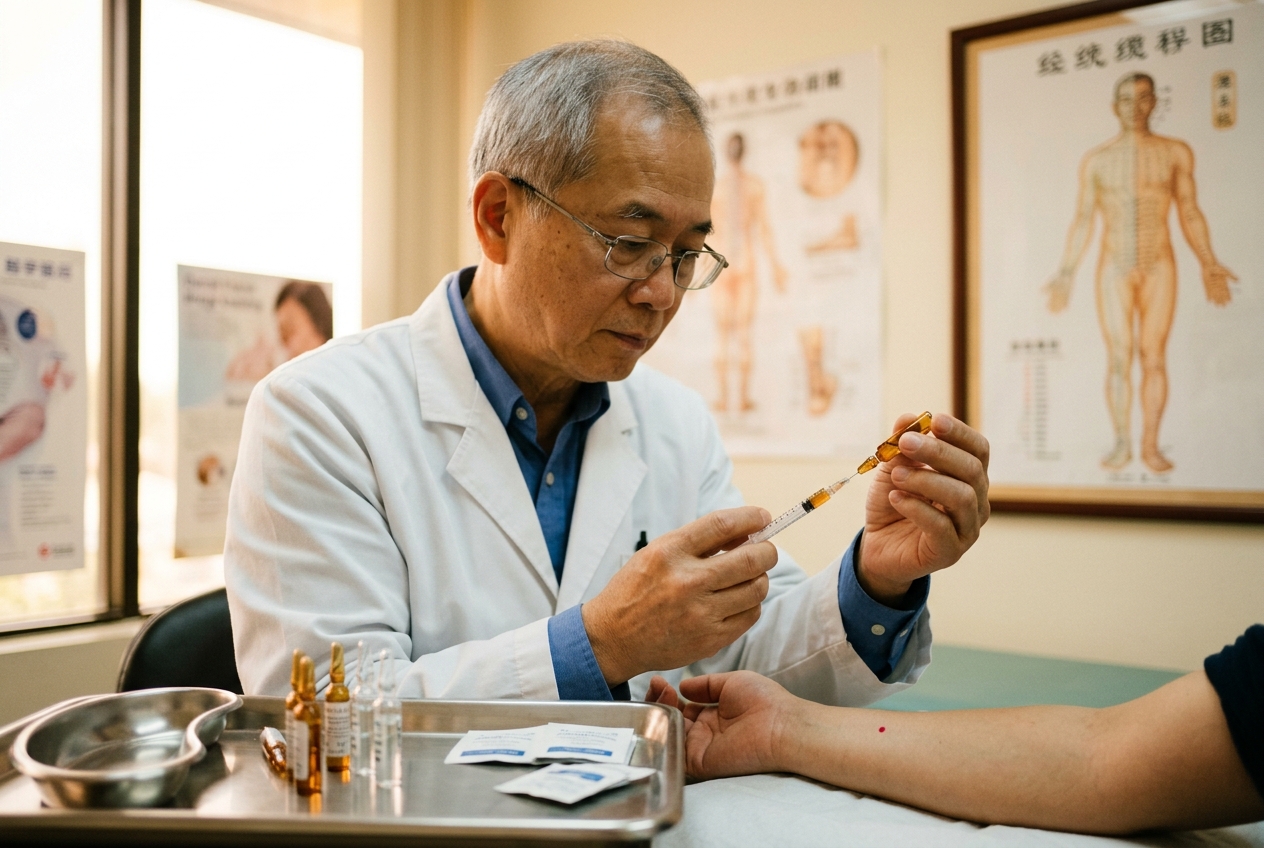
To resolve such intractable conditions, modern integrative clinical practice developed Acupoint Injection Therapy (Xue Wei Zhu She Fa / 穴位注射法, historically termed Shui Zhen Fa / 水针法 or "water-needling"). By introducing micro-volumes of sterile herbal extracts or physiological carriers directly into the bioactive microenvironment of classical acupuncture points, this modality creates a profound bio-mechanical and neurochemical intervention. It merges classical acupuncture mechanics with targeted pharmaceutical bio-action.
+---------------------------------------------------------------------------------------------------+
| CLINICAL RESULT BOX: DUAL-ACTION MECHANISM OF XUE WEI ZHU SHE FA                                   |
+---------------------------------------------------------------------------------------------------+
| 1. Primary Phase: Needle Insertion & Rotation -> Collagen Winding -> Mechanoreceptor Deqi Signal |
| 2. Secondary Phase: Micro-Volume Fluid Distension -> Sustained Interstitial Hydrostatic Pressure  |
| 3. Tertiary Phase: Targeted Phytochemical Elution -> Prolonged Regional Bioavailability & Healing |
+---------------------------------------------------------------------------------------------------+
2. What This Organ System Does: The Meridian-Somatovisceral Axis, Fascial Architecture, and Hydrodynamic Principles
To understand why fluid infiltration at an acupoint exerts such systemic power, one must look at how the meridian system (Jing-Luo) interfaces with the body's connective tissue architecture and neurovascular pathways.
Traditional Chinese Medicine conceptualizes the body not as a set of isolated anatomical compartments, but as a dynamic matrix governed by functional organ networks (Zang-Fu) linked by channels of information, vitality, and interstitial communication.
       [ Classical Meridian Network (Jing-Luo) ]
                         |
                         v
       [ Interstitial Connective Tissue Matrix ]
                         |
      +------------------+------------------+
      |                                     |
      v                                     v
[ Neuro-Fascial Gating ]          [ Somatovisceral Reflexes ]
(Pain modulation, PIEZO1/2)       (Vagal tone, Visceral motility)
In plain terms: * The Meridian Network (Jing-Luo): Think of this as the body’s bio-conductive transit network. It coordinates communication between the superficial body tissues (muscles, skin, fascia) and the internal organ systems. When traffic flows smoothly, tissues remain oxygenated, hydrated, and resilient. * The Acupoint (Xue Wei): A specialized anatomical gateway or nexus, typically situated where peripheral nerves, blood vessels, and fascial cleavage planes converge. These sites exhibit low electrical impedance and high concentrations of sensory nerve endings, mast cells, and microvascular beds. * The Arrival of Energy (Deqi): The distinctive somatic sensation elicited during acupuncture manipulation—described as a complex blend of heaviness, distension, tingling, and mild electric radiation. Neurophysiologically, this marks the depolarization of high-threshold mechanosensitive afferents and the mechanical grasping of connective tissue around the needle shaft.
+----------------------------------------------------------------------------------------------------+
| KEY TCM AND BIOPHYSICAL TERMINOLOGY                                                                |
+------------------------------------+---------------------------------------------------------------+
| TCM / Technical Term               | Plain-English Functional Definition                           |
+------------------------------------+---------------------------------------------------------------+
| Xue Wei Zhu She Fa (穴位注射法)    | Acupoint Injection Therapy / Modern Hydro-Acupuncture.        |
| Shui Zhen Fa (水针法)              | Classical Water-Needling Therapy.                             |
| Deqi (得气)                        | Somatosensory signal indicating neuro-fascial activation.     |
| Ashi Points (阿是穴)               | Local trigger points of maximum tenderness and stagnation.    |
| Back-Shu Loci (背俞穴)             | Paravertebral points reflecting and regulating internal organs.|
| Mechanotransduction                | Cellular conversion of physical mechanical stress to biochemical|
|                                    | signaling (via PIEZO1, PIEZO2, and TRPV4 channels).           |
| Interstitial Fluid Pressure (IFP)  | Hydrostatic pressure inside the extracellular collagen matrix.|
+------------------------------------+---------------------------------------------------------------+
The Historical Evolution of Hydro-Acupuncture
The conceptual roots of water-needling trace back to the classical texts of the Huangdi Neijing (The Yellow Emperor's Inner Classic), which emphasized the dynamic relationship between fluid physiology (Jinye) and energetic circulation (Qi).
However, the formal genesis of modern Xue Wei Zhu She Fa took shape in Chinese clinical hospitals during the mid-20th century. Practitioners sought to augment the transient stimulation of standard filiform dry-needling by injecting physiological solutions, including sterile saline, glucose, and distilled water.
Over subsequent decades, this evolved into a refined pharmacological delivery system. Modern practice utilizes sterile, standardized herbal extracts such as: * Danshen (Salvia miltiorrhiza): Highly prized for resolving blood stasis, dampening pro-inflammatory cytokines, and promoting regional capillary perfusion. Documented extensively in Salvia miltiorrhiza research on NCBI. * Danggui (Angelica sinensis): Celebrated for nourishing blood, inducing local tissue regeneration, and exerting antispasmodic effects on smooth and skeletal muscle fibers. * Huangqi (Astragalus membranaceus): Deployed to boost primary Qi, stimulate macrophage phagocytic activity, and accelerate tissue repair.
Biophysics and Neurophysiology of Dual Stimulation
The therapeutic efficacy of Acupoint Injection Therapy stems from an orchestrated dual stimulation mechanism:
[ Needle Manipulation ] --------> Mechanical Winding (Collagen fibers) ---> Immediate Deqi Afferent Discharge
                                                                                  |
[ Liquid Hydro-Bolus ] ---------> Interstitial Distension (Hydrostatic) ---> Sustained Baroreceptor Depolarization
                                                                                  |
                                                                                  v
                                                            [ Somatovisceral Modulation & Microvascular Repair ]
-
Phase 1: Mechanical Needle Engagement: When the hypodermic needle penetrates the stratum corneum and enters the fascial plane, subtle manipulation generates mechanical shear forces. As demonstrated by research into connective tissue mechanotransduction, needle rotation winds interstitial collagen fibers around the cannula. This mechanical deformation directly opens PIEZO1 and PIEZO2 mechanosensitive ion channels, triggering an immediate afferent volley via A-beta, A-delta, and unmyelinated C-fibers to the dorsal horn of the spinal cord. This closes the spinal pain gate and modulates ascending nociceptive pathways.
-
Phase 2: Hydrodynamic Interstitial Distension: Once Deqi is verified, the practitioner slowly injects a calibrated volume (ranging from 0.2 mL in distal extremity points to 2.0–5.0 mL in dense muscular trigger sites). The introduced fluid creates a localized micro-edema, elevating regional interstitial fluid pressure (IFP). This hydraulic bolus physically separates adhered fascial sheets and sustains continuous micro-mechanical pressure on low- and high-threshold baroreceptors for hours after the needle is withdrawn.
-
Phase 3: Pharmacokinetic Bioavailability and Depot Effect: Unlike intravenous or oral administration—which undergoes rapid systemic dilution and first-pass hepatic metabolism—injected botanical components form a concentrated regional drug depot. The dense capillary and lymphatic networks characteristic of acupoints facilitate a slow, sustained release into the microcirculation, directly bathing regional nerve terminals and fascial receptors.
3. How You Can Feel It — Signs of Balance and Imbalance
When your body's meridian circuits and interstitial fluid pathways operate in balance, your musculoskeletal system feels light, pliable, and responsive. Postural transitions are effortless, peripheral extremities remain warm and well-perfused, and visceral functions—such as digestion, elimination, and sleep architecture—proceed with quiet, self-regulating efficiency.
When stagnation occurs within the meridian network, the body provides unmistakable warning signs.
+----------------------------------------------------------------------------------------------------+
| CLINICAL MANIFESTATION SPECTRUM                                                                    |
+----------------------------------+----------------------------------+------------------------------+
| Diagnostic Category              | Physical & Somatic Presentation  | Underlying Meridian Patho-   |
|                                  |                                  | physiology                   |
+----------------------------------+----------------------------------+------------------------------+
| Refractory Bi Syndrome           | Deep, fixed, weather-sensitive   | Cold-Damp and Blood Stasis   |
| (Painful Obstruction)            | joint/tendon pain; morning       | obstructing collateral       |
|                                  | stiffness; restricted ROM.       | channels (Luo Mai).          |
+----------------------------------+----------------------------------+------------------------------+
| Post-Herpetic Neuralgia          | Burning, allodynic, lancinating  | Toxic Heat residual fire     |
| & Neuropathic Pain               | dermatomal pain following viral  | consuming Yin, binding to    |
|                                  | reactivation; hyperalgesia.      | local collateral nerves.     |
+----------------------------------+----------------------------------+------------------------------+
| Lumbar Radiculopathy             | Searing, electric pain down the  | Qi stagnation and Qi         |
| & Sciatic Compression            | Bladder/Gallbladder channel;     | deficiency failing to        |
|                                  | localized muscle atrophy.        | nourish spinal nerve roots.  |
+----------------------------------+----------------------------------+------------------------------+
| Gastrointestinal Dysmotility     | Postprandial bloating, nausea,   | Spleen-Stomach disharmony,   |
| & Functional Stasis              | alternating bowel habits,        | Liver Qi invading Middle     |
|                                  | epigastric distension.           | Jiao, vagal dysregulation.   |
+----------------------------------+----------------------------------+------------------------------+
Self-Assessment: Evaluating Your Systemic Flow and Fascial Mobility
Take a moment to assess the balance of your own meridian-fascial network:
- The Palpatory Test for "Ashi" Stagnation: With moderate thumb pressure, glide your fingers along the upper trapezius ridge (Jianjing GB21) or along the lateral side of your calf just below the knee (Yanglingquan GB34). Do you detect discrete, marble-like nodules that evoke a radiating, achy tenderness? These are Ashi loci—sites of localized microvascular ischemia and neuro-fascial densification.
- The Spinal Rotational Glide: Stand with your feet planted, arms loose. Gently rotate your torso from side to side. Does the movement feel fluid and spring-like, or is there a rigid, hitching resistance in the thoracolumbar region? Resistance signals fascial dehydrations along the Bladder Meridian and the Du Mai (Governing Vessel).
- The Visceral Tone Check: Place your palm flat over your upper abdomen (the epigastrium), breathing normally. Does the tissue feel soft and receptive, or tight, tender, and resistant to deep diaphragmatic descent? Tightness indicates Middle Jiao stagnation, a common driver of functional gastrointestinal dysmotility.
4. Qigong & Movement Practice: The Fascial Hydration & Microcirculatory Flow Protocol
While clinical hydro-acupuncture utilizes hypodermic infiltration to separate adhesions and hydrate interstitial spaces, you can achieve a comparable biomechanical effect at home through specialized movement.
This 8-minute Qigong practice utilizes internal myofascial traction, rhythmic intra-abdominal pressure fluctuations, and coordinated breathwork to mobilize interstitial fluid along the main meridian pathways.
   [ Wuji Stance ]
          |
   (Inhale 4s) --> Elevate hands along Central Channel (Ren Mai)
          |
   (Hold 2s)   --> Opposing Palms Extension (Tension Matrix Expansion)
          |
   (Exhale 6s) --> Spiral Torso Rotation & Descending Grounding Wave
          |
   [ Sensation Check: Tingling, warmth, axial unwinding (Deqi) ]
Movement Instructions: "Separating Heaven and Earth to Hydrate the Meridian Matrix"
Step 1: Starting Position and Setup
- Stand barefoot or in flat, flexible shoes with your feet shoulder-width apart, parallel to one another.
- Soften your knees slightly, allowing your sacrum to drop naturally toward the floor.
- Relax your shoulders, gently tuck your chin to lengthen the cervical spine, and imagine the crown of your head (Baihui GV20) suspended by a fine silk thread.
- Rest the tip of your tongue against the roof of your mouth behind your upper incisors. Rest your hands gently over your lower abdomen (Dantian).
Step 2: The Coordinated Movement Cycle
- Inhale (4 Seconds): Slowly draw your hands up the midline of your torso toward your chest, palms facing upward, drawing fresh energy (Qi) from the Earth.
- The Turn and Stretch (Opposing Vectors): As your hands reach the level of your sternum, begin rotating your palms: * Press your right palm straight up toward the sky, fingers pointing inward toward your midline, heel of the hand flexing upward. * Simultaneously, press your left palm downward toward the earth, fingers pointing forward, heel of the hand pressing down. * Gently turn your head to gaze over your left shoulder, creating a full-body spiral stretch along the fascial lines of the torso and limbs.
- Exhale (6 Seconds): Slowly soften both arms, bringing both hands back toward the center of your chest, letting the spiral tension unwind like a released spring. Allow your breath to descend into the lower abdomen.
- Alternate Sides: Repeat the motion on the opposite side (left hand pressing upward to the sky, right hand pressing down to the earth, head turning gently to gaze over the right shoulder).
Step 3: Duration and Repetitions
- Perform 8 complete cycles (4 repetitions per side).
- Transition into 2 minutes of quiet, still standing in the Wuji posture, hands folded over the lower abdomen, observing internal somatic sensations.
Step 4: Sensation to Look For
As you press and unwind, you should feel a distinct warm, tingling sensation rippling across your ribcage, down your forearms, and through the soles of your feet. This is the subjective sensory feedback of microcirculatory perfusion and collagen realignment—the home-based somatic equivalent of the Deqi phenomenon.
5. Acupressure Points You Can Try Today
To recreate the therapeutic benefits of point stimulation without injection equipment, apply focused ischemic acupressure to these primary clinical loci. These three points serve as foundational centers for treating neuropathic pain, motor dysfunction, and gastrointestinal disharmony.
       [ ST36: Zusanli ]              [ GB34: Yanglingquan ]           [ BL23 / Jiaji Loci ]
    (4 fingers below knee)         (Depression below fibular head)   (Paravertebral Lumbar)
              |                                  |                              |
              v                                  v                              v
   Vagal-Anti-inflammatory            Fascial Unwinding & Tendon      Spinal Root Decompression
    & Somatovisceral Tone              Motor Pain Desensitization      & Local Ischemia Relief
+----------------------------------------------------------------------------------------------------+
| TARGET ACUPRESSURE PROTOCOLS                                                                       |
+-------------------+------------------------------+---------------------------+---------------------+
| Acupoint          | Anatomical Location          | Pressure Vector & Depth   | Primary Indications |
+-------------------+------------------------------+---------------------------+---------------------+
| Zusanli (ST36)    | 4 finger-widths below the    | Perpendicular, firm, deep | Gastric cramping,   |
| "Leg Three Miles" | patella, 1 finger-width      | circular kneading;        | fatigue, systemic   |
|                   | lateral to the tibial crest. | 2–3 minutes per limb.     | inflammation.       |
+-------------------+------------------------------+---------------------------+---------------------+
| Yanglingquan      | In the tender depression     | Oblique-posterior vector; | Sciatica, lateral   |
| (GB34) "Yang      | anterior and inferior to     | sustained steady thumb    | hip pain, tendon    |
| Mound Spring"     | the head of the fibula.      | pressure; 2 minutes.      | tightness, cramps.  |
+-------------------+------------------------------+---------------------------+---------------------+
| Huatuojiaji       | 0.5 to 1.0 cun (thumb-width) | Bilateral rolling thumb   | Lumbar disc strain, |
| (L4-S1 Para-      | lateral to the lower borders | pressure; steady friction;| radiculopathy, low  |
| vertebral Loci)   | of the lumbar spine.         | 3 minutes.                | back stiffness.     |
+-------------------+------------------------------+---------------------------+---------------------+
1. Zusanli (ST36 / 足三里) — "Leg Three Miles"
- How to Locate: Sit with your knees bent at a 90-degree angle. Place the four fingers of your hand across your shin, directly beneath the base of your kneecap. Locate the outer edge of your shinbone (the anterior tibial crest); move your finger one thumb-width lateral into the soft belly of the tibialis anterior muscle. You will feel a distinct muscular depression that aches pleasantly when pressed.
- How to Press: Use the tip of your thumb or a rounded knuckle. Apply firm, perpendicular pressure directed slightly toward the bone. Maintain this pressure while executing small, rhythmic circular motions for 2 to 3 minutes. Aim for a deep, radiating ache (Suan-Zhang) that may travel down the shin or into the foot.
- Clinical Purpose: The premier point on the Stomach channel. Clinically validated to trigger vagal-splenic anti-inflammatory mechanisms, regulate gastric dysmotility, relieve fatigue, and promote systemic immune vitality.
2. Yanglingquan (GB34 / 阳陵泉) — "Yang Mound Spring"
- How to Locate: Run your fingers up the outside of your lower leg toward the knee until you hit a small, distinct bony prominence on the lateral aspect of the calf—this is the head of the fibula. Slide your finger slightly forward and downward into the soft hollow just beneath and in front of this bony head.
- How to Press: Apply firm, sustained pressure angled slightly upward and inward. Hold steadily for 90 to 120 seconds while taking deep, slow diaphragmatic breaths.
- Clinical Purpose: Known in classical texts as the Hui-Confluent point of the Sinews and Fascia (Jin Hui). It is the principal point for easing muscular spasms, relieving sciatica and radicular leg pain, releasing tension in the iliotibial band, and restoring ease to restricted joints.
3. Huatuojiaji (EX-B2 / 华佗夹脊) — Paravertebral Lumbar Segments
- How to Locate: These points lie in the muscular grooves running parallel to your spine, approximately half a thumb-width (0.5 to 1 inch) to either side of your spinal bones (spinous processes), specifically in the lower back (L4 to S1 levels).
- How to Press: Place two firm rubber massage balls or tennis balls inside a sock. Lie on your back on a firm carpet or yoga mat, positioning the balls directly beneath your lower back on either side of the spine (avoiding direct pressure on the spinal bones). Allow your body weight to rest over the balls for 3 to 5 minutes, breathing deeply and letting your lumbar paraspinal muscles soften around the focal pressure.
- Clinical Purpose: Directly stimulates the posterior rami of the spinal nerves and deep multifidus muscles. This alleviates radicular tension, decompresses compressed spinal roots, and restores blood supply to ischemic lumbar tissues.
6. Food & Lifestyle — Small Changes for Today
Acupoint therapy addresses local connective tissue and neural balance; however, systemic hydration and dietary therapy (Shi Liao) ensure that the interstitial matrix remains chemically receptive to repair.
To support tissue repair, prevent connective tissue stagnation, and clear chronic dampness, adopt these evidence-based nutritional strategies using everyday ingredients.
       [ Dietary & Lifestyle Protocols ]
                      |
      +---------------+---------------+
      |                               |
      v                               v
[ Microvascular Herbs ]    [ Interstitial Hydration ]
- Fresh Ginger (Jiang)      - Warm Collagen Broths
- Turmeric (Jianghuang)     - Electrolyte-Rich Warm Water
- Cinnamon (Guizhi)         - Thermal Meridian Shielding
+----------------------------------------------------------------------------------------------------+
| DIETARY AND LIFESTYLE ADAPTATION MATRIX                                                            |
+----------------------------+-----------------------------------+-----------------------------------+
| Category                   | Items to Prioritise               | Items to Minimise or Eliminate    |
+----------------------------+-----------------------------------+-----------------------------------+
| Thermal & Fluid Dynamics   | Warm broths; warm water with      | Iced beverages; frozen smoothies; |
|                            | sea salt and lemon; cooked stews. | raw salads eaten in cold weather. |
+----------------------------+-----------------------------------+-----------------------------------+
| Natural Microcirculatory   | Fresh ginger root; turmeric;      | Refined seed oils; trans fats;    |
| Activators                 | rosemary; cracked black pepper.   | excessive refined sugars.         |
+----------------------------+-----------------------------------+-----------------------------------+
| Connective Tissue & Fascia | Bone broth; shiitake mushrooms;   | Ultra-processed salty snacks;     |
| Nourishers                 | root vegetables; pumpkin seeds.   | artificial sweeteners.            |
+----------------------------+-----------------------------------+-----------------------------------+
| Environmental Habits       | Thermal neck/lumbar coverage;     | Sitting in direct cold AC drafts; |
|                            | 20-minute post-meal gentle walks. | prolonged static sitting >90 min. |
+----------------------------+-----------------------------------+-----------------------------------+
Key Dietary Recommendations
-
Incorporate Kitchen "Micro-Circulators": * Fresh Ginger (Sheng Jiang): Add 3–4 slices of freshly crushed ginger to warm water or tea daily. Gingerols and shogaols gently stimulate peripheral microcirculation, dispel internal Cold, and promote gastrointestinal motility. * Turmeric (Jiang Huang): Warm 1/2 teaspoon of ground turmeric in warm milk or plant milk with a pinch of black pepper and cinnamon. Curcuminoids act as systemic anti-inflammatory agents, resolving blood stagnation within the microvasculature.
-
Hydrate the Extracellular Matrix Correctly: * Fascial sheets become brittle and prone to adhesion when dehydrated. Cold or iced water contracts gastric micro-vessels and slows lymphatic drainage. * Transition entirely to warm or room-temperature liquids. Sip warm water throughout the day, and incorporate nutrient-rich, warm bone broths or vegetable-seaweed decoctions. These deliver essential amino acids (proline, glycine) that support collagen elasticity.
-
Thermal Care for Vulnerable Meridian Zones: * Protect the back of your neck (the Wind Gate / Feng Chi GB20 zone) and your lower back from direct exposure to cold air conditioning drafts. Cold induces immediate microvascular constriction in skeletal muscles, creating localized ischemia and triggering the return of Bi syndrome symptoms.
7. Today's Takeaway
+---------------------------------------------------------------------------------------------------+
| YOUR 5-MINUTE DAILY PROTOCOL FOR MERIDIAN INTEGRITY                                               |
|                                                                                                   |
| 1. Pour a cup of warm water with two thin slices of fresh ginger.                                |
| 2. Sit comfortably, spine tall, and locate Zusanli (ST36) on both legs.                          |
| 3. Apply 2 minutes of firm, rhythmic circular pressure to both points simultaneously.            |
| 4. Take 10 slow diaphragmatic breaths: inhale for 4 seconds, exhale for 6 seconds.                |
| 5. Stand and gently twist your torso from side to side 10 times to release your spine.            |
+---------------------------------------------------------------------------------------------------+
You do not need specialized injection equipment or complex pharmaceuticals to begin restoring flow to your body's vital channels.
Take five minutes today to sit quietly, hydrate with warm water, and apply firm, mindful pressure to Zusanli (ST36) on both legs. By synchronizing deep, unhurried breathing with this targeted point stimulation, you actively decompress local nerve pathways, stimulate vagal tone, and encourage healthy fluid movement throughout your connective tissue matrix.
For further exploration of integrative medicine frameworks, refer to authoritative publications such as the WHO Traditional Medicine Global Initiatives, the scientific consensus on mechanisms of acupoint stimulation on NCBI, and reviews covering post-herpetic neuralgia and neuropathic therapies.