Acupoint Application Techniques (Xue Wei Tie Fu Fa) Meridian Dynamics: Governing Transdermal Herbal Penetration, Cutaneous Microvascular Perfusion, Prolonged Acupoint Activation, and Winter-Disease Summer-Treatment Homeostasis in Traditional Chinese Medicine
1. Opening Scene — A Moment You'll Recognise
You step out of a warm room into a sudden gust of sharp, biting autumn wind. Within seconds, a familiar cascade unfolds: your throat tightens with an instinctive tickle, your shoulders involuntarily hunch toward your ears, the fine hairs along your forearms stand on end, and a sudden, dry sneeze breaks through your chest. Long before any virus can incubate or an inflammatory panel registers cellular change, your body has mounted an immediate, defensive reflex at the physical frontier where inner physiology meets the external atmosphere.
+------------------------------------------------------------------------------------+
|                                THE CUTANEOUS SHIELD                                |
|                                                                                    |
|   Atmospheric Pathogen (Cold/Wind) ---> Stratum Corneum & C-Fibers                 |
|                                         |                                          |
|                                         v                                          |
|                        Localized Cutaneous Vasoconstriction                        |
|                                         |                                          |
|                                         v                                          |
|                Somatosensory Afferents (A-delta / C-Fibers)                         |
|                                         |                                          |
|                                         v                                          |
|             Spinal Dorsal Horn ---> Somatovisceral Reflex Arc                      |
|                                         |                                          |
|                                         v                                          |
|              Airway Smooth Muscle Contraction & Wei Qi Mobilization                |
+------------------------------------------------------------------------------------+
In Traditional Chinese Medicine (TCM), this immediate reactivity is the domain of the Lung (Fèi, 肺) and its external shield, Defensive Qi (Wèi Qì, 卫气). Far from operating merely as two passive sacs exchanging respiratory gases, the Lung in classical medicine is conceived as the "Canopy of the Zang-Fu Organs" (Huá Gài, 华盖)—the primary organ interface directly vulnerable to atmospheric fluctuations. When this energetic and immunological barrier weakens, the body becomes trapped in seasonal cycles of recurrent bronchitis, allergic rhinitis, and intractable fatigue.
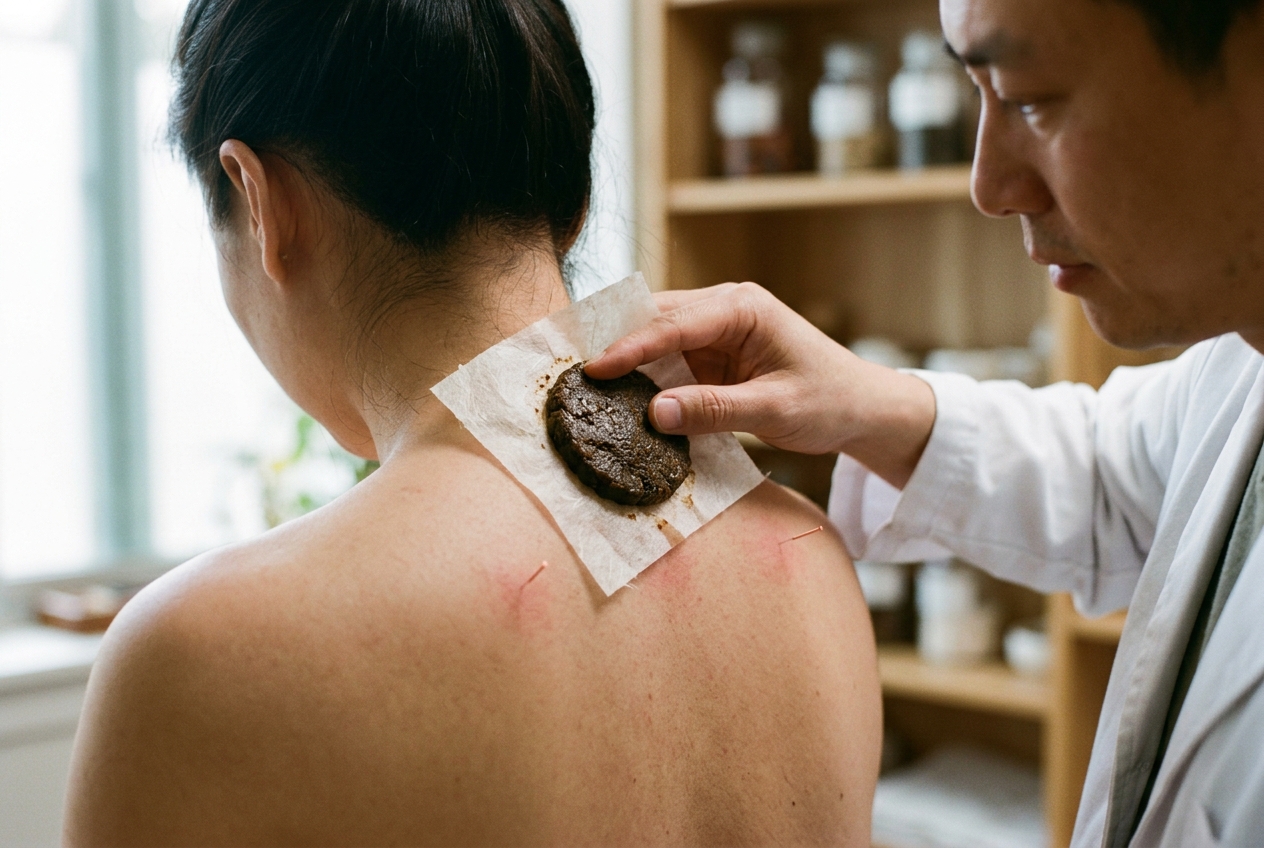
To break this chronic susceptibility, Chinese clinical medicine developed one of its most sophisticated biophysical interventions: Xuè Wèi Tiē Fū Fǎ (穴位贴敷法, Acupoint Application Therapy). By applying pungent, pharmacologically active herbal plasters to specific nodal points along the body’s cutaneous collaterals during precise solar intervals, clinicians activate a dual pathway of transdermal biochemical permeation and sustained somatovisceral reflex modulation, transforming systemic immune resilience from the outside in.
2. What This Organ System Does: The Lung, Defensive Qi, and Meridian Dynamics
In classical medical theory, the Lung governs Qi and respiration (Fèi Zhǔ Qì, Zhǔ Hū Xī), controls dispersing and descending (Zhǔ Xuān Fā Sù Jiàng), and regulates the waterways (Zhǔ Tōng Diào Shuǐ Dào). Translating these foundational concepts into modern physiological frameworks reveals a sophisticated understanding of the respiratory, cutaneous, and autonomic nervous systems working as a single homeostatic loop.
                           +--------------------------+
                           |   LUNG ORGAN SYSTEM      |
                           |   (Fei / Upper Canopy)   |
                           +------------+-------------+
                                        |
               +------------------------+------------------------+
               |                                                 |
               v                                                 v
    +----------------------+                          +----------------------+
    |  DISPERSING (Xuan)   |                          |   DESCENDING (Jiang) |
    |  Propels Wei Qi &    |                          |   Directs Fluids &   |
    |  Fluids to Skin &    |                          |   Inspiratory Air    |
    |  Intercellular Pores |                          |   to Kidneys/Bladder |
    +----------+-----------+                          +----------+-----------+
               |                                                 |
               v                                                 v
    [Cutaneous Defense /                         [Systemic Fluid Balance /
     Stratum Corneum Integrity]                   Deep Osmoregulation]
The Concept of Dispersing (Xuān Fā) and Descending (Sù Jiàng)
- Dispersing (Xuān Fā, 宣发): The upward and outward distribution of bio-fluids (Jīn Yè) and Wèi Qì to the skin surface and interstitial spaces. This process maintains cutaneous hydration, regulates pore opening and closing (Còu Lǐ, 腠理), and modulates the primary barrier against environmental pathogens.
- Descending (Sù Jiàng, 肃降): The downward physiological trajectory that directs inhaled air and metabolized fluids toward the Kidneys (Shèn) and Urinary Bladder (Páng Guāng). Failure of descending manifests as upward-rebellious Qi (Qì Nì), resulting in tachypnea, paroxysmal coughing, and chest tightness.
The Cutaneous Collateral Axis (Pí Bù and Neurovascular Bundles)
Classical treatises state that "the Lung opens into the nose and manifests in the skin and body hair" (Fèi Kāi Qiào Yú Bí, Qí Huá Zài Máo). In contemporary dermatological and histological terms, Acupuncture Points along the Lung Meridian (Hand Taiyin) and the Governing Vessel (Du Mai) represent anatomical sites characterized by dense concentrations of free nerve endings, unmyelinated C-fibers, lightly myelinated A-delta fibers, mast cells, and microvascular capillary beds.
The Pí Bù (cutaneous regions) function as external receptor fields for the internal viscera. Cutaneous stimulation transmits electrical and neurochemical signals through somatic sensory afferents to the spinal dorsal horn, engaging the somatovisceral reflex arc to alter bronchial caliber, modulate mucosal secretion, and re-tune visceral autonomic tone.
3. How You Can Feel It: Signs of Balance and Imbalance
The state of your Lung Qi and its cutaneous defensive network reveals itself through distinct physical patterns, emotional shifts, and autonomic behaviors.
+-------------------------------------------------------------------------------------+
|                              LUNG SYSTEM ASSESSMENT MATRIX                          |
+--------------------------+----------------------------------------------------------+
| Balanced State           | - Clear, unobstructed nasal breathing                    |
|                          | - Resilient skin barrier; normal thermoregulatory sweating|
|                          | - Steady vocal resonance and strong exercise endurance   |
|                          | - Emotional capacity for healthy closure and letting go  |
+--------------------------+----------------------------------------------------------+
| Deficient / Excess State | - Spontaneous cold sweats (*Zì Hàn*) upon mild exertion  |
|                          | - Chronic allergic rhinitis, morning sneezing fits       |
|                          | - Dry, flaking stratum corneum, eczema, or pale complexion|
|                          | - Persistent low-grade sadness, grief, or fatigue        |
+--------------------------+----------------------------------------------------------+
Clinical Signs of Imbalance
- Defensive Qi Insecurity (Wèi Qì Bù Gù): Marked by spontaneous perspiration (Zì Hàn) triggered by trivial physical movement, extreme aversion to drafts, and recurring viral upper-respiratory infections that linger for weeks.
- Lung Qi Impairment (Fèi Qì Xū): Clinically evident through a weak, raspy voice, chronic low-grade shortness of breath on exertion, pale-white facial complexion, and a weak, floating pulse (Fú Mài) in the right inch (Cùn) position.
- Phlegm-Fluids Obstructing the Chest (Tán Yǐn Zǔ Fèi): Heavy, congested sensation across the sternum, wheezing, and excessive sputum production exacerbated by cold temperatures or dairy consumption.
- Psycho-Emotional Dimension (Grief and Melancholy): In Five-Element theory (Wǔ Xíng), the Lung corresponds to Metal (Jīn) and the emotion of grief (Bēi). Pathological Lung depletion frequently correlates with prolonged, unresolved sorrow, chronic sighing, and an inability to adapt to life transitions.
4. Academic Deep-Dive: Acupoint Application (Xue Wei Tie Fu Fa) and Transdermal Meridian Dynamics
Xuè Wèi Tiē Fū Fǎ (穴位贴敷法) represents the pinnacle of TCM external medicine (Wài Zhì Fǎ), systematically canonized in Qing Dynasty masterworks such as Wu Shangxian’s Lǐ Yùe Pián Wén (理瀹骈文, A Treatise on External Therapy). This modality utilizes the synergistic interaction between acrid, volatile botanical agents and high-conductance acupoints to achieve both local cellular activation and systemic neuro-immunomodulation.
   [RAW BOTANICAL FORMULA]
   - Bai Jie Zi (Sinapis Semen)       --> Allyl Isothiocyanate / Sinapine
   - Xi Xin (Asari Radix)             --> Methyleugenol / Asarone
   - Yan Hu Suo (Corydalis Rhizoma)   --> Tetrahydropalmatine
   - Gan Sui (Euphorbiae Kansui)      --> Ingenol Diterpenes
              |
              +---> Processed with Fresh Sheng Jiang Juice (Gingerols/Shogaols)
              |
              v
   [TOPICAL PASTE / APPLIED TO ACUPOINTS (e.g., BL13, GV14, EX-B1)]
              |
              +-----------------------------------+
              |                                   |
              v                                   v
   [TRANSDERMAL ABSORPTION]             [NEUROCHEMICAL & MERIDIAN ACTION]
   Stratum Corneum Lipid Bilayer        TRPV1 / TRPA1 Receptor Agonism
   Fluidized by Volatile Terpenes                     |
              |                         C-Fiber & A-delta Afferent Depolarization
              v                                       |
   Cutaneous Microvascular Uptake       Spinal Cord Dorsal Horn (Somatovisceral Arc)
              |                                       |
              v                                       v
   [SYSTEMIC IMMUNOMODULATION]          [VISCERAL TARGET RESPONSE]
   - Th1 Up-regulation (IFN-gamma)      - Bronchial Smooth Muscle Relaxation
   - Th2 Down-regulation (IL-4, IL-5)   - Mast Cell Stabilization
   - Macrophage M1 -> M2 Shift          - Resolution of Submucosal Edema
Chronobiological Principles: Dong Bing Xia Zhi and Dong Zhi Tie
The operational timing of acupoint plaster therapy is governed by chronobiological paradigms validated by modern circadian and seasonal neuroendocrinology:
+--------------------------------------------------------------------------------------+
|                         CHRONOBIOLOGICAL TREATMENT PARADIGM                          |
+------------------------------------+-------------------------------------------------+
| San Fu Tie                         | Dong Zhi Tie                                    |
| ("Treating Winter Disease in Summer")| ("Winter Solstice Plaster Application")       |
+------------------------------------+-------------------------------------------------+
| Applied during the three *Fu* days | Applied across the three nine-day periods       |
| (hottest midsummer period).        | (*San Jiu*) following the Winter Solstice.     |
| Maximizes peak ambient Yang Qi to  | Consolidates deep Kidney-Lung Yang, prevents    |
| open cutaneous pores, facilitating | cold-induced airway hyperreactivity, and       |
| deep eradication of latent cold    | supports baseline mucosal immunity.             |
| (*Fú Xié*) and phlegm-rheum.       |                                                 |
+------------------------------------+-------------------------------------------------+
Clinical trials indexed in PubMed Central demonstrate that San Fu Tie interventions significantly reduce the annualized frequency of acute exacerbations in chronic obstructive pulmonary disease (COPD) and persistent pediatric asthma.
Phytochemical Synergy of Penetrating Herbs
The therapeutic efficacy of classical San Fu Tie formulations relies on specific thermogenic and membrane-fluidizing botanical compounds:
- Bai Jie Zi (Sinapis Alba Semen / White Mustard Seed): Contains high concentrations of the glucosinolate sinigrin, which hydrolyzes into allyl isothiocyanate. This potent volatile agent acts as a natural penetration enhancer by disrupting the ordered intercellular lipid bilayers within the stratum corneum. Furthermore, it directly activates transient receptor potential ankyrin 1 (TRPA1) and vanilloid 1 (TRPV1) ion channels on primary cutaneous sensory afferents.
- Xi Xin (Asari Radix et Rhizoma / Wild Ginger): Rich in volatile essential oils, including methyleugenol, safrole, and asarone. These compounds stimulate local microvascular perfusion, exert topical analgesic effects via voltage-gated sodium channel inhibition, and facilitate transdermal transit of co-administered alkaloids.
- Yan Hu Suo (Corydalis Rhizoma): Contains active isoquinoline alkaloids, predominantly dl-tetrahydropalmatine (THP) and corydaline, which inhibit dopamine D2 receptor signaling and suppress systemic neurogenic inflammation.
- Gan Sui (Euphorbiae Kansui Radix): Contains ingenol-type diterpenoids that induce targeted local cutaneous hyperemia, activating dermal macrophage clearance cascades and promoting extravasation of latent exudates.
- Fresh Sheng Jiang Juice (Zingiberis Rhizoma Recens): Used as the liquid vehicle. Its lipophilic 6-gingerol and 6-shogaol constituents lower interfacial tension, enhance drug solubility, and accelerate trans-appendageal transport through sebaceous glands and hair follicle infundibula.
+----------------------------------------------------------------------------------------+
|                  PHYTOCHEMICAL TRANSDERMAL MECHANISMS OF ACTION                        |
+------------------+------------------------------+--------------------------------------+
| Botanical Agent  | Key Active Constituents      | Biophysical / Cellular Function      |
+------------------+------------------------------+--------------------------------------+
| Bai Jie Zi       | Sinigrin, Allyl Isothiocyanate| Fluidizes stratum corneum lipids;    |
|                  |                              | agonizes TRPV1/TRPA1 channels.       |
| Xi Xin           | Methyleugenol, Asarone       | Induces vasodilation; enhances deep  |
|                  |                              | microvascular tissue absorption.     |
| Yan Hu Suo       | Tetrahydropalmatine          | Inhibits neurogenic inflammatory     |
|                  |                              | transmission and central pain arcs.  |
| Gan Sui          | Ingenol-type Diterpenes      | Mobilizes deep interstitial fluid;   |
|                  |                              | triggers macrophage polarization.    |
| Sheng Jiang Zhi  | 6-Gingerol, 6-Shogaol        | Lowers surface tension; enhances     |
| (Vehicle)        |                              | trans-follicular drug delivery.      |
+------------------+------------------------------+--------------------------------------+
Neuro-Immunological Mechanisms: Somatovisceral Reflexes and Th1/Th2 Balancing
At the cellular and immunological levels, transdermal acupoint stimulation initiates a multi-tiered regulatory cascade documented by the World Health Organization Traditional Medicine frameworks:
               [ SUSTAINED ACUPOINT PERMEATION & IRRITATION ]
                                      |
                     +----------------+----------------+
                     |                                 |
                     v                                 v
        [ CUTANEOUS NEUROGENIC AXIS ]         [ IMMUNOLOGICAL AXIS ]
        - Activation of C-Fibers &            - Dermal Dendritic Cell &
          A-delta Sensory Afferents             Macrophage Activation
        - Substance P & CGRP Release          - Down-regulation of IL-4, IL-5,
                     |                          IL-13, and Serum IgE
                     v                                 |
        [ SPINAL DORSAL HORN INTEGRATION ]             v
        - Somatovisceral Sympathetic/         [ Th1 / Th2 CYTOKINE REBALANCING ]
          Parasympathetic Tuning              - Elevation of IFN-gamma
                     |                        - Suppression of Eosinophil
                     v                          Airway Infiltration
        [ VISCERAL AIRWAY REMODELING ]                 |
        - Smooth Muscle Spasmolysis                    |
        - Reduced Goblet Cell Hyperplasia              v
                     |                                 |
                     +----------------+----------------+
                                      |
                                      v
         [ RESOLUTION OF CHRONIC ASTHMA, ALLERGIC RHINITIS & COPD ]
- Somatovisceral Autonomic Reflex Loop: Sustained mechanochemical excitation of segmental dermatomes (e.g., T1–T5 spinal segments underlying Feishu BL13 and Dingchuan EX-B1) projects via the spinothalamic pathway, down-regulating hyperactive cholinergic parasympathetic drive to the lungs. This inhibits bronchoconstriction and reduces airway hypersecretion.
- Systemic Cytokine Balancing: In patients with atopic asthma and allergic rhinitis, the immune profile is dominated by a T-helper type 2 (Th2) phenotype, characterized by elevated interleukin-4 (IL-4), interleukin-5 (IL-5), interleukin-13 (IL-13), and serum IgE. Rigorous trials cataloged on NCBI Medical Subject Headings show that herbal acupoint application drives naive CD4+ T cells toward a T-helper type 1 (Th1) phenotype, up-regulating interferon-gamma (IFN-γ) expression, suppressing eosinophil degranulation, and dampening bronchial remodeling.
5. Clinical Protocols, Paste Preparation, and Safety Management
Clinical precision during preparation and application is essential for optimal therapeutic outcomes and patient safety.
+--------------------------------------------------------------------------------------+
|                     CLINICAL FORMULATION AND DWELL PROTOCOL                          |
+--------------------+-----------------------------------------------------------------+
| Dry Powder Ratio   | Bai Jie Zi (40%), Xi Xin (20%), Yan Hu Suo (20%), Gan Sui (20%).|
| Processing Method  | Pulverize to 120-mesh fine powder; triturate with fresh-pressed |
|                    | ginger juice to form a cohesive, malleable paste.              |
| Adult Dwell Time   | 2 to 4 hours per session (discontinue immediately if severe    |
|                    | burning or pain occurs).                                        |
| Pediatric Dwell    | 0.5 to 1.5 hours maximum (requires continuous visual monitoring).|
| Frequency          | 3 to 4 applications spaced across the solar *San Fu* intervals.|
+--------------------+-----------------------------------------------------------------+
Blistering (Tian Jiu) versus Non-Blistering Methods
- Vesiculation Method (Tiān Jiǔ, 天灸 / Natural Blistering): Historically intended to induce mild sterile chemical vesiculation (blister formation) through prolonged contact with irritant diterpenes and allyl isothiocyanates. The resulting cutaneous inflammation stimulates macrophage recruitment and long-term immunomodulation.
- Modern Non-Blistering Protocol: The contemporary clinical standard focuses on sub-vesicular therapeutic delivery, adjusting dwell times so the patient experiences warm erythema and mild tingling without epidermal separation or bullae formation.
+-------------------------------------------------------------------------------------+
|                      VESICULATION & BLISTER MANAGEMENT PROTOCOL                     |
+------------------------+------------------------------------------------------------+
| Minor Blisters (<1 cm) | Leave intact. Disinfect with 0.5% povidone-iodine; allow   |
|                        | fluid to reabsorb under sterile, non-adherent gauze.       |
| Large Bullae (>1 cm)   | Aspirate fluid using a sterile 25G syringe at the blister  |
|                        | base under aseptic conditions. Preserve epidermal roof as  |
|                        | a biological dressing; apply mupirocin ointment.           |
+------------------------+------------------------------------------------------------+
| Contraindications      | - Acute febrile illness (body temperature > 38.0°C)        |
|                        | - Active skin lesions, ulcerations, or contact dermatitis  |
|                        | - Pregnancy (due to pelvic-pelvic reflex stimulation)       |
|                        | - Severe uncompensated cardiac, renal, or hepatic disease  |
|                        | - Documented hypersensitivity to volatile botanical oils   |
+------------------------+------------------------------------------------------------+
6. Qigong & Movement Practice: Expanding the Chest to Regulate Lung Qi
This movement draws from the classical Eight Brocades (Bā Duàn Jǐn, 八段锦) routine—specifically "Drawing the Bow to Shoot the Hawk" (Zuǒ Yòu Kāi Gōng Sì Shè Diāo)—adapted here to mechanically mobilize the pectoral fascia, open the Lung meridian (Hand Taiyin), and stimulate the neurovascular pathways of the chest canopy.
               [ QIGONG PRACTICE: EXPANDING THE CHEST CANOPY ]

STEP 1: ROOTED STANCE         STEP 2: FASCIAL EXPANSION      STEP 3: SINKING RETURN
         (Zhan Zhuang)                (Kai Gong She Diao)            (Qi Chen Dan Tian)

              (o o)                         \ (o o) /                    (o o)
               | |                           \  |  /                      | |
              /   \                         ===|===                      /   \
             /     \                           / \                      /     \
            [Feet Parallel]              [Elbows Extended,            [Slow Exhalation,
                                          Scapulae Retracted]          Palms Sinking]
Step-by-Step Instructions
1. Setup and Grounding
Stand with feet shoulder-width apart, toes pointing straight forward. Soften the knees slightly without collapsing inward. Allow the pelvis to settle into a neutral tilt, release muscular tension in the lower back, and align the crown of the head (Bǎihuì, GV20) toward the sky. Let your arms hang naturally at your sides with the armpits hollowed (Xū Yè), leaving space to hold an imaginary small egg.
2. Movement and Breath Synchronization
- Inhalation (4 Seconds): Slowly raise both hands up along the midline of the torso to chest height. Cross the wrists at the sternum over the Danzhong (CV17) point, right wrist in front of left, with palms facing inward toward the heart.
- Fascial Extension (Hold 2 Seconds): As the breath fills the lower ribs and lateral lungs, extend the left arm out to the side in an open "L-shape" hand position (thumb and index finger extended at a 90-degree angle, remaining fingers curled gently into the palm). Simultaneously draw the right elbow back horizontally at shoulder height, retracting the right scapula as if drawing a heavy composite bowstring. Turn your head to gaze over the extended left index finger along the path of the Lung meridian.
- Exhalation (6 Seconds): Release the tension smoothly. Uncurl the fingers, sweep both arms in a wide horizontal arc back to the center line, and sink the palms downward toward the lower abdomen (Dān Tián), lowering your center of gravity.
- Alternating Repetition: Repeat the movement toward the right side, crossing the left wrist in front of the right.
3. Dosage and Sensations
- Duration: Perform 8 complete cycles (4 to each side), taking approximately 5 to 7 minutes each morning.
- Sensations to Monitor: You should feel a distinct myofascial stretch extending from the pectoral insertion near Zhongfu (LU1) down the anterolateral aspect of the bicep to the base of the thumb. A warm tingling or spreading fullness along the palm indicates vasodilation and collateral activation.
7. Acupressure Points You Can Try Today
For daily self-care and maintenance between seasonal plaster applications, stimulate these primary homeostatic points using sustained perpendicular digitopressure.
   [DAZHUI (GV14)] - Below C7 Spinous Process
          |
          +--- [DINGCHUAN (EX-B1)] - 0.5 cun Lateral to C7
          |
   [FEISHU (BL13)] - 1.5 cun Lateral to T3 Spinous Process
+----------------------------------------------------------------------------------------+
|                          CLINICAL ACUPRESSURE REFERENCE TABLE                          |
+--------------------+------------------------------+------------------------------------+
| Point Name         | Anatomical Location          | Application Technique & Indication |
+--------------------+------------------------------+------------------------------------+
| Feishu (BL13, 肺俞)| 1.5 cun (approx. two finger- | Apply steady perpendicular thumb   |
|                    | widths) lateral to the lower | pressure with small circular       |
|                    | border of the spinous        | oscillations for 2–3 minutes.      |
|                    | process of T3.               | Relieves chronic cough, seasonal   |
|                    |                              | rhinitis, and night sweats.        |
+--------------------+------------------------------+------------------------------------+
| Dingchuan (EX-B1,  | 0.5 cun lateral to the lower | Use firm, sustained pad-of-thumb   |
| 定喘)              | border of the spinous        | pressure for 1–2 minutes while     |
|                    | process of C7 (prominent     | performing deep diaphragmatic      |
|                    | vertebra at base of neck).   | breaths. Arrests acute wheezing    |
|                    |                              | and eases bronchial spasms.        |
+--------------------+------------------------------+------------------------------------+
| Tiantu (CV22, 天突)| In the center of the         | Hook index finger gently downward  |
|                    | suprasternal fossa, just     | behind the superior border of the  |
|                    | superior to the suprasternal | manubrium for 60 seconds with light|
|                    | notch.                       | pressure. Clears throat tickles,   |
|                    |                              | acute pharyngitis, and hoarseness. |
+--------------------+------------------------------+------------------------------------+
8. Food & Lifestyle — Small Changes for Today
Dietary and environmental strategies provide the essential substrate (Jīng) required to maintain the Lung-skin barrier throughout the year.
               [ LUNG SYSTEM NUTRITIONAL & ENVIRONMENTAL ARCHITECTURE ]

+-------------------------------+-------------------------------+
          |                               |                               |
          v                               v                               v
    [ MOISTENING & TONIFYING ]      [ PUNGENT DISPERSING ]          [ ENVIRONMENTAL HYGIENE ]
    - White Tremella Mushroom       - Fresh Ginger (Sheng Jiang)    - Regulated Ambient Humidity
    - Asian Pears (Steamed/Honey)   - Scallion Whites (Cong Bai)      (45% - 60% Target)
    - Daikon Radish & Lotus Root    - Daikon, Garlic & Cardamom     - Avoid Excessive Cold/Raw Food
Foods to Prioritize
- Moistening White Foods (Bái Sè Rù Fèi): In classical correspondence theory, white foods nourish Lung Yin and protect the mucous membranes against arid environmental conditions. Integrate steamed Asian pears with a dash of raw honey, boiled white tremella mushroom (Yín Ěr), lotus root, and blanched daikon radish into your weekly meals.
- Gentle Pungent Dispersers: Mildly acrid aromatics promote the outward movement of Wèi Qì without depleting body fluids. Incorporate scallion bulbs (Cōng Bái), fresh ginger slices, white pepper, and cardamom into soups and broths.
Foods and Habits to Reduce
- Excessive Raw, Cold, and Mucus-Promoting Foods: Iced beverages, refined sugar, and high volumes of unfermented dairy impair the Spleen’s transformative capacity (Pí Shī Jiàn Yùn), generating dampness and phlegm (Shī Tán) that ascends and congests the Lung canopy.
- Overheated, Arid Living Environments: Constant exposure to dry indoor heating dehydrates the respiratory epithelium and degrades the stratum corneum's barrier lipids, accelerating susceptibility to airborne pathogens.
9. Today's Takeaway
Authoritative Scientific & Clinical References
- World Health Organization: Traditional, Complementary and Integrative Medicine Guidelines
- National Center for Biotechnology Information: Acupoint Application Therapy for Allergic and Respiratory Conditions
- PubMed Central Archive: Mechanisms of Transdermal Herbal Drug Permeation and Stratum Corneum Fluidization
- Wikipedia Reference Encyclopedia: Traditional Chinese Medicine Foundation and Meridian Collateral Theory
- Wikipedia Reference Encyclopedia: Acupuncture Point Histology and Neurovascular Anatomy
- Wikipedia Reference Encyclopedia: Stratum Corneum Biophysics and Intercellular Lipid Pathways