Smooth Min-Entropy: Establishing One-Shot Information Limits and Finite-Key Security in Quantum Cryptography
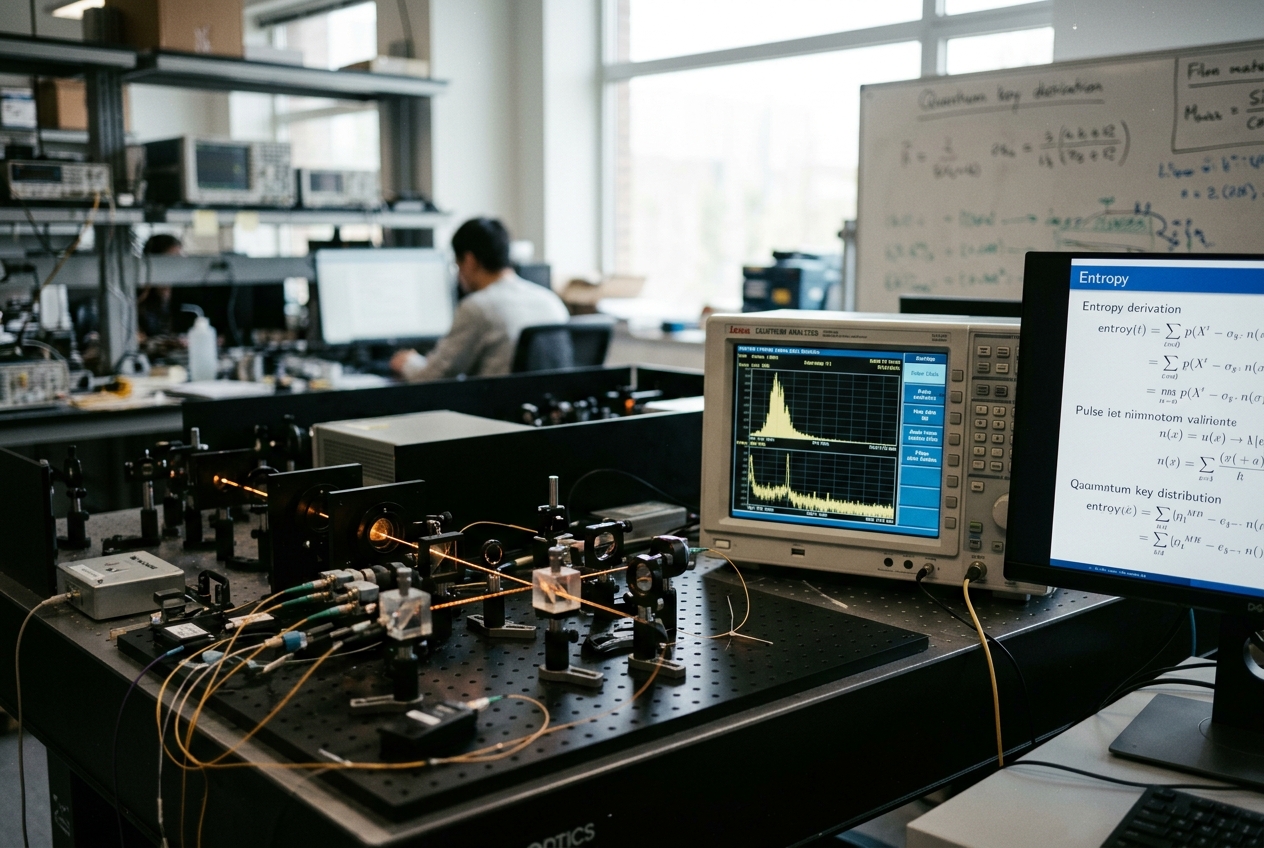
1. Opening Hook — Why You Should Care
Every single second, the global financial architecture transmits trillions of dollars in encrypted transactions over terrestrial optical cables and satellite links. For nearly five decades, the mathematical locks securing this astronomical wealth—alongside state secrets, electrical grid telemetry, and personal medical dossiers—have rested on the computational intractability of mathematical problems like prime factorization and discrete logarithms. We have long understood that a sufficiently powerful quantum computer running Shor’s algorithm will tear through these classical locks in a matter of hours. The celebrated antidote to this existential threat is Quantum Key Distribution (QKD), a cryptographic paradigm that promises absolute, information-theoretic security guaranteed not by the limitations of human computation, but by the fundamental laws of quantum mechanics.
Yet, for decades, that promise concealed a catastrophic theoretical flaw.
The textbook proofs of quantum security were built on an imaginary world. They assumed that communication channels operate in what mathematicians call the "asymptotic limit"—a fantasy where sender and receiver exchange an infinite sequence of identical, independent particles of light. In this idealized realm, statistical averages behave impeccably, thermal noise vanishes into predictable bell curves, and eavesdroppers are constrained by clean laws of large numbers.
Real-world hardware does not live in an infinite wonderland. A physical laser diode in a telecom rack emits a finite burst of photons; an optical detector suffers from jitter, dark counts, and dead time; and an adversary named Eve can exploit minute, unpredictable correlations across pulses. If an encryption key must be distilled from twenty thousand optical pulses rather than an infinite stream, classical information theory collapses. It cannot tell you whether your key is unconditionally secure or quietly compromised.
To bridge this chasm between infinite mathematical fiction and finite quantum reality, physicists and mathematicians had to reinvent the very definition of uncertainty. The resulting mathematical breakthrough—known as smooth min-entropy—did not merely patch a technical loophole. It established the bedrock of one-shot quantum information theory, transforming quantum cryptography from a delicate laboratory curiosity into an industrial-grade defense shield for the modern world.
2. The Idea in Plain English
To understand why traditional information theory fails in the real world, consider how we measure surprise.
In classical physics and standard computing, uncertainty is quantified using Shannon entropy, adapted to quantum states by John von Neumann as von Neumann entropy. Think of von Neumann entropy as a meteorological report on average annual rainfall. If a climatologist tells you that a valley receives an average of two inches of rain per month, that statistic is useful for planning agriculture over a fifty-year horizon. But it is utterly useless if you are an engineer building a flash-flood barrier for tomorrow afternoon. The average hides the catastrophic outlier: a once-in-a-century storm that dumps ten inches of water in two hours.
Traditional quantum entropy measures the average uncertainty per particle across an infinite stream of experiments. If an eavesdropper intercepts an infinite sequence of signals, the average information she gleans per signal dictates her total knowledge. But in a cryptographic exchange that lasts only a fraction of a millisecond, the sender and receiver are not dealing with the climate; they are dealing with tomorrow’s weather. What matters is not the eavesdropper’s average ignorance, but her worst-case advantage. If there is even a single, highly probable configuration of quantum measurements that allows her to guess the cryptographic key correctly on the first attempt, the key is broken—even if her average uncertainty across hypothetical parallel universes remains high.
This worst-case uncertainty is captured by min-entropy. Min-entropy does not ask how spread out a probability distribution is on average; it focuses exclusively on the tallest peak—the single most probable outcome. If an adversary attempts to guess a secret string in one single shot, her probability of success is determined precisely by the min-entropy.
However, unadulterated min-entropy introduces the opposite pathology: it is overly pessimistic. Imagine an encryption system that produces perfectly random numbers 99.9999999% of the time, but suffers from an exotic, vanishingly rare quantum fluctuation with a probability of one in a billion that reveals the secret state. Standard min-entropy evaluates the entire system solely by that microscopic flaw, declaring the system completely insecure. It refuses to certify an almost perfect cryptographic key because of an event that will practically never happen in the lifetime of the universe.
This is where the genius of smoothing enters.
Pioneered in the mid-2000s by Swiss theoretical physicist Renato Renner at ETH Zurich, smoothing introduces a microscopic tolerance threshold, denoted by the Greek letter epsilon ($\epsilon$). Imagine surrounding your physical quantum state with an infinitesimally small bubble containing all mathematically possible alternative states that are virtually indistinguishable from your true state. Smoothing allows the cryptographer to disregard rare anomalies whose total probability falls below $\epsilon$. Within this tolerance ball, we seek the neighboring quantum state that maximizes min-entropy.
Smooth min-entropy, therefore, represents the highest achievable worst-case randomness of a physical system, once we discount a negligible margin of error $\epsilon$. It discards the mathematical ghosts that paralyze raw min-entropy while preserving rigorous, rock-solid security guarantees against realistic adversaries.
3. How It Actually Works — The Mechanics
To appreciate the mathematical elegance of smooth min-entropy, one must examine how quantum information theory formalizes the battle of wits between two communicating parties (Alice and Bob) and an eavesdropper (Eve) holding a quantum memory device.
       +--------------------------------------------------------+
       |           PURIFIED DISTANCE EPSILON-BALL               |
       |                                                        |
       |     ~\                                                 |
       |    rho_AB  (Fictitious neighboring state               |
       |      *      maximizing worst-case uncertainty)         |
       |      |                                                 |
       |      |  P(rho, ~rho) <= epsilon                        |
       |      v                                                 |
       |    rho_AB  (True physical bipartite density operator)  |
       |      *                                                 |
       +--------------------------------------------------------+
                                  |
                                  v
       +--------------------------------------------------------+
       |   QUANTUM LEFTOVER HASH LEMMA (Randomness Extraction)  |
       |                                                        |
       |   Extracts l = H_min^eps(A|E) - 2 log2(1/eps') bits    |
       |   of composably secure uniform secret key              |
       +--------------------------------------------------------+
The Failure of the Asymptotic Assumption
In classical statistics, the Shannon entropy $H(X) = -\sum_x p(x) \log_2 p(x)$ and its quantum counterpart, the von Neumann entropy $S(\rho) = -\mathrm{Tr}(\rho \log_2 \rho)$, derive their operational meaning from the Asymptotic Equipartition Property (AEP). The AEP asserts that when an experiment is repeated $n$ times independently and identically (the i.i.d. assumption), the tensor-product state $\rho^{\otimes n}$ collapses into a "typical subspace" whose dimension is approximately $2^{n S(\rho)}$.
In a real quantum cryptographic protocol, the i.i.d. assumption fails entirely: 1. Finite Blocklengths: Real transmissions process finite packets of optical pulses (e.g., $n = 10^5$ to $10^8$ signals), where finite-size fluctuations deviate significantly from the asymptotic mean. 2. Coherent Attacks: An eavesdropper can entangle an unmeasured ancillary quantum system across all transmitted pulses simultaneously, creating collective quantum correlations that cannot be described by independent, identical states.
Conditional Min-Entropy and Semidefinite Duality
In one-shot quantum information theory, Alice’s classical measurement output is represented by a register $A$, while Eve’s entangled quantum side-information is stored in a quantum system $E$, forming a joint classical-quantum density operator $\rho_{AE}$ on the Hilbert space $\mathcal{H}_A \otimes \mathcal{H}_E$.
The conditional min-entropy $H_{\min}(A|E)_\rho$ quantifies the maximum probability that Eve can correctly guess Alice's value $A$ when Eve applies the optimal quantum measurement strategy (a Positive Operator-Valued Measure, or POVM) to her quantum memory $E$. Through the powerful framework of semidefinite programming (SDP) duality, this operational guessing probability can be formulated as a pristine geometric optimization problem over density operators:
$$H_{\min}(A|B)\rho = -\log_2 \inf{\sigma_B \ge 0} \left{ \mathrm{Tr}(\sigma_B) : I_A \otimes \sigma_B \ge \rho_{AB} \right}$$
In this expression, $\rho_{AB}$ is the bipartite density operator describing the shared quantum state, $I_A$ is the identity operator acting on Alice’s state space, and the operator inequality $I_A \otimes \sigma_B \ge \rho_{AB}$ requires that the difference matrix $(I_A \otimes \sigma_B - \rho_{AB})$ be positive semidefinite. The quantity $\sigma_B$ acts as a reference state on Bob’s (or Eve’s) subsystem.
In plain words: this formula searches across all possible quantum states of the receiver's system to find the smallest scaling factor that can mathematically dominate the combined state. The base-2 logarithm of that minimum value gives the exact number of bits of absolute randomness that the sender possesses relative to the receiver.
Renner's Epsilon-Smoothing Framework
Because raw min-entropy is hypersensitive to negligible statistical artifacts, Renato Renner defined the smooth conditional min-entropy by optimizing $H_{\min}(A|B)$ over a neighborhood of sub-normalized quantum states located within an $\epsilon$-ball of the physical state $\rho_{AB}$.
To measure the distance between quantum states without creating mathematical pathologies, information theorists utilize the purified distance $P(\rho, \tau) = \sqrt{1 - F(\rho, \tau)^2}$, where $F(\rho, \tau) = |\sqrt{\rho}\sqrt{\tau}|_1 + \sqrt{(1-\mathrm{Tr}(\rho))(1-\mathrm{Tr}(\tau))}$ is the generalized quantum fidelity. The smoothed quantity is defined as:
$$H_{\min}^\epsilon(A|B)\rho = \sup{\tilde{\rho}{AB} \in \mathcal{B}^\epsilon(\rho{AB})} H_{\min}(A|B)_{\tilde{\rho}}$$
where $\mathcal{B}^\epsilon(\rho_{AB}) = { \tilde{\rho}{AB} \ge 0 : \mathrm{Tr}(\tilde{\rho}{AB}) \le 1,\; P(\rho_{AB}, \tilde{\rho}_{AB}) \le \epsilon }$.
The operational power of this definition lies in its flexibility: it identifies the most benign quantum state $\tilde{\rho}{AB}$ that is physically indistinguishable from the actual experimental state $\rho{AB}$ within a statistical tolerance $\epsilon$, and extracts the operational unpredictability of that optimized state.
+-------------------------------------------------------------------------+
|                  CORE RESULT: THE QUANTUM EXTENSION                     |
|                                                                         |
|  Smooth min-entropy recovers von Neumann entropy in the asymptotic      |
|  limit via the Quantum AEP, while remaining universally valid for       |
|  single-shot, finite-length quantum communications:                     |
|                                                                         |
|        lim_{n -> inf} (1/n) * H_min^eps(A^n | B^n)_{rho^{otimes n}}     |
|                              = H(A | B)_rho                             |
+-------------------------------------------------------------------------+
The Quantum Asymptotic Equipartition Property (AEP)
A pivotal triumph of Renner's formulation is that it unifies one-shot information theory with classical asymptotic theory. The Quantum Asymptotic Equipartition Property proves that when a quantum channel is used across $n$ independent and identical runs, the smooth min-entropy per run converges precisely to the conditional von Neumann entropy as $n$ approaches infinity:
$$\lim_{n \to \infty} \frac{1}{n} H_{\min}^\epsilon(A^n|B^n){\rho^{\otimes n}} = H(A|B)\rho$$
For finite $n$, the convergence is bounded by explicit second-order dispersion terms:
$$\frac{1}{n} H_{\min}^\epsilon(A^n|B^n){\rho^{\otimes n}} \approx H(A|B)\rho - \sqrt{\frac{V(A|B)_\rho}{n}} \Phi^{-1}(\epsilon)$$
where $V(A|B)_\rho$ represents the quantum information variance and $\Phi^{-1}$ is the inverse cumulative normal distribution function. This exact expansion provides the mathematical machinery required to audit finite-length communications with rigorous error margins.
Privacy Amplification via the Quantum Leftover Hash Lemma
The true operational value of smooth min-entropy emerges during privacy amplification—the final phase of quantum key distribution where Alice and Bob compress their error-corrected raw bit strings into a shorter, perfectly secret key.
How many bits of true security can Alice distill from a raw sequence of measurements when an eavesdropper Eve holds entangled quantum side-information in a quantum memory? The answer is dictated by the Quantum Leftover Hash Lemma.
Alice applies a two-universal hash function (a random mathematical compression algorithm chosen from an open set) to her raw string $X$. If Alice compresses an $n$-bit raw string into an $\ell$-bit target key $K$, the leftover hash lemma guarantees that the trace distance between the actual extracted key-eavesdropper state $\rho_{KE}$ and the ideal state (a perfectly uniform random key $U_K$ entirely decoupled from Eve’s system $\rho_E$) satisfies:
$$\frac{1}{2} \left| \rho_{KE} - U_K \otimes \rho_E \right|1 \le 2^{-\frac{1}{2}\left( H{\min}^\epsilon(A|E)_\rho - \ell \right)} + 2\epsilon$$
This yields the fundamental key-length formula for finite-key quantum cryptography:
$$\ell \le H_{\min}^\epsilon(A|E)\rho - 2 \log_2\left(\frac{1}{2\epsilon{\mathrm{PA}}}\right)$$
This inequality is the holy grail of physical cybersecurity. It tells engineers the exact number of provably secure cryptographic bits $\ell$ they can extract from a noisy optical transmission while guaranteeing that Eve’s total information leakage remains bounded by a composable security parameter $\epsilon_{\mathrm{sec}} = \epsilon + \epsilon_{\mathrm{PA}}$.
4. Real-World Applications Today
The theoretical formulation of smooth min-entropy is not an abstract mathematical curiosity confined to chalkboard proofs; it is the fundamental mathematical engine driving deployed quantum communications infrastructure, aerospace security, and hardware cryptography across the globe between 2024 and 2026.
================================================================================
                    GLOBAL APPLICATIONS OF SMOOTH MIN-ENTROPY
================================================================================

[ Satellite QKD Networks ]  --> Micius, ESA SAGA, SpeQtral
                                 Dynamic finite-pass key distillation
                                 under atmospheric turbulence

[ Industrial Telecom QKD ]  --> Toshiba Europe, BT Cambridge Ring, SK Telecom
                                 Decoy-state BB84 protocols over optical fiber
                                 with finite-blocklength security proofs

[ Quantum Hardware & QRNG ] --> ID Quantique, QuintessenceLabs
                                 Device-independent true randomness extraction
                                 using Leftover Hash Lemma

[ Cloud Quantum Computing ] --> IBM Quantum, Oxford Quantum Circuits
                                 Blind quantum computing & verifiable delegation
                                 over distributed quantum networks
================================================================================
1. Satellite-to-Ground Quantum Cryptography
- Key Institutions: European Space Agency (ESA Eagle-1 / SAGA initiatives), Chinese Academy of Sciences (Micius satellite program), and Singapore-based SpeQtral.
- The Mission: Establishing quantum-encrypted communication channels between low-Earth orbit (LEO) satellites and optical ground stations to secure transoceanic diplomatic and banking backbones.
- The Quantum Advantage: A satellite flying overhead at 7.5 kilometers per second has an optical line-of-sight window lasting only three to five minutes before dipping below the horizon. During this ephemeral pass, atmospheric turbulence, beam divergence, and background sunlight limit the received signal to a strictly finite burst of roughly $10^6$ to $10^7$ detected photons. Asymptotic security proofs are invalid under these conditions. By utilizing smooth min-entropy bounds in decoy-state BB84 protocols, aerospace engineers dynamically calculate the exact finite-key distillation rate, extracting tens of kilobits of composably secure keys per satellite pass.
2. Commercial Fiber-Optic Metropolitan QKD Networks
- Key Institutions: Toshiba Europe, British Telecom (BT), and SK Telecom.
- The Mission: Operating production-grade quantum-secured metro networks, such as the commercial quantum network connecting financial trading centers between Cambridge and London.
- The Quantum Advantage: Fiber networks must continuously distill fresh cryptographic keys to encrypt high-throughput 400 Gbps optical channels using AES-256 in Galois/Counter Mode. Because phase drift, polarization misalignment, and thermal fluctuations in terrestrial fiber cause continuous fluctuations in the Quantum Bit Error Rate (QBER), these networks process key generation in discrete blocks of $10^5$ bits. Smooth min-entropy enables the system's firmware to compute the exact privacy amplification compression ratio in real time, guaranteeing that an adversary with advanced quantum memories cannot harvest correlated signals across consecutive blocks.
3. Certified Quantum Random Number Generation (QRNG)
- Key Institutions: ID Quantique, QuintessenceLabs, and the US National Institute of Standards and Technology (NIST).
- The Mission: Generating mathematically certified, untamperable random numbers for military-grade cryptographic key generation, lotteries, and large-scale Monte Carlo simulations.
- The Quantum Advantage: Traditional pseudo-random number generators rely on deterministic algorithms, while uncertified hardware generators are vulnerable to thermal noise bias or physical tampering. In Source-Device-Independent QRNGs, raw measurements derived from quantum tunneling or phase noise are partially correlated with environmental side-information. The Quantum Leftover Hash Lemma, parameterized via smooth min-entropy, allows these devices to mathematically purge physical side-channel leakage, condensing raw physical noise into pure, provably uniform numbers characterized by an error parameter $\epsilon \le 10^{-15}$.
4. Blind and Verifiable Cloud Quantum Computing
- Key Institutions: IBM Quantum Network, Oxford Quantum Circuits (OQC), and researchers at MIT Center for Theoretical Physics.
- The Mission: Enabling private corporate clients to run confidential quantum algorithms (such as proprietary drug design simulations or proprietary financial risk models) on third-party cloud quantum mainframes without the cloud provider discovering the input data, computation logic, or output results.
- The Quantum Advantage: Using measurement-based quantum computing and cryptographic blind delegation protocols, clients send single-photon states entangled with private registers to the cloud server. Smooth min-entropy provides the mathematical proof that the server's multi-qubit entanglement measurements cannot reveal the client's execution graph, guaranteeing unconditional client privacy even if the cloud provider deploys a hostile operating system.
5. What This Means for You
It is easy to dismiss mathematical concepts like "semidefinite duality" or "purified distance neighborhoods" as rarefied abstractions detached from everyday human existence. That assumption is dangerously mistaken.
We are currently living through the dawn of the "Harvest Now, Decrypt Later" era. Hostile intelligence agencies and criminal syndicates are routinely intercepting and archiving petabytes of encrypted internet traffic—including electronic health records, intellectual property, diplomatic cables, and personal banking communications. They cannot decrypt this data today using classical computers. They are holding it in high-capacity server farms, waiting for the day an enterprise quantum computer with sufficient error-corrected logical qubits comes online to strip the classical encryption away retroactively.
       TODAY                                          FUTURE
 [ Encrypted Data ] ---- Intercepted & Stored ----> [ Quantum Computer ]
 (AES / RSA Locks)                                  (Shor's Algorithm)
                                                            |
                                                            v
                                                    [ DATA COMPROMISED ]

       TODAY (With Smooth Min-Entropy Security)       FUTURE
 [ Quantum-Keyed  ] ---- Information-Theoretic ---> [ Infinite Quantum ]
 [ Communications ]      Security Over Finite       [ Computing Power  ]
                         Blocklengths                       |
                                                            v
                                                    [ STILL UNBREAKABLE ]
When you transmit your medical history to a hospital network or authorize a mortgage wire transfer, your security cannot depend on a mathematical proof that assumes an infinite stream of photons. If the security theorem protecting your data relies on asymptotic assumptions, an eavesdropper capturing a finite five-second transmission could exploit subtle statistical deviations to decode your private life a decade from now.
Smooth min-entropy is the mathematical seal that prevents this catastrophic retroactive decryption. It ensures that the security guarantees applied to your finite, physical communications are composable. In cryptographic parlance, composability means that a secure key generated today can be plugged into any other encryption algorithm, protocol, or network tomorrow without creating unforeseen security vulnerabilities. It guarantees that even if a future adversary possesses an infinitely powerful quantum computer and unlimited quantum memory, your data remains mathematically unbreakable.
6. Today's Takeaway
+-------------------------------------------------------------------------+
|                           THE CORE LESSON                               |
|                                                                         |
|  Infinity is the luxury of theoretical mathematics; real physics must   |
|  operate within the finite. By defining worst-case uncertainty over a   |
|  microscopic neighborhood of physical reality, smooth min-entropy       |
|  bridges the divide between quantum mechanics and real-world            |
|  engineering—transforming the fragile dream of unconditional privacy    |
|  into an unbreakable mathematical shield for the modern age.            |
+-------------------------------------------------------------------------+
Traditional information theory measured the gentle, predictable average uncertainty of infinite systems, leaving finite quantum devices dangerously exposed to real-world threats. Smooth min-entropy corrected this fundamental blind spot by focusing on the adversary's worst-case advantage while discarding negligible statistical anomalies within an $\epsilon$-ball of purified distance. By underpinning the Quantum Asymptotic Equipartition Property and the Quantum Leftover Hash Lemma, smooth min-entropy enables cryptographers to calculate the exact, finite-length secret key rates of real-world quantum hardware. It stands as one of the most profound intellectual triumphs of modern physics: a rigorous mathematical framework proving that even in an imperfect, finite world, human beings can generate absolute, unbreakable secrets.
For further academic study and rigorous derivations, explore research literature across Nature Physics, foundational lecture series on MIT OpenCourseWare, quantum computing documentation at IBM Quantum, detailed mathematical entries on Wikipedia's Min-Entropy Portal, and preprints on the arXiv Quantum Physics Archive.