Quantum Singleton Bound: Establishing Fundamental Redundancy Limits and Distance Trade-Offs in Quantum Error Correction
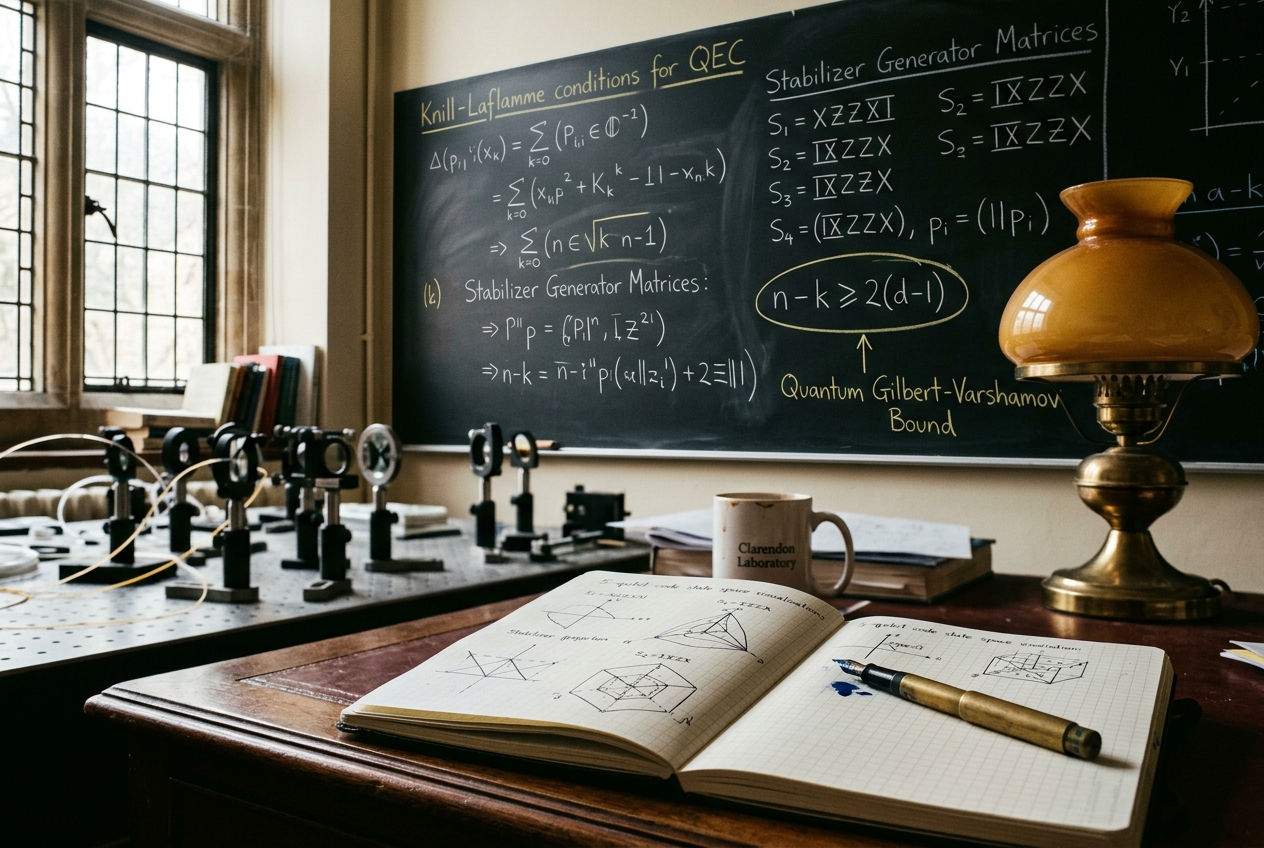
The global financial system, private encrypted communications, and national security databases all depend on a mathematical truth that is rapidly approaching its expiration date: classical computers find the factoring of large prime numbers impossibly difficult. A conventional supercomputer churning through billions of possibilities would require millions of years to break standard RSA-2048 encryption. A fault-tolerant quantum computer, operating under the counterintuitive laws of quantum mechanics, could unravel that same cipher in a matter of hours.
Yet, between our current experimental hardware and that cryptographically transformative future lies a formidable physical barricade: noise. Quantum bits, or qubits, are exquisitely sensitive. The faintest thermal vibration, a microscopic stray magnetic field, or even a single stray photon can knock a qubit out of its delicate computational state, instantly corrupting the calculation. To build a machine capable of curing diseases through molecular simulation, designing room-temperature superconductors, or cracking global encryption, we must continuously detect and repair these errors in real time without looking directly at the information being processed.
Protecting quantum data comes at a steep, mathematically inviolable price. In the classical digital world, safeguarding data is straightforward: if you want to protect a bit, you simply create backup copies. In the quantum realm, the fundamental laws of physics forbid copying entirely. To shield quantum information, we must pay what theoretical physicists call the "quantum tax"—a strict mandate dictated by the Quantum Singleton Bound. This mathematical law reveals that safeguarding fragile quantum data requires precisely twice the redundancy demanded by classical information theory. Understanding why this factor of two exists is not merely an esoteric puzzle for mathematicians; it explains why building a functional quantum computer is the most grueling engineering challenge in human history, and how researchers are deploying brilliant mathematical shortcuts to overcome it.
2. The Idea in Plain English
To understand why quantum error correction is so demanding, consider how ordinary computers protect data. In a classical system, information is composed of binary digits—bits—that sit reliably as either a 0 or a 1, much like a coin lying flat on a table, firmly showing heads or tails. If a scratch or a power surge might flip that coin, engineers use a simple repetition method: instead of storing a single coin showing heads, they store three coins showing heads. If a transient electrical error flips one coin to tails, the computer inspects all three, notices two heads and one tail, and declares by majority vote that the intended value was heads. The error is repaired, and the data remains intact.
A qubit, however, behaves like a coin spinning dynamically in mid-air. It exists in a "superposition," holding a continuous blend of possibilities until the precise moment it is measured. If you try to copy a spinning coin, you run headfirst into one of the bedrock principles of modern physics: the No-cloning theorem. Nature strictly forbids the creation of an identical copy of an arbitrary, unknown quantum state. Furthermore, the instant you observe the spinning coin to inspect its state, your measurement forces it to snap out of the air and land flat on the table, permanently destroying the computational superposition.
Because we cannot copy a qubit, we cannot use classical repetition codes. How, then, can we protect a quantum state that we are forbidden to copy and forbidden to look at?
The solution is an extraordinary feat of physical sleight of hand known as quantum error correction. Instead of duplicating the spinning coin, we weave its fragile identity across a network of multiple entangled particles. Think of this process like a hologram or a jigsaw puzzle. If you look at any individual piece of the puzzle, you see nothing but meaningless random noise. The true information does not live inside any single piece; it is stored entirely in the subtle, collective mathematical relationships—the entanglement—between the pieces. If environmental noise corrupts or destroys a single piece of the puzzle, the overall picture can still be fully reconstructed from the remaining entangled pieces.
However, this holographic distribution is subject to a strict geometric limit: the Quantum Singleton Bound. This bound dictates the absolute minimum number of physical puzzle pieces you must assemble to protect a given amount of quantum data against a specific number of errors.
3. How It Actually Works — The Mechanics
To see where this bound comes from, we must first examine how classical coding theory defines the limits of reliability. In 1964, mathematician Richard Singleton established an elegant mathematical ceiling for classical error-correcting codes, documented comprehensively within classical coding theory.
Suppose you want to transmit a message of $k$ bits of raw information using a larger block of $n$ total bits. The extra bits ($n - k$) serve as redundant padding. The quality of protection is measured by the "code distance," denoted by $d$. The distance represents the minimum number of bit changes required to accidentally transform one valid encoded message into another valid encoded message. A code with distance $d$ can successfully detect up to $d - 1$ corrupted bits, or pinpoint and correct up to $\lfloor(d - 1)/2\rfloor$ arbitrary bit-flip errors.
Singleton proved that the amount of redundant padding must always be at least as large as the code distance minus one:
$$n - k \ge d - 1$$
In plain English, this formula states that if you remove any $d - 1$ bits from your $n$-bit message, the remaining bits must still contain enough raw capacity to uniquely identify all $k$ bits of your original message without ambiguity. If this inequality were violated, two different messages would become indistinguishable whenever errors occurred.
When physicists turned to quantum error-correcting codes—denoted by the standard notation $[[n, k, d]]$, representing $k$ protected "logical" qubits encoded across $n$ "physical" qubits with code distance $d$—they discovered that the classical bound fails catastrophically. In 1996, pioneering quantum theorists proved that quantum information requires a substantially larger penalty. The Quantum Singleton Bound establishes that:
$$n - k \ge 2(d - 1)$$
Notice the critical factor of 2 multiplying the distance term. To achieve the exact same protection distance $d$ for an equivalent amount of information $k$, a quantum architecture must provide precisely twice the redundancy of a classical system.
+-----------------------------------------------------------------------------------------+
|                               THE FUNDAMENTAL COMPARISON                                |
+-----------------------------------------------------------------------------------------+
|  Classical Singleton Bound:    n - k >= d - 1                                           |
|  Quantum Singleton Bound:      n - k >= 2(d - 1)                                        |
|                                                                                         |
|  The Physical Origin:                                                                   |
|  The factor of 2 emerges directly from the No-Cloning Theorem and quantum erasure       |
|  channel equivalence. If a code could correct more than (n - k)/2 lost qubits,           |
|  an eavesdropper could split the system into two pieces and reconstruct identical       |
|  copies of an unknown quantum state, violating fundamental quantum mechanics.           |
+-----------------------------------------------------------------------------------------+
Why Does the Factor of Two Emerge? The Physics of No-Cloning
Why does nature demand this double penalty? The physical origin is directly tied to the no-cloning theorem through the lens of what information theorists call the "quantum erasure channel."
An erasure error occurs when a qubit's exact physical location is lost or wiped out, but the system knows precisely which qubit went missing. In quantum mechanics, an $[[n, k, d]]$ code can correct up to $d - 1$ erasure errors at known locations, while it can correct up to $t = \lfloor(d - 1)/2\rfloor$ arbitrary errors (such as combined bit-flips and phase-flips) at unknown locations.
Now, conduct a thought experiment. Imagine an engineer constructs a hypothetical quantum code that violates the quantum bound—suppose it could correct $e$ erasures where $e$ is strictly greater than half the available redundancy, such that $e > (n - k) / 2$.
If such a code existed, we could take the $n$ physical qubits holding an encoded quantum state and divide them between two distinct observers, Alice and Bob. We give a subset of $e$ qubits to Alice, and the remaining $n - e$ qubits to Bob.
Because our hypothetical code can correct $e$ erasures, Bob (who holds $n - e$ qubits) can treat Alice's missing $e$ qubits as "erased" and run the decoding procedure to perfectly reconstruct the original logical quantum state. But because we assumed $e$ was larger than half the redundancy, Alice's partition of $e$ qubits is also large enough to treat Bob's portion as an erasure and reconstruct the original logical state herself.
If both Alice and Bob can simultaneously reconstruct the original quantum state from their isolated subsets of physical qubits, they have succeeded in creating two identical, independent copies of an arbitrary, unknown quantum state from a single original. This blatantly violates the no-cloning theorem.
To prevent this paradox, quantum mechanics imposes a strict operational rule: if a subsystem holds enough information to reconstruct the logical state, its complementary subsystem must contain strictly zero information about that state. By analyzing this constraint through the subadditivity of von Neumann entropy—which quantifies the mathematical limits of information contained in quantum subsystems—and the Knill-Laflamme conditions (the mathematical criteria governing whether a set of quantum errors can be reversed), physicists proved that the complementary subsystem cannot correct the state unless it is strictly larger than the lost fraction. This operational asymmetry forces the factor of two into the bound.
Quantum MDS Codes and the Canonical Five-Qubit Code
Codes that achieve the theoretical maximum efficiency by turning the inequality of the Quantum Singleton Bound into an exact equality are designated as Quantum Maximum Distance Separable (MDS) codes:
$$n - k = 2(d - 1)$$
These codes are the absolute pinnacle of spatial efficiency in quantum error correction. The most famous example is the canonical $[[5, 1, 3]]$ five-qubit code, discovered independently by Charles Bennett, David DiVincenzo, John Smolin, and William Wootters, and by Raymond Laflamme and colleagues in 1996.
If our objective is to protect a single logical qubit ($k = 1$) against any single physical error occurring anywhere in the system, our code must have a distance of $d = 3$ (since correcting $t = 1$ arbitrary error requires $d = 2t + 1 = 3$). Plugging these parameters into the Quantum Singleton Bound yields:
$$n - 1 \ge 2(3 - 1) = 4 \implies n \ge 5$$
This calculation demonstrates that it is physically impossible to construct a quantum error-correcting code that protects one qubit against an arbitrary error using four or fewer physical qubits. The five-qubit code saturates the bound with mathematical perfection ($5 - 1 = 2(3 - 1)$), making it the smallest possible quantum error-correcting code in existence.
The Architectural Dilemma: Topological vs. Quantum LDPC Codes
While Quantum MDS codes such as the $[[5, 1, 3]]$ code are maximally compact, they present severe practical challenges for hardware engineers. To extract error information (known as error syndromes) from an MDS code, every physical qubit must interact with almost every other physical qubit in complex, multi-qubit entangling operations. In physical hardware, such as superconducting circuits laid out on a flat two-dimensional microchip, wiring every qubit to every other qubit creates an unmanageable tangle of control lines.
To bypass this routing nightmare, mainstream quantum computing efforts for the past two decades—championed by industrial research groups—focused heavily on topological surface codes. Surface codes arrange qubits on a simple two-dimensional square grid where operations only occur between immediate geometric neighbors.
However, surface codes pay a devastating architectural penalty for this spatial convenience. Because they prioritize local 2D connections, their code rate (the ratio of useful logical qubits to total physical qubits, $k/n$) plummets to near zero as the system scales up. A standard surface code typically encodes only $k = 1$ or $k = 2$ logical qubits across hundreds or thousands of physical qubits ($n \sim d^2$). As a result, building a machine with 1,000 fault-tolerant logical qubits using surface codes could easily require over one million physical qubits.
+-----------------------------------------------------------------------------------------+
|                                CODE ARCHITECTURE TRADE-OFFS                             |
+-----------------------------------------------------------------------------------------+
| Architecture           | Rate (k/n)       | Connectivity      | Hardware Complexity    |
+------------------------+------------------+-------------------+------------------------+
| Quantum MDS [[5,1,3]]  | High (Saturated) | All-to-All        | High (Doesn't scale)   |
| 2D Surface Codes       | Extremely Low    | Nearest-Neighbor  | Low (Planar 2D grid)   |
| Modern qLDPC Codes     | High & Constant  | Sparse Long-Range | Moderate (Advanced)    |
+-----------------------------------------------------------------------------------------+
To break free from this million-qubit footprint trap, modern quantum computing has shifted toward Quantum Low-Density Parity-Check (qLDPC) codes. As detailed in recent research highlighted by Nature, qLDPC codes navigate the fundamental boundaries of quantum information by introducing sparse, non-local connections between qubits. Instead of requiring full all-to-all connectivity like MDS codes, or strictly nearest-neighbor connectivity like surface codes, qLDPC codes use mathematically optimized routing networks.
By leveraging architectures such as bivariate bicycle codes and 3D interconnects, modern qLDPC codes achieve high, non-vanishing encoding rates ($k/n > 0$) while preserving high code distances. This allows hardware designers to move significantly closer to the theoretical efficiency limits established by the Quantum Singleton Bound, dramatically reducing the physical machine size required for fault-tolerant computation.
4. Real-World Applications Today
The principles of quantum error correction and the strict limits imposed by the Quantum Singleton Bound are actively driving real-world engineering across industrial and academic labs between 2024 and 2026:
-
IBM Quantum (Bivariate Bicycle qLDPC Architectures)
The Mission: IBM Quantum has officially integrated quantum Low-Density Parity-Check (qLDPC) codes into its long-term hardware roadmap to escape the massive qubit overhead of traditional surface codes.
The Advantage: By replacing planar surface codes with bivariate bicycle qLDPC codes that utilize sparse long-range couplers, IBM aims to encode dozens of protected logical qubits into just a few hundred physical superconducting transmon qubits. This dramatically compresses the physical footprint of future commercial quantum processors. -
Google Quantum AI (Surface Code Scaling and Threshold Verification)
The Mission: Google Quantum AI is actively demonstrating that scaling up physical qubit grids suppresses physical error rates exponentially, proving that error correction works below the fault-tolerant threshold.
The Advantage: Google’s Sycamore processor experiments validate that despite the double redundancy mandated by the Quantum Singleton Bound, increasing the distance $d$ of a quantum code reliably reduces the net logical error rate, paving the path toward practical, billion-gate quantum algorithms. -
Quantinuum and Harvard / QuEra (Neutral-Atom and Trapped-Ion All-to-All Encodings)
The Mission: Collaborations between Harvard University, QuEra Computing, and Quantinuum are utilizing dynamically shuttled neutral atoms and trapped ions to implement non-local, high-rate error-correcting codes.
The Advantage: Because neutral atoms can be physically moved in real time using optical tweezers, these systems possess reconfigurable, all-to-all connectivity. This freedom allows researchers to implement compact, highly efficient codes that approach MDS-like performance limits, achieving fault-tolerant logical operations with significantly fewer total atoms. -
Quantum Key Distribution (QKD) and Satellite Quantum Repeaters
The Mission: Telecommunications consortia and aerospace agencies are deploying quantum repeaters across optical fiber networks and satellite links to enable unhackable global communications.
The Advantage: Signal loss across long-distance fiber optics functions as a pure quantum erasure channel. Engineers utilize the Quantum Singleton Bound to calculate the exact error-correction thresholds required to reconstruct lost photon states, ensuring that eavesdroppers cannot intercept or clone quantum encryption keys in transit.
5. What This Means for You
It is easy to view mathematical theorems like the Quantum Singleton Bound as abstract curiosities confined to university physics departments. In reality, this bound directly dictates the timeline of when quantum technology will transform your daily life.
Consider modern medicine. Today, designing a life-saving drug often requires years of expensive trial-and-error laboratory synthesis because classical supercomputers cannot accurately model the quantum interactions of complex molecular bonds. A fault-tolerant quantum computer could simulate those exact molecular dynamics in minutes, drastically accelerating the discovery of targeted cancer therapies, personalized vaccines, and revolutionary catalysts for clean energy.
The reason you do not yet have those quantum-designed drugs at your local pharmacy is precisely the factor of two in the Quantum Singleton Bound. Because quantum information cannot be cloned, every single logical operation requires an expansive web of physical qubits to detect and correct errors in real time. The "quantum tax" doubled the engineering mountain that hardware manufacturers must climb.
However, by understanding these exact mathematical constraints, scientists have stopped trying to build brute-force machines with millions of isolated physical qubits. Instead, they are designing sophisticated qLDPC architectures that navigate around these physical bounds with mathematical elegance. When fault-tolerant quantum computing arrives in commercial cloud data centers over the coming decade, it will be because engineers solved the puzzle of protecting fragile quantum reality within the strict boundaries that nature allows.
6. Today's Takeaway
The Quantum Singleton Bound ($n - k \ge 2(d - 1)$) establishes an inviolable physical truth: because nature forbids the cloning of unknown quantum states, protecting quantum information against environmental noise demands precisely twice the redundancy of classical data. While this fundamental tax makes the construction of fault-tolerant quantum hardware an extraordinary engineering challenge, it provides the precise mathematical blueprint that guides modern quantum computing away from brute-force hardware scaling and toward elegant, high-efficiency architectures.