Quantum Self-Testing: Certifying Quantum States and Uncharacterized Measurements Via Maximal Non-Local Violations
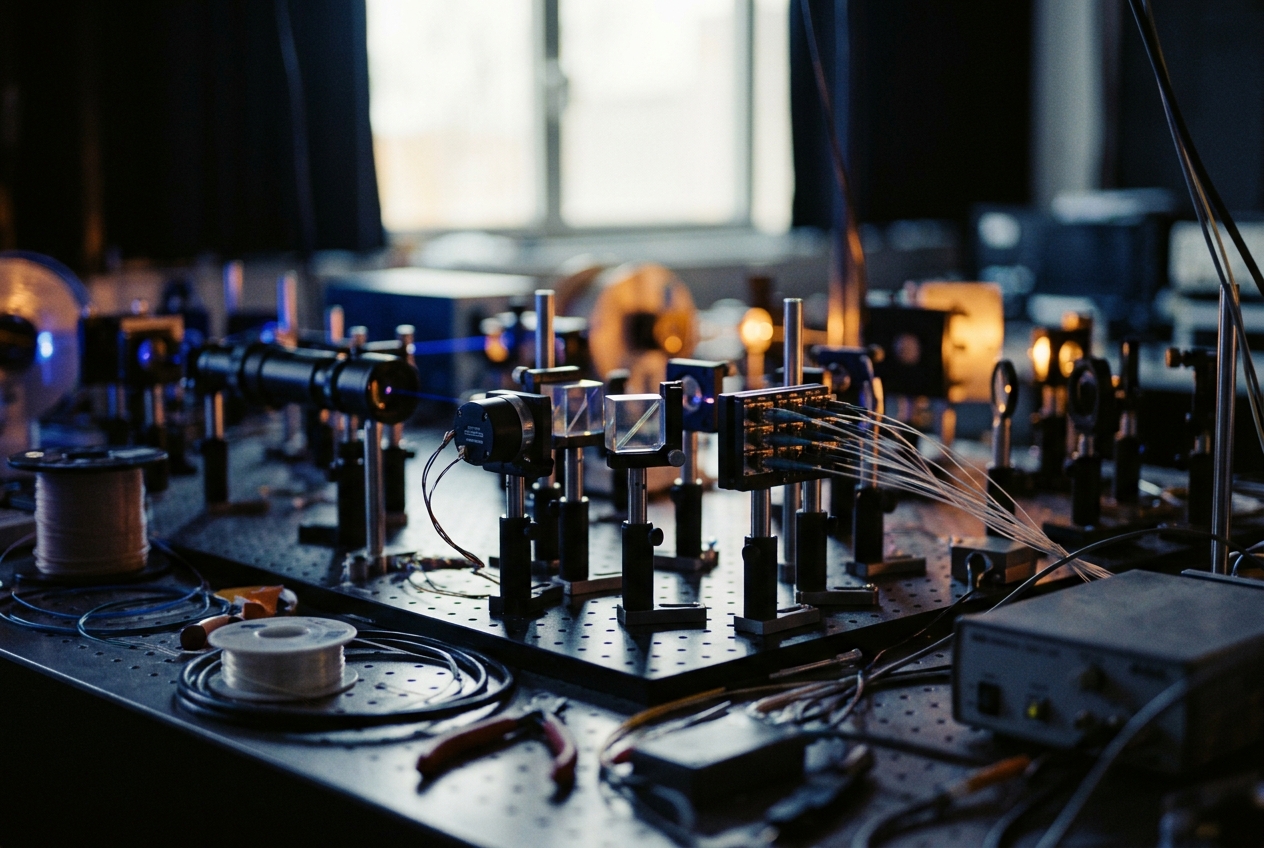
In classical computing, resolving such paranoia is impossible without invasive microscopic inspection. You must trust the foundry, the supply chain, and the diagnostic probes. In the quantum realm, however, physics grants an astonishing escape hatch known as quantum self-testing. Through this theoretical breakthrough, you can treat both machines as completely blind black boxes, feed them simple classical questions, record their answers, and prove with absolute mathematical certainty the exact quantum state inside and the precise measurements being performed—all without making a single assumption about the inner workings, dimensions, or trustworthiness of the hardware.
1. Opening Hook — Why You Should Care
The global digital economy rests upon an unsettling pact of blind faith. Every secure transmission sent between banking mainframes, government ministries, and civilian smartphones depends on cryptographic primitives that assume our underlying physical hardware executes instructions faithfully. Yet supply-chain interdiction, hardware Trojans, and micro-architectural side-channel attacks consistently demonstrate that trusting physical devices is a dangerous gamble.
As society transitions toward a quantum infrastructure—where quantum computers break legacy public-key encryption and quantum key distribution promises physical-law security—this trust dilemma becomes an existential bottleneck. If you purchase a quantum hardware component from a third party, classical validation techniques fail. You cannot peer into a subatomic superposition with an electron microscope without collapsing the very properties you wish to verify.
Quantum self-testing solves the ultimate paradox of cybersecurity: it enables device-independent verification. It provides an operational protocol by which two untrusted, uncharacterized black boxes can certify their own internal quantum mechanical nature solely from their input-output statistical correlations. If the machines generate a specific statistical signature, they are physically incapable of cheating. The stakes are immense: self-testing transforms quantum physics from an experimental puzzle into a self-authenticating cryptographic substrate for global finance, sovereign communications, and verifiable cloud computing.
2. The Idea in Plain English
To understand how a machine can prove its internal mechanics from the outside, imagine two criminal suspects locked in separate, soundproof interrogation rooms. The interrogators ask each suspect a series of unpredictable yes-or-no questions. If the detectives compare notes afterward and find that the suspects' answers match with a statistical frequency that defies any pre-arranged strategy or coincidental luck, they can deduce that the suspects were somehow communicating during the interrogation.
Now imagine a scenario where the questions are chosen at random, the suspects are separated by light-years, and yet their answers exhibit correlations so intensely synchronized that even instantaneous light-speed signaling could not explain them. According to the foundational principles of quantum entanglement, such correlations are only possible if the suspects share entangled pairs of quantum particles.
Self-testing takes this revelation to its logical zenith. It demonstrates that not only are the suspects entangled, but there exists a unique, singular quantum configuration that can achieve the absolute theoretical ceiling of these correlations.
+-------------------------------------------------------------------------+
|                        THE SELF-TESTING PARADIGM                        |
|                                                                         |
|  Classical Inputs (x, y) ---------> [ UNTRUSTED BLACK BOXES ]           |
|                                          |         |                    |
|                                     (Device A) (Device B)               |
|                                          |         |                    |
|  Classical Outputs (a, b) <--------+-----+---------+                    |
|                                                                         |
|  Observed Correlation Statistics  ===>  UNIQUE QUANTUM STATE IDENTIFIED |
|  P(a, b | x, y)                         UP TO LOCAL ISOMETRY            |
+-------------------------------------------------------------------------+
When we observe these maximal correlations, the physical system is backed into an algebraic corner: it has no choice but to be operating on a specific quantum state (such as the two-qubit maximally entangled Bell state) and measuring it with specific complementary observables (like the standard Pauli spin operators).
To make sense of this without getting lost in mathematical abstraction, we must define three fundamental concepts:
- The Device-Independent Paradigm: A framework where protocols are evaluated solely on their classical input-output statistics. We do not assume that the device uses two-level systems (qubits), ten-level systems, or an infinite-dimensional field. The device is purely a black box with buttons for inputs and displays for outputs.
- Target State and Reference Observables: The idealized quantum architecture we wish to certify—typically a pair of particles linked in a maximally entangled singlet state, measured along orthogonal geometric axes.
- Local Isometry: In practical terms, this is a mathematical translation mechanism. Because we cannot control how an untrusted device labels its internal coordinates or how much unused "junk" memory it carries, self-testing guarantees that the device's state is identical to the target state up to a local change of coordinates and the presence of decoupled, auxiliary dimensions.
3. How It Actually Works — The Mechanics
The engine driving quantum self-testing is the violation of Bell inequalities, most famously formalized by John Clauser, Michael Horne, Abner Shimony, and Richard Holt in the CHSH inequality. In a standard CHSH test, two separated parties, traditionally named Alice and Bob, receive random binary inputs $x, y \in {0, 1}$ and produce binary outcomes $a, b \in {+1, -1}$.
Alice measures one of two uncharacterized physical observables, $A_0$ or $A_1$, depending on her input $x$. Bob simultaneously measures $B_0$ or $B_1$ depending on his input $y$. If the universe operated purely on classical, local-realistic principles, the statistical combination of their measurements—known as the CHSH correlation value $\langle \mathcal{B} \rangle$—could never exceed an upper limit of 2.
In 1980, the physicist Boris Tsirelson proved that quantum mechanics permits a higher threshold, but one that is strictly capped by a fundamental mathematical ceiling known as the Tsirelson bound.
$$\langle \mathcal{B} \rangle = \langle A_0 B_0 \rangle + \langle A_0 B_1 \rangle + \langle A_1 B_0 \rangle - \langle A_1 B_1 \rangle \le 2\sqrt{2}$$
The number $2\sqrt{2} \approx 2.828$ is not just an arbitrary statistical record; it is an extremal point of quantum operator geometry. When an experimentalist observes black-box statistical correlation data yielding an expectation value exactly equal to $2\sqrt{2}$, something extraordinary happens to the underlying operator equations: the system exhibits algebraic rigidity.
To see why, consider what must happen mathematically to achieve this maximum. When the CHSH operator is squared and applied to the shared physical state $|\psi\rangle$, reaching the value of $8$ forces the measurement operators of Alice to satisfy an exact anti-commutation relation when acting upon the state.
$${A_0, A_1}|\psi\rangle = (A_0 A_1 + A_1 A_0)|\psi\rangle = 0$$
In the language of physics, anti-commutation means that measuring property $A_0$ followed by $A_1$ yields the exact opposite mathematical sign as measuring $A_1$ followed by $A_0$. This is the defining algebraic hallmark of completely complementary, mutually unbiased quantum observables—identical to the behavior of the foundational Pauli spin matrices $\sigma_z$ and $\sigma_x$ taught in standard quantum curricula such as MIT OpenCourseWare Quantum Physics.
Because this anti-commutation property is forced directly by the experimental statistics, Alice’s uncharacterized measurements must act like $\sigma_z$ and $\sigma_x$, and Bob’s measurements must act like their symmetric counterparts $(\sigma_z + \sigma_x)/\sqrt{2}$ and $(\sigma_z - \sigma_x)/\sqrt{2}$.
From this rigid operator algebra, mathematicians construct a local isometry—an explicit, state-preserving transformation $\Phi = \Phi_A \otimes \Phi_B$ made of local quantum gates. This mapping acts independently on Alice’s and Bob’s laboratories, decoupling any irrelevant physical degrees of freedom and extracting the pristine target state:
$$\Phi(|\psi\rangle) = |\Phi^+\rangle \otimes |\text{junk}\rangle = \frac{|00\rangle + |11\rangle}{\sqrt{2}} \otimes |\text{junk}\rangle$$
This formula represents the pinnacle of self-testing theory: it proves that hidden within the arbitrary, unknown physical system $|\psi\rangle$ lies the canonical maximally entangled two-qubit Bell state $|\Phi^+\rangle$, completely disentangled from any environmental noise or auxiliary "junk" states.
Key Architectural Insight: Algebraic Rigidity Self-testing works because extremal points of quantum probability distributions do not admit multiple physical explanations. Hitting the Tsirelson bound of $2\sqrt{2}$ creates a rigid algebraic constraint that collapses all possible infinite-dimensional Hilbert space representations into a single unique equivalence class isomorphic to a pair of maximally entangled qubits.
Robustness and Experimental Reality
In an actual laboratory, no detector is perfectly efficient, and no laser is perfectly aligned. Real-world experimental data will never yield an exact CHSH value of $2\sqrt{2}$; instead, an experimenter might measure $2\sqrt{2} - \delta$, where $\delta > 0$ represents a tiny deviation caused by thermal noise or optical loss.
Can self-testing survive experimental imperfections? The answer lies in robustness bounds. Through rigorous functional analysis, researchers have shown that if the observed correlation deviates from the Tsirelson bound by an amount $\delta$, the physical state $|\psi\rangle$ remains close to the ideal Bell state $|\Phi^+\rangle$ within a quantifiable trace distance error:
$$\mathcal{D}(\Phi(\rho), |\Phi^+\rangle\langle\Phi^+|) \le \mathcal{O}(\sqrt{\delta})$$
Modern analytical techniques developed over the past decade have continuously sharpened these bounds. Today, experimentalists accounting for finite statistical sampling—the fact that a laboratory can only run a finite number of trial rounds before the lasers drift—can still obtain airtight certification metrics with rigorous statistical confidence intervals.
4. Real-World Applications Today
The theoretical machinery of quantum self-testing has leaped from foundational mathematical physics into cutting-edge industrial and academic engineering initiatives between 2024 and 2026.
+-------------------------------------------------------------------------+
|                  FRONTIERS OF QUANTUM SELF-TESTING                      |
|                                                                         |
|  [ DI-QKD ]              [ Blind Quantum Cloud ]   [ Quantum Networks ] |
|  Oxford & QuTech         MIT, Edinburgh & IBM      Max Planck & Harvard |
|  Hacking-proof keys      Private remote computing  Graph-state routing  |
|  without trusted nodes   on untrusted servers      across repeaters     |
+-------------------------------------------------------------------------+
1. Device-Independent Quantum Key Distribution (DI-QKD)
- Key Institutions: University of Oxford, Ludwig Maximilian University of Munich, and QuTech / TU Delft.
- The Mission: Conventional Quantum Key Distribution (QKD) assumes that the photon detectors and laser sources inside the transmitter and receiver do not leak information. In groundbreaking demonstrations published in Nature, these research consortia achieved fully device-independent quantum key distribution across optical fiber and free-space links.
- The Quantum Advantage: By continuously performing a CHSH self-test on the incoming photon pairs, the communicating parties verify that the cryptographic keys are mathematically insulated from any eavesdropper or malicious hardware Trojan inserted during fabrication. If an adversary attempts to intercept or clone the signals, the CHSH value immediately drops below the self-testing threshold, aborting the key generation.
2. Verifiable and Blind Cloud Quantum Computing
- Key Institutions: University of Edinburgh, Sorbonne Université, and experimental teams collaborating on IBM Quantum Qiskit architectures.
- The Mission: As quantum processors scale into hundreds of noisy qubits, corporate and defense users must outsource complex simulations (such as molecular catalyst design or battery chemistry) to third-party cloud servers. Blind quantum computation protocols utilize self-testing to let a computationally weak client verify that a massive remote server is executing the exact quantum circuits requested without the server ever learning the input data, the algorithm, or the results.
- The Quantum Advantage: Self-testing allows the client to send "trap" calculations hidden inside an entangled graph state. If the remote quantum server attempts to cheat or substitute a classical shortcut, the algebraic rigidity relations break, exposing the fraud instantly.
3. Certified Randomness Generation
- Key Institutions: National Institute of Standards and Technology (NIST) and the National Physical Laboratory (UK).
- The Mission: Critical encryption protocols, lotteries, and scientific Monte Carlo simulations require true, non-deterministic entropy. Classical pseudo-random number generators are fundamentally deterministic and vulnerable to reverse engineering.
- The Quantum Advantage: By utilizing self-testing Bell tests on trapped ions and superconducting circuits, metrology institutes can generate "publicly certifiable randomness." Because the observed Bell violation mathematically certifies that the state is entangled and the measurements are non-commuting, the resulting output bits are fundamentally unpredictable to any observer in the universe, including the engineers who built the device.
4. Multipartite Quantum Internet and Graph-State Verification
- Key Institutions: Max Planck Institute of Quantum Optics and Harvard University.
- The Mission: Future quantum communications will rely on distributed quantum networks connected via quantum repeaters. These networks use complex entangled structures known as graph states and cluster states spanning multiple nodes.
- The Quantum Advantage: Self-testing has been expanded beyond simple two-particle Bell pairs to verify multipartite graph states and high-dimensional multi-level quantum systems (qudits). Network operators can independently verify that multi-node entanglement is distributed across global routing paths without needing to trust intermediate repeater stations, as detailed in recent treatises on Physical Review Letters / APS Physics.
5. What This Means for You
It is tempting to dismiss quantum self-testing as an esoteric curiosity confined to academic chalkboards and multimillion-dollar physics laboratories. Yet its philosophical and practical ramifications touch the fundamental core of our digital lives.
We are living through an era where digital trust is steadily eroding. Deepfakes undermine sensory evidence, firmware backdoors compromise critical infrastructure, and the looming arrival of cryptanalytically relevant quantum computers threatens to unravel the mathematical foundations of electronic banking, medical record privacy, and global supply chains.
Quantum self-testing offers humanity a radically new foundation for truth. It is the first technology in history where a machine’s integrity is guaranteed not by human audits, corporate promises, or governmental regulations, but by the invariant symmetries of the laws of nature.
When you deposit funds into a bank, authorize a confidential medical treatment, or transmit sensitive intellectual property in the coming quantum era, self-testing ensures that the encryption protecting your life does not require you to trust the foreign foundry that etched the microchip or the cloud conglomerate that hosts the server. You only need to trust the laws of quantum mechanics—laws that have remained unbreakable across fourteen billion years of cosmic history.
6. Today's Takeaway
Quantum self-testing is the ultimate physical audit: by demonstrating that uncharacterized black-box devices violate classical probability limits and reach the extremal Tsirelson bound of quantum non-locality, we mathematically force those devices to contain exact entangled states and pristine quantum measurements, constructing unshakeable cryptographic trust in a completely untrusted world.