Quantum Reverse Shannon Theorem: Simulating Noisy Channels Via Shared Entanglement and Classical Communication
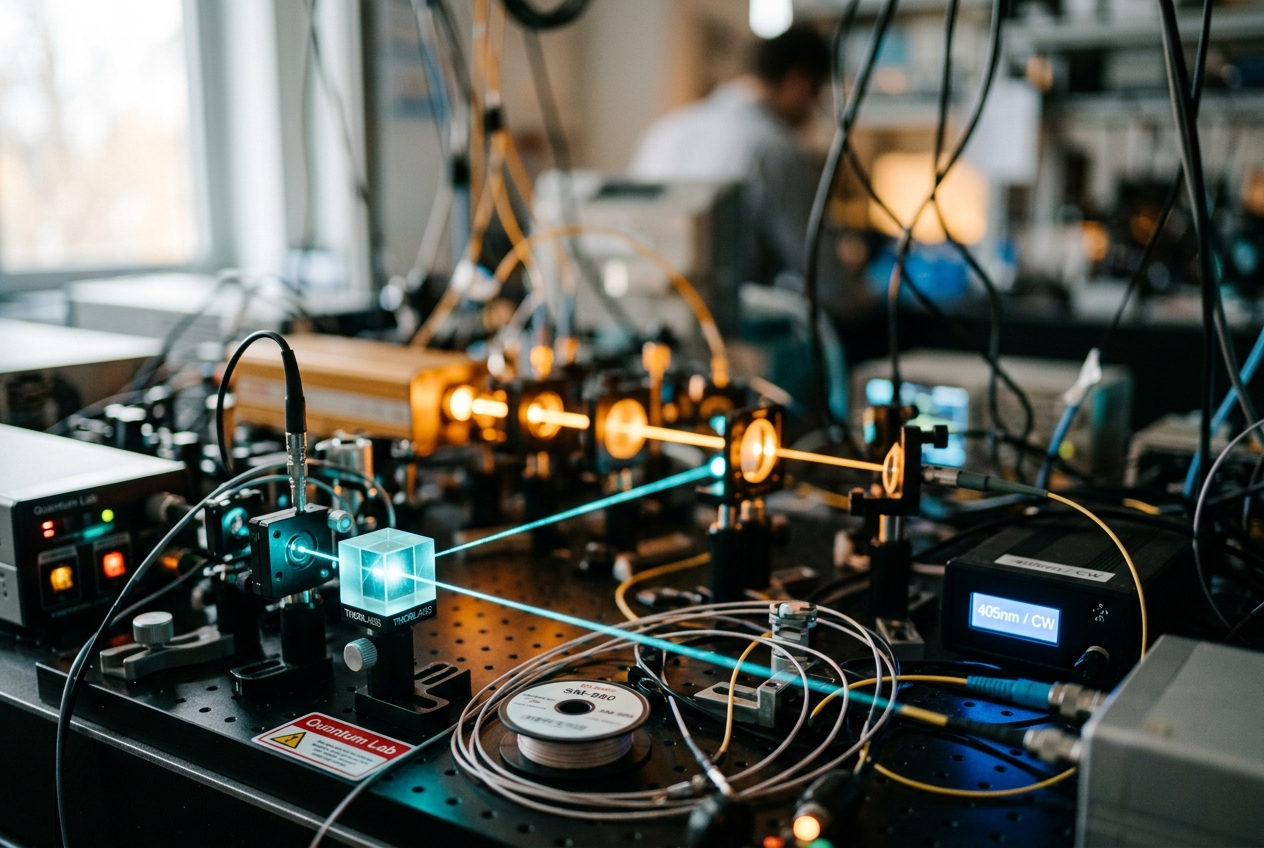
To bridge this chasm, physicists must answer a profound foundational question: what is the absolute minimum informational cost required to simulate a physical process?
If you want two distant research laboratories to perfectly mimic the behavior of a noisy fiber-optic cable, an imperfect quantum memory chip, or an open chemical system, how many pristine bits of information must they exchange? The answer is codified in one of the crowning triumphs of modern theoretical physics: the Quantum Reverse Shannon Theorem.
By calculating the exact exchange rate between classical communication, quantum entanglement, and physical noise, this theorem proves that simulating the imperfections of the universe requires precisely the same fundamental informational currency as communicating through them. In doing so, it provides the ultimate blueprint for distributed quantum networks, cloud-based quantum supercomputing, and our understanding of physical reality itself.
1. Opening Hook — Why You Should Care
Consider the sprawling submarine cable networks that crisscross the floor of the Atlantic Ocean. Every financial transaction, medical record transfer, and high-definition video call sent across the world travels through optical fibers that subtly distort, attenuate, and degrade the light pulses carrying the data. For nearly eighty years, telecommunications engineers have understood how to conquer this degradation thanks to Claude Shannon’s 1948 landmark noisy-channel coding theorem, which defined the maximum rate at which information can be sent reliably through a noisy medium without error.
Now invert the entire scenario. Imagine you are building the future quantum internet. Before laying thousands of miles of expensive cryogenic repeaters under the sea, you want to build a flawless, distributed digital twin of that noisy quantum link between two remote server centers. You do not want to clean up the noise; you want to reproduce the exact physical degradation of that channel with absolute mathematical fidelity, using only clean, noiseless classical communication lines assisted by shared quantum entanglement.
How many classical bits must you broadcast across your network to fool the laws of physics into believing that an actual, physical quantum channel was used?
Until the formulation of the Quantum Reverse Shannon Theorem, many physicists believed that synthesizing physical noise would be vastly more expensive than overcoming it. It seemed intuitive that generating all the chaotic, messy possibilities of quantum decoherence would demand an exponential blizzard of data. The theorem proved the opposite: nature does not charge a surcharge for realism. The cost to simulate a physical channel is mathematically identical to its capacity to transmit information. This discovery has radically altered our understanding of distributed quantum computing, cryptographic verification, and the foundational thermodynamics of information.
2. The Idea in Plain English: Crafting the Perfect Counterfeit
To understand the core intuition of the Quantum Reverse Shannon Theorem, we must first contrast two fundamentally different tasks: channel transmission and channel simulation.
Imagine a game of broken telephone played across a noisy room. In the classical forward problem solved by Claude Shannon, Alice wants to shout a clear, pristine message to Bob. The room is filled with static, chatter, and echoes. Shannon proved that if Alice adds the right mathematical redundancy to her words, Bob can filter out the chaos and reconstruct her original sentence with near-perfect accuracy. Forward channel capacity is the science of defeating the noise to preserve a clean message.
Now consider the reverse problem. Alice and Bob are in two soundproof recording studios on opposite sides of the planet, connected only by a pristine digital telephone line. Their goal is not to transmit a clean message, but to play a practical joke on a listener by perfectly recreating the exact acoustic properties, static, reverberation, and distortions of that noisy room.
Alice speaks into her microphone, measures her environment, and sends a stream of clean digital numbers over the line to Bob. Bob uses those numbers to manipulate an audio synthesizer. If a listener cannot distinguish whether Alice and Bob are communicating through the actual noisy room or through their synthetic setup, Alice and Bob have successfully simulated the channel.
In the quantum world, this task is infinitely more delicate. A quantum message is not a string of static binary digits; it is an ensemble of quantum bits (qubits) that can exist in superpositions of zero and one simultaneously, entangled with other particles across space. When a quantum channel acts on a qubit, it does not simply flip a zero to a one with some probability. It subjects the particle to decoherence—a physical process where the delicate phase relationships of the quantum state leak into the surrounding universe.
Key Definition: Decoherence is the loss of quantum coherence, occurring when an otherwise isolated quantum system interacts with its external environment, causing its superpositions to degrade into ordinary classical probabilities.
If Alice and Bob attempt to simulate a noisy quantum channel using only classical telephone lines, they will fail. Classical bits cannot preserve the ghostly correlations of quantum entanglement. However, if Alice and Bob are pre-supplied with a pool of shared entangled particle pairs—often called ebits (entanglement bits)—they unlock a remarkable shortcut.
The Quantum Reverse Shannon Theorem establishes that by consuming their shared entanglement and broadcasting a strictly budgeted number of classical bits, Alice and Bob can synthesize any arbitrary noisy quantum channel. The counterfeit is so physically indistinguishable from the real channel that not even an adversary with access to an ideal quantum computer can detect the illusion.
3. How It Actually Works — The Mechanics of Quantum Channel Synthesis
The theoretical architecture underpinning the Quantum Reverse Shannon Theorem was formulated in a landmark series of papers by Charles Bennett, Igor Devetak, Aram Harrow, Peter Shor, and Andreas Winter (often abbreviated as the BDHSW framework), with critical generalized formulations advanced by Mario Berta, Matthias Christandl, and Renato Renner.
To see how the mechanics operate, one must view a noisy quantum channel through the lens of a fundamental principle known as Stinespring dilation. In quantum mechanics, noise is never truly an act of destruction; it is an act of dispersion. When a quantum channel corrupts a state, what is actually happening is that the input qubit interacts unitarily with an unobserved environment. The information is not deleted from the cosmos—it is simply scrambled and transferred into environmental degrees of freedom that Bob cannot access.
Because every noisy channel can be viewed as an unobserved environmental interaction, Alice can simulate the channel locally by taking the input state, introducing a synthetic "environment" in her own laboratory, applying the unitary transformation, and then discarding the synthetic environment.
However, Bob is located miles away. How can Alice perform this operation when Bob holds the receiving end of the system?
The Core Protocol: State Merging and Decoupling
The operational engine of the reverse theorem relies on two profound techniques in modern quantum information theory: Schumacher compression and quantum state merging.
- Schumacher Compression: Just as classical data compression squeezes text files down to their fundamental entropy limit, quantum compression squeezes a stream of quantum states into the smallest possible physical quantum memory, discarding empty subspace dimensions without losing fidelity.
- Decoupling Lemma: Alice applies a randomized mathematical transformation to her quantum system that mathematically "decouples" the information intended for Bob from the information that must be lost to the environment. Once decoupled, the correlations that need to go to Bob can be converted into classical measurement outcomes.
- Quantum State Merging: Alice measures her portion of the system and sends the classical measurement results to Bob. Using these classical instructions alongside their previously shared entangled pairs, Bob performs local unitary rotations on his half of the entangled states, reconstructing the exact mixed quantum state that the physical channel would have produced.
The mathematical beauty of the theorem emerges when evaluating the exact rate of classical communication required per channel use.
The Governing Equations of Channel Simulation
Before examining the formula, consider what it represents: it measures the total correlation that can exist between the sender and the receiver when the channel is assisted by an unlimited supply of free entanglement. In technical terms, this is the entanglement-assisted mutual information.
The mutual information between two quantum subsystems $A$ and $B$, described by a joint quantum state $\sigma_{AB}$, is quantified through the von Neumann entropy $S(\cdot)$:
$$I(A;B)\sigma = S(\rho_A) + S(\rho_B) - S(\sigma{AB})$$
Here, the von Neumann entropy $S(\rho) = -\mathrm{Tr}(\rho \log_2 \rho)$ acts as the quantum analogue of the classical Shannon entropy, calculating the amount of uncertainty or missing information contained within a density matrix.
The central result of the Bennett-Devetak-Harrow-Shor-Winter framework establishes that the optimal classical communication cost per channel use, denoted as $R_{\text{comm}}$, asymptotically equals exactly half of the maximal quantum mutual information generated by the channel’s purified output:
$$R_{\text{comm}} = \frac{1}{2} \max_{\rho} I(A;B){(\mathrm{id} \otimes \mathcal{N})(\psi\rho)}$$
In this equation, $\psi_\rho$ represents a mathematical purification of the input state $\rho$, and $(\mathrm{id} \otimes \mathcal{N})$ denotes the channel acting on half of this pure state.
Simultaneously, the protocol consumes shared entanglement at a rate governed by the amount of information that leaks into the unobserved environment $E$:
$$E_{\text{cost}} = \frac{1}{2} \max_{\rho} I(A;E){(\mathrm{id} \otimes \mathcal{U})(\psi\rho)}$$
This balance sheet reveals an astonishing physical symmetry. The classical communication cost required to simulate a noisy quantum channel across space matches the exact classical capacity needed to transmit data through that same channel when assisted by entanglement. Nature maintains an exact conservation law: the informational difficulty of creating a physical illusion equals the capacity of the reality it imitates.
The Reverse Shannon Equivalence Principle
In classical information theory, simulating a noisy channel requires both classical communication and shared randomness. In the quantum domain, simulating a noisy quantum channel requires classical communication and shared entanglement. When entanglement is freely available, Channel Capacity $\equiv$ Channel Simulation Cost.
4. Real-World Applications Today (2024–2026)
Far from being merely a blackboard abstraction, the Quantum Reverse Shannon Theorem has become a bedrock mathematical tool across several cutting-edge domains of 21st-century technology.
1. Distributed Quantum Cloud Computing and Hardware Emulation
Leading quantum computing architectures, such as those developed by IBM Quantum, are transitioning from monolithic single-chip processors toward modular multi-core quantum processors connected via classical and quantum networks. To benchmark algorithms across these distributed nodes, software engineers use platforms like Qiskit to run realistic noise emulations.
The Quantum Reverse Shannon Theorem provides the exact mathematical bounds on how much classical metadata must flow between physical server racks to faithfully emulate the cross-talk, thermal dissipation, and gate errors of remote processing units without needing to build full-scale physical prototypes.
2. Quantum Internet Architecture and Repeater Networks
Research consortia such as QuTech in the Netherlands and global initiatives documented in Nature are actively designing long-range quantum repeaters. Because photons travelling down optical fibers suffer exponential attenuation, quantum networks must dynamically allocate entanglement resources.
Network engineers apply the reverse theorem to calculate the minimum entanglement and classical signaling overhead required to simulate arbitrary routing channels, ensuring that quantum repeaters operate at the absolute theoretical limit of thermodynamic efficiency.
3. Open-System Quantum Chemistry and Materials Science
When researching solid-state catalysts, light-harvesting photosynthetic complexes, or high-temperature superconductors, academic institutions like the MIT Department of Physics and industrial teams at Google Quantum AI must model open quantum systems that continuously shed energy into a thermal bath.
Directly simulating an infinite thermal environment is computationally impossible. By leveraging the decoupling mechanics from the Reverse Shannon Theorem, researchers can replace vast environmental thermal baths with compact, entanglement-assisted simulation subroutines, drastically reducing the circuit depth needed to model complex molecular reactions.
4. Communication Complexity and Cryptographic Verification
In modern quantum cryptography, verified "blind" quantum computing allows a bank or government agency to run private algorithms on an untrusted third-party quantum cloud server without the server ever discovering what the calculation is.
Physicists use the Reverse Shannon Theorem to establish mathematically rigorous lower bounds on communication complexity. Because the theorem dictates the absolute minimum number of classical bits required to simulate a quantum interaction, it allows cryptographers to construct security proofs that are physically guaranteed against even the most powerful quantum eavesdroppers.
5. What This Means for You
It is easy to view quantum information theory as a remote realm of mathematics, detached from the mundane realities of daily life. Yet the principles established by the Quantum Reverse Shannon Theorem touch the fundamental limits of how information, energy, and reality itself are processed.
For the non-physicist, the primary dividend of this research will be felt in the speed and reliability of next-generation technologies:
- Accelerated Drug and Battery Discovery: Modern drug design often stalls because simulating the wet, warm, and noisy environment of the human body on a classical computer is intractable. By teaching engineers how to simulate noisy quantum channels using the bare minimum informational resources, this theorem shortens the algorithmic runway needed to bring real-world pharmaceuticals and advanced clean-energy battery chemistries to market.
- Unbreakable Network Privacy: As quantum computers mature, traditional public-key cryptography will become vulnerable. The mathematical frameworks descended from channel simulation theorems allow telecommunication providers to build distributed quantum key distribution (QKD) networks whose security is certified not by mathematical assumptions, but by the immutable conservation laws of quantum physics.
- The Cost of Reality in the Cloud: Just as streaming high-definition video requires video compression standards like MP4 and AV1, running quantum algorithms on remote cloud servers requires optimal quantum data compression. The Reverse Shannon Theorem is the theoretical bedrock for the "compression codecs" of the future quantum internet, ensuring that when you connect to a quantum server, your data is processed at the lowest possible cost in energy and time.
6. Today's Takeaway
The Quantum Reverse Shannon Theorem settles one of the deepest philosophical and practical puzzles of modern physics: it proves that synthesizing the messy, decoherent reality of physical nature requires no more informational currency than that which nature permits us to transmit through it. By establishing that the forward capacity to overcome noise and the reverse capacity to simulate it are two sides of the exact same coin, the theorem provides the master key for building distributed quantum supercomputers, architecting the quantum internet, and exploring the ultimate limits of physical computation.
Further Reading & Authoritative References
- Explore the theoretical foundations of quantum channels at the MIT OpenCourseWare Quantum Information Science Portal.
- Read the original landmark formulations of entanglement-assisted communication on the arXiv Quantum Physics Archive.
- Discover ongoing distributed quantum computing architectures at IBM Quantum Computing Resources.
- Review foundational research on quantum channel capacity and state merging published in Nature Physics.
- Study the foundational overview of Quantum Information Theory on Wikipedia.