Popescu-Rohrlich Box: Bounding Superquantum Non-Locality and Algebraic Correlations Beyond Tsirelson's Limit
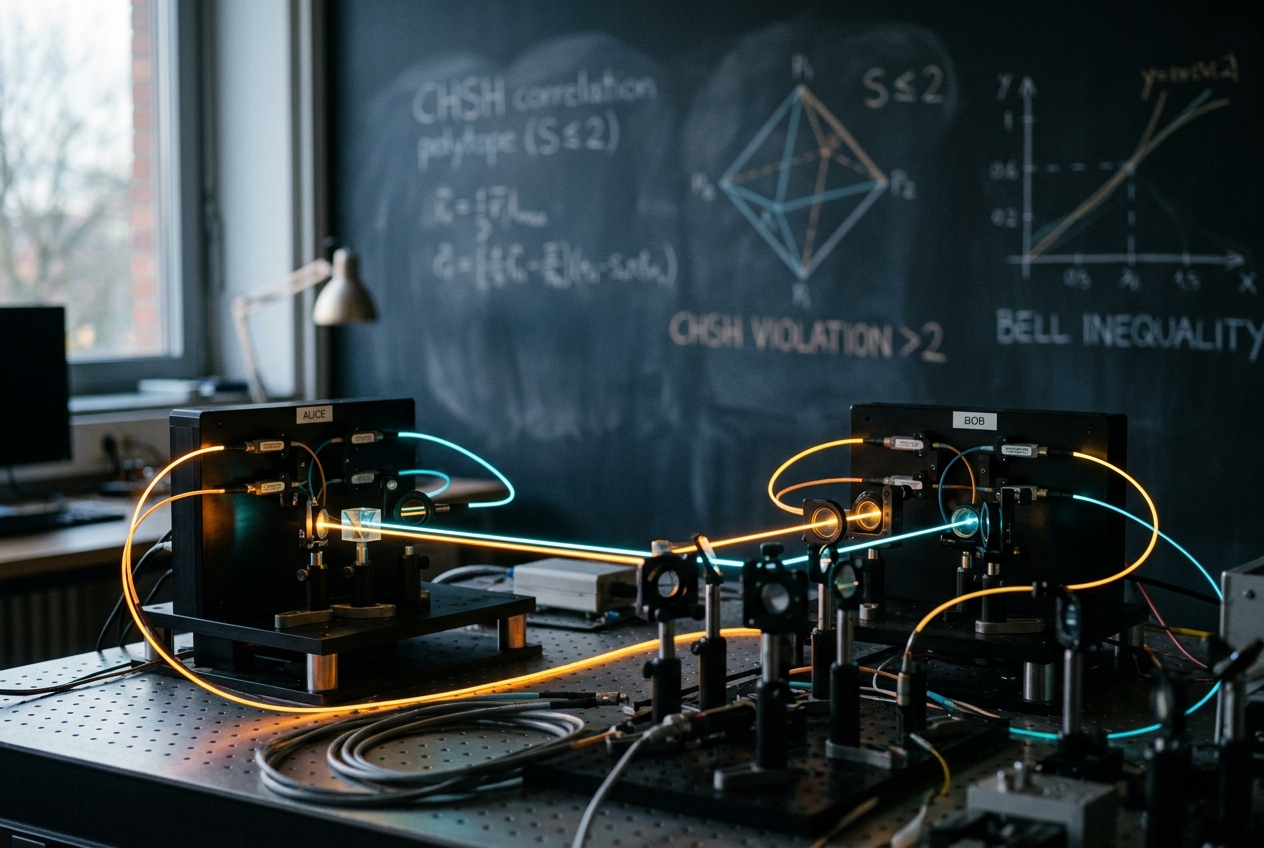
The modern digital economy rests upon an unstated article of faith: that the mathematical laws protecting our private data cannot be subverted by an adversary with superior computing power. When you log into an encrypted banking portal, authenticate a medical record, or transmit proprietary commercial data, security algorithms depend on mathematical problems that would demand thousands of years from today’s fastest supercomputers. The impending deployment of fault-tolerant quantum computing promises to upend that paradigm, rendering many conventional public-key cryptosystems obsolete while ushering in quantum-safe alternatives based on quantum entanglement.
Yet, deep within the foundations of theoretical physics lies an even more destabilizing question—one that has puzzled physicists, mathematicians, and computer scientists for over three decades. Is quantum mechanics the most non-local, interconnected theory possible in our universe? Or is our quantum reality merely an island in a vastly larger ocean of conceivable physical theories that are even more radically non-local, yet completely compatible with Albert Einstein’s special theory of relativity?
In 1994, theoretical physicists Sandu Popescu and Daniel Rohrlich posed this exact enigma. In doing so, they constructed a conceptual thought experiment now known worldwide as the Popescu-Rohrlich (PR) box. This theoretical device demonstrates that an imaginary universe could exhibit correlations far stronger than anything permitted by quantum entanglement without ever allowing faster-than-light communication. Exploring why our universe stops precisely at the quantum boundary—and refuses to allow the super-correlations of the PR-box—has transformed modern physics, laying the conceptual groundwork for device-independent cryptography, quantum information theory, and the axiomatic reconstruction of quantum mechanics itself.
1. The Geometry of Separation: From Bell and CHSH to Tsirelson's Bound
To appreciate the conceptual shockwave caused by the Popescu-Rohrlich box, one must first trace the boundary between classical common sense and the counter-intuitive reality of quantum entanglement.
In classical physics, nature conforms to local realism: 1. Realism: Physical systems possess definite, objective properties prior to and independent of measurement. 2. Locality: An action or measurement performed at point $A$ cannot instantaneously alter the physical state of a system at a distant point $B$, as no physical influence can travel faster than the speed of light ($c$).
In 1964, John Stewart Bell demonstrated that local realism is not merely a philosophical preference; it imposes rigid, experimentally testable mathematical constraints on the correlations between distant measurements. In 1969, John Clauser, Michael Horne, Abner Shimony, and Richard Holt refined Bell’s insight into the celebrated CHSH inequality.
Consider two observers, Alice and Bob, situated at spacelike separation. Alice chooses between two binary measurement settings $x \in {0, 1}$ and obtains a binary outcome $a \in {0, 1}$ (often mapped to values $+1$ and $-1$). Simultaneously, Bob chooses a setting $y \in {0, 1}$ and obtains an outcome $b \in {0, 1}$.
Defining the correlation expectation value $E(x, y)$ as the statistical average of their joint outcomes:
$$E(x, y) = P(a = b \mid x, y) - P(a \neq b \mid x, y)$$
The CHSH correlator sum $S$ is defined across all four setting combinations:
$$S = E(0, 0) + E(0, 1) + E(1, 0) - E(1, 1)$$
Under any local hidden variable theory, where correlations arise solely from shared classical randomness established in the common past, the correlator is strictly bounded:
$$S_{\text{classical}} \le 2$$
The Quantum Violation and Tsirelson's Ceiling
When Alice and Bob share an entangled pair of qubits—such as the maximally entangled Bell state $|\Phi^+\rangle = \frac{1}{\sqrt{2}}(|00\rangle + |11\rangle)$—and orient their measurement polarizers at optimal angles (for instance, Alice measuring at $0^\circ$ and $45^\circ$, while Bob measures at $22.5^\circ$ and $67.5^\circ$), quantum mechanics violates the classical bound. Each of the first three terms yields $E(x, y) = \frac{1}{\sqrt{2}}$, while the fourth term yields $E(1, 1) = -\frac{1}{\sqrt{2}}$, culminating in:
$$S_{\text{quantum}} = \frac{1}{\sqrt{2}} + \frac{1}{\sqrt{2}} + \frac{1}{\sqrt{2}} - \left(-\frac{1}{\sqrt{2}}\right) = \frac{4}{\sqrt{2}} = 2\sqrt{2} \approx 2.8284$$
This value is not an accidental artifact of specific measurement angles. In 1980, the mathematician Boris Tsirelson proved that within the standard Hilbert space formulation of quantum mechanics, regardless of the dimension of the quantum states or the choice of Hermitian operators, no quantum state can ever exceed this threshold:
$$S \le 2\sqrt{2}$$
This limit, known as Tsirelson's bound, establishes a fundamental boundary for quantum physics. Yet, looking at the algebraic definition of $S$, each of the four individual expectation values $E(x, y)$ is bounded between $-1$ and $+1$. Algebraically, one could imagine:
$$S_{\text{algebraic}} = 1 + 1 + 1 - (-1) = 4$$
Why does quantum mechanics stop at $2\sqrt{2}$? Why does nature permit a violation of classical locality ($S > 2$) but strictly forbid the maximal algebraic violation ($S = 4$)?
For decades, physicists assumed that any correlation exceeding $2\sqrt{2}$ would inevitably violate Albert Einstein's relativistic causality by allowing instantaneous, faster-than-light signaling. In 1994, Sandu Popescu and Daniel Rohrlich demolished that assumption.
2. The Popescu-Rohrlich Box: Definition, Mechanics, and Non-Signalling
Popescu and Rohrlich set out to determine whether relativistic causality alone dictates the mathematical structure of quantum mechanics. To answer this, they designed a theoretical input-output black box—a bipartite resource shared between Alice and Bob—operating under the simplest possible non-trivial conditions.
Formal Mathematical Specification
Let Alice input a bit $x \in {0, 1}$ and receive an output $a \in {0, 1}$. Let Bob input a bit $y \in {0, 1}$ and receive an output $b \in {0, 1}$. A Popescu-Rohrlich (PR) box is defined by the conditional probability distribution $P(a, b \mid x, y)$ satisfying the core condition:
$$a \oplus b = x \cdot y \pmod 2$$
where $\oplus$ denotes addition modulo 2 (the Boolean exclusive OR operation, $\text{XOR}$), and $x \cdot y$ denotes the standard Boolean $\text{AND}$ multiplication.
Furthermore, the box enforces perfectly random and unbiased local outcomes:
$$P(a = 0 \mid x) = P(a = 1 \mid x) = \frac{1}{2} \quad \forall x \in {0, 1}$$
$$P(b = 0 \mid y) = P(b = 1 \mid y) = \frac{1}{2} \quad \forall y \in {0, 1}$$
Explicitly, the joint probability distribution across all sixteen possible input-output configurations is defined as:
$$P(a, b \mid x, y) = \begin{cases} \frac{1}{2} & \text{if } a \oplus b = x \cdot y \ 0 & \text{if } a \oplus b \neq x \cdot y \end{cases}$$
Complete Joint Probability Matrix
We can tabulate the complete conditional probability table:
| Input $(x, y)$ | Product $x \cdot y$ | Required Relation | $P(0,0)$ | $P(0,1)$ | $P(1,0)$ | $P(1,1)$ | Correlation $E(x,y)$ | | :---: | :---: | :---: | :---: | :---: | :---: | :---: | | $(0, 0)$ | $0$ | $a \oplus b = 0 \implies a = b$ | $1/2$ | $0$ | $0$ | $1/2$ | $+1$ | | $(0, 1)$ | $0$ | $a \oplus b = 0 \implies a = b$ | $1/2$ | $0$ | $0$ | $1/2$ | $+1$ | | $(1, 0)$ | $0$ | $a \oplus b = 0 \implies a = b$ | $1/2$ | $0$ | $0$ | $1/2$ | $+1$ | | $(1, 1)$ | $1$ | $a \oplus b = 1 \implies a \neq b$ | $0$ | $1/2$ | $1/2$ | $0$ | $-1$ |
Whenever at least one party inputs a $0$ ($xy = 0$), Alice and Bob are guaranteed to observe identical outputs ($a = b$). When and only when both parties input a $1$ ($xy = 1$), their outputs are guaranteed to be opposite ($a \neq b$).
Formal Proof of the No-Signalling Principle
A physical device allows faster-than-light communication if and only if one party's choice of input can instantaneously alter the marginal probability distribution of the other party's measurement outcomes.
For Alice, her marginal probability of observing output $a$ given input $x$, averaged over all possible outcomes Bob might receive, is computed by summing the joint distribution over Bob's output variable $b$:
$$P(a \mid x, y) = \sum_{b \in {0, 1}} P(a, b \mid x, y)$$
Let us evaluate this marginal for every possible case:
-
Case $x = 0, y = 0$: $$P(a=0 \mid 0, 0) = P(0, 0 \mid 0, 0) + P(0, 1 \mid 0, 0) = \frac{1}{2} + 0 = \frac{1}{2}$$ $$P(a=1 \mid 0, 0) = P(1, 0 \mid 0, 0) + P(1, 1 \mid 0, 0) = 0 + \frac{1}{2} = \frac{1}{2}$$
-
Case $x = 0, y = 1$: $$P(a=0 \mid 0, 1) = P(0, 0 \mid 0, 1) + P(0, 1 \mid 0, 1) = \frac{1}{2} + 0 = \frac{1}{2}$$ $$P(a=1 \mid 0, 1) = P(1, 0 \mid 0, 1) + P(1, 1 \mid 0, 1) = 0 + \frac{1}{2} = \frac{1}{2}$$
-
Case $x = 1, y = 0$: $$P(a=0 \mid 1, 0) = P(0, 0 \mid 1, 0) + P(0, 1 \mid 1, 0) = \frac{1}{2} + 0 = \frac{1}{2}$$ $$P(a=1 \mid 1, 0) = P(1, 0 \mid 1, 0) + P(1, 1 \mid 1, 0) = 0 + \frac{1}{2} = \frac{1}{2}$$
-
Case $x = 1, y = 1$: $$P(a=0 \mid 1, 1) = P(0, 0 \mid 1, 1) + P(0, 1 \mid 1, 1) = 0 + \frac{1}{2} = \frac{1}{2}$$ $$P(a=1 \mid 1, 1) = P(1, 0 \mid 1, 1) + P(1, 1 \mid 1, 1) = \frac{1}{2} + 0 = \frac{1}{2}$$
In all configurations:
$$\sum_{b} P(a \mid x, y) = P(a \mid x) = \frac{1}{2} \quad \forall a, x, y$$
By symmetry, the exact same calculation holds for Bob:
$$\sum_{a} P(a, b \mid x, y) = P(b \mid y) = \frac{1}{2} \quad \forall b, x, y$$
Because $P(a \mid x, y)$ is entirely independent of Bob's input $y$, and $P(b \mid x, y)$ is entirely independent of Alice's input $x$, neither observer can transmit a single bit of information to the other by choosing or altering their measurement input. Local measurements on a PR box generate completely uniform, pure white noise. Only when Alice and Bob bring their recorded lists of measurement settings and outcomes together at a classical communication sub-luminal channel do the super-correlations become manifest.
Algebraic Saturation of the CHSH Ceiling ($S = 4$)
Let us now evaluate the CHSH correlator sum for the PR box:
$$E(0, 0) = P(a=b \mid 0, 0) - P(a \neq b \mid 0, 0) = 1 - 0 = +1$$ $$E(0, 1) = P(a=b \mid 0, 1) - P(a \neq b \mid 0, 1) = 1 - 0 = +1$$ $$E(1, 0) = P(a=b \mid 1, 0) - P(a \neq b \mid 1, 0) = 1 - 0 = +1$$ $$E(1, 1) = P(a=b \mid 1, 1) - P(a \neq b \mid 1, 1) = 0 - 1 = -1$$
Substituting these into the CHSH inequality:
$$S_{\text{PR}} = E(0, 0) + E(0, 1) + E(1, 0) - E(1, 1) = 1 + 1 + 1 - (-1) = 4$$
The PR box achieves the absolute algebraic maximum of $S = 4$, completely bypassing the quantum limit of $S = 2\sqrt{2}$, while strictly upholding the relativistic no-signalling principle. Consequently, relativistic causality alone cannot explain why quantum mechanics is restricted to Tsirelson's bound.
3. The Computational Catastrophe: Wim van Dam's Theorem
If Popescu-Rohrlich correlations do not violate relativity, what makes them physically implausible? The answer surfaced from an unexpected direction: theoretical computer science and communication complexity.
In distributed computing, communication complexity measures the minimum number of classical bits that two distant parties (Alice holding an $n$-bit string $\mathbf{x} = (x_1, x_2, \dots, x_n)$ and Bob holding an $n$-bit string $\mathbf{y} = (y_1, y_2, \dots, y_n)$) must exchange to compute a joint Boolean function $f(\mathbf{x}, \mathbf{y})$.
A canonical benchmark is the distributed Inner Product modulo 2 function:
$$\text{IP}n(\mathbf{x}, \mathbf{y}) = \mathbf{x} \cdot \mathbf{y} \pmod 2 = \bigoplus{i=1}^n x_i y_i$$
In classical distributed computing, a fundamental theorem proved by Alexander Razborov establishes that computing the Inner Product function requires the transmission of $\Omega(n)$ bits of communication. Even when Alice and Bob share an unlimited supply of quantum entangled states, quantum communication complexity proofs demonstrate that they still need to transmit at least $\Omega(n)$ quantum or classical bits.
In 1999, computer scientist Wim van Dam proved a striking result: if Alice and Bob have access to shared PR boxes, the communication complexity of every distributed Boolean function collapses to a single bit.
Derivation of the Communication Collapse
The proof of Van Dam's theorem is remarkably elegant and can be reconstructed directly from the algebraic properties of the PR box:
- Let Alice possess $\mathbf{x} = (x_1, \dots, x_n) \in {0, 1}^n$ and Bob possess $\mathbf{y} = (y_1, \dots, y_n) \in {0, 1}^n$.
- They share $n$ independent PR boxes numbered $i = 1, 2, \dots, n$.
- For each index $i$, Alice inputs $x_i$ into the $i$-th PR box and receives output $a_i \in {0, 1}$.
- Simultaneously, Bob inputs $y_i$ into the $i$-th PR box and receives output $b_i \in {0, 1}$.
- By the definition of the PR box, every pair of outputs satisfies: $$a_i \oplus b_i = x_i \cdot y_i$$
- Summing all $n$ equations modulo 2: $$\bigoplus_{i=1}^n (a_i \oplus b_i) = \bigoplus_{i=1}^n x_i y_i$$
- By the associativity and commutativity of the $\text{XOR}$ operator: $$\left(\bigoplus_{i=1}^n a_i\right) \oplus \left(\bigoplus_{i=1}^n b_i\right) = \text{IP}_n(\mathbf{x}, \mathbf{y})$$
- Alice calculates the single parity bit $A = \bigoplus_{i=1}^n a_i$ from her local outputs and transmits this single bit $A$ across a classical channel to Bob.
- Bob computes his local parity bit $B = \bigoplus_{i=1}^n b_i$ and evaluates: $$A \oplus B = \text{IP}_n(\mathbf{x}, \mathbf{y})$$
With just one single bit of classical communication, Bob recovers the exact distributed inner product of two arbitrarily long $n$-bit vectors.
Because any Boolean function $f(\mathbf{x}, \mathbf{y}): {0, 1}^n \times {0, 1}^n \to {0, 1}$ can be represented as an algebraic polynomial over the Galois field $\text{GF}(2)$ (its algebraic normal form), Van Dam demonstrated that this protocol generalizes to all distributed functions. In a universe equipped with PR boxes, distributed computational complexity is completely trivialized.
Many physicists interpret this computational collapse as a strong indication that nature disallows PR boxes because they violate fundamental information-theoretic conservation laws.
4. Principles of Reconstruction: Why Does Nature Enforce Tsirelson's Bound?
The discovery of the PR box gave birth to a major modern research program: Generalized Probabilistic Theories (GPTs). Instead of taking the abstract axioms of complex Hilbert spaces, wavefunctions, and self-adjoint operators as given, researchers seek to derive quantum mechanics from intuitive, physical, and information-theoretic principles.
Several physical principles have been proposed that successfully rule out PR boxes and single out the quantum boundary ($S \le 2\sqrt{2}$).
1. Information Causality
Introduced in 2009 by Marcin Pawłowski and colleagues in a landmark paper in Nature, Information Causality generalizes the no-signalling principle.
Suppose Alice holds a database of $N$ classical random bits $\mathbf{x} = (x_0, x_1, \dots, x_{N-1})$, and Bob wishes to guess one specific bit $x_K$, where $K \in {0, \dots, N-1}$ is an index known only to Bob. Alice is permitted to send Bob a classical message of length $m$ bits ($m < N$).
Information Causality states that the total mutual information Bob can gain about all the bits in Alice's database cannot exceed the number of transmitted bits $m$:
$$\sum_{k=0}^{N-1} I(x_k : b_k \mid K=k) \le m$$
Pawłowski et al. proved that: - Classical mechanics respects Information Causality. - Standard quantum mechanics strictly respects Information Causality, achieving the maximum possible efficiency allowed by the bound ($S = 2\sqrt{2}$). - Any physical theory permitting correlations stronger than $2\sqrt{2}$ (including PR boxes) violates Information Causality, allowing Bob to extract significantly more information about multiple bits than the transmission length $m$ warrants.
2. Macroscopic Locality
Proposed by Miguel Navascués and Harald Wunderlich in 2010, Macroscopic Locality requires that any physical theory must reproduce classical physics when observed at macroscopic scales.
If an experiment involves high-intensity beams containing billions of particles where individual quantum fluctuations cannot be resolved (coarse-grained measurements), all observed correlations between macroscopic observables must admit a local-realistic description ($S_{\text{macro}} \le 2$).
- Standard quantum mechanics satisfies Macroscopic Locality: the microscopic quantum fluctuations average out under the central limit theorem to form classical correlations.
- PR-box theories fail this test: ensembles of PR boxes continue to violate the classical Bell bound even in the infinite-particle macroscopic limit, producing macroscopic super-correlations that contradict everyday physical reality.
3. Local Quantum Tomography
In generalized probabilistic theories, a fundamental structural axiom is Local Tomography: the global state of a composite bipartite system must be completely characterized by the collection of all local measurements and their joint correlations.
While classical and standard quantum mechanics over complex Hilbert spaces satisfy local tomography, systems augmented with extremal super-quantum resources often break the smooth continuity and self-duality of state spaces, producing geometric state spaces that lack operational physical symmetry.
5. The Geometry of the Non-Signalling Polytope
To visualize how PR boxes fit alongside classical and quantum physics, mathematicians and theoretical physicists map correlations into geometric convex state spaces.
For a bipartite scenario with binary inputs and binary outputs, any experimental setup is fully characterized by a vector of 16 conditional probabilities $\vec{P} = {P(a, b \mid x, y)}$. Due to normalization ($\sum_{a,b} P(a, b \mid x, y) = 1$) and no-signalling constraints, this probability vector resides in an 8-dimensional affine space $\mathbb{R}^8$.
The geometric hierarchy consists of three nested convex sets:
$$\mathcal{L} \subset \mathcal{Q} \subset \mathcal{NS}$$
-
The Classical / Local Polytope ($\mathcal{L}$): - A convex polytope whose vertices correspond to the 16 deterministic local strategies where Alice and Bob fix their outputs in advance. - The boundaries (facets) of this polytope are defined exactly by the CHSH inequalities and trivial positivity bounds ($S \le 2$).
-
The Quantum Convex Body ($\mathcal{Q}$): - The set of all probability distributions obtainable by measuring entangled quantum states with spatial local operators. - $\mathcal{Q}$ is strictly larger than $\mathcal{L}$ and possesses a smooth, curved boundary. The points of maximum distance from the classical polytope along the CHSH directions correspond to the Tsirelson limit ($S = 2\sqrt{2}$).
-
The Non-Signalling Polytope ($\mathcal{NS}$): - The set of all conceivable probability distributions that strictly respect the no-signalling principle. - $\mathcal{NS}$ is a polytope bounded by flat hyperplanes. It has 24 extremal vertices: 16 correspond to the deterministic classical strategies, while the remaining 8 are the Popescu-Rohrlich (PR) boxes (comprising the canonical PR box and its isomorphic variants under local bit-flips and input permutations).
The PR boxes represent the sharp, extremal corners of the non-signalling polytope, standing far outside the smooth boundaries of quantum mechanics.
6. Real-World Applications: Device-Independent Quantum Technologies (2024–2026)
Although PR boxes are hypothetical constructs that do not exist in nature, studying the boundaries of the non-signalling polytope has catalyzed the most secure commercial technologies in modern quantum information science: device-independent quantum protocols.
In standard quantum cryptography, security proofs assume that the physical devices inside an optical setup (lasers, beam splitters, single-photon detectors) behave exactly according to ideal mathematical models. If a component is flawed or tampered with by a malicious manufacturer, security guarantees collapse.
Device-independent protocols eliminate the need to trust physical hardware. By treating measurement stations as uncharacterized black boxes and measuring the statistical violation of the CHSH inequality ($S > 2$), users can certify security based purely on physical correlations.
1. Device-Independent Quantum Key Distribution (DI-QKD)
- Institutions: University of Oxford, Ludwig Maximilian University of Munich (LMU), and École Normale Supérieure (ENS) Paris.
- Mechanism: In experimental milestones verified between 2022 and 2026, researchers demonstrated DI-QKD over optical fiber networks. Alice and Bob continuously run a CHSH Bell test on shared entangled photons. As long as the observed correlator satisfies $S > 2$, the mathematical theorems derived from the non-signalling polytope prove that no third party (eavesdropper)—even one possessing super-quantum capabilities constrained only by no-signalling—can know the generated cryptographic key.
2. Device-Independent Certified Randomness Generation
- Institutions: National Institute of Standards and Technology (NIST) and European Quantum Flagship consortia.
- Mechanism: Classical computers and deterministic algorithms cannot generate true randomness. By operating a Bell-violating quantum device, researchers can mathematically prove that the outputs $a$ and $b$ are fundamentally unpredictable to any observer in the universe. The PR-box framework provides the mathematical lower bound on entropy generation per measurement trial.
3. Quantum Self-Testing and Fault-Tolerant Hardware Certification
- Institutions: IBM Quantum, Quantinuum, and academic groups at MIT.
- Mechanism: How do you verify that a 1,000-qubit processor is truly entangled without simulating the entire exponentially large Hilbert space? Through quantum self-testing, a technique originating from Tsirelson's bound and the geometry of the quantum body $\mathcal{Q}$. Observing a CHSH violation near $S = 2\sqrt{2}$ guarantees, up to local unitary transformations, that the physical qubits and measurement operators are mathematically faithful Bell pairs, without ever inspecting the internal hardware.
7. What This Means for Science and Society
The study of the Popescu-Rohrlich box represents a profound epistemological shift in how humanity understands physical law.
Throughout the twentieth century, physics operated top-down: scientists constructed mathematical frameworks—such as wave equations, Hilbert spaces, and operator algebras—and worked downward to predict physical phenomena. The PR-box inverted this methodology. By asking why nature does not permit super-quantum correlations, physicists began reconstructing physical theory from bottom-up information-theoretic principles.
For the non-specialist, this research offers a reassuring guarantee. The security of emerging quantum communication networks does not depend on our engineering prowess, the honesty of hardware vendors, or assumptions about an adversary's computational power. It is hardcoded into the geometric architecture of space, time, and causality.
8. Today's Takeaway
The Popescu-Rohrlich box reveals that quantum mechanics is not nature’s most extreme non-local theory, but rather a finely tuned middle ground. By achieving the absolute maximum correlation of $S = 4$ without violating relativistic causality, the PR box exposes the profound gap between what mathematics permits and what physics tolerates. In ruling out the super-correlations of the PR box through principles like Information Causality and Macroscopic Locality, modern physics has discovered that the boundary of quantum mechanics ($S = 2\sqrt{2}$) is not an arbitrary limit, but the exact threshold required to preserve a coherent, computationally stable, and decipherable universe.
Authoritative References and Further Reading
- Foundations of Non-Locality: Review the comprehensive pedagogical treatments of Bell's theorem and non-locality at the Stanford Encyclopedia of Philosophy and the foundational mechanics of the CHSH Inequality on Wikipedia.
- Tsirelson's Bound and the Quantum Limit: Detailed mathematical derivations of Tsirelson's ceiling can be explored on Tsirelson's Bound (Wikipedia).
- Information Causality: Read the seminal research paper by M. Pawłowski et al., "Information Causality as a Physical Principle", available directly via Nature.
- Interactive Quantum Games and Bell Tests: Explore hands-on implementations of the CHSH game and non-locality algorithms using the IBM Qiskit Interactive Learning Course.
- Academic Lectures on Quantum Foundations: Access foundational physics coursework and lecture series via MIT OpenCourseWare Quantum Physics.