Page's Theorem: Deriving Average Subsystem Entanglement Entropy in Haar-Random Quantum States
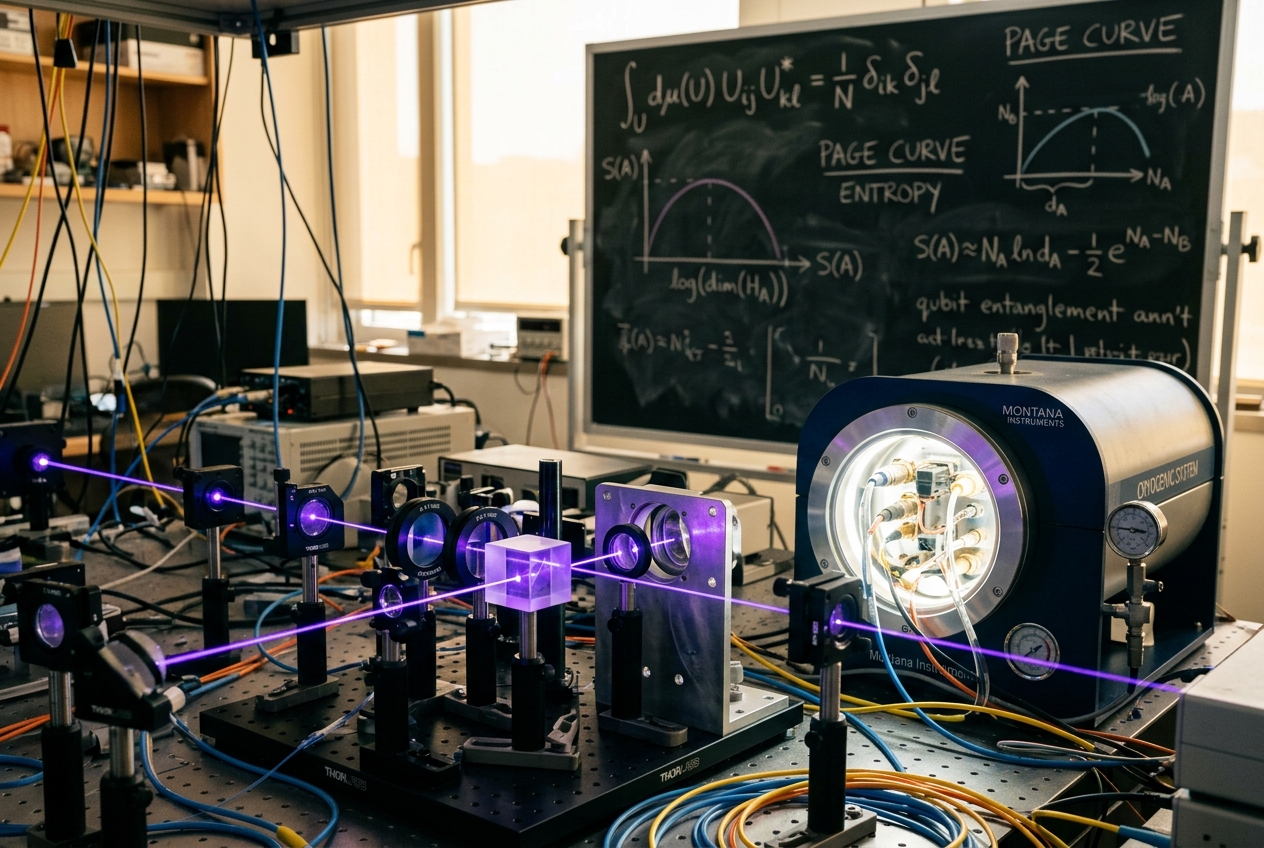
The bedrock principle of modern physics is that information is never truly destroyed. If you incinerate a confidential manuscript, the text appears lost to the flames, yet every letter remains encoded in the precise trajectories of rising soot particles, the wavelengths of thermal radiation, and the chaotic vibrations of heated air. In a classical universe, a supreme intelligence possessing infinite computational power could trace these microscopic remnants backward and reconstruct every syllable.
Yet in 1975, Stephen Hawking uncovered a devastating paradox at the junction of general relativity and quantum mechanics. When matter falls past the event horizon of a black hole, it disappears from our observable universe. As the black hole gradually radiates away its mass through thermal emissions, known as Hawking radiation, it eventually evaporates into nothingness. If this radiation is purely thermal and featureless, the information that formed the black hole is permanently wiped from reality. This scenario violates unitarity—the foundational law of quantum mechanics ensuring that probability and information are strictly conserved across time.
For eighteen years, theoretical physics stood at an impasse: either general relativity was fundamentally incomplete at horizon scales, or quantum mechanics was wrong. The resolution began not with exotic string dualities or gravitational modifications, but with a deceptively simple mathematical inquiry into the geometry of quantum states.
In 1993, the Canadian theoretical physicist Don Page published a breakthrough calculation on the average quantum entanglement of subsystems. Page demonstrated that in any typical, randomly selected quantum system, entanglement entropy does not grow without bound. Instead, it follows a universal, symmetric trajectory known today as the Page curve. Page’s Theorem not only established the mathematical blueprint for how black holes must release information during evaporation, but it also revolutionized our understanding of how quantum systems thermalize from within, providing the mathematical foundation for modern quantum computing, chaotic scrambling, and holographic error correction.
1. The Idea in Plain English: The Mystery of Hidden Correlations
To appreciate the significance of Page’s Theorem, one must first confront the counter-intuitive nature of quantum entropy. In classical physics, entropy is an index of our personal ignorance: a shuffled deck of cards has high entropy because we do not know the exact order of the cards, whereas a sorted deck has zero entropy. If you hold complete information about the entire deck, you inevitably hold complete information about every individual card within it.
Quantum mechanics upends this intuition through the phenomenon of entanglement. Consider a bipartite universe split into two components: a smaller subsystem, which we will designate as System $A$, and a larger surrounding environment, designated as System $B$. The combined system $AB$ can exist in a "pure state"—a configuration of absolute certainty where the wave function of the global universe is known with complete mathematical perfection. In classical physics, knowing the whole implies knowing all the parts. In quantum mechanics, the opposite is true.
       GLOBAL PURE STATE (H_AB = H_A ⊗ H_B)
  +---------------------------------------------------+
  |                                                   |
  |   +-----------------+     Entangled Correlations  |
  |   |  Subsystem A    |<========================>   |
  |   |  (Dimension dA) |                             |
  |   +-----------------+                             |
  |            |                                      |
  |            | Traces out environment               |
  |            v                                      |
  |   Thermal-like state (ρ_A)                        |
  |   Entropy S(ρ_A) ≈ ln(dA) - dA / (2 dB)           |
  |                                                   |
  |                     Environment B (Dimension dB)  |
  +---------------------------------------------------+
Imagine an encyclopedic library containing a thousand volumes. If this library is prepared in a typical quantum pure state, the information describing the library is not printed on any single page, nor is it stored in any specific book. Instead, the information is stored almost entirely within the non-local quantum correlations between the volumes.
If you pick up a single book (System $A$) and read it in isolation, it will not read as coherent text. It will appear entirely random and chaotic, displaying maximal thermodynamic entropy. The information has not been destroyed; it has been scrambled across the global entanglement network of the entire library (System $B$).
Don Page asked a precise mathematical question: If a composite quantum system is in a completely random pure state, how much entanglement entropy does a typical subsystem contain? Prior to Page’s work, many physicists suspected that typical subsystems would exhibit intermediate amounts of entanglement. Page proved that a generic subsystem is almost maximally entangled with its environment. It appears indistinguishable from a thermal state at high temperature, even though the total system is in a zero-entropy pure state.
2. How It Actually Works: The Mathematics of Page's Theorem
To formalize this mechanism, let us consider a bipartite quantum system whose state space is the tensor product of two finite-dimensional Hilbert spaces:
$$\mathcal{H} = \mathcal{H}_A \otimes \mathcal{H}_B$$
Let the dimension of $\mathcal{H}_A$ be $d_A$ and the dimension of $\mathcal{H}_B$ be $d_B$, with the assumption without loss of generality that $d_A \le d_B$. The total dimension of the composite system is $D = d_A d_B$.
A pure state $|\psi\rangle \in \mathcal{H}$ is drawn uniformly at random from the space of all possible states according to the unique unitarily invariant Haar measure on the unit sphere $S^{2D-1}$. The density operator of the global system is the rank-one projector:
$$\rho_{AB} = |\psi\rangle \langle\psi|$$
Because the global state is pure, its total von Neumann entropy is identically zero: $S(\rho_{AB}) = -\text{Tr}(\rho_{AB} \ln \rho_{AB}) = 0$.
To observe only the subsystem $A$, we compute the reduced density matrix $\rho_A$ by performing a partial trace over the degrees of freedom of the environmental Hilbert space $\mathcal{H}_B$:
$$\rho_A = \text{Tr}_B \left(|\psi\rangle \langle\psi|\right)$$
The entanglement entropy of the subsystem is the von Neumann entropy of this reduced density matrix:
$$S(\rho_A) = -\text{Tr}\left(\rho_A \ln \rho_A\right)$$
Because the state $|\psi\rangle$ is selected Haar-randomly, $\rho_A$ is a random matrix, and its entropy $S(\rho_A)$ is a statistical random variable. Don Page conjectured in 1993, and subsequent works rigorously proved, that the ensemble average of the entanglement entropy $\langle S(\rho_A) \rangle$ is given by an exact closed-form expression:
$$\langle S(\rho_A) \rangle = \sum_{k=d_B+1}^{d_A d_B} \frac{1}{k} - \frac{d_A - 1}{2 d_B}$$
The Leading-Order Asymptotic Derivation
To grasp the physical implications of Page's exact formula, we examine the asymptotic regime where the dimensions $d_A$ and $d_B$ are large ($d_B \ge d_A \gg 1$). We can approximate the harmonic sum using Euler-Maclaurin summation or the standard logarithmic approximation for the digamma function $\psi(x) = \frac{d}{dx} \ln \Gamma(x) \approx \ln(x) - \frac{1}{2x} + \mathcal{O}(x^{-2})$.
The sum can be expressed as the difference of two harmonic series:
$$\sum_{k=d_B+1}^{d_A d_B} \frac{1}{k} = H_{d_A d_B} - H_{d_B}$$
Using the asymptotic expansion $H_N = \ln(N) + \gamma + \frac{1}{2N} + \mathcal{O}(N^{-2})$, where $\gamma$ is the Euler-Mascheroni constant:
$$H_{d_A d_B} - H_{d_B} \approx \left[\ln(d_A d_B) + \gamma + \frac{1}{2 d_A d_B}\right] - \left[\ln(d_B) + \gamma + \frac{1}{2 d_B}\right]$$
Canceling the Euler-Mascheroni constant and combining the logarithms:
$$H_{d_A d_B} - H_{d_B} \approx \ln\left(\frac{d_A d_B}{d_B}\right) + \frac{1}{2 d_A d_B} - \frac{1}{2 d_B} = \ln(d_A) - \frac{1}{2 d_B} + \mathcal{O}\left(\frac{1}{d_A d_B}\right)$$
Substituting this result back into Page's exact theorem:
$$\langle S(\rho_A) \rangle \approx \ln(d_A) - \frac{1}{2 d_B} - \frac{d_A - 1}{2 d_B} = \ln(d_A) - \frac{d_A}{2 d_B}$$
This leading-order expression provides a central result in quantum statistical mechanics:
$$\langle S(\rho_A) \rangle \approx \ln(d_A) - \frac{d_A}{2 d_B}$$
========================================================================
                      PAGE'S THEOREM AT A GLANCE
========================================================================
  Exact Formula:
    ⟨S(ρ_A)⟩ = ∑_{k=d_B+1}^{d_A d_B} (1/k) - (d_A - 1) / (2 d_B)

Asymptotic Approximation (d_B ≥ d_A ≫ 1):
    ⟨S(ρ_A)⟩ ≈ ln(d_A) - d_A / (2 d_B)

Key Physical Meaning:
    The maximum possible entropy for subsystem A is ln(d_A).
    The deviation from maximal mixing is only d_A / (2 d_B).
    When d_A ≪ d_B, this correction is exponentially negligible.
========================================================================
The theoretical maximum entropy that subsystem $A$ could ever hold is $\ln(d_A)$, corresponding to a maximally mixed identity state $\rho_A = \frac{1}{d_A} \mathbb{I}_A$. Page’s result demonstrates that the average deviation from absolute maximal entropy is merely the rational fraction $\frac{d_A}{2 d_B}$.
If subsystem $A$ represents a small fraction of the total system—such that $d_B$ is exponentially larger than $d_A$ (as is typical when $A$ is a few particles and $B$ is the rest of the universe)—the correction term $\frac{d_A}{2 d_B}$ vanishes. Subsystem $A$ is not merely somewhat entangled; it is maximally entangled with its environment to within an exponentially tiny margin.
The Mathematical Proofs via Random Matrix Theory
Shortly after Page proposed his formula as a conjecture, it was proved independently by S. K. Foong and S. Kanno (1994), J. Sánchez-Ruiz (1995), and S. Sen (1996). These proofs bridged quantum information theory and Random Matrix Theory (RMT).
The reduced density matrix $\rho_A = \text{Tr}_B(|\psi\rangle\langle\psi|)$ can be modeled through the Wishart-Laguerre ensemble. A Haar-distributed pure state $|\psi\rangle$ can be generated by populating a $d_A \times d_B$ matrix $X$ with independent, identically distributed complex Gaussian random variables:
$$X_{i\mu} \sim \mathcal{CN}(0, 1), \quad 1 \le i \le d_A, \quad 1 \le \mu \le d_B$$
The unnormalized reduced density matrix is the complex Wishart matrix $W = X X^\dagger$, which is positive semi-definite and Hermitian. The physical density matrix is obtained by normalizing by its trace:
$$\rho_A = \frac{X X^\dagger}{\text{Tr}(X X^\dagger)}$$
The joint probability distribution of the eigenvalues $\lambda = (\lambda_1, \lambda_2, \dots, \lambda_{d_A})$ of an unnormalized Wishart matrix $W$ is given analytically by the Laguerre unitary ensemble:
$$P(\lambda_1, \dots, \lambda_{d_A}) = \frac{1}{C} \prod_{1 \le i < j \le d_A} (\lambda_i - \lambda_j)^2 \prod_{i=1}^{d_A} \lambda_i^{d_B - d_A} e^{-\lambda_i}$$
where $C$ is a normalization constant determined by Selberg-type integrals.
Using orthogonal polynomials (specifically Laguerre polynomials) and contour integration techniques, Foong and Kanno computed the average of the trace of $\rho_A^2$ (the purity) and derived the exact average of $\text{Tr}(\rho_A \ln \rho_A)$. Sen subsequently provided an elegant proof by exploiting the spectral resolvent and the continuous eigenvalue density, establishing that the distribution of eigenvalues for large dimensions converges to the Marchenko-Pastur distribution.
Furthermore, Patrick Hayden, Debbie Leung, Peter Shor, and Andreas Winter proved in 2006 that the variance of $S(\rho_A)$ around the mean $\langle S(\rho_A) \rangle$ is bounded by:
$$\text{Var}(S(\rho_A)) \le \frac{c}{d_A d_B}$$
By applying Levy’s Lemma on the concentration of measure on high-dimensional spheres, one finds that the probability of choosing a pure state whose subsystem entropy deviates from Page’s value by even a microscopic amount $\epsilon$ is doubly exponentially suppressed:
$$\mathbb{P}\left(|S(\rho_A) - \langle S(\rho_A) \rangle| \ge \epsilon\right) \le 2 \exp\left( - \frac{C \cdot d_A d_B \epsilon^2}{\ln^2(d_A)} \right)$$
This concentration of measure establishes Canonical Typicality: an arbitrary subsystem of an isolated, interacting quantum system does not need an external thermal reservoir to reach thermal equilibrium. The entanglement with the remaining degrees of freedom forces the subsystem into a state that is locally indistinguishable from a canonical Gibbs ensemble.
3. The Page Curve and the Black Hole Information Paradox
The most celebrated application of Page’s Theorem is the resolution of the black hole information paradox.
Consider a black hole formed by the collapse of matter in a pure quantum state. As the black hole radiates, the total Hilbert space is partitioned into two subsystems: the remaining black hole $B$ and the emitted Hawking radiation $R$. Initially, before evaporation starts, the radiation system has dimension $d_R = 1$ and entropy $S(R) = 0$. The black hole contains all the degrees of freedom, with its entropy given by the Bekenstein-Hawking area formula:
$$S_{BH} = \frac{k_B c^3 A}{4 G \hbar}$$
According to Stephen Hawking’s semiclassical calculation, every emitted Hawking pair consists of one particle escaping to infinity and one falling past the horizon. Because the calculation treats the background geometry as fixed, each radiated photon appears purely thermal and adds an independent quantum of entanglement to the radiation field. Thus, Hawking predicted that the entanglement entropy of the radiation, $S(R)$, would climb monotonically throughout the lifetime of the black hole, reaching a maximum when the black hole completely vanishes. This would leave behind a mixed state of radiation with non-zero entropy, violating unitarity.
 ENTANGLEMENT
 ENTROPY S(R)
      ^
      |                 Hawking's Non-Unitary Prediction
      |                             /
      |                            /
      |            Page Point     /
      |                 *        /
      |                / \      /
      |               /   \    /
      |              /     \  /
      |             /       v
      |            /         \   Unitary Page Curve
      |           /           \
      |          /             \
      +---------+---------------+------------------------> TIME
      t=0   Early Radiation    t_Page         Complete Evaporation
Don Page applied his theorem to this bipartite system ($\mathcal{H}{\text{total}} = \mathcal{H}{\text{BH}} \otimes \mathcal{H}_{\text{Rad}}$). Assuming that quantum gravity respects unitarity and that black hole interior dynamics are sufficiently chaotic to act as a pseudo-random Haar scrambler, Page applied his formula across the evaporation process:
-
The Early Phase ($d_R \ll d_{BH}$): During the initial stages of evaporation, the radiation Hilbert space is far smaller than that of the black hole. Applying Page’s formula with $d_A = d_R$ and $d_B = d_{BH}$: $$S(R) \approx \ln(d_R) - \frac{d_R}{2 d_{BH}} \approx \ln(d_R)$$ In this phase, the entropy of the radiation increases linearly with the number of emitted particles. The radiation appears completely thermal, exactly as Hawking predicted.
-
The Page Time ($t_{\text{Page}}$): The system reaches a turning point when the dimension of the radiation Hilbert space equals the dimension of the remaining black hole: $$d_R = d_{BH} \implies S_{BH}(t) = S_{\text{Rad}}(t)$$ At this point, known as the Page Time, the black hole has radiated away approximately half of its Bekenstein-Hawking entropy.
-
The Late Phase ($d_R \gg d_{BH}$): After the Page time, the black hole becomes the smaller subsystem ($d_A = d_{BH}$ and $d_B = d_R$). The roles invert. Applying Page's formula again: $$S(R) = S(BH) \approx \ln(d_{BH}) - \frac{d_{BH}}{2 d_R} \approx \ln(d_{BH})$$ Because the remaining black hole continues to shrink in area, $\ln(d_{BH})$ decreases. Consequently, the entanglement entropy of the radiation must turn around and decrease, eventually reaching zero when the black hole finishes evaporating.
This turnaround curve is the Page curve. It proves that unitary quantum mechanics requires the radiation to contain subtle, multi-particle quantum correlations after the Page time. Information begins leaking out of the black hole not at the very end of its life, but at the halfway point. In recent years, breakthroughs in string theory and semi-classical gravity using the "island formula" and holographic Ryu-Takayanagi surfaces have independently derived Page's curve from path integrals, confirming Page's 1993 prediction.
4. Real-World Applications Today (2024–2026)
While born out of gravitational theory, Page’s Theorem and the mathematics of Haar-random pure states are directly driving experimental and technological frontiers across quantum science.
+-------------------------------------------------------------------------------+
|                       APPLICATIONS OF PAGE'S THEOREM                          |
+===============================================================================+
| Quantum Computing & Benchmarking                                              |
| • Institution: IBM Quantum                                                    |
| • Focus: Randomized Benchmarking & Unitary t-designs                          |
| • Advantage: Quantifies gate crosstalk and noise without full state tomography|
+-------------------------------------------------------------------------------+
| Holographic Quantum Error Correction                                          |
| • Institution: Google Quantum AI & Caltech                                    |
| • Focus: Random Scrambling Circuits & Surface Codes                          |
| • Advantage: Reaches optimal code capacity for multi-qubit fault tolerance   |
+-------------------------------------------------------------------------------+
| Quantum Chaos & Scrambling Simulation                                         |
| • Institution: Quantinuum, Harvard, Nature                                    |
| • Focus: SYK Model Simulation & Hayden-Preskill Protocol                      |
| • Advantage: Validates non-local information recovery on ion-trap hardware    |
+-------------------------------------------------------------------------------+
| Many-Body Thermalization (ETH)                                                |
| • Institution: MIT OpenCourseWare & Max Planck Institute                      |
| • Focus: Cold-Atom Lattices & Many-Body Localization                          |
| • Advantage: Identifies phase transitions where quantum memory is preserved   |
+-------------------------------------------------------------------------------+
1. Quantum Computing Benchmarking and Unitary Designs
At IBM Quantum, researchers orchestrate processors containing hundreds of superconducting qubits. Characterizing noise in such massive Hilbert spaces using full quantum state tomography is impossible, as the required measurements scale exponentially ($4^N$).
Engineers rely on Randomized Benchmarking and unitary 2-designs, which approximate Haar-random states using shallow, pseudo-random Clifford circuits. Page's theorem provides the theoretical baseline for these benchmarks: it tells researchers what the entanglement entropy and purity of an ideal, uncorrupted random circuit should be. By comparing the measured entropy of a multi-qubit processor to the Page limit, engineers quantify gate fidelity, coherent cross-talk, and decoherence rates across complex multi-qubit registers.
2. Quantum Error Correction via Holographic Codes
At Google Quantum AI, building fault-tolerant quantum computers requires protecting delicate logical qubits from environmental phase errors and bit-flips. Quantum error-correcting architectures, such as holographic tensor network codes, treat the encoding process as a chaotic scrambling circuit that mimics Haar randomness.
Page’s Theorem explains why these codes work: by scrambling logical information uniformly across the global Hilbert space, no localized measurement by a noisy environment can extract or destroy the data. The subsystem entropy saturation predicted by Page guarantees that local errors have zero mutual information with the protected logical state, ensuring optimal code capacity.
3. Laboratory Analogues of Black Hole Scrambling
In research published across Nature, consortia from Harvard, MIT, and Quantinuum have utilized trapped-ion and neutral-atom processors to experimentally simulate quantum gravity toy models, such as the Sachdev-Ye-Kitaev (SYK) model.
Using the Hayden-Preskill thought experiment—a protocol showing how a black hole past its Page time acts as an efficient quantum information mirror—physicists inject entangled qubits into a scrambling network and reconstruct the state from simulated Hawking radiation. Page's theorem serves as the diagnostic benchmark: tracking the entanglement entropy curve of the simulated radiation verifies whether the quantum hardware correctly reproduces unitary information recovery.
4. Quantum Many-Body Thermalization and Many-Body Localization (MBL)
In condensed matter physics, pedagogical initiatives at MIT OpenCourseWare and advanced laboratories globally explore the Eigenstate Thermalization Hypothesis (ETH). By observing ultra-cold Rydberg atoms trapped in optical lattices, physicists investigate how closed quantum systems equilibrate.
Page’s theorem establishes the maximum entropy boundary for thermalizing phases. When strong disorder is introduced, systems enter a Many-Body Localized (MBL) phase, breaking ergodicity and failing to reach the Page entropy limit. This allows researchers to engineer novel quantum memories capable of storing coherent states without decaying into thermal noise.
5. What This Means for You
For anyone outside the cleanrooms of quantum computing laboratories or the blackboards of theoretical physics, Page’s Theorem carries deep philosophical and practical consequences.
First, it demystifies the arrow of time and the nature of thermal equilibrium. In classical daily life, we think of heat as the physical decay of order into disorder—a hot cup of coffee cooling down until its organized heat is lost to the room. Page’s theorem reveals that at the fundamental quantum level, information is never lost; it is merely redistributed into correlations we cannot easily access. Thermalization is not the erasure of data, but the conversion of local information into global, non-local entanglement.
CLASSICAL THERMALIZATION:
Order (Low Entropy) -------------> Decay into Disorder (High Entropy)
[Information is treated as lost]

QUANTUM THERMALIZATION (PAGE'S THEOREM):
Local State (Pure) ---------------> Global Entanglement (Pure)
[Information is preserved across non-local quantum correlations]
Second, this principle guarantees the ultimate security of emerging quantum communication networks. The fact that a small subsystem of a randomly scrambled pure state yields zero usable information to an outside observer means that quantum encryption schemes based on multi-particle entanglement are mathematically secure against eavesdropping. An attacker intercepting a fraction of the transmitted photons receives pure, maximal entropy noise. Without access to the global quantum state, decryption is forbidden by the laws of quantum mechanics.
6. Today's Takeaway
Page’s Theorem demonstrates that in any typical, isolated quantum system, information is fundamentally non-local: even when the universe as a whole is known with absolute certainty, any small part of it will appear completely random and thermal because all its information is woven into the entanglement between the parts. By proving that a radiating black hole must release its hidden information once it crosses its halfway mark, Don Page restored unitarity to quantum gravity and provided the mathematical blueprint that today guides quantum computing, error correction, and our understanding of physical reality.