McEliece Cryptosystem: Grounding Post-Quantum Encryption in Hard Goppa Code Syndrome Decoding
1. Opening Hook — Why You Should Care
Every digital secret currently moving across the global internet—from sovereign diplomatic cables and biometric passport registries to banking transactions and private medical dossiers—travels inside an envelope sealed by a mathematical timer. Intelligence agencies and cybersecurity specialists call the unfolding crisis "Harvest Now, Decrypt Later." Hostile state actors and well-funded cyber syndicates are intercepting and storing massive volumes of encrypted global network traffic in specialized data vaults. They cannot read these transmissions today, but they do not need to. They are waiting for the arrival of a cryptanalytically relevant quantum computer.
When mathematician Peter Shor formulated his landmark quantum algorithm at Bell Laboratories in 1994, he proved that a machine exploiting the bizarre physical laws of quantum mechanics could tear through the foundation of modern digital security in hours. The algorithms safeguarding our global economy—RSA, Diffie-Hellman, and Elliptic Curve Cryptography—rely entirely on the sheer difficulty of specific arithmetic puzzles, namely factoring massive integers and calculating discrete logarithms. To a classical computer, testing every path through these puzzles takes millions of years. To a quantum computer operating with coherent qubits, the problem dissolves into a rapid exercise in wave interference.
Yet, sixteen years before Shor published his breakthrough, an American information theorist named Robert McEliece at the California Institute of Technology and NASA’s Jet Propulsion Laboratory designed an asymmetric encryption scheme that seems almost clairvoyant in retrospect. Published in 1978, the McEliece cryptosystem does not rely on prime numbers, clock arithmetic, or geometric curves. Instead, it turns telecommunications noise into an impenetrable mathematical shield.
Nearly half a century later, despite fifty years of relentless assault by both classical mathematicians and quantum theorists, McEliece’s original design stands unbreached. While modern cryptographers scramble to invent exotic, unproven defenses against the quantum threat, our most resilient digital armor is an algorithm that predates the commercial internet itself.
2. The Idea in Plain English
To understand how McEliece outwitted quantum computers decades before they were conceived, one must first understand how engineers send messages through outer space.
When NASA transmits a digital photograph from the Voyager spacecraft across billions of miles of cosmic radiation, cosmic rays inevitably flip some of the digital ones into zeros and zeros into ones. To prevent the image from arriving as corrupted static, telecommunications engineers use what are known as error-correcting codes. An error-correcting code is a mathematical framework that adds carefully calculated redundant patterns to a string of digital data. If you know the precise mathematical architecture of the code, you can easily detect which bits were corrupted during flight and snap them back into their original positions.
Robert McEliece looked at this standard engineering tool and had a radical, counter-intuitive insight: what if deliberate noise is the lock, and the ability to correct that noise is the private key?
Imagine a master clockmaker who invents an intricate, one-of-a-kind mechanical clockwork. Because the clockmaker possesses the original blueprints, he knows the exact gear ratios and escapement mechanisms. Even if someone aggressively shakes the clock, throws a handful of sand into the gears, and knocks five teeth out of alignment, the clockmaker can look at the damaged mechanism, calculate precisely where the teeth slipped, and restore the exact time in seconds.
Now imagine that before placing this clock in the town square for public use, the clockmaker applies an algebraic disguise. He encases the mechanism in a dense outer casing and rearranges the external numbering with a secret mathematical shuffling technique.
To any passerby in the town square, the disguised clock looks like an unrecognizable, tangled heap of scrap metal—what mathematicians call a random linear code. Anyone can drop a secret message into the clock and deliberately scatter a fixed number of loose ball bearings into the gears to jam it. For a malicious eavesdropper staring at this chaotic mess, figuring out what message was deposited amidst the intentional debris is an impossibly difficult computational task known as general syndrome decoding.
However, for the clockmaker who holds the private trapdoor—the secret permutation that strips away the disguise—the mechanical disorder vanishes instantaneously. The clockmaker removes the external casing, applies his private blueprint, clears the sand, and reads the message effortlessly.
3. How It Actually Works — The Mechanics
Beneath its conceptual elegance, the McEliece cryptosystem is powered by rigorous algebraic geometry and linear algebra over finite Galois extension fields, denoted as $\text{GF}(2^m)$. A finite field is simply a self-contained arithmetic universe containing a finite number of elements, where addition, subtraction, multiplication, and division can be performed without remainders escaping the set.
The Secret Blueprint: Binary Goppa Codes
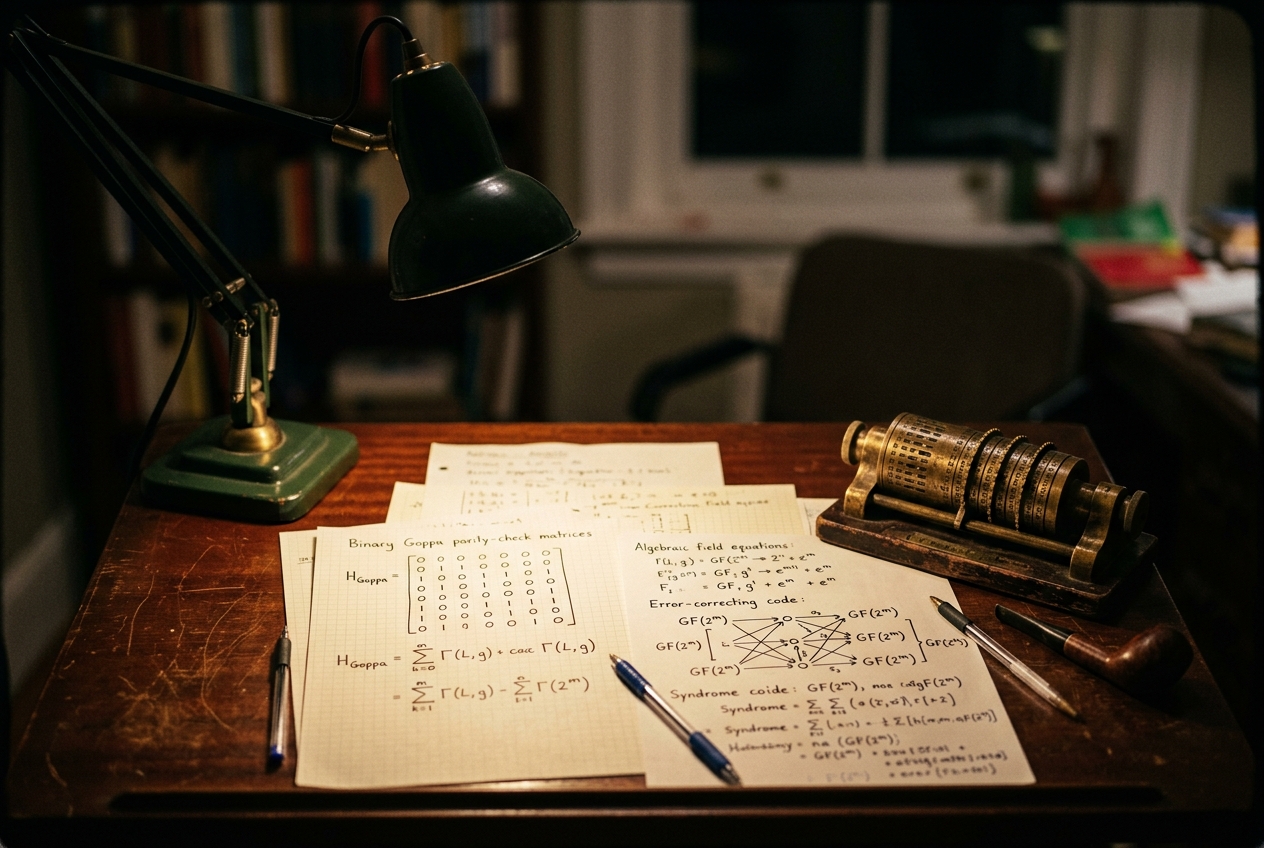
At the heart of the system lies a specialized class of linear error-correcting codes known as binary Goppa codes, designated $\Gamma(L, g(x))$. A Goppa code is defined by two mathematical components: 1. A support set $L = (\alpha_1, \alpha_2, \dots, \alpha_n)$, which is an ordered list of $n$ distinct elements chosen from the finite field $\text{GF}(2^m)$. 2. A Goppa polynomial $g(x)$ of degree $t$ with coefficients in $\text{GF}(2^m)$, selected such that it has no roots anywhere within the support set $L$.
The degree $t$ of this polynomial determines the precise error-correcting capacity of the code. A binary Goppa code has the extraordinary property that it can automatically detect and correct up to $t$ arbitrary bit-flip errors across an $n$-bit transmission block. From these parameters, the system constructs an algebraic generator matrix $G$, which converts a $k$-bit message into an $n$-bit codeword.
Generating the Trapdoor: The Algebraic Disguise
If the raw generator matrix $G$ were published directly, an eavesdropper could exploit the known symmetries of the Goppa polynomial to reconstruct the private decoding algorithm. To prevent this, the recipient must mathematically camouflage the structure of $G$.
The recipient generates two secret matrices:
* The Scrambler Matrix ($S$): A randomly chosen, dense $k \times k$ binary matrix that is fully invertible. Multiplying by $S$ mixes the rows of $G$ into complex linear combinations.
* The Permutation Matrix ($P$): A randomly chosen $n \times n$ binary matrix that contains exactly one 1 in every row and column. Multiplying by $P$ shuffles the order of the code's columns.
The public encryption key is then computed as the product of these three matrices:
$$G_{\text{pub}} = S \cdot G \cdot P$$
Equation 1: The construction of the public key matrix. This calculation disguises the structured Goppa generator matrix $G$ behind the secret row-scrambler $S$ and column-permutation $P$, yielding a public matrix $G_{\text{pub}}$ that is computationally indistinguishable from a completely random binary linear code.
The recipient publishes $G_{\text{pub}}$ to the world while keeping the private key triplet $(S, g(x), P)$ strictly secret.
Encryption: Injecting Intentional Entropy
When a sender wishes to transmit a secret binary message $m$ of length $k$, they multiply the message by the public key matrix $G_{\text{pub}}$. Then, they deliberately generate a random binary error vector $e$ of length $n$ that contains exactly $t$ ones (representing flipped bits) and $n-t$ zeros.
The resulting ciphertext $c$ is calculated as:
$$c = m \cdot G_{\text{pub}} + e$$
Equation 2: The encryption formula. The clean message-vector product $m \cdot G_{\text{pub}}$ is intentionally corrupted by adding the sparse error vector $e$ via bitwise XOR addition, pushing the transmitted vector off its legal code lattice into a cloud of mathematical static.
Decryption: Patterson’s Algorithm
Upon receiving the noisy vector $c$, an unauthorized interceptor faces an unsolvable task because they do not know the underlying Goppa structure. But the legitimate recipient decodes the transmission in four rapid algebraic steps:
- Undoing the Permutation: The receiver multiplies the ciphertext by the inverse permutation matrix $P^{-1}$, which restores the scrambled columns to their proper geometric order: $$c \cdot P^{-1} = (m \cdot S \cdot G) + (e \cdot P^{-1})$$
- Computing the Syndrome: The receiver evaluates the noisy vector against the secret Goppa polynomial $g(x)$, calculating an algebraic fingerprint called the syndrome.
- Patterson's Decoding Routine: Using Patterson’s algorithm—an ultra-fast decoding method published by N. J. Patterson in 1975—the receiver solves a key equation using the Euclidean polynomial greatest common divisor (GCD) algorithm and square-root operations over $\text{GF}(2^m)$. This instantly locates the exact positions of the errors injected by $e \cdot P^{-1}$ and flips them back.
- Stripping the Scrambler: With the error-free codeword $m \cdot S \cdot G$ recovered, the receiver extracts $m \cdot S$ and multiplies it by the inverse scrambler matrix $S^{-1}$, flawlessly retrieving the original plaintext message $m$.
The Dual Counterpart: The Niederreiter Variant
In 1986, Austrian mathematician Harald Niederreiter introduced an elegant dual formulation of McEliece’s system. Instead of using the generator matrix $G$, the Niederreiter cryptosystem employs the code’s parity-check matrix $H$, which defines the linear constraints that every valid codeword must satisfy.
In Niederreiter’s scheme, the message is not encoded as a row vector; rather, the plaintext is encoded directly as the sparse error vector $e$ itself. The ciphertext is the resulting syndrome vector $s$:
$$s = H_{\text{pub}} \cdot e^T$$
Equation 3: The Niederreiter syndrome encryption formula. The plaintext message is mapped to a sparse binary error vector $e$ of length $n$ and weight $t$. Multiplying $e$ by the public parity-check matrix $H_{\text{pub}}$ generates a compact syndrome vector $s$, producing smaller ciphertexts while retaining identical mathematical security.
Niederreiter’s variant is mathematically equivalent in security to McEliece, but it yields significantly smaller ciphertext transmissions, making it the preferred formulation for modern implementations like Classic McEliece.
| Feature / Metric | McEliece Cryptosystem (1978) | Niederreiter Cryptosystem (1986) |
|---|---|---|
| Mathematical Basis | Generator Matrix $G$ | Parity-Check Matrix $H$ |
| Plaintext Representation | Unconstrained Binary Vector $m \in \mathbb{F}_2^k$ | Sparse Error Vector $e \in \mathbb{F}_2^n$ (Weight $t$) |
| Ciphertext Representation | Full Vector $c = m G_{\text{pub}} + e \in \mathbb{F}_2^n$ | Syndrome Vector $s = H_{\text{pub}} e^T \in \mathbb{F}_2^{n-k}$ |
| Ciphertext Size | Larger ($n$ bits) | Compact ($n-k$ bits) |
| Security Equivalence | Identical underlying hardness | Identical underlying hardness |
Why Quantum Computers Cannot Break It
To understand why quantum algorithms fail against McEliece, one must examine how Shor's algorithm works. Shor's algorithm is an algebraic sniper rifle aimed at a very specific mathematical target: the Hidden Subgroup Problem over Abelian groups.
RSA and Elliptic Curve systems rely on mathematical groups that have a clean, repeating, periodic structure. When you raise a number to successive powers in RSA, the outputs cycle in a periodic rhythm. A quantum computer uses quantum superposition and the Quantum Fourier Transform to inspect all cycles simultaneously, locating the hidden period in polynomial time and collapsing the security of the key.
The McEliece cryptosystem possesses no periodic Abelian structure. Scrambling a linear code destroys global periodicity. Finding the original codeword without the Goppa trapdoor is equivalent to solving the Syndrome Decoding Problem, which was proven by Elwyn Berlekamp, Robert McEliece, and Henk van Tilborg to be NP-complete.
The only known quantum threat comes from Grover's search algorithm, which can accelerate classical attack strategies known as Information Set Decoding (ISD) algorithms—such as the Prange (1962), Stern (1989), and Dumer (1991) routines. However, Grover’s algorithm provides only a quadratic speedup, not an exponential one.
To defeat a quadratic quantum speedup, cryptographers do not need to invent new mathematics; they simply adjust the parameter dial. By scaling the Goppa code parameters (for example, setting $n = 8192$, $m = 13$, and $t = 119$), the work required to break the system with a quantum computer exceeds $2^{256}$ elementary quantum operations—a computational threshold that would require more energy than is emitted by our sun over its lifetime.
The Engineering Trade-Off: Megabytes vs. Microseconds
If the McEliece cryptosystem is so robust, why has it not replaced RSA everywhere over the past forty years? The answer lies in an architectural trade-off between memory and speed:
McEliece public keys are massive. Because the public key is an entire scrambled matrix $G_{\text{pub}}$, key sizes range from 255 kilobytes to over 1 megabyte. In 1978, when room-sized mainframe computers operated with 64 kilobytes of magnetic core memory, storing a single McEliece key was an engineering impossibility. Even today, sending a 1-megabyte public key inside every transient web-browsing packet would congest constrained edge networks.
However, McEliece possesses a decisive operational superpower: ultra-fast decryption. Because Patterson's algorithm relies on simple bitwise XOR logic and finite field polynomial division, decryption takes single-digit microseconds ($\approx 3 \mu\text{s}$) with minimal processor overhead, vastly outperforming complex lattice-based algorithms.
4. Real-World Applications Today
As the post-quantum transition accelerates between 2024 and 2026, the McEliece cryptosystem has transitioned from an academic classic into a foundational pillar of global security engineering.
1. The NIST Post-Quantum Cryptography Standardization
The United States National Institute of Standards and Technology (NIST PQC Project) has led the global effort to standardize quantum-resistant cryptography. While NIST selected lattice-based schemes (such as ML-KEM, formerly CRYSTALS-Kyber) for general-purpose internet encryption due to their compact key sizes, it retained Classic McEliece in its Fourth Round evaluation track.
NIST and international intelligence consortia treat Classic McEliece as the ultimate cryptographic insurance policy. If future mathematical breakthroughs expose an unforeseen flaw in newer lattice mathematics, Classic McEliece stands ready as the battle-tested, conservative standard with five decades of uninterrupted security analysis.
2. The German Federal Office for Information Security (BSI) Long-Term Archives
The German Federal Cyber Agency (BSI Post-Quantum Directives) explicitly highlights code-based systems for sovereign data archival. Government entities manage state secrets, land registries, and intelligence dossiers that must remain confidential for 50 to 100 years.
Because Classic McEliece is completely immune to hidden structural collapses, the BSI recommends code-based encryption to secure long-term offline digital vaults against future quantum decryption.
3. Aerospace and Satellite Optical Communications
Leading aerospace entities, including the European Space Agency (ESA) and defense contractors, are actively deploying McEliece variants in deep-space and low-Earth orbit (LEO) satellite constellations. In satellite downlinks, transmitting a 500-kilobyte public key once across a high-bandwidth optical laser beam is trivial.
Once the key is established, the microsecond decryption speed and ultra-low power consumption of McEliece allow radiation-hardened, low-wattage onboard satellite processors to decrypt control instructions instantly without overheating or causing latency bottlenecks.
4. Enterprise Infrastructure and Backbone Interconnects
Major internet infrastructure operators, including Cloudflare and Google, have tested hybrid post-quantum key exchanges across their internal data center backbones. In core fiber-optic networks where gigabytes of bandwidth flow every second, the large key size of Classic McEliece is irrelevant. Network engineers utilize McEliece to secure high-throughput data pipelines connecting global data centers, guaranteeing that core infrastructure traffic remains completely secure against state-level surveillance.
5. What This Means for You
It is tempting to view post-quantum cryptography as an abstract mathematical debate relevant only to intelligence agencies and academic researchers. In reality, you have an immediate personal stake in this technology.
Everything about your modern identity—your electronic health records documenting genetic predispositions, the digital deed to your home, your retirement fund credentials, and your encrypted personal communications—is stored on servers connected to the internet. If an adversary harvests those encrypted packets today, they are effectively holding your future privacy hostage. When a quantum computer arrives in the 2030s, that stored static will become an open book.
The adoption of code-based cryptography like Classic McEliece ensures that when that day arrives, your private data remains unreadable. Robert McEliece’s 1978 algorithm proves that in digital security, the newest, trendiest technology is not necessarily the safest. By turning intentional mathematical noise into an unbreakable cryptographic lock, McEliece built a digital bunker that will protect our personal sovereignty well into the next century.
6. Today’s Takeaway
The genius of the McEliece cryptosystem lies in a profound philosophical inversion: instead of attempting to protect secrets with fragile, orderly mathematical symmetries that quantum computers can effortlessly dismantle, it constructs an impenetrable fortress out of raw, scrambled telecommunications noise. By transforming intentional static into a one-way mathematical trapdoor, McEliece created a post-quantum cryptographic masterpiece that has stood undefeated for nearly fifty years—and remains our most reliable digital shield for the quantum age.