Quantum Landauer Principle: Establishing the Fundamental Thermodynamic Cost of Information Erasure in Coherent Systems
Every time a modern data centre processes an artificial intelligence query, handles a financial transaction, or routes an email, it burns through vast megawatts of electrical power. Massive cooling towers roar outside server farms, dumping gigajoules of thermal energy into the atmosphere. Most computer scientists view this heat as an engineering nuisance—an inevitable by-product of imperfect copper wiring, transistor resistance, and switching capacitance. But deep within the foundations of theoretical physics lies a far more profound truth: heat is not merely the accidental exhaust of messy hardware; it is the inescapable thermodynamic cost of erasing information.
In 1961, the physicist Rolf Landauer discovered that destroying a single bit of information carries an absolute, irreducible energy penalty dictated by the laws of thermodynamics. For decades, this barrier was treated as a curiosity confined to classical textbook thought experiments. Today, as quantum computers transition from delicate laboratory prototypes into multi-qubit fault-tolerant systems, Landauer’s baseline has become one of the most critical frontiers in modern physics. When computation enters the quantum realm, the boundary between data, entropy, and energy dissolves entirely. Researchers are now discovering that quantum entanglement can dramatically alter this thermodynamic toll—enabling information erasure that produces zero heat, or even turning the process into a microscopic refrigerator that pulls thermal energy out of its surroundings.
1. Opening Hook — Why You Should Care
Consider the staggering scale of the world’s computational footprint. By the end of this decade, digital infrastructure is projected to consume a double-digit fraction of global electrical production. Yet if you examine modern silicon microprocessors, they run millions of times above the absolute physical limit of energy efficiency. The ultimate physical boundary of how efficiently any machine—classical or quantum—can think is governed by the thermodynamics of memory reset.
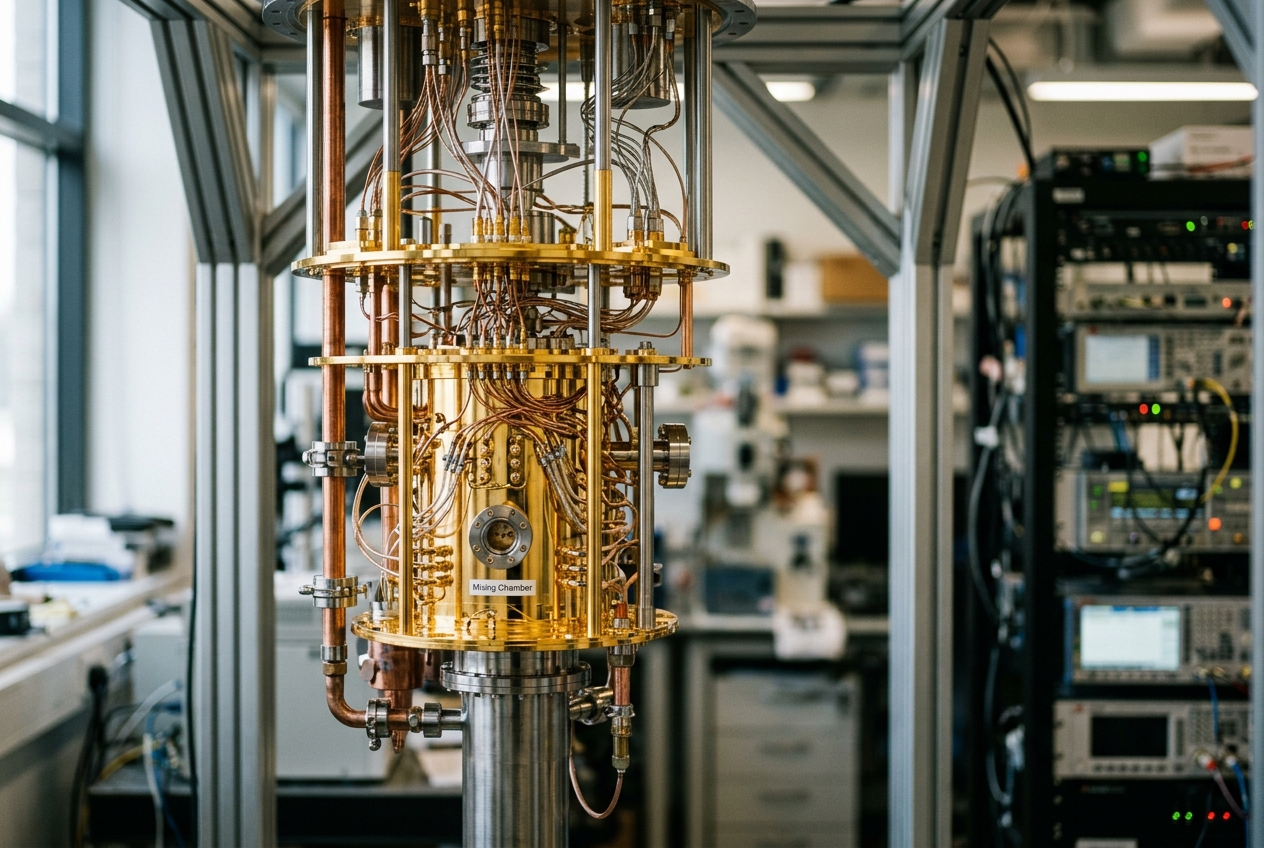
In quantum computing architectures, such as those being developed by IBM Quantum and academic consortia worldwide, processors operate inside dilution refrigerators chilled to fractions of a degree above absolute zero. At these sub-kelvin temperatures, even the tiniest puff of dissipated heat can destroy the fragile quantum states that allow the computer to function. In large-scale quantum processors executing quantum error correction, millions of auxiliary helper qubits must be measured and reset to a clean default state billions of times per second.
If this constant erasure dumps too much heat into the cryogenic chamber, the entire quantum machine overheats and crashes. Understanding the quantum mechanical limits of information erasure is not an abstract academic exercise. It is the fundamental physical bottleneck that will determine whether humanity can build planetary-scale quantum supercomputers capable of discovering life-saving pharmaceuticals, designing room-temperature superconductors, and revolutionizing materials science.
2. The Idea in Plain English
To understand why erasing data demands energy, imagine a single classical bit represented by a coin resting in a closed box. If the coin is heads, we call it a binary 0; if it is tails, it is a binary 1. If you know the coin is showing heads, you have zero uncertainty. But if someone shakes the box, the coin has an equal chance of being heads or tails. The box is in a state of maximum disorder, or entropy.
Now, suppose you are commanded to "reset" or "erase" the memory, forcing the coin back to heads, regardless of what it was before. To do this, you must tilt the box, shake it, or apply a mechanical force. You are compressing two possible physical states into one known, deterministic state. By reducing the entropy of the coin inside the box, the second law of thermodynamics demands that you must increase entropy somewhere else. That entropy is expelled into the surrounding environment as a tiny pulse of heat.
In the classical world, Rolf Landauer proved that resetting one bit of unknown information in a thermal environment at temperature $T$ must dissipate a minimum heat into the environment. As catalogued in foundational physics literature on Landauer's Principle, this minimal dissipation represents the inescapable bridge connecting abstract mathematics to physical reality.
+-------------------------------------------------------------------------------+
|                      THE CLASSICAL LANDAUER BOUND                             |
|                                                                               |
|   Any logically irreversible manipulation of classical information, such as   |
|   the erasure of a single unknown bit in a thermal reservoir at absolute      |
|   temperature T, must dissipate an amount of heat Q satisfying:               |
|                                                                               |
|                       Q >= k_B * T * ln(2)                                    |
|                                                                               |
|   where k_B is Boltzmann's constant and ln(2) is the natural logarithm of 2.  |
+-------------------------------------------------------------------------------+
In plain words, this famous equation calculates the irreducible energy bill for forgetting. It asserts that heat dissipation is directly proportional to the ambient temperature and the natural logarithm of the number of states being collapsed.
However, a quantum bit (qubit) is not a rigid classical coin. A qubit can exist in a coherent superposition of both binary states simultaneously, behaving more like a coin spinning in mid-air. Furthermore, a qubit can become deeply entangled with its environment or with a secondary quantum memory register. When an observer holds an entangled quantum memory that shares correlations with the qubit to be erased, the nature of information changes completely.
In classical physics, your uncertainty about a system can never be less than zero. In quantum mechanics, quantum correlations allow the mathematical measure of uncertainty—known as conditional quantum entropy—to become negative. This leads to a startling, counter-intuitive conclusion: if you use quantum entanglement strategically, you can erase a qubit's state without generating any heat at all. You can even extract useful work from the surrounding thermal bath, cooling down the processor in an effect known as anomalous quantum refrigeration.
3. How It Actually Works — The Mechanics
To see how the classical Landauer limit transforms in the quantum regime, physicists treat both the quantum system being erased and its surrounding thermal reservoir as a single, isolated, closed universe governed by the strict laws of quantum mechanics.
       +-----------------------------------------------------------------+
       |              ISOLATED TOTAL SYSTEM H_S (x) H_B                  |
       |                                                                 |
       |    +---------------------+           +---------------------+    |
       |    |   Quantum System    |           |   Thermal Bath      |    |
       |    |   H_S (Density      | <=======> |   H_B (Temperature  |    |
       |    |   Matrix rho_S)     |  Joint    |   T, State rho_B)   |    |
       |    +---------------------+  Unitary  +---------------------+    |
       |               |             Time                |               |
       |               v             Evolution           v               |
       |    +---------------------+  U(t)     +---------------------+    |
       |    |   Erased System     |           |   Heated/Cooled     |    |
       |    |   State |0><0|      |           |   Bath rho_B'       |    |
       |    +---------------------+           +---------------------+    |
       +-----------------------------------------------------------------+
The Quantum Mechanical Formulation
Let the quantum information be encoded in a system Hilbert space $\mathcal{H}_S$ described by a density operator $\rho_S$. The system is coupled to a thermal bath occupying Hilbert space $\mathcal{H}_B$, which begins in a canonical thermal equilibrium state $\rho_B = e^{-\beta H_B} / \mathcal{Z}_B$, where $\beta = 1/(k_B T)$ is the inverse temperature and $H_B$ is the bath Hamiltonian.
Because the combined composite system $\mathcal{H}_S \otimes \mathcal{H}_B$ is closed, its time evolution is strictly unitary, mediated by a time-evolution operator $U$. Unitary transformations are completely reversible; they preserve quantum information and keep the total von Neumann entropy of the combined universe invariant. The von Neumann entropy, which quantifies the amount of quantum information and mixedness in a quantum state, is defined for any state $\rho$ as the trace of $\rho$ multiplied by its natural logarithm.
When the system undergoes an erasure operation, its initial state $\rho_S$ is mapped to a standard pure reference state, such as the ground state $|0\rangle\langle 0|$, while the bath absorbs the disturbance, transitioning from its initial thermal state $\rho_B$ to a perturbed state $\rho_B'$. Because the total unitary evolution preserves relative entropy—a mathematical measure of distinguishability between quantum states—the change in the thermal bath's energy must balance the entropy lost by the system.
When researchers at the Massachusetts Institute of Technology OpenCourseWare and leading quantum theory groups derive this process mathematically, they obtain the generalized quantum Landauer equality:
+-------------------------------------------------------------------------------+
|                  THE GENERALIZED QUANTUM LANDAUER BOUND                       |
|                                                                               |
|   For any quantum erasure protocol acting on a system S coupled to a thermal  |
|   reservoir B at inverse temperature beta = 1 / (k_B * T), the heat Delta Q   |
|   transferred into the reservoir is bounded by:                               |
|                                                                               |
|               Delta Q_bath >= k_B * T * [ S(rho_S) - S(rho_S') ]              |
|                                                                               |
|   where S(rho) = -Tr(rho * ln(rho)) is the von Neumann entropy of the state,  |
|   and rho_S' represents the final reset state of the quantum system.          |
+-------------------------------------------------------------------------------+
This relation states that the heat absorbed by the thermal environment is bounded below by the product of the temperature and the total reduction in the system’s von Neumann entropy. If the initial quantum state is completely mixed across two orthogonal dimensions, its initial entropy is $\ln 2$, and resetting it to a pure state yields precisely the classical Landauer threshold $k_B T \ln 2$.
The Power of Quantum Side Information: Negative Conditional Entropy
The paradigm shifts entirely when the system qubit $S$ is entangled with an auxiliary quantum memory register, often denoted as the "quantum observer" or environment $E$. In a landmark paper published in Nature, physicists demonstrated that the thermodynamic cost of erasing a quantum system depends on the observer's knowledge of that system.
If the observer holds a classical memory correlated with the qubit, the uncertainty is measured by the classical conditional Shannon entropy, which is strictly non-negative. However, when the system $S$ and the memory $E$ share maximally entangled states (such as Bell pairs), the joint state is pure, meaning the composite entropy $S(\rho_{SE})$ is zero, while the individual subsystem entropy $S(\rho_E)$ is positive.
The conditional von Neumann entropy of the system given the quantum memory, defined as $S(S|E) = S(\rho_{SE}) - S(\rho_E)$, becomes strictly negative: $S(S|E) = -\ln 2$.
+-------------------------------------------------------------------------------+
|              QUANTUM LANDAUER BOUND WITH QUANTUM SIDE INFORMATION             |
|                                                                               |
|   When an erasing agent has access to an entangled quantum memory E, the      |
|   work W_erasure required to reset the quantum system S satisfies:            |
|                                                                               |
|                     W_erasure >= k_B * T * ln(2) * S(S|E)                     |
|                                                                               |
|   When S(S|E) < 0 due to quantum entanglement, W_erasure becomes negative,    |
|   allowing erasure to extract net work and refrigerate the thermal reservoir. |
+-------------------------------------------------------------------------------+
This equation reveals the astonishing mechanism of erasure with work gain. Because $S(S|E)$ is negative, the minimum external work required to erase the qubit falls below zero. Instead of consuming energy and dumping heat, the erasure protocol can consume the entanglement between the qubit and the observer to actively pull thermal energy out of the heat bath and convert it into useful mechanical or electrical work. Information erasure becomes an engine of refrigeration.
       +-----------------------------------------------------------------+
       |             ERASURE WITH QUANTUM SIDE INFORMATION               |
       |                                                                 |
       |      System S (Qubit) <==== MAXIMAL ENTANGLEMENT ====> Memory E |
       |                                                                 |
       |        * Joint Entropy S(S,E) = 0                               |
       |        * Subsystem Entropy S(E) = ln(2)                         |
       |        * Conditional Entropy S(S|E) = 0 - ln(2) = -ln(2)        |
       |                                                                 |
       |                            |                                    |
       |                            v                                    |
       |              ERASURE PROCESS APPLIED TO S                       |
       |                            |                                    |
       |                            v                                    |
       |   Heat absorbed FROM the bath: Q_extracted = k_B * T * ln(2)    |
       |   Result: Work is gained, and the local reservoir cools down!   |
       +-----------------------------------------------------------------+
Finite-Time Non-Equilibrium Effects and Quantum Speed Limits
The bounds described above apply to ideal, quasistatic processes carried out over infinitely long timescales. In real-world quantum computers, operations must happen in nanoseconds. When an erasure cycle is driven at finite speed, the system is thrown out of thermal equilibrium.
Non-equilibrium thermodynamic friction generates irreversible entropy, causing the dissipated heat to surge well above the theoretical Landauer minimum. Fundamental physical constraints known as Quantum Speed Limits (such as the Mandelstam–Tamm and Margolus–Levitin bounds) establish a strict trade-off: the faster you force a qubit to erase its state, the more excess heat you must inevitably dump into the environment.
Pioneering experimental verifications in Physical Review Letters have tested these principles using microscopic optical tweezers, colloidal particles, and single trapped ions. These experiments systematically proved that as the cycle time approaches the quantum speed limit, non-equilibrium dissipation dominates, demanding sophisticated shortcuts to adiabaticity to keep energy dissipation manageable.
4. Real-World Applications Today
The quantum Landauer principle is no longer confined to the chalkboard. Between 2024 and 2026, researchers across multiple disciplines are actively applying its insights to solve pressing technological challenges.
+-------------------------------------------------------------------------------------------------------+
|                              CONTEMPORARY APPLICATIONS & RESEARCH (2024–2026)                         |
+------------------------------+------------------------------------+-----------------------------------+
| Field / Discipline           | Institutions / Companies           | Realized Quantum Advantage        |
+------------------------------+------------------------------------+-----------------------------------+
| Cryogenic Qubit Reset        | IBM Quantum, Google Quantum AI     | Fast, low-dissipation syndrome    |
| & Error Correction           |                                    | reset in dilution refrigerators.  |
+------------------------------+------------------------------------+-----------------------------------+
| Quantum Heat Engines &       | Oxford, ETH Zurich, MIT            | Nanoscale cooling of sensitive    |
| Micro-Refrigeration          |                                    | quantum sensors using side info.  |
+------------------------------+------------------------------------+-----------------------------------+
| Trapped-Ion Precision        | NIST, University of Innsbruck,     | Direct experimental verification  |
| Nanocalorimetry              | Sorbonne Université                | of finite-time Landauer bounds.   |
+------------------------------+------------------------------------+-----------------------------------+
| Minimally Dissipative        | RIKEN, D-Wave Quantum Systems      | Thermodynamic optimization of     |
| Neuromorphic Computing       |                                    | adiabatic flux qubit annealers.   |
+------------------------------+------------------------------------+-----------------------------------+
1. Cryogenic Qubit Reset in Fault-Tolerant Quantum Processors
- Institutions: IBM Quantum, Google Quantum AI, and the University of Chicago.
- Objective: In fault-tolerant quantum computers running surface-code error correction, thousands of auxiliary "syndrome" qubits must be repeatedly initialized, entangled, measured, and reset every few hundred nanoseconds.
- The Quantum Advantage: Standard active reset protocols apply microwave pulses that dissipate excess energy directly into the dilution refrigerator's 15-millikelvin stage. By applying quantum Landauer thermodynamics and engineered reservoir coupling, engineers are designing autonomous reset protocols that route entropy away from the processor core with minimal thermal dissipation, preventing cryogenic thermal runaway.
2. Quantum Heat Engines and Nanoscale Refrigerators
- Institutions: University of Oxford, ETH Zurich, and Harvard University.
- Objective: Developing autonomous nanoscale thermal machines that manage heat flow at the single-atom scale.
- The Quantum Advantage: Exploiting negative conditional entropy allows these devices to act as quantum absorption chillers. By consuming entanglement stored in auxiliary quantum registers, these microscopic engines can extract heat from nearby quantum sensors or superconducting circuits without requiring external mechanical work, achieving cooling performance that classical thermodynamics prohibits.
3. Trapped-Ion and Optical Precision Nanocalorimetry
- Institutions: National Institute of Standards and Technology (NIST), University of Innsbruck, and Sorbonne Université.
- Objective: Measuring heat dissipation and entropy production at the single-quantum-state level.
- The Quantum Advantage: Using single trapped ions ($^{40}\text{Ca}^+$ and $^{171}\text{Yb}^+$) held in radio-frequency Paul traps, physicists can measure single-phonon energy exchanges. Recent studies published in Nature Physics have verified both the quantum Landauer limit and finite-time non-equilibrium corrections with sub-yoctojoule precision, providing empirical calibration for future quantum thermodynamic hardware.
4. Minimally Dissipative Neuromorphic and Annealing Hardware
- Institutions: RIKEN Center for Quantum Computing and D-Wave Quantum Systems.
- Objective: Developing next-generation, ultra-low-power computing chips inspired by biological neural networks and quantum annealing.
- The Quantum Advantage: Classical digital neuromorphic chips are limited by the thermal dissipation of updating synaptic weights. By incorporating superconducting flux qubits and adiabatic state recycling governed by quantum Landauer dynamics, researchers are constructing hybrid neuromorphic architectures that operate near the quantum Landauer bound, consuming orders of magnitude less energy than conventional CMOS processors.
5. What This Means for You
It is easy to view quantum thermodynamics as a remote branch of physics, detached from daily life. In truth, the principles uncovered by Landauer and his quantum successors govern the physical fate of all human information technology.
Every computational device you own—from the smartphone in your pocket to the banking networks protecting your life savings—is currently hurtling toward fundamental thermodynamic barriers. As classical microchips approach single-nanometre scales, their performance is no longer limited by how fast electrons move, but by how effectively heat can be extracted from silicon chips.
       +-----------------------------------------------------------------+
       |                  THE COMPUTATIONAL HORIZON                      |
       |                                                                 |
       |   Classical Computing:               Quantum Thermodynamics:    |
       |   * Trapped by thermal limits.       * Leverages entanglement.  |
       |   * Millions of times above          * Approaches absolute      |
       |     Landauer bound.                    physical zero-dissipation|
       |   * Escalating global power grid       limits.                  |
       |     strain.                          * Powers green, planetary- |
       |                                        scale supercomputing.    |
       +-----------------------------------------------------------------+
In the near future, the design of energy-efficient computing will dictate how quickly scientists can simulate complex biomolecules to cure diseases, model climate systems with absolute fidelity, and train artificial intelligence architectures without overloading national power grids.
By mastering the quantum Landauer principle, scientists are learning how to compute at the absolute thermodynamic limits of nature. Understanding that information is physical—and that quantum entanglement can balance the energetic ledger of data destruction—transforms information erasure from an environmental liability into a precision instrument for sustainable computation.
6. Today's Takeaway
+-------------------------------------------------------------------------------+
|                              TODAY'S TAKEAWAY                                 |
|                                                                               |
|   Information is not an abstract mathematical ghost; it is an inextricably    |
|   physical property woven into the energetic fabric of the universe. While    |
|   erasing classical data always exacts an unavoidable tax in dissipated heat,  |
|   quantum entanglement allows us to rewrite the rules of thermodynamics—      |
|   enabling zero-heat computation and turning the very act of forgetting into  |
|   a source of refrigeration and useful work.                                  |
+-------------------------------------------------------------------------------+