Hong-Ou-Mandel Effect: Resolving Two-Photon Quantum Interference, Wavepacket Indistinguishability, and Bosonic Bunching
The global race to construct a commercially viable, fault-tolerant quantum computer is universally understood as a battle of physical substrates. While industrial titans have poured billions into superconducting transmons and trapped-ion traps, both approaches struggle against an unforgiving physical reality: extreme environmental fragility. Superconducting qubits require gargantuan dilution refrigerators cooled to millikelvin temperatures—colder than deep interstellar space—while trapped ions demand ultra-high vacuum chambers and intricate magnetic shielding.
Yet there exists a fundamentally different paradigm that operates at ambient room temperature, travels at 300,000 kilometers per second, and traverses intercontinental distances across standard telecommunications fiber without losing quantum coherence: the photon.
Light is nature's supreme carrier of information. However, this unmatched virtue conceals a foundational computational dilemma. Photons are non-interacting bosons; two beams of light crossing in free space pass through one another like phantoms, completely oblivious to each other's presence. In classical electrodynamics, Maxwell’s equations are strictly linear, meaning light waves superimpose rather than collide.
To execute quantum logic gates—such as the Controlled-NOT (CNOT) operation essential for universal computation—two distinct quantum bits must conditionally modify each other’s states. If particles of light do not naturally interact, how can one ever force them to perform a deterministic two-qubit logic operation?
The answer lies within an exquisite, counterintuitive phenomenon uncovered in 1987: the Hong-Ou-Mandel (HOM) effect. When two fundamentally identical photons arrive simultaneously at the two input ports of a simple 50:50 beam splitter, they do not bounce or transmit independently. Instead, driven by the pure geometry of quantum probability amplitudes, they undergo complete destructive quantum interference and are forced to exit the device glued together into the same output channel.
2. The Idea in Plain English
To understand the Hong-Ou-Mandel effect, it helps to cast aside abstract mathematical formalism for a moment and envision a classical game of miniature billiards.
Imagine a crossroad intersection formed by two pathways entering a central junction. In the middle of this junction sits a half-silvered mirror—a balanced 50:50 beam splitter. From one side, we roll a red billiard ball toward the mirror (Input Port 1); from the opposite side, we roll a blue billiard ball at the exact same speed (Input Port 2). When each ball strikes the half-silvered mirror, classical physics dictates that it has an independent 50% chance of passing straight through (transmission) and a 50% chance of bouncing off at a right angle (reflection).
If we track where the two balls emerge, classical probability dictates four equally likely pathways, each occurring with a probability of 25%: 1. Both balls reflect ($RR$): The red ball bounces into Output 2, and the blue ball bounces into Output 1. 2. Both balls transmit ($TT$): The red ball passes into Output 1, and the blue ball passes into Output 2. 3. Red reflects, Blue transmits ($RT$): Both balls emerge together in Output 2. 4. Red transmits, Blue reflects ($TR$): Both balls emerge together in Output 1.
Under classical statistics, if you place a sensor at Output 1 and another at Output 2, you will observe a "coincidence"—one ball arriving at Output 1 and one ball arriving at Output 2 simultaneously—exactly 50% of the time (the sum of the $RR$ and $TT$ possibilities). The remaining 50% of the time, both balls exit the same port ($RT$ or $TR$).
Now, replace the macroscopic billiard balls with two single photons of light. If these two photons are made completely indistinguishable—sharing identical polarization, matching optical frequency, identical spatial mode profiles, and arriving at the exact same femtosecond—the classical rulebook evaporates.
In quantum mechanics, when multiple indistinguishable physical pathways lead to the exact same observable outcome, nature does not sum classical probabilities; it sums quantum probability amplitudes. These amplitudes are complex numbers that possess both a magnitude and a phase.
At a symmetric dielectric beam splitter, reflecting off the mirror introduces a relative $\pi$ phase flip ($180^\circ$) compared to passing through it. When the two photons attempt to both reflect ($RR$) or both transmit ($TT$), their quantum probability amplitudes are equal in magnitude but precisely opposite in sign ($+1/2$ and $-1/2$). Consequently, the two possibilities cancel each other out in a flash of destructive quantum interference.
The coincidence probability drops straight to zero. The photons never exit into opposite ports; instead, they "bunch" together, emerging from the beam splitter in a quantum superposition of being both in Output 1 or both in Output 2.
3. How It Actually Works — The Mechanics
To appreciate the mathematical elegance and experimental realization of this effect, we examine the formal quantum optics framework developed by Chung Ki Hong, Zheyu Ou, and Leonard Mandel in their landmark 1987 paper in the Physical Review Letters.
3.1 The Physics of Photon Indistinguishability
A single photon is not an infinitesimal point particle; it is a single-excitation quantum state of the quantized electromagnetic field characterized by four core degrees of freedom: 1. Spatial Mode: The transverse spatial profile (e.g., fundamental Gaussian $\text{TEM}_{00}$ mode). 2. Polarization Mode: The transverse spin angular momentum state ($|H\rangle$, $|V\rangle$, or arbitrary elliptical states). 3. Spectral Mode: The central optical frequency $\omega_0$ and spectral distribution $\phi(\omega)$. 4. Temporal Mode: The longitudinal arrival envelope $\psi(t)$ at the interaction plane.
Two single-photon wavepackets entering input ports 1 and 2 can be expressed via second-quantization creation operators acting on the vacuum state $|0\rangle$:
$$\hat{a}_j^\dagger = \int d\omega \, \phi_j(\omega) \, \hat{a}_j^\dagger(\omega)$$
For ideal Hong-Ou-Mandel interference, the spatial, polarization, and spectral wavefunctions must be strictly identical: $\phi_1(\omega) = \phi_2(\omega)$.
3.2 Algebraic Derivation of the Beam Splitter Transformation
Consider a lossless, symmetric, balanced (50:50) beam splitter with two input spatial modes ($\hat{a}_1, \hat{a}_2$) and two output spatial modes ($\hat{b}_1, \hat{b}_2$). Conservation of energy and optical reciprocity require the scattering matrix connecting input and output operators to be unitary.
Under the standard symmetric convention, the unitary matrix transformation relating output creation operators to input creation operators is given by:
$$\begin{pmatrix} \hat{a}_1^\dagger \ \hat{a}_2^\dagger \end{pmatrix} = \frac{1}{\sqrt{2}} \begin{pmatrix} 1 & 1 \ 1 & -1 \end{pmatrix} \begin{pmatrix} \hat{b}_1^\dagger \ \hat{b}_2^\dagger \end{pmatrix}$$
Expressed explicitly for each input mode operator:
$$\hat{a}_1^\dagger = \frac{1}{\sqrt{2}} \left( \hat{b}_1^\dagger + \hat{b}_2^\dagger \right)$$
$$\hat{a}_2^\dagger = \frac{1}{\sqrt{2}} \left( \hat{b}_1^\dagger - \hat{b}_2^\dagger \right)$$
Now, let a single photon enter Port 1 and a single photon enter Port 2 simultaneously. The joint quantum input state is represented in the Fock (number-state) basis as $|1, 1\rangle_{12} = \hat{a}_1^\dagger \hat{a}_2^\dagger |0, 0\rangle$.
We substitute the beam splitter transformation equations into this input state:
$$\hat{a}_1^\dagger \hat{a}_2^\dagger |0, 0\rangle = \left[ \frac{1}{\sqrt{2}} \left( \hat{b}_1^\dagger + \hat{b}_2^\dagger \right) \right] \left[ \frac{1}{\sqrt{2}} \left( \hat{b}_1^\dagger - \hat{b}_2^\dagger \right) \right] |0, 0\rangle$$
Expanding the polynomial product with careful adherence to operator ordering:
$$\hat{a}_1^\dagger \hat{a}_2^\dagger = \frac{1}{2} \left[ (\hat{b}_1^\dagger)^2 - \hat{b}_1^\dagger \hat{b}_2^\dagger + \hat{b}_2^\dagger \hat{b}_1^\dagger - (\hat{b}_2^\dagger)^2 \right]$$
Because spatial modes 1 and 2 correspond to independent, orthogonal degrees of freedom, their bosonic creation operators strictly commute:
$$\left[ \hat{b}_1^\dagger, \hat{b}_2^\dagger \right] = \hat{b}_1^\dagger \hat{b}_2^\dagger - \hat{b}_2^\dagger \hat{b}_1^\dagger = 0 \implies \hat{b}_2^\dagger \hat{b}_1^\dagger = \hat{b}_1^\dagger \hat{b}_2^\dagger$$
Substituting this commutation identity directly back into our expanded operator expression:
$$\hat{a}_1^\dagger \hat{a}_2^\dagger = \frac{1}{2} \left[ (\hat{b}_1^\dagger)^2 - \hat{b}_1^\dagger \hat{b}_2^\dagger + \hat{b}_1^\dagger \hat{b}_2^\dagger - (\hat{b}_2^\dagger)^2 \right] = \frac{1}{2} \left[ (\hat{b}_1^\dagger)^2 - (\hat{b}_2^\dagger)^2 \right]$$
Recalling the definition of normalized two-photon Fock states $(\hat{b}_j^\dagger)^2 |0\rangle = \sqrt{2!} |2\rangle_j = \sqrt{2} |2\rangle_j$, we apply the transformed operator to the vacuum state:
$$|1, 1\rangle_{12} \xrightarrow{\text{Beam Splitter}} \frac{1}{\sqrt{2}} |2, 0\rangle_{12} - \frac{1}{\sqrt{2}} |0, 2\rangle_{12}$$
3.3 The Temporal HOM Dip and Quantum Visibility
In an experimental setting, one introduces an adjustable temporal delay $\tau$ between the two input wavepackets by physically translating a mirror mounted on a motorized stage.
If the incoming photons have normalized temporal envelope functions $\psi_1(t)$ and $\psi_2(t - \tau)$, the coincidence detection probability $P_{11}(\tau)$ recorded between detectors $D_1$ and $D_2$ as a function of temporal delay is given by:
$$P_{11}(\tau) = \frac{1}{2} \left[ 1 - V \cdot \exp\left( -\frac{\tau^2}{2 \sigma_t^2} \right) \right]$$
where $\sigma_t$ represents the coherence time (temporal duration) of the single-photon wavepackets, and $V$ is the interference visibility, defined by:
$$V = \frac{P_{11}(\infty) - P_{11}(0)}{P_{11}(\infty)}$$
- When $|\tau| \gg \sigma_t$, the photons arrive at completely different times, rendering them fully distinguishable by their arrival timestamps. The interference vanishes, and the system defaults to the classical coincidence probability of $P_{11}(\infty) = 0.5$.
- When $\tau = 0$, maximum temporal overlap occurs. For perfectly indistinguishable pure photons, the coincidence rate drops to $P_{11}(0) = 0$, yielding a quantum visibility of $V = 100\%$.
The Classical Wave Limit
It is a foundational theorem of quantum optics that classical light pulses (coherent states or thermal states) traversing a 50:50 beam splitter can produce intensity correlation dips, but the visibility of a classical field is strictly bounded:
$$V_{\text{classical}} \le 50\%$$
Any experimentally measured visibility exceeding $50\%$ ($V > 0.5$) provides an unequivocal, non-classical signature proving both the quantization of the electromagnetic field and the indistinguishability of the incident single-photon wavepackets. Detailed mathematical foundations can be explored further in the MIT OpenCourseWare Quantum Optical Communication course.
3.4 Experimental Architecture
The classical architecture for demonstrating Hong-Ou-Mandel interference comprises three interconnected sub-systems:
- Heralded Single-Photon Generation: A pulsed laser pumps a second-order nonlinear crystal (such as Beta-Barium Borate, $\beta$-$\text{BaB}_2\text{O}_4$ or Periodically Poled Lithium Niobate, PPLN) to induce Spontaneous Parametric Down-Conversion (SPDC). A single high-energy pump photon spontaneously splits into an energy-conserving pair of lower-energy photons termed the signal and idler: $$\hbar\omega_p = \hbar\omega_s + \hbar\omega_i, \quad \mathbf{k}_p = \mathbf{k}_s + \mathbf{k}_i$$
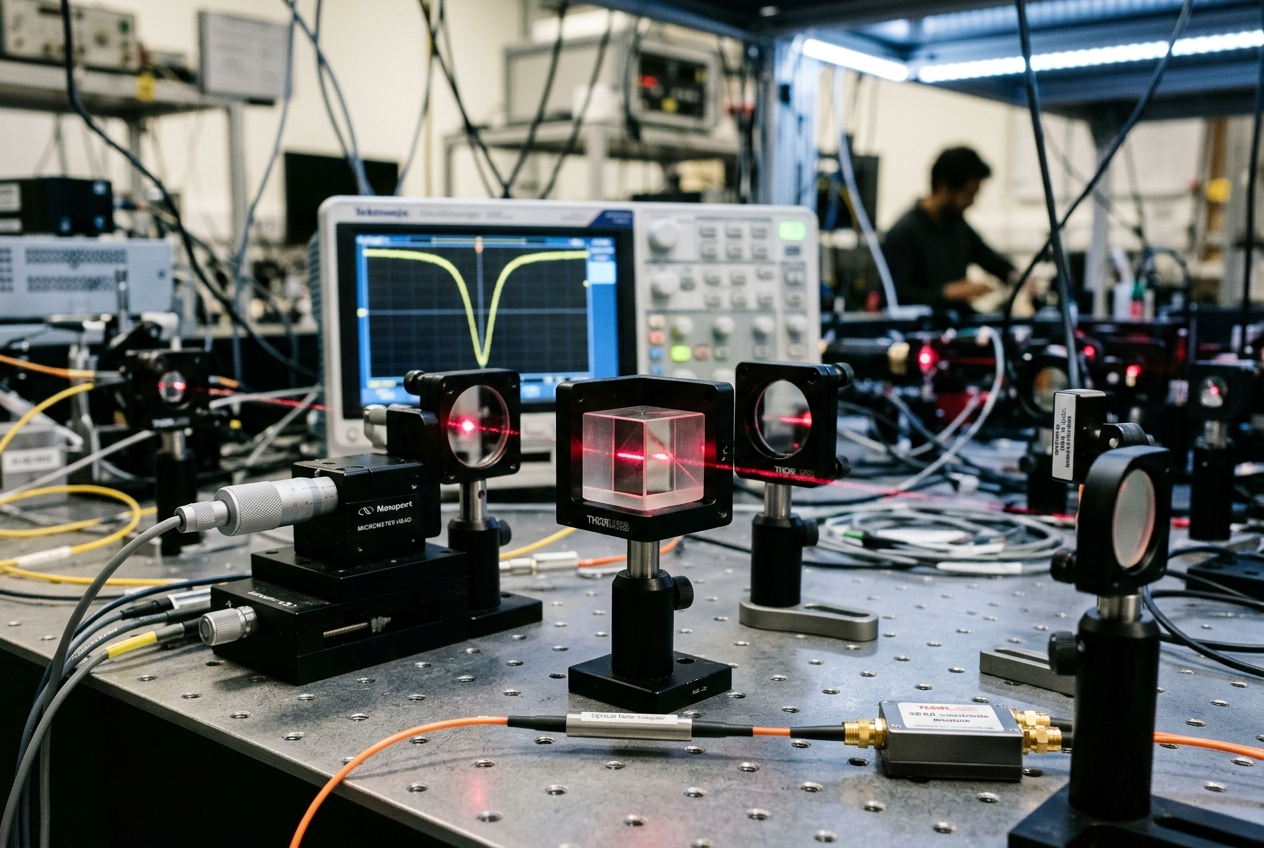
- Sub-Picosecond Path Matching: The signal photon enters Input 1 through single-mode optical fiber, while the idler photon enters Input 2 via a motorized linear translation stage. Because a photon travels approximately 0.3 micrometers in a single femtosecond ($10^{-15}\text{ s}$), piezoelectric micro-actuators tune the physical path difference with sub-micron precision to align the wavepacket centers within femtoseconds.
- Detection and Correlation: Detectors placed at both outputs—modernly realized via Superconducting Nanowire Single-Photon Detectors (SNSPDs) operating at 2.5 Kelvin with over $98\%$ quantum efficiency—convert photon absorption events into electrical pulses. A Time-Correlated Single-Photon Counting (TCSPC) module records detection time tags with picosecond resolution, tallying simultaneous events within a rigid coincidence window ($\Delta t \approx 1\text{ ns}$).
For deeper technical explorations of the underlying quantum theory, consult the comprehensive overview on the Wikipedia Hong–Ou–Mandel effect page.
4. Real-World Applications Today (2024–2026)
Far from being merely an academic curiosity, the Hong-Ou-Mandel effect is the core enabling mechanism behind modern photonic quantum technologies. Below are four frontier domains where HOM interference drives industrial and scientific breakthroughs today.
4.1 Linear Optical Quantum Computing (PsiQuantum & Xanadu)
Because photons do not naturally experience non-linear interactions at single-photon power levels, building an entangling logic gate—such as a CNOT or Controlled-Phase (CZ) gate—was long believed to require colossal optical non-linearities.
In 2001, the landmark Knill-Laflamme-Milburn (KLM) protocol proved that scalable quantum computing is possible using only linear optical elements (beam splitters, phase shifters), single-photon sources, and single-photon detectors. At the exact heart of every linear optical CNOT gate is Hong-Ou-Mandel interference.
Today, commercial leaders such as PsiQuantum (Palo Alto) and Xanadu (Toronto) are building silicon photonic quantum processors. PsiQuantum utilizes Fusion-Based Quantum Computing (FBQC), where small entangled resource states of light are continuously stitched together into a fault-tolerant 3D cluster state. The elementary "fusion measurements" that intertwine these optical qubits are two-photon HOM interference measurements executed on integrated silicon nitride waveguides.
The quantum advantage here is staggering: photonic qubits fabricated on standard semiconductor CMOS lines can compute at room temperature without the severe coherence time limits that plague solid-state matter qubits.
4.2 Bell State Measurement & Long-Range Quantum Teleportation (USTC & QuTech)
In quantum communication, transmitting a fragile quantum state across thousands of kilometers cannot be accomplished by traditional optical amplifiers, which introduce fatal quantum noise. Instead, one must implement Quantum Repeaters via Entanglement Swapping.
When two independent nodes (Alice and Bob) send unentangled photons to an intermediate node (Charlie), Charlie directs both photons onto a 50:50 beam splitter. By observing a Hong-Ou-Mandel bunching or anti-bunching signature across two single-photon detectors, Charlie executes a projective Bell State Measurement (BSM).
Institutions like the University of Science and Technology of China (USTC) and QuTech (Delft) routinely use HOM-based Bell state analyzers to demonstrate inter-city quantum teleportation and satellite-to-ground entanglement distribution. The degree of indistinguishability achieved in the HOM dip sets the ultimate upper limit on the fidelity of the teleported quantum state. For deeper insight into quantum logic circuits, explore the IBM Quantum / Qiskit Learning Platform.
4.3 Deterministic Single-Photon Source Benchmarking (Quandela & Toshiba)
To build industrial optical quantum computers, one cannot rely solely on probabilistic SPDC sources, which generate photon pairs at random intervals. Instead, the industry relies on deterministic Semiconductor Quantum Dots embedded in micropillar optical cavities.
French quantum computing firm Quandela and Toshiba Europe manufacture solid-state single-photon sources capable of emitting tens of millions of identical single photons per second. To certify that these quantum dots emit truly pure, single, and transform-limited photons, engineers use the Hong-Ou-Mandel interferometer as the universal gold standard quality metric.
By measuring the HOM dip visibility $V$ between consecutive single photons emitted by the same quantum dot microcavity, manufacturers directly quantify the photon indistinguishability parameter $M$. A quantum dot source cannot be integrated into a quantum computational cluster unless it demonstrates $V_{\text{HOM}} > 95\%$, proving the total absence of spectral diffusion and decohering phonon scattering.
4.4 Quantum-Enhanced Optical Coherence Tomography (Q-OCT)
In medical physics and ophthalmology, Optical Coherence Tomography (OCT) is used to perform non-invasive, high-resolution 3D cross-sectional imaging of biological tissue, such as the human retina. Classical OCT, however, suffers from a severe trade-off: increasing axial imaging resolution requires broader spectral bandwidth, which inherently introduces optical group velocity dispersion (GVD), blurring the structural image.
Quantum Optical Coherence Tomography (Q-OCT) replaces classical laser light with energy-time entangled photon pairs and a Hong-Ou-Mandel interferometer. Because the signal and idler photons are frequency-entangled, dispersion effects accumulated by the photon probing the biological sample are mathematically cancelled by the symmetric frequency correlation of the partner photon.
Consequently, Q-OCT achieves twice the axial resolution of classical OCT while operating at exceptionally low photon flux—preventing thermal or photodamage to sensitive neural and retinal tissues. Leading research at the intersection of quantum metrology and biophotonics is extensively documented across Nature Photonics and the seminal Reviews of Modern Physics survey on Linear Optical Quantum Computing.
5. What This Means for You
While the mathematical formalism of second quantization and operator commutation relations may feel abstract, the Hong-Ou-Mandel effect directly shapes the security and technological infrastructure of our immediate future.
Unhackable Critical Infrastructure
The encryption underpinning global financial transactions, defense communication, and national electrical grids is vulnerable to prospective Shor's algorithm decryption by quantum computers. Quantum Key Distribution (QKD) networks—such as the emerging quantum internet nodes connecting European and Asian capitals—rely on measurement-device-independent protocols anchored by the HOM effect. When your bank eventually transitions to quantum-secure encrypted data transfer, the cryptographic integrity protecting your personal assets will be physically guaranteed by the destructive interference of indistinguishable photons.
Accelerated Molecular Discovery
Because linear optical quantum computers utilize photons interacting via HOM gates, room-temperature photonic processors (like those under development by PsiQuantum) promise to leapfrog cryogenic architectures in total physical qubit count. When these optical processors scale to thousands of logical qubits, their earliest applications will not be running video games or consumer software, but rather simulating complex quantum molecular interactions: - Modeling the nitrogenase enzyme to discover low-energy industrial fertilizer synthesis, cutting global natural gas consumption. - Simulating protein-folding pathways to design targeted pharmaceutical compounds for oncology and neurodegenerative diseases in days rather than decades.
6. Today's Takeaway
The Hong-Ou-Mandel effect reveals one of nature’s most profound design principles: particles that are genuinely, completely identical lose their individual identities and are forced by the laws of quantum symmetry to act as a unified whole. By transforming a modest half-silvered mirror into an arena of destructive interference where independent trajectories erase one another, this two-photon interaction provides the missing physical bridge needed to turn ordinary light into the logic gates of tomorrow's quantum supercomputers.