Hayden-Preskill Protocol: Decoding Information Scrambling and Quantum Evaporation Via Entangled Mirrors
THE ESSENTIAL TAKEAWAY
For decades, theoretical physics assumed that anything tossed into a black hole was obliterated or locked behind an impenetrable cosmic vault for quadrillions of years. The Hayden-Preskill protocol proved the opposite: if a black hole is sufficiently old, it acts not as a permanent tomb for information, but as an ultra-fast quantum information mirror. By collecting just a microscopic sliver of newly emitted Hawking radiation alongside historical emissions, an external observer can reconstruct an infalling secret almost instantaneously.
1. Opening Hook — Why You Should Care
If you drop your smartphone into an incinerator, conventional intuition suggests that its photos, encrypted messages, and contacts have been destroyed forever. To a classical observer, thermal chaos and chemical breakdown reduce the device to ash, soot, and escaping heat. Yet, according to the bedrock laws of quantum mechanics, information is strictly immortal. In principle, if an omniscient observer possessed a supercomputer capable of tracking every radiated photon, every smoke molecule, and every thermal vibration, the device’s internal data could be calculated backward in time and restored with mathematical perfection.
For over three decades, black holes broke this fundamental promise. When Stephen Hawking demonstrated that black holes slowly evaporate by radiating a steady, thermal hiss of particles, he introduced the black hole information paradox: the outgoing radiation appeared completely random and featureless, implying that anything crossing the event horizon had its quantum history permanently deleted from reality. If black holes could erase information, the mathematical foundations of quantum physics—specifically the principle of unitarity, which dictates that the sum of all probabilities in the universe must always equal exactly one—would collapse.
The resolution to this existential crisis did not arise from deep-space telescopes, but from the cross-pollination of general relativity and quantum information theory. In 2007, physicists Patrick Hayden and John Preskill published a transformative quantum information study on random subsystems. They revealed that once a black hole passes its midpoint of evaporation—a threshold known as the Page time—it ceases to behave like a bottomless data sink. Instead, it transforms into an ultra-efficient, rapidly scrambling quantum reflector. If an adversary tosses a classified quantum diary into an aged black hole, you do not need to wait eons for the black hole to finish evaporating to read it. By capturing just a tiny handful of newly emitted Hawking photons and cross-referencing them with the radiation emitted in the black hole's youth, you can reconstitute the diary’s contents almost immediately.
This discovery fundamentally reshaped how physicists understand the geometry of spacetime, the nature of quantum chaos, and the architecture of fault-tolerant quantum computers.
2. The Idea in Plain English: From Cosmic Vaults to Entangled Mirrors
To understand how an object known for trapping light can broadcast information, we must unpack three foundational quantum concepts: entanglement, scrambling, and the Page curve.
The Interconnected Cosmic Ledger
At the heart of the Hayden-Preskill protocol lies quantum entanglement. In classical physics, two objects are distinct entities; learning something about one tells you nothing about the other unless they physically communicate. In quantum mechanics, two particles can become inextricably linked such that their properties cannot be described independently, regardless of the physical distance separating them.
Imagine two identical ledger books kept on opposite sides of the galaxy. If you write an entry on page 42 of Ledger $A$, that exact entry instantaneously manifests on page 42 of Ledger $B$, even without any signal traveling between them. When a black hole emits thermal Hawking radiation over billions of years, each escaping particle leaves behind an entangled partner inside the event horizon. Over time, the exterior radiation field becomes an enormous, highly entangled reservoir that mirrors the microscopic quantum states remaining within the black hole.
The Fast-Scrambling Ink Drop
The second vital ingredient is quantum scrambling. Scrambling is the process by which localized quantum information is rapidly smeared, dispersed, and interwoven across all the degrees of freedom of a complex system.
Consider dropping a single drop of red dye into a glass of water. Initially, the dye is localized in one spot—the information is "readable" by simply looking at that coordinate. Within seconds, the dye diffuses through molecular collisions until the entire glass appears uniformly light pink. The dye is not destroyed; rather, the information regarding its original structure is now hidden within the complex, chaotic correlations among trillions of water molecules.
Black holes are not ordinary glasses of water: they are the fastest, most potent quantum scramblers permitted by the laws of physics. The moment a quantum state crosses the event horizon, the black hole’s internal gravitational dynamics act like an ideal blender, entangling the new arrival with all existing internal states in the absolute minimum time permitted by nature.
The Page Time Threshold
For the first half of a black hole's life, the information thrown into it remains locked inside because the internal system is not yet maximally entangled with the outside universe. However, once the black hole radiates away roughly half of its total entropy—a milestone named the Page time, after physicist Don Page—a profound phase transition occurs. The black hole becomes maximally entangled with its past emissions.
At this juncture, the black hole is saturated. Any new quantum information tossed into it cannot remain isolated. Because the internal states are already tied to the early radiation reservoir, the scrambling process instantaneously pushes the newly added information into the global correlations shared between the black hole and the outside world.
3. How It Actually Works: The Mathematical and Physical Mechanics
To formalize this thought experiment, Patrick Hayden and John Preskill framed the problem using the mathematical language of quantum channels, random matrix theory, and the decoupling theorem.
The Tripartite Architecture
Consider an aged black hole that has already passed its Page time. The global quantum system can be decomposed into three primary Hilbert spaces:
- The Infalling Message ($A$): A secret quantum state comprising $k$ qubits that an observer (often named Alice) drops into the black hole.
- The Black Hole Remnant ($B$): The remaining body of the black hole, consisting of $N$ qubits, where $N \gg k$.
- The Early Radiation ($E$): The vast reservoir of Hawking radiation emitted prior to Page time, which is maximally entangled with the black hole body $B$.
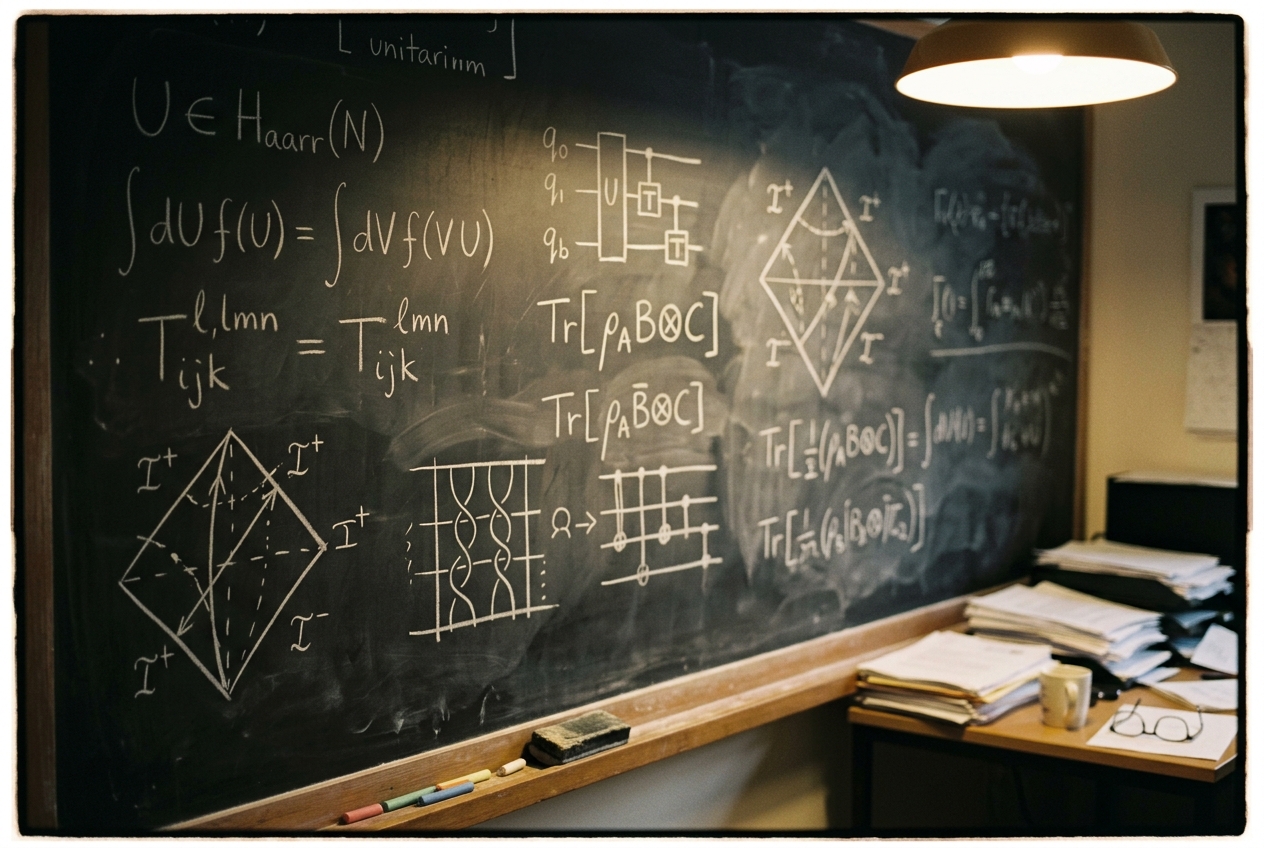
Before the message is thrown in, the black hole $B$ and early radiation $E$ form a maximally entangled state. When Alice drops subsystem $A$ into the black hole, the combined system $A \cup B$ undergoes internal dynamical evolution governed by a unitary transformation $U$.
Because black holes exhibit maximal quantum chaos, this time evolution can be modeled as a Haar-random unitary matrix—a mathematical operator drawn uniformly at random from the space of all possible unitary transformations. In practical quantum circuits, this chaotic mixing is achieved using unitary 2-designs, which replicate the first two statistical moments of a fully Haar-random distribution with vastly lower circuit complexity.
The Decoupling Theorem and Information Extraction
After the internal scrambling transformation $U$ takes place, the black hole emits a tiny packet of new Hawking radiation, designated as subsystem $R$, consisting of $c$ qubits. The remnant black hole that remains behind is labeled $B'$.
The fundamental question posed by Hayden and Preskill was: How large must the new radiation packet $R$ be in order for an external observer (Bob), who has painstakingly collected all early radiation $E$, to reconstruct Alice’s original $k$-qubit message with near-perfect fidelity?
The answer is governed by the Decoupling Theorem. In quantum information theory, decoupling states that if the quantum correlations between the message $A$ and the remaining black hole $B'$ drop to zero, the information about $A$ must, by conservation of quantum information, reside entirely within the combination of the new radiation $R$ and the old radiation $E$.
Mathematically, the average distance (measured via the trace norm) between the actual state of the remaining black hole $\rho_{B' R}$ and a completely unentangled, decorrelated thermal state is bounded by the dimensions of the respective Hilbert spaces:
$$\int_{\mathcal{U}} \left| \rho_{B' R}(U) - \rho_{B'} \otimes \frac{I_R}{|R|} \right|_1 dU \le \sqrt{\frac{|A| \cdot |R|}{|B|}} = 2^{-\frac{1}{2}(c - k)}$$
Equation 1: The Decoupling Bound. Here, $|A| = 2^k$ is the dimension of the message, $|R| = 2^c$ is the dimension of the new radiation, and the integral averages over all possible scrambling operations $U$.
This equation yields a startling physical conclusion. The error in the reconstruction decreases exponentially with the parameter $\epsilon = c - k$, which represents the surplus radiation qubits collected beyond the message size:
$$\text{Error} \le \mathcal{O}\left(2^{-\epsilon}\right)$$
If Alice drops a 100-qubit message ($k = 100$) into a black hole the size of our Sun, Bob does not need to collect half the mass of the black hole to recover it. Bob only needs to capture $k + \epsilon$ qubits of new radiation—for example, 105 qubits ($\epsilon = 5$). With just five extra photons over the original message size, the decoupling condition is satisfied, and the fidelity of the reconstructed quantum state approaches $97\%$. The black hole acts as an almost instantaneous quantum information mirror.
Out-of-Time-Ordered Correlators (OTOCs) and Scrambling Dynamics
How fast does this reflection occur? The speed at which information spreads across the event horizon is quantified using Out-of-Time-Ordered Correlators (OTOCs). Unlike conventional correlation functions that measure how a signal propagates from point $A$ to point $B$ forward in time, an OTOC evaluates the sensitivity of a quantum system to microscopic perturbations by calculating the expectation value of operators nested non-sequentially in time:
$$F(t) = \langle W^\dagger(t) V^\dagger(0) W(t) V(0) \rangle \approx 1 - \frac{f_0}{N} e^{\lambda_L t}$$
Equation 2: The OTOC decay profile. $V(0)$ is a local perturbation applied at time zero, $W(t)$ is an interrogation operator at time $t$, $N$ is the system size, and $\lambda_L$ is the quantum Lyapunov exponent.
In classical chaos theory, the Lyapunov exponent measures how rapidly two adjacent trajectories diverge (the "butterfly effect"). In quantum systems, the growth of the commutator $[W(t), V(0)]$ measures how a local operator grows into a highly non-local, complex operator spanning the entire Hilbert space.
In 2016, Juan Maldacena, Stephen Shenker, and Douglas Stanford established that nature imposes a fundamental speed limit on quantum chaos:
$$\lambda_L \le \frac{2\pi k_B T}{\hbar} = \frac{2\pi}{\beta}$$
Black holes saturate this theoretical upper bound. As a result, the time required for a black hole to completely scramble a message across its entire event horizon—the scrambling time $t_{\text{scramble}}$—is logarithmic with respect to its entropy $S$:
$$t_{\text{scramble}} = \frac{\beta}{2\pi} \ln S$$
Equation 3: The fast-scrambling timescale, where $\beta$ is the inverse Hawking temperature and $S$ is the Bekenstein-Hawking entropy.
For an astrophysical black hole, this scrambling timescale is measured in fractions of a millisecond.
The Yoshida-Kitaev Reconstruction Circuit
For years, the Hayden-Preskill protocol was considered a non-constructive thought experiment: it proved that the information existed in the radiation, but offered no practical algorithm for extracting it without performing an impossibly complex search through Hilbert space.
In 2017, Beni Yoshida and Alexei Kitaev unlocked a deterministic decoding protocol by translating the physics of black holes directly into a concrete quantum circuit.
The Yoshida-Kitaev decoder works by maintaining an entangled auxiliary system in the laboratory that mimics the scrambling dynamics of the black hole:
- Bob prepares an entangled pair of systems $(E', B')$ that mirrors the state of the black hole and its early radiation.
- Bob captures the newly emitted radiation $R$ from the real black hole.
- Bob passes his auxiliary system through the complex-conjugate time-evolution operator $U^*$, effectively running the black hole's scrambling dynamics in reverse.
- By performing an entangled projective measurement between the real radiation $R$ and the simulated radiation $R'$, the quantum state collapses.
- Alice's original message $|\psi\rangle$ is instantly teleported onto Bob’s auxiliary register $A'$ with unit fidelity.
This breakthrough demonstrated that the Hayden-Preskill protocol is fundamentally an advanced variant of quantum teleportation, operating through an entangled many-body channel.
4. Real-World Applications Today (2024–2026)
Far from being confined to abstract astrophysics, the mathematics of the Hayden-Preskill protocol has become an essential framework for cutting-edge quantum engineering, cryptographic design, and condensed matter physics.
1. Quantum Processor Benchmarking and Chaos Verification
- Key Institutions: Google Quantum AI, Quantinuum, and MIT OpenCourseWare Quantum Computing Lab
- The Initiative: Measuring the rate at which quantum processors generate genuine many-body entanglement across large arrays of superconducting and trapped-ion qubits.
- The Quantum Advantage: As quantum processors scale to hundreds of physical qubits, classical computers cannot verify whether the system is performing coherent quantum operations or succumbing to classical noise. By implementing scaled-down Yoshida-Kitaev circuits and measuring OTOC decay rates across qubit lattices, engineers directly quantify how quickly a quantum chip scrambles information. If an experimental processor matches the theoretical scrambling rate without loss of coherence, it confirms that the device is maintaining high-fidelity quantum entanglement across its entire computational space.
2. Fault-Tolerant Quantum Error-Correcting Architectures
- Key Institutions: IBM Quantum, Harvard University Quantum Initiative, and QuEra Computing
- The Initiative: Developing new Low-Density Parity-Check (qLDPC) codes and holographic spacetime codes to protect sensitive quantum memory from environmental noise.
- The Quantum Advantage: In a classical hard drive, data is protected by repeating bits (e.g., storing three copies of
1). Quantum states cannot be cloned due to the No-Cloning Theorem. The Hayden-Preskill protocol demonstrates that a black hole protects information by instantly encoding a local message into non-local, global entanglement. Quantum computing researchers are adapting this exact mechanism: by deliberately scrambling logical qubits across complex, highly connected topological networks, a stray burst of environmental noise (which affects only local qubits) cannot destroy the global quantum data.
3. Non-Local Quantum Cryptography and Secret Sharing
- Key Institutions: SandboxAQ, QuSecure, and leading academic defense laboratories
- The Initiative: Designing distributed, multi-party quantum key distribution (QKD) networks that are inherently resilient against localized eavesdropping attacks.
- The Quantum Advantage: Leveraging the Decoupling Theorem, security architects create communication protocols where a shared master cryptographic secret is scrambled across an array of distributed nodes. An adversary intercepting any single transmission line or compromising a subset of nodes obtains zero mutual information regarding the underlying secret. Only a designated receiver who holds the corresponding entangled auxiliary key can reconstruct the cleartext message with minimal communication overhead ($c = k + \epsilon$).
4. Simulating Exotic Materials and High-Temperature Superconductors
- Key Institutions: Max Planck Institute of Quantum Optics, Rigetti Computing, and Nature Physics Research Consortiums
- The Initiative: Simulating the Sachdev-Ye-Kitaev (SYK) model—a theoretical model of quantum matter that exhibits identical scrambling dynamics to black holes—on programmable quantum simulators.
- The Quantum Advantage: Strongly correlated electron systems, such as "strange metals" and high-temperature cuprate superconductors, resist analysis by classical supercomputers because their electrons are maximally scrambled and entangled. Because the SYK model mathematically maps to the Hayden-Preskill scrambling process, running these protocols on quantum hardware allows physicists to explore how electrical current moves through strange metals without resistance, potentially unlocking room-temperature superconductors.
5. What This Means for You
For the curious non-physicist, the mechanics of black hole scrambling may sound like pure science fiction. Yet this theoretical framework has direct, tangible consequences for the future of digital society.
Consider the vulnerability of today's digital infrastructure. When you send sensitive financial information or medical data across the internet, that data travels through localized server hubs and fiber-optic cables. If an attacker intercepts the physical packet or if a data center burns down, the information is either compromised or permanently lost.
The principles established by the Hayden-Preskill protocol are catalyzing a paradigm shift toward holographic and scrambled data storage. In future quantum communications networks, your personal data will not sit in a single physical memory slot. Instead, it will be scrambled across global entangled networks. Even if half of the physical communication lines are severed or monitored by unauthorized third parties, the data remains mathematically undetectable to the eavesdropper, yet instantly reconstructible by you using an entangled verification key.
On a deeper philosophical level, the Hayden-Preskill protocol reassures us of the fundamental integrity of our physical universe. Nature does not possess a cosmic delete button. Every action, every particle interaction, and every quantum state remains permanently woven into the cosmic tapestry, accessible to anyone who understands the subtle, beautiful language of quantum information.
6. Today's Takeaway
The Hayden-Preskill protocol dismantles the ancient view of black holes as cosmic destroyers, revealing them instead as nature's ultimate information mirrors. By demonstrating that an aged black hole rapidly scrambles incoming matter across its pre-existing reservoir of entangled Hawking radiation, the protocol proves that quantum secrets can be recovered from an infinitesimal sample of outgoing particles with near-perfect mathematical fidelity. In solving the black hole information paradox, this revolutionary framework has gifted modern science the blueprints for fault-tolerant quantum computers, unbreakable cryptographic networks, and an unprecedented understanding of how spacetime itself emerges from quantum entanglement.
Authoritative References & Further Study
- Patrick Hayden & John Preskill: Black Holes as Mirrors (arXiv:0708.4025) — The landmark original paper on quantum information in random subsystems.
- Nature: Experimental Verification of Quantum Information Scrambling — Groundbreaking laboratory implementation of OTOCs and the Yoshida-Kitaev circuit.
- IBM Quantum Learning: Quantum Error Correction & Decoupling — Practical guides on building fault-tolerant quantum algorithms using Qiskit.
- MIT OpenCourseWare: Quantum Physics & Quantum Computation — Comprehensive open university lectures on entanglement, density matrices, and unitarity.
- Wikipedia: The Black Hole Information Paradox & Page Time — An accessible primer on the history of Hawking radiation, Page curves, and unitary evaporation.