Hardy's Paradox: Demonstrating Quantum Non-Locality and Logical Contradictions Without Statistical Inequalities
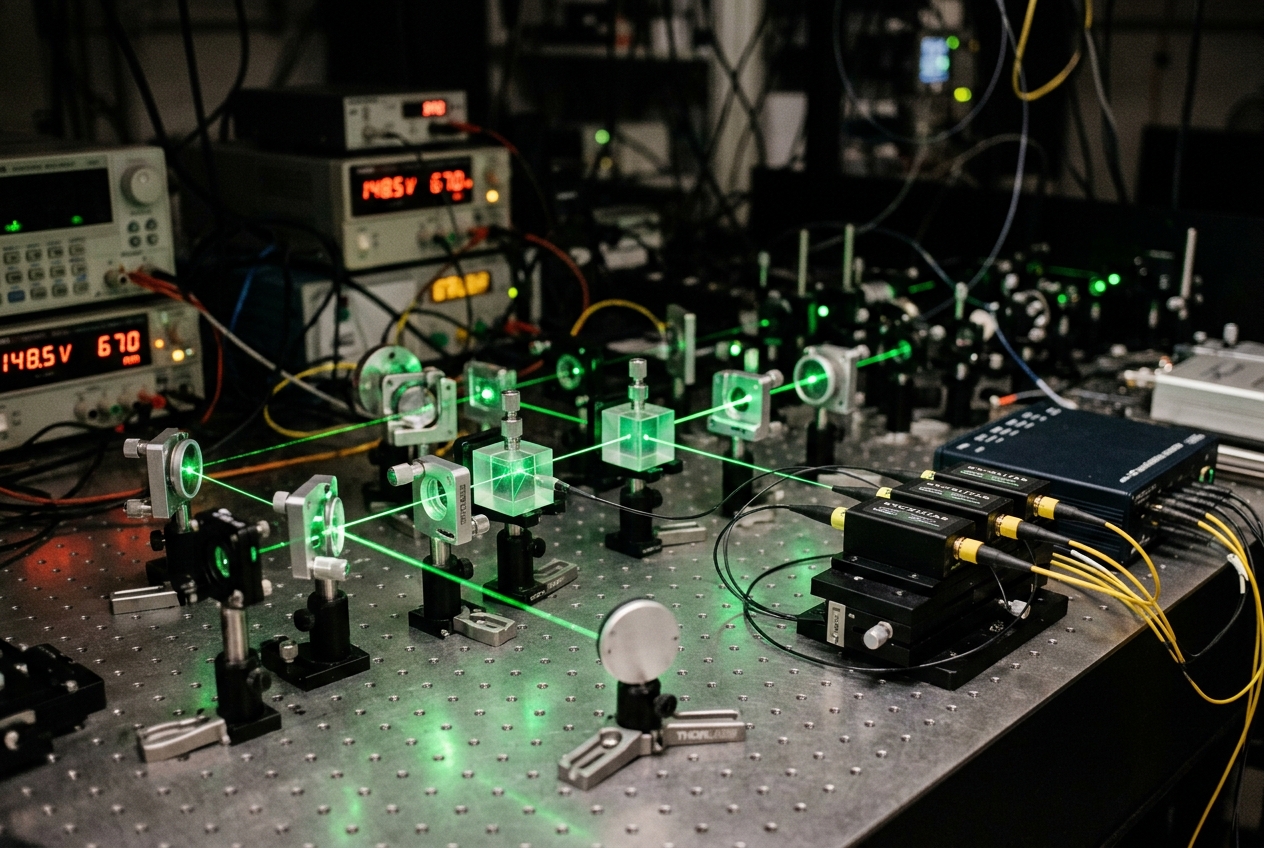
Yet at the fundamental scale of the universe, nature repudiates this common-sense logic. For decades, physicists proved this departure from classical intuition using statistical tests known as Bell inequalities, which require aggregating millions of probabilistic measurements to demonstrate that particles share "spooky" correlations. But in the early 1990s, British physicist Lucien Hardy achieved something far more devastating to the classical worldview. He formulated a thought experiment—now known universally as Hardy's Paradox—which proves that quantum mechanics violates local realism not through statistical averages, but through pure, deterministic logic.
Hardy demonstrated a scenario involving two entangled particles where four undeniable logical deductions lead to an impossible mathematical contradiction. According to classical reasoning, a specific joint event has a probability of exactly zero; yet quantum mechanics predicts, and laboratory experiments confirm, that it happens roughly 9% of the time. This "almost-quantum-magic" is not an experimental error or an optical illusion. It is an intrinsic feature of our cosmos that is actively reshaping modern quantum computing, self-testing cryptographic hardware, and our understanding of physical existence.
1. The Idea in Plain English: When Logic Refutes Reality
To understand why Hardy’s discovery sent shockwaves through theoretical physics, consider a simple physical analogy involving two secure rooms, two observers, and two coins.
Imagine two investigators, Alice and Bob, stationed in isolated laboratories miles apart. Each morning, a central machine shoots an unexamined coin into Alice’s room and another coin into Bob’s room. Alice and Bob each have two choices: they can either catch their incoming coin flat on a table (Measurement Option A) or let it bounce through a series of angled mirrors and balance on its rim (Measurement Option B).
          [ Central Source ]
             /          \
    (Particle 1)      (Particle 2)
           /              \
    [ Alice's Lab ]   [ Bob's Lab ]
    Choice A or B     Choice A or B
Over months of experimentation, Alice and Bob compare their notebooks and establish three ironclad rules:
- First Observation: Whenever Alice chooses Option B and observes her coin landing Heads, and Bob simultaneously chooses Option A, Bob always finds his coin landing Heads without exception ($100\%$ correlation). Alice deduces: "If my coin shows Heads under setup B, the pair must have been pre-programmed such that Bob’s coin is Heads under setup A."
- Second Observation: By perfect symmetry, whenever Bob chooses Option B and observes his coin landing Heads, and Alice chooses Option A, Alice always finds her coin landing Heads ($100\%$ correlation). Bob deduces: "If my coin shows Heads under setup B, Alice’s coin must be Heads under setup A."
- Third Observation: Whenever Alice and Bob both choose Option A, they discover that it is physically impossible for both coins to show Heads simultaneously. The probability is strictly zero ($0\%$).
Now comes the moment of classical reckoning. Suppose on a particular morning, Alice and Bob both decide to choose Option B. Alice looks at her detector and sees Heads. She immediately uses Rule #1 to deduce: "Because I saw Heads under setup B, Bob's coin would have shown Heads if he had chosen setup A." Meanwhile, Bob looks at his detector and also sees Heads under setup B. He applies Rule #2 and deduces: "Because I saw Heads under setup B, Alice's coin would have shown Heads if she had chosen setup A."
If classical local realism holds—meaning each coin possesses predetermined, objective properties independent of how the observers choose to measure them—these two deductions must hold simultaneously. Therefore, had they both switched to setup A, both of their coins would have shown Heads.
However, Rule #3 states that both coins showing Heads under setup A is strictly forbidden ($P = 0$). Classical logic dictates that Alice and Bob can never simultaneously observe Heads when both choose setup B. Yet, in the quantum world, Alice and Bob look down at their detectors under setup B and see both coins showing Heads in roughly one out of every eleven trials.
This is the essence of Hardy's Paradox: a direct, deterministic clash where local realistic logic insists that an event cannot occur, yet quantum mechanics proves that it does.
2. The Historical Leap: Beyond Statistical Averages and Many-Particle Systems
To appreciate the theoretical weight of this result, one must trace the lineage of quantum non-locality. In 1935, Albert Einstein, Boris Podolsky, and Nathan Rosen published their celebrated EPR paradox, arguing that quantum mechanics must be incomplete because it disallowed "hidden variables" that predetermine measurement outcomes. In 1964, John Stewart Bell revolutionized the debate by deriving mathematical bounds—Bell inequalities—that any local hidden variable theory must satisfy.
However, Bell inequalities possess an inherent experimental drawback: they are fundamentally statistical. To prove that nature violates a Bell inequality, researchers must measure thousands or millions of particle pairs, calculate expectation values across different detector angles, and demonstrate that a cumulative numerical score exceeds the classical threshold (such as the Clauser-Horne-Shimony-Holt bound of $2$). Sceptics could argue that these statistical violations might arise from subtle sampling biases, detector inefficiencies, or peculiar statistical anomalies.
+-----------------------------------------------------------------------------+
|                      EVOLUTION OF NON-LOCALITY THEOREMS                     |
+-----------------------------------------------------------------------------+
| 1. Bell's Theorem (1964):                                                   |
|    - Statistical inequality based on measurement averages.                  |
|    - Requires thousands of trials to prove violation.                       |
|    - Valid for 2 or more particles.                                         |
|                                                                             |
| 2. GHZ Theorem (1989):                                                      |
|    - Non-statistical, all-or-nothing logical contradiction.                 |
|    - Requires at least 3 entangled particles (tripartite state).            |
|                                                                             |
| 3. Hardy's Paradox (1992/1993):                                             |
|    - Non-statistical, pure logical contradiction.                           |
|    - Requires only 2 particles (bipartite state).                           |
|    - "The simplest form of Bell's theorem."                                 |
+-----------------------------------------------------------------------------+
In 1989, Daniel Greenberger, Michael Horne, and Anton Zeilinger introduced the GHZ theorem, which eliminated the need for statistical averages by demonstrating an "all-or-nothing" logical contradiction. In the GHZ framework, local realism predicts an outcome of $+1$ for a specific joint measurement, whereas quantum mechanics deterministically predicts $-1$. But the GHZ theorem carried a significant experimental caveat: it required a minimum of three entangled particles. Generating and manipulating three-qubit entangled states in the laboratory presented formidable technical hurdles.
In 1992 and 1993, Lucien Hardy published two seminal papers in Physical Review Letters demonstrating that an all-or-nothing logical contradiction could be constructed for the minimal system of only two particles. Often hailed as the "simplest and most beautiful formulation of Bell's theorem," Hardy's proof removed the need for statistical summations while maintaining the structural simplicity of a two-body interaction.
3. How It Actually Works: Overlapping Interferometers and the Mechanics of Contradiction
The original physical setup conceived by Lucien Hardy involves two overlapping Mach-Zehnder interferometers, one carrying an electron ($e^-$) and the other carrying a positron ($e^+$).
Each interferometer consists of a 50:50 beam splitter at the entrance, two alternative path arms—an outer non-overlapping path ($v$) and an inner overlapping path ($u$)—and a 50:50 recombination beam splitter leading to two detectors: a "constructive/bright" detector ($C$) and a "destructive/dark" detector ($D$).
                Electron Source (e-)
                         |
                   [Beam Splitter 1]
                      /     \
         (Outer arm v-)     (Inner arm u-)
                    |         \
                    |          X  <--- Overlapping Annihilation Zone
                    |         /        (e+ + e- -> gamma + gamma)
         (Outer arm v+)     (Inner arm u+)
                      \     /
                   [Beam Splitter 2]
                         |
                Positron Source (e+)
The Annihilation Condition
The geometry is arranged such that the inner arms of both interferometers ($u^-$ and $u^+$) cross in an interaction region. If the electron takes path $u^-$ and the positron simultaneously takes path $u^+$, they meet and annihilate each other into gamma-ray photons:
$$e^- + e^+ \longrightarrow \gamma + \gamma$$
If annihilation occurs, neither particle reaches the final beam splitters, and no detector clicks.
The Single-Particle Calibration
When an isolated particle traverses a standard Mach-Zehnder interferometer, the path lengths are tuned to produce complete destructive interference at the dark port $D$. Thus, for a single electron or single positron traversing its respective apparatus alone: - Detector $C$ always registers the particle ($100\%$ probability). - Detector $D$ never registers the particle ($0\%$ probability).
A detection at port $D$ can occur if and only if the delicate wave interference inside the interferometer is disrupted by an external interaction—such as the physical presence or blocking action of another particle along the inner path $u$.
Formulating the Mathematical Framework
Let $D_1=1$ and $D_2=1$ denote the registration of a particle at the dark detectors for the electron and positron, respectively. Let $C_1=1$ and $C_2=1$ denote registrations at the bright detectors.
When both particles enter the system simultaneously without annihilating, quantum mechanics describes the system via four distinct joint measurement probability conditions:
+-----------------------------------------------------------------------------+
|                     THE FOUR HARDY PROBABILITY PROPOSITIONS                 |
+-----------------------------------------------------------------------------+
| 1. Non-Zero Dark-Dark Probability:                                         |
|    P(D1 = 1, D2 = 1) > 0                                                    |
|    In a fraction of runs, both dark detectors click simultaneously.         |
|                                                                             |
| 2. First Orthogonality Condition:                                           |
|    P(D1 = 1, C2 = 1) = 0                                                    |
|    If electron dark detector D1 clicks, positron bright detector C2 cannot. |
|                                                                             |
| 3. Second Orthogonality Condition:                                          |
|    P(C1 = 1, D2 = 1) = 0                                                    |
|    If positron dark detector D2 clicks, electron bright detector C1 cannot. |
|                                                                             |
| 4. Destructive Annihilation Constraint:                                     |
|    P(C1 = 0, C2 = 0 | particles detected) = 0                              |
|    Both particles cannot simultaneously occupy the overlapping arms u- and  |
|    u+ and still emerge at the detectors without annihilating.               |
+-----------------------------------------------------------------------------+
The Analytical Derivation and the Logical Breakdown
Let us trace the strict chain of classical inferences when an event satisfying Condition 1 occurs ($D_1=1$ and $D_2=1$ simultaneously):
- Examine Detector $D_1$: The electron's dark detector clicked ($D_1=1$). Under single-particle physics, this interference could only be disrupted if the positron traveled along the inner path $u^+$, blocking the electron's wave amplitude. If the positron had traveled the outer path $v^+$, the electron would have experienced unperturbed interference and emerged strictly at $C_1$. Therefore, assuming local realism, $D_1=1$ implies with absolute certainty that the positron occupied inner path $u^+$, meaning it did not occupy path $v^+$ ($C_2=0$).
- Examine Detector $D_2$: By exact identical logic, the positron's dark detector clicked ($D_2=1$). This disruption could only happen if the electron traveled along its inner path $u^-$, blocking the positron's wave amplitude. Therefore, local realism dictates that $D_2=1$ implies with absolute certainty that the electron occupied inner path $u^-$ ($C_1=0$).
- The Classical Synthesis: Whenever we observe $D_1=1$ and $D_2=1$, local realistic realism forces us to conclude that the electron was in path $u^-$ and the positron was in path $u^+$.
- The Impossible Contradiction: If the electron was in path $u^-$ and the positron was in path $u^+$, they must have collided in the intersection zone and annihilated into gamma-ray photons. They could never have reached the exit beam splitters to trigger $D_1$ and $D_2$ in the first place!
Local realism asserts that the simultaneous detection $P(D_1=1, D_2=1)$ must be strictly zero. Yet quantum mechanical calculations show that this term is strictly positive.
4. Analytical Derivation: Why Non-Maximally Entangled States are Required
A natural question arises: can Hardy's paradox be observed using standard, maximally entangled Bell states, such as $|\Phi^+\rangle = \frac{1}{\sqrt{2}}(|00\rangle + |11\rangle)$?
Remarkably, the answer is no. For maximally entangled states, the probability of satisfying Hardy's conditions drops precisely to zero. Hardy's paradox requires an asymmetric, non-maximally entangled state.
To understand why, let us express the quantum state of two qubits in an arbitrary entangled basis:
$$|\Psi(\theta)\rangle = \cos\theta |00\rangle + \sin\theta |11\rangle$$
where $\theta \in (0, \pi/4)$ represents the degree of entanglement. When mapped onto the spatial projection operators corresponding to the interferometer paths and detector choices, we can define two measurement bases for each observer: a computational basis ${|0\rangle, |1\rangle}$ representing the physical paths, and a rotated basis representing the beam splitter transformations:
$$|D\rangle = \cos\phi |0\rangle - \sin\phi |1\rangle, \quad |C\rangle = \sin\phi |0\rangle + \cos\phi |1\rangle$$
To satisfy the two null conditions $P(D_1=1, C_2=1)=0$ and $P(C_1=1, D_2=1)=0$, the state $|\Psi\rangle$ must be strictly orthogonal to the joint state vectors $|D_1 C_2\rangle$ and $|C_1 D_2\rangle$. Furthermore, to satisfy the annihilation condition, the state must have no projection onto the mutual path state $|u_1 u_2\rangle$.
When we enforce these geometric orthogonality constraints in the two-qubit Hilbert space and calculate the success probability $P_{\text{Hardy}} = |\langle D_1 D_2 | \Psi(\theta) \rangle|^2$ as a function of the parameter $\theta$, we obtain the probability distribution:
$$P_{\text{Hardy}}(\theta) = \frac{\sin^2(2\theta)(1 - 2\sin^2\theta)}{1 + \sin^2(2\theta)}$$
Maximizing this expression with respect to $\theta$ yields an exact algebraic solution intimately tied to the golden ratio:
THE HARDY PROBABILITY MAXIMUM
By setting $\frac{d P_{\text{Hardy}}}{d\theta} = 0$, the optimum angle satisfies $\sin^2\theta = \frac{3 - \sqrt{5}}{2} = \left(\frac{\sqrt{5}-1}{2}\right)^2$. Substituting this back into the probability function yields the maximum theoretical violation probability:
$$P_{\text{max}} = \frac{5\sqrt{5} - 11}{2} \approx 0.09016994 \dots \approx 9.017\%$$
This mathematical result represents an absolute upper bound for two-particle systems in two-dimensional Hilbert spaces. While an occurrence rate of $9.017\%$ might appear modest at first glance, its philosophical power is absolute: in nearly one out of every ten experiments, nature directly contradicts classical Boolean logic.
5. Experimental Implementations: From Thought Experiment to Laboratory Reality
Constructing overlapping electron-positron interferometers proved experimentally unfeasible in the 1990s due to the immense difficulty of manipulating single antiparticles and managing Coulombic attraction. However, quantum optics provided an ideal playground.
       Spontaneous Parametric Down-Conversion (BBO Crystal)
                              |
                     [Entangled Photons]
                       /            \
          (Polarization State)  (Polarization State)
                     /                \
        [Alice: Waveplates & PBS]  [Bob: Waveplates & PBS]
                     \                /
                 [Coincidence Logic Unit]
Optical Implementations
In the mid-to-late 1990s, pioneering teams led by J. R. Torgerson et al. (1995) and W. T. H. Irvine, A. Lamas-Linares, and D. Bouwmeester at the University of Oxford (1997), followed by Andrew White et al. (1999), translated Hardy's thought experiment into quantum optical architectures. Using non-linear BBO crystals pumped by ultraviolet lasers, they generated pairs of polarization-entangled photons via Spontaneous Parametric Down-Conversion (SPDC).
In these experiments: - Spatial paths ($u, v$) were mapped directly onto orthogonal photon polarization states ($|H\rangle$ for horizontal, $|V\rangle$ for vertical). - The overlapping annihilation region was synthesized using partial polarizing beam splitters (PPBS) that selectively attenuated horizontal polarization amplitudes, mimicking the destructive annihilation of paths. - Half-wave plates (HWP) and quarter-wave plates (QWP) rotated the measurement bases, allowing detectors to measure both the path and the interference bases.
The experimental coincidence counts confirmed Hardy's prediction, recording non-zero detections at the dark ports that matched the theoretical $9.017\%$ limit within experimental uncertainties.
Resolving the Paradox with Weak Measurements
In 2009, a landmark experiment conducted by Jeff Lundeen and Aephraim Steinberg at the University of Toronto, published in Physical Review Letters, used the technique of quantum weak measurements (pioneered by Yakir Aharonov, David Albert, and Lev Vaidman) to look inside the interferometer without collapsing the wave function.
+-----------------------------------------------------------------------------+
|                  WEAK VALUES IN HARDY'S INTERFEROMETER                     |
+-----------------------------------------------------------------------------+
| Path Occupation Probabilities Measured via Weak Values:                     |
|                                                                             |
| - Weak presence of electron in inner path:   +1.00                          |
| - Weak presence of positron in inner path:   +1.00                          |
| - Weak presence of BOTH in inner path:       -1.00   <-- (Negative Value!)  |
|                                                                             |
| Interpretation:                                                             |
| The joint occupation probability is NEGATIVE, explaining why single-particle|
| detectors find them both present, yet they do not annihilate.               |
+-----------------------------------------------------------------------------+
Steinberg and Lundeen measured the "weak value" of the particle occupation in the overlapping paths. Their measurements revealed that: 1. The conditional probability of finding the electron in the inner arm was $+1$. 2. The conditional probability of finding the positron in the inner arm was $+1$. 3. The joint conditional probability of finding both particles in the inner arm was $-1$.
This experimental tour-de-force demonstrated how quantum systems resolve the paradox: quantum mechanics accommodates negative joint quasi-probabilities (akin to the Wigner distribution), neutralizing the probability of annihilation while preserving single-particle detection signatures.
Closing the Loopholes
Early experimental validations were subject to the detection loophole (where unmeasured photons could theoretically mask a classical distribution) and the locality loophole (where sub-luminal signals between detectors could coordinate outcomes).
Between 2008 and 2016, advancements in high-efficiency superconducting transition-edge sensors (TES) and fast random-number generators enabled fully loophole-free tests of Hardy-type non-locality. These tests conclusively verified that no local hidden-variable theory can describe quantum phenomena.
6. Real-World Applications Today (2024–2026)
Far from being a purely philosophical curiosity, the non-statistical logic of Hardy's paradox forms the bedrock of several cutting-edge quantum technologies deployed across academia and industry today.
+-------------------------------------------------------------------------------+
|                       HARDY'S PARADOX: MODERN APPLICATIONS                    |
+-------------------------------------------------------------------------------+
|  1. Device-Independent QKD (DI-QKD)       -> Unhackable Black-Box Encryption  |
|  2. Self-Testing Quantum Hardware         -> Quantum Chip Verification        |
|  3. Verifiable Random Number Generation   -> Certified Unpredictability       |
|  4. Weak-Measurement Quantum Sensing      -> Ultra-Precise Optical Metrology  |
+-------------------------------------------------------------------------------+
1. Device-Independent Quantum Key Distribution (DI-QKD)
- Leading Organizations: Toshiba Quantum Information Laboratories, ID Quantique, University of Oxford.
- The Objective: Creating communication systems whose security is guaranteed by physical laws, even if the cryptographic hardware is manufactured by an untrusted or compromised third party.
- The Quantum Advantage: Standard QKD protocols (like BB84) require users to trust that their photon detectors are calibrated correctly. DI-QKD protocols use Hardy-type logical tests to certify entanglement on the fly. Because no classical system can satisfy Hardy’s logical chain, successfully observing the $9\%$ Hardy signature proves that the communication channel is intrinsically quantum and physically immune to eavesdropping.
2. Self-Testing Quantum Processors and Fault-Tolerant Architectures
- Leading Organizations: IBM Quantum, Quantinuum, MIT Lincoln Laboratory.
- The Objective: Verifying that multi-qubit quantum processors are generating genuine quantum entanglement without performing expensive full quantum state tomography.
- The Quantum Advantage: As quantum processors scale to hundreds of qubits, verifying entangling gates using IBM Qiskit becomes computationally intractable. Hardy paradox circuits provide an efficient "self-testing" subroutine. By executing a compact, two-qubit circuit and measuring the output state probabilities against Hardy’s conditions, quantum engineers can verify the fidelity of entangling gates within milliseconds.
3. Certified Quantum Random Number Generation (QRNG)
- Leading Organizations: National Institute of Standards and Technology (NIST), Quside, CQC (Quantinuum).
- The Objective: Generating entropy sources with mathematical proofs of absolute unpredictability for defense, financial modeling, and cryptographic key generation.
- The Quantum Advantage: Classical random number generators rely on mathematical algorithms or chaotic thermal noise that can theoretically be predicted or intercepted. QRNG devices based on Hardy's paradox use the logical impossibility of classical outcomes to guarantee that the generated numbers did not exist prior to the act of measurement.
4. Weak-Measurement Quantum Metrology and Sensing
- Leading Organizations: Institute for Quantum Optics and Quantum Information (IQOQI Vienna), University of Toronto, Paris Sciences et Lettres (PSL).
- The Objective: Measuring ultra-small physical parameters—such as optical phase shifts, microscopic beam deflections, and gravitational gradients—with sensitivity surpassing classical shot-noise limits.
- The Quantum Advantage: The negative quasi-probabilities discovered in Hardy's setup are harnessed in weak-value amplification techniques. By post-selecting specific quantum states, researchers amplify weak optical signals by several orders of magnitude, enabling the detection of nanoscale surface defects in semiconductor manufacturing.
7. What This Means for You: The Personal Stake in Quantum Logic
It is tempting to view quantum paradoxes as esoteric physics confined to subterranean laboratories. Yet the collapse of classical local realism directly touches the foundational security of our global digital society.
Every piece of confidential information you generate—your medical records, your private messages, your credit card transactions—relies on cryptographic architectures vulnerable to classical hacking or future quantum decryption. The transition to a quantum-secured world requires absolute certainty that our cryptographic keys cannot be simulated, intercepted, or pre-computed.
Hardy's paradox provides the ultimate proof of this guarantee. It demonstrates that quantum information is not simply "faster classical information," but a fundamentally different way the universe processes existence. When you rely on quantum-certified security, your privacy is protected not by the computational difficulty of factoring large numbers, but by the same logical impossibility that prevents Alice and Bob's coins from obeying classical common sense.
8. Today's Takeaway
+=============================================================================+
|                                CORE TAKEAWAY                                |
+=============================================================================+
| Hardy's Paradox proves that classical local realism is mathematically       |
| untenable, not through statistical averages, but through an inescapable     |
| logical contradiction. For two non-maximally entangled particles, four      |
| elementary deductions show that an event forbidden by classical logic       |
| must occur roughly 9.017% of the time in quantum mechanics. In our universe,|
| physical properties do not exist independently of the questions we choose   |
| to ask them.                                                                |
+=============================================================================+
Hardy’s paradox strips away the complex statistical machinery of quantum theory to reveal a stark and poetic truth: the physical universe does not possess predetermined, local properties waiting passively to be discovered. Reality is not a pre-written book whose pages we simply turn; it is a dynamic, participatory dialogue where the act of observation fundamentally weaves the fabric of what becomes real.
Authoritative References and Further Reading
- Lucien Hardy's Original 1993 Paper in Physical Review Letters
- Hardy's Paradox Overview on Wikipedia
- Bell's Theorem and Non-Locality — Stanford Encyclopedia of Philosophy
- Weak Measurement of Hardy's Paradox — Nature Physics & Physical Review
- Quantum Information Science Course Materials — MIT OpenCourseWare
- Quantum Circuits and Non-Locality Verification — IBM Qiskit Documentation