Hui Yang Jiu Zhen Ge: Navigating Classical Yang-Restoring Verse Dynamics, Critical Qi Resuscitation Matrices, and Precision Acupressure Protocols
1. Opening — A Problem This Solves Today
If you have ever woken from an ostensibly full night of sleep only to find your limbs heavy as cast iron, your hands and feet perpetually ice-cold, and your cognitive faculties veiled behind a stubborn, low-grade fog, you have experienced a modern manifestation of systemic bioenergetic collapse. In contemporary clinical terminology, this pervasive state is frequently categorized under the rubric of autonomic nervous system (ANS) dysregulation, post-viral fatigue, hypothalamic-pituitary-adrenal (HPA) axis exhaustion, or vasomotor instability. The body remains trapped in an unresolved sympathetic "freeze" or chronic parasympathetic exhaustion: peripheral arterioles remain constricted, splanchnic circulation stalls, digestion falters, and the central nervous system struggles to generate the basic metabolic drive required to navigate daily existence.
Classical Chinese medicine conceptualized this profound physiological deficit through an uncompromising lens known as Yang collapse (Wang Yang 亡阳) or counterflow frigidity of the extremities (Jue Ni 厥逆). Rather than viewing these symptoms as disparate, unrelated complaints, classical physicians recognized them as an acute or subacute uncoupling of the organism’s core thermo-metabolic engine from its peripheral circulatory pathways.
To resolve this critical failure of vital perfusion, the great Ming-dynasty clinician Yang Jizhou (杨继洲, 1522–1620) synthesized a sequence of nine paramount resuscitation points in his monumental 1601 compendium, the Zhenjiu Dacheng (The Great Compendium of Acupuncture and Moxibustion). Known across centuries of clinical transmission as the Hui Yang Jiu Zhen Ge (回阳九针歌, The Song of the Nine Needles for Restoring Yang), this rhyming matrix was deployed in life-threatening scenarios—sudden loss of consciousness, hypothermic shock, hemorrhagic collapse, and profound somatic prostration.
Today, this historical resuscitation matrix offers an invaluable somatic roadmap. When deconstructed through modern neurovascular anatomy, mechanobiology, and autonomic physiology, the Nine Needles provide an accessible, non-invasive therapeutic protocol. By translating Yang Jizhou’s classical needle sequence into targeted, bilateral acupressure interventions, anyone experiencing profound burnout, dysautonomia, and chronic circulation deficits can systematically stimulate peripheral neurovascular bundles, recalibrate autonomic tone, and restore core physiological vitality.
2. The Meridian Path & Classical Matrix — A Somatic Journey Through the Resuscitation Circuit
To appreciate why these nine specific points were selected over hundreds of other potential loci on the human body, one must trace the somatic circuits that bridge our central axis to our outermost extremities. The human body functions as a continuous, closed-loop bioelectric and neurovascular network. When vital energy—what classical medicine termed Yang Qi and what modern physiology understands as oxidative cellular metabolism coupled with autonomic vasomotor tone—fails, the collapse follows a predictable centripetal pattern: the furthest peripheral terminals (the feet and hands) go cold first, followed by the collapse of gastrointestinal motility, and finally the descent of cerebral perfusion into stupor.
The Nine Needles formulation maps a deliberate geometric circuit across the human form:
- The Upper Cranial Apex: Anchored at the nape of the neck, directly beneath the occipital ridge, where the spinal cord transitions into the brainstem.
- The Upper Peripheral Terminals: Situated in the very hollow of the palms (where the fingertips naturally curl) and within the muscular web between the thumb and index finger.
- The Central Axial Furnace: Running straight down the midline of the abdomen, encompassing the solar plexus just above the stomach and the lower pelvic basin nestled between the navel and pubic bone.
- The Lower Structural Pillars: Extending down the lateral muscle belly of the shin, tracing the inner edge of the lower leg just behind the shinbone, and culminating in the deep concave well on the sole of the foot.
- The Posterior Pelvic Hinge: Anchored deep within the gluteal musculature, midway between the hip bone and the sacral base.
THE CLASSICAL SEED VERSE
"哑门劳宫三阴交,涌泉中脘合谷超,
 关元气海足三里,跳跃环跳回阳高。"
— Yang Jizhou, Zhen Jiu Da Cheng (1601 CE)
From a neurobiological standpoint, this classical distribution is profound. Modern investigations into acupuncture point neurovascular anatomy reveal that these classical resuscitation loci correspond to regions with exceptionally high concentrations of myelinated $A\beta$ and $A\delta$ sensory nerve fibers, encapsulated mechanoreceptors, and perivascular autonomic nerve plexuses.
When mechanical pressure is applied across this matrix, cutaneous and muscular afferent signals ascend via the spinothalamic tracts directly into the nucleus tractus solitarii (NTS), the rostral ventrolateral medulla (RVLM), and the periaqueductal gray (PAG). This somatic input stimulates the release of potent vasoactive and neuromodulatory peptides—including Calcitonin Gene-Related Peptide (CGRP), Nitric Oxide (NO), and Substance P—which trigger rapid microvascular dilation, normalize baroreflex sensitivity, and shift the autonomic balance out of sympathetic spasm and into homeostatic equilibrium. Groundbreaking studies published in Nature have confirmed that targeted stimulation of specific deep somatic points, such as Zusanli (ST36), directly drives a neuroanatomical vagal-adrenal anti-inflammatory axis, providing definitive mechanistic validation for what classical practitioners called "rescuing the Yang."
3. Exhaustive Anatomical, Neurovascular & Point-by-Point Analysis
Yang Jizhou's Hui Yang Jiu Zhen Ge integrates nine precise anatomical loci. Each point operates as a distinct physiological switchboard, addressing a specific link in the chain of autonomic, circulatory, and visceral maintenance.
=========================================================================================
THE NINE RESUSCITATION LOCI (HUI YANG JIU ZHEN)
=========================================================================================
Point Name & Code      Anatomical Landmark                  Key Neurovascular Substrate
-----------------------------------------------------------------------------------------
1. Yamen (GV15)        Nape midline, 0.5 cun in hairline    Greater occipital n., vert. a.
2. Laogong (PC8)       Palm center (flex 3rd digit)         Median n., palmar arterial arch
3. Sanyinjiao (SP6)    3 cun superior to medial malleolus   Tibial n., post. tibial artery
4. Yongquan (KI1)      Anterior 1/3 plantar depression      Medial plantar n. & arch
5. Zhongwan (CV12)     Midline, 4 cun above umbilicus       Intercostal nn., celiac plexus
6. Hegu (LI4)          Midpoint 2nd metacarpal radial edge  Superficial radial n., 1st dorsal a.
7. Guanyuan (CV4)/     Midline, 3 cun / 1.5 cun inferior    Iliohypogastric n., hypogastric plx
   Qihai (CV6)         to umbilicus
8. Zusanli (ST36)      3 cun below patella, 1 finger lat.   Deep fibular n., ant. tibial a.
9. Huantiao (GB30)     Lateral 1/3 of trochanter-hiatus line Sciatic nerve trunk, gluteal aa.
=========================================================================================
1. Yamen (GV15 / DU15) — The Gate of Muteness
- Classical Location & Bone Proportional Cun: Situated along the posterior midline of the neck, in the depression 0.5 cun superior to the posterior hairline, directly below the spinous process of the first cervical vertebra (atlas), within the nuchal ligament. Refer to the World Health Organization (WHO) Standard Acupuncture Point Locations for standardized global metrics.
- Neurovascular Topography: Traversed by branches of the greater occipital nerve, the third occipital nerve, and the suboccipital venous plexus, lying superficial to the vertebral artery as it ascends through the foramen magnum.
- Physiological & Clinical Mechanism: In classical resuscitation, Yamen was pierced to awaken the brain and open sensory orifices during stroke, comatose stupor, or tongue stiffness. Somatosensory mechanical stimulation here modulates cerebral blood flow via trigeminocervical pathways and relieves cranial-dural tension, clearing severe cognitive fatigue.
- Acupressure Vector & Sensation: Apply gentle, cephalic (upward-angled) stationary thumb pressure into the suboccipital notch. Expect a deep, spreading warmth across the base of the skull.
2. Laogong (PC8) — The Palace of Toil
- Classical Location & Bone Proportional Cun: On the palmar aspect of the hand, between the second and third metacarpal bones, proximal to the metacarpophalangeal joint. When the fist is clenched, the point lies directly beneath the tip of the middle finger.
- Neurovascular Topography: Innervated by the common palmar digital branches of the median nerve, overlying the superficial palmar arterial arch.
- Physiological & Clinical Mechanism: As the Ying-Spring (Fire) point of the Pericardium channel, Laogong possesses a profound regulatory effect on cardiac rhythm and autonomic balance. Research indexed on NCBI PubMed on Autonomic Neuromodulation demonstrates that stimulation of the Pericardium channel enhances heart rate variability (HRV) and suppresses sympathetic hyperarousal, making it indispensable for acute anxiety, cold palmar sweating, and panic-induced tachycardia.
- Acupressure Vector & Sensation: Direct perpendicular thumb compression against the opposing metacarpal bone. Expect a sharp, radiant ache traveling through the center of the hand.
3. Sanyinjiao (SP6) — Three Yin Intersection
- Classical Location & Bone Proportional Cun: On the medial aspect of the lower leg, exactly 3 cun superior to the prominence of the medial malleolus, situated in the soft depression immediately posterior to the medial border of the tibia.
- Neurovascular Topography: Innervated by the saphenous nerve and the deeper tibial nerve; directly adjacent to the posterior tibial artery and accompanying venae comitantes.
- Physiological & Clinical Mechanism: SP6 is the junction point of the Spleen, Liver, and Kidney channels. It governs fluid dynamics, blood volume distribution, and endocrine-pelvic tone. Stimulating SP6 triggers local nitric oxide production, dilating peripheral vessels and drawing systemic circulation into chronically ischemic lower extremities.
- Acupressure Vector & Sensation: Press perpendicularly with the thumb, hooking slightly beneath the posterior edge of the tibia. Sensation is characteristically tender, with a heavy, distending ache radiating up the inner leg.
4. Yongquan (KI1) — The Gushing Spring
- Classical Location & Bone Proportional Cun: On the sole of the foot, in the prominent depression formed when the foot is in slight plantar flexion, approximately at the anterior one-third and posterior two-thirds junction of the line connecting the web between the second and third toes to the heel.
- Neurovascular Topography: Deeply situated over the plantar aponeurosis, innervated by the medial plantar nerve, and supplied by the plantar arterial arch.
- Physiological & Clinical Mechanism: As the Jing-Well and Wood point of the Kidney meridian, Yongquan is the foundational grounding locus of the entire body. It is classical medicine's ultimate tool for descending hyperactive Yang (such as hypertensive crises or severe vertigo) while revitalizing depleted Yin essence. Mechanosensation at KI1 stimulates plantar baroreceptors, promoting systemic peripheral vasodilation and stabilizing autonomic tone during postural orthostatic tachycardia.
- Acupressure Vector & Sensation: Firm, deep perpendicular pressure directed toward the center of the dorsum of the foot. Yields an intense, electric, deeply grounding ache.
5. Zhongwan (CV12 / RN12) — The Central Venter
- Classical Location & Bone Proportional Cun: On the anterior midline of the epigastrium, exactly 4 cun superior to the center of the umbilicus, midway between the sternocostal angle and the navel.
- Neurovascular Topography: Supported by the anterior cutaneous branches of the 7th–8th intercostal nerves and the superior epigastric artery and vein, overlying the deeper celiac ganglion network.
- Physiological & Clinical Mechanism: The Front-Mu point of the Stomach and the Hui-Meeting point of the Fu (hollow) organs. In cases of metabolic exhaustion, CV12 reignites gastrointestinal motility and splanchnic perfusion. Somato-visceral reflexes initiated at this point increase gastric mucosal blood supply and promote parasympathetic vagal dominance across the upper gastrointestinal tract.
- Acupressure Vector & Sensation: Use three relaxed fingertips to exert gentle, rhythmic, posterior-superior pressure synchronized with exhalation. Expect a warming sensation across the solar plexus and immediate reduction of abdominal epigastric tension.
6. Hegu (LI4) — The Joining Valleys
- Classical Location & Bone Proportional Cun: On the dorsum of the hand, radial to the midpoint of the second metacarpal bone, in the peak of the first dorsal interosseous muscle when the thumb and index finger are fully adducted.
- Neurovascular Topography: Innervated by the superficial radial nerve and the deep motor branch of the ulnar nerve; supplied by the first dorsal metacarpal artery and radial venous network.
- Physiological & Clinical Mechanism: As the Yuan-Source point of the Large Intestine channel, Hegu is the most clinically proven point in modern literature for pain modulation, systemic vasomotor regulation, and facial microperfusion. Functional neuroimaging confirms that LI4 stimulation modulates the limbic system, reduces cortisol release, and elevates pain thresholds through central endorphin cascades.
- Acupressure Vector & Sensation: Squeeze the muscular web between your thumb and index finger, directing force firmly against the shaft of the second metacarpal bone. Sensation should be an intense, spreading, sour ache.
7. Guanyuan (CV4) & Qihai (CV6) — The Gate of Origin & The Sea of Qi
- Classical Location & Bone Proportional Cun: Along the anterior midline of the lower abdomen. Qihai (CV6) is 1.5 cun inferior to the umbilicus; Guanyuan (CV4) is 3 cun inferior to the umbilicus (two-fifths the distance from the navel to the pubic crest).
- Neurovascular Topography: Innervated by the anterior cutaneous branches of the 11th–12th intercostal and iliohypogastric nerves, overlying the inferior hypogastric autonomic plexus.
- Physiological & Clinical Mechanism: These loci represent the physiological repository of primal vitality (Yuan Qi). In cases of chronic depletion, CV4 and CV6 stimulate pelvic-splanchnic autonomic plexuses, enhancing mitochondrial cellular bioenergetics, stabilizing bladder function, and supporting reproductive and adrenal vitality.
- Acupressure Vector & Sensation: Flat palm or multi-finger stationary compression directed gently downward and inward. Elicits a pervasive, deeply soothing warmth across the lower pelvis.
8. Zusanli (ST36) — Leg Three Miles
- Classical Location & Bone Proportional Cun: On the anterior-lateral aspect of the lower leg, 3 cun inferior to the lateral infrapatellar depression (ST35 / Dubi), one fingerbreadth (middle phalanx of the index finger) lateral to the anterior crest of the tibia, within the belly of the tibialis anterior muscle.
- Neurovascular Topography: Innervated superficially by the lateral sural cutaneous nerve and deeply by the deep fibular (peroneal) nerve; perfused by the anterior tibial artery.
- Physiological & Clinical Mechanism: Renowned as the premier systemic tonification point in Traditional Chinese Medicine. ST36 stimulation activates vagal-adrenal efferents, triggering the release of dopamine and suppressive cytokines (such as TNF-$\alpha$ and IL-6 inhibitors). It systematically boosts muscular endurance, stimulates gastric rhythm, and stabilizes systemic blood pressure.
- Acupressure Vector & Sensation: Direct thumb or knuckle pressure perpendicularly into the muscle belly, angled slightly toward the tibia. Yields a signature deep, traveling ache that radiates down into the dorsum of the foot.
9. Huantiao (GB30) — The Jumping Circle
- Classical Location & Bone Proportional Cun: On the posterolateral aspect of the gluteal region. When lying in a lateral decubitus position with the thigh flexed, it lies at the junction of the lateral one-third and medial two-thirds of the line connecting the prominence of the greater trochanter to the sacral hiatus.
- Neurovascular Topography: Traversed deeply by the massive sciatic nerve trunk, the inferior gluteal nerve, and the inferior gluteal artery.
- Physiological & Clinical Mechanism: As the meeting point of the Gallbladder and Urinary Bladder channels, Huantiao frees the lower structural carriage of the body. Stimulation de-compresses the lumbosacral plexus, restores venous and lymphatic return from the lower extremities, and relieves severe structural stagnation along the entire posterior kinetic chain.
- Acupressure Vector & Sensation: Deep, sustained pressure with a reinforced thumb, elbow, or acupressure tool directed inward toward the hip joint. Generates an expansive, heavy sensation throughout the hip and down the hamstring.
4. A Point Combination Protocol for Somatic Exhaustion & Autonomic Dysregulation
To translate this acute resuscitation matrix into an effective restorative sequence for daily life, we synthesize these nine loci into a coherent, 12-minute somatic unwinding protocol. This sequence is specifically engineered for individuals suffering from evening exhaustion, autonomic freeze, cold limbs, and post-stress collapse.
=========================================================================================
THE 12-MINUTE SOMATIC RESTORATION SEQUENCE
=========================================================================================
Phase      Target Points                 Technique & Timing             Target Outcome
-----------------------------------------------------------------------------------------
Phase 1    KI1 (Yongquan)                Deep circular friction         Grounding / Vasodilation
           Bilateral                     (90 sec per foot)              Calms ascending agitation

Phase 2    LI4 (Hegu) + SP6 (Sanyinjiao) Sustained cross-body hold      Systemic microvascular
           Bilateral Cross-Chain         (2 min total per side)         perfusion & pain reset

Phase 3    CV12 (Zhongwan) +             Synchronized breathing         Splanchnic parasympathetic
           CV4/6 (Guanyuan/Qihai)        compression (3 min)            reset & core warming

Phase 4    ST36 (Zusanli)                Rhythmic sustained pulsing     Vagal anti-inflammatory
           Bilateral                     (90 sec per leg)               drive & metabolic recovery

Phase 5    PC8 (Laogong)                 Gentle palm-center cupping     Cardiovascular settling &
           Bilateral                     (60 sec per hand)              autonomic integration
=========================================================================================
The Protocol (Step-by-Step Instructions)
- Preparation & Posture: Sit comfortably on a firm mat or the edge of a bed with your spine upright and feet flat on the floor. Take three slow, diaphragmatic breaths (inhale for 4 seconds through the nose, exhale for 6 seconds through pursed lips) to initiate vagal braking.
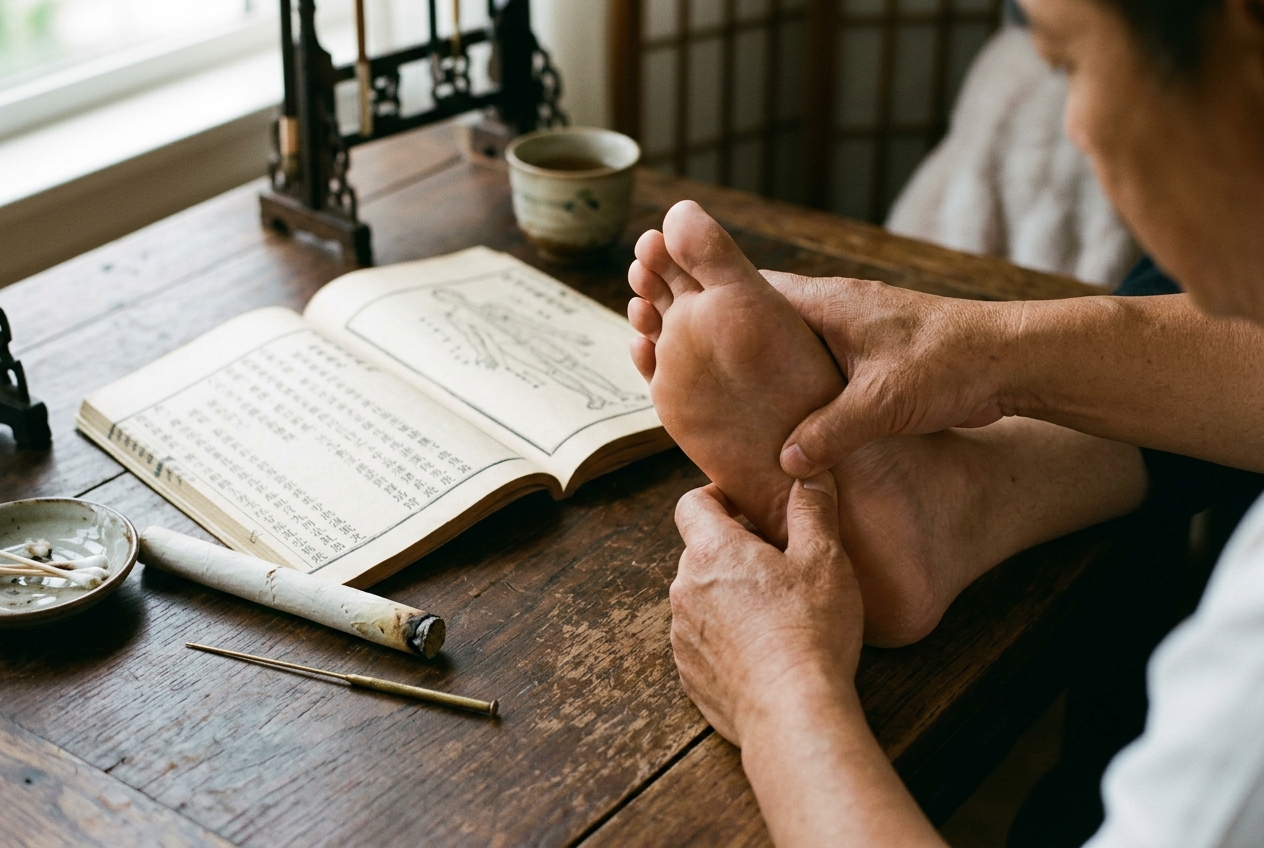
- Step 1: Grounding the Base (Yongquan KI1): Begin by crossing your right foot over your left knee. Place your left thumb directly into the center-upper third hollow of the sole (KI1). Apply firm, circular pressure with your thumb while supporting the top of your foot with your remaining fingers. Continue for 90 seconds until a deep, radiant warmth emerges in the sole. Repeat on the left foot.
- Step 2: Activating the Microvascular Cross-Chain (Hegu LI4 + Sanyinjiao SP6): With your left hand, firmly grasp the muscular web of your right hand (LI4), pressing firmly against the second metacarpal bone. Simultaneously, use your right foot or right hand to apply sustained thumb pressure on your left inner leg at SP6 (four fingerbreadths above the inner ankle). Hold both points with steady, unwavering pressure for 2 minutes while breathing slowly into your lower abdomen. Switch sides and repeat.
- Step 3: Rekindling the Core Furnace (Zhongwan CV12 & Guanyuan CV4): Lie flat on your back with your knees comfortably bent and feet flat on the mattress. Place the pads of your right fingers at the midpoint between your breastbone and navel (CV12), and the pads of your left fingers two inches below your navel (CV4/CV6). As you exhale, gently sink your fingers 1 to 1.5 inches into your abdomen; as you inhale, allow your abdominal wall to lift your hands back up. Maintain this synchronized, gentle rocking pressure for 3 minutes.
- Step 4: Driving Systemic Tonification (Zusanli ST36): Return to a seated position. Locate ST36 on both legs (four fingerbreadths below the kneecap, just outside the shinbone). Place your thumbs firmly onto the points, wrapping your fingers around the back of your calves. Apply a pulsing pressure—firming up for 3 seconds, releasing slightly for 1 second—for 90 seconds simultaneously on both legs.
- Step 5: Closing & Autonomic Integration (Laogong PC8): Rest your hands open on your thighs, palms facing upward. Use your right thumb to gently press and hold the exact center of your left palm (PC8) for 60 seconds with steady, calming pressure. Close your eyes and observe your heart rate settle. Switch hands and hold the right palm center for 60 seconds.
5. Safety, Contraindications & Clinical Sense
While acupressure is an inherently safe, non-invasive modality, working with potent classical resuscitation points requires discernment, precise technique, and clinical responsibility.
Critical Contraindications
- Pregnancy Precautions: Points Hegu (LI4), Sanyinjiao (SP6), Guanyuan (CV4), and Qihai (CV6) possess strong downward-bearing, oxytocic actions that historically stimulate uterine contractions and promote labor. They are strictly contraindicated throughout all trimesters of pregnancy.
- Cervical Spine Safety at Yamen (GV15): In clinical acupuncture, Yamen requires advanced anatomical mastery due to its proximity to the subarachnoid space and medulla oblongata. When practicing self-acupressure, never use sharp, forceful, or deeply thrusting pressure at the nape of the neck. Apply only broad, gentle, superficial fingertip contact.
- Pressure Intensity and Tissue Integrity: "Effective pressure" should produce what classical texts term De Qi (得气)—a dull, spreading, heavy ache or mild tingling sensation. It should never feel sharp, burning, or excruciatingly painful. Avoid applying pressure directly over varicose veins, open wounds, inflamed joints, or active hematomas.
6. Today's Takeaway — The Two-Minute Reset
You do not need twelve minutes to begin feeling the autonomic benefits of this classical system. If you are reading this at a desk, feeling mentally drained, physically chilled, or overwhelmed by cognitive stress, perform this single two-minute intervention right now:
By connecting ancient empirical lineage with contemporary neurobiology, the Nine Needles for Restoring Yang reminds us that our bodies carry an innate architecture for repair. With just a few minutes of informed, intentional pressure, you can step out of systemic exhaustion and systematically rekindle your vital physical reserve.