Gigantic Jet Dynamics & Stratospheric Electrical Breakdown: How Upward Leader Propagation and Cloud-Top Charge Imbalances Bridge Thunderstorms to the Ionosphere
1. Opening Scene: The Breath Before the Flash
The late-summer twilight over the coastal waters hangs heavy, stagnant, and thick with salt and moisture. Standing on an exposed bluff fifty miles from the core of an offshore storm complex, you can feel the physical weight of the atmosphere shifting around you. The barometer on your wrist has been steadily ticking downward for the past two hours, dropping through millibar after millibar as an enormous mesoscale convective system organizes over the warm sea. The wind, which had blown offshore in fitful, warm gusts, suddenly stalls into an eerie, glass-like calm.
Across the distant horizon, the sky is dominated by a towering cumulonimbus anvil. Its frozen crown punches through the tropopause into the lower stratosphere, forming an overshooting dome that glows a pale slate-gray against the dying indigo of dusk. The air near the ground smells acutely of ozone and petrichor—the metallic tang of electrical charge mixing with the dust of desiccated earth moistened by the first scattered, fat raindrops. Deep within the thunderhead, silent pulses of intracloud lightning illuminate the billowing cloud cauldrons from within, flickering like a stuttering neon bulb.
                    IONOSPHERE (~85-90 km)
             -------------------------------------
                             /|\
                            / | \     Mesospheric Crown
                           /  |  \    (Crimson Red N2 1P)
                          /   |   \
                         /    |    \
                        /     |     \
                             |||      Stratospheric Transition
                             |||      (Purple / Mixed Emissions)
                             |||
                              |
                              |       Thermalized Leader Trunk
                              |       (Cobalt Blue N2+ 1N / N2 2P)
                              |
                     ................... Cloud Anvil Boundary (~16-18 km)
                    [  +  +  +  +  +  +  ] Upper Positive Charge Layer
                    [  -  -  -  -  -  -  ] Depleted Mid-Level Negative Core
                    =====================
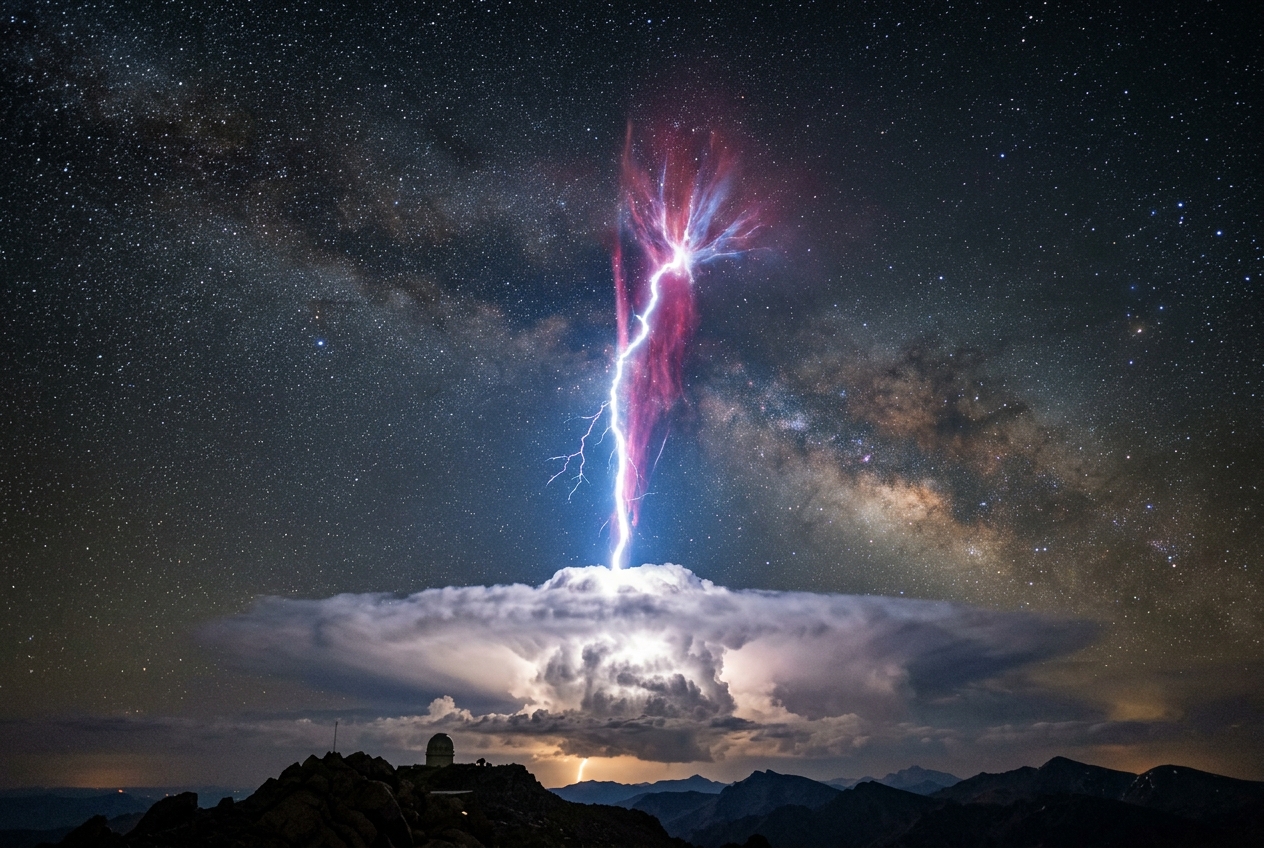
Then, without a single bolt striking the sea below, something extraordinary occurs above the cloud. From the apex of the overshooting top, a blinding spire of cobalt-blue fire erupts vertically into the pristine, starry stratosphere. In less than a tenth of a second, the narrow jet rockets upward, widening as it climbs. At forty kilometers, its hue softens into violet; by sixty kilometers, it blooms into a majestic, dendritic crown of incandescent crimson that brushes the lower ionosphere eighty-five kilometers above the Earth. For a fraction of a heartbeat, the storm has forged a direct, conducting plasma conduit between the weather engine of the troposphere and the edge of space itself.
2. What is Actually Happening: Plain English First
To understand why a thunderstorm shoots electricity into space rather than into the ground, think of the atmosphere as a vast, layered cake of gas. The bottom layer—the troposphere, where all our weather lives—is dense, heavy, and compressed by the weight of everything above it. As you climb upward into the stratosphere and mesosphere, the air thins out exponentially. By the time you reach seventy kilometers above sea level, the air is thousands of times less dense than the air filling your lungs right now.
Inside an active thunderstorm, powerful updrafts and downdrafts act as a gigantic electrostatic generator. Millions of tiny ice crystals and heavy, soft hail pellets called graupel collide constantly. The lighter ice crystals strip electrons from the graupel and get swept to the top of the cloud, creating a reservoir of positive electrical charge. The heavier graupel settles into the middle and lower regions, creating a reservoir of negative electrical charge.
                                  [ Ionosphere: Highly Conductive ]
                                                 ^
                                                 |  Gigantic Jet: Escaping
                                                 |  bidirectional leader
                                                 |  bridges cloud to space
                                                 |
                       - - - - - Screening Layer | (- charge from stratosphere)
                     + + + + + + Upper Cloud Top | (+ charge reservoir)

                     - - - - - - Mid-Level Core  | (Neutralized by IC discharge)

                     + + + + + + Cloud Base
             ----------------------------------------------------------------
                                   [ Earth Surface / Sea ]
Normally, this electrical tension resolves itself through lightning bolts connecting the cloud's middle to the ground, or connecting the positive top to the negative center inside the cloud. But in violent, oceanic thunderstorms or massive supercells, an unusual imbalance can occur. If an internal lightning discharge suddenly neutralizes the negative charge core in the middle of the storm, the massive positive charge at the top of the cloud is left completely exposed and unshielded.
This leftover pool of charge creates an immense vertical electric field that points straight up toward the heavens. Because the air above the storm gets thinner with every kilometer of altitude, it becomes progressively easier for electricity to tear through the air molecules. A self-propagating spark—a plasma channel called a leader—blasts out of the top of the cloud. Unlike common lightning that zigzags downward, this electrical monster races upward toward the electrically conductive layer of our upper atmosphere known as the ionosphere.
Meteorologists classify these high-altitude electrical flashes under the umbrella of Transient Luminous Events (TLEs). However, gigantic jets are fundamentally distinct from their cousins: * Red Sprites: These are cold, diffuse electrical glows that flicker high in the mesosphere (50–90 km) in response to a massive, separate cloud-to-ground lightning strike far below. They do not physically connect the cloud top to the ionosphere. * Blue Jets and Blue Starters: These are upward-propagating cones of light that shoot from the cloud top but run out of energy and extinguish in the stratosphere, rarely climbing above 40 to 50 kilometers. * Gigantic Jets (GJs): These are the heavyweights of atmospheric electrodynamics. They are fully developed, hot plasma channels that successfully bridge the entire gap from the thunderstorm anvil (16–20 km) all the way to the ionosphere (80–90 km), transferring immense electrical charge directly across the middle atmosphere.
3. The Science: Electrodynamics, Dielectric Breakdown, and Leader Kinetics
To rigorously model how a gigantic jet forms and propagates, we must analyze the electrodynamics of dielectric breakdown in a gas of exponentially decreasing density, the kinetics of the streamer-to-leader transition, and the optical spectroscopy of excited molecular nitrogen.
The Altitude-Dependent Dielectric Breakdown Field
The conventional dielectric breakdown threshold of ambient air, $E_k$, is the electric field strength at which the rate of electron ionization through collision exceeds the rate of electron loss via attachment to neutral molecules (primarily $O_2$). At standard temperature and pressure ($T_0 = 273.15\text{ K}$, $P_0 = 1013.25\text{ hPa}$, neutral gas number density $N_0 \approx 2.687 \times 10^{25}\text{ m}^{-3}$), this threshold is:
$$E_0 \approx 3.2 \times 10^6\text{ V/m} \quad (32\text{ kV/cm})$$
Because the breakdown field is directly proportional to neutral air density $\rho(z)$, it decreases exponentially with altitude $z$ according to the barometric scale height $H \approx 7.2\text{ km}$:
$$E_k(z) = E_0 \cdot \frac{\rho(z)}{\rho_0} = E_0 \exp\left(-\frac{z}{H}\right)$$
Altitude (z) | Relative Density (ρ/ρ0) | Breakdown Field Ek(z)
--------------------------------------------------------------
 0 km (STP)  | 1.0                     | 3,200,000 V/m
18 km (Anvil)| ~0.082                  |   262,400 V/m
40 km (Strat)| ~0.0038                 |    12,160 V/m
75 km (Mesos)| ~0.000030               |        96 V/m
Worked Calculation: Dielectric Breakdown at 18 km versus 75 km
Let us calculate the critical electric field required to initiate an electrical discharge at the cloud anvil top ($z_1 = 18\text{ km}$) and compare it to the field required to sustain streamer propagation in the mesosphere ($z_2 = 75\text{ km}$).
-
At the cloud top ($z_1 = 18\text{ km}$): $$\frac{\rho(18)}{\rho_0} = \exp\left(-\frac{18\text{ km}}{7.2\text{ km}}\right) = \exp(-2.5) \approx 0.08208$$ $$E_k(18\text{ km}) = 3.2 \times 10^6\text{ V/m} \times 0.08208 \approx 2.63 \times 10^5\text{ V/m} = 263\text{ kV/m}$$
-
In the mesosphere ($z_2 = 75\text{ km}$): $$\frac{\rho(75)}{\rho_0} = \exp\left(-\frac{75\text{ km}}{7.2\text{ km}}\right) = \exp(-10.417) \approx 2.99 \times 10^{-5}$$ $$E_k(75\text{ km}) = 3.2 \times 10^6\text{ V/m} \times 2.99 \times 10^{-5} \approx 95.7\text{ V/m}$$
This stark contrast explains why gigantic jets undergo a dramatic morphological transition as they climb. Near the cloud top at 18 km, the electric field must be hundreds of kilovolts per meter, requiring a highly concentrated, thermalized plasma channel (the leader). But once that leader ascends into the mesosphere, the threshold drops to double-digit volts per meter, allowing the discharge to explode laterally into thousands of diffuse, branching streamer filaments forming a vast crown.
       DIELECTRIC BREAKDOWN THRESHOLD vs. ALTITUDE
   Altitude (km)
      80 |* (Ek ≈ 50 V/m - Diffuse Mesospheric Crown)
      70 | *
      60 |  *
      50 |   *
      40 |    * (Ek ≈ 12 kV/m - Violet Transition)
      30 |      *
      20 |        * (Ek ≈ 200 kV/m - Narrow Thermalized Leader)
      10 |            *
       0 +----------------*------------------
         0.1            100               10,000  kV/m (log scale)
Thunderstorm Charge Structure and Unbalanced Dipoles
For a gigantic jet to escape the cloud, the internal charge geometry of the cumulonimbus must be fundamentally disrupted. Thunderclouds typically exhibit a tripole structure: a main mid-level negative charge layer ($Q_1 \approx -40\text{ to } -80\text{ C}$) at temperatures between $-10^\circ\text{C}$ and $-25^\circ\text{C}$, an upper positive charge layer ($Q_2 \approx +40\text{ to } +80\text{ C}$) near the anvil top ($-40^\circ\text{C}$ to $-60^\circ\text{C}$), and a small lower positive charge layer near the cloud base.
At the upper boundary of the anvil, cosmic-ray-induced atmospheric conductivity causes negative ions from the stratosphere to accumulate on the outer cloud boundary, creating a thin screening charge layer ($\sigma_{\text{screen}} < 0$). Under normal conditions, this screening layer traps the electric field lines entirely inside the cloud.
                               UPPER STRATOSPHERE
    -------------------------------------------------------------------------
                               ↑ ↑ ↑  E_escape ↑ ↑ ↑
    -------------------------------------------------------------------------
    [ - - - - - - - - - - - - - - - - - - - - - - - - - ] Negative Screening Layer
    [ + + + + + + + + + + + + + + + + + + + + + + + + + ] Upper Positive Layer (Q_upper)

              ↑               X (Internal IC Lightning cancels mid-level core)
              |
    [ . . . . . . . . . . . . . . . . . . . . . . . . . ] Neutralized Mid-Level Core

    -------------------------------------------------------------------------
The initiation of a negative gigantic jet proceeds through the following electrodynamic steps: 1. Mid-Level Charge Neutralization: An intense, multi-pulse intracloud (IC) lightning discharge occurs between the mid-level negative core and the lower positive charge, or between the mid-level negative and adjacent regions of the storm. 2. Unbalanced Potential: The removal of the mid-level negative charge leaves the upper positive charge layer ($Q_{\text{upper}}$) without an internal counterpart. 3. Screening Layer Penetration: Because the overshooting convective top pushes physically above the main anvil, the localized electric field between the upper positive core and the negative screening layer exceeds the local breakdown field $E_k(z)$. 4. Upward Bidirectional Leader Initiation: A bidirectional leader initiates at the cloud boundary. The downward-propagating positive leader neutralizes remaining negative charge inside the cloud, while the upward-propagating negative leader bursts out into the stratosphere.
Streamer-to-Leader Thermalization Kinetics
The upward discharge does not remain a cold streamer. To penetrate tens of kilometers through the dense stratosphere, the channel must undergo thermalization.
When a streamer's current density $J$ exceeds a critical threshold, gas heating occurs via electron-neutral vibrational-translational ($V\text{-}T$) energy relaxation:
$$\frac{d T_{\text{gas}}}{dt} = \frac{\eta_h \cdot \mathbf{J} \cdot \mathbf{E}}{\rho(z) c_p}$$
where $\eta_h$ is the heating efficiency fraction, $\mathbf{J} \cdot \mathbf{E}$ is the Joule heating power per unit volume, and $c_p$ is the specific heat capacity at constant pressure.
As $T_{\text{gas}}$ exceeds $3,000\text{ K}$, thermal dissociation of air molecules occurs, drastically reducing the local neutral gas density within the core ($\rho_{\text{core}} \ll \rho_{\text{ambient}}$). This hydrodynamic expansion maintains a low internal breakdown field, transforming the cold streamer bundle into a highly conductive, hot leader channel with conductivity:
$$\sigma = n_e e \mu_e$$
where $n_e$ is the electron number density ($n_e \sim 10^{19}\text{ m}^{-3}$ in the leader core), $e$ is the elementary charge, and $\mu_e$ is electron mobility. This thermalized core acts as a nearly perfect metallic wire projecting upward at velocities exceeding $10^5\text{ to } 10^6\text{ m/s}$.
Charge Moment Change ($\Delta M_q$) Calculation
The macroscopic electrical impact of a gigantic jet is characterized by its Charge Moment Change ($\Delta M_q$), which represents the quantity of charge transferred multiplied by the vertical distance over which it is moved:
$$\Delta M_q = \int_0^{\Delta t} I(t) \cdot z(t) \, dt \approx Q \cdot \Delta z$$
Gigantic jets typically transfer between $Q = 50\text{ C}$ and $300\text{ C}$ from the cloud top ($z_1 \approx 18\text{ km}$) to the ionosphere ($z_2 \approx 85\text{ km}$), yielding vertical displacements $\Delta z \approx 67\text{ km}$.
Worked Calculation: Charge Moment Change of a Giant Event
Suppose a gigantic jet observed by low-frequency radio arrays transfers an average current $I = 2.5\text{ kA}$ over a duration $\Delta t = 80\text{ ms}$ from an effective cloud altitude $z_1 = 18\text{ km}$ to the ionospheric boundary $z_2 = 80\text{ km}$.
-
Calculate total charge transferred ($Q$): $$Q = I \cdot \Delta t = 2,500\text{ A} \times 0.080\text{ s} = 200\text{ C}$$
-
Calculate vertical displacement ($\Delta z$): $$\Delta z = 80\text{ km} - 18\text{ km} = 62\text{ km}$$
-
Calculate the Charge Moment Change ($\Delta M_q$): $$\Delta M_q = Q \cdot \Delta z = 200\text{ C} \times 62\text{ km} = 12,400\text{ C}\cdot\text{km}$$
For context, standard cloud-to-ground lightning strokes produce charge moment changes of $200\text{ to } 1,000\text{ C}\cdot\text{km}$. A gigantic jet producing over $10,000\text{ C}\cdot\text{km}$ represents one of the single most powerful electrical charge transfers anywhere in the planetary climate system.
+---------------------------------------------------------------------------+
|                          CHARGE MOMENT RESULT BOX                         |
|                                                                           |
|   Current (I): 2.5 kA         Duration (Δt): 80 ms                        |
|   Charge (Q):  200 Coulombs   Distance (Δz): 62 Kilometers                |
|                                                                           |
|   TOTAL CHARGE MOMENT CHANGE:                                             |
|   ΔMq = 12,400 C·km  (Exceeds conventional lightning by 10x to 50x)       |
+---------------------------------------------------------------------------+
Optical Spectroscopy and Emission Physics
The striking color gradient of gigantic jets—from vivid cobalt blue at the base to fiery crimson at the crown—is dictated by the quantum mechanics of molecular nitrogen and the pressure-dependent rate of collisional quenching.
                  QUANTUM TRANSITIONS AND QUENCHING

  [ C^3Π_u State ] --- (Short radiative lifetime ~37 ns) ---> [ B^3Π_g State ]
         |                                                           |
         | (N2 2P Emission: 337.1 nm Blue/UV)                        | (N2 1P Emission: 650-890 nm Red)
         v                                                           v
  [ Radiates even in dense air at 20 km ]                   [ Quenched below 45 km by O2/N2 collisions ]
                                                            [ Radiates freely in thin air at 70 km ]
-
The Lower Channel (16–35 km: Blue/Violet): In the dense lower stratosphere, high kinetic collision rates with neutral $O_2$ and $N_2$ molecules instantly deactivate (quench) long-lived electronic excited states before they can emit photons. However, the Nitrogen Second Positive System ($N_2\text{ 2P}$, $C^3\Pi_u \to B^3\Pi_g$) and the ionized Nitrogen First Negative System ($N_2^+\text{ 1N}$, $B^2\Sigma_u^+ \to X^2\Sigma_g^+$) have exceptionally short radiative lifetimes ($\tau_{\text{rad}} \approx 37\text{ ns}$). They emit photons in the near-ultraviolet and blue spectrum (predominantly $337.1\text{ nm}$, $391.4\text{ nm}$, and $427.8\text{ nm}$) before collisions can quench them.
-
The Upper Crown (50–90 km: Crimson Red): In the high mesosphere, the Nitrogen First Positive System ($N_2\text{ 1P}$, $B^3\Pi_g \to A^3\Sigma_u^+$) dominates. This transition emits in the red and near-infrared spectral range ($650\text{ to } 890\text{ nm}$). Because the upper state has a relatively long radiative lifetime ($\tau_{\text{rad}} \approx 6\text{ }\mu\text{s}$), it is completely quenched in the lower atmosphere. But at altitudes above 50 km, where the collision frequency drops below the spontaneous emission rate:
$$\nu_{\text{collision}}(z) < \frac{1}{\tau_{\text{rad}}}$$
the red transitions radiate uninhibited, painting the mesospheric tree-like canopy in deep crimson.
Radio and Electrodynamic Signatures
Unlike red sprites, which are preceded by a powerful positive cloud-to-ground ($+\text{CG}$) return stroke detected by networks like the NOAA National Severe Storms Laboratory and Met Office lightning location systems, gigantic jets produce a fundamentally different signature: * Absence of Parent Return Stroke: Global lightning detection networks record no ground strike at the moment of jet initiation. * Extremely Low Frequency (ELF) Waves: Gigantic jets produce distinct continuous waveforms in the 3 Hz to 3 kHz ELF band. These magnetic pulses reflect the sustained upward flow of electric current lasting 50 to 150 milliseconds. * Schumann Resonance Excitation: The direct current injection into the lower ionosphere excites the Earth-ionosphere waveguide cavity, producing measurable spikes in global Schumann Resonances recorded thousands of miles away.
4. Practical Outdoor Guidance: Spotting and Measuring Extreme Convective Discharges
While gigantic jets are among the rarest optical phenomena in the atmosphere, dedicated observers, storm chasers, and mariners routinely capture them with the proper knowledge and equipment.
                             OBSERVATION GEOMETRY
                               Mesospheric Crown (~80 km)
                                         *
                                       * | *
                                      *  |  *
                                         |
                                         |
                                         |  Elevation Angle: 10° - 25° Above Horizon
                                         |  Line-of-Sight: 100 - 300 km Clear Air
   Observer Location                     |
         o-------------------------------[ Anvil Cloud Top: 16-18 km ]
   (Under Clear Skies)
What to Look for in the Sky
- Storm Architecture: Look for large, isolated tropical oceanic thunderstorms, tropical cyclones, or massive continental Mesoscale Convective Systems (MCS) during mid-to-late summer. The storm must possess a vigorous, bubbling overshooting top that punches through the flat anvil surface.
- Observer Distance: You cannot see a gigantic jet if you are directly under the storm; the cloud anvil will block your view. You must be located between 100 and 300 kilometers away, where the sky above you is completely clear and dark, but the distant storm top is visible just above the horizon.
- Visual Appearance: To the naked eye adapted to the dark, a gigantic jet appears as a silent, towering white-blue pillar that instantaneously erupts upward from the distant cloud top, terminating in an expansive, ghostly red flicker that vanishes in the blink of an eye ($\sim 100\text{ ms}$).
Instruments and Readings to Monitor
- Barometric Pressure: Watch for deep, steady regional pressure drops ($> 3\text{ hPa/hr}$) indicating the intensification of an organized convective complex.
- Infrared Satellite Imagery: Consult resources from the World Meteorological Organization (WMO) and NASA Earth Observatory. Look for cloud-top brightness temperatures dropping below $-75^\circ\text{C}$ to $-85^\circ\text{C}$, signifying extreme convective updrafts punching into the tropopause.
- Camera Setup: Mount a high-sensitivity mirrorless camera or low-light CMOS astronomy camera on a sturdy tripod. Set the lens to its widest aperture ($f/1.4 - f/2.8$), manual focus at infinity, ISO 3200–6400, and run continuous 2-to-4 second exposures aimed 10° to 25° above the distant thunderhead anvil.
Practical Rules for Outdoorsmen and Mariners
- The Mariner's Horizon Rule: If you are sailing in tropical waters and observe intense, persistent intracloud anvil flickering with almost zero cloud-to-ground strikes on your marine lightning receiver, you are viewing an electrical environment ripe for upward leader escape. Maintain visual watch above the anvil.
- The Hiker's Safety Paradox: If you can see the stars directly above your campsite, but a towering anvil head looms on the distant horizon, you are in the perfect, safe observation zone. Never attempt to observe TLEs while positioned within the precipitation core or under the anvil of the parent thunderstorm.
5. Today's Meteorological Rule of Thumb
When a tropical storm punches the stratosphere and holds its electrical charge within its icy crown rather than striking the sea, look upward: the atmosphere's thinnest air offers the path of least resistance, turning the thunderstorm into a conduit that bridges Earth to the edge of space.
Authoritative References & Further Reading
- NOAA National Severe Storms Laboratory - Severe Weather and Lightning Physics
- World Meteorological Organization (WMO) - Thunderstorms and Upper Atmospheric Phenomena
- Met Office - Atmospheric Electrical Discharges and Thunderstorm Structure
- NASA Earth Observatory - Observing Transient Luminous Events from Orbit
- Wikipedia - Upper-Atmospheric Lightning and Gigantic Jets