Sun Pillars & Light Pillar Optics: How Flat Ice Crystal Aerodynamics and Specular Reflection Forge Towering Twilight Beams
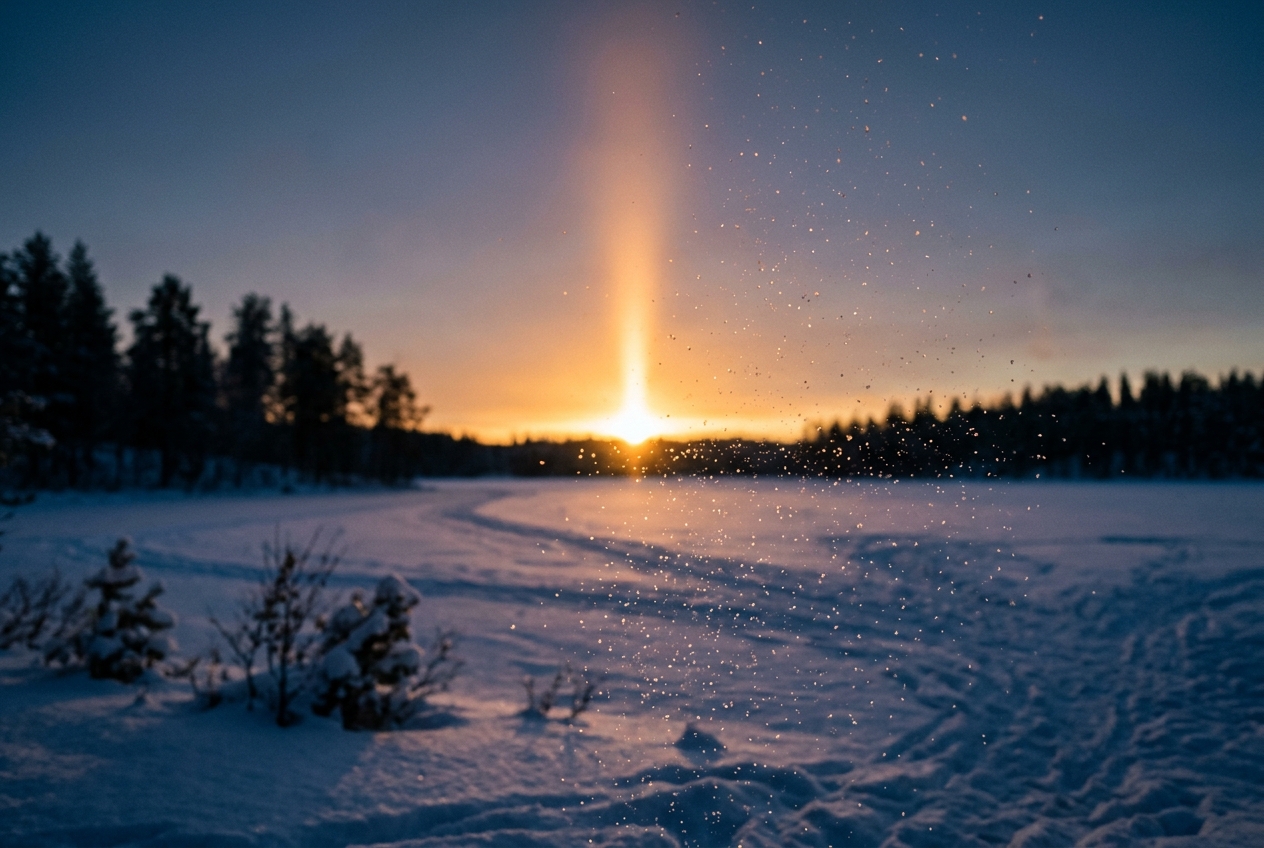
The temperature has fallen past $-22^\circ\text{C}$, and the stillness of the polar night is absolute. Every inhalation carries a searing dryness that crystallises moisture inside the nostrils in a fraction of a second, while the snowpack beneath heavy insulated boots emits a high-pitched, styrofoam-like screech—the acoustic signature of ice grains welded together by brittle thermal contraction. The atmosphere feels strangely dense, purged of all convective motion by an intense surface-based temperature inversion. As the last embers of astronomical twilight dissolve into deep indigo along the northern horizon, the frozen valley below awakens not with ordinary diffuse illumination, but with an otherworldly architecture of vertical light.
Above every sodium streetlamp, porch lantern, and industrial floodlight, brilliant vertical columns of pure luminescence climb hundreds of metres into the clear troposphere. Unbroken by horizontal spread or chromatic fringing, these towering shafts of cold fire stand perfectly erect, shimmering with a gentle, metallic glitter whenever a stray breath of air passes through the valley. To an observer walking down the frozen road, the pillars do not behave like physical beams of searchlight cutting through fog. Instead, they glide across the sky in perfect unison with the observer's footsteps, tracking the eye with an uncanny geometric fidelity. High above the distant, sunless horizon, an identical golden pillar rises directly out of the buried sun’s position, ascending like a luminous spear through the evening sky.
What’s Actually Happening: The Atmosphere as a Million Microscopic Mirrors
To comprehend the origin of these spectacular light shafts, one must first abandon the intuitive assumption that light pillars are physical columns of glowing air. When a lighthouse sweeps its beam through marine fog, the path of the beam is made visible by Mie scattering—a process where suspended liquid droplets scatter incoming photons indiscriminately in all directions, illuminating the physical volume of the air column. If you walk toward a lighthouse beam, the beam stays firmly anchored in its spatial track.
A light pillar behaves in an entirely different manner. It is not an illuminated object; it is an optical caustic, a collective virtual image generated simultaneously by millions of macroscopic, horizontally floating ice crystal facets acting as flat, microscopic mirrors.
                      [ Incoming Light Rays ]
                             \       /
                              \     /
                 ==============\===/==============  <-- Basal Plane (0001)
                                \ /
                          [ Ice Crystal ]
                                 |
                                 v  (Specular Reflection)
                          [ Observer Eye ]
Think of the lower atmosphere during a frigid, calm winter evening as a ballroom floor covered with falling poker chips or dinner plates. If you drop a sheet of flat cardstock through still air, it does not tumble edge-first like an arrow; aerodynamic drag against its broad, flat face forces it to descend horizontally, gliding gently from side to side. In the frozen troposphere, water vapour crystallises directly into paper-thin hexagonal plates and flat prisms known meteorologically as "diamond dust." As these crystalline wafers settle under gravity through quiescent air, the aerodynamic pressure distribution across their surfaces forces their broad basal faces to orient almost perfectly horizontal, parallel to the ground.
When rays of light from the sun, the moon, or a ground-level streetlight strike these descending crystal plates, the light does not pass through the crystal to be refracted and separated into rainbow colours—a mechanism governed by Snell's law that produces spectacular refractive halo phenomena such as 22° halos, parhelia (sundogs), and circumhorizontal arcs, as documented in the World Meteorological Organization (WMO) International Cloud Atlas. Instead, the light undergoes pure specular reflection from the flat upper or lower basal faces.
Because the crystals are not pinned rigidly in space but exhibit a slight aerodynamic wobble, each individual crystal reflects light toward the observer's eye only when its instantaneous tilt satisfies the fundamental law of reflection: the angle of incidence equals the angle of reflection. When thousands of these settling crystals at varying altitudes simultaneously flash a momentary glint of reflected light into the observer's pupil, the human visual cortex integrates these discrete point glints into a single, continuous, vertically oriented shaft of light. The pillar takes on the exact colour of its illuminating source—amber for high-pressure sodium lamps, stark cool white for modern light-emitting diodes, and deep vermilion or gold for a setting sun.
The Science: Microphysics, Hydrodynamics, and Geometric Caustics
1. Ice Crystal Morphogenesis in the Nakaya Window
The formation of atmospheric light pillars requires a specific microphysical regime governed by temperature and ice supersaturation. According to the classical Nakaya diagram of ice crystal morphology, the habit of an ice crystal growing from vapour is dictated primarily by ambient temperature:
- Between $0^\circ\text{C}$ and $-4^\circ\text{C}$, growth favors thin basal plates.
- Between $-4^\circ\text{C}$ and $-10^\circ\text{C}$, the crystal habit switches decisively to columnar prisms and needles.
- Between $-10^\circ\text{C}$ and $-15^\circ\text{C}$, growth transitions back to broad, flat hexagonal plates, sector plates, and dendritic crystals.
- Below $-20^\circ\text{C}$, growth returns to complex combinations of prisms, hollow columns, and pyramidal forms.
For light pillars to attain exceptional brightness and vertical coherence, the atmospheric boundary layer must be dominated by thin, unagglomerated hexagonal plates whose crystallographic basal faces—designated in Miller-Bravais indices as the $(0001)$ planes—are mirror-smooth and structurally intact. If columnar crystals or dendritic flakes dominate, diffuse scattering or multi-facet refraction destroys the specular reflection channel.
       Miller-Bravais Basal Face (0001)
                 +-------------+
                /               \
               /                 \
              +                   +  <-- Prism Facet {10-10}
               \                 /
                \               /
                 +-------------+
                 Basal Face (0001)
2. Aerodynamic Stability and the Wobble Distribution
As a hexagonal ice plate falls through the atmosphere, its motion is governed by low-to-intermediate Reynolds number hydrodynamics:
$$\text{Re} = \frac{\rho_{\text{air}} v_t d}{\mu_{\text{air}}}$$
where $\rho_{\text{air}}$ is air density, $v_t$ is terminal settling velocity (typically $0.1\text{ to }0.5\text{ m s}^{-1}$ for diamond dust plates), $d$ is the crystal diameter ($50\text{ to }500\,\mu\text{m}$), and $\mu_{\text{air}}$ is dynamic viscosity. Under typical sub-zero boundary layer conditions, $\text{Re}$ ranges between $0.5$ and $20$.
In this flow regime, viscous shear forces and inertial pressure fields generate a restoring aerodynamic torque whenever the crystal tilts away from the horizontal plane. The centre of pressure shifts toward the leading edge of the tilt, creating a torque that forces the broad $(0001)$ basal face perpendicular to the relative airflow (i.e., horizontal).
However, microscopic ambient shear, shedding vortex rings, and thermal Brownian perturbations prevent the crystals from maintaining a static horizontal orientation. Instead, the crystals experience a continuous, low-amplitude aerodynamic flutter or wobble. The tilt angle $\alpha$ (the angular deviation of the crystal's basal surface normal $\mathbf{n}$ from the true zenith $\mathbf{z}$) is distributed according to a two-dimensional Gaussian probability density function:
$$P(\alpha) = \frac{1}{\sigma_\alpha \sqrt{2\pi}} \exp\left(-\frac{\alpha^2}{2\sigma_\alpha^2}\right)$$
In stable, non-turbulent atmospheric inversions, the standard deviation of crystal tilt $\sigma_\alpha$ typically resides between $0.5^\circ$ and $4.0^\circ$, reaching up to $8.0^\circ$ in weak convective stirring. This narrow angular distribution is the primary physical parameter determining the maximum vertical extension of solar and lunar pillars.
                       RAY GEOMETRY OF SOLAR PILLAR REFLECTION

Solar Rays (Parallel)
             \             \             \
              \             \             \
               \             \             \
        ~~~~~~~~[+alpha]~~~~~~~[ 0 deg ]~~~~~~~[-alpha]~~~~~~~  <-- Wobbling Ice Plates
                 \             |             /
                  \            |            /
                   \           |           /
                    \          |          /
                     \         |         /
                      v        v        v
                            [Observer]
3. Mathematical Derivation of Solar Pillar Angular Height
When light originates from an astronomical object at infinity—such as the sun—incoming light rays are parallel. Let the solar elevation angle above the true astronomical horizon be $\phi_s$, and consider an ice crystal whose basal normal is tilted by an angle $\alpha$ within the vertical plane containing the sun and the observer.
According to the law of specular reflection, the incident ray vector $\mathbf{i}$, the reflected ray vector $\mathbf{r}$, and the surface normal $\mathbf{n}$ satisfy:
$$\mathbf{r} = \mathbf{i} - 2(\mathbf{i} \cdot \mathbf{n})\mathbf{n}$$
For a crystal tilted toward or away from the sun by an angle $\alpha$, the elevation angle of the reflected ray reaching the observer's eye, $\theta_{\text{obs}}$, is given geometrically by:
$$\theta_{\text{obs}} = -\phi_s + 2\alpha$$
Because the human observer perceives the reflected ray as originating from elevation $\theta_{\text{obs}}$, the total vertical angular extension of the pillar above the sun's position, $\theta_{\text{pillar}}$, across a crystal ensemble with a maximum effective tilt angle $\alpha_{\text{max}}$, simplifies under small-angle approximations for low solar elevations ($\phi_s \approx 0$) to:
$$\theta_{\text{pillar}} \approx 2\alpha_{\text{max}} \cos(\phi_s)$$
Worked Numerical Example: Solar Pillar Elevation
Problem: Calculate the apparent angular height of a sun pillar observed during sunset when the solar disc is centered exactly on the horizon ($\phi_s = 0^\circ$), assuming an atmospheric ice plate population with a maximum tilt cutoff $\alpha_{\text{max}} = 4.5^\circ$.
- Identify the input variables: - Solar elevation: $\phi_s = 0.0^\circ$ - Maximum crystal tilt: $\alpha_{\text{max}} = 4.5^\circ$
- Evaluate the trigonometric factor: - $\cos(0.0^\circ) = 1.000$
- Apply the angular extension equation: $$\theta_{\text{pillar}} = 2 \times 4.5^\circ \times 1.000 = 9.0^\circ$$
- Physical Interpretation: The sun pillar will extend vertically $9.0^\circ$ above the horizon—equivalent to roughly 18 apparent solar diameters (since the sun's angular diameter $\delta_\odot \approx 0.5^\circ$) or approximately the width of a fist held at arm's length.
If the sun descends below the horizon to $\phi_s = -2.0^\circ$, the upper tip of the pillar remains visible at $\theta_{\text{obs}} = -(-2.0^\circ) + 2(4.5^\circ) = +7.0^\circ$ above the local horizon, explaining why sun pillars often appear most dramatic after solar transit below the topographic horizon, when the dazzling glare of the solar disc is physically occluded by the Earth's curvature.
4. Point-Source Divergence and Terrestrial Light Pillars
While solar pillars are generated by parallel rays from an infinite distance, artificial light pillars originate from terrestrial point sources (e.g., streetlamps) located inside the crystal cloud itself. This fundamental difference in optical geometry alters the caustic structure.
       DIVERGENT POINT SOURCE GEOMETRY (STREETLAMP)

Zenith
                     ^
                     |     Ice Crystal Cloud
             . - - - | - - - .
           /         |         \
          /   [Ice]  |  [Ice]   \     <-- Caustic envelope forms vertical line
         /      \    |    /      \
        /        \   |   /        \
       /          \  |  /          \
      /             v|v             \
   [Lamp]         [Observer]       [Lamp]
   Source 1                        Source 2
For a point source at distance $D$ from the observer and height $h_s$, light rays diverge radially outward in a spherical wavefront. A crystal at horizontal position $(x, y)$ and altitude $z$ reflects light into the observer's eye only if its local surface normal bisects the angle between the vector pointing to the source and the vector pointing to the observer.
Because the crystal swarm is three-dimensional and horizontally stratified, the locus of all valid reflection points for a given lamp forms a vertical sheet of caustics oriented along the vertical plane connecting the lamp, the observer, and the zenith. To the observer, this produces a narrow, perfectly vertical pillar that appears rooted to the lamp itself and ascends toward the zenith.
Crucially, because this caustic depends entirely on the relative position of the observer, moving 10 metres to the left causes the apparent light pillar in the sky to translate 10 metres to the left as well. The pillar has no absolute spatial coordinates; it exists purely as an observer-centric virtual caustic.
Practical Outdoor Guidance: The Observer's Diagnostic Checklist
For meteorologists, mountaineers, and winter night sky observers, forecasting and identifying light pillars requires assessing specific thermodynamic, boundary-layer, and optical indicators.
+---------------------------------------------------------------------------------------------------+
|                        METEOROLOGICAL DIAGNOSTIC MATRIX: LIGHT PILLARS                            |
+----------------------+-----------------------------+----------------------------------------------+
| Parameter            | Optimal Threshold           | Physical Diagnostic Purpose                  |
+----------------------+-----------------------------+----------------------------------------------+
| Surface Temperature  | T < -10°C (Idealy < -15°C)  | Enters the Nakaya plate-growth regime        |
| 10m Wind Speed       | u < 1.5 m/s (Calm / Light)  | Prevents mechanical boundary-layer tumbling  |
| Boundary Layer State | Strong Surface Inversion    | Suppresses turbulent kinetic energy (TKE)    |
| Ice Saturation       | RH_ice >= 100%              | Maintains crystal faces without sublimation  |
| Crystal Morphology   | Unagglomerated Plates       | Provides flat specular basal mirrors (0001)  |
+----------------------+-----------------------------+----------------------------------------------+
What to Look for in the Sky and Environment
- The Diamond Dust Sparkle: Under street lighting, examine the immediate air around you. If you see tiny, glittering points of light drifting slowly downward like suspended glitter—rather than tumbling, complex snowflakes—the atmosphere is charged with pristine hexagonal plates ready to form pillars.
- Color Homogeneity: Inspect the pillar's chromatic profile. True light pillars exhibit the exact spectral signature of their parent source from base to summit. If you observe separated red and blue fringes, you are looking at a refractive halo phenomenon (such as an upper tangent arc or a sun dog) rather than a specular reflection pillar.
- Subsun Detection (Aviation Perspective): If flying above a freezing cloud deck or standing atop a high alpine peak looking downward into diamond dust when the sun is high, look for the subsun—a blindingly bright, direct reflection of the sun appearing as an oval patch of light on the cloud sheet below the horizon, created by the exact same basal-plane specular mechanics.
- Lunar Pillars: During a full moon in sub-zero conditions, look for silver, ghostly pillars ascending above the lunar disc. Because the human eye relies on rod-dominated scotopic vision under low light, lunar pillars appear pale and monochromatic compared to their solar counterparts.
Essential Diagnostic Tools
- Precision Thermometer: Verify ambient surface temperatures are below $-10^\circ\text{C}$. At temperatures warmer than $-8^\circ\text{C}$, column and needle growth dominates, terminating pillar formation. Atmospheric profiles can be monitored via NOAA's National Weather Service sounding archives.
- Handheld Anemometer: Measure surface winds. Sustained winds exceeding $3.0\text{ m s}^{-1}$ ($6\text{ knots}$) introduce mechanical shear turbulence that rotates crystal plates chaotically, collapsing vertical pillars into diffuse, formless light hazes.
- Barometric Trend: Look for high-pressure anticyclonic stagnation (barometer reading $> 1020\text{ hPa}$ with a rising or steady trend), which drives the radiative cooling necessary to build sharp ground inversions, as outlined by the UK Met Office Weather Guide.
Today's Meteorological Rule of Thumb
The Pillar Axiom: When the temperature plunges below $-10^\circ\text{C}$ in dead calm air and the streetlamps begin to glitter with diamond dust, look straight above the lights: if the air is still enough for physics to balance a falling crystal, the sky will build you a cathedral of mirrors.
Comparative Summary of Ice Optical Phenomena
| Optical Phenomenon | Primary Physical Mechanism | Active Crystal Morphology | Color Characteristic | Relative Position to Light Source |
|---|---|---|---|---|
| Light / Sun Pillar | Specular External/Internal Reflection | Horizontally oriented flat plates | Monochromatic (Matches source) | Vertically aligned through source |
| Subsun | Direct Basal Reflection | Horizontally oriented flat plates | Pure solar white | Directly below sun (viewed from above) |
| 22° Halo | Refraction ($60^\circ$ prism angle) | Randomly oriented columns/plates | Chromatically dispersed (Red inner rim) | $22^\circ$ circular ring around source |
| Parhelion (Sundog) | Refraction ($60^\circ$ prism angle) | Horizontally aligned thin plates | Vibrant spectrum (Red toward sun) | $22^\circ$ horizontally flanking sun |
| Circumzenithal Arc | Refraction ($90^\circ$ prism angle) | Horizontally aligned thin plates | Ultra-pure rainbow spectrum | High altitude, curved around zenith |
Whenever the winter boundary layer freezes into laminar stillness, these floating planar crystals transform mundane municipal grids and polar twilights into sublime optical laboratories. By unifying fluid shear mechanics, crystal thermodynamics, and specular ray geometry, the science of the light pillar proves that even the most ethereal atmospheric spectacles are anchored in rigorous physical laws.