Stepped Leader & Return Stroke Kinematics: How Dielectric Breakdown Channels and High-Current Wavefronts Forge Cloud-to-Ground Lightning
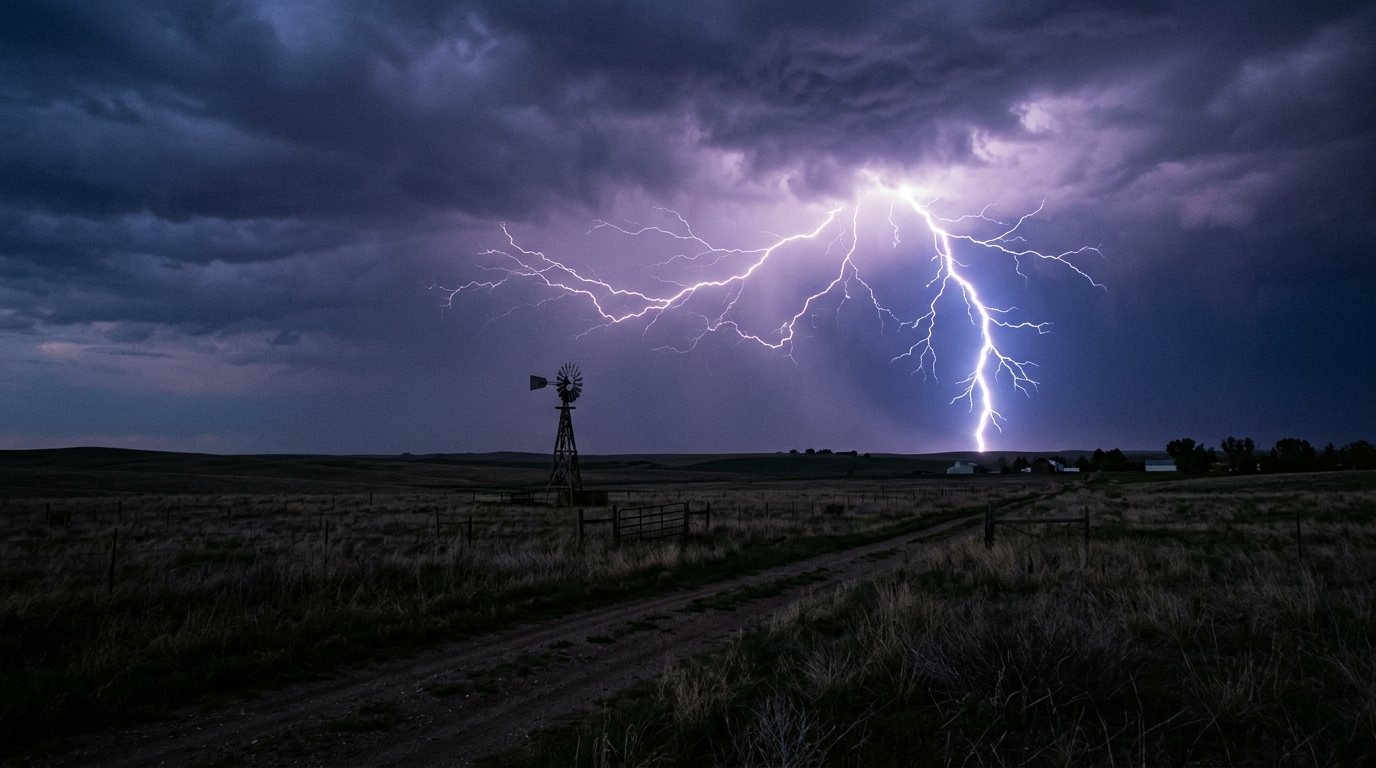
To stand beneath an approaching midsummer thunderstorm is to witness the atmosphere transform from an invisible, life-giving medium into a colossal, volatile engine of electrical breakdown. On a sultry July afternoon across the open uplands, the initial warning is not visual but tactile. The air, which for hours has hung heavy with stifling humidity, grows eerily motionless. The ambient barometric pressure begins a subtle, rhythmic decline that you register as a faint fullness in your inner ear and sinuses. Across the southern horizon, the sky curdles: the billowing, cauliflower-like turrets of cumulonimbus congestus glaciate into fibrous sheets of cirrostratus, forging a vast anvil—the cumulonimbus incus—that stretches out like a blackened canopy over the landscape.
       [ C L O U D   B A S E :  - - - - - - - - - - - - - ]
                               |
                               |  Stepped Leader (descends in 50m steps)
                               v  v ~ 10^5 m/s
                             /   \
                            /     \  (Branching channels)
                           /       \
                          |         |
                          v         v
                     [ Striking Distance Sphere, r_s ]
                                    :
                                    ^  Upward Positive Streamer
                                    |  (Inception from tallest structure)
       ___________________________[ TALL TOWER ]___________________________
                              G R O U N D
As the leading edge of the storm’s shelf cloud sweeps overhead, a dramatic thermal transition occurs. The oppressive heat is violently severed by the storm’s gust front—a dense, descending wedge of rain-chilled air racing out from the precipitation core. The ambient temperature plummets by eight to ten degrees Celsius in a matter of seconds. The wind veers sharply, rattling the canopy of nearby oaks and carrying the sharp, terrestrial fragrance of geosmin—the distinct smell of petrichor rising from sun-baked soil suddenly moistened by virga.
Then, nature falls abruptly silent. The birds cease their territorial calls; the rustling grasses stiffen. In that suspended second, the hair on your forearms prickles and lifts as an invisible electrostatic tension builds between the earth and the sky. Without warning, the gloom is annihilated by a blinding, branched incision of incandescent violet-white light. The discharge does not merely illuminate the terrain; it etches the surrounding topography with razor-sharp clarity. Before your retinal afterimage can even register the intricate, dendritic branching of the channel, a violent, bone-rattling percussion hammers against your sternum—a concussive crack of thunder that rattles windowpanes and rolls across the distant valleys in a low, reverberating crescendo.
Although to human perception this cataclysm appears instantaneous, it is in truth an exquisitely choreographed sequence of electrodynamic processes operating across nanoseconds, microseconds, and milliseconds.
2. What's Actually Happening — Plain English First
To understand the birth of a cloud-to-ground lightning bolt, one must first look at how a thunderstorm converts mechanical storm energy into electrical potential.
The Atmospheric Capacitor
Think of a thundercloud as a colossal, turbulent battery suspended in the troposphere. Deep within the storm’s central updraft, between altitudes where temperatures range from $-10^\circ\text{C}$ to $-20^\circ\text{C}$, billions of tiny, rising ice crystals collide with heavier, falling pellets of soft hail, known as graupel. Through non-inductive charge transfer, these collisions strip electrons from the rising ice crystals and deposit them onto the falling graupel. The vigorous updraft carries the positively charged ice crystals toward the upper fringes of the anvil, while gravity pulls the heavier, negatively charged graupel toward the lower-middle tiers of the cloud.
This spatial segregation establishes a profound dipole: a vast reservoir of positive charge aloft, an intensely concentrated pool of negative charge at the cloud base, and an induced shadow of positive charge migrating across the surface of the Earth directly beneath the storm, mirroring its movements across hills, forests, and buildings.
                  +  +  +  +  +  +  +  +  +  +  +  (Upper Anvil: Positive)
                 [                                ]
                 [       C L O U D   C O R E      ]
                 [                                ]
                  -  -  -  -  -  -  -  -  -  -  -  (Lower Base: Negative)

                                | | |  Electric Field (E)
                                v v v

                  +  +  +  +  +  +  +  +  +  +  +  (Earth Surface: Induced Positive)
The Townsend Avalanche and Dielectric Breakdown
Under ordinary conditions, ambient air is a magnificent electrical insulator. The gas molecules of nitrogen and oxygen cling tightly to their electrons. However, if you subject air to an ever-strengthening electric field, a tipping point arrives known as the dielectric breakdown threshold.
At sea level in pristine, dry air, this threshold ($E_c$) is roughly $3 \times 10^6\text{ V/m}$ (three million volts per metre). Yet, high-altitude balloon and aircraft measurements coordinated by the World Meteorological Organization (WMO) and academic researchers consistently observe that bulk electric fields inside thunderclouds rarely exceed $3 \times 10^5\text{ V/m}$—only a tenth of the theoretical breakdown value.
How does the air break down under such seemingly insufficient fields? The answer lies in the microphysics of suspended precipitation particles, or hydrometeors. When raindrops and ice crystals are suspended within a strong background electric field, the charges on their surfaces polarize, creating sharp, localized field enhancements at their pointed tips. These micro-scale field enhancements easily exceed the threshold for a physical chain reaction known as the Townsend discharge or Townsend avalanche.
A stray energetic electron, accelerated by this localized field, slams into neutral air molecules, knocking free secondary electrons. These newly liberated electrons are accelerated in turn, liberating further electrons in an exponential cascade. Within nanoseconds, a cold, non-equilibrium pocket of ionized gas—a plasma—is born.
The Stuttering Descent: The Stepped Leader
Once this conductive embryonic channel forms at the cloud base, it does not shoot straight to the ground in an unbroken stream. Instead, it advances in a stuttering, halting fashion called a negatively charged stepped leader.
Think of the stepped leader as a cautious scout navigating an uncharted path in total darkness. The negative charge pushes downward in a rapid, luminous spurt roughly 50 metres long, traversing this distance in less than a microsecond. Then, it pauses for 20 to 50 microseconds, during which the tip of the channel glows faintly as it pools fresh negative charge from the cloud above. Once the localized electric field at the newly established tip re-exceeds the dielectric breakdown threshold of the virgin air ahead, the leader takes another 50-metre leap, frequently bifurcating into two or more distinct branches.
Because of these periodic pauses, the overall downward propagation velocity of the stepped leader is surprisingly leisurely by electromagnetic standards: roughly $10^5\text{ m/s}$ (one hundred kilometres per second), which is less than 0.1% of the speed of light. It takes several tens of milliseconds for the stepped leader to bridge the kilometres of airspace between the cloud base and the earth.
The Upward Reaching Streamer
As the heavily charged foot of the stepped leader descends within a hundred metres of the surface, its concentrated negative charge creates an immense electrostatic attraction for the positive charges accumulated in the ground. The electric field at the Earth’s surface surges dramatically.
Because electric field lines concentrate at sharp points and elevated structures, tall objects—such as church spires, communications masts, isolated oak trees, and even people standing in open fields—begin to glow with faint, purplish corona discharges. When the downward leader draws sufficiently near, these surface points launch one or more upward positive connecting streamers. These streamers are channels of ionized air carrying positive charge upward at high speed, racing to meet the descending stepped leader.
3. The Science: Mathematical Kinematics and Plasma Electrodynamics
For those wishing to examine the quantitative mechanics governing this atmospheric circuit, we turn to the governing equations that define the moment of ground attachment, the surge of the return stroke, and the acoustic shockwave of thunder.
       =====================================================================
                           LIGHTNING STRIKE TIMELINE
       =====================================================================
       Time:       t = 0 ms          t = 20-40 ms          t = 40.001 ms
       Phase:   [Stepped Leader] -> [Attachment]       -> [Return Stroke]
       Speed:     ~ 10^5 m/s         Streamer connects      ~ 10^8 m/s (c/3)
       Current:   100 - 1,000 A      Inception threshold    30,000 - 100,000 A
       Temp:      ~ 5,000 K          Bridging channel       ~ 30,000 K (5x Sun)
       =====================================================================
The Electrogeometric Model and Striking Distance
The crucial moment in a cloud-to-ground lightning strike occurs at the final jump, where the downward-propagating stepped leader establishes electrical connectivity with an upward connecting streamer. High-voltage power transmission engineers and atmospheric physicists model this interaction using the Electrogeometric Model (EGM).
The EGM predicts the striking distance ($r_s$)—the radius of an imaginary sphere centered on the descending leader tip. When the surface of this sphere intersects a grounded object, the electric field at that object's tip surpasses the threshold for launching a stable upward connecting streamer, sealing the fate of that ground point as the strike termination target.
The striking distance is directly proportional to the prospective peak current ($I_p$) of the resulting return stroke:
$$r_s = 10 \cdot I_p^{0.65}$$
Where: * $r_s$ is the striking distance measured in metres ($\text{m}$). * $I_p$ is the prospective peak return stroke current measured in kiloamperes ($\text{kA}$). * The coefficient $10$ and the scaling exponent $0.65$ are empirical constants derived from high-voltage laboratory spark discharges and field observations published in research by the National Oceanic and Atmospheric Administration (NOAA).
Worked Example: Calculating Striking Distance for Standard vs. Superbolt Discharges
Let us evaluate what the Electrogeometric Model predicts for two distinct lightning strikes: a typical median cloud-to-ground stroke and an exceptionally powerful "superbolt."
- Case A: A Median Negative Cloud-to-Ground Stroke ($I_p = 30\text{ kA}$)
Substituting $30\text{ kA}$ into the electrogeometric relation: $$r_s = 10 \cdot (30)^{0.65}$$
Using logarithmic expansion: $$\ln(30) \approx 3.4012 \implies 0.65 \times 3.4012 = 2.2108$$ $$e^{2.2108} \approx 9.123$$ $$r_s \approx 10 \times 9.123 \approx 91.2\text{ metres}$$
Physical Meaning: For an average stroke, the descending leader does not "sense" or select its specific terrestrial target until its tip descends to roughly 91 metres above the ground or structure. A 100-metre communication tower within this 91-metre radius will intercept the stroke with an upward streamer before the leader can reach flat ground.
- Case B: A Severe Positive Return Stroke or Superbolt ($I_p = 100\text{ kA}$)
Substituting $100\text{ kA}$ into our equation: $$r_s = 10 \cdot (100)^{0.65} = 10 \cdot (10^2)^{0.65} = 10 \cdot 10^{1.30} = 10 \cdot 19.95 \approx 199.5\text{ metres}$$
Physical Meaning: For a massive $100\text{ kA}$ discharge, the striking distance expands to nearly 200 metres. The leader initiates upward streamers from elevated points when it is still high above the terrain, drastically widening the protective shadow or catchment basin of tall structures.
The Explosive Kinetics of the Primary Return Stroke
When the downward leader tip and the upward positive streamer fuse several dozen metres above the surface, an uninterrupted, highly conductive ionized channel connects the cloud's primary charge center directly to the earth.
What follows is the primary return stroke. Rather than charge flowing downward, the return stroke is a wave of ground potential surging upward into the pre-ionized channel. This luminosity wave ascends at a significant fraction of the speed of light:
$$v_{rs} \approx \frac{1}{3}c \approx 1.0 \times 10^8\text{ m/s}$$
================================================================================
                    PRIMARY RETURN STROKE PLASMA KINETICS
================================================================================
Upward Wave Velocity (v_rs)   : ~ 100,000,000 m/s (1/3 the speed of light)
Peak Channel Current (I_p)    : 30 kA - 100 kA (transferred in 1 - 2 microseconds)
Peak Core Temperature (T_max) : ~ 30,000 K (approx. 5x surface of the Sun)
Internal Channel Pressure     : 10 - 50 atm (exploding outward supersonically)
================================================================================
As tens of kiloamperes of electric current surge through a plasma channel only a few centimetres in diameter, intense ohmic (Joule) dissipation ($P = I^2 R$) deposits colossal amounts of thermal energy into the channel gas. Within 1 to 2 microseconds, the internal temperature of the lightning channel climbs from roughly $5,000\text{ K}$ to an astonishing peak of $30,000\text{ K}$—roughly five times hotter than the surface of the Sun.
Rankine-Hugoniot Cylindrical Shockwaves and the Birth of Thunder
Because this heating occurs on a microsecond timescale—far faster than the surrounding gas can expand hydrodynamically—the pressure inside the narrow plasma channel skyrockets instantaneously to between 10 and 50 atmospheres ($1.0 \times 10^6\text{ Pa}$ to $5.0 \times 10^6\text{ Pa}$).
This ultra-dense, superheated cylinder of air detonates radially outward into the surrounding ambient atmosphere as a supersonic cylindrical blast wave, mathematically governed by the Rankine–Hugoniot conditions for compressible fluid flow:
$$\rho_1 (u_1 - v_s) = \rho_2 (u_2 - v_s)$$ $$p_1 + \rho_1 (u_1 - v_s)^2 = p_2 + \rho_2 (u_2 - v_s)^2$$
Where subscripts 1 and 2 represent the unshocked ambient air and the compressed shocked gas, respectively, $p$ is static pressure, $\rho$ is gas density, $u$ is particle velocity, and $v_s$ is shock propagation velocity.
Within a radial distance of roughly two to three metres from the channel axis, the shock front rapidly expands and sheds its excess kinetic energy, decelerating from Mach numbers exceeding $M = 5$ down to the local linear acoustic speed ($M = 1.0$). At this transition point, the violent, destructive shockwave transforms into the familiar acoustic pressure wave we register as thunder.
Because lightning channels are tortuous, branched, and span vertical distances of five to eight kilometres, sound waves generated at different altitudes and horizontal branches arrive at an observer's ear at different times. The sharp initial "crack" originates from the nearest segment of the strike channel, while the prolonged, rolling "rumble" is the acoustic arrival of higher-altitude channel segments, whose sound paths are bent and stretched by atmospheric temperature gradients and wind shear.
Acoustic Flash-to-Bang Calculation
The speed of acoustic propagation ($v_s$) in air depends on ambient temperature ($T$ in $^\circ\text{C}$):
$$v_s \approx 331.3 \cdot \sqrt{1 + \frac{T}{273.15}}\text{ m/s}$$
At a standard warm summer surface temperature of $T = 20^\circ\text{C}$: $$v_s \approx 331.3 \cdot \sqrt{1 + \frac{20}{273.15}} = 331.3 \cdot \sqrt{1.0732} \approx 343.2\text{ m/s}$$
To compute the time delay ($\Delta t$) between observing the optical flash of the return stroke (propagating at $c \approx 3 \times 10^8\text{ m/s}$, effectively instantaneous) and the arrival of the first acoustic compression wave across distance $d$:
$$\Delta t = \frac{d}{v_s} \implies d = v_s \cdot \Delta t$$
For a distance of exactly $1.0\text{ kilometre}$ ($1,000\text{ m}$): $$\Delta t = \frac{1000\text{ m}}{343.2\text{ m/s}} \approx 2.913\text{ seconds}$$
This provides the mathematical basis for the classic meteorological rule of thumb: every 3 seconds of delay between flash and bang represents approximately 1 kilometre of distance (or roughly 5 seconds per statute mile).
Subsequent Strokes and Dart Leaders
A cloud-to-ground lightning event is rarely a single, isolated discharge. In over 80% of negative cloud-to-ground flashes, the initial return stroke is followed by secondary strokes along the exact same path.
Once the primary return stroke ceases, the plasma channel begins to cool and deionize. However, a residual path of warm, lower-density air with elevated electron conductivity persists for up to 100 milliseconds. If the upper cloud reservoir redistributes charge and drives a new surge of electrons into the channel head, a dart leader is launched.
Unlike the halting, stepped leader, the dart leader is a continuous, luminous spear of negative charge that shoots smoothly down the pre-existing, ionized channel at velocities between $10^6\text{ m/s}$ and $10^7\text{ m/s}$—ten to one hundred times faster than the original stepped leader. Because the ionized path is already established, the dart leader does not step or branch. When it strikes the ground, it triggers an immediate secondary return stroke. This rapid succession of three to five return strokes occurring within a third of a second creates the rapid, strobing flicker seen in summer thunderstorms.
4. Practical Outdoor Guidance: Field Observations and Safety Kinematics
Understanding the electrodynamics of lightning is not merely an academic exercise; it provides the observational framework necessary to anticipate severe weather hazards and make life-saving decisions in the field.
================================================================================
                       OUTDOOR METEOROLOGICAL CHECKLIST
================================================================================
[Visual Sky Signs]     : Anvil glaciation (incus), rapid vertical cloud growth,
                         dark green/turquoise precipitation cores, lowering wall clouds.
[Barometric Clues]     : Sharp pressure drop (mesolow), followed immediately
                         by a steep pressure jump (> 2 hPa) on the gust front.
[Thermal Signals]      : Sudden 5°C - 10°C temperature drop; gust front arrival.
[Electrification Sign] : Prickling skin, static on AM radio bands, buzzing metal wires.
[Acoustic Rule]        : Flash-to-Bang in seconds divided by 3 = Distance in km.
================================================================================
1. What to Look for in the Sky
- Anvil Glaciation and Overshooting Tops: Monitor the summit of towering cumulus clouds. When crisp, hard cauliflower outlines soften and take on a fibrous, silky appearance, the cloud top has penetrated the freezing level and glaciated into ice crystals. This marks the onset of the non-inductive charging mechanism. If a dense dome punches through the flat anvil into the lower stratosphere—an overshooting top—the updraft is powerful enough to generate severe electrical activity.
- Mammatus Formations and Green Sky Tints: Bulbous pouches (mammatus) hanging beneath the anvil indicate intense downdrafts carrying heavy concentrations of precipitation aloft. A distinct green or turquoise hue in the cloud base indicates high liquid water and hail content, which scatters light and signals an electrically charged storm core.
- Pre-Discharge Corona: If you find yourself outdoors and notice a faint buzzing sound from wire fences, or if your hair stands on end, you are standing in an electric field exceeding $10^5\text{ V/m}$. An upward connecting streamer may be on the verge of launching directly from your position.
2. Instrument Readings to Watch
- The Barometer: Before the storm arrives, an aneroid or digital barometer will reveal a steady drop of 1 to 3 hectopascals (hPa) as the storm's meso-low passes. As the gust front arrives, the barometer will exhibit a sudden, sharp spike—the thunderstorm high or bubble high—caused by the impact of dense, rain-cooled downdraft air on the ground.
- The Thermometer & Anemometer: A sudden temperature collapse of 5°C to 10°C coupled with an abrupt shift in wind direction (often turning 90 to 180 degrees to blow outward from the dark cloud base) indicates that the downdraft has hit the surface. Lightning strikes frequently accompany or immediately follow this leading gust boundary.
3. Safety Rules for Hikers, Gardeners, and Sailors
- The 30/30 Safety Rule: Developed by meteorological agencies including the UK Met Office, this rule states that if the time between seeing the lightning flash and hearing the thunder is 30 seconds or less (indicating the strike is within 10 kilometres), you are within direct striking distance and must immediately seek substantial indoor shelter or an enclosed, metal-topped vehicle. Remain inside for at least 30 minutes after the final clap of thunder.
- Avoid Geometric Traps: As proven by the electrogeometric equation ($r_s = 10 \cdot I_p^{0.65}$), tall, isolated structures act as lightning rods by focusing electric field lines and launching upward streamers prematurely. Never seek shelter under isolated trees, open gazebos, cliff edges, or near metal fences. If caught in the open with no shelter available, avoid lying flat on the wet ground, as ground currents flowing outward from a nearby strike can enter your body through step potential. Instead, crouch low on the balls of your feet with your heels touching, minimizing both your physical height and your contact area with the ground.
5. Today's Meteorological Rule of Thumb
Count the seconds between the lightning flash and the thunder's arrival and divide by three to find your distance in kilometres (or divide by five for miles). If that interval drops below thirty seconds, the storm's striking distance encompasses your location—seek fully enclosed shelter immediately.
Summary of Discharging Physics
| Phase of Strike | Typical Duration | Velocity / Speed | Peak Physical Parameter | Governing Physical Principle |
|---|---|---|---|---|
| Charge Separation | Minutes to Hours | Updrafts: $10 - 40\text{ m/s}$ | Cloud Potential: $10^8\text{ V}$ | Non-inductive ice-graupel collisions |
| Stepped Leader | $20 - 50\text{ ms}$ | $\sim 10^5\text{ m/s}$ ($0.03\%\text{ c}$) | Step Length: $\sim 50\text{ m}$ | Townsend avalanche dielectric breakdown |
| Upward Streamer | $10 - 50\text{ }\mu\text{s}$ | $\sim 10^6\text{ m/s}$ | Field: $> 5 \times 10^5\text{ V/m}$ | Positive point-discharge corona inception |
| Attachment Jump | $< 1\text{ }\mu\text{s}$ | Near $c$ locally | Striking Distance: $r_s = 10 I_p^{0.65}$ | Electrogeometric field closure |
| Primary Return Stroke | $50 - 100\text{ }\mu\text{s}$ | $\sim 10^8\text{ m/s}$ ($33\%\text{ c}$) | Current: $30 - 100\text{ kA}$, Temp: $30,000\text{ K}$ | Ohmic heating and capacitor discharge |
| Acoustic Shockwave | Seconds | $\sim 343\text{ m/s}$ | Overpressure: $10 - 50\text{ atm}$ | Rankine-Hugoniot cylindrical expansion |
| Dart Leader | $1 - 5\text{ ms}$ | $\sim 10^7\text{ m/s}$ | Re-ionized Channel: $100\text{ A}$ | Low-density plasma path conductance |
To watch a thunderstorm is to witness the atmosphere resolve an extreme thermodynamic and electrostatic imbalance through the laws of high-energy plasma physics. What our eyes register as a jagged flash of light is in reality an intricate cascade of electron avalanches, discrete 50-metre steps, and explosive return shockwaves that briefly rival the surface of the Sun in heat and brilliance.
For further reading on atmospheric electricity and severe storm dynamics, consult resources provided by the NOAA Severe Storms Laboratory and the UK Met Office Thunderstorm Guide.