Heterogeneous Ice Nucleation & Ice Nucleating Particles (INPs): How Aerosol Catalysts and Surface Thermodynamics Trigger Cloud Glaciation
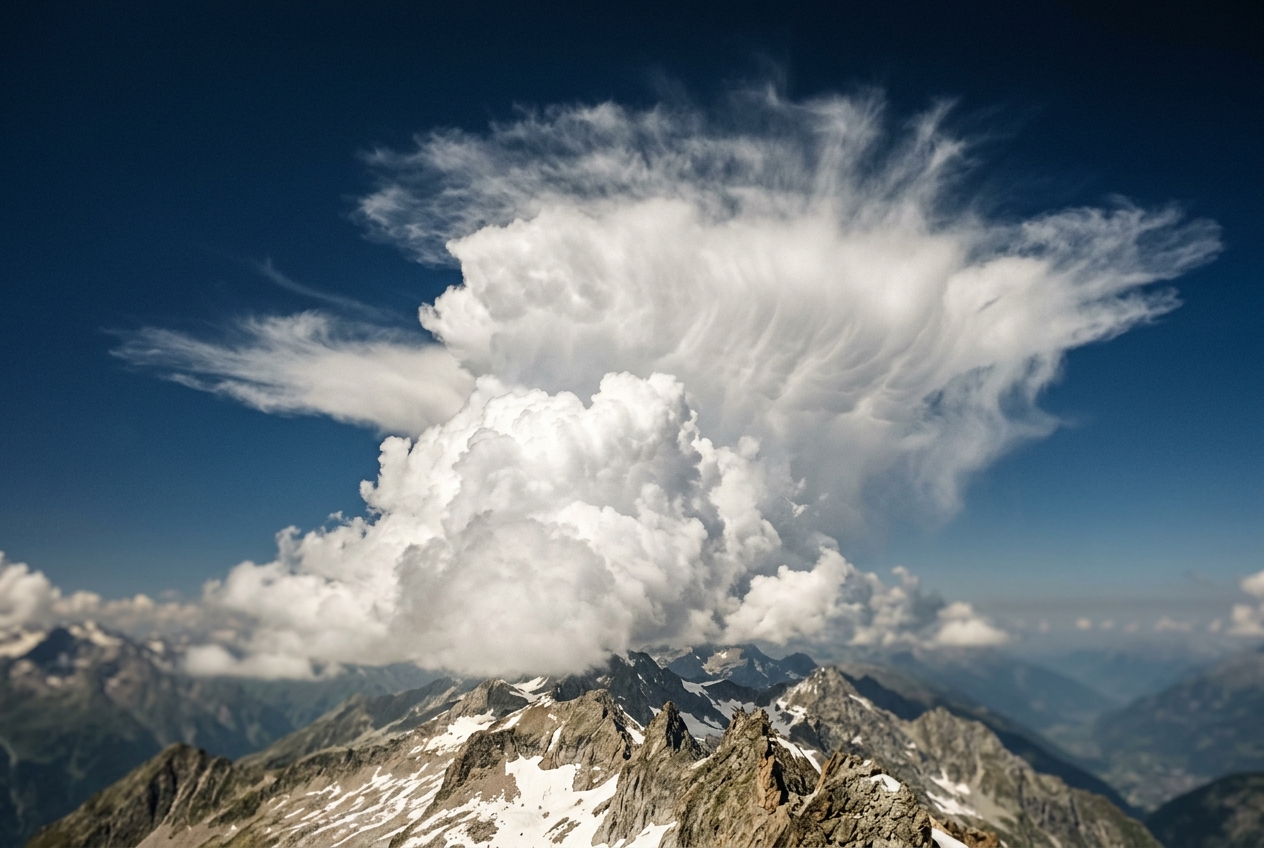
On a sweltering July afternoon across the continental interior, the atmosphere holds its breath. The ambient air at ground level is thick, soupy, and fragrant with the sharp, earthy musk of dry soil waiting for rain. The barometric pressure on your wrist watch has been steadily eroding over the past three hours, sliding downward millibar by millibar as an invisible column of heated, buoyant air lifts off the sun-baked cornfields. High above, against an otherwise sharp cobalt-blue sky, a cumulus cloud is growing aggressively. At first, its crown resembles a boiling head of white cauliflower—solid, crisp-edged, brilliant in the midday sun, its boundary so sharply delineated against the azure background that you could trace its bulging lobes with a fine pen.
Then, within the span of barely five minutes, something profound and irreversible occurs in the upper tiers of that towering giant.
       CONVECTIVE UPDRAFT                    GLACIATION MORPHOLOGY

     ~ -15°C  . - . - . - .              ~ -15°C  ~~~~~~~~~~~~~~~~~~~  <- Diffuse, fibrous
             (  BOILING  )                       (  ANVIL VEIL      )     cirriform top
             ( CAULIFLOWER)       ----->        (  (GLACIATED)      )     (Ice Crystals)
     ~ 0°C   (  DROPLETS )               ~ 0°C  (                   )
             ' - . - . - '                      ' - . - . - . - . - '
               / / | \ \                          / / / / | \ \ \ \
             Warm Updraft                        Heavy Precipitation Core
The crisp, knobby contours of the cloud’s summit suddenly dissolve. The cauliflower bubbles lose their hard edges, melting into a diffuse, fibrous, shimmering veil of white silk. A silvery halo flickers momentarily near the cloud top. Down at the surface, the sultry stillness breaks; the temperature plummets by eight degrees Celsius in less than two minutes as a cool, downdraft-driven breeze charges through the trees, carrying the distinctive metallic scent of ozone and the sudden, heavy spatters of cold raindrops.
Without setting foot in an atmospheric physics laboratory, you have just witnessed one of the most consequential phase transitions on Earth: heterogeneous ice nucleation. High aloft, where the ambient temperature has plunged well below the nominal freezing point, millions of tons of supercooled liquid water have been catalyzed into solid ice by a handful of microscopic airborne specks—mineral dust from distant deserts, sea-spray organics, and living bacterial proteins drifting on the wind.
What’s Actually Happening: The Supercooled Water Paradox
To understand the sky above us, we must first dismantle a pervasive physical misconception taught in elementary school: that pure liquid water automatically turns to ice the moment it cools to $0^\circ\text{C}$ ($273.15\text{K}$).
In the free atmosphere, it does no such thing.
Liquid water droplets inside clouds are routinely observed floating in a liquid state at $-10^\circ\text{C}$, $-20^\circ\text{C}$, and even $-35^\circ\text{C}$. Atmospheric scientists term this fragile thermodynamic state supercooling. Water molecules in a liquid droplet are in constant, disordered, thermal motion. To transform into ice, those molecules must assemble themselves into a rigid, highly ordered hexagonal crystal lattice. But creating that initial microscopic cluster of ordered molecules—known as an ice embryo or germ—requires overcoming a massive energetic hurdle.
Think of liquid water at subzero temperatures as an audience in a crowded auditorium, ready to stand and perform a synchronized dance. Even though everyone agrees that dancing is the lower-energy, more stable state in the cold room, nobody knows where to begin. Left entirely to themselves, with no reference pattern, random thermal collisions will occasionally bump a few dozen water molecules into a fleeting hexagonal arrangement. However, because the surface area of such a tiny, sub-nanometer cluster creates a high-energy boundary with the surrounding liquid, the liquid’s chaotic jostling almost immediately tears the nascent crystal apart.
Only when the temperature drops to a frigid $-38^\circ\text{C}$ ($235.15\text{K}$) do spontaneous molecular fluctuations become violent and frequent enough to reliably overcome this barrier without external assistance. This threshold is the homogeneous freezing limit, documented by the Met Office Cloud Guide and the World Meteorological Organization.
Yet, most clouds in our atmosphere begin freezing at temperatures far warmer than $-38^\circ\text{C}$—typically between $-5^\circ\text{C}$ and $-20^\circ\text{C}$. They can do this only because of a vanishingly rare class of atmospheric aerosols known as Ice Nucleating Particles (INPs).
An INP acts as an atomic scaffold. When supercooled water molecules encounter the surface of an INP, the microscopic fissures, crystalline steps, and chemical charge distributions on the particle’s surface mirror the geometry of an ice lattice. The particle essentially acts as an architectural blueprint, stabilizing the embryonic cluster of water molecules and slashing the thermodynamic energy required to initiate freezing. In a cloud containing billions of liquid droplets, only one aerosol particle in a million possesses this extraordinary catalytic property. Yet that single particle is sufficient to transform a liquid cloud into an explosive, ice-driven storm.
+-----------------------------------------------------------------------------------+
|                           THE FREEZING SPECTRUM                                   |
|                                                                                   |
|   0°C                 -10°C               -20°C               -38°C               |
|    |--------------------|-------------------|-------------------|                 |
|  Melting point     Heterogeneous Nucleation Active        Homogeneous Freezing    |
|  of bulk ice       (Mineral Dusts, Bio-proteins)          Limit (Spontaneous)     |
+-----------------------------------------------------------------------------------+
The Four Pathways of Heterogeneous Ice Formation
Atmospheric scientists classify heterogeneous nucleation into four distinct microphysical pathways, depending on how the aerosol particle interacts with ambient water vapor and liquid droplets:
- Immersion Freezing: An INP is fully submerged inside a supercooled liquid droplet as the droplet is carried upward into colder air by convective updrafts. At a characteristic supercooled temperature, the internal particle triggers crystallization from within. This is the dominant mechanism in mixed-phase convective storms.
- Contact Freezing: An airborne, dry INP collides with the outer surface of an existing supercooled droplet. The mechanical disturbance and instantaneous contact at the air-water-particle three-phase boundary trigger immediate crystallization, often at higher temperatures than immersion freezing.
- Deposition Nucleation: In sub-saturated air with respect to liquid water, but supersaturated with respect to ice, water vapor deposits directly onto the dry surface of an INP as solid ice, completely bypassing the liquid phase.
- Condensation Freezing: An aerosol particle acts simultaneously as a Cloud Condensation Nucleus (CCN) and an INP, condensing liquid water upon its surface at subzero temperatures and immediately freezing that condensed liquid in an unbroken thermodynamic continuum.
The Science: Classical Nucleation Theory and Active Sites
For those who want to examine the exact mathematical machinery, we turn to Classical Nucleation Theory (CNT), as formalized in atmospheric physics literature and indexed on Wikipedia's Nucleation Framework.
CNT models the formation of a spherical ice embryo of radius $r$ forming within supercooled water or vapor. The net change in Gibbs free energy ($\Delta G$) represents a fierce competition between two opposing forces: * A favorable volume term ($-\frac{4}{3}\pi r^3 \Delta g_v$), representing the thermodynamic drive of supercooled water to transition to the lower-energy solid phase. * An unfavorable surface term ($4\pi r^2 \gamma_{iv}$), representing the energy penalty required to create a new physical boundary between the ice embryo and its parent phase.
       ΔG (Free Energy)
             ^
             |                 /---\  <-- Maximum Barrier: ΔG*
             |               /       \
             |              /         \
             |             /           \
             |            /             \
             0-----------+---------------+--------> Radius (r)
                         |       r*
                   Sub-critical     Super-critical
                   (Dissolves)      (Grows spontaneously)
By differentiating $\Delta G$ with respect to $r$ and setting the derivative to zero, we obtain the critical ice embryo radius ($r^*$), below which an embryo spontaneously dissolves, and above which it grows uncontrollably:
$$r^* = \frac{2 \gamma_{iv}}{\rho_i L_f \ln\left(\frac{T_0}{T}\right)}$$
where: * $\gamma_{iv}$ is the interfacial surface tension between the ice embryo and the surrounding liquid water (approximately $0.028\text{ J m}^{-2}$), * $\rho_i$ is the density of ice ($917\text{ kg m}^{-3}$), * $L_f$ is the latent heat of fusion ($3.34 \times 10^5\text{ J kg}^{-1}$), * $T_0$ is the standard triple-point melting temperature ($273.15\text{ K}$), * $T$ is the actual supercooled cloud temperature in Kelvin.
Worked Example: The Critical Embryo at $-15^\circ\text{C}$
Consider a supercooled cloud droplet at $T = 258.15\text{ K}$ ($-15^\circ\text{C}$):
- Calculate the logarithmic temperature ratio: $$\ln\left(\frac{273.15}{258.15}\right) = \ln(1.0581) \approx 0.0565$$
- Compute the thermodynamic driving potential in the denominator: $$\rho_i L_f \ln\left(\frac{T_0}{T}\right) = (917\text{ kg m}^{-3}) \times (3.34 \times 10^5\text{ J kg}^{-1}) \times 0.0565 \approx 1.73 \times 10^7\text{ J m}^{-3}$$
- Solve for $r^$: $$r^ = \frac{2 \times 0.028\text{ J m}^{-2}}{1.73 \times 10^7\text{ J m}^{-3}} \approx 3.24 \times 10^{-9}\text{ m} = 3.24\text{ nm}$$
A cluster of pure water molecules must assemble a flawless sphere over $3.2$ nanometers in radius—encompassing roughly $4,500$ perfectly arranged molecules—before homogeneous growth becomes thermodynamically favorable. At $-15^\circ\text{C}$, the statistical probability of this occurring spontaneously through random collisions across a cloud droplet is practically zero.
The Catalytic Reduction Factor $f(m)$
An Ice Nucleating Particle introduces a solid substrate that truncates the spherical embryo into a spherical cap, drastically reducing the volume of ice required to reach that critical radius $r^*$.
                   ICE EMBRYO (Spherical Cap)
                         . - ~ ~ - .
                     . '             ' .
                   /                     \
                  |                       |
               ---|-----------------------|---  Substrate Surface
                  \<-   Contact Angle θ  ->/
                     \                   /
                       - . _ _ _ _ _ . -
The thermodynamic energy barrier for heterogeneous nucleation ($\Delta G^_{\text{het}}$) is directly scaled down from the homogeneous barrier ($\Delta G^_{\text{hom}}$) by a geometric reduction factor, $f(m)$:
$$\Delta G^_{\text{het}} = \Delta G^_{\text{hom}} \cdot f(m)$$
$$f(m) = \frac{(2 + m)(1 - m)^2}{4}$$
where $m = \cos(\theta)$, and $\theta$ is the contact angle between the embryonic ice crystal and the aerosol substrate.
For an efficient atmospheric mineral dust particle with a contact angle of $\theta = 30^\circ$ ($m = \cos(30^\circ) \approx 0.866$): $$f(0.866) = \frac{(2 + 0.866)(1 - 0.866)^2}{4} = \frac{(2.866)(0.01796)}{4} \approx 0.0129$$ The aerosol substrate slashes the energetic barrier to a mere 1.3% of its homogeneous value, permitting explosive freezing at modest subzero temperatures.
The Singular Active-Site Parameterization
Atmospheric modelers at institutions like the European Centre for Medium-Range Weather Forecasts (ECMWF) and National Oceanic and Atmospheric Administration (NOAA) often bypass time-dependent stochastic equations in favor of the singular active-site framework. In this model, nucleation occurs deterministically at distinct nanoscale structural defects, chemical functional groups, or crystalline steps on the aerosol surface called active sites.
The active-site surface density, $n_s(T)$ (expressed in sites per square meter of aerosol surface), represents the cumulative number of ice-active sites that become catalytically active at or above temperature $T$. The ice-active fraction of aerosol particles ($F_{\text{ice}}$) with surface area $A$ is given by:
$$F_{\text{ice}}(T) = 1 - \exp\left(-A \cdot n_s(T)\right)$$
As the convective updraft lifts the aerosol into colder layers of the troposphere, $n_s(T)$ increases exponentially, activating progressively more particles until the entire droplet population glaciates.
The Cast of Atmospheric INPs
What are these elusive aerosols roaming the planetary boundary layer and free troposphere?
+------------------------------------------------------------------------------------+
| AEROSOL CLASS            PRIMARY SPECIES                 NUCLEATION ONSET RANGE   |
+------------------------------------------------------------------------------------+
| Biological               Pseudomonas syringae (inaZ)      -2°C to -6°C             |
| Mineral Dust             K-Feldspar (Microcline)          -6°C to -15°C            |
| Soil Organic Matter      Humic/Fulvic macromolecules      -10°C to -18°C           |
| Marine Organics          Sea-surface microlayer exudates  -15°C to -25°C           |
| Clay Minerals            Illite, Kaolinite                -15°C to -26°C           |
| Soot / Combustion        Aviation and wildfire black carbon -20°C to -35°C         |
+------------------------------------------------------------------------------------+
1. Potassium-Rich Feldspar (K-Feldspar)
Desert dust swept aloft from the Sahara, Gobi, and Arabian deserts constitutes the largest volumetric contributor to global INP concentrations. While desert dust consists of various clay minerals (illite, montmorillonite, kaolinite), groundbreaking atmospheric chemistry research has demonstrated that K-feldspar (specifically the polymorph microcline, $\text{KAlSi}_3\text{O}_8$) dominates mineral-driven ice nucleation. The crystallographic cleavage planes of microcline exhibit surface hydroxyl group spacings and surface topography that align with sub-angstrom precision to the basal $(0001)$ and prism $(10\bar{1}0)$ faces of hexagonal ice ($I_h$).
2. Biological Super-Nucleators (Pseudomonas syringae)
Nature's most potent ice nucleators are not rocks, but living organisms. Plant-pathogenic bacteria, notably Pseudomonas syringae, express specialized ice-nucleation active proteins on their outer cell membranes (encoded by the inaZ gene). These proteins possess repetitive arrays of amino acid sequences that bind water molecules and pre-align them into an ice-like lattice.
While mineral dust typically requires cooling to $-15^\circ\text{C}$ to initiate freezing, P. syringae can trigger ice formation at temperatures as astonishingly warm as $-2^\circ\text{C}$ to $-4^\circ\text{C}$. In nature, this enables the bacterium to crack open frost-sensitive plant cell walls to access nutrients; in the atmosphere, lofted bacteria serve as ultra-efficient catalysts for precipitation initiation.
3. Marine Organic Matter
Over remote oceans far from continental dust plumes, marine biogenic aerosols govern cloud microphysics. Phytoplankton blooms produce exopolymeric substances, lipids, and cell fragments that concentrate in the sea-surface microlayer. Wave breaking and bubble bursting eject these organic films into the marine boundary layer as submicron sea-spray aerosols, sustaining mixed-phase cloud glaciation across pristine regions like the Southern Ocean.
Practical Outdoor Guidance: Spotting Glaciation in Real Time
Armed with this microphysical understanding, any hiker, sailor, or outdoor enthusiast can read the sky to anticipate storm development long before radar shows a heavy precipitation core.
       CUMULUS CONGESTUS                         CUMULONIMBUS CALVUS / CAPILLATUS
    (Liquid Droplet State)                             (Glaciated State)

.---.     .---.                                   ~~~~~~~~~~~~~~~~~~~
      (     )   (     )                                 (   DIFFUSE ANVIL   )
     (       ) (       )         --------->            (                     )
    (   HARD, CRISP     )                              (     FIBROUS SILK    )
     ( CAULIFLOWER EDGES)                               (                   )
       '---'     '---'                                   ' - . - . - . - . - '
         |         |                                       |       |       |
         |         |                                       |       |       |
     HIGH CONTRAST / BRIGHT                              OPTICAL CIRRUS HAZE / SHADOW
1. The Visual Diagnosis: From Cauliflower to Silk
Look at the summit of a swelling cumulus congestus tower during a warm afternoon: * The Liquid State (Pre-Glaciation): As long as the cloud consists entirely of supercooled liquid droplets, the cloud boundary remains sharp, crisp, and high-contrast. The lobes look dense and solid, resembling mounds of freshly cut cauliflower. This sharpness occurs because liquid cloud droplets are tiny (typically $10\text{ }\mu\text{m}$ in diameter) and possess high number densities ($300\text{ to }1,000\text{ droplets per cm}^3$), causing intense, multiple geometric scattering of sunlight right at the cloud perimeter. * The Glaciated State (Post-Nucleation): The exact moment heterogeneous ice nucleation ignites, the cloud summit undergoes a dramatic physical metamorphosis. Because the equilibrium saturation vapor pressure over ice is significantly lower than that over liquid water at the same subzero temperature (the Wegener-Bergeron-Findeisen process), the rapidly forming ice crystals grow explosively at the expense of evaporating liquid droplets. * The crystal size increases by orders of magnitude (from $10\text{ }\mu\text{m}$ to over $100\text{ }\mu\text{m}$), while the particle number density plummets. Sunlight now passes deeper into the cloud and undergoes forward scattering. The once-solid cauliflower crowns instantly melt into a soft, fibrous, feather-like anvil (Cumulonimbus calvus or capillatus).
2. Instrumental Signatures to Monitor
If you carry a pocket weather station, altimeter watch, or field barometer: * Barometer Trend: Watch for the thunderstorm pressure nose. In the hours prior to convection, the barometer drops steadily. However, 1 to 2 minutes before the precipitation shaft hits, the barometer will spike upward sharply by $1.0\text{ to }3.0\text{ hPa}$. This sudden pressure rise marks the arrival of the cold, dense, ice-cooled downdraft slamming into the ground. * Ambient Thermometer & Hygrometer: A sudden, sharp plunge in dry-bulb temperature accompanied by a surging dew point indicates that precipitation-cooled downdraft air (evaporatively cooled by falling rain and melting graupel) has displaced the warm surface boundary layer. * Wind Direction: A complete $180^\circ$ reversal of the wind direction—suddenly blowing outward from the base of the distant cloud toward you—marks the leading edge of the cold-pool gust front.
Today’s Meteorological Rule of Thumb
When a boiling cumulus tower loses its crisp cauliflower edge and frays into a diffuse, fibrous veil aloft, the cloud has frozen: seek shelter immediately, for rain, lightning, and downdrafts will strike the surface within twenty minutes.