Graupel Dynamics & Riming Accretion Kinetics: How Supercooled Droplet Freezing on Snow Crystals Bridges Winter Flurries and Severe Hail
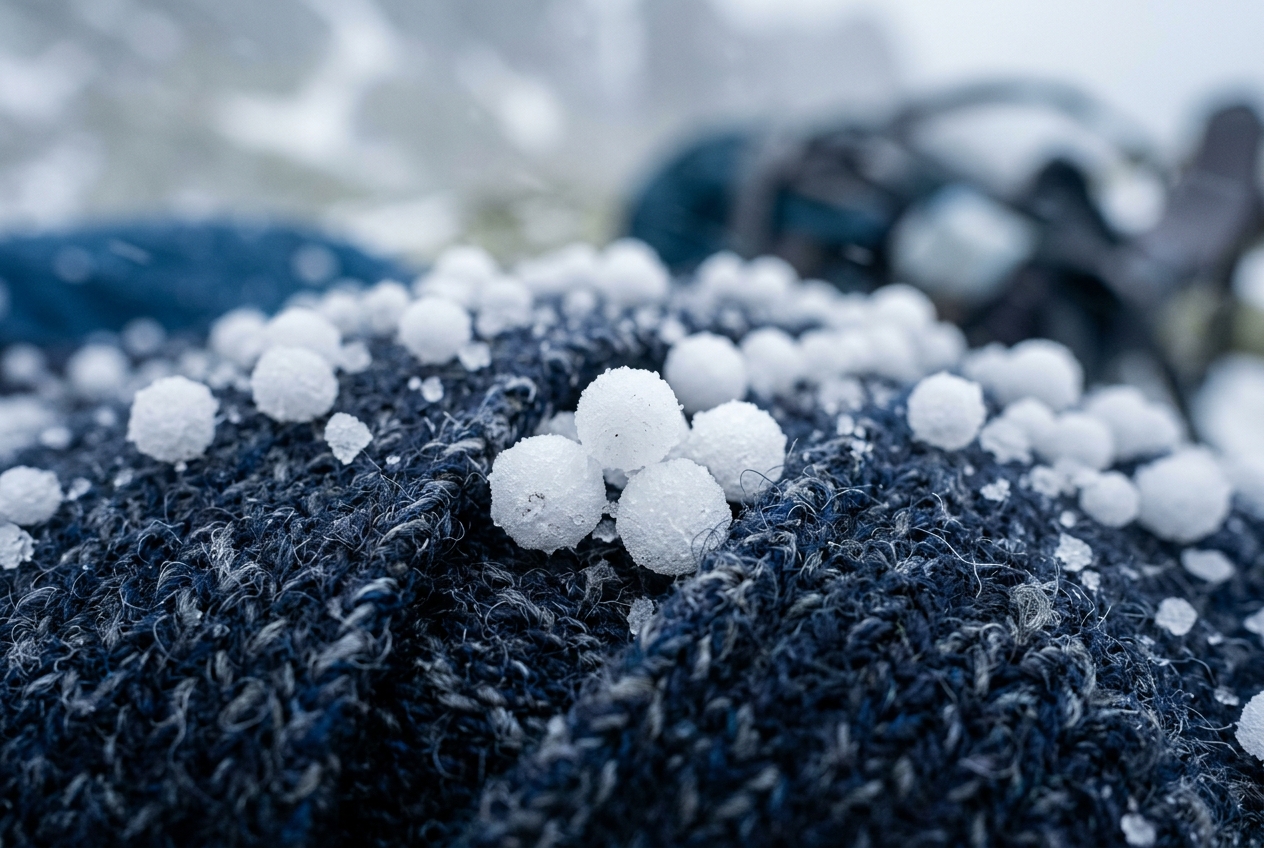
1. The Observer's Field Encounter: The Day the Sky Rained Styrofoam
Ascending an exposed ridge in late autumn or early spring, the atmosphere often signals its impending violence not with a roar, but with a sharp thermodynamic inversion. The air thins into a crystalline chill; the barometer in your watch drops precipitously by four hectopascals in under twenty minutes. Overhead, the gentle altocumulus deck curdles into dark, turbulent mammatus lobes and towering cumulus congestus clouds, their underbellies bruised with slate-grey virga. A sudden downdraft slumps down the mountainside, carrying the sharp, metallic tang of ozone mixed with petrichor.
Then, the precipitation begins.
It is not the silent, fluttering descent of six-petalled dendritic snowflakes, nor the deafening, bone-shattering bombardment of clear, laminated hailstones. Instead, millions of tiny, brilliant-white spherules strike the taut nylon of your jacket and bounce. They scatter across the scree like miniature beads of expanded polystyrene.
These are snow pellets, known within fluid dynamics and atmospheric physics by the German term graupel (defined by the American Meteorological Society).
Catch a few upon a chilled woollen glove. Under close inspection, their geometry reveals an exquisite physical narrative. Unlike a pristine stellar snowflake, whose intricate hexagonal lattice reflects diffusion-dominated vapor growth directly from gas to solid, graupel is blunt, irregular, and often conical or spherical, spanning two to five millimetres across. When pressed between thumb and forefinger, a graupel pellet does not slice like a frozen crystal, nor does it resist like solid ice. It yields with a crisp, muffled crush, disintegrating into a powdery matrix of micro-crystalline rubble.
Graupel represents an intermediate, highly energetic phase transition: the aerodynamic collision and instantaneous flash-freezing of thousands of supercooled liquid water droplets onto a falling ice crystal core—a process known as riming.
2. What's Actually Happening — Plain English First
To understand how a fluffy snowflake transforms into a dense, bouncing projectile, imagine the cloud above you as a chaotic, refrigerated aerosol suspension. We are often taught that liquid water turns to ice at 0°C (32°F). In the pristine heights of the troposphere, however, this is a half-truth. Liquid water requires an initial microscopic template—a cloud condensation nucleus or ice nucleating particle, such as a speck of mineral dust or bacterial fragment—to organise its molecules into an ice lattice. Without these nucleators, pure cloud droplets remain liquid in a precarious, high-energy state known as supercooling, surviving at temperatures down to -20°C, and under laboratory conditions, down to the homogeneous nucleation threshold of -38°C.
Mixed-phase convective clouds, frequently profiled by the UK Met Office, contain both embryonic ice crystals and billions of these supercooled liquid droplets suspended together.
Think of the cloud as an automated factory: - The Ice Crystal (The Collector): A single pristine hexagonal plate or stellar dendrite grows via vapor diffusion (the classical Wegener-Bergeron-Findeisen mechanism). As it gathers mass, gravity overcomes the cloud’s thermal updraft, and it begins to settle downwards. - The Droplets (The Aerosol): Surrounding the crystal is a dense fog of microscopic supercooled water droplets, each spanning between 5 and 30 micrometres in diameter—roughly one-tenth the width of a human hair. - The Sweeping Effect: As the ice crystal falls, it acts like the windscreen of a car driving through dense freezing fog at highway speeds. The falling ice crystal sweeps through the volume of air beneath it. Droplets lying directly in its path collide with its leading edges. - The Flash Freeze: Upon mechanical impact, the supercooled droplet is instantaneously shocked out of its metastable liquid equilibrium. The droplet crystallises in milliseconds. Because freezing is virtually instantaneous, the droplet freezes as a spherical bead, trapping microscopic pockets of air between itself and neighboring frozen droplets.
When only a few droplets freeze to a crystal, meteorologists call it rimed snow. When the accretion is so relentless that the original crystal template is completely entombed beneath thousands of frozen droplets, the object becomes graupel. If the cloud contains extreme updrafts and dense liquid water, this riming accelerates until water coats the particle faster than it can freeze, giving birth to solid, concentric hailstones (as catalogued in the World Meteorological Organization's International Cloud Atlas).
3. The Science: Accretion Kinetics, Phase Thermodynamics, and Aerodynamics
For those who wish to investigate the underlying mathematical physics, the evolution of graupel is governed by classical continuous collection kinetics, boundary-layer thermodynamics, and aerodynamic drag scaling.
The Continuous Collection Equation
The rate at which a falling hydrometeor sweeps up mass from supercooled cloud water is modelled by the Continuous Collection Equation:
$$\frac{dM}{dt} = E_{\text{coll}} \cdot A(D) \cdot \text{LWC} \cdot \left| v_t(D) - v_d \right|$$
Where: - $M$ is the instantaneous mass of the graupel particle ($\text{kg}$). - $E_{\text{coll}}$ is the bulk collection efficiency (dimensionless, bounded between $0$ and $1$). - $A(D) = \frac{\pi D^2}{4}$ is the geometric cross-sectional area of the hydrometeor of diameter $D$ perpendicular to the fall vector ($\text{m}^2$). - $\text{LWC}$ is the Cloud Liquid Water Content ($\text{kg/m}^3$ or $\text{g/m}^3$). - $v_t(D)$ is the terminal fall velocity of the graupel particle ($\text{m/s}$). - $v_d$ is the settling velocity of the microscopic cloud droplets ($\text{m/s}$, typically negligible, $\approx 0.01\text{ m/s}$).
The collection efficiency $E_{\text{coll}}$ is the product of two distinct probabilities:
$$E_{\text{coll}} = E_{\text{collision}} \times E_{\text{coalescence}}$$
Because supercooled water droplets freeze almost immediately on impact, the coalescence (sticking) efficiency $E_{\text{coalescence}} \approx 1$. Thus, the growth rate depends entirely on the hydrodynamic collision efficiency ($E_{\text{collision}}$).
As the graupel particle falls, it displaces the air beneath it, setting up fluid streamlines around its blunt body. Very small droplets (diameter $d < 10\ \mu\text{m}$) have minimal mass and low inertia; they follow the diverging streamlines around the particle and avoid collision.
Larger droplets ($d > 20\ \mu\text{m}$) possess higher momentum characterized by their Stokes Number ($\text{Stk} = \frac{\rho_w d^2 v_t}{18 \mu_{\text{air}} D}$). Their inertia overcomes the aerodynamic drag force of the diverging air, forcing them across streamlines into direct impact with the graupel collector.
Worked Physical Example 1: Calculating Graupel Accretion Rate
Let us calculate the instantaneous mass accumulation rate for a developing conical graupel pellet falling through a mixed-phase convective cloud core:
Assigned Environmental and Particle Parameters: - Graupel diameter, $D = 3.0\text{ mm} = 3.0 \times 10^{-3}\text{ m}$ - Geometric cross-section, $A = \frac{\pi (3.0 \times 10^{-3})^2}{4} \approx 7.07 \times 10^{-6}\text{ m}^2$ - Terminal velocity, $v_t = 2.4\text{ m/s}$ (neglecting droplet fall velocity $v_d \approx 0$) - Cloud Liquid Water Content, $\text{LWC} = 1.2\text{ g/m}^3 = 1.2 \times 10^{-3}\text{ kg/m}^3$ - Hydrodynamic collision efficiency, $E_{\text{coll}} = 0.82$
CALCULATION STEP-BY-STEP:
1. Swept Volume Rate = A * v_t
   = (7.07 x 10^-6 m^2) * (2.4 m/s)
   = 1.697 x 10^-5 m^3/s

2. Mass Collection Rate (dM/dt) = E_coll * Swept Volume Rate * LWC
   = 0.82 * (1.697 x 10^-5 m^3/s) * (1.2 x 10^-3 kg/m^3)
   = 1.67 x 10^-8 kg/s
   = 0.0167 mg/s (or ~1.00 mg per minute)
At this rate, a graupel particle with an initial core mass of $1.5\text{ mg}$ doubles its total mass in roughly ninety seconds of in-cloud transit.
The Schumann-Ludlam Limit: Dry vs Wet Growth Regimes
Why does graupel remain opaque, porous, and crushable rather than turning into crystalline hail? The answer lies in the latent heat of fusion.
When liquid water freezes at $0^\circ\text{C}$, it releases latent heat ($L_f \approx 3.34 \times 10^5\text{ J/kg}$). This thermal energy must be conducted away into the surrounding air through sensible heat exchange and vapor sublimation:
$$\dot{Q}_{\text{released}} = L_f \cdot \frac{dM}{dt}$$
$$\dot{Q}{\text{dissipated}} = 4\pi r \left[ K{\text{air}}(T_s - T_a) + L_v D_v (\rho_{vs}(T_s) - \rho_{va}(T_a)) \right]$$
This thermal balance sets up two distinct physical growth regimes:
[!WARNING] The Wet Growth Regime (Hailstone Transition): When the $\text{LWC}$ exceeds the Schumann-Ludlam Critical Limit, latent heat is released faster than the boundary layer can dissipate it. The surface temperature rises to $0^\circ\text{C}$. The accreted droplets can no longer freeze instantaneously; instead, they spread out over the surface into a continuous liquid film, filling all interstitial voids before slowly freezing. This yields high-density, bubble-free glaze ice: $$\rho_{\text{hail}} \approx 0.85 \text{ to } 0.92\text{ g/cm}^3$$
Terminal Velocity and Aerodynamic Drag Metamorphosis
As an unrimed snowflake accretes rime droplets and transitions into graupel, its terminal fall speed changes fundamentally. A pristine stellar dendrite has an expansive surface area relative to its minuscule mass, yielding high aerodynamic drag and a gentle terminal settling velocity:
$$v_{t,\text{snow}} \approx 0.3 \text{ to } 0.8\text{ m/s}$$
As riming fills the void spaces of the crystal, its mass scales with volume ($\propto D^3$) while its projected area scales only quadratically ($\propto D^2$). The particle's drag coefficient collapses, and its terminal velocity accelerates:
$$v_{t,\text{graupel}} = a D^b \approx 1.5 \text{ to } 3.5\text{ m/s}$$
Furthermore, falling graupel pellets frequently orient themselves aerodynamically with their broad, flattened base facing upstream into the flow. This base-down or base-up stability occurs because the center of mass shifts toward the primary accretion surface, generating a stable self-righting torque that preserves their conical, tear-drop shape.
4. Electrification, Updraft Dipoles, and Radar Diagnostics
Graupel is not merely an interesting form of frozen precipitation; it is the primary engine behind terrestrial lightning.
The Microphysics of Thunderstorm Charging
Inside convective clouds studied by the NOAA National Severe Storms Laboratory, strong updrafts suspend millions of kilograms of supercooled liquid droplets alongside graupel pellets and pristine ice crystals. When a fast-falling graupel pellet collides with a tiny, ascending ice crystal in the presence of supercooled liquid water, charge is transferred non-inductively across their transient contact boundary.
This mechanism, first quantified by Reynolds, Brook, and Takahashi, depends strongly on temperature: - Below the Charge Reversal Temperature ($T_R \approx -15^\circ\text{C}$): The graupel pellet acquires a net negative charge, while the rebounding ice crystal carries away a net positive charge. - Kinematic Separation: Gravity pulls the heavy, negatively charged graupel downward toward the mid-levels of the storm, while the convective updraft sweeps the light, positively charged ice crystals to the upper troposphere (the anvil). - The Storm Dipole: This spatial sorting creates a massive macroscopic dipole—a towering positive charge center aloft and a concentrated negative charge layer between $-10^\circ\text{C}$ and $-20^\circ\text{C}$. Once the electric field exceeds the dielectric breakdown strength of humid air ($\sim 3\times 10^5\text{ V/m}$), cloud-to-ground or intra-cloud lightning discharges.
Dual-Polarization Radar Signatures
Modern meteorological radar systems, such as the NOAA WSR-88D Dual-Polarization Radar network, detect graupel within clouds by transmitting both horizontally ($H$) and vertically ($V$) polarized microwave pulses.
+------------------------------------+------------------------------------+
| RADAR PARAMETER                    | GRAUPEL SIGNATURE / INTERPRETATION |
+------------------------------------+------------------------------------+
| Differential Reflectivity (Z_DR)   | Near Zero: ~ -0.2 to +0.4 dB       |
|                                    | Pellets tumble chaotically or fall |
|                                    | as isotropic cones/spheres.        |
+------------------------------------+------------------------------------+
| Copolar Correlation (rho_hv)       | Moderate to High: ~ 0.92 to 0.97   |
|                                    | Mixed-phase diversity (ice cores + |
|                                    | rime shells + liquid droplets).    |
+------------------------------------+------------------------------------+
| Equivalent Reflectivity (Z_H)      | Moderate: ~ 25 to 45 dBZ           |
|                                    | Distinctly lower than dense hail   |
|                                    | (>50 dBZ) due to low bulk density. |
+------------------------------------+------------------------------------+
5. The Observer's Back-of-the-Envelope Proof: Calculating In-Cloud Liquid Water
When caught in a graupel shower, an observer on the ground can estimate the average liquid water content ($\text{LWC}$) and minimum transit time of the cloud aloft using basic physical measurements.
       SIMPLIFIED MASS EVOLUTION PROOF

Graupel Radius Growth:
    dr/dt = (E_coll * LWC * v_t) / (4 * ρ_g)

Integrating over Cloud Depth (H):
    Δr = (E_coll * LWC * H) / (4 * ρ_g)

  Rearranging for Cloud LWC:
    LWC = (4 * ρ_g * Δr) / (E_coll * H)
Derivation of the Radial Growth Rate
Assuming a spherical graupel pellet of radius $r$ and bulk density $\rho_g$:
$$M = \frac{4}{3}\pi r^3 \rho_g \implies \frac{dM}{dt} = 4\pi r^2 \rho_g \frac{dr}{dt}$$
Equating this with the continuous collection equation ($\frac{dM}{dt} = E_{\text{coll}} \cdot (\pi r^2) \cdot \text{LWC} \cdot v_t$):
$$4\pi r^2 \rho_g \frac{dr}{dt} = E_{\text{coll}} \cdot \pi r^2 \cdot \text{LWC} \cdot v_t$$
Cancelling common terms yields the radial growth rate:
$$\frac{dr}{dt} = \frac{E_{\text{coll}} \cdot \text{LWC} \cdot v_t}{4 \rho_g}$$
Integrating over total in-cloud fall time $t_{\text{transit}} = \frac{H}{v_t}$ (where $H$ is the mixed-phase cloud depth):
$$\Delta r = \frac{E_{\text{coll}} \cdot \text{LWC} \cdot H}{4 \rho_g}$$
Rearranging directly reveals the average in-cloud liquid water content:
$$\text{LWC} = \frac{4 \cdot \rho_g \cdot \Delta r}{E_{\text{coll}} \cdot H}$$
Step-by-Step Field Measurement Example
OBSERVATION DATA:
- Measured Ground Pellet Diameter: D = 4.0 mm  ->  Radius r_final = 2.0 mm = 2.0 x 10^-3 m
- Assumed Initial Crystal Radius:  r_initial ≈ 0.2 mm
- Radial Growth:                   Δr = 1.8 mm = 1.8 x 10^-3 m
- Graupel Density (crush test):    ρ_g ≈ 300 kg/m^3 (0.30 g/cm^3)
- Estimated Cloud Depth:           H = 2,000 m (from cloud base to freezing level)
- Assumed Collision Efficiency:    E_coll ≈ 0.80
EVALUATION:
1. Numerator:
   4 * ρ_g * Δr = 4 * (300 kg/m^3) * (1.8 x 10^-3 m)
                = 2.16 kg/m^2

2. Denominator:
   E_coll * H   = 0.80 * 2,000 m
                = 1,600 m

3. Resulting In-Cloud LWC:
   LWC = 2.16 / 1,600 = 0.00135 kg/m^3 = 1.35 g/m^3
4. Estimated In-Cloud Growth Transit Time:
   At v_t ≈ 2.5 m/s across H = 2,000 m:
   t_transit = 2,000 m / 2.5 m/s = 800 seconds (~13.3 minutes)
This derived value ($1.35\text{ g/m}^3$) aligns with physical measurements taken by research aircraft inside active mixed-phase convective cloud cells.
6. Practical Outdoor Guidance: Field Diagnostics for Observers
When you encounter graupel in the backcountry, on a marine passage, or in your garden, you are standing under an active atmospheric particle accelerator. Here is how to evaluate the conditions:
1. Visual Sky Features
- Watch for convective clouds with dark, ragged bases (cumulus congestus or cumulonimbus calvus).
- Look for virga shafts beneath the cloud that appear diffuse and milky white rather than the dark grey streamers of rain. This indicates frozen hydrometeors melting as they descend toward warmer air.
2. Barometer and Thermometer Signatures
- The Cold-Pool Pressure Jump: As graupel forms, sub-cloud evaporation and melting chill the air column, causing a sudden downdraft (a micro-cold pool). Your barometer will often register a sharp, transient spike of $+1\text{ to }+2\text{ hPa}$, accompanied by a sudden temperature drop of $3^\circ\text{C}$ to $7^\circ\text{C}$.
- Near-Surface Wet-Bulb Temperature: Graupel can reach the surface at air temperatures as high as $+5^\circ\text{C}$ ($41^\circ\text{F}$) if the relative humidity is low. Evaporative cooling along the hydrometeor's descent path prevents it from melting entirely before impact.
3. Static Electricity and Lightning Precautions
- Because graupel growth actively separates electrical charge in the cloud core above you, its arrival at the surface means that the cloud's electrostatic dipole is fully formed.
- If your hair stands on end, if you hear an unexplainable faint hissing or buzzing from your trekking poles, ice axe, or radio antennas (corona discharge / St. Elmo's Fire), you are in an immediate lightning strike hazard zone. Descend ridgelines immediately, avoid isolated trees, and seek enclosed shelter.
7. Today's Meteorological Rule of Thumb
Authoritative Meteorological References
- American Meteorological Society: Glossary of Meteorology (Graupel)
- World Meteorological Organization: International Cloud Atlas
- NOAA National Severe Storms Laboratory: Thunderstorm & Hail Microphysics
- UK Met Office: Snow and Winter Precipitation Types
- NOAA JetStream: Online School for Weather — Precipitation Types