Freezing Fog & Rime Ice Deposition: How Supercooled Droplet Impaction and Latent Heat Dissipation Sculpt Mountain Frost Spires
1. Opening Scene: The Frost-Engine on the Ridge
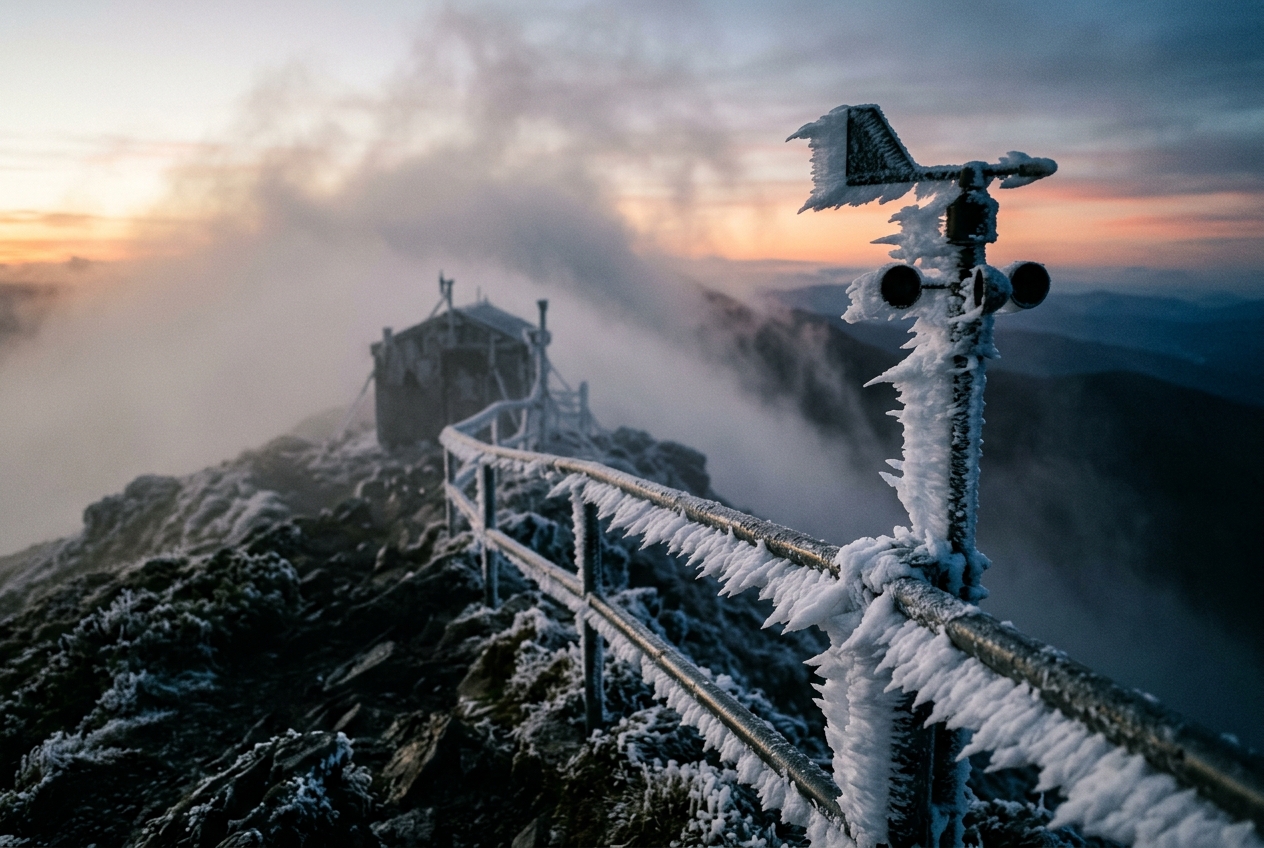
At dawn upon the wind-scoured crest of an exposed upland ridge, the world is consumed by a luminous, suffocating grey. The barometer has settled into the quiet stagnation of a post-frontal anticyclone, yet along this elevated escarpment, a brisk sub-zero gale drives an unbroken river of cloud across the terrain. Step into the cloud mass, and the air immediately feels paradoxically wet and biting. Your woollen gloves and the microfibre shell of your jacket are soon beaded with what appears to be ordinary dew. Breathing in, the air carries no scent of frozen snow crystals; it smells earthy and damp, laden with suspended water droplets that coat your eyelashes and mist your spectacles.
Yet the ambient air temperature sits firmly at $-7^\circ\text{C}$.
Within minutes, an extraordinary transformation takes place across the landscape. The moisture does not evaporate, nor does it trickle down the surfaces in liquid streams. Instead, as the mist rushes past, every obstacle standing against the flow begins to cast out brilliant, chalk-white horns into the gale. Fencelines, windward rock faces, and the stiff needles of Scots pine sprout delicate, razor-sharp crystalline plumes that grow directly into the teeth of the oncoming wind.
Wind Direction: =========================> [Obstacle]
                                          <--- Accreting Rime Feathers
                                               (Grows Upwind Toward Source)
On the lee side of these same posts and branches, the timber remains bone-dry and bare. Overhead, the guy-wires of an automated weather mast hum with a deadened, heavy frequency; their slender steel cords have thickened into cylindrical clubs of icy plumage several inches thick, throwing the mast into severe asymmetric tension. You are standing inside a natural cloud chamber, witnessing one of the boundary layer’s most dynamic thermodynamic phenomena: the rapid accretion of rime ice from a river of supercooled liquid fog.
2. What’s Actually Happening — Plain English First
To understand why a sub-zero fog creates architectural ice sculptures rather than snowdrifts, one must first confront a surprising truth of atmospheric physics: water does not automatically turn to ice the moment the thermometer crosses $0^\circ\text{C}$.
The Metastability of Supercooled Droplets
Liquid water at sub-freezing temperatures is in a state of delicate thermodynamic suspension known as metastability. For liquid water molecules to rearrange themselves into a rigid, hexagonal crystalline lattice, they require either extreme cold or a structural template to build upon.
Think of water molecules as a crowd of dancers in a ballroom. At warm temperatures, they move too fast to hold hands. As the room cools below freezing, they want to form an orderly, interlocking ring, but without a central person stepping in to set the pattern, they continue milling around in confusion. In the atmosphere, these "pattern-setters" are microscopic airborne mineral particles, clay fragments, or biological aerosols known to atmospheric scientists as Ice Nucleating Particles (INPs).
If the air mass is clean and lacks effective INPs, cloud and fog droplets can easily remain liquid down to $-10^\circ\text{C}$, $-20^\circ\text{C}$, or even lower. Only when temperatures plummet below the homogeneous nucleation threshold of $-38^\circ\text{C}$ does spontaneous freezing occur without a catalyst. In an ordinary hill fog or mountain cap cloud between $0^\circ\text{C}$ and $-15^\circ\text{C}$, billions of microscopic droplets float as supercooled liquid spheres. They are liquid bombs waiting for a trigger. The moment one of these droplets strikes an unyielding surface—such as a telegraph pole, a rock, or your jacket—the mechanical impact violently disrupts its metastable equilibrium, initiating instantaneous heterogeneous freezing.
Inertia Versus Aerodynamic Drag
Why do some objects gather thick crusts of rime while others escape untouched? The answer lies in the physics of vehicle collisions on a microscopic scale.
Imagine a stream of air flowing around an obstacle, like river water parting around a bridge pier. The air molecules, being light and agile, easily sweep around the curved contours of the obstacle. The water droplets suspended in that air, however, possess mass and therefore momentum.
Consider the difference between a heavy lorry and a light bicycle trying to make a sharp turn on an icy bend. The light bicycle can follow the curving road, but the heavy lorry has too much forward momentum and ploughs straight off the corner into the embankment.
- When the wind approaches a broad, flat surface (like a wide building wall or a massive cliff), it begins parting far upstream, creating a wide, gentle cushion of deflected air. The tiny fog droplets have ample time to be carried along the streamlines, slipping safely around the structure without touching it.
- When the wind encounters a slender object (such as a pine needle, a wire, or an anemometer strut), the streamlines must bend abruptly at the very last fraction of a millimetre. The droplets cannot make this emergency turn; their inertia carries them across the bending streamlines, slamming them directly into the windward face of the wire.
Slender objects act as extraordinarily efficient particle collectors, while broad surfaces deflect the microscopic fog.
3. The Science: Aerodynamics, Inertia, and Energy Budgets
For meteorologists, engineers, and physical scientists, predicting ice accretion requires quantifying two interconnected physical processes: droplet collision efficiency (the aerodynamic phase) and the Messinger-Ludlam thermodynamic energy balance (the thermodynamic phase).
3.1 Droplet Aerodynamics & The Stokes Number
The probability that a suspended droplet will cross the curving streamlines of air and collide with an obstacle is governed by a dimensionless quantity known as the Stokes number ($\text{St}$).
$$\text{St} = \frac{\rho_w d^2 U}{18 \mu_a D}$$
This formulation balances droplet inertia against the viscous aerodynamic drag of the surrounding air: * $\rho_w$ is the density of liquid water ($\approx 1000\,\text{kg/m}^3$). * $d$ is the droplet diameter (in metres, typically $10 \text{ to } 30\,\mu\text{m}$ for fog). * $U$ is the free-stream wind velocity (in $\text{m/s}$). * $\mu_a$ is the dynamic viscosity of air ($\approx 1.7 \times 10^{-5}\,\text{Pa}\cdot\text{s}$ at sub-zero temperatures). * $D$ is the characteristic diameter or cross-stream width of the obstacle (in metres).
   STREAMLINE DEFLECTION AROUND OBSTACLES OF DIFFERING WIDTHS

Broad Obstacle (Large D, Low St << 1)     Slender Obstacle (Small D, High St >> 1)

        ~~~~~~~~~~~\                           ~~~~~~~~~~\
        ~~~~~~~~----\                          ~~~~~~~----\
   Air  ============ \  [ Broad ]         Air  ===========->|[Pin]|
   Flow ~~~~----/       [Obstacle]        Flow ~~~~~~~----/
        ~~~~~~~~~~~/                           ~~~~~~~~~~/
   (Droplets follow streamlines around)    (Droplets slam directly into face)
The collision efficiency, $E$ (the fraction of droplets in the upwind projected frontal area that actually impact the surface), is an increasing function of $\text{St}$. When $\text{St} \ll 1$, viscous drag dominates, droplets follow the air streamlines perfectly, and $E \to 0$. When $\text{St} \gg 1$, droplet momentum dominates, droplets travel in straight ballistic paths regardless of the airflow, and $E \to 1$.
Worked Example: Pine Needle vs. Tree Trunk
Let us calculate $\text{St}$ for a freezing fog event on an exposed hillside: * Droplet diameter, $d = 20\,\mu\text{m} = 2.0 \times 10^{-5}\,\text{m}$ * Wind speed, $U = 10\,\text{m/s}$ ($\approx 36\,\text{km/h}$) * Dynamic viscosity of air, $\mu_a = 1.71 \times 10^{-5}\,\text{kg/(m}\cdot\text{s)}$
================================================================================
CASE 1: Slender Pine Needle (D = 1.5 mm = 0.0015 m)
================================================================================
        (1000 kg/m³) * (2.0 x 10^-5 m)² * (10 m/s)
St = -------------------------------------------------
     18 * (1.71 x 10^-5 kg/(m·s)) * (0.0015 m)

4.0 x 10^-6
St = ----------------- ≈ 8.66
        4.617 x 10^-7

Result: St >> 1.
The droplet's stopping distance far exceeds the scale of the needle.
The collision efficiency E is high (~0.75–0.85). The needle collects rime rapidly.

================================================================================
CASE 2: Broad Tree Trunk (D = 0.40 m)
================================================================================
        (1000 kg/m³) * (2.0 x 10^-5 m)² * (10 m/s)
St = -------------------------------------------------
     18 * (1.71 x 10^-5 kg/(m·s)) * (0.40 m)

4.0 x 10^-6
St = ----------------- ≈ 0.032
        1.231 x 10^-4

Result: St << 1.
Droplet inertia is entirely overpowered by air drag.
The collision efficiency E drops below 0.05. The trunk remains virtually bare.
================================================================================
3.2 The Messinger-Ludlam Thermodynamic Energy Balance
Once droplets collide with the surface, their fate is governed by thermodynamics. Freezing is an exothermic phase change. For every kilogram of supercooled water that solidifies into ice, it releases the latent heat of fusion:
$$L_f \approx 3.34 \times 10^5\,\text{J/kg}$$
This released heat warms the accreting surface above the temperature of the ambient air. The rate at which the surface can freeze incoming droplets depends strictly on how fast it can shed this heat to the passing wind.
The mass accretion rate per unit frontal area ($\dot{M} = dM/dt$) is governed by the collision efficiency $E$, the atmospheric Liquid Water Content ($\text{LWC}$, measured in $\text{g/m}^3$ or $\text{kg/m}^3$), and the wind speed $U$:
$$\dot{M} = E \cdot \text{LWC} \cdot U$$
To maintain continuous freezing, the thermodynamic energy budget per unit area on the icing surface must balance:
$$\dot{Q}{\text{latent}} + \dot{Q}{\text{kinetic}} = \dot{Q}{\text{sensible}} + \dot{Q}{\text{evaporation}} + \dot{Q}_{\text{droplet_warming}}$$
In boundary layer fog conditions, kinetic heating from impact is negligible. The dominant balance simplifies to:
$$\dot{M}f L_f = h_c (T_s - T_a) + h_m L_v (\rho{v,s} - \rho_{v,a}) + \dot{M} c_w (T_s - T_a)$$
where: * $\dot{M}f$ is the actual mass rate of freezing ice ($\text{kg}/(\text{m}^2\cdot\text{s})$). * $h_c$ is the convective sensible heat transfer coefficient. * $T_s$ is the icing surface equilibrium temperature; $T_a$ is the ambient air temperature. * $h_m$ is the convective mass transfer coefficient, driving evaporative/sublimative heat loss through vapour density differentials $(\rho{v,s} - \rho_{v,a})$. * $c_w$ is the specific heat capacity of liquid water ($4186\,\text{J}/(\text{kg}\cdot\text{K})$).
          THE ICING REGIME SPECTRUM: DRY VS. WET GROWTH

  Increasing Ambient Temperature (Ta -> 0°C) or High Liquid Water Content (LWC)
  ---------------------------------------------------------------------------->

  [ SOFT RIME ]           [ HARD RIME ]                 [ GLAZE / CLEAR ICE ]
  Density: 0.1–0.3 g/cm³  Density: 0.4–0.7 g/cm³        Density: ~0.9 g/cm³
  Ta < -8°C, Light Wind   Ta: -3°C to -8°C, Mod. Wind   Ta: 0°C to -3°C, High LWC
  ----------------------------------------------------------------------------
  Dry Growth Regime       Intermediate Transition       Wet Growth Regime
  ----------------------------------------------------------------------------
  • Instant freezing      • Partial droplet spreading   • Incomplete freezing
  • Trapped air bubbles   • Dense, milky structure      • Liquid runoff film
  • Feathery & fragile    • Tenacious adherence         • Pure, transparent, heavy
This thermodynamic balance establishes two distinct physical regimes:
- The Dry-Growth Regime (Soft and Hard Rime): When $T_a$ is sufficiently cold and $\text{LWC}$ is moderate, the convective and evaporative cooling capacity of the wind exceeds the rate of latent heat release. Every supercooled droplet freezes instantly at the exact point of impact without coalescing. Tiny pockets of air are permanently trapped between the rapidly solidifying droplet spheres. This creates soft rime (density $\rho_i \approx 0.1 \text{ to } 0.3\,\text{g/cm}^3$) or hard rime (density $\rho_i \approx 0.4 \text{ to } 0.7\,\text{g/cm}^3$). The trapped air boundaries scatter all wavelengths of visible light, giving rime its opaque, chalky white appearance.
- The Wet-Growth Regime (Glaze / Clear Ice): As identified by meteorologist F. H. Ludlam in his seminal work on accretion physics, if the flux of supercooled liquid ($\dot{M}$) is so high, or the ambient temperature so close to $0^\circ\text{C}$, that convective heat dissipation cannot shed the latent heat of fusion, the surface temperature $T_s$ reaches $0^\circ\text{C}$. The droplets cannot freeze immediately. A continuous thin film of liquid water spreads across the object before slowly freezing or running off under gravity and aerodynamic shear. This produces dense, bubble-free, structural glaze ice ($\rho_i \approx 0.9\,\text{g/cm}^3$), which is transparent, smooth, and mechanically devastating to infrastructure.
Calculating the Ludlam Limit for Freezing Fog
The Ludlam Limit defines the critical liquid water content ($\text{LWC}{\text{crit}}$) or critical temperature ($T{\text{crit}}$) above which an accretion surface transitions from dry rime to wet glaze.
Suppose a high-voltage power transmission line ($D = 0.02\,\text{m}$) traverses a mountain pass under the following conditions: * $T_a = -4.0^\circ\text{C}$ * Wind speed, $U = 12\,\text{m/s}$ * Convective heat transfer coefficient, $h_c \approx 85\,\text{W}/(\text{m}^2\cdot\text{K})$ * Collision efficiency, $E \approx 0.60$ * Liquid Water Content, $\text{LWC} = 0.40\,\text{g/m}^3 = 4.0 \times 10^{-4}\,\text{kg/m}^3$
================================================================================
STEP 1: Calculate Mass Accretion Rate per Unit Area
================================================================================
M_dot = E * LWC * U
M_dot = 0.60 * (4.0 x 10^-4 kg/m³) * (12 m/s)
M_dot = 2.88 x 10^-3 kg/(m²·s)

================================================================================
STEP 2: Calculate Latent Heat Released if 100% Freezes Instantly
================================================================================
Q_latent = M_dot * L_f
Q_latent = (2.88 x 10^-3 kg/(m²·s)) * (3.34 x 10^5 J/kg)
Q_latent = 961.9 W/m²

================================================================================
STEP 3: Calculate Maximum Convective Heat Loss to Air (at Ts = 0°C)
================================================================================
Q_sensible_max = h_c * (0°C - Ta)
Q_sensible_max = (85 W/(m²·K)) * (0 - (-4.0 K))
Q_sensible_max = 340.0 W/m²

(Evaporative and droplet warming terms contribute an additional ~120 W/m²).
Total Maximum Heat Dissipation Capacity ≈ 460 W/m²

================================================================================
CONCLUSION: The Surface Exceeds the Ludlam Limit
================================================================================
Q_latent (961.9 W/m²) > Q_dissipation_max (460 W/m²)

The wind cannot extract the latent heat fast enough to freeze the water at impact.
The surface warms to 0°C, entering the WET GROWTH regime.
Instead of dry rime, clear glaze ice coats the power cables, forming smooth icicles
and dramatically increasing mechanical structural load.
================================================================================
4. Practical Outdoor Guidance: Field Diagnostics & Observations
When navigating, working, or forecasting in cold environments, understanding rime ice physics provides immediate insight into microclimates, structural loads, and boundary layer atmospheric stability.
       TYPICAL BOUNDARY LAYER TEMPERATURE PROFILE IN FREEZING FOG

   Altitude (z)
       ^
       |          Warm Air Mass (Above Inversion)
       |           \
       |            \     Temperature Inversion Base (T > 0°C)
       |~~~~~~~~~~~~~\~~~~~~~~~~~~~~~~~~~~~~~~~~~~~~~~~~~~~~~~~~ Top of Fog Deck
       |   CLOUD /    \
       |   FOG LAYER   \  Freezing Fog (T < 0°C, Supercooled Droplets)
       |                \
       +-----------------\-------------------------------------> Temperature (T)
      Ground             0°C
1. Decoding Synoptic Signatures and METAR Reports
Professional surface weather observations report freezing fog under the standard World Meteorological Organization (WMO) code FZFG.
FZFG(Freezing Fog): Indicates visibility $< 1000\,\text{m}$ with ambient temperatures below $0^\circ\text{C}$ where supercooled water droplets are observed in suspension.- Temperature-Dewpoint Depression: When viewing automated reports from upland stations or valley airports, observe the spread between ambient temperature ($T$) and dewpoint ($T_d$). In active freezing fog, $T - T_d \approx 0^\circ\text{C}$, confirming water saturation ($100\%$ relative humidity with respect to liquid water). If $T$ sits between $-2^\circ\text{C}$ and $-12^\circ\text{C}$ with calm or moderate winds, supercooled droplet stability is at its peak.
- For deeper technical criteria on aviation hazard reporting, refer to the NOAA National Weather Service Glossary and operational guidelines from the Met Office on Freezing Fog Hazards.
2. Reading Rime Feathers as a Natural Wind Vane
Because rime requires continuous droplet collision, rime feathers can only accrete on the windward (stagnation) face of an obstacle.
- The crystalline feathers grow directly out into the incoming wind vector, pointing like arrows toward the upstream droplet source.
- If you encounter an old rime formation where the newest crystal needles branch off at a $45^\circ$ angle from the base layer, you are seeing a frozen record of a backing or veering synoptic wind shift that occurred mid-storm.
- The length of the rime feathers serves as a natural integrator of $\text{LWC} \times U \times \Delta t$. Slender structures that have accumulated $20\,\text{cm}$ of rime indicate prolonged exposure to high-velocity supercooled cloud drift.
3. Mountain Cap Clouds vs. Valley Radiation Inversions
Rime accretion occurs in two distinct synoptic environments: * Valley Radiation Inversions: High-pressure anticyclones in winter produce severe radiational cooling under clear night skies, trapping stagnant moisture in low basins. Freezing fog in this setting has low wind speed ($U \to 0$ to $2\,\text{m/s}$), meaning collision efficiencies on large objects are minimal. Accretion is restricted to delicate, needle-thin twigs, spiderwebs, and wire fences. * Orographic Cap Clouds: Strong winds force moist boundary layer air up mountain slopes, cooling it dynamically to saturation. Here, wind speeds are high ($U > 15\,\text{m/s}$) and $\text{LWC}$ is continually replenished. Rime accretion is rapid and violent, encrusting telecommunication towers, ski lifts, and weather stations with tonnes of hard rime in a single afternoon. Comprehensive tutorials on these dynamic icing environments are documented by UCAR’s COMET Program on In-Flight and Structural Icing.
                 STRUCTURAL AND AERODYNAMIC HAZARDS

   Un-iced Conductor Cable                Rimed Teardrop Cross-Section

         ( O )                            ( O )<=====================
       Symmetric                         Asymmetric Accretion Foil
     Low Drag (Cd ≈ 1.0)               High Aerodynamic Lift (Cd > 2.0)
     Stable in Crosswind               Triggers Destructive Cable Flutter / Galloping
4. Structural Hazards: Beyond Deadweight
While the static weight of hard rime ($\approx 500\,\text{kg/m}^3$) can buckle transmission towers, the aerodynamic alteration of cables is often more destructive: * As rime grows into the wind, it transforms a circular wire cross-section into an asymmetric, teardrop-shaped aerofoil. * Steady crosswinds blowing over this newly formed aerofoil generate aerodynamic lift and flow separation vortices. This induces conductor galloping—large-amplitude, low-frequency vertical oscillations that tear power lines from pylons and cause catastrophic short-circuits. * Unheated rotating instruments (cup anemometers and wind vanes) quickly seize as ice fills the small mechanical gaps between the rotor and the housing.
5. Today’s Meteorological Rule of Thumb
The Windward Rule of Rime:
Rime ice always builds into the teeth of the wind, never away from it. If an icy surface is chalky white and feathery, the air was cold enough to freeze droplets on contact; if it is smooth, thick, and glassy, the cloud was too dense or too mild for the wind to shed its heat.
Next time you step onto a sub-zero mountain ridge or traverse a frost-bound winter valley, look closely at the slenderest wire or twig you can find. It is not merely cold; it is an aerodynamic collector, recording the invisible balance between water droplets, wind momentum, and latent heat.
Further Reading & Authoritative References
- Detailed classifications of fog, mist, and ice hydrometeors can be explored in the WMO International Cloud Atlas.
- For comprehensive engineering models of structural and boundary-layer ice accretion, see the overview on Atmospheric Icing on Structures.
- Practical aviation safety guides and icing physics are maintained by the Federal Aviation Administration (FAA) and the Met Office.