Diamond Dust & Clear-Sky Ice Crystal Precipitation: How Radiative Surface Supercooling and Vapor Deposition Forge Shimmering Polar Prisms
1. Opening Scene
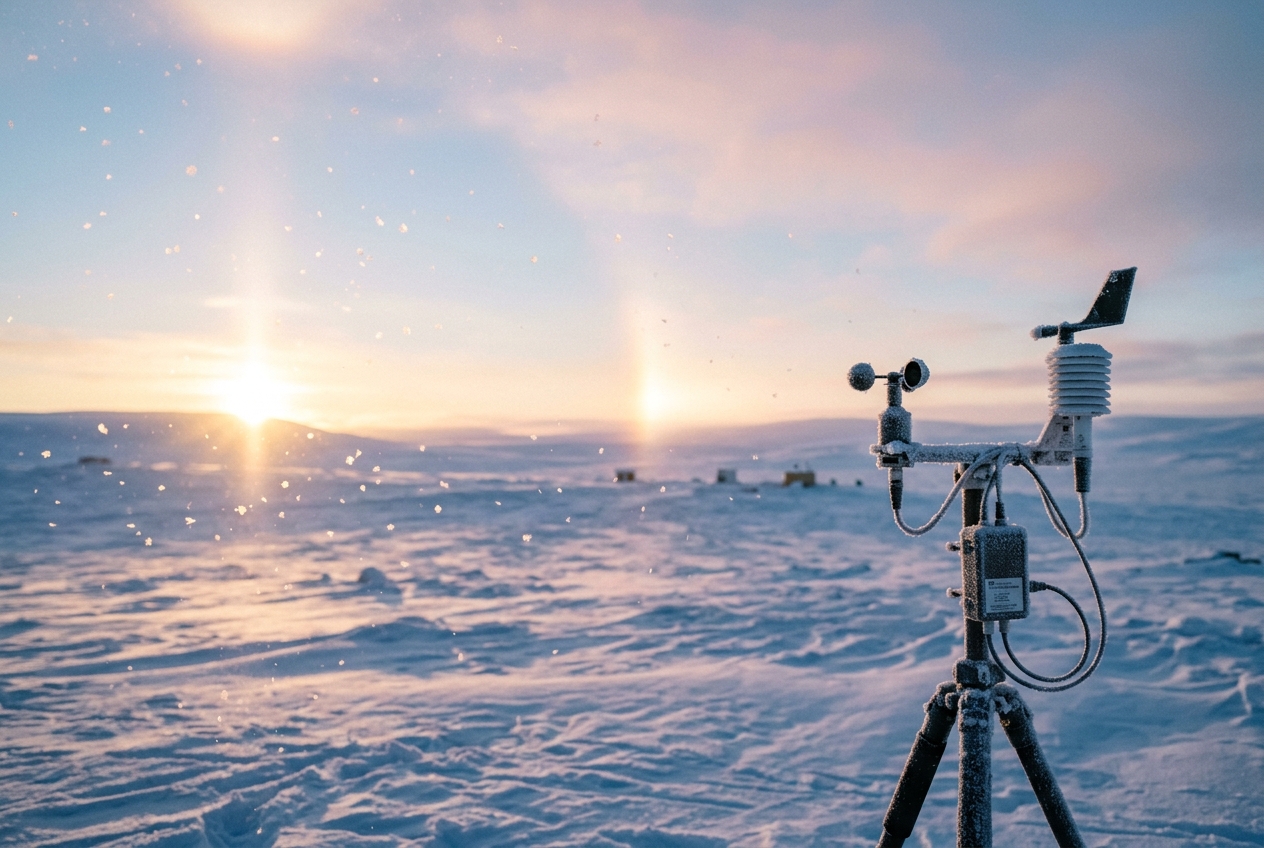
At eighty-two degrees north, an hour before solar noon in late February, the high Arctic horizon is bathed in an unblemished, cobalt gradient. There is not a wisp of cirrus overhead, nor the faintest underbelly of a stratus deck to occlude the pale, copper disc of the sun. The air is motionless. The windsock atop the weather station mast hangs limp against its iron stay, registering a dead calm where the anemometer cups have frozen into stillness.
When you exhale, the breath does not simply billow as steam; it crackles with a faint, dry hiss—a phenomenon polar explorers termed the whisper of the stars—before vanishing into the dry ambient air. The cold at thirty-eight degrees below zero Celsius is not merely a temperature; it is a physical mass that presses against exposed skin, instantly solidifying the moisture on your eyelashes and turning the inhalation of air into a sharp, cauterising sensation in the bronchial tract.
       UNCLOUDED AZURE SKY (T = -22°C at z = 150m)
                     \   |   /
                      \  |  /  Solar Radiation
                       \ | /
                        v v
   - - - - - - - - - - - - - - - - - - - - - - - Top of Inversion
   .  *  .  *  .  *  .  *  .  *  .  *  .  *  .  *  Diamond Dust Layer
      *  .   *   .  *   .   *   .  *   .   *   .  (METAR: IC)
   .    *   .    *    .   *    .    *    .    *   Vapor Deposition Growth
  ================================================ Snow Surface (T = -41°C)
  /////////// EXTREME RADIATIVE COOLING ////////// (Net Longwave Loss)
Then, without the arrival of any cloud, the atmosphere transforms. Walking forward, you step into what appears to be a localized fracture in optical space. The empty air between your outstretched mittens and the distant horizon ignites with billions of microscopic, drifting embers of light.
These are not falling snowflakes—there are no downy clumps, no turbulent swirling, no obscuration of the sky. Instead, millions of pristine, individual ice crystals, invisible until they catch the low-angled solar rays at precisely the right geometry, drift lazily through the azure emptiness like diamond shavings suspended in amber.
The sky above remains violently clear, yet all around you, precipitation is occurring. A brilliant vertical pillar of amber light shoots straight upward from the sun toward the zenith, bracketed by a luminous, iridescent circular halo that paints a rainbow-like arc across a sky that has not seen a cloud in three days. You are standing in the middle of diamond dust: precipitation born of pure, unclouded thermodynamics.
2. What is Actually Happening — Plain English First
To understand how precipitation can fall from a cloudless sky, one must first dismantle the everyday assumption that rain and snow require a parent cloud to exist. In conventional meteorology, warm, moist air rises, expands, cools to its dew point, and condenses around tiny aerosols to create the visible billows of a cumulus or stratus cloud. Inside that protected, saturated cloud environment, droplets or ice crystals bump into one another, grow heavy, and fall out of the bottom.
Diamond dust—recorded internationally in meteorological aviation observations under the World Meteorological Organization and METAR code IC (Ice Crystals)—bypasses this traditional nursery entirely.
Think of the polar boundary layer as an inverted thermodynamic engine. During long winter nights or over snow-covered landscapes under low sun, the surface of the Earth acts like an open freezer door radiating heat directly into the black void of space. The snow surface loses heat rapidly through infrared radiation. Consequently, the air resting directly on the ice becomes brutally cold—perhaps $-40^\circ\text{C}$—while the air just a hundred meters above remains ten or fifteen degrees warmer. Meteorologists call this a temperature inversion because the normal atmospheric order (warm at the ground, colder as you go up) is turned upside down.
Altitude (z)
    ^
    |          Warm, moist advected layer (e.g., -25°C)
150m|         /
    |        / <--- Inversion Top (Steep Temperature Inversion)
    |       /
 50m|      /   Cold, stagnant surface layer (e.g., -40°C)
    |     /    [Ice Supersaturation Region: S_i > 0]
  0m+----+-------------------------------------------------->
       -45°C      -40°C      -35°C      -30°C      -25°C   Temperature (T)
Now, consider how air holds moisture. Warmer air can accommodate a generous amount of invisible water vapor, whereas bitterly cold air can hold almost none. When mild, moisture-bearing air gently drifts over this intense surface cold pool, heat rapidly bleeds downward out of the warm air layer into the frozen surface below.
As that relatively warm air is chilled from underneath, its ability to hold water vapor collapses. The vapor molecules find themselves crowded into an environment that can no longer sustain them in a gaseous state.
Because the temperatures are far below the freezing mark, these surplus water vapor molecules do not condense into liquid droplets (which would create an ordinary water fog). Instead, they leap directly across the phase boundary from gas to solid—a process called deposition—attaching themselves atom by atom to the microscopic aerosol particles suspended in the pristine air.
Because this cooling happens uniformly across the lowest tens of meters of the atmosphere without the violent updrafts that churn up turbulent, thick clouds, the crystals grow slowly, evenly, and in complete isolation. The air remains transparent because the total number of crystals per cubic meter is tiny compared to a dense cloud, yet each crystal grows into an optically flawless, geometric prism of pure ice.
3. The Science (For Those Who Want to Go Deeper)
To formalize the physics governing clear-sky precipitation, we must examine three coupled mechanisms: radiative boundary layer divergence, the phase equilibrium differential described by the Clausius-Clapeyron relation, and the electrostatic diffusion model of crystal growth.
3.1 Radiative Flux Divergence and the Polar Inversion
The generation of diamond dust begins with an extreme radiative imbalance. Under clear skies with minimal greenhouse absorption (low absolute humidity), the upward terrestrial longwave radiative flux $F_{\text{lw}}^{\uparrow}$ emitted by the snow surface vastly exceeds the downwelling atmospheric counter-radiation $F_{\text{lw}}^{\downarrow}$. The net radiative flux at the surface is given by:
$$F_{\text{net}} = F_{\text{lw}}^{\downarrow} - \sigma \epsilon T_s^4$$
where $\sigma = 5.670 \times 10^{-8} \text{ W m}^{-2}\text{ K}^{-4}$ is the Stefan-Boltzmann constant, $\epsilon \approx 0.98$ is the snow surface emissivity, and $T_s$ is the surface skin temperature.
This surface energy deficit creates a steep radiative flux divergence in the lowest boundary layer:
$$\frac{\partial T}{\partial t} = -\frac{1}{\rho_a c_p} \frac{\partial F_{\text{rad}}}{\partial z}$$
where $\rho_a$ is air density and $c_p \approx 1005 \text{ J kg}^{-1}\text{ K}^{-1}$ is the specific heat of dry air at constant pressure. In the lowest 10 to 100 meters, $\partial F_{\text{rad}}/\partial z > 0$, driving cooling rates that can exceed $1 \text{ to } 3\text{ K hr}^{-1}$ in the absence of mechanical mixing. This establishes a surface-based temperature inversion where:
$$\frac{\partial T}{\partial z} \gg 0$$
3.2 The Clausius-Clapeyron Disparity and Ice Supersaturation
The thermodynamic heart of diamond dust lies in the differing saturation vapor pressures over liquid water versus solid ice. The phase boundary equilibrium is defined by the Clausius-Clapeyron equation:
$$\frac{d e_s}{d T} = \frac{L \, e_s}{R_v T^2}$$
Here, $L$ represents the latent heat of transition, $R_v = 461.5 \text{ J kg}^{-1}\text{ K}^{-1}$ is the specific gas constant for water vapor, and $T$ is temperature in Kelvin.
Because the latent heat of sublimation ($L_s \approx 2.834 \times 10^6 \text{ J kg}^{-1}$) is significantly greater than the latent heat of vaporization ($L_v \approx 2.501 \times 10^6 \text{ J kg}^{-1}$), the slope of the saturation vapor pressure curve for ice ($e_{s,i}$) is steeper than that for liquid water ($e_{s,w}$).
Vapor Pressure (e)
   ^
   |                                 / Liquid Saturation Curve e_{s,w}(T)
   |                                /
   |          ICE SUPER-           /
   |          SATURATION          /  / Ice Saturation Curve e_{s,i}(T)
   |          REGION (S_i > 0)   /  /
   |                            /  /
 e | - - - - - - - - - - - - - *  /  <-- Ambient Vapor Pressure (e)
   |                          /| /
e_{s,i}| - - - - - - - - - - / |*
   |                        /  |
   +-----------------------+---+--------------------------->
                          -35°C  0°C               Temperature (T)
At any sub-freezing temperature ($T < 0^\circ\text{C}$), the saturation vapor pressure over supercooled liquid water is strictly higher than that over ice:
$$e_{s,w}(T) > e_{s,i}(T)$$
The saturation ratio with respect to ice is defined as:
$$S_i = \frac{e - e_{s,i}(T)}{e_{s,i}(T)} = \frac{e}{e_{s,i}(T)} - 1$$
When clear air cools into the range of $-30^\circ\text{C}$ to $-45^\circ\text{C}$, the ambient vapor pressure $e$ can easily settle between $e_{s,i}(T)$ and $e_{s,w}(T)$. Under this condition:
$$\frac{e}{e_{s,w}(T)} < 1.0 \quad \text{and} \quad \frac{e}{e_{s,i}(T)} > 1.0$$
In plain terms: the air has a relative humidity with respect to water of perhaps $75\%$ to $85\%$ (meaning liquid cloud droplets cannot form or activate Cloud Condensation Nuclei), while simultaneously possessing an ice relative humidity of $110\%$ to $130\%$ ($S_i > 0$). The air is dramatically supersaturated with respect to ice in an otherwise cloudless sky.
Worked Example 1: Calculating Ice Supersaturation in Clear Air
Let us evaluate a clear Arctic boundary layer parcel where the ambient temperature is $T = -35^\circ\text{C}$ ($238.15\text{ K}$) and the relative humidity with respect to liquid water is measured at $RH_w = 78\%$.
Using the standard Goff-Gratch formulations (or modern IAPWS formulations): 1. The saturation vapor pressure over liquid water at $-35^\circ\text{C}$ is: $$e_{s,w}(-35^\circ\text{C}) \approx 31.45\text{ Pa}$$ 2. The ambient vapor pressure $e$ is: $$e = RH_w \times e_{s,w} = 0.78 \times 31.45\text{ Pa} = 24.53\text{ Pa}$$ 3. The saturation vapor pressure over ice at $-35^\circ\text{C}$ is: $$e_{s,i}(-35^\circ\text{C}) \approx 22.34\text{ Pa}$$ 4. Now calculate the ice supersaturation ratio $S_i$: $$S_i = \frac{e - e_{s,i}}{e_{s,i}} = \frac{24.53 - 22.34}{22.34} = \frac{2.19}{22.34} \approx 0.098 \quad (9.8\% \text{ supersaturation})$$
Because $RH_w = 78\% < 100\%$, not a single visible cloud droplet can condense. Yet because $S_i = +0.098$, any microscopic ice embryo or active ice-nucleating particle (INP) present will experience relentless, rapid depositional mass growth.
3.3 Vapor Deposition Kinetics: The Electrostatic Capacitance Model
Because these crystals grow in isolation without colliding with other particles, their mass accumulation is dictated purely by the diffusion of water vapor toward the crystal and the conduction of latent heat away from it.
Following the classical electrostatic analogy first derived by James Clerk Maxwell and refined in modern cloud physics, the rate of crystal mass growth ($dm/dt$) is modeled as:
$$\frac{dm}{dt} = \frac{4\pi C S_i}{\left( \frac{L_s^2}{K R_v T^2} + \frac{R_v T}{D e_{s,i}(T)} \right)}$$
Where: * $C$ is the electrostatic capacitance of the crystal geometry (measured in meters). For a flat hexagonal plate of radius $r$, $C \approx 2r/\pi$; for an elongated column of semi-major axis $a$ and eccentricity $\epsilon_c$, $C \approx 2a/\ln[(1+\epsilon_c)/(1-\epsilon_c)]$. * $S_i$ is the ice supersaturation fraction ($e/e_{s,i} - 1$). * $K$ is the thermal conductivity of air ($\approx 0.021 \text{ W m}^{-1}\text{ K}^{-1}$ at $-35^\circ\text{C}$). * $D$ is the molecular diffusivity of water vapor in air ($\approx 1.7 \times 10^{-5}\text{ m}^2\text{ s}^{-1}$ at cold temperatures). * $L_s$ is the latent heat of sublimation ($2.834 \times 10^6\text{ J kg}^{-1}$).
The two bracketed denominator terms represent the coupled thermodynamic resistances: 1. Thermal resistance $\left(\frac{L_s^2}{K R_v T^2}\right)$: How efficiently the crystal can dump its latent heat of sublimation into the surrounding air to prevent surface warming. 2. Vapor diffusion resistance $\left(\frac{R_v T}{D e_{s,i}}\right)$: The speed at which random molecular motion delivers fresh water vapor across the boundary layer to the crystal facets.
Under the Nakaya Crystal Classification, ice crystal habit (shape) is primarily controlled by temperature, while the growth rate and structural complexity are controlled by supersaturation $S_i$.
At temperatures between $-30^\circ\text{C}$ and $-45^\circ\text{C}$, combined with the modest supersaturations characteristic of diamond dust ($S_i \approx 0.05 \text{ to } 0.15$), growth occurs in the low-energy regime. The crystals do not form delicate, branching dendrites (which require high supersaturation). Instead, they grow into solid hexagonal prisms, hollow columns, and thin hexagonal plates possessing atomic mirror smoothness.
3.4 Terminal Settling Velocity and Stokes' Aerodynamics
Why does diamond dust appear to hover weightlessly rather than falling like ordinary snow? The answer lies in the balance between the gravitational body force and viscous aerodynamic drag at micro-scale Reynolds numbers.
For an ice crystal of effective radius $r \le 50\,\mu\text{m}$, the flow regime is characterized by a Reynolds number $Re = \frac{2 \rho_a r v_t}{\eta} \ll 1$. Under this laminar regime, the drag force is governed by Stokes' Law:
$$F_d = 6 \pi \eta r v_t$$
Equating the downward gravitational force (accounting for the tiny buoyancy correction of air) to the viscous drag yields the terminal settling velocity $v_t$:
$$m g = \frac{4}{3}\pi r^3 \rho_i g = 6 \pi \eta r v_t \implies v_t = \frac{2 \rho_i g r^2}{9 \eta}$$
Where: * $\rho_i \approx 917\text{ kg m}^{-3}$ is the bulk density of solid ice. * $g = 9.81\text{ m s}^{-2}$ is the gravitational acceleration. * $\eta \approx 1.52 \times 10^{-5}\text{ Pa s}$ is the dynamic viscosity of air at $-35^\circ\text{C}$. * $r$ is the effective hydrodynamic radius of the crystal.
       Crystal Aerodynamic Balance (Stokes Regime)
                     ^
                     | Drag Force: F_d = 6*pi*eta*r*v_t
                 +-------+
                 |  ICE  | ---> Settling Velocity: v_t ≈ 0.1 m/s
                 +-------+
                     |
                     v Gravity Force: F_g = (4/3)*pi*r^3*rho_i*g
Worked Example 2: Terminal Velocity of a Diamond Dust Hexagonal Plate
Consider a typical diamond dust plate crystal with an effective radius $r = 30\,\mu\text{m}$ ($3.0 \times 10^{-5}\text{ m}$) falling through air at $T = -35^\circ\text{C}$.
- Square the radius: $$r^2 = (3.0 \times 10^{-5}\text{ m})^2 = 9.0 \times 10^{-10}\text{ m}^2$$
- Compute the numerator ($2 \rho_i g r^2$): $$\text{Num} = 2 \times 917\text{ kg m}^{-3} \times 9.81\text{ m s}^{-2} \times 9.0 \times 10^{-10}\text{ m}^2 = 1.619 \times 10^{-5}\text{ N m}^{-1}$$
- Compute the denominator ($9 \eta$): $$\text{Den} = 9 \times 1.52 \times 10^{-5}\text{ Pa s} = 1.368 \times 10^{-4}\text{ Pa s}$$
- Calculate terminal velocity $v_t$: $$v_t = \frac{1.619 \times 10^{-5}}{1.368 \times 10^{-4}} \approx 0.118\text{ m s}^{-1} \quad (11.8\text{ cm s}^{-1})$$
The slightest micro-convective thermal motion or gentle drainage drift will completely counterbalance this descent, giving the visual illusion that the glittering particles are permanently suspended in the clear air.
3.5 Atmospheric Optics: The Signatures of Crystal Perfection
Because diamond dust crystals grow through slow, undisturbed vapor deposition, their prism faces are molecularly flat and free from the rime (frozen cloud droplets) that coats ordinary snow crystals. When sunlight enters these pristine dielectric media, they act as high-precision optical prisms.
       OPTICAL RAY PATHS IN HEXAGONAL PRISMS

          22° HALO RAY PATH                 SUN PILLAR RAY PATH
        (Minimum Deviation: 60°)           (External Basal Reflection)

/|                                      | Solar Ray
             / |                                      v
  Ray In -> /  |                                 +----------+  <-- Top Basal
           /   | \                             /            /|      Face
          /____|__\ -> Ray Out                +------------+ |
          \    |  /                           |            | |
           \   | /                            |            | +
            \  |/                             |            |/
             --                               +------------+
        (Refraction through                   (Specular reflection
       alternate prism faces)                from horizontal plates)
-
The 22° Halo: Light enters one side face of a randomly oriented hexagonal column and exits through an alternate face inclined at an angle of $A = 60^\circ$. Snell's law determines the minimum angle of deviation $\theta_{\text{min}}$ according to: $$\theta_{\text{min}} = 2 \arcsin\left(n_{\text{ice}} \sin\frac{A}{2}\right) - A$$ For ice ($n_{\text{ice}} \approx 1.31$ at solar wavelengths), $\theta_{\text{min}} \approx 21.8^\circ \approx 22^\circ$, generating the classic luminous ring around the sun.
-
Sun Pillars and Sub-Suns: As thin hexagonal plates descend through viscous air, aerodynamic forces exert a stabilizing torque that forces their broad basal faces to align strictly horizontal. Sunlight striking these horizontal mirrors undergoes external or internal specular reflection without refraction, projecting a towering, un-dispersed vertical column of light—a sun pillar—extending directly above and below the solar disc.
4. Practical Outdoor Guidance
Diamond dust is one of the most sublime and diagnostically informative events an outdoor observer, polar researcher, or cold-weather hiker can encounter. However, it is frequently misidentified in field logs as freezing fog, blowing snow, or distant virga.
+-----------------------------------------------------------------------------------------------+
|                        FIELD IDENTIFICATION MATRIX: CLEAR-SKY ICE PHENOMENA                   |
+-------------------+--------------------+------------------------+-----------------------------+
| Feature           | Diamond Dust (IC)  | Freezing Fog (FZFG)    | Blowing Snow (BLSN)         |
+-------------------+--------------------+------------------------+-----------------------------+
| Horizontal Vis.   | > 1 to 10+ km      | < 1 km (Dense mist)    | Variable (< 100m to 5km)    |
| Sky Obscuration   | Completely Clear   | Obscured / Gray Ceiling| Surface Obscured, Blue Above|
| Crystal Structure | Pristine Prisms    | Supercooled Droplets   | Broken, rounded fragments   |
| Wind Speed        | Calm (< 2 m/s)     | Light (1 - 4 m/s)      | Strong / Gale (> 8 m/s)     |
| Optical Effects   | Sharp Halos/Pillars| Weak Corona / Diffuse  | None / Blinding whiteout    |
+-------------------+--------------------+------------------------+-----------------------------+
What to Look for in the Sky
- The "Glittering Void": Look toward the sun (shielding the disc with your hand) or search the beam of a high-intensity headlamp at night. In true diamond dust, the background sky remains a deep, transparent blue or black, while individual points of light flash brightly like sequins as they rotate.
- Sharp-Edged Optical Displays: The presence of an intensely sharp 22° halo, parhelia (sun dogs), or a sun pillar confirms that the crystals are unrimed, single-crystal prisms. Freezing fog, which consists of spherical liquid droplets, produces diffuse white fogs or small diffraction coronas rather than sharp geometric refraction halos.
- Surface Hoar Accumulation: Look at horizontal surfaces, wires, and tree branches. Diamond dust is accompanied by the rapid direct growth of large, feather-like surface hoar crystals on the snowpack, signaling that the ground-level air is strongly supersaturated with respect to ice.
Instruments and Readings to Monitor
- Digital Barometer: Look for very high, steady, or slowly rising barometric pressure ($> 1025\text{ hPa}$). Diamond dust requires the stagnant, subsidence-dominated core of a continental Arctic or Antarctic anticyclone.
- Thermometer: Monitor for surface temperatures dropping below $-25^\circ\text{C}$ (and especially below $-35^\circ\text{C}$). If you have access to a mast with dual sensors (at $2\text{ m}$ and $10\text{ m}$), verify that the $10\text{ m}$ reading is warmer than the $2\text{ m}$ reading—this confirms the presence of the requisite surface radiation inversion.
- Anemometer / Wind Vane: True diamond dust requires boundary layer shear to remain beneath the threshold of mechanical turbulence. Wind speeds must be under $2 \text{ to } 3\text{ m s}^{-1}$ ($< 5\text{ knots}$). Any sudden increase in wind will mechanically mix the warm air aloft into the surface layer, destroying the temperature inversion and causing the diamond dust to evaporate.
Rule of Thumb for the Field
If you shine a flashlight horizontally into the dark and see individual dancing sparklers without any fog-like haze, you are witnessing pure clear-sky depositional precipitation.
5. Today's Meteorological Rule of Thumb
Clear skies do not guarantee an absence of precipitation; whenever severe radiative cooling pushes surface air below $-30^\circ\text{C}$, the atmosphere's capacity for water vapor collapses so steeply that the crystal-clear sky will freeze its own invisible moisture into falling jewels.
Authoritative References & Further Reading
- World Meteorological Organization (WMO) International Cloud Atlas — Ice Crystals (Diamond Dust)
- National Oceanic and Atmospheric Administration (NOAA) Arctic Research Program
- Met Office (UK) Atmospheric Optical Phenomenon & Halos
- American Meteorological Society Glossary — Diamond Dust
- Ukichiro Nakaya's Snow Crystal Morphology and Phase Classification