Chappuis Absorption & Blue Hour Optics: How Stratospheric Ozone Bands and Slanted Solar Rays Forge Twilight's Deep Indigo Glow
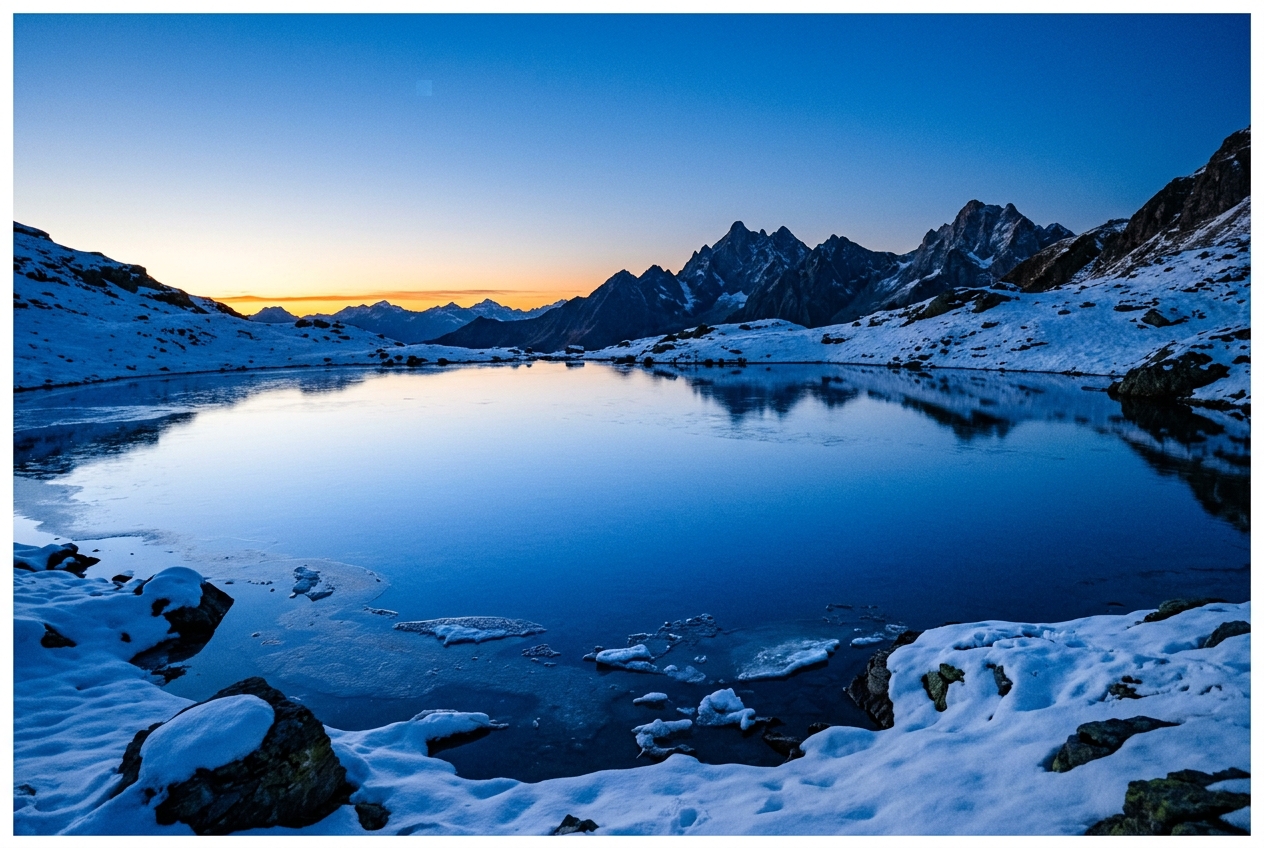
1. Opening Scene: The Sudden Cold and the Electric Blue
Stand upon an open moorland or an elevated coastal headland twenty minutes after the sun has slipped beneath the horizon. The kinetic drama of the golden hour—the blazing amber rims, the blinding solar disc, the long crimson shadows cast across heather and stone—has dissolved. A profound stillness settles over the landscape. The surface air temperature drops sharply as the planetary boundary layer decouples from the cooling turf; a faint, cool katabatic draft begins to slide down the contours of the valley, carrying the crisp scent of damp peat, ozone, and settling dew.
       SOLAR RAYS (Grazing Stratosphere)
  ===========================================> [Stratospheric Ozone Layer (15-35 km)]
                                                         \
                                                Selective Absorption
                                               (Orange/Red Extinguished)
                                                           \
                                                            v  [Rayleigh Scatter]
                                                       Zenith Sky
                                                           |
                                                           | (Pure Blue Light)
                                                           v
                                                      [Observer]
Look directly upward, toward the astronomical zenith. The sky overhead does not fade into the murky, slate-grey wash or pale yellow gloom that intuitive intuition might suggest for a dying light source. Instead, as the civil twilight deepens into early nautical twilight, the vault of the heavens undergoes an extraordinary chromatic transformation: it ignites into an intense, velvet, almost electric cobalt blue.
This is the "blue hour"—l'heure bleue—a brief optical window cherished by landscape photographers and field naturalists alike. While the western horizon remains stained with a fading gradient of orange and vermilion, the zenith achieves a saturation and colorimetric purity far deeper than the azure of midday. To human eyes, the world beneath this dome is bathed in a shadowless, monochromatic clarity. Every blade of grass and outcrop of rock seems outlined in indigo. Yet this familiar aesthetic marvel conceals one of the most elegant paradoxes in atmospheric physics: if our atmosphere were governed solely by the molecular scattering that paints the midday sky blue, the twilight zenith would not be cobalt at all. It would be an uninspiring, muddy greenish-grey.
2. What is Actually Happening: The Rayleigh Paradox and the Stratospheric Sponge
To understand why the twilight sky turns an intense sapphire, one must first confront the historical failure of classical optics to explain it. In 1871, John William Strutt, 3rd Baron Rayleigh, published his seminal theory of molecular scattering. Lord Rayleigh’s scattering model demonstrated that when light encounters particles much smaller than its wavelength—such as nitrogen ($N_2$) and oxygen ($O_2$) molecules—the intensity of the scattered light is inversely proportional to the fourth power of the wavelength:
$$\text{Scattering Intensity} \propto \frac{1}{\lambda^4}$$
Because blue light ($\lambda \approx 450\text{ nm}$) has a much shorter wavelength than red light ($\lambda \approx 650\text{ nm}$), it is scattered approximately 4.3 times more efficiently. During the middle of the day, as sunlight penetrates the relatively thin vertical column of air directly above us, this preferential scattering floods the sky with diffuse blue light, while the direct solar beam remains bright white-gold.
+-----------------------------------------------------------------------------------+
|                           THE TWILIGHT RAYLEIGH PARADOX                           |
|                                                                                   |
|  1. Midday Sun:                                                                   |
|     Short path length -> Blue light scattered diffusely -> Sky appears cyan-blue. |
|                                                                                   |
|  2. Sunset Horizon:                                                               |
|     Long path length -> All blue light scattered out -> Direct beam turns red.    |
|                                                                                   |
|  3. Twilight Zenith (Rayleigh ONLY):                                              |
|     Direct beam reaches zenith already stripped of blue -> Only red/orange left   |
|     -> Rayleigh scatters that remaining orange -> Zenith should look PALE YELLOW! |
|                                                                                   |
|  4. Reality (With Ozone Chappuis Absorption):                                     |
|     Ozone absorbs the orange/red -> Only blue survives -> Zenith glows COBALT!    |
+-----------------------------------------------------------------------------------+
Herein lies the paradox that baffled 19th-century physicists. When the sun dips several degrees below the horizon, sunlight can no longer strike the lower troposphere directly. Instead, solar rays must travel along a vast, sweeping tangent through the atmosphere before reaching the upper air parcels directly above the observer, which then scatter light down to the ground.
By the time sunlight has traversed this colossal horizontal path of dense tropospheric air, Rayleigh scattering has thoroughly depleted all the short blue wavelengths from the direct beam—the very process that makes the setting sun look deep crimson. If that reddened, blue-depleted beam were subsequently scattered by the zenith air molecules, the overhead sky would inevitably appear a dull, desaturated yellow-orange or pale grey. Mathematically, a pure molecular atmosphere cannot sustain a blue zenith after sunset.
The solution to this paradox was first uncovered by French chemist James Chappuis in 1880 and later quantified for atmospheric optics by American geophysicist Edward O. Hulburt in 1953. The blue of twilight is not primarily a scattering phenomenon; it is an absorption phenomenon.
Think of the atmosphere as a layered sponge. High above the weather, suspended in the stratosphere between 15 and 35 kilometres above sea level, lies the Earth's ozone layer. While ozone ($O_3$) is celebrated for absorbing lethal ultraviolet radiation in the Hartley and Huggins bands, it also possesses a subtle, broad absorption band across the visible spectrum: the Chappuis band, spanning wavelengths between 500 and 700 nanometres, centered firmly in the yellow-orange region at 603 nanometres.
       VISUAL SPECTRUM TRANSMISSION THROUGH STRATOSPHERIC OZONE
========================================================================
 Wavelength:  400nm (Blue)      550nm (Green)      603nm (Orange)   700nm (Red)
 Absorption:   [ MINIMAL ]        [ MODERATE ]       [ PEAK ]       [ LOW ]
 Action:       Transmitted        Partial Loss       Absorbed       Absorbed
========================================================================
 Result: Pure Blue / Violet light emerges intact along tangential paths.
During the daytime, when the sun is overhead, sunlight punches vertically through this thin stratospheric sponge. The ozone layer is so thin (equivalent to a layer only about 3 millimetres thick at standard temperature and pressure) that visible absorption is negligible, removing barely 1 to 2 percent of the yellow-orange light.
However, at twilight, geometric perspective forces solar rays to travel sideways through the spherical shell of the stratosphere. The path length through the ozone layer increases thirty- to forty-fold. As the beam skims tangentially through thousands of kilometres of stratospheric ozone, the Chappuis band acts as an aggressive optical notch filter, selectively annihilating the yellow, orange, and red wavelengths. The blue and violet photons at 400–480 nanometres, largely unaffected by ozone absorption, pass cleanly through this stratospheric gauntlet. When this filtered, blue-enriched beam finally strikes the upper atmosphere above the observer, zenith air molecules scatter it downward. The twilight zenith glows cobalt because the stratosphere has devoured the rest of the rainbow.
3. The Science: Stratospheric Geometry, Chapman Functions, and the Beer-Lambert Extinction
To quantify the photophysical mechanics governing the blue hour, we examine the coupling of spherical atmospheric geometry, absorption cross-sections, and radiative transfer formulations established by the World Meteorological Organization and atmospheric radiative transfer models.
A. The Photochemistry and Spectral Profile of the Chappuis Band
Ozone absorption in the visible spectrum arises from weak electronic transitions from the ground state ($\tilde{X}^1A_1$) to the repulsive excited states ($^1B_1$ and $^1B_2$), resulting in the photolytic dissociation:
$$O_3 + h\nu \xrightarrow{\text{Chappuis}} O_2(^3\Sigma_g^-) + O(^3P)$$
The spectral absorption cross-section, denoted $\sigma_{O_3}(\lambda)$, forms a broad, bell-shaped continuum between 450 nm and 750 nm, reaching its absolute maximum at $\lambda = 603\text{ nm}$ with a cross-section of:
$$\sigma_{O_3}(603\text{ nm}) \approx 5.15 \times 10^{-21}\text{ cm}^2\text{ molecule}^{-1}$$
In stark contrast, within the deep blue window at $\lambda = 450\text{ nm}$, the absorption cross-section drops by more than an order of magnitude:
$$\sigma_{O_3}(450\text{ nm}) \approx 3.0 \times 10^{-22}\text{ cm}^2\text{ molecule}^{-1}$$
   Absorption Cross-Section sigma(lambda) across Visible Spectrum
   10^-21 cm^2
        ^
    6.0 |                     * * * (Peak ~603 nm)
    5.0 |                 * *       * *
    4.0 |              *                 *
    3.0 |            *                     *
    2.0 |          *                         *
    1.0 |        *                             *
    0.0 +--*---------------------------------------*----->
          400nm (Blue)       550nm (Green)      700nm (Red)
B. Equation 1: Tangential Stratospheric Geometry and the Air-Mass Factor
When the solar depression angle—the angle of the sun below the true astronomical horizon, denoted $\delta$ (or solar zenith angle $\chi = 90^\circ + \delta$)—reaches $2^\circ$ to $8^\circ$, plane-parallel approximations of the atmosphere collapse. One must compute the optical path through a spherical shell atmosphere using the Chapman grazing incidence function, $\text{Ch}(\chi, x)$, where $x = (R_\oplus + z) / H$, with $R_\oplus \approx 6,371\text{ km}$ being Earth's radius, $z$ the altitude of the layer, and $H$ the atmospheric scale height ($\approx 7.5\text{ km}$).
                             ZENITH SCATTERING GEOMETRY

                                      [ Zenith Atmosphere ]
                                             |  |
                                             |  |  Rayleigh Scatter
                                             |  |  to ground (theta = 90 deg)
                                             v  v
   Grazing Solar Beam                     [ Observer ]
   =========================> ( Tangent Point )
                                     |
                                  ___+___
                                 /       \
                                |  EARTH  |
                                 \_______/
The geometric path length $L$ of a solar ray traversing a spherical stratospheric shell between base altitude $z_1$ and top altitude $z_2$ with a tangent height $z_t$ is derived via Pythagorean chord geometry:
$$L(z_t) = 2 \left( \sqrt{(R_\oplus + z_2)^2 - (R_\oplus + z_t)^2} - \sqrt{(R_\oplus + z_1)^2 - (R_\oplus + z_t)^2} \right)$$
This dramatic geometric elongation amplifies the effective optical air-mass factor for ozone, $m_{\text{eff, } O_3}(\delta)$, far beyond standard secant approximations:
$$m_{\text{eff, } O_3}(\delta) \approx \frac{1}{\sqrt{1 - \left(\frac{R_\oplus + z_{\text{tan}}}{R_\oplus + z_{\text{peak}}}\right)^2 \cos^2 \delta}}$$
Worked Numerical Proof: The Ozone Air-Mass Multiplication
Let us evaluate the effective ozone path multiplier for an observer witnessing nautical twilight at a solar depression angle of $\delta = 4^\circ$ ($\chi = 94^\circ$). - Mean stratospheric ozone peak altitude: $z_{\text{peak}} = 22\text{ km} = 22,000\text{ m}$ - Stratospheric shell bounds: $z_1 = 15\text{ km}$, $z_2 = 30\text{ km}$ - Earth radius: $R_\oplus = 6,371\text{ km}$
For a grazing solar ray illuminating the upper troposphere/mesosphere overhead, the tangent ray path traverses a horizontal chord through the ozone layer of length:
$$L_{\text{tangent}} \approx 2 \sqrt{2 R_\oplus (z_2 - z_1)} = 2 \sqrt{2 \times 6371 \times (30 - 15)} = 2 \sqrt{191130} \approx 874.36\text{ km}$$
Comparing this horizontal chord of $\approx 874\text{ km}$ to the vertical thickness of the layer ($\Delta z = 15\text{ km}$):
$$\text{Geometric Ozone Air Mass Factor } m_{\text{eff, } O_3} \approx \frac{874.36}{15} \approx 38.3$$
C. Equation 2: The Spectral Extinction Law and Zenith Radiance Balance
The monochromatic solar spectral irradiance $I(\lambda, \delta)$ reaching the scattering parcel at the zenith is governed by the classic Beer-Lambert-Bouguer extinction law:
$$I(\lambda, \delta) = I_0(\lambda) \cdot \exp\left[ - m_{\text{Ray}}(\delta)\,\tau_{\text{Ray}}(\lambda) - m_{\text{eff, } O_3}(\delta)\,\tau_{O_3}(\lambda) - m_{\text{aer}}(\delta)\,\tau_{\text{aer}}(\lambda) \right]$$
Where: - $I_0(\lambda)$ is the extra-terrestrial solar spectral irradiance. - $\tau_{\text{Ray}}(\lambda)$ is the vertical Rayleigh optical depth: $\tau_{\text{Ray}}(\lambda) \approx 0.008735 \cdot \lambda^{-4.08}$ (with $\lambda$ in $\mu\text{m}$). - $\tau_{O_3}(\lambda) = \sigma_{O_3}(\lambda) \cdot N_{\text{col}}$ is the vertical ozone optical depth, where $N_{\text{col}}$ is the vertical column density in $\text{molecules}\cdot\text{cm}^{-2}$. - $m_{\text{Ray}}(\delta)$ and $m_{\text{eff, } O_3}(\delta)$ are the respective air-mass factors along the grazing chord.
Once this heavily filtered beam reaches the overhead column, the spectral zenith radiance $L_z(\lambda, \delta)$ observed from the ground via single scattering is:
$$L_z(\lambda, \delta) \propto I(\lambda, \delta) \cdot \frac{3}{16\pi}\left(1 + \cos^2 \Theta\right) \cdot \sigma_{\text{Ray}}(\lambda) \cdot \exp\left[ -\tau_{\text{zenith}}(\lambda) \right]$$
Since the scattering angle to the zenith observer is $\Theta = 90^\circ + \delta \approx 90^\circ$, the phase function $(1 + \cos^2 \Theta) \approx 1$.
+-----------------------------------------------------------------------------------------+
|                    WORKED CALCULATION: ORANGE VS. BLUE EXTINCTION                       |
|                                                                                         |
|  Standard Total Column Ozone = 300 Dobson Units (DU)                                    |
|  1 DU = 2.687 x 10^16 molecules/cm^2  ==>  N_col = 8.06 x 10^18 molecules/cm^2          |
|  Grazing Air-Mass Factor at delta = 4 deg: m_eff = 38.3                                 |
|                                                                                         |
|  1. At Peak Chappuis Absorption (Orange, lambda = 603 nm):                              |
|     - Absorption Cross-Section: sigma = 5.15 x 10^-21 cm^2                              |
|     - Vertical Optical Depth: tau_O3 = (5.15 x 10^-21) x (8.06 x 10^18) = 0.0415       |
|     - Tangential Optical Depth: tau_tangent = 38.3 x 0.0415 = 1.589                     |
|     - Transmittance through Ozone gauntlet:                                             |
|       T_O3(603 nm) = exp(-1.589) = 0.204  ===> (79.6% OF ORANGE LIGHT ABSORBED!)        |
|                                                                                         |
|  2. In the Pure Blue Window (Blue, lambda = 450 nm):                                    |
|     - Absorption Cross-Section: sigma = 3.00 x 10^-22 cm^2                              |
|     - Vertical Optical Depth: tau_O3 = (3.00 x 10^-22) x (8.06 x 10^18) = 0.00242      |
|     - Tangential Optical Depth: tau_tangent = 38.3 x 0.00242 = 0.0927                   |
|     - Transmittance through Ozone gauntlet:                                             |
|       T_O3(450 nm) = exp(-0.0927) = 0.911 ===> (91.1% OF BLUE LIGHT SURVIVES!)         |
|                                                                                         |
|  3. Downward Zenith Scattering Efficiency (lambda^-4 scaling):                          |
|     - Rayleigh Scatter ratio: (603 / 450)^4 = (1.34)^4 = 3.22x in favor of blue        |
|                                                                                         |
|  4. Combined Zenith Contrast Ratio:                                                     |
|     Ratio = [ T_O3(450) / T_O3(603) ] x [ Scatter(450) / Scatter(603) ]                 |
|     Ratio = [ 0.911 / 0.204 ] x 3.22 = 4.465 x 3.22 = 14.38                            |
|                                                                                         |
|  CONCLUSION: Blue light dominates over orange at the zenith by a factor of > 14 to 1.   |
+-----------------------------------------------------------------------------------------+
Without the Chappuis band, the ratio would be governed solely by Rayleigh scattering along a path where blue light had already suffered severe attenuation in the lower air, resulting in a calculated zenith chromaticity shifted heavily toward the yellow-green coordinate space ($x \approx 0.38, y \approx 0.42$ in standard CIE 1931 space). With the Chappuis band integrated, the spectral radiance peak snaps decisively into the blue ($x \approx 0.22, y \approx 0.24$), creating the vivid, saturated cobalt observed across the globe. Comprehensive real-time atmospheric data confirming these vertical trace gas distributions can be tracked via the NOAA Global Monitoring Laboratory and the Met Office Atmospheric Dynamics Division.
4. Practical Outdoor Guidance: Reading the Twilight Sky
For hikers, sailors, meteorologists, and photographers, understanding the Chappuis mechanism transforms the twilight sky into a precise instrument for assessing atmospheric composition, solar geometry, and impending weather changes.
       CHRONOLOGICAL PHASES OF THE TWILIGHT TRANSITION
+--------------------+---------------------+---------------------------------------------+
| Phase              | Solar Depression    | Primary Optical Phenomenon                  |
+--------------------+---------------------+---------------------------------------------+
| Golden Hour        | +6° down to 0°      | Forward Mie scattering, long red shadows    |
| Civil Twilight     | 0° down to 6°       | Earth shadow rises; Chappuis blue emerges   |
| Nautical Twilight  | 6° down to 12°      | Zenith hits peak cobalt saturation; stars   |
| Astronomical Twil. | 12° down to 18°     | Airglow and zodiacal light; sky turns black |
+--------------------+---------------------+---------------------------------------------+
What to Look for in the Sky
-
The Anti-Solar Horizon and the Belt of Venus ($\delta = 1^\circ \text{ to } 3^\circ$):
Turn your back to the sunset. Look east. You will observe a dark blue-grey segment rising smoothly from the horizon: the shadow of the Earth projected onto the atmosphere. Directly above this dark band rests a soft pink or lilac glow known as the Belt of Venus (or anti-twilight arch). The pink hue is caused by backscattered, highly reddened direct sunlight passing through the lower troposphere, whereas the dark band beneath it represents tropospheric air already plunged into complete terrestrial shadow. -
The Zenith Inversion ($\delta = 3^\circ \text{ to } 6^\circ$):
Shift your gaze directly overhead. As the Belt of Venus fades, the zenith enters its period of highest chromatic purity. The sky overhead does not appear dark; rather, it appears intensely illuminated from within. This is the peak of the Chappuis window, where the geometric path through the ozone layer reaches its maximum effective magnification ($\approx 35\text{–}45\times$) while sufficient upper-tropospheric air density remains illuminated to scatter photons downward. -
Aerosol Signatures and Volcanic Indicators:
If the twilight zenith appears milky, greenish-blue, or muddy ochre rather than deep cobalt, the atmosphere contains high concentrations of tropospheric aerosols, smoke particles, or maritime haze. Aerosols introduce wavelength-independent or weak Mie scattering ($\lambda^{-\alpha}$, where $\alpha \approx 1$), which scatters all wavelengths indiscriminately and washes out the sharp Chappuis spectral notch. Conversely, major stratospheric volcanic eruptions (which inject sulfate aerosols directly into the ozone layer) produce vivid purple twilights due to the optical superposition of Chappuis blue scattering and aerosol-scattered red light.
     EASTERN HORIZON (Anti-Solar Point during Early Civil Twilight)

        +---------------------------------------------------+
        |       DEEPENING CHAPPUIS BLUE VAULT               |
        |                                                   |
        |  . - ~ - . - ~ - . - ~ - . - ~ - . - ~ - . - ~ -  |
        |  BELT OF VENUS (Backscattered Reddened Light)     |  <-- Pink / Lilac
        |  ===============================================  |
        |  EARTH'S SHADOW (Unilluminated Lower Atmosphere)  |  <-- Dark Blue-Grey
        |___________________________________________________|
      ////////////////// TERRESTRIAL HORIZON ///////////////////
Instrument Readings to Monitor
- Barometer (Atmospheric Pressure):
The purest, deepest blue hours occur under post-frontal, cold polar maritime air masses associated with high-pressure systems ($> 1020\text{ hPa}$). Cold air has low absolute humidity, stripping out water vapor clusters and boundary-layer haze that degrade colorimetric purity. - Thermometer and Dew Point:
A wide spread between ambient temperature and dew point at sunset indicates dry lower air, ensuring minimal condensation nuclei. If the temperature hits the dew point during twilight, mist droplets will cause forward Mie scatter, rapidly grey-out the lower sky, and diminish zenith contrast. - Camera Calibration and Spectrometric Analysis:
Photographers attempting to capture the true spectral signature of Chappuis absorption should lock their camera white balance to standard daylight ($5200\text{K}\text{–}5600\text{K}$) rather than using Auto White Balance (AWB). AWB algorithms treat the intense blue cast as an error and artificially inject yellow/amber tint, destroying the natural Chappuis profile. A raw histogram will clearly show the red channel dropping precipitously while the blue channel remains saturated long after sunset.
5. Today's Meteorological Rule of Thumb
When the sun drops beneath the horizon on a crisp, cloudless evening, the deep cobalt blue overhead is not the fading residue of daytime scattering, but the living shadow of the ozone layer. If your twilight zenith glows pure electric sapphire, you are standing beneath dry, clean upper air; if it fades into a murky greenish-grey, expect high boundary-layer humidity, heavy aerosol loading, or an approaching warm front.
Further Reading & Authoritative References
- Detailed real-time tracking of global ozone distributions: NASA Ozone Watch
- Baseline solar radiation and atmospheric physics: NOAA Earth System Research Laboratories
- Observation guides on atmospheric optics and twilights: UK Met Office Sky Phenonema
- Atmospheric physics protocols and global standards: World Meteorological Organization (WMO)
- Foundational quantum molecular mechanics: Ozone Spectral Bands (Chappuis, Hartley, Huggins)