Airglow Optics & Mesospheric Chemiluminescence: How Hydroxyl Emissions and Atmospheric Gravity Waves Forge Rippling Night Skies
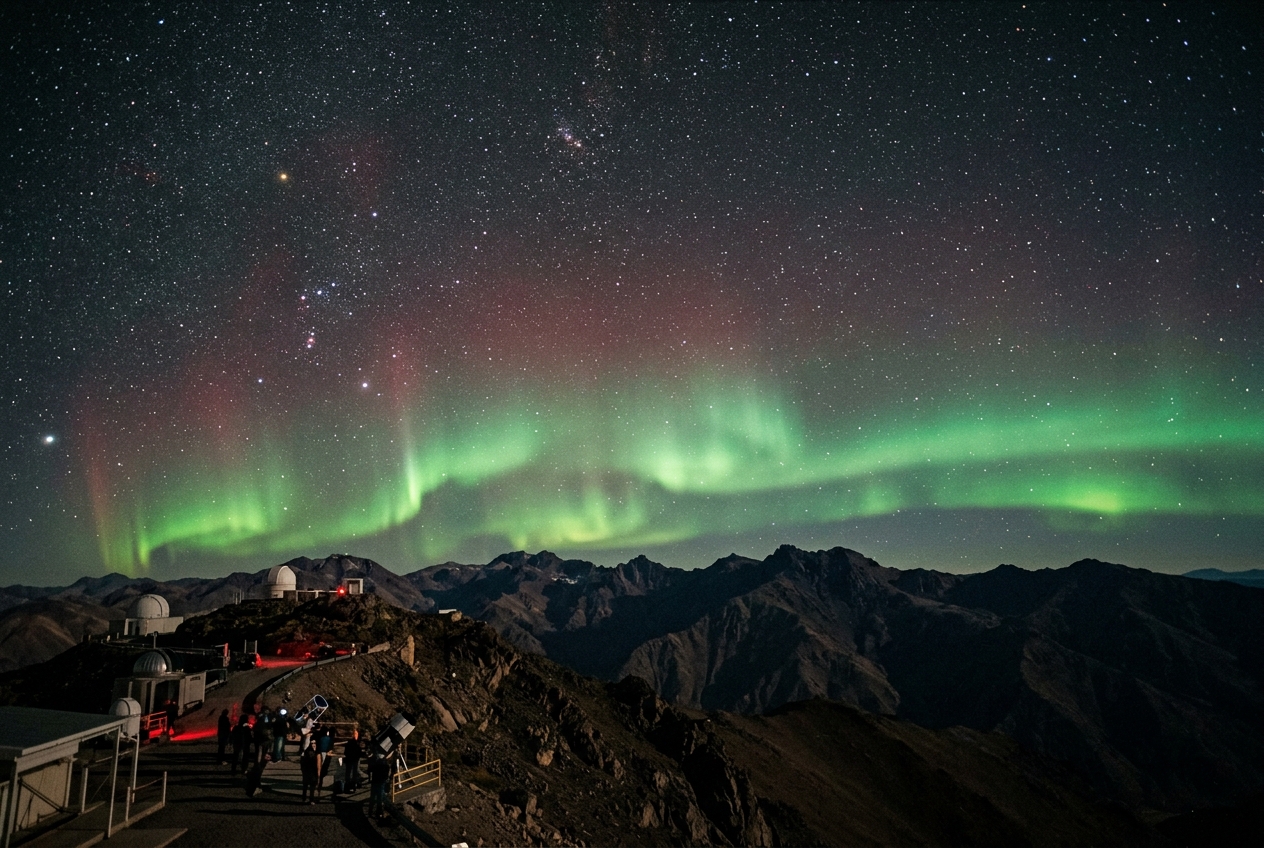
1. Opening Scene: The Living Canopy of the High Desert
Stand atop an arid plateau in the high desert at three o’clock on a moonless morning, far beyond the reach of industrial light domes. The environment is intensely physical. The air is razor-sharp, bone-dry, and bitingly cold, carrying the faint, resinous aroma of desiccated sage and basalt dust cooling under an open universe. The wind has collapsed to a complete dead calm, yet your skin detects the subtle, rhythmic pulse of micro-barometric shifts draining down from adjacent mountain ranges. Looking up into what should be an abyss of Bortle Class 1 darkness, an unexpected reality reveals itself: the night sky is not black.
                                  MESOPAUSE (~87-100 km)
 [Space]  -------------------------------------------------------------
           *  *  *  CHEMILUMINESCENT EMISSION LAYER (Airglow)  *  *  *
          - - - - - - - - - - - - - - - - - - - - - - - - - - - - - - -
               ^             ^                  ^            ^
              /               \                /              \
             /  Exponential    \              /  Wavefront     \
            /   Amplitude       \            /   Interference   \
           /    Growth:          \          /    Patterns        \
          /     A(z) ~ ρ(z)^(-1/2)\        /                      \
         /                         \      /                        \
 [Troposphere]                      \    /
  ---------------------------------------------------------------------
          [Convective Updrafts / Severe Thunderstorm Complex]
Suspended between the silhouettes of jagged peaks and the pinprick fires of the Milky Way, the upper atmosphere glows with an ethereal, dynamic luminescence. Broad ribbons of spectral emerald weave across the zenith, interlaced with diffuse, wine-red bands and intricate, undulating herringbone patterns that drift silently across the star fields. Four hundred kilometres to the south, below the curved horizon, a severe mesoscale convective system flashes silently behind distant ranges. Yet directly overhead, entirely disconnected from any geomagnetic storm or polar auroral curtain, the very fabric of the high atmosphere is breathing in slow, luminous waves. The celestial vault is behaving not as empty space, but as a vast, fluid phosphorescent sea.
2. What Is Actually Happening: Plain English First
To understand why the upper atmosphere glows in the dark, think of the Earth’s atmosphere as a colossal photochemical storage battery that charges by day under intense solar radiation and slowly discharges through the night.
Between 85 and 100 kilometres above our heads lies the mesopause—the coldest region in Earth's atmosphere, forming the boundary between the mesosphere and the thermosphere. During daylight hours, harsh solar ultraviolet (UV) radiation strikes this rarified zone. These high-energy photons slam into stable molecules of oxygen ($O_2$), snapping their chemical bonds and tearing them apart into individual, highly reactive oxygen atoms ($O$).
At sea level, a free oxygen atom would bump into another molecule and recombine in a fraction of a microsecond. But at 90 kilometres altitude, the air is nearly a million times thinner than at the surface. Molecules are separated by vast relative distances. Consequently, an unbonded oxygen atom can wander through the mesosphere for hours without colliding with a suitable partner. When night falls and the sun’s photolysing rays vanish, these isolated atoms finally collide, recombine, and release their stored daytime energy as visible and infrared photons. This continuous, nocturnal chemical reaction is known as chemiluminescence, and the visible radiation it creates is called airglow (or nightglow).
This glowing layer is governed by three primary chemical lanterns:
- The Emerald Oxygen Line ($557.7\text{ nm}$): When free oxygen atoms recombine via three-body collisions, they transfer their energy to single oxygen atoms, kicking their electrons into an excited quantum state known as $O(^1S)$. When that electron relaxes to the $O(^1D)$ state, it discharges a photon of pure emerald-green light at a wavelength of precisely $557.7\text{ nm}$.
- The Hydroxyl ($OH^*$) Carmine Furnace: Trace amounts of water vapour transported to the mesosphere react with atomic oxygen to form ozone ($O_3$) and atomic hydrogen ($H$). When hydrogen reacts with ozone, it produces vibrationally excited hydroxyl radicals ($OH^*$). As these radicals cascade down their quantum vibrational-rotational ladders, they emit a powerful wash of deep-red and near-infrared light known as the Meinel bands, centered between 80 and 90 kilometres altitude.
- The Meteoritic Sodium Glow ($589.0 / 589.6\text{ nm}$): Every day, billions of micrometeorites vaporize upon entering the upper atmosphere, depositing a fine, permanent layer of atomic sodium metal at roughly 90 kilometres altitude. Oxidation and reduction cycles involving this cosmic dust liberate the classic amber-yellow light identical to that of vintage low-pressure sodium street lamps.
+---------------------------------------------------------------------+
|                      THE THREE AIRGLOW LANTERNS                     |
+---------------------------------------------------------------------+
| 1. ATOMIC OXYGEN (557.7 nm)   -> Brilliant emerald ribbons at 96 km |
| 2. HYDROXYL RADICALS (OH*)    -> Deep red & near-infrared at 87 km  |
| 3. ABLATED SODIUM (589.0 nm)  -> Warm amber-yellow glow at 90 km    |
+---------------------------------------------------------------------+
The Atmosphere as a Ruffled Pond: Atmospheric Gravity Waves
Why does this glow form distinct, undulating ripples, bands, and herringbone interference patterns rather than a flat, homogeneous haze?
Imagine tossing a heavy stone into a deep, crystal-clear pond. The splash pushes water upward against gravity, and as gravity pulls the water back down, concentric ripples spread out across the surface. In our atmosphere, powerful tropospheric events—such as deep convective updrafts within severe thunderstorms, massive jet-stream shears, or strong winds blasting over major mountain ranges—act as the stone. They forcefully displace air packets vertically.
Because the atmosphere is stably stratified (warm, buoyant air resting above cooler, denser air in the stratosphere), gravity and buoyancy act as restorative forces. The displaced air oscillates up and down, generating internal atmospheric gravity waves that propagate vertically and horizontally through the stratosphere and mesosphere.
As these waves climb into the increasingly rarified mesosphere, conservation of kinetic energy forces their physical wave amplitude to grow exponentially. By the time a gravity wave reaches the airglow layer at 90 kilometres, a vertical oscillation that began in the troposphere as a mere whisper of a few centimetres per second has amplified into massive, hundred-metre vertical displacements and violent temperature swings. As these waves compress, heat, rarefy, and cool the chemical emission layers, they modulate the local reaction rates. The result is a stunning, visible map of deep atmospheric dynamics painted across the night sky in glowing, moving wavefronts.
3. The Science: For Those Who Want to Go Deeper
To rigorously characterize the physical state of the mesosphere through optical airglow observations, atmospheric dynamicists rely on quantitative formulations linking fluid mechanics, chemical reaction kinetics, and radiative emission.
TROPOSPHERIC DISTURBANCE            PROPAGATION THROUGH DENSITY GRADIENT             MESOSPHERIC MODULATION
+-----------------------+           +----------------------------------+            +----------------------+
| Deep Convection Core  | --------> | Wave kinetic energy conserved:   | ---------> | Layer compressed and |
| or Mountain Wave Drag |           | Amplitude A(z) ~ exp(z / 2H)     |            | heated; airglow rate |
| launches Gravity Wave |           | Density drops by factor of 10^6  |            | varies by ±10-30%    |
+-----------------------+           +----------------------------------+            +----------------------+
The Chapman Three-Body Recombination Kinetics
The primary engine of the green oxygen airglow is the classic Chapman mechanism, described by a sequence of termolecular and bimolecular steps:
$$\text{O}(^3\text{P}) + \text{O}(^3\text{P}) + \text{M} \xrightarrow{k_1} \text{O}_2^* + \text{M}$$
$$\text{O}_2^* + \text{O}(^3\text{P}) \xrightarrow{k_2} \text{O}_2 + \text{O}(^1\text{S})$$
$$\text{O}(^1\text{S}) \xrightarrow{A_{5577}} \text{O}(^1\text{D}) + h\nu \quad (\lambda = 557.7\text{ nm})$$
where $\text{M}$ represents a non-reactive ambient third body (primarily $\text{N}2$ or $\text{O}_2$) required to carry away excess momentum, and $A{5577} \approx 1.26\text{ s}^{-1}$ is the Einstein transition probability for this optically "forbidden" metastable state. Because this transition is quantum-mechanically forbidden, the excited atom has a remarkably long radiative lifetime ($\tau \approx 0.79\text{ seconds}$). In the dense lower atmosphere, collisional quenching would instantly deactivate this state before a photon could be emitted; at the mesopause, however, the collision interval is sufficiently long that the atom survives to radiate its emerald photon.
Wave Amplification with Scale Height
As an internal gravity wave propagates upwards from the troposphere, its vertical energy flux $F_z$ remains conserved in the absence of dissipative wave-breaking or turbulent viscosity:
$$F_z = \rho_0(z) \overline{u' w'} = \text{constant}$$
Because atmospheric background density $\rho_0(z)$ decays exponentially with altitude $z$ according to the barometric law:
$$\rho_0(z) = \rho_0(0) \exp\left(-\frac{z}{H}\right)$$
where $H = \frac{k_B T}{m g} \approx 6.5\text{ km}$ represents the atmospheric scale height, the wave perturbation velocity $u'(z)$ and temperature perturbation $T'(z)$ must scale inversely with the square root of the background density:
$$u'(z) \propto \left[\rho_0(z)\right]^{-1/2} = \exp\left(\frac{z}{2H}\right)$$
==============================================================================
               WORKED MATHEMATICAL PROOF: WAVE AMPLIFICATION
==============================================================================
Consider a gravity wave generated by a severe storm cell at z_0 = 10 km
with an initial horizontal velocity perturbation of u'(10 km) = 0.05 m/s.
Assume an average scale height H = 6.5 km up to the mesopause at z = 88 km.

Altitude displacement: Δz = 88 km - 10 km = 78 km
Amplification factor:  exp(Δz / 2H) = exp(78 / (2 * 6.5)) = exp(6.0) ≈ 403.4

Resulting perturbation velocity at 88 km:
u'(88 km) = 0.05 m/s * 403.4 = 20.17 m/s

A negligible 5 cm/s tremor in the troposphere amplifies into a fierce
20.2 m/s oscillating gale at the mesopause, capable of compressing and
modulating the chemical emission layer dramatically.
==============================================================================
Mathematical Formulation 1: The Krassovsky Ratio ($\eta$)
To evaluate how these amplified gravity waves modulate the brightness of the night sky, upper-atmosphere physicists employ the Krassovsky Ratio ($\eta$).
What it predicts in plain English:
The Krassovsky ratio quantifies how much the brightness of an airglow emission layer changes relative to a given percentage change in local atmospheric temperature caused by a passing gravity wave. It defines the sensitivity of the chemical lantern to wave-induced heating and cooling.
Mathematically, the complex Krassovsky ratio is expressed as:
$$\eta = \frac{\Delta I / \bar{I}}{\Delta T / \bar{T}} \exp(-i \phi)$$
where: * $\Delta I / \bar{I}$ is the fractional fluctuation in airglow emission intensity (brightness). * $\Delta T / \bar{T}$ is the fractional fluctuation in ambient neutral temperature. * $\phi$ is the phase angle difference between the peak temperature perturbation and the peak brightness perturbation.
------------------------------------------------------------------------------
                   WORKED EXAMPLE: KRASSOVSKY BRIGHTNESS RESPONSE
------------------------------------------------------------------------------
An all-sky spectral imager targeting the OH*(6-2) band at 87 km measures a mean
background temperature of T_bar = 185 K. A propagating gravity wave induces a
temperature oscillation of ΔT = ±4.5 K. For the mesospheric hydroxyl layer,
empirical and theoretical models establish |η| ≈ 3.4.

1. Compute the fractional temperature perturbation:
   ΔT / T_bar = 4.5 K / 185 K = 0.0243 (or 2.43%)

2. Compute the resulting fractional intensity perturbation:
   ΔI / I_bar = |η| * (ΔT / T_bar) = 3.4 * 0.0243 = 0.0827 (or 8.27%)

Result: A modest 4.5 K temperature oscillation produces an 8.3% brightness
modulation across the sky—an intensity variation easily detected by modern
CMOS sensors and visible to dark-adapted human eyes under pristine skies.
------------------------------------------------------------------------------
Mathematical Formulation 2: Photometric Radiance in Rayleighs and Wave Phase Speed
Airglow emission rates are globally standardized using the Rayleigh (R), a unit of omnidirectional column emission rate established by upper atmospheric physicists.
What it predicts in plain English:
The Rayleigh measures the total number of photons emitted per second inside a one-square-centimetre column of air extending from the ground straight out to the edge of space. Combined with time-lapse imaging, tracking these emissions allows us to compute the exact speed at which energy travels through the high atmosphere.
The definition of the Rayleigh is:
$$1\text{ Rayleigh (R)} = 10^6\text{ photons}\cdot\text{cm}^{-2}\cdot\text{s}^{-1}\cdot(4\pi\text{ sr})^{-1} = \frac{10^{10}}{4\pi}\text{ photons}\cdot\text{m}^{-2}\cdot\text{s}^{-1}\cdot\text{sr}^{-1}$$
The horizontal phase speed ($c_h$) of the modulating gravity wave is derived from the spatial horizontal wavelength ($\lambda_h$) and the temporal period ($\tau$) observed across calibrated sequential frames:
$$c_h = \frac{\lambda_h}{\tau} = \frac{\omega}{k_h}$$
------------------------------------------------------------------------------
                 WORKED EXAMPLE: GRAVITY WAVE SPEED DERIVATION
------------------------------------------------------------------------------
An observer captures a time-lapse of the green oxygen layer (557.7 nm).
Star calibration shows that consecutive glowing wave crests are separated by
a horizontal distance of λ_h = 36.0 km. A crest takes exactly τ = 12.0 minutes
(720 seconds) to pass a stationary celestial landmark.

Calculate the horizontal phase speed (c_h):
c_h = λ_h / τ = 36,000 m / 720 s = 50.0 m/s  (180 km/h)

Interpretation: This wave is racing horizontally through the 96 km altitude
mesopause at 180 km/h, carrying mechanical momentum launched by a frontal
squall line hundreds of kilometres away in the lower troposphere.
------------------------------------------------------------------------------
4. Practical Outdoor Guidance
Observing and photographing mesospheric airglow offers ground-based observers a direct window into the dynamic coupling between surface weather and space weather. Modern digital cameras with high quantum-efficiency CMOS sensors can capture these subtle phenomena with remarkable clarity.
+--------------------------------------------------------------------------------------------------------+
|                                    AIRGLOW FIELD IDENTIFICATION MATRIX                                 |
+----------------------+--------------------+--------------------+-------------------+-------------------+
| Diagnostic Feature   | Mesospheric        | Auroral            | Noctilucent       | High Cirrus       |
|                      | Airglow            | Curtain            | Clouds (NLC)      | Clouds            |
+----------------------+--------------------+--------------------+-------------------+-------------------+
| Typical Altitude     | 85 – 100 km        | 100 – 400 km       | 80 – 85 km        | 6 – 12 km         |
| Primary Trigger      | Chemiluminescence  | Particle collision | Ice crystalliz.   | Ice crystalliz.   |
|                      | + Gravity Waves    | (Solar Wind/CME)   | on meteor smoke   | (Troposphere)     |
| Geomagnetic Dep.     | None (Kp = 0 to 9) | Strict (High Kp)   | None              | None              |
| Latitudinal Range    | Global (Equator-   | Polar / Sub-auroral| High Latitudes    | Global            |
|                      | Pole)              | ovals (typically)  | (50° – 70°)       |                   |
| Optical Spectrum     | 557.7 nm (green),  | 557.7 nm, 630.0 nm,| Broadband diffuse | Scattered ground  |
|                      | OH* (NIR), 589 nm  | 391.4 nm (N2+)     | solar scattering  | light / extinction|
| Star Visibility      | Unextinguished     | Unextinguished     | Unextinguished    | Dimmed / Blocked  |
|                      | (Stars stay sharp) | (Stars stay sharp) | (Stars stay sharp)| (Star extinction) |
+----------------------+--------------------+--------------------+-------------------+-------------------+
How to Distinguish Airglow from Auroras, Clouds, and Light Pollution
- Airglow vs. Aurora: * Geomagnetic Independence: Airglow occurs every single night across all latitudes, from the equator to the poles, regardless of whether the NOAA Space Weather Prediction Center reports a geomagnetic storm ($Kp = 0$). Auroras require active geomagnetic disturbances driven by the solar wind. * Morphology: Airglow forms horizontal, undulating ripples, concentric rings, and banded interference structures that slowly drift across the sky. Auroral displays exhibit vertical rays, curtains, and fast-moving dynamic folds aligned with geomagnetic field lines.
- Airglow vs. High Cirrus Sheets: * Star Extinction: Cirrus clouds scatter and absorb starlight; stars viewed through cirrus appear dimmed, haloed, or occluded. Airglow is an emission phenomenon occurring far above the clouds: stars viewed through intense airglow ripples remain pinpoint-sharp and unattenuated.
- Airglow vs. Urban Light Domes: * Spatial Distribution: City light pollution is fixed to the horizon, decaying steadily toward the zenith. Airglow encompasses the entire sky dome and exhibits the Van Rhijn Effect—an optical brightening toward the horizon caused by looking through a longer path length of the thin emitting layer at shallow elevation angles.
                       THE VAN RHIJN EFFECT
                 Zenith (Short path length = dimmer)
                         |
                         V
       -----------------***------------------  <- Airglow Layer (~90 km)
                      /     \
                     /       \
  Horizon (Long path)         (Long path) Horizon
         \                         /
          \                       /
           +---------------------+
           |      OBSERVER       |
           +---------------------+
Astrophotographer’s Field Protocol
To record mesospheric gravity waves:
- Location & Timing: Choose a Bortle Class 1 or 2 location at high altitude during an astronomical new moon. The best displays often occur 2 to 6 hours after local sunset, following intense summer afternoon convection upwind.
- Camera Configuration: Use a full-frame sensor paired with a fast, wide-angle lens ($14\text{ mm}$ to $24\text{ mm}$, $f/1.4$ to $f/2.8$). Set the exposure to $15\text{–}25\text{ seconds}$ at ISO 3200–6400. Avoid exposures longer than 30 seconds to prevent wave-motion blur.
- Sensor Modification: While stock cameras capture the $557.7\text{ nm}$ green oxygen line well, an astro-modified (full-spectrum or Ha-converted) sensor provides high sensitivity to the powerful near-infrared Hydroxyl ($OH^*$) Meinel bands, revealing deep crimson and infrared wave structures invisible to standard consumer cameras.
- Meteorological Triangulation: Review regional Doppler radar and water-vapor satellite imagery from agencies such as the World Meteorological Organization or NASA Earth Observatory. Identify severe Mesoscale Convective Systems (MCS) located 200 to 800 kilometres upwind; their anvil updrafts are the primary drivers of concentric mesospheric gravity waves.
+---------------------------------------------------------------------+
|                     NIGHT-SKY OBSERVER'S CHECKLIST                  |
+---------------------------------------------------------------------+
| [ ] Pristine dark-sky site (Bortle 1-2, zero light pollution)       |
| [ ] Moonless window (Astronomical Twilight to Twilight)             |
| [ ] Deep tropospheric storm complex active 200-600 km upwind        |
| [ ] Camera on sturdy tripod: 20s exposure, f/1.8, ISO 3200          |
| [ ] Observe zenith-to-horizon Van Rhijn brightening                 |
| [ ] Confirm background stars remain unextinguished and sharp        |
+---------------------------------------------------------------------+
5. Today's Meteorological Rule of Thumb
==============================================================================
                    TODAY'S METEOROLOGICAL RULE OF THUMB
==============================================================================
If the moonless midnight sky glows with shimmering green and amber bands
while the stars remain razor-sharp and geomagnetic conditions are completely
quiescent, you are not witnessing an aurora or high-altitude cloud cover.

You are watching the chemical discharge of daytime solar energy in the
mesopause, shaped and modulated by atmospheric gravity waves launched from
severe thunderstorms hundreds of kilometres beyond your horizon.
==============================================================================