Zusanli Cavity Leg Three Miles: Tibial Fascial Decompression, Post-Heaven Qi Fortification, and Anterior Kinetic Chain Integration in Classical Neigong
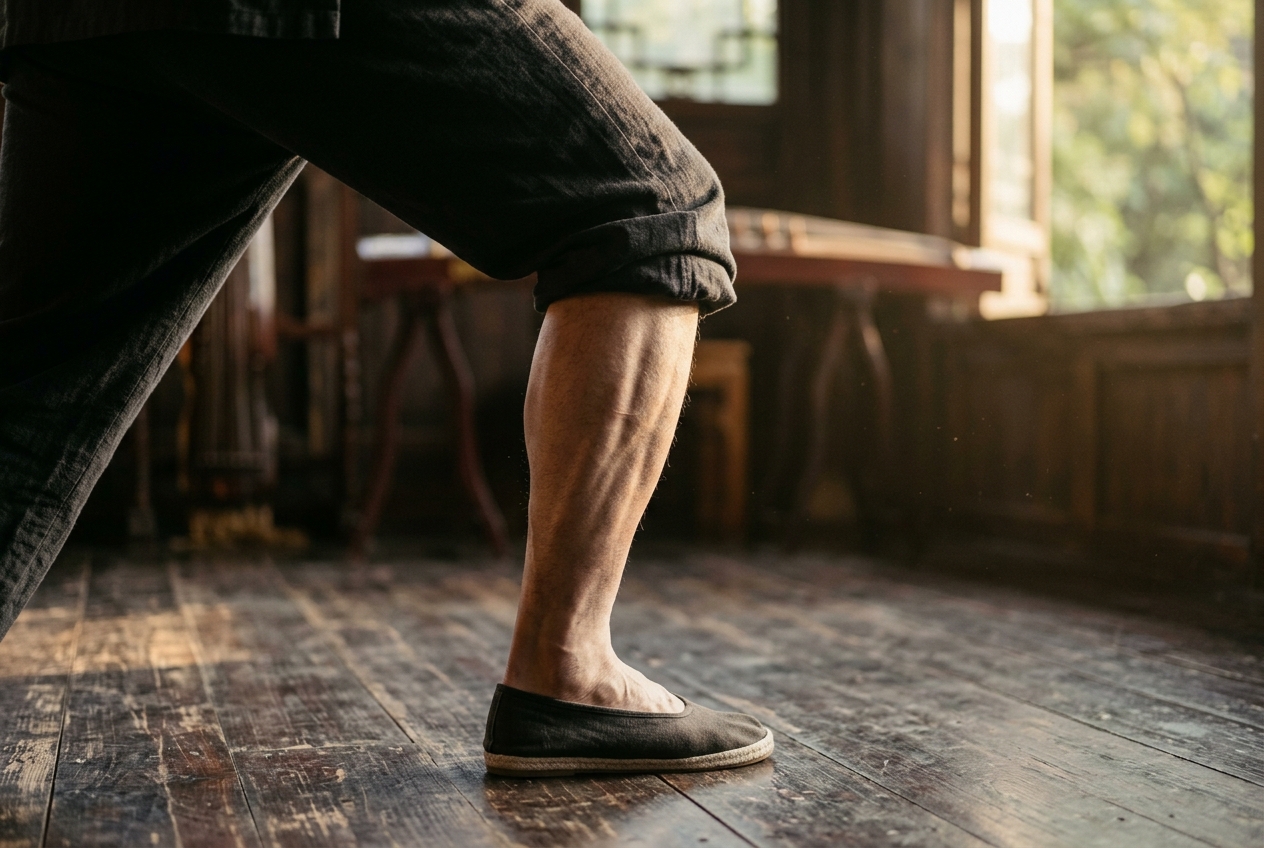
While centuries of folklore surround this point, the underlying mechanism is grounded in physical architecture. In Classical Chinese Medicine, Zusanli is classified as the He-Sea (Uniting) and Earth point of the Foot Yangming Stomach meridian, serving as the premier systemic "Command Point" for the entire abdomen. It governs the generation of Hou Tian Zhi Qi (后天之气)—the "Post-Heaven" or acquired vitality derived continuously from food, water, and respiration. When modern internal martial artists sink their weight through the hips (Kua) and maintain a suspended crown during standing meditation (Zhan Zhuang), they are actively loading and decompressing this exact muscular compartment, stimulating the deep neurovascular bundle and sending grounding bioelectric signals through the fascial web.
Anatomical Topography and Neurovascular Architecture
To engage Zusanli with clinical and somatic precision, one must understand its structural milieu. Topographically, the point resides four finger-widths (measured by the practitioner's own interphalangeal joint width, or 3 cun) inferior to the lateral infracollar fossa of the patella—termed Dubi (ST35) or the "lateral eye of the knee"—and one transverse finger-breadth lateral to the sharp anterior crest of the tibia. Somatically, it sits squarely within the muscular belly of the tibialis anterior, adjacent to the extensor digitorum longus muscle and bound by the dense crural fascia of the leg’s anterior compartment.
Beneath the superficial skin and adipose layer, needle insertion or mechanical acupressure traverses the tough crural fascia into the anterior tibial compartment. Here lies an intricate neurovascular bundle comprising: 1. The Deep Peroneal Nerve (Nervus fibularis profundus): A major terminal branch of the common fibular nerve that innervates the anterior compartment muscles and conveys deep somatic afferent fibers. 2. The Anterior Tibial Artery and Vein: The primary vascular conduit delivering oxygenated microvascular perfusion to the dorsum of the foot and anterior leg. 3. The Superficial and Deep Investing Fascia: Collagenous sheets continuous with the lateral retinaculum of the knee above and the superior extensor retinaculum of the ankle below.
In classical meridian theory, this zone represents the pathway of the Yangming Jing Jin (Stomach Sinew Channel)—an expansive myofascial kinetic meridian that mirrors what contemporary anatomists term the Superficial Front Line. This fascial continuity links the dorsal surface of the toes, runs through the tibialis anterior, crosses the patellofemoral retinaculum, courses up the rectus femoris, traverses the rectus abdominis, and terminates at the cranial fascia and facial musculature. By manipulating the mechanical tension and neural tone at Zusanli, the practitioner influences not merely an isolated locus on the leg, but the entire anterior kinetic chain of the human body.
Step-by-Step Practice Guide: Locating, Decompressing, and Activating ST36
The cultivation of Zusanli within internal martial arts (Neigong) and therapeutic exercises (Daoyin) relies on integrating posture, breath, intention, and manual stimulation. Follow this progressive didactic protocol.
1. Somatosensory Palpation and Manual Stimulation
- Finding the Notch: Sit comfortably on the edge of a sturdy chair with your feet flat on the ground and your knees bent at ninety degrees. Place your palm over your patella so your fingers point downward along your shin. Your ring finger will naturally rest approximately four finger-widths below the knee joint line; slide your fingertip outward into the soft, tender depression just off the tibial ridge.
- Acupressure Modulation: Hook the pads of your thumbs into the notch of Zusanli on both legs. Apply firm, gradual perpendicular pressure directed slightly toward the tibia until you elicit a pronounced sensation known in acupuncture as De Qi (得气)—a dull, spreading ache accompanied by a tingling warmth traveling down the shin toward the second and third toes. Hold steady pressure for three slow breath cycles, then execute ten clockwise circular kneadings, followed by ten counter-clockwise kneadings.
- Rhythmic Percussive Tapping (Pai Da): Form loose, hollow fists with both hands. Rhythmically tap the Zusanli area with the cushioned base of your palms or knuckles, alternating left and right at a cadence of roughly one to two beats per second for sixty seconds. Maintain relaxed wrists; allow the vibration to penetrate deep through the crural fascia.
2. Grounding Stance Alignment: Cheng Bao Zhuang (Embracing the Tree)
- The Root (Yongquan): Stand with feet parallel, shoulder-width apart. Distribute 60 percent of your weight across the balls of your feet and 40 percent across your heels, ensuring the plantar vault is domed and the Yongquan cavity (Kidney 1, located in the central depression of the anterior third of the sole) remains open, buoyant, and suctioned to the earth.
- The Sinking of the Kua: Fold gently at the inguinal crease (Kua), letting the pelvis sit back as if descending an inch onto an imaginary stool. Ensure your knees remain directly tracking above your second toes and do not collapse inward (valgus) or project past the tips of your toes.
- Cranial Suspension (Baihui): Counterbalance the sinking pelvis by gently lifting the crown of your head (Baihui, GV20) upward, lightly tucking the chin to lengthen the cervical spine. This creates a vertical vector of axial decompression through the spine while loading the lower limbs via tensegrity.
- Arm Positioning: Bring your arms up in front of your chest as though lightly encircling the trunk of an ancient pine tree, elbows dropped below the wrists, fingers softly open and pointing toward each other across a four-inch gap.
3. Breath Synchronization and Mind-Intent (Yi Dao Qi Dao)
- Abdominal Respiration: Inhale smoothly through your nose for a count of four. Feel your lower abdomen, lower back, and lateral flanks expand omnidirectionally (360-degree intra-abdominal pressure expansion).
- Directing the Micro-Circulation: As you inhale, maintain your mental focus (Yi) at the lower belly (Dantian). As you exhale through the nose for a count of six, apply the principle of Yi Dao Qi Dao ("where the mind-intent goes, the vital energy follows"). Guide your kinesthetic awareness down through the hip joints (Kua), down the anterior thighs, sweeping through the hollow of Zusanli on both shins, and plunging into the floor through Yongquan.
- Sensory Markers: As you hold this stance for five to fifteen minutes, observe the gradual emergence of specific physiological feedback: a sensation of heavy lead-like rooting through the shins, a fine tingling or micro-pulsation around the tibialis anterior, and a soothing, radiating warmth within the central epigastrium.
Common Structural Faults and Corrections
| Alignment Fault | Biomechanical Consequence | Self-Correction Protocol |
|---|---|---|
| Knees Projecting Past Toes | Excessive patellofemoral shearing; locks the crural fascia and inhibits flow through ST36. | Deepen the crease at the hips (Kua); sit the sitz bones backward while keeping the torso upright. |
| Medial Knee Collapse (Valgus) | Crushes the inner kinetic chain and overstretches the lateral Stomach meridian sinew. | Actively spiral the femoral heads outward (wrapping the knees) while anchoring the big toe roots. |
| Posterior Pelvic Over-Tuck | Flattens the natural lumbar lordosis, compressing the diaphragm and stalling descent of breath. | Neutralize the sacrum; imagine the tailbone is a plumb-line suspended freely by gravity. |
| Collapsed Plantar Arch | Disconnects Yongquan (KI1), transferring destabilizing torsion directly to the shin and knee. | Engage the intrinsic foot muscles (short foot exercise) to dome the transverse and longitudinal arches. |
Neurobiology and Fascial Tensegrity: Why the Practice Works
Modern physiological and medical investigations have increasingly validated the profound clinical mechanisms of Zusanli. Landmark biomedical research published via the National Center for Biotechnology Information demonstrates that mechanical and electrical stimulation of ST36 reliably engages the cholinergic anti-inflammatory pathway through precise neuroanatomical circuits.
When the deep peroneal nerve branches at ST36 are engaged through sustained biomechanical loading or manual pressure, afferent sensory signals ascend through the spinal cord to the nucleus tractus solitarius in the medulla oblongata. This stimulates the dorsal motor nucleus of the vagus nerve, augmenting efferent parasympathetic vagal outflow. This vagal surge triggers the release of acetylcholine within the reticuloendothelial system—particularly the spleen—where it binds to alpha-7 nicotinic acetylcholine receptors ($\alpha7\text{nAChR}$) on resident macrophages. This biochemical cascade dramatically suppresses the transcription and secretion of pro-inflammatory cytokines, including tumor necrosis factor-alpha ($\text{TNF-}\alpha$), interleukin-6 ($\text{IL-6}$), and high mobility group box 1 ($\text{HMGB1}$).
Simultaneously, this parasympathetic dominance entrains the enteric nervous system (the intrinsic neural plexus of the gastrointestinal tract, often termed the "second brain"). Vagal activation stimulates local nitric oxide and vasoactive intestinal peptide release, elevating mucosal microvascular perfusion across the gastric and intestinal epithelium, accelerating gastric motility, and harmonizing digestive secretion. For individuals afflicted by chronic stress-induced sympathetic vasoconstriction, this provides an immediate somatic reset.
From the standpoint of fascial mechanics and biotensegrity, the anterior compartment of the lower leg acts as a critical kinetic shock absorber and hydraulic pump. As documented in anatomical texts and global health paradigms recognized by the World Health Organization, acupuncture points represent zones of enriched neurovascular arborization, mast cell density, and unmyelinated nerve endings wrapped within dense loose connective tissue matrices. Sinking the physical weight through the Kua while maintaining upward cranial elongation subjects the crural fascia and the interstitial collagen network around Zusanli to dynamic mechanotransduction.
This mechanical shearing generates piezoelectric micro-currents, promotes fluid shear stress across fibroblasts, and facilitates interstitial fluid circulation. Rather than concentrating compressive impact inside the delicate patellofemoral cartilage, correct Neigong alignment routes the ground reaction forces safely through the fascial envelope of the tibialis anterior, decompressing the knee joint space while anchoring the body's center of mass directly into the earth.
Classical Lineages and Historical Context
The clinical and martial veneration of Zusanli stretches back millennia through foundational treatises of Daoist self-cultivation and Classical Chinese Medicine. The earliest extant references appear within the Han Dynasty masterpiece, the Huangdi Neijing (黄帝内经, The Yellow Emperor's Inner Canon), specifically within the Lingshu (Spiritual Pivot). The text designates Zusanli as the prime He-Sea point of the Stomach channel, noting: "When disease resides within the Stomach and the organs of digestion, select Zusanli."
During the Tang Dynasty, the revered Daoist physician and alchemist Sun Simiao (孙思邈, 581–682 CE)—author of the Beiji Qianjin Yaofang (Essential Prescriptions Worth a Thousand Pieces of Gold)—elevated the point into an indispensable pillar of preventative longevity (Yang Sheng, 养生). Sun Simiao famously declared that a traveler venturing through damp, miasmic regions should never embark on a journey without regularly applying moxibustion (the therapeutic burning of dried mugwort, Artemisia vulgaris) to Zusanli, asserting that keeping this gateway warm and active prevented endemic pestilence and fortified the lower limbs against fatigue.
In the Ming Dynasty, Yang Jizhou’s seminal compendium, the Zhenjiu Dacheng (针灸大成, Great Compendium of Acupuncture and Moxibustion), codified the celebrated "Four Command Points" (Si Zong Xue). In this clinical rhyme, memorized by generations of physicians, Zusanli is crowned the supreme command point for all conditions of the upper and lower abdomen: "For ailments of the belly and abdomen, seek Zusanli without delay" (肚腹三里留).
Within Daoist internal martial traditions—including Wudang Neijia, Xingyiquan, and Taijiquan lineages—Zusanli was approached not merely as a therapeutic point, but as an energetic conduit bridging the physical form and internal alchemy (Neidan). Practitioners realized that deep physical endurance and internal power (Fa Jin) could not be sustained on innate (Xiantian) vitality alone. By cultivating the Post-Heaven (Houtian) digestive fire and harmonizing the Spleen-Stomach network through stance work and intentional breath, the adept ensures that physical training replenishes the body's reservoirs rather than draining them. Comprehensive overviews of these lineages and their modern pedagogical frameworks are maintained by the National Qigong Association and documented within historical records on Wikipedia.
Today's Practice Commitment
To transform theoretical knowledge into somatic vitality, commit to this exact five-minute ritual tomorrow morning, completed prior to consuming your first tea or coffee:
- Minute 0–1 (Manual Awakening): Sit down, locate Zusanli on both legs, and perform one minute of rhythmic alternating percussive tapping (Pai Da) with loose fists, awakening the deep peroneal nerve pathway and crural fascia.
- Minute 1–2 (Direct Stimulation): Apply firm, stationary thumb acupressure directly into the Zusanli notch. Take six deep, diaphragmatic breaths, exhaling tension while focusing on the spreading De Qi sensation.
- Minute 2–5 (Standing Posture & Intent): Rise into the Cheng Bao Zhuang (Embracing the Tree) stance. Settle your weight deep into your hips (Kua), open your feet at Yongquan, suspend your crown (Baihui), and initiate slow abdominal breathing. With every six-second exhalation, consciously direct your attention down through the shins, bathing Zusanli in rhythmic mental intent (Yi Dao Qi Dao).
Notice the subtle yet palpable shifts across the subsequent hour: the warming of your digestive core, a quiet clarity settling over your nervous system, and a rooted, grounded resilience coursing through your physical stride. In both ancient internal alchemy and contemporary neurophysiology, the path to enduring systemic vitality begins precisely three miles down the shin.