Zi Wu Dao Jiu: Navigating Rhythmic Pounding-Thrusting Mechanics, Profound Damp-Phlegm Mobilization, and Precision Acupressure Protocols
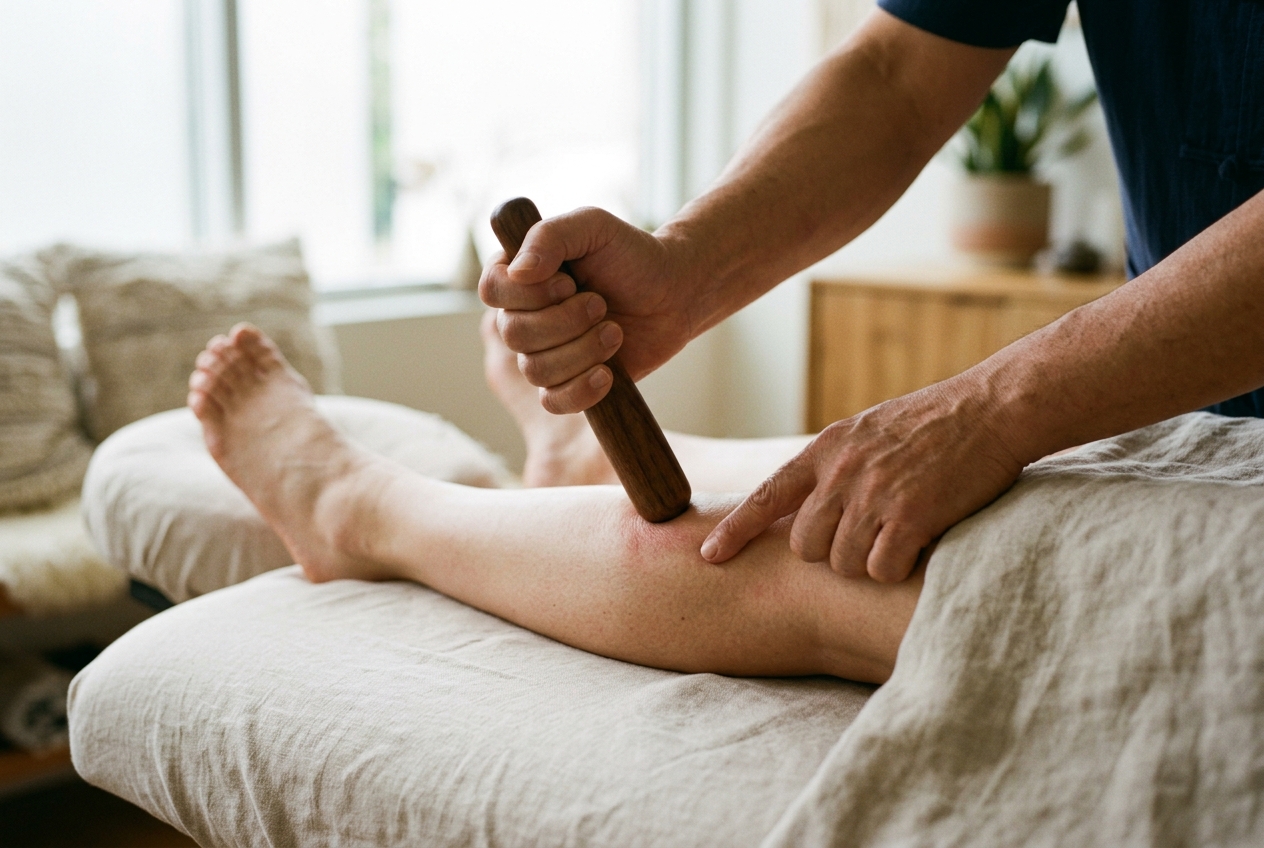
By translating the intricate needle dynamics of the Ming Dynasty’s Zi Wu Dao Jiu into contemporary fascial acupressure, we unlock a biophysical blueprint for clearing recalcitrant fluid retention, metabolic dampness, and abdominal distension.
1. Opening: The Heavy Tide — A Problem This Solves Today
If you have ever woken to a pervasive sense of heaviness in your limbs, a stubborn postprandial distension that lingers hours after a modest meal, or a dense mental fogginess that resists even the sharpest espresso, you are experiencing what classical East Asian medicine categorises as systemic damp stagnation (Shi, 湿) and phlegm-rheum retention (Tan Yin, 痰饮). In our contemporary landscape of prolonged seated posture, high-glycemic nutrition, and chronic sympathetic nervous activation, the body’s interstitial fluid dynamics frequently stall. Interstitial fluid becomes gel-like rather than sol-like; lymphatic drainage slows through the deep mesenteric and inguinal nodes; and the abdominal cavity develops a dull, unyielding fullness that clinical gastroenterology often labels as functional bloating or non-ulcer dyspepsia.
In the canon of Traditional Chinese Medicine, this state is not viewed merely as a local digestive deficit, but as a failure of the body’s systemic conduits (Jingluo, 经络) to circulate vital fluids (Jinye, 津液) across the three metabolic burners (Sanjiao, 三焦). Classical physicians developed sophisticated, highly choreographic manual and needling methodologies to resolve these deep-seated stagnations.
Foremost among these is Zi Wu Dao Jiu (子午捣臼), translated poetically as the Midnight-Noon Pounding Pestle Manipulation.
First codified systematically during the Ming Dynasty by the master acupuncturist Xu Feng in his seminal work Jin Zhen Fu (金针赋, Song of the Gold Needle, c. 1439) and later expanded by Yang Jizhou in the monumental 1601 compendium Zhen Jiu Da Cheng (Compendium of Acupuncture and Moxibustion), Zi Wu Dao Jiu is classified as a premier "compound manipulation" (Fu Shi Shou Fa, 复式手法). Designed specifically to break up intractable accumulations—such as Gu Zhang (tympanites/ascites-like abdominal distension), deep edema, and stubborn channel phlegm—this technique combines alternating rotational vectors with multi-depth, stepped vertical percussion.
While originally developed for stainless and silver filiform needles, the fundamental biophysical principles of Zi Wu Dao Jiu translate directly into non-invasive, high-precision manual acupressure. By understanding the mechanical coupling between manual manipulation, fascial mechanoreceptors, and fluid dynamics, we can apply this classical art to drain metabolic fluid retention, ease visceral fullness, and restore systemic equilibrium.
2. The Meridian Path: A Journey Through the Aqueducts of the Body
To understand how Zi Wu Dao Jiu functions, one must first map the primary energetic conduits governing fluid transformation in the human soma: the Stomach Meridian of Foot Yangming (Zu Yangming Wei Jing) and its interior-exterior partner, the Spleen Meridian of Foot Taiyin (Zu Taiyin Pi Jing), alongside the central reservoir of the Conception Vessel (Ren Mai).
Rather than thinking in abstract energetic lines, envision these pathways as an interconnected architectural aqueduct running through distinct myofascial compartments:
-
The Descending Highway (Yangming / Stomach): The pathway begins directly beneath the centre of the eye, descends across the cheekbone into the jaw, wraps along the throat, and cascades over the collarbone. It runs vertically down the front of the ribcage and abdomen—roughly two finger-widths lateral to the bodily midline—passes through the inguinal crease of the groin, travels down the fleshy anterior-lateral aspect of the thigh, crosses the outside border of the kneecap, and travels straight down the muscular ridge just lateral to the shinbone (the anterior tibialis muscle). It finally tracks over the dorsum of the foot to terminate at the outside edge of the second toe. This is the great downward-conducting conduit of the body: when it flows unobstructed, food, fluids, and internal heat descend smoothly without regurgitation or abdominal swelling.
-
The Ascending Collector (Taiyin / Spleen): Originating at the inside corner of the great toenail, this pathway runs along the medial margin of the foot, passes just in front of the prominent inner ankle bone, and ascends the inner lower leg along the posterior border of the shinbone. It traverses the inner knee crease, sweeps up the inner thigh, enters the lower abdomen, ascends through the spleen and stomach visceral fields, and fans out across the lateral ribcage beneath the armpit. The Spleen conduit is the body's upward hydraulic pump: it draws clear fluids against gravity, dispersing moisture to the lungs and tissues while preventing fluid pooling in the lower extremities and pelvis.
-
The Central Reservoir (Ren Mai / Conception Vessel): Ascending directly up the anterior midline of the human torso from the perineum to the lower lip, the Conception Vessel acts as the master regulator of all Yin channels. The segment traversing the mid-abdomen, spanning from the pubic symphysis to the sternal notch, houses critical fluid-clearing landmarks that govern the partitioning of clear physiological fluids from turbid metabolic waste.
When dampness stalls within these pathways, local hydrostatic pressure rises, collagen fiber bundles within the surrounding connective tissue matrix become bound with cross-linked proteoglycans, and cellular wastes accumulate in the interstitium. Zi Wu Dao Jiu serves as an external mechanical pump to mobilize this stagnant milieu.
3. Classical Mechanics and Biophysical Substrates of Zi Wu Dao Jiu
The Ming Dynasty masters were keen observers of natural cyclic dynamics. The nomenclature itself reveals the theoretical framework: Zi (子) corresponds to the midnight hour (23:00–01:00), the winter solstice, water, and the embryonic stirring of Yang within absolute Yin; Wu (午) corresponds to the noon hour (11:00–13:00), the summer solstice, fire, and the inception of Yin within peak Yang. Dao Jiu (捣臼) refers explicitly to the vertical, rhythmic movement of a heavy pestle striking down into a mortar to pulverize rigid grain.
+-----------------------------------------------------------------------------+
|               STRUCTURAL DYNAMICS OF ZI WU DAO JIU                          |
+--------------------+--------------------------------------------------------+
| PHASE              | MECHANICAL ACTION & PHYSIOLOGICAL SUBSTRATE            |
+--------------------+--------------------------------------------------------+
| 1. The Zi Vector   | • 9 Clockwise Rotational Cycles (Yang Generation)       |
|    (Water / Yang)  | • Collagen fibril winding; shear-stress activation     |
|                    | • Recruits initial piezocurrents via fibroblast grip   |
+--------------------+--------------------------------------------------------+
| 2. The Dao Jiu     | • Multi-level vertical lifting and thrusting (Pestle)  |
|    (Percussion)    | • Stepped depth progression: Heaven -> Human -> Earth   |
|                    | • Interstitial fluid pump; clears hydrostatic pooling  |
+--------------------+--------------------------------------------------------+
| 3. The Wu Vector   | • 6 Counter-Clockwise Rotations (Yin Drainage)         |
|    (Fire / Yin)    | • Mechanoreceptive unwinding; lymphatic uptake         |
|                    | • Calms local nociceptors; disperses bound stasis      |
+--------------------+--------------------------------------------------------+
The Classical Mathematical Framework: The 9 and 6 Dynamic
In standard classical acupuncture theory derived from the I Ching (Book of Changes), Nine is the supreme number of Old Yang (generative, warming, ascending, active), while Six is the number of Old Yin (clearing, draining, descending, cooling).
When performing Zi Wu Dao Jiu: * The practitioner engages the point and performs nine clockwise rotations (the Zi phase) to generate metabolic heat, activate local circulation, and mobilise functional Qi. * This is immediately followed by Dao Jiu—a sequence of rhythmic, stepped vertical percussions (lifting and thrusting across three physiological depths: Heaven/Superficial, Human/Intermediate, and Earth/Deep). * The cycle concludes with six counter-clockwise rotations (the Wu phase) to sedate stagnation, clear latent damp-heat, and drain turbid fluids downwards.
Contemporary Biophysical Mechanisms
Modern biomechanics and fascial histology provide a clear physiological rationale for this ancient sequence:
- Collagen Winding and Mechanotransduction: Rigorous connective tissue studies by Langevin et al. on subcutaneous tissue and mechanical cellular signaling demonstrate that rotational manipulation of needles or firm focused manual pressure causes subcutaneous connective tissue to wrap mechanically around the instrument or pressing finger. This mechanical "winding" transmits a progressive lateral shear strain to surrounding fibroblasts.
- Piezoelectric Currents and Interstitial Flow: The alternating rotational strain (9 clockwise followed by 6 counter-clockwise) deforms the extracellular matrix, activating stretch-sensitive Piezo ion channels on cellular membranes. This triggers intracellular calcium influx, induces endothelial nitric oxide synthase (eNOS) release, and shifts interstitial fluids from a stagnant, gel-like state into a low-viscosity, free-flowing fluid state.
- Hydrostatic Percussion and Lymphatic Clearance: The stepped vertical "pestle" percussion (Dao Jiu) creates high-frequency micro-pressure gradients within the fascial interstitium. This functions as an external hydraulic pump, forcing stagnant metabolic byproducts and trapped fluid across initial lymphatic endothelial valves (lacteals and initial lymphatics), dramatically accelerating systemic lymphatic return as documented in modern lymphatic perfusion literature.
Comparative Analysis: Flying Needle Manipulations
To appreciate the distinct function of Zi Wu Dao Jiu, we must contrast it with the other legendary classical compound methods codified in the Jin Zhen Fu:
+-----------------------------------------------------------------------------+
|          COMPARATIVE TAXONOMY OF CLASSICAL COMPOUND MANIPULATIONS           |
+-------------------------+--------------------+------------------------------+
| METHOD                  | MECHANICS          | PRIMARY CLINICAL INDICATION  |
+-------------------------+--------------------+------------------------------+
| Zi Wu Dao Jiu           | 9 Clockwise twists | Recalcitrant water-dampness, |
| (Midnight-Noon Pestle)  | + Stepped pestle   | phlegm stasis, ascites,      |
|                         | + 6 Counter twists | profound visceral distension |
+-------------------------+--------------------+------------------------------+
| Cang Gui Tan Xue        | 4-directional      | Migratory pain, systemic bi- |
| (Green Tortoise Cave)   | oblique probing    | obstruction, hidden channel  |
|                         | at depth           | pathogens in joints          |
+-------------------------+--------------------+------------------------------+
| Chi Feng Yao Tou        | Deep insertion,    | Stubborn Blood stasis, cold  |
| (Red Phoenix Head-Shake)| lateral shaking    | coagulation, severe tendon   |
|                         | with rapid tremor  | contracture and spasm        |
+-------------------------+--------------------+------------------------------+
| Bai Hu Yao Tou          | Rapid vibration    | High-grade inflammatory pain,|
| (White Tiger Head-Shake)| like ringing a bell| acute channel rebellion,     |
|                         | while advancing    | intense thermal excess       |
+-------------------------+--------------------+------------------------------+
| Long Hu Jiao Zhan       | Interlocking rapid | Deep, stubborn cold-dampness,|
| (Dragon & Tiger Battle) | left-right torque  | intractable arthritic masses,|
|                         | oscillations       | chronic structural fixation  |
+-------------------------+--------------------+------------------------------+
While techniques like Cang Gui Tan Xue search broadly for migratory joint pathogens and Chi Feng Yao Tou shakes loose deep vascular blood stasis, Zi Wu Dao Jiu is the unrivaled hydraulic hammer of classical East Asian medicine, engineered specifically for breaking up, liquefying, and evacuating immobile fluid matrices.
4. Primary Nodes of Activation: Four Acupoints for Manual Pestle Manipulation
To execute Zi Wu Dao Jiu without needles, we adapt the classical protocol into a high-density, focused fingertip or thumb acupressure routine. The four points below represent the most critical anatomic loci for resolving fluid retention, clearing metabolic dampness, and re-establishing digestive motility according to World Health Organization (WHO) Standard Acupuncture Locations.
Point 1: ST36 (Zusanli, 足三里) — "Leg Three Miles"
- Surface Landmark: Locate the bottom edge of your kneecap. Place four fingers horizontally across the front of your shinbone, starting just below the knee. ST36 lies four finger-widths below the kneecap, exactly one thumb-width outward from the sharp anterior crest of your shinbone, nestled directly into the fleshy, resilient muscle belly of the anterior tibialis.
- Tactile Deqi Marker: When engaged with firm inward pressure, this site yields a characteristic spreading, dull, deep ache that frequently radiates down the shin toward the ankle or ascends toward the knee joint.
- Manual Pestle Protocol: 1. Anchor your thumb perpendicular to the tissue plane. 2. Perform 9 rhythmic clockwise circular twists (approx. 1 twist per second), gradually deepening your focal pressure to wind the superficial fascia. 3. Perform Dao Jiu: Without losing your anchored position, apply 3 stepped, spring-like vertical compressions (Superficial, Medium, Deep), holding the deep pressure for 2 seconds before relaxing slightly. Repeat this 3-step vertical percussion 3 times (9 total vertical pulses). 4. Perform 6 counter-clockwise circular twists, intentionally sweeping outward to encourage decongestion. 5. Total duration: 2 to 3 minutes per leg.
- Primary Clinical Applications: Profound stimulation of gastrointestinal motility via vagal nerve pathways, relief of chronic postprandial fatigue, reduction of systemic edema, and clearance of lower limb heaviness.
Point 2: SP9 (Yinlingquan, 阴陵泉) — "Yin Mound Spring"
- Surface Landmark: Run your thumb smoothly up the inside surface of your shinbone. As your thumb approaches the inner curve of your knee, the bone angles sharply backward and widens into a prominent flare (the medial condyle of the tibia). SP9 lies directly in the pronounced soft depression or pocket immediately beneath this bony overhang, where the shinbone meets the calf musculature.
- Tactile Deqi Marker: Extremely sensitive to palpation in individuals with active fluid stagnation; produces an intense, localized sour tenderness accompanied by a cooling sensation that travels down the inner calf.
- Manual Pestle Protocol: 1. Angle your pressing thumb slightly upward toward the posterior aspect of the knee joint. 2. Execute the 9 Yang clockwise rotations, maintaining steady mechanical pressure against the posterior border of the tibia. 3. Execute the stepped vertical pestle thrusts: Compress downward into the deep fascial cleft in 3 distinct rhythmic depth stages, rebounding slightly between pulses (repeat 3 times). 4. Conclude with the 6 Yin counter-clockwise rotations to drain water-damp accumulation from the pelvic and abdominal basins. 5. Total duration: 2 minutes per leg.
- Primary Clinical Applications: The single most potent point on the human body for draining systemic water-dampness, resolving ankle swelling, eliminating pelvic heaviness, and soothing lower abdominal fullness.
Point 3: ST40 (Fenglong, 丰隆) — "Abundant Bulge"
- Surface Landmark: Measure the exact distance between the crease on the outside of your knee and the prominent point of your outer ankle bone. The midpoint of this line marks the vertical level. ST40 is located precisely at this halfway point, approximately two finger-widths lateral to the sharp anterior crest of the shinbone, in the groove between the anterior tibialis and the extensor digitorum longus muscles.
- Tactile Deqi Marker: A sharp, highly distinct electrical or numbing sensation that propagates downward into the dorsum of the foot and the second/third toes.
- Manual Pestle Protocol: 1. Use your supported thumb or the rounded knuckle of your index finger to engage this dense muscular cleft. 2. Initiate the 9 clockwise cycles, establishing strong torsional traction on the deep peroneal fascia. 3. Implement Dao Jiu: Drive 3 progressive vertical compression pulses deep into the intermuscular septum, holding the deepest point firmly before releasing. Repeat 3 times. 4. Perform the 6 counter-clockwise dispersals, drawing fluid stagnation out of the deep myofascial plane. 5. Total duration: 2 minutes per leg.
- Primary Clinical Applications: The classical master point for resolving all varieties of phlegm stasis (Tan Yin), whether presenting as dense cognitive fog ("brain fog"), stubborn lipid and metabolic stagnation, or chronic chest and sinus congestion.
Point 4: CV9 (Shuifen, 水分) — "Water Divide"
- Surface Landmark: Lie comfortably on your back with your knees softly bent to slacken the abdominal wall. Locate the exact center of your navel (umbilicus). Measure one thumb-width (approx. 2–2.5 cm) directly upward along the central vertical midline of your abdomen. CV9 sits directly on the fibrous linea alba at this level.
- Tactile Deqi Marker: A mild, diffuse intra-abdominal warmth or a sensation of fluid gurgling (borborygmus), accompanied by a distinct release of visceral muscular tension beneath the fingers.
- Manual Pestle Protocol: 1. Use the pads of your overlapping middle and index fingers, keeping your wrists relaxed. 2. Coordinate with your respiratory cycle: on the exhale, press gently into the abdomen and execute 9 slow, wide clockwise circular rotations. 3. Apply Dao Jiu: In synchronization with two complete deep diaphragmatic exhales, apply 3 gentle, progressive vertical compressions downward toward the spine (Heaven: skin level; Human: rectus sheath; Earth: deep visceral fascial plane). Never use jarring or forceful downward thrusts on the abdomen. 4. Complete the cycle with 6 soothing counter-clockwise rotations, harmonizing the peritoneal membranes. 5. Total duration: 3 minutes.
- Primary Clinical Applications: Classical partition point for fluid metabolism; directly stimulates renal-adrenal fluid regulation, resolves post-eating abdominal distension, and clears water pooling in the digestive tract.
5. Clinical Prescriptions: An Evening Protocol for Recalcitrant Distension and Edema
When deep fatigue, abdominal bloating, and heavy legs coincide at the end of a demanding day, perform this integrated 10-minute restorative sequence. This protocol arranges the points in a specific descending hydraulic order to clear the upper reservoirs first before opening the distal drainage gates of the lower limbs.
+-----------------------------------------------------------------------------+
|                THE 10-MINUTE EVENING FLUID DECONGESTION PROTOCOL            |
+------+------------------+------------+--------------------------------------+
| STEP | POINT            | DURATION   | ACTION & INTENT                      |
+------+------------------+------------+--------------------------------------+
| 1    | CV9 (Shuifen)    | 3 Minutes  | Opens central abdominal aqueduct;    |
|      |                  |            | releases mesenteric fluid pooling    |
+------+------------------+------------+--------------------------------------+
| 2    | SP9 (Yinlingquan)| 2 Minutes  | Drains visceral water accumulation   |
|      |                  | (Bilateral)| down through pelvic lymphatics       |
+------+------------------+------------+--------------------------------------+
| 3    | ST36 (Zusanli)   | 2 Minutes  | Stimulates downward gastrointestinal |
|      |                  | (Bilateral)| peristalsis and systemic Qi flow     |
+------+------------------+------------+--------------------------------------+
| 4    | ST40 (Fenglong)  | 2 Minutes  | Resolves metabolic phlegm stasis and |
|      |                  | (Bilateral)| clears cognitive/visceral heaviness  |
+------+------------------+------------+--------------------------------------+
| 5    | Systemic Drain   | 1 Minute   | Long downward strokes from knees     |
|      |                  |            | to toes to consolidate flow          |
+------+------------------+------------+--------------------------------------+
Step-by-Step Procedure:
- Preparation and Posture: Lie supine on a firm, comfortable surface. Place a small pillow under your knees to induce complete relaxation of the rectus abdominis and psoas muscles. Take three deep, diaphragmatic breaths, expanding your lower abdomen on the inhale and softening on the exhale.
- Phase 1 — Unlocking the Center (CV9): Place your warm fingertips onto CV9 (one thumb-width above your navel). Over 3 minutes, perform two full cycles of the Zi Wu Dao Jiu method (9 clockwise turns, 3 stepped vertical pulses on exhalation, 6 counter-clockwise turns). Listen for intestinal fluid shifting or stomach rumbling—this is a primary clinical indicator of restored motility.
- Phase 2 — Opening the Medial Floodgate (SP9): Reach down to your inner legs. Locate the tender depression beneath the inner knee flare on both legs. Engage both points simultaneously with your thumbs. Execute the full Zi Wu Dao Jiu dynamic for 2 minutes, maintaining steady, sustained pressure against the posterior border of the tibia.
- Phase 3 — Driving the Downward Current (ST36): Shift your hands to the outer lower legs, four finger-widths below the kneecaps. Press firmly into the belly of the anterior tibialis muscle. Apply the 9 clockwise rotations, perform the stepped vertical pestle compressions, and complete with the 6 counter-clockwise rotations over 2 minutes.
- Phase 4 — Dissolving the Deep Phlegm Matrix (ST40): Move your thumbs halfway down the shin to the muscular junction of ST40. Apply firm, steady pressure, working through the full Zi Wu Dao Jiu sequence for 2 minutes to clear residual systemic dampness.
- Consolidation: Conclude by placing both palms on your knees and performing five broad, sweeping downward strokes along your shins, over your ankles, and off the tips of your toes, visually and physically directing stagnant fluid down and out of the body.
6. Safety, Sensory Guardrails, and Clinical Discretion
While manual acupressure is an extraordinarily safe modality, applying compound classical manipulations requires mindful precision and clear clinical boundaries:
+-----------------------------------------------------------------------------+
|                             SAFETY CHECKLIST                                |
+------------------------------------+----------------------------------------+
| CONDITION                          | CLINICAL DIRECTIVE                     |
+------------------------------------+----------------------------------------+
| Pregnancy (All Trimesters)         | STRICT CAUTION: Avoid deep pressure on |
|                                    | lower abdominal points (CV9) and strong|
|                                    | downward draining on distal limb nodes.|
+------------------------------------+----------------------------------------+
| Suspected Deep Vein Thrombosis     | ABSOLUTE CONTRAINDICATION: Do NOT      |
| (Unilateral hot/swollen calf)      | massage or perform pestle percussion   |
|                                    | on lower extremities. Seek ER care.    |
+------------------------------------+----------------------------------------+
| Acute Congestive Heart Failure /   | ABSOLUTE CONTRAINDICATION: Pitting     |
| End-Stage Renal Edema              | edema from organic organ failure must  |
|                                    | be managed by medical specialists.     |
+------------------------------------+----------------------------------------+
| Acute Abdominal Inflammation       | DO NOT PRESS: Acute, sharp, rebound    |
| (Appendicitis, Diverticulitis)     | tenderness requires emergency care.    |
+------------------------------------+----------------------------------------+
Defining "Too Much Pressure"
The intended neuro-sensory goal of Zi Wu Dao Jiu is the generation of Deqi (得气)—a dull, spreading, heavy, or mildly aching sensation that feels constructive, therapeutic, and deeply releasing.
When to Seek Professional Consultation
Self-administered acupressure serves as exceptional maintenance, prevention, and functional relief. However, if your fluid retention is accompanied by shortness of breath, sudden unilateral leg swelling, high fever, unexplained rapid weight gain, or severe persistent abdominal pain, you must schedule an immediate evaluation with a qualified biomedical physician. For deep-seated, chronic conditions, consulting a licensed acupuncturist holding state licensure or national board certification ensures precise diagnosis and comprehensive herbal/needling treatment plans.
7. Today's Takeaway: The Two-Minute Shinbone Flush
You do not need an entire clinical session to begin mobilizing stagnant dampness. Before you close this article, take precisely two minutes to revitalize your digestive engine and clear leg fatigue:
+-----------------------------------------------------------------------------+
|                     2-MINUTE ZUSANLI PESTLE PROTOCOL                        |
+-----------------------------------------------------------------------------+
| 1. LOCATE (10s)   : Place 4 fingers beneath your kneecap, 1 thumb-width     |
|                     lateral to the shinbone crest on ST36 (Zusanli).        |
| 2. ZI PHASE (30s) : Perform 9 deliberate, firm CLOCKWISE rotations with    |
|                     your thumb to generate metabolic warmth.                |
| 3. DAO JIU (40s)  : Apply 3 stepped, springy VERTICAL COMPRESSIONS down     |
|                     into the muscle bed, pulsing in 3 distinct depths.      |
|                     Repeat this 3-tier pulse sequence 3 times (9 pulses).   |
| 4. WU PHASE (20s) : Finish with 6 soothing COUNTER-CLOCKWISE rotations to   |
|                     drain local fullness and disperse tension.              |
| 5. REPEAT (20s)   : Perform the identical sequence on your opposite leg.    |
+-----------------------------------------------------------------------------+
As you complete the final rotation, pause for a moment. You will likely notice an immediate lightness in your lower legs, a subtle release of tension in your diaphragm, and a warm, descending sensation moving through your abdomen. You have just engaged the living mechanics of Zi Wu Dao Jiu—a 600-year-old masterpiece of East Asian hydraulic medicine, revitalized through your own two hands.