Zhongwan Cavity Middle Venter: Epigastric Fascial Decompression, Celiac Plexus Autonomic Modulation, and Post-Heaven Digestive Qi Vectoring in Classical Neigong
                       [ Xiphoid Process / Sternum ]
                                     |
                                   2 cun
                                     |
                        [ Shangwan / Ren 13 ]
                                     |
                                   2 cun
                                     |
===> [ REN 12 / ZHONGWAN ] <===  (4 cun superior to Navel)
     * Front-Mu of Stomach        * Epigastric Aponeurosis
     * Hui-Meeting of Six Fu      * Celiac Plexus Intersection
                                     |
                                   2 cun
                                     |
                        [ Jianli / Ren 11 ]
                                     |
                                   2 cun
                                     |
                               [ Umbilicus ]
When palpating this coordinate, the practitioner penetrates through the skin and superficial fascia to contact the linea alba—the dense, fibrous tendinous raphe formed by the interlacing aponeuroses of the external oblique, internal oblique, and transversus abdominis muscles. Directly beneath this fascial seam lies the transversalis fascia, the extraperitoneal adipose tissue, the parietal peritoneum, and, in deeper visceral topography, the anterior wall of the stomach body (specifically the gastric antrum and lesser curvature), the transverse colon, and the neck of the pancreas.
In classical energetic taxonomy, Zhongwan is assigned a triumvirate of foundational classifications that underscore its operational supremacy:
- The Front-Mu (Alarm/Collecting) Point of the Stomach (Wei Mu): Under classical meridian theory as cataloged by the World Health Organization, Front-Mu points represent the specific anatomical coordinates on the venter of the torso where the visceral Qi of a specific Zang-Fu organ gathers, concentrates, and manifests directly. As the Front-Mu of the Stomach, Zhongwan acts as a sensitive diagnostic reflector and therapeutic aperture for all functional dynamics, repletion states, and vacuities of the gastric basin.
- The Hui-Meeting Point of the Six Fu Organs (Fu Hui): As codified in Chapter 45 of the Nan Jing (The Classic of Difficult Issues), Zhongwan is the systemic gathering hub for all Yang or "hollow" organs (Fu): the Stomach, Small Intestine, Large Intestine, Gallbladder, Urinary Bladder, and San Jiao (Triple Burner). Because the Six Fu organs bear the biological mandate of receiving, breaking down, conveying, and discharging physical substances without storing them, Zhongwan functions as the central regulatory conduit through which peristaltic transit, fluid transmission, and visceral clearance are energetically harmonized.
- The Multichannel Energetic Crossroad: While residing on the Conception Vessel (Ren Mai)—the primary Yin reservoir of the human biofield—Zhongwan represents a profound confluence point where the Ren Mai intersects with the Divergent and Primary channels of the Hand Taiyang (Small Intestine), Hand Shaoyang (San Jiao / Triple Burner), and Foot Yangming (Stomach) meridians. This multidimensional confluence allows therapeutic interventions or somatic releases at Zhongwan to influence everything from systemic microcirculation and lymphatic drainage to cognitive alertness and ocular radiance.
Neuro-Fascial Mechanics & Epigastric Decompression
To understand why the release of Zhongwan induces an immediate, palpable cascade of systemic relaxation, one must analyze the intimate biomechanical interplay between the epigastric aponeurosis, the crural attachments of the respiratory diaphragm, and the autonomic nervous system.
       +-----------------------------------------------+
       |             Respiratory Diaphragm             |
       |         (Crura & Median Arcuate Ligament)     |
       +-----------------------+-----------------------+
                               |
                   Mechanical Interlocking
                               |
                               v
       +-----------------------------------------------+
       |             Epigastric Fascial Web            |
       |          Linea Alba & Rectus Sheath           |
       |              [ REN 12 / ZHONGWAN ]            |
       +-----------------------+-----------------------+
                               |
                Decompression / Somatic "Song"
                               |
                               v
       +-----------------------------------------------+
       |          Celiac (Solar) Plexus Hub            |
       |  * Splanchnic Sympathetic Down-Regulation     |
       |  * Vagal Enteric Parasympathetic Entrainment  |
       |  * Restored Visceral Microcirculation         |
       +-----------------------------------------------+
The respiratory diaphragm is anchored posterior-inferiorly to the upper lumbar vertebrae via two thick musculo-tendinous bands known as the right and left crura. Anteriorly, its fascial envelopment merges with the transversus abdominis and the posterior layer of the rectus sheath. Directly behind the linea alba at the level of Zhongwan, the median arcuate ligament forms an arch bridging the diaphragmatic crura over the abdominal aorta and the celiac trunk.
When an individual experiences psychological stress, postural slump, or unexpressed emotional distress, the rectus abdominis and epigastric aponeurosis instinctively brace. This hypertonicity draws the ribcage downward and inward, creating chronic mechanical tension across the linea alba. This tension directly restricts the descent of the diaphragm during inspiration.
Trapped beneath this rigid fascial dome sits the celiac plexus, traditionally known as the solar plexus. The celiac plexus represents the largest autonomic nerve center in the abdominal cavity, housing the celiac ganglia which receive sympathetic preganglionic fibers via the greater splanchnic nerves (T5–T9) and lesser splanchnic nerves (T10–T11), alongside parasympathetic contributions from the posterior vagal trunk.
When the epigastric aponeurosis and diaphragmatic crura are locked in chronic tension, the celiac plexus experiences persistent mechanical entrapment. This stimulates splanchnic afferent pathways, driving the entire organism into a continuous loop of sympathetic overdrive: - Vasoconstriction of the mesenteric and gastric vasculature occurs, diminishing mucosal perfusion. - Peristalsis is inhibited, leading to functional dyspepsia, delayed gastric emptying, and gastroesophageal reflux. - Systemic heart rate variability (HRV) drops, cementing emotional anxiety and somatic hyperarousal.
+-----------------------------------------------------------------------------------------+
|                                NEURO-SOMATIC MECHANISM                                  |
|                                                                                         |
|  Releasing Zhongwan (CV 12) Fascia                                                      |
|    ---> Relieves Mechanical Tension on Diaphragmatic Crura                              |
|    ---> Decompresses the Celiac Ganglia and Splanchnic Trunks                           |
|    ---> Halts Sympathetic Vasoconstriction of Mesenteric Beds                          |
|    ---> Ignites Subdiaphragmatic Vagal Tone via the Enteric Nervous System              |
|    ---> Elevates Heart Rate Variability & Restores Systemic Homeostasis                 |
+-----------------------------------------------------------------------------------------+
When Zhongwan is systematically opened through authentic Neigong alignments, Daoyin release protocols, or breathwork, the linea alba broadens and the diaphragmatic crura decompress. This structural expansion lifts mechanical pressure from the celiac ganglia. According to research indexed on the National Center for Biotechnology Information, subdiaphragmatic vagal stimulation directly entrains the enteric nervous system (ENS), initiating anti-inflammatory cascades, increasing microcirculation to the liver and stomach, and shifting the central autonomic network into ventral vagal social-engagement dominance.
Post-Heaven Qi Transmutation & Middle Dantian Dynamics
In the esoteric physiology of Classical Chinese Medicine and Taoist internal alchemy (Neidan), human vitality is sustained through the continuous interaction of two primordial energy matrices: Pre-Heaven Qi (Xian Tian Qi), the finite, ancestral reserve of foundational vitality (Jing) stored within the kidneys and the Lower Dantian (Xia Dantian), and Post-Heaven Qi (Hou Tian Qi), the regenerative, dynamic energy generated after birth through the ingestion of food, water, and breath.
       [ Clear Celestial Qi (Tian Qi) ]       [ Food & Drink Essence (Shui Gu) ]
                      \                                      /
                       \                                    /
                        v                                  v
                Lung Inhalation                     Stomach Digestion
               (Middle Dantian)                     (Zhongwan / Ren 12)
                        \                                  /
                         \                                /
                          +------------> [ GU QI ] <-----+
                                            |
                                  Spleen Ascending Pivot
                                            |
                                            v
                                 [ ZONG QI (Gathering Qi) ]
                                            |
                              Heart & Lung Alchemy Integration
                                            |
                                            v
                                 [ ZHEN QI (True Vitality) ]
                                 /                         \
                                v                           v
                     [ Ying Qi (Nutritive) ]     [ Wei Qi (Defensive) ]
Zhongwan stands as the physiological and energetic forge of Post-Heaven Qi. When food and liquids (Shui Gu) enter the stomach, the Middle Burner breaks them down into fine biological and energetic substrates known as Food Essence or Grain Qi (Gu Qi). However, raw Gu Qi cannot be directly utilized by the physical organs or the energetic channels in its unrefined state; it requires distillation.
This refinement relies on the Spleen-Stomach Digestive Pivot (Pi Wei Sheng Jiang): - The Stomach (Yang/Fu) is charged with descending the turbid Yin (Wei Jiang Zhuo), driving digested matter downward through the pylorus into the small and large intestines for separation and excretion. - The Spleen (Yin/Zang) is charged with raising the clear Yang (Pi Sheng Qing), extracting the refined vapor of Gu Qi and elevating it upward through the diaphragm into the chest cavity.
Once elevated to the chest, this refined Gu Qi merges with the pure atmospheric oxygen and celestial energy inhaled by the lungs (Tian Qi or Clear Celestial Qi). The union of Gu Qi and Tian Qi within the thoracic cavity gives birth to Zong Qi (Gathering or Pectoral Qi), which pools at the Middle Dantian (Zhong Dantian, centered at Shanzhong / Ren 17). Zong Qi subsequently fuels cardiac rhythm, powers respiratory volume, and is catalyzed by the kidney Yuan Qi to form Zhen Qi (True Qi), which splits into Ying Qi (Nutritive Qi flowing in the blood vessels) and Wei Qi (Defensive Qi patrolling the fascia and skin).
Within the three-tier landscape of the human energetic vessel: - The Lower Dantian (Xia Dantian, anchored at Guanyuan / Ren 4 and Qihai / Ren 6) serves as the cauldron for consolidating and refining biological essence (Jing). - The Middle Dantian (Zhong Dantian, anchored at Shanzhong / Ren 17) acts as the crucible for expanding emotional harmony and breathing power (Qi). - The Upper Dantian (Shang Dantian, anchored at Yintang and Baihui) provides the chamber for stabilizing cognitive awareness and spirit (Shen).
Zhongwan occupies the dynamic, transitional inter-space connecting the Lower and Middle Dantians. If Zhongwan is obstructed by physical tension, visceral inflammation, or energetic stagnation, a catastrophic functional disconnection occurs: the Jing consolidated in the lower abdomen cannot ascend to nourish the heart and lungs, while the emotional and psychic heat gathered in the chest cannot sink and ground into the lower reservoir. Releasing Zhongwan clears this energetic channel, allowing the ascending clear Yang and descending turbid Yin to circulate freely.
Somatic Cultivation Protocols & Breathwork Integration
To transition these theoretical principles into somatic realization, the practitioner must engage in systematic Daoyin and Neigong protocols designed to decompress the epigastric fascia, soften the linea alba, and regulate intra-abdominal pressure (IAP). The following curriculum provides a rigorous, step-by-step methodology for awakening and liberating Zhongwan.
       ===============================================================
                         ZHONGWAN CULTIVATION SUITE
       ===============================================================

       1. POSTURAL FOUNDATION   --->  Zhan Zhuang Alignment (Wuji Stance)
                                      * Baihui Suspended, Mingmen Opened
                                      * Epigastric Cavity "Song" (Hollow-Release)

       2. FASCIAL AWAKENING     --->  Classical Rou Fu (Circular Kneading)
                                      * Spiral Deceleration over Ren 12
                                      * Mechanical Softening of the Linea Alba

       3. RESPIRATORY FORGE     --->  Natural vs. Reverse Breathing Calibration
                                      * Diaphragmatic Piston Oscillation
                                      * Regulated Intra-Abdominal Pressure (IAP)

       4. BIOENERGETIC PIVOT    --->  Microcosmic Orbit Integration
                                      * Uniting Lower & Middle Dantian Matrices
       ===============================================================
1. Structural Setup: Zhan Zhuang Alignment for Epigastric Freedom
True relaxation of the upper abdomen cannot occur if the spine is collapsed or if the pelvis is locked in anterior tilt. Postural integrity provides the scaffolding upon which the soft tissues can release.
- Base & Footing: Stand with your feet parallel, precisely shoulder-width apart. Root through the "Bubbling Well" (Yongquan, Kidney 1), distributing weight evenly across the tripod of each foot (heel, first metatarsal head, fifth metatarsal head).
- Knee & Pelvic Unlock: Soften your knees without letting them buckle inward. Relax the inguinal creases (Kua), allowing your sacrum to sink naturally toward the earth as if resting against a tall stool. This gently flattens the lumbar lordosis and opens the "Gate of Life" (Mingmen, Du 4).
- Axial Suspension: Imagine an invisible silk cord suspending the crown of your head from the celestial zenith via the Baihui (Du 20) point. Tuck the chin slightly to lengthen the cervical spine and open the suboccipital space.
- The Epigastric Hollow (Song): As the crown floats upward and the sacrum anchors downward, consciously relax the sternum downward. Do not collapse the chest; instead, let the pectoral muscles melt like warm wax. Feel the upper abdomen at Zhongwan soften and hollow slightly backward toward the spine, dissolving all defensive muscular bracing.
2. Manual Daoyin Therapy: Classical Rou Fu (Abdominal Kneading)
Prior to stationary breathwork, manual mechanical release of the linea alba removes dense adhesions and draws therapeutic blood flow to the epigastrium.
                  [ Xiphoid Process ]
                           |
                     (Phase 1: Sinking)
                           |
                           v
               ( 1 ) ---> ( 2 ) ---> ( 3 )   <--- Clockwise Spirals
                 ^                     |          Centered directly
                 |    [ REN 12 ]       |          upon Zhongwan
                 |    (Zhongwan)       v
               ( 6 ) <--- ( 5 ) <--- ( 4 )
                           |
                     (Phase 3: Exhaling)
                           |
                           v
                      [ Umbilicus ]
- Hand Preparation: Rub the palms of your hands vigorously together until intense frictional heat builds across the Laogong (Pericardium 8) points in the centers of your palms.
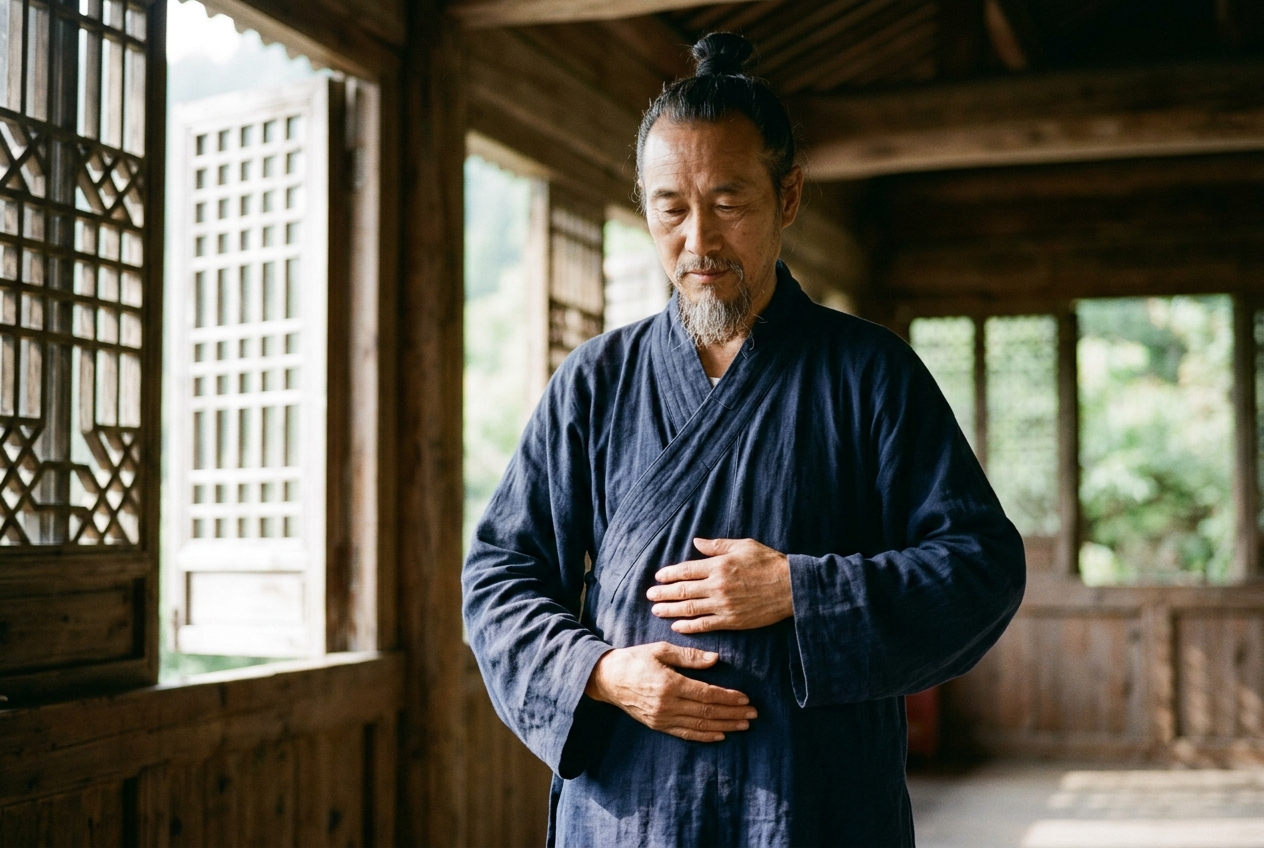
- Contact Placement: Place your right palm flat over Zhongwan (4 cun above the navel), and overlay your left palm directly on top of the right back of the hand to reinforce pressure.
- Spiral Kneading Protocol: - Inhale slowly through your nose into the sides and back of your ribcage. - On the slow, continuous exhale, apply firm, gentle inward pressure (sinking approximately 1 to 1.5 inches deep, respecting physical comfort) and execute slow, deliberate clockwise circular massages around the perimeter of Zhongwan. - Perform 36 clockwise revolutions, feeling the dense epigastric aponeurosis soften with each cycle. - Reverse direction and perform 24 counter-clockwise revolutions, consciously visualizing toxic heat and stagnation discharging downward through the intestines.
- Thermal Integration: Rest your warm palms motionless over Zhongwan for nine complete, unhurried respiratory cycles, projecting soothing warmth from the Laogong points directly into the celiac plexus.
3. Respiratory Dynamics: Natural vs. Taoist Reverse Breathing
A core challenge in Neigong is learning to calibrate intra-abdominal pressure without provoking epigastric hypertonicity. Practices certified by the National Qigong Association emphasize strict differentiation between Natural Abdominal Breathing (Zheng Hu Xi) and Advanced Taoist Reverse Breathing (Ni Hu Xi).
+-----------------------------------------------------------------------------------------------+
|                       INTRA-ABDOMINAL PRESSURE & BREATHWORK MATRIX                            |
+------------------------------+-------------------------------+--------------------------------+
| DYNAMIC PARAMETER            | NATURAL BREATHING (ZHENG HU)  | REVERSE BREATHING (NI HU)      |
+------------------------------+-------------------------------+--------------------------------+
| Inhalation Action            | Abdomen expands outward 360°  | Lower belly draws gently in    |
| Zhongwan State (Inhale)      | Expands softly, zero tension  | Broadens laterally, NO bracing |
| Exhalation Action            | Abdomen softly recoils inward | Lower belly gently expands out |
| Zhongwan State (Exhale)      | Sinks deep, releases to spine | Melts completely, yields deep  |
| Primary Somatic Effect       | Parasympathetic, Vagal Reset  | Jing-to-Qi Compression         |
| Danger of Error              | Slack posture / lethargy      | Epigastric locking / reflux    |
+------------------------------+-------------------------------+--------------------------------+
Phase A: Natural Abdominal Breathing (Zheng Hu Xi)
- Inhalation: Inhale smoothly through the nose. Allow the descending diaphragm to push the abdominal viscera downward, expanding the lower abdomen, flank tissues, and lower back in a complete 360-degree cylinder. Zhongwan expands forward and outward softly, remaining completely free of muscular resistance.
- Exhalation: Exhale naturally through the nose. The abdominal wall softly recoils inward toward the spine. Zhongwan melts deep into the torso, releasing residual tension toward the posterior abdominal wall.
Phase B: Advanced Taoist Reverse Breathing (Ni Hu Xi)
- Inhalation: Inhale slowly through the nose. Gently draw the lower abdomen (the region below the navel, Xia Dantian) inward toward the sacrum while lightly elevating the perineum (Huiyin, Ren 1).
- CRITICAL CUE FOR ZHONGWAN: As the lower belly draws inward, do not allow Zhongwan or the epigastrium to lock or brace. Instead, direct the resulting intra-abdominal pressure backward into the kidneys (Mingmen) and laterally into the lower ribs. Zhongwan must remain completely hollow, receptive, and soft, serving as a pressure-release chimney rather than a rigid blockade.
- Exhalation: Exhale smoothly. Release the perineal elevation and allow the lower abdomen to expand softly back outward. As the breath leaves the body, feel an intense, warm wave of bioelectrical energy cascade from Zhongwan down through the navel into the Lower Dantian.
Somatic Diagnostics, Pathological Patterns, and Remedial Cues
When evaluating an internal arts student or clinical patient, the state of Zhongwan provides an unmistakable window into their autonomic balance and energetic equilibrium.
       +-------------------------------------------------------------+
       |         DIAGNOSTIC LANDSCAPE OF ZHONGWAN (REN 12)           |
       +-------------------------------------------------------------+
                                      |
         +----------------------------+----------------------------+
         |                                                         |
         v                                                         v
  [ REPLETION / EXCESS ]                                  [ VACUITY / DEFICIENCY ]
  * Epigastric Rigidity & Tenderness                      * Flaccid, Spongy, Sunken Pit
  * Sensation of "Plum Pit" / Knotting                    * Dull Aches Relieved by Pressure
  * Stomach Fire, Acid Reflux, Belching                   * Fatigue, Prolapse, Poor Absorption
  * Sympathetic Overdrive, Agitation                      * Chronic Spleen Qi Deficiency
  * Remedial: Dispersing Rou Fu, Song                     * Remedial: Moxibustion, Gentle Tonification
Diagnostic Palpation Patterns
- Repletion / Constriction (Excess Pattern - Shi): - Palpatory Finding: The practitioner’s fingers meet a dense, board-like resistance immediately below the skin. Palpation evokes acute tenderness, sharp discomfort, or an immediate instinct to hold the breath. - Clinical Manifestations: Sensation of a suffocating emotional knot in the solar plexus, acid reflux, chronic belching, epigastric distension, temporal migraines, and emotional irritability stemming from Liver Qi invading the Stomach (Gan Qi Fan Wei).
- Vacuity / Collapse (Deficiency Pattern - Xu): - Palpatory Finding: The epigastric tissue feels flaccid, hollow, or spongy, like pressing into unbaked dough, with no resilient rebound. The fingers sink deep into the abdominal cavity without resistance. - Clinical Manifestations: Chronic lethargy, gastrointestinal prolapse, loose stools, postprandial fatigue, cold extremities, and an inability to hold Qi in the Middle Burner due to Spleen Qi Deficiency (Pi Qi Xu).
Somatic Remedial Cues for Authentic "Song" (放鬆)
Many practitioners mistake postural collapse (slumping the thoracic spine) for somatic release (Song). When the spine slumps, the ribcage collapses directly onto the stomach, increasing mechanical compression at Zhongwan.
Use these pedagogical cues to maintain axial height while achieving profound epigastric freedom:
+-----------------------------------------------------------------------------------------+
|                                 SOMATIC CORRECTION MATRIX                               |
+------------------------------------+----------------------------------------------------+
| FAULTY MOVEMENT PATTERN            | CORRECTIVE SOMATIC CUE                             |
+------------------------------------+----------------------------------------------------+
| Epigastric Bracing / Armoring      | "Imagine a scoop of ice cream at the solar plexus   |
| (Pushing belly out with tension)   | melting under a warm summer sun."                  |
+------------------------------------+----------------------------------------------------+
| Thoracic Slump / Chest Collapse    | "Suspend the crown from the stars (Baihui); let    |
| (Crushing Zhongwan mechanically)   | the breastbone slide down its internal track."     |
+------------------------------------+----------------------------------------------------+
| Paradoxical Epigastric Inversion   | "Inhale into the kidneys at Mingmen; allow the     |
| (Sucking in the upper belly)       | upper belly to stay completely wide and silent."   |
+------------------------------------+----------------------------------------------------+
Classical Lineage, Historical Context & Alchemical Lore
The clinical and alchemical prominence of Zhongwan is woven across the foundational texts of Chinese medicine and internal cultivation.
                                [ HISTORICAL LINEAGE TIMELINE ]

    Warring States Period (475–221 BCE)
    ================================================================================
    * Huangdi Neijing (Suwen & Lingshu): First codification of Ren 12 / Zhongwan
    * Daoyin Tu (Mawangdui Silk Texts): Early somatic postures for epigastric release
                                |
                                v
    Han Dynasty (202 BCE – 220 CE)
    ================================================================================
    * Nan Jing (Classic of Difficult Issues): Chapter 45 establishes Zhongwan as the
      supreme Hui-Meeting Point of all Six Fu (Yang/Hollow) Organs
                                |
                                v
    Tang Dynasty (618–907 CE)
    ================================================================================
    * Sun Simiao (Qianjin Yaofang): Epigastric moxibustion for longevity and
      alchemical digestion protocols uniting Middle and Lower Dantians
                                |
                                v
    Song through Qing Dynasties (960–1912 CE)
    ================================================================================
    * Integration into Neidan (Internal Alchemy) texts and Taijiquan classics:
      "Sink Qi to Dantian, hollow the chest, unlock the Middle Venter"
In the foundational chapters of the Huangdi Neijing (The Yellow Emperor's Inner Classic, comprising the Suwen and Lingshu), compiled over two millennia ago, the Stomach is celebrated as the "Sea of Water and Grain" (Shui Gu Zhi Hai), while the Spleen and Stomach together are termed the "Ministers of the Granaries," responsible for generating the five flavors and sustaining life. The Lingshu explicitly identifies the epigastric region as the crucial staging ground where post-natal Qi is extracted and distributed across the twelve primary channels.
During the Han Dynasty, the Nan Jing elevated Zhongwan's status by designating it the definitive Fu Hui (Hui-Meeting point of the six hollow organs). Chapter 45 of this masterwork details how systemic imbalances across the digestive tract—from the esophageal swallow down to the rectal elimination—can be regulated through this single aperture.
In the Tang Dynasty, the legendary Daoist physician Sun Simiao detailed in his magnum opus Qianjin Yaofang (Essential Prescriptions Worth a Thousand Pieces of Gold) that keeping the Middle Venter warm, pliable, and open was the foundational secret for longevity and immunity. Sun Simiao utilized direct moxibustion and manual Daoyin massage over Zhongwan to treat wasting diseases, chronic coldness of the limbs, and mental agitation, noting that when the "Middle Burner is open, one hundred illnesses find no soil in which to root."
In the Neidan (Internal Alchemy) lineages that flourished from the Song Dynasty onward, Zhongwan was integrated into the circulation of the Microcosmic Orbit (Xiao Zhou Tian). Alchemists understood that the "Golden Elixir" (Jin Dan) could not form in the Lower Dantian if energetic transit at the Middle Venter was severed. Zhongwan was regarded as the central stove or "Yellow Court" (Huang Ting) where spiritual fire and somatic water achieve sublime equilibrium.
What to Look For: Somatic Benchmarks and Sensations
As you work with Zhongwan over weeks and months of sustained cultivation, your nervous system and fascial sheets will shift through distinct physiological milestones:
+-----------------------------------------------------------------------------------------+
|                         STAGES OF ZHONGWAN BIOENERGETIC RELEASE                         |
+---------------------+-----------------------------------+-------------------------------+
| PHASE               | PHYSICAL / SOMATIC SENSATION      | PHYSIOLOGICAL SIGNIFICANCE    |
+---------------------+-----------------------------------+-------------------------------+
| 1. Mechanical Thaw  | Rumbling, gurgling (borborygmi),  | Return of peristalsis; vagal  |
|                     | increased salivation, deep sighs  | activation of the GI tract    |
+---------------------+-----------------------------------+-------------------------------+
| 2. Thermal Bloom    | Spreading radiance of deep heat   | Celiac vasodilation; restored |
|                     | from solar plexus to the navel    | mesenteric microcirculation   |
+---------------------+-----------------------------------+-------------------------------+
| 3. Fascial Float    | Sensation of hollow suspension;   | Decompression of crura; true  |
|                     | weightless axial spinal freedom   | structural somatic "Song"     |
+---------------------+-----------------------------------+-------------------------------+
| 4. Alchemical Flux  | Micro-pulsing bioelectric stream  | Unhindered Jing-to-Qi ascent  |
|                     | between Lower and Middle Dantian  | along the Conception Vessel   |
+---------------------+-----------------------------------+-------------------------------+
- Borborygmi and Salivation: Within three to five minutes of proper Zhan Zhuang alignment and epigastric release, you should experience audible digestive gurgling (borborygmi) and a spontaneous accumulation of sweet, thin saliva in the mouth. This is the physiological signature of parasympathetic activation, indicating that the vagus nerve has successfully countermanded splanchnic sympathetic tone.
- Deep Involuntary Sighing: The respiratory control centers in the brainstem will spontaneously trigger deep, resetting exhalations as the crura of the diaphragm release their hold on the median arcuate ligament.
- The "Solar Bloom" Warmth: A distinct, radiant sensation of thermal expansion spreading outward from behind the linea alba, traveling downward toward the navel and backward into the lumbar spine. This marks the restoration of mesenteric microcirculation and the activation of Gu Qi transmutation.
Today's Somatic Practice Commitment
Tomorrow morning, before you consume your first cup of coffee or engage with any digital screens, commit to this Seven-Minute Zhongwan Reset Protocol:
+-----------------------------------------------------------------------------------------+
|                           7-MINUTE MORNING ZHONGWAN REGIMEN                             |
|                                                                                         |
|  [0:00 - 1:00]  Palpatory Assessment: Gentle touch to gauge baseline epigastric tone    |
|  [1:00 - 3:30]  Rou Fu Massage: 36 Clockwise Spirals, 24 Counter-Clockwise Spirals      |
|  [3:30 - 4:30]  Thermal Resting: Palms settled over Ren 12 with slow nasal breathing    |
|  [4:30 - 7:00]  Wuji Zhan Zhuang: Upright standing alignment with Epigastric "Song"     |
+-----------------------------------------------------------------------------------------+
- Minute 0:00 to 1:00 (Palpation): Stand barefoot. Place the pads of your fingers on Zhongwan (4 cun above your navel). Take three slow, unhurried breaths and calmly assess your baseline epigastric tension.
- Minute 1:00 to 3:30 (Rou Fu Massage): Rub your palms until hot. Execute 36 slow, clockwise circular kneading rotations directly centered on Zhongwan, followed by 24 counter-clockwise rotations, coordinating every downward arc with a smooth exhalation.
- Minute 3:30 to 4:30 (Thermal Rest): Rest your warm palms motionless over Zhongwan. Inhale smoothly into the back of your waist; exhale and feel your upper belly soften into the cavity of your spine.
- Minute 4:30 to 7:00 (Wuji Zhan Zhuang): Drop your arms naturally to your sides. Suspend the crown of your head from Baihui, sink your tailbone to open Mingmen, and maintain the "melted ice cream" softness at your solar plexus. Breathe naturally through your nose.
Notice how your energy, mental lucidity, digestive comfort, and emotional poise stabilize across the remainder of your day. By systematically liberating this single somatic crossroad, you step into conscious mastery of your physiological and bioenergetic vessel.