Zhongji Cavity Central Pole: Hypogastric Fascial Decompression, Bladder Mu Meridian Synthesis, and Deep Pelvic Kinetic Anchoring in Classical Neigong
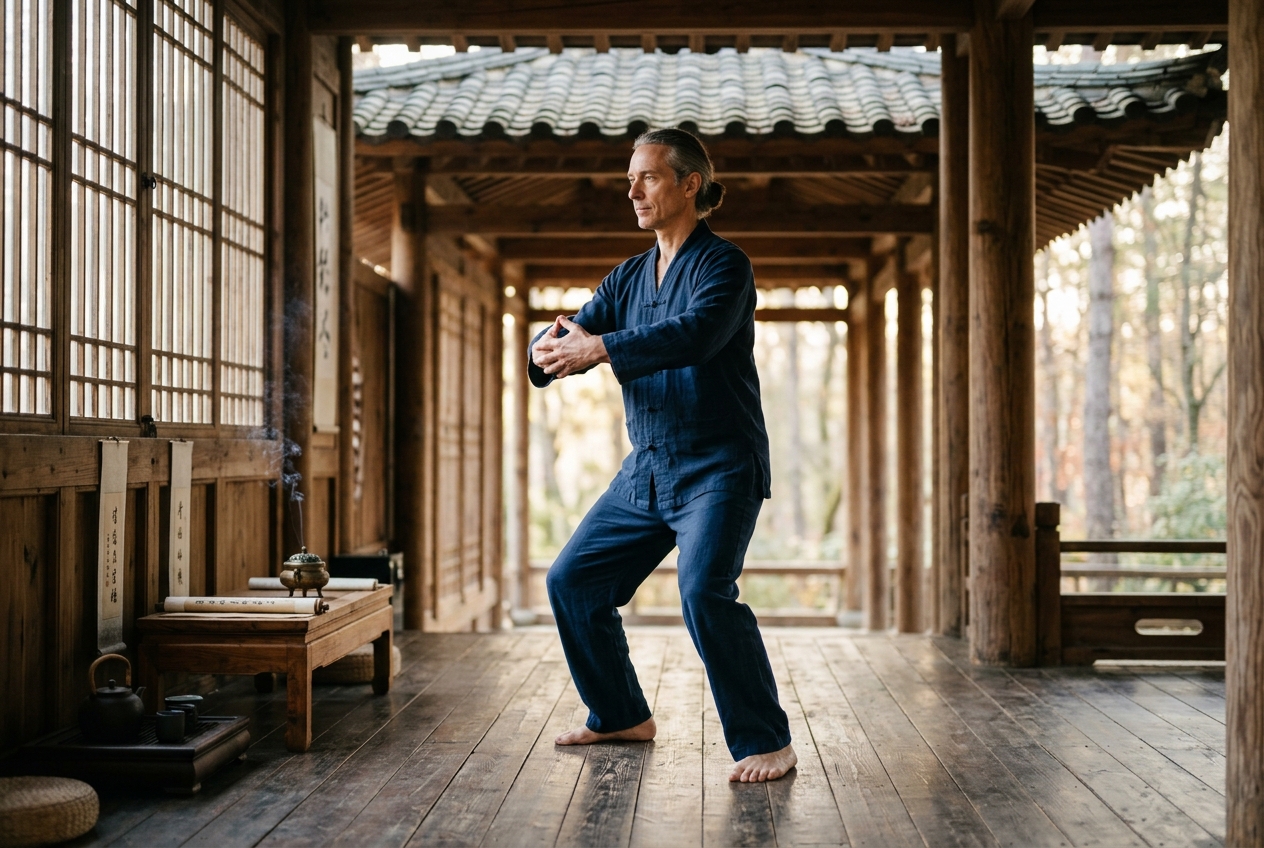
In plain terms, Zhongji work is the practice of consciously softening, aligning, and breathing into the lowest central chamber of your abdomen—four finger-widths below the navel, directly above the pubic bone. In traditional Chinese medicine (TCM), this point acts as the primary alarm gate for the urinary bladder and the master crossroads where the energy channels of the liver, spleen, and kidneys meet the central conception vessel (Ren Mai). When you learn to decompress the deep fascial webbing around this node through specialized posture and breathwork, you restore fluid circulation through the pelvic floor, release lower-back compression, and build an unshakable physical center of gravity.
1. Classical Foundations & Energetic Topography
In the classical cosmological cartography of East Asian medicine, the nomenclature assigned to an acupuncture cavity (xue / 穴) is never arbitrary; it serves as a functional and spiritual blueprint. The ideogram Zhong (中) denotes the central equilibrium, the balance point between Yin and Yang. The character Ji (極) translates as "Culmination," "Ridgepole," or "Extreme Pole," directly evoking Beiji (北極)—the Northern Celestial Pole Star around which the entire celestial sphere revolves.
Applied to the human microcosm, Zhongji designates the anterior pivot of the lower abdomen: the immovable somatic axis around which the fluid mechanics, ancestral vitality, and structural kinetics of the lower body rotate.
+-----------------------------------------------------------------------------------+
|                           CANONICAL ATTRIBUTES OF REN 3                           |
+---------------------+-------------------------------------------------------------+
| Meridian System     | Conception Vessel / Directing Vessel (Ren Mai / 任脈)       |
| Energetic Category  | Front-Mu (Alarm / Gathering) Point of the Urinary Bladder   |
| Channel Confluence  | Crossing Node (Jiao Hui Xue) of Spleen, Liver, & Kidney Yin |
| Primary Actions     | Regulates Qi Hua (Fluid Transformation), Drains Damp-Heat,  |
|                     | Anchors Yuan Qi, Stabilizes Urogenital-Pelvic Tensegrity    |
+---------------------+-------------------------------------------------------------+
As codified in the World Health Organization: Standard Acupuncture Point Locations, Zhongji lies along the median line of the lower abdomen. Functionally, it is classified as the Front-Mu point (募穴, Mu Xue) of the Urinary Bladder (Pangguang). In the taxonomy of classical channel theory, Front-Mu cavities are specialized gathering sites on the ventral surface of the trunk where the visceral Qi (Zang-Fu Qi) of an organ concentrates and surfaces.
Chapter 8 of the foundational medical canon, the Huangdi Neijing Suwen (黃帝內經·素問), states:
"The Bladder is the official in charge of reservoirs; bodily fluids are stored within it, and through the vaporization and transformation of Qi (Qi Hua / 氣化), they can be properly discharged."
The physiological capacity of the bladder to transform fluids relies not merely on local smooth-muscle contraction, but on the thermodynamic catalyzing power of the Lower Dantian (Xia Dantian / 下丹田) and the Mingmen fire (命門火). Zhongji serves as the anterior aperture through which this metabolic transformation (Qi Hua) is governed.
Furthermore, Zhongji functions as a primary Intersection Node (Jiao Hui Xue / 交會穴), where the Conception Vessel (Ren Mai) intersects the Three Leg Yin Channels (Zu San Yin / 足三陰): 1. Foot Taiyin (Spleen Meridian): Governs the transformation and transportation of fluids, muscular structural integrity, and the upward holding of visceral organs. 2. Foot Jueyin (Liver Meridian): Encircles the external genitalia, governs the fascial sinews (Jin / 筋), and maintains the free, uninhibited coursing of somatic Qi. 3. Foot Shaoyin (Kidney Meridian): Houses the primordial essence (Jing / 精), anchors the breath into the lower crucible, and supplies the root fire and water for all physiological processes.
Because these three vital Yin pathways cross the midline at Zhongji, tension or stagnation at this specific node creates collateral stasis across blood storage (Liver), post-heaven fluid metabolism (Spleen), and pre-heaven constitutional reserves (Kidney). In the classical Jin-Dynasty compendium Zhenjiu Jiayi Jing (針灸甲乙經) by Huangfu Mi, Zhongji is celebrated for resolving intractable urinary retention, clearing latent lower-burner damp-heat (Shi Re / 濕熱), and stabilizing urogenital weakness.
In Daoist internal alchemy (Neidan / 內丹), as documented in texts such as the Wuzhen Pian (悟真篇) and the Xingming Guizhi (性命圭旨), Zhongji is recognized as the anterior gateway that seals the base of the lower alchemical crucible, preventing the downward leakage of Jing and anchoring the Original Qi (Yuan Qi / 元氣) during reverse abdominal respiration.
2. Functional Anatomy & Fascial Tensegrity
To understand why the Zhongji aperture exerts such profound influence over somatic stability and visceral health, one must examine its micro-anatomical topography and fascial tensegrity.
Precise Anatomical Localization
Zhongji is situated precisely on the anterior midline of the abdomen, 4 cun inferior to the center of the umbilicus and 1 cun superior to the superior border of the pubic symphysis.
Topographically, this places the cavity over the lowermost section of the Linea Alba, the fibrous collagenous band formed by the interweaving aponeuroses of the external oblique, internal oblique, and transversus abdominis muscles.
Deep Fascial Architecture
Directly beneath the skin and subcutaneous adipose tissue (Camper's and Scarpa's fasciae) at Zhongji lies the lower rectus abdominis sheath.
Crucially, this landmark sits well inferior to the arcuate line of Douglas. Below this line, the structural anatomy undergoes a dramatic transition: the posterior layer of the rectus sheath terminates, meaning that the rectus abdominis muscle rests directly upon the transversalis fascia with only a thin layer of preperitoneal fat separating it.
Deep to the transversalis fascia at this locus lies the prevesical space, clinically known as the Retropubic Space (or Space of Retzius).
This non-peritoneal potential space contains loose neurovascular connective tissue and is bounded: * Anteriorly by the pubic symphysis and transversalis fascia. * Posteriorly by the anterior wall of the urinary bladder and the surrounding vesical fascia. * Inferiorly by the pubovesical ligaments (in females) or puboprostatic ligaments (in males), which anchor the neck of the bladder firmly to the posterior aspect of the pubic bones.
Extending superiorly from the apex of the bladder toward the umbilicus is the median umbilical ligament (the fibrotic remnant of the embryological allantoic urachus), flanked bilaterally by the medial umbilical ligaments (the fibrous cords of the obliterated umbilical arteries).
Zhongji sits at the anterior confluence of this internal suspensory tripod. When the lower abdominal wall experiences chronic hypertonic contracture, it pulls directly upon this visceral ligamentous continuum, distorting the resting geometry of the bladder and restricting the mechanical excursion of the pelvic floor.
Neuro-Visceral & Biomechanical Integration
The neurological wiring of the Zhongji locus represents an intricate bridge between the somatic and autonomic nervous systems: * Somatic Innervation: The cutaneous and myofascial layers are supplied by the anterior cutaneous branch of the iliohypogastric nerve (L1) and the subcostal nerve (T12). * Autonomic Innervation: Directly deep to this cavity lies the network of the Inferior Hypogastric Plexus and the pelvic splanchnic nerves (S2–S4 parasympathetic outflow), alongside sympathetic contributions from the lumbar splanchnic nerves (T10–L2).
According to research documented in the NCBI Bookshelf: Hypogastric Plexus and Pelvic Splanchnic Innervation, the parasympathetic outflow coordinates the contraction of the detrusor vesicae muscle and the reciprocal relaxation of the internal urinary sphincter, while sympathetic tone maintains continence.
Biopathologically, chronic somatic bracing of the lower rectus and transversus abdominis sends retrograde afferent distress signals into the pelvic plexus, inducing autonomic dysregulation, pelvic floor hypertonicity, and impaired venous/lymphatic return from the prostatic and vesical venous plexuses.
From the perspective of myofascial tensegrity—detailed in studies such as NCBI PubMed: Fascia and Tensegrity in Somatic Movement—Zhongji is a critical transmission node in the Deep Front Line (DFL).
The resting tone of the lower abdominal wall at Zhongji must maintain a dynamic, reciprocal balance with the pelvic diaphragm (levator ani: pubococcygeus, puborectalis, and iliococcygeus).
If the lower rectus abdominis clamps down rigidly, the levator ani is pulled into chronic compensatory spasm or functional weakness, destabilizing the entire pelvic bowl.
3. Neigong Dynamics & Biomechanical Rooting
In classical Neigong (內功) and internal martial arts (Taijiquan, Baguazhang, and Xingyiquan), the hypogastric region is not merely a biological container; it is the master kinematic gearbox of the body.
A primary structural flaw encountered in modern practitioners is hyperlordotic anterior pelvic tilt—a postural distortion characterized by an overly arched lumbar spine, anteriorly tipped iliac crests, and jammed inguinal folds (Kua / 胯).
+-----------------------------------------------------------------------------------+
|               BIOMECHANICAL POLARITY: OPENING THE LOWER CRUCIBLE                  |
+-----------------------+-----------------------------------------------------------+
| Postural Distortion   | Somatic Consequence & Energetic Stagnation                |
+-----------------------+-----------------------------------------------------------+
| Anterior Pelvic Tilt  | Hypogastric compression at Zhongji, shearing of L5-S1,    |
| ("Duck Tail")         | Mingmen collapsed, Qi ascends into chest (False Yang).    |
+-----------------------+-----------------------------------------------------------+
| Forced Posterior Tilt | Rigid retroversion, buttock clenching, perineum locked,   |
| (Over-Correction)     | restricted diaphragmatic excursion, deadened ground root. |
+-----------------------+-----------------------------------------------------------+
| True Pelvic Neutral   | Zhongji decompressed, Mingmen filled, Huiyin suspended,   |
| (Song Kua / Yuan Dang)| kinetic forces flow unbroken from Yongquan to vertex.     |
+-----------------------+-----------------------------------------------------------+
Resolving Hypogastric Constriction (Song Kua & Yuan Dang)
When the fascial matrix around Zhongji is chronically contracted, it acts like a shortened bowstring between the umbilicus and the pubic bone, dragging the anterior pelvis upward-and-forward while tilting the sacral base downward-and-backward.
This mechanical distortion pinches the femoral neurovascular bundle and disables Song Kua (鬆胯)—the critical release and sinking of the hip creases.
Decompressing Zhongji releases this anterior tether. It permits the sacrum to drop naturally under gravity without forced muscular tucking, leveling the pelvic bowl.
This unweights the hip sockets, opens the perineal arch into Yuan Dang (圓襠, "Rounded Crotch"), and creates the elastic spring-loaded base necessary for whole-body power generation (Fa Jin / 發勁).
The Three-Point Lower Crucible Polarity
Authentic internal rooting relies on a dynamic three-dimensional geometric relationship within the pelvic cavity:
- Anterior Pivot: Zhongji (Ren 3) provides an elastic, responsive anterior boundary that softens outward during diaphragmatic descent without losing structural continuity.
- Posterior Pivot: Mingmen (GV4 / Gate of Life) and Guanyuan (Ren 4) across the dorso-ventral axis must remain "filled" (Chong / 充), eliminating excessive lumbar inward curvature and un-pinching the spinal cord.
- Inferior Base: Huiyin (Ren 1 / Perineum) acts as the dynamic floor, subtly elevated and tonified via micro-elastic suspension of the levator ani.
When these three poles are harmonized, the Lower Dantian transforms from an anatomical abstraction into an integrated pressurized chamber. Intravasation of intra-abdominal pressure (IAP) stabilizes the axial spine without requiring rigid bracing of the superficial abdominal musculature.
Transmitting Ground Reaction Forces
Ground reaction forces enter the human body through the Yongquan cavity (K1 / Bubbling Well) on the plantar surface of the foot.
From Yongquan, kinetic energy ascends the medial kinetic chain—along the tibialis posterior, through the medial compartment of the thigh (adductor longus, adductor magnus, and gracilis), and through the obturator fascia into the pelvic ring.
If the Zhongji intersection node is fascialized into a rigid knot, this ascending kinetic wave hits a functional roadblock at the pubic brim. The force is deflected into the lumbar vertebrae, causing spinal microtrauma.
Conversely, when Zhongji is decompressed and open, the medial kinetic line links smoothly with the transversalis fascia, the diaphragm, and the deep spinal stabilizers (multifidi, psoas minor, and anterior longitudinal ligament), conducting mechanical power cleanly through the core into the upper extremities.
4. Step-by-Step Cultivation & Daoyin Somatics
The following didactic protocol is designed to transition the practitioner from intellectual comprehension to somatic embodiment through targeted palpation, breath-directed neuro-fascial unwinding, and dynamic martial integration.
+===================================================================================+
|                     SUMMARY OF 5-STAGE CULTIVATION PROTOCOL                       |
+===================================================================================+
| Phase 1: Palpation & Localization    | Map the 4-cun/1-cun coordinate and test   |
|                                      | baseline tissue resistance with pads.      |
+--------------------------------------+-------------------------------------------+
| Phase 2: Postural Grounding (Wuji)   | Establish shoulder-width stance, soften   |
|                                      | the Kua, and align the three pelvic poles.|
+--------------------------------------+-------------------------------------------+
| Phase 3: Reverse Abdominal Breathing | Inhale with subtle lower belly tone;      |
|          (Ni Fuhu Xi)                | exhale and expand tissue through Zhongji. |
+--------------------------------------+-------------------------------------------+
| Phase 4: Intention-Guided Vectoring  | Circulate warmth from Yongquan (K1) up    |
|          (Yi Dao Qi Dao)             | through Zhongji into the axial spine.     |
+--------------------------------------+-------------------------------------------+
| Phase 5: Dynamic Stepping Transfer   | Maintain the decompressed hypogastric      |
|                                      | crucible through slow Taiji weight shifts.|
+--------------------------------------+-------------------------------------------+
Stage 1: Granular Palpation & Localization Protocol
- Preparation: Empty the urinary bladder completely prior to this practice. Stand comfortably or lie supine with knees bent at a 90-degree angle, feet flat on the floor to eliminate baseline rectus abdominis tension.
- Mapping the Coordinate: * Place the thumb of your dominant hand on the lower rim of the umbilicus (Shenque, CV8). * Place the pinky finger of your non-dominant hand along the superior cartilaginous border of the pubic symphysis (Qugu, Ren 2). * The distance between these two anatomical landmarks is standardized as 5 cun. * Locate the point exactly one-fifth of the distance superior to the pubic bone (4 cun below the navel, 1 cun above the pubic crest). This small, subtle depression in the linea alba is the Zhongji cavity.
- Fascial Exploration: * Gently place the combined pads of your index, middle, and ring fingers over Zhongji. * Do not poke aggressively with rigid fingertips. Apply a slow, sustained pressure at a 45-degree angle pointing slightly inferiorly toward the retropubic space. * Assess the tissue quality: Is there localized tenderness, sharp guarding, or a rubbery fibrous density? Note these diagnostic markers without attempting to force a mechanical release.
Stage 2: Zhan Zhuang Postural Set-Up (Wuji Alignment)
- The Stance: Stand with feet parallel, shoulder-width apart, weight distributed evenly across the tripod of each foot: the base of the first metatarsal, the base of the fifth metatarsal, and the calcaneus.
- Knee and Pelvic Geometry: * Soften the knee joints; never hyperextend or lock them. * Allow the hips to sink downward as if resting against a tall barstool (Song Kua). * Imagine a lead plumb-line suspended from your coccyx dropping straight down between your heels.
- Upper Structure Suspension: * Gently draw the chin inward, lifting the crown of the head (Baihui, GV20) upward as if suspended by an ethereal silk thread. * Allow the shoulders to drape outward and downward, creating hollow armpits (Hu Kou). * Place the palms in the low embracing posture (Cheng Bao Zhuang), with fingertips pointing toward one another across the Zhongji plane, approximately four inches away from the skin.
Stage 3: Lower Dantian Reverse Respiration (Ni Fuhu Xi)
- Inhalation Phase (Internal Gathering): * Draw the breath slowly, smoothly, and silently through the nostrils, targeting a 5-to-6-second cadence. * As the thoracic diaphragm contracts and descends, do not allow the belly to simply balloon outward flaccidly. * Instead, maintain a subtle, elastic tone at the Zhongji aperture. Gently draw the perineum (Huiyin, Ren 1) upward 2 to 3 millimeters, and allow the lower back (Mingmen, GV4) to expand posteriorly. * The intra-abdominal pressure rises smoothly, packing bio-mechanical and energetic density into the deep space behind Zhongji (the Space of Retzius).
- Exhalation Phase (Decompression & Radiance): * Exhale slowly through the nose or lightly parted lips over a 6-to-8-second cadence. * As the thoracic diaphragm relaxes upward, consciously release all residual tension in the rectus sheath directly at Zhongji. * Allow the hypogastric tissues beneath the navel to expand softly forward and outward, dissolving any hardness. * Simultaneously release the upward lift of Huiyin, letting your ground reaction forces sink deep into the earth through Yongquan (K1).
- The Micro-Posterior Reset: * At the very end of the exhalation, allow the pubic symphysis to undergo an infinitesimal (1-millimeter) upward-and-backward floating motion, driven by the transversus abdominis, while the coccyx settles downward. This permanently unlocks the anterior lower lumbar hinge.
Stage 4: Intention-Guided Channel Synthesis (Yi Dao Qi Dao)
- While maintaining this rhythmic respiration, direct your conscious awareness (Yi / 意) to the soles of your feet at Yongquan (K1).
- As you inhale, imagine drawing cool, nourishing Yin energy up the medial arches of the feet, through the inner ankles (Spleen 6 / Sanyinjiao), ascending the inner thighs along the deep fascial track.
- Bring these three streams of intention to meet directly at the Zhongji intersection node. Feel the convergence point growing dense, clear, and vibrant.
- As you exhale, allow that gathered energy to radiate outward as a warm, golden micro-fascial heat that washes through the urinary bladder, saturates the pelvic floor, and settles into the bone marrow of the sacrum.
Stage 5: Dynamic Stepping Integration (Taiji / Bagua Weight Transfer)
- Shift 100% of your weight onto the right leg, sinking the right Kua while keeping the crown elevated.
- Ensure the Zhongji cavity does not twist or veer off-axis; the lower abdominal midpoint remains oriented with the moving direction of the central sternum.
- Peel the left foot up and step forward along an empty diagonal path. As the left heel touches down, do not throw your weight forward.
- Pour the weight smoothly into the left foot by releasing the left side of the hypogastrium at Zhongji, letting the kinetic vector flow seamlessly through the pelvic crucible into the front root.
5. Why It Works — The Body Science
The benefits of Zhongji cultivation are rooted in verifiable neuro-visceral and biomechanical mechanisms. Modern physiology confirms the systemic transformations catalyzed by this practice.
+===================================================================================+
|               NEURO-VISCERAL & BIOMECHANICAL TRANSLATION MATRIX                   |
+================================+==================================================+
| Traditional Neigong Concept    | Contemporary Western Physiological Mechanism      |
+================================+==================================================+
| Dissolving Abdominal Stagnation| Decompressing the Space of Retzius; improving     |
|                                | pelvic venous & lymphatic drainage.              |
+--------------------------------+--------------------------------------------------+
| Vaporization / Qi Hua of       | Stimulating S2–S4 parasympathetic outflow;        |
| Bladder Fluids                 | optimizing detrusor tone & vesical compliance.   |
+--------------------------------+--------------------------------------------------+
| Mingmen-Zhongji Polarity       | Balances Intra-Abdominal Pressure (IAP) through   |
|                                | co-activation of transversus abdominis & pelvic  |
|                                | diaphragm without hyperlordotic shear.           |
+--------------------------------+--------------------------------------------------+
| Three Leg Yin Convergence      | Integrating the Deep Front Line (DFL) fascial     |
|                                | continuum from plantar fascia to respiratory core.|
+================================+==================================================+
Parasympathetic Activation via Pelvic Splanchnic Outflow
Chronic psychological stress and structural bracing lock the autonomic nervous system into sympathetic overdrive. This triggers continuous vasoconstriction throughout the splanchnic circulation and induces unyielding tone in the pelvic floor.
By executing sustained, gentle diaphragmatic respiration with targeted myofascial softening at Zhongji, the practitioner mechanically stimulates the pelvic splanchnic nerves (S2–S4) and down-regulates the sympathetic chain via the inferior hypogastric plexus.
This somatic shift elevates systemic Heart Rate Variability (HRV), enhances microvascular perfusion to the pelvic organs, and restores healthy autonomic baseline balance.
Diaphragmatic-Pelvic Floor Piston Mechanics
The human torso operates biomechanically as a dual-piston cylinder. The thoracic diaphragm serves as the upper piston, while the pelvic diaphragm (levator ani) acts as the lower piston.
During normative respiration, these two structures descend and ascend in phase-locked harmony.
When Zhongji is locked in chronic spasm, the anterior wall of the cylinder cannot deform elastically. This forces the intra-abdominal pressure downward with excessive, unmitigated shear stress, predisposing the individual to pelvic organ prolapse, inguinal herniation, and chronic pelvic pain syndromes.
Decompressing Zhongji restores elastic compliance to the anterior hypogastric boundary, allowing intra-abdominal pressure to be distributed evenly across the entire myofascial cylinder.
Fascial Biotensegrity & Piezoelectric Signaling
Fascia is not inert biological packing material; it is an active, liquid-crystal sensory organ. The collagen fibers comprising the lower rectus sheath, linea alba, and transversalis fascia possess piezoelectric properties: when subjected to rhythmic mechanical deformation, stretching, and shear through Daoyin breathwork, they generate micro-electrical signals.
These signals guide fibroblast remodeling, normalize collagen cross-linking, and hydrate the ground substance (hyaluronan matrix).
Opening the Zhongji node literally re-lubricates the deep sliding planes of the lower abdomen, freeing the bladder and reproductive organs to glide unimpeded during locomotion.
6. Classical Lineage & Historical Context
The cultivation of the hypogastric energetic center traces an unbroken historical lineage across millennia of Daoist self-cultivation, classical medicine, and martial arts evolution.
During the Han Dynasty, the theoretical architecture of the Front-Mu points was formally systematized in the Nan Jing (難經 / Classic of Difficulties), specifically within Chapter 67, which established the clinical primacy of treating Yin diseases through anterior Mu apertures.
Simultaneously, the early Daoist alchemical traditions associated with Ge Hong (葛洪, 283–343 CE) and the Shangqing (上清 / Supreme Purity) revelations placed paramount emphasis on Taixi (胎息, "Embryonic Breathing")—a method of respiration that ceased reliance on the upper thoracic cavity, anchoring the breath entirely in the hypogastric space behind Zhongji and Guanyuan.
In the Tang Dynasty, the legendary physician-alchemist Sun Simiao (孫思邈, 581–682 CE) recorded in his masterwork Beiji Qianjin Yaofang (備急千金要方) specific Daoyin movement sets that combined pelvic rocking and focal intention on the "Central Pole" to eradicate systemic edema, clear damp-heat turbidity, and reverse premature vitality depletion.
With the later flowering of the Quanzhen (全真 / Complete Reality) Daoist school and the synthesis of internal martial arts (Neijiaquan) during the Ming and Qing Dynasties, these esoteric medical practices were incorporated directly into combative mechanics.
Lineage masters recognized that a martial artist who possessed exceptional muscular strength (Zhuo Li / 拙力) but lacked an open, decompressed Zhongji cavity would always remain "top-heavy" (Tou Zhong Jiao Qing / 頭重腳輕).
True internal power (Neijin / 內勁) demanded that the front of the pelvis be hollowed and supple, allowing the practitioner to root into the earth like an ancient cedar while maintaining explosive, liquid responsiveness throughout the spine.
Today, this rich tradition is preserved and disseminated globally through organizations such as the National Qigong Association, bridging classical Eastern somatic arts with modern human performance and rehabilitation sciences.
7. Contraindications, Safety Guidelines & Diagnostic Markers
Because the Zhongji aperture sits directly anterior to critical visceral and neurovascular structures, practitioners and instructors must adhere to strict safety protocols and clinical precautions.
+===================================================================================+
|                     CONTRAINDICATIONS & PRACTICE PRECAUTIONS                      |
+=========================+=========================================================+
| Full Urinary Bladder    | CRITICAL: Always void the bladder before practice.      |
|                         | Compressing a distended bladder can cause severe local  |
|                         | discomfort, autonomic distress, or tissue micro-trauma. |
+-------------------------+---------------------------------------------------------+
| Pregnancy Precautions   | AVOID deep pressure, forceful breath retention, or deep |
|                         | reverse respiration over Zhongji during all trimesters. |
+-------------------------+---------------------------------------------------------+
| Acute Pelvic Pathology  | Contraindicated during acute cystitis, unmanaged UTIs,  |
|                         | acute pelvic inflammatory disease (PID), or recent      |
|                         | abdominal/pelvic surgical interventions.                |
+=========================+=========================================================+
+===================================================================================+
|               SOMATIC DIAGNOSTIC FEEDBACK: AUTHENTIC VS. PATHOLOGICAL             |
+================================+==================================================+
| Authentic Release Markers (✓)  | Pathological Bracing Markers (✗)                 |
+================================+==================================================+
| Micro-fascial warmth radiating | Sharp, stabbing, or pinching pain at the pubic   |
| across the lower abdomen.      | symphysis or within the groin.                   |
+--------------------------------+--------------------------------------------------+
| Spontaneous borborygmi (fluid  | Abdominal splitting or upward bulging            |
| gurgling / parasympathetic gut | (diastasis recti doming) along the linea alba.   |
| activation).                   |                                                  |
+--------------------------------+--------------------------------------------------+
| Sensation of the pelvis        | Tightening of the throat, clenching of the jaw,  |
| "unfurling" or dropping down.  | or breath holding.                               |
+--------------------------------+--------------------------------------------------+
| Gentle, full-body vascular     | Numbness, tingling, or referred nerve pain       |
| pulse in the fingertips & toes.| radiating down the anterior thighs.              |
+================================+==================================================+
Common Beginner Mistakes and Precise Corrections
- Mistake 1: Forcing a Posterior Pelvic Tilt by Squeezing the Gluteal Muscles.
- The Error: The practitioner clamps the gluteus maximus tightly to flatten the lower back, believing this achieves pelvic neutral. This chokes the hip joints and shuts down the flow of ground forces.
- The Correction: Relax the buttocks completely. Allow the pelvis to level through the anterior softening of Zhongji and the natural downward gravitational pull on the coccyx, not through posterior muscular clamping.
- Mistake 2: Abdominal "Doming" or Over-Pressurization.
- The Error: During reverse respiration, the practitioner pushes intra-abdominal pressure violently outward, causing the linea alba to bulge outward rigidly.
- The Correction: Maintain an even, cylindrical containment. The breath must expand 360 degrees—into the lower back, the lateral flanks, and the pelvic floor—while Zhongji remains an elastic, yielding gate.
- Mistake 3: Lifting the Chest and Shoulders During Inhalation.
- The Error: The clavicles and ribcage rise, drawing the center of mass up into the throat and neck.
- The Correction: Keep the sternum relaxed and sunken (Han Xiong Ba Bei). Imagine the breath dropping directly beneath your navel on every inhalation.
8. Today's Practice Commitment
To translate this deep anatomical and classical wisdom into tangible physiological transformation, you must make a daily, consistent investment in your somatic framework. Theory without daily embodiment remains mere philosophy.
[!TIP] Your Daily 7-Minute Cultivation Protocol
Commit to the following sequence tomorrow morning, immediately upon waking and after emptying your bladder, before consuming coffee or engaging with digital devices:
Minute 0:00 – 1:30 | Supine Palpation & Release: * Lie flat on your back with knees bent, feet resting on the floor. * Place your fingertips on Zhongji (1 cun above the pubic bone). * Take 5 deep, slow diaphragmatic breaths, consciously willing the tissues beneath your fingertips to soften, melt, and yield toward the floor.
Minute 1:30 – 5:00 | Standing Zhan Zhuang (Wuji Alignment): * Stand with feet shoulder-width apart, knees unlocked, head suspended. * Hover your palms 4 inches outside Zhongji in the lower embrace posture. * Execute 15 complete cycles of Lower Dantian Reverse Respiration: Inhale smoothly for 5 seconds (subtle lift of Huiyin, firm internal core), exhale for 7 seconds (complete softening and radiant warmth spreading through Zhongji).
Minute 5:00 – 7:00 | Dynamic Stepping Transfer: * Perform 10 ultra-slow, deliberate Taiji walking steps across your room. * With every step, verify that your lower hypogastrium remains completely open, unweighted, and relaxed as you transfer your mass from root to root.
Notice the immediate shift in your physical and mental landscape over the subsequent hour: the drop in baseline anxiety, the warmth in your extremities, the quiet stability of your lower back, and the profound sensation of being anchored solidly into the earth. You have engaged the Central Pole—the celestial pivot of your somatic universe.