Zhongfu Cavity Central Treasury: Deltopectoral Fascial Decompression, Pulmonary Qi Dispersal, and Anterior Thoracic Kinetic Expansion in Classical Neigong
In the seminal Han dynasty medical canon, the Huangdi Neijing Lingshu (Spiritual Pivot, Chapter 10), the Lung meridian is identified as the prime mover of the body’s twelve regular channels. It is the Lung meridian that initiates the circadian cycle of energetic circulation (Zhongshi) at the dawn hour of the Tiger (3:00 AM to 5:00 AM). However, the internal energetic pathway does not begin in the lungs themselves; it originates deep within the Middle Dantian (the stomach and spleen organ complex).
According to classical physiology, the Spleen transforms digested food and fluids into Gu Qi (grain essence or nutritive energy). This Post-Heaven essence ascends through the internal branch of the Spleen meridian, passing through the diaphragm, and emerges superficially at the chest at point SP-20 (Zhourong) before spilling directly into Zhongfu (LU-1). At Zhongfu, this earth-derived Gu Qi meets Kong Qi (the pure atmospheric Qi drawn through the respiratory tract). In the alchemical chamber of the upper thoracic cavity, these two energetic streams synthesize to form Zong Qi (Gathering or Pectoral Qi), which subsequently fuels cardiac pulsation and pulmonary respiration, ultimately distributing Zhen Qi (True Qi) throughout the entire vascular and fascial matrix.
The Ming dynasty compendium Zhenjiu Dacheng (Great Compendium of Acupuncture and Moxibustion) by Yang Jizhou highlights Zhongfu as the diagnostic and therapeutic clearinghouse for pulmonary stagnation, wheezing, thoracic fullness, and systemic fatigue. Because it is the Front-Mu point, internal disharmony or somatic distress in the lung organ reflects immediately as physical tenderness, fascial thickening, or ischemic pain at LU-1. Alchemically, Zhongfu is termed the "Central Treasury" because it acts as the storehouse where the physical resources of the Middle Burner (Zhong Jiao) are refined into the spiritual and functional vitality of the Upper Burner (Shang Jiao). When Zhongfu is structurally compressed or energetically locked, the ascent of digestive Qi is obstructed, leading to upper thoracic oppression, emotional melancholy (the psycho-spiritual pathology of the Lung’s Po soul), and diminished systemic vitality.
Myofascial Tensegrity and Neurovascular Decompression
While classical texts articulated these dynamics through the poetic phenomenology of Qi and meridians, modern biomedical science and fascia research describe the exact same physiological mechanisms through the lenses of biotensegrity, neurovascular anatomy, and respiratory biomechanics.
Anatomically, Zhongfu is situated in the infraclavicular fossa within the deltopectoral groove, approximately six cun lateral to the anterior midline in the first intercostal space, roughly one cun directly inferior to Yunmen (LU-2). Dissection reveals that the point pierces the deep clavipectoral fascia, a dense sheet of connective tissue suspended between the clavicle and the upper thoracic wall, immediately superior and medial to the insertion of the pectoralis minor muscle on the coracoid process of the scapula.
In the structural paradigm of Thomas Myers' Anatomy Trains, Zhongfu sits at the critical crossroad of two primary myofascial pathways: the Deep Front Arm Line (DFAL) and the Anterior Functional Line (AFL). The Deep Front Arm Line tracks continuously from the third, fourth, and fifth ribs through the pectoralis minor and clavipectoral fascia, courses along the coracobrachialis and biceps brachii, traverses the radial periosteum, passes across the thenar eminence of the hand, and terminates at the radial tip of the thumb. This anatomical chain corresponds precisely with the trajectory of the classical Hand Taiyin Lung meridian.
When an individual adopts the ubiquitous rounded-shoulder, forward-head posture of modern sedentary life, the pectoralis minor undergoes chronic adaptive shortening. This draws the coracoid process anteriorly and inferiorly, producing a dense fibrotic cross-linking within the clavipectoral fascia at Zhongfu. This fascial contracture exerts profound pathomechanical consequences:
- Neurovascular Entrapment: The tightened clavipectoral sheath constricts the superior thoracic aperture, contributing directly to neurogenic and vascular thoracic outlet syndrome. It compresses the lateral pectoral nerve, impinges the cords of the brachial plexus (specifically those innervating the median and radial lines), and impedes venous return through the cephalic vein as it pierces the fascia to join the axillary vein.
- Apical Pulmonary Restriction: Fascial restriction at the first and second ribs anchors the apex of the lung in a semi-collapsed state. This prevents full apical expansion during inspiration, forcing the body into compensatory accessory muscle breathing via the sternocleidomastoid and scalenes.
- Diaphragmatic Decoupling: By locking the upper rib cage in internal rotation, the reciprocal biomechanical piston between the respiratory diaphragm and the pelvic floor is disrupted. Research indexed in the National Center for Biotechnology Information demonstrates that freeing the anterior thoracic wall and restoring diaphragmatic excursion increases heart rate variability (HRV), stimulates the pulmonary branches of the vagus nerve, downregulates systemic inflammation, and shifts autonomic balance from sympathetic fight-or-flight to parasympathetic restorative homeostasis.
Kinetic Mechanics in Classical Daoyin and Martial Internal Power
In the internal martial arts (Neijiaquan—encompassing Taijiquan, Xingyiquan, and Baguazhang) as well as therapeutic Daoyin exercises, the Zhongfu cavity is not treated as a static anatomical point, but as a dynamic biomechanical transmission gear. It functions as the kinetic hinge that translates rotational torque generated by the legs and pelvic basin into expansive, vector-controlled power (Peng Jin) expressed through the upper extremities.
A core martial tenet shared across these traditions is Han Xiong Ba Bei (含胸拔背), traditionally translated as "containing the chest and plucking up the back." Beginners frequently misunderstand this instruction as an invitation to slouch or cave the sternum inward. In classical Neigong, Han Xiong refers specifically to the relaxation and broadening of the clavipectoral fascia around Zhongfu. Rather than collapsing the chest, the practitioner releases the superficial pectoralis major and minor, allowing the sternum to soften vertically while the infraclavicular spaces widen laterally.
When the scapulae are settled downward (Chen Jian Zhui Zhou—sinking the shoulders and dropping the elbows), the serratus anterior engages to stabilize the shoulder girdle against the rib cage. This mechanical arrangement opens the subclavicular vault at Zhongfu, creating a hollow, pressurized arch across the upper torso.
During the execution of silk-reeling spirals (Chan Si Gong), rotational movement initiated at the feet passes through the pelvic core (Dantian) and the lumbar spine (Mingmen). If Zhongfu is pinched or rigid, this kinetic wave crashes and dissipates at the shoulder joint, manifesting as muscular strain and weak, disconnected arm movements. Conversely, when Zhongfu remains decompressed and structurally open, the kinetic wave glides frictionlessly through the clavipectoral gateway, traveling down the Deep Front Arm Line along the radial edge of the forearm to manifest as an elastic, unbendable hydrodynamic force at the palm and thumb.
Step-by-Step Practice Guide: The Three-Stage Zhongfu Cultivation Protocol
To systematically release, activate, and integrate the Zhongfu cavity, follow this structured, progressive sequence developed from classical Neigong and traditional Daoyin methodologies recognized by the National Qigong Association.
+==============================================================================+
|                     ZHONGFU NEIGONG PRACTICE ROADMAP                         |
+==============================================================================+
| STAGE I:   Acoustic & Palpatory Decompression (Static Wuji Stance)           |
|            - Manual myofascial friction at LU-1                              |
|            - Sub-vocalized "Shang" (商) resonant sound vibration             |
|                                                                              |
| STAGE II:  Oscillatory Silk-Reeling Spirals (Dynamic Arm Rotation)           |
|            - Inhalation: External humeral rotation, expanding the treasury   |
|            - Exhalation: Internal radial spiraling, projecting to the thumb  |
|                                                                              |
| STAGE III: Martial Form Integration (Baduanjin: Drawing the Bow)             |
|            - Asymmetric bilateral load: drawing hand vs. projecting palm     |
|            - Full somatic vector alignment and apical lung ventilation       |
+==============================================================================+
Stage I: Static Sensory Palpation and Acoustic Resonance (Liu Zi Jue)
- Foundational Stance: Stand in the Wuji posture. Place feet parallel, hip-width apart. Unlock your knees, gently tuck the tailbone to lengthen the lumbar spine, and suspend the crown of your head from above (Xu Ling Ding Jin). Let your arms hang naturally.
- Cavity Location and Engagement: Cross your left hand over your chest and place your fingertips into the right Zhongfu point (in the depression below the clavicle, six cun lateral to the sternal midline, roughly three finger-widths below the outer collarbone notch). Place your right hand over your lower abdomen (Lower Dantian).
- Breath Coordination and Acoustic Purging: Inhale smoothly through your nose for a count of four, feeling the breath expand first in the lower abdomen, then ascend into the upper right chest, physically pressing the Zhongfu tissues outward into your fingertips.
- Phonation of the Shang Tone: Open your mouth slightly, draw the corners of your lips back, and exhale for a count of eight while producing the sibilant acoustic tone "Sssss" (the classical Shang 商 sound associated with the Metal element and Lung organ in the Liu Zi Jue Six Healing Sounds). Feel the micro-acoustic vibration resonating directly inside the clavipectoral fascia beneath your palpating fingers, liquefying collagenous adhesions. Perform 6 to 9 repetitions per side.
Stage II: Dynamic Oscillatory Spiral Expansion (Chan Si Gong)
- Setup: Return both arms to your sides in Wuji posture. Settle your weight evenly through the bubbling springs of your feet (Yongquan, KD-1).
- Inhalation & External Spiral: Inhale slowly through your nose. Simultaneously spiral both arms outward into external rotation: turn your palms forward, then outward, leading the motion with your thumbs. As the forearms supinate, deliberately widen the space between your collarbones and shoulder tips without lifting your shoulders. Feel the Zhongfu cavities on both sides inflate and stretch open horizontally like opening double doors into a treasury.
- Exhalation & Internal Projection: Exhale smoothly through the nose. Reverse the spiral into internal rotation: lead with the pinky fingers as your palms turn inward and downward, spiraling the radial meridian line forward. Soften the center of the chest (Han Xiong), sink the scapulae, and project a sensation of elastic extension through the thenar muscles to the tips of your thumbs (Shaoshang, LU-11). Repeat for 12 continuous, fluid cycles.
Stage III: Kinetic Integration into Movement Forms (Baduanjin)
Integrate the decompressed Zhongfu cavity into the classical Baduanjin qigong posture, "Drawing the Bow to Shoot the Eagle" (Zuo You Kai Gong Si Shuang Diao):
- Horse Stance Transition: Step out with your left foot into a comfortable, stable Horse Stance (Ma Bu), sinking your pelvis while maintaining an erect, suspended spine.
- Crossing the Hands: Inhale as you cross your wrists before your chest at the level of the Heart center, right wrist inside, left wrist outside. Relax both Zhongfu hollows.
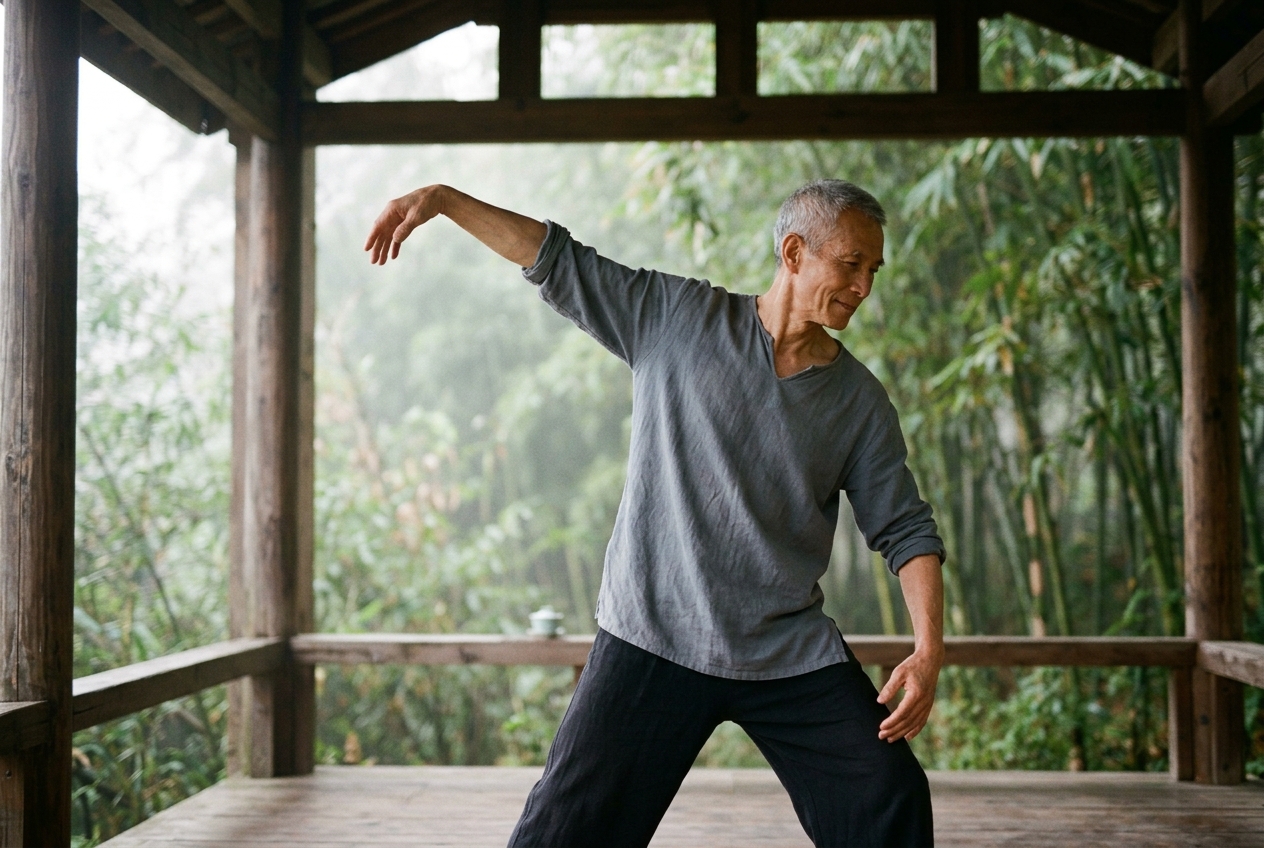
- Drawing the Bow: Exhale as you extend your left arm horizontally to the left, forming the "Sword Fingers" or classical L-shaped palm (thumb and index finger extended at right angles, middle, ring, and pinky fingers curled inward). Gaze intently past your left index finger. Simultaneously, draw your right hand back toward your right shoulder as if pulling a taut 100-pound bowstring.
- Zhongfu Vector Alignment: In the terminal posture, consciously adjust the bilateral mechanics of the Central Treasury: - On the left (projecting) side, sink the shoulder blade, rotate the radial border of the forearm upward, and open the left Zhongfu cavity forward and outward to transmit elastic force through the thumb. - On the right (drawing) side, pull the elbow horizontally backward, expanding the right Zhongfu cavity in a broad lateral stretch across the rib cage without allowing the shoulder to shrug upward.
- Release and Recoil: Inhale, soften both chests, sweep the arms inward in a circular arc, and return to the center. Alternate to the right side. Perform 8 balanced repetitions.
Diagnostic Troubleshooting and Common Compensatory Errors
When cultivating the Zhongfu cavity, practitioners frequently encounter structural compensations that neutralize the physiological and energetic benefits of the practice. Use the diagnostic matrix below to identify and rectify these errors.
| Compensatory Error | Underlying Biomechanical Cause | Pathological Consequence | Direct Somatic Correction |
|---|---|---|---|
| Clavicular Elevation (Shrugging) | Overactive upper trapezius and levator scapulae during arm abduction or inhalation. | Compresses the neurovascular bundle against the first rib; locks Zhongfu in a superior spasm. | Consciously anchor the lower trapezius and serratus anterior; imagine heavy lead weights suspended from your elbow tips (Chen Jian). |
| Hyperlordosis (Rib Flaring) | Inability to separate thoracic expansion from lumbar extension; weak abdominal wall. | Pinches the posterior spinal facets; forces thoracic air into a shallow anterior flare, cutting off the lower Dantian. | Engage the transversus abdominis; draw the lower floating ribs gently inward toward the spine; lengthen the tailbone downward. |
| Brachial Pinching | Retracting the humeral head too far posteriorly during arm expansion. | Impinges the biceps long head and anterior capsule; collapses the anterior fascial dome of Zhongfu. | Preserve a soft, rounded curve in the axillary hollow (Peng); imagine holding a ripe peach gently in your armpit. |
| Sternal Slumping (False Han Xiong) | Caving the middle chest inward through spinal flexion rather than fascial softening. | Compresses the heart and lungs; restricts diaphragmatic downward excursion; induces postural kyphosis. | Keep the thoracic spine erect and suspended from the crown; release tension laterally from the midline rather than hollowing the bone inward. |
Somatosensory Indicators of Correct Activation
As the clavipectoral fascia decompresses and the energetic pathway clears, you should observe specific somatic sensations: * Microvascular Reperfusion: A distinct spreading sensation of heavy warmth and gentle throbbing in the thenar eminence (base of the thumb) and palms, signaling peripheral vasodilation via parasympathetic activation. * Neuro-Fascial Tingling: A champagne-like effervescence or gentle electric vibration tracking along the radial nerve pathway and the Deep Front Arm Line from the chest to the thumb tip. * Apical Satiation: A profound subjective sensation of respiratory ease, characterized by the feeling that inhaled air flows unimpeded into the uppermost peaks of your lungs and under your collarbones without any muscular strain.
Classical Lineage, Historical Context, and Theoretical Evolution
The systematic cultivation of the upper thoracic cavities has an unbroken pedigree stretching across more than two millennia of Chinese somatic history. The earliest visual record of these movements appears in the famous Daoyin Tu (Gymnastics Chart), a painted silk manuscript excavated from the Western Han dynasty Mawangdui Tomb 3 in Changsha, Hunan province (dated to 168 BCE).
Among the forty-four figures illustrated performing therapeutic calisthenics, several postures—such as Yin Bei (Pulling the Back) and Zhan Chi (Spreading the Wings)—depict dynamic lateral expansions of the infraclavicular space specifically designed to purge pathogenic wind-cold from the pulmonary tract and facilitate the circulation of Gu Qi.
During the Southern and Northern Dynasties, the Daoist alchemist and physician Tao Hongjing (456–536 CE) codified the Six Healing Sounds in his foundational longevity treatise Yangxing Yanming Lu (Records of Nourishing Nature and Extending Life). Tao recognized that specific acoustic frequencies could exert mechanical resonance upon visceral organs. The Shang tone was mathematically paired with the Metal element, the autumn season, and the Lung system. By phonating this sound while stretching the upper chest, practitioners utilized internal sound wave mechanics to break down chronic fascial cross-linking around Zhongfu long before the invention of modern soft-tissue therapies.
In the Song dynasty, as monastic and military physical cultivation systems synthesized, General Yue Fei and Daoist masters refined these principles into the universally practiced Baduanjin (Eight Pieces of Brocade). The specific movement "Drawing the Bow to Shoot the Eagle" was engineered precisely to decompress the clavipectoral fascia under the asymmetrical physical load of archery training, ensuring that archers did not develop debilitating upper crossed syndromes or respiratory exhaustion.
In the late Ming and early Qing dynasties, the founders of internal martial arts integrated these medical and Daoyin discoveries directly into martial kinetic frameworks. Master Chen Wangting of Chen Family Taijiquan and subsequent masters of the Yang, Wu, and Sun lineages placed Han Xiong Ba Bei at the apex of their training requirements. They realized that without the lateral opening and myofascial decompression of the Zhongfu cavity, true internal power (Neijin) could never reach the hands, and martial movement would remain trapped in the inefficient, brittle domain of isolated muscular exertion.
Today’s Practice Commitment: The 7-Minute Morning Protocol
To reclaim the function of your Central Treasury, commit to this brief, highly concentrated somatic protocol every morning before sitting down at your desk or drinking your first cup of coffee:
+==============================================================================+
|                       7-MINUTE DAILY MORNING PROTOCOL                        |
+==============================================================================+
| MINUTE 0:00 - 2:00  | Bilateral Palpation & "Shang" Tone Phonation (Stage I) |
|                     | Releases overnight clavipectoral adhesions.            |
|---------------------+--------------------------------------------------------|
| MINUTE 2:00 - 4:30  | Oscillatory Silk-Reeling Arm Spirals (Stage II)        |
|                     | Re-establishes Deep Front Arm Line fascial glide.      |
|---------------------+--------------------------------------------------------|
| MINUTE 4:30 - 6:30  | Baduanjin "Drawing the Bow" (Stage III)                |
|                     | Integrates dynamic postural vector alignment.          |
|---------------------+--------------------------------------------------------|
| MINUTE 6:30 - 7:00  | Stillness Integration in Wuji                          |
|                     | Observe apical breathing volume and peripheral warmth. |
+==============================================================================+
As you complete this sequence, stand quietly for thirty seconds with your hands resting over your lower abdomen. Notice the immediate shift in your somatic state: the sensation of warmth spreading across your palms, the dropped, effortless stability of your shoulder girdle, and the unobstructed, oceanic rise and fall of your breath filling the full volume of your lungs. By systematically restoring the Central Treasury, you bridge ancient energetic wisdom and contemporary movement science, establishing a physical foundation of resilience, clarity, and ease that sustains you throughout the day.