Zhaohai Cavity Shining Sea: Sub-Malleolar Fascial Decompression, Yin Qiao Mai Activation, and Calcaneal Kinetic Rooting in Classical Neigong
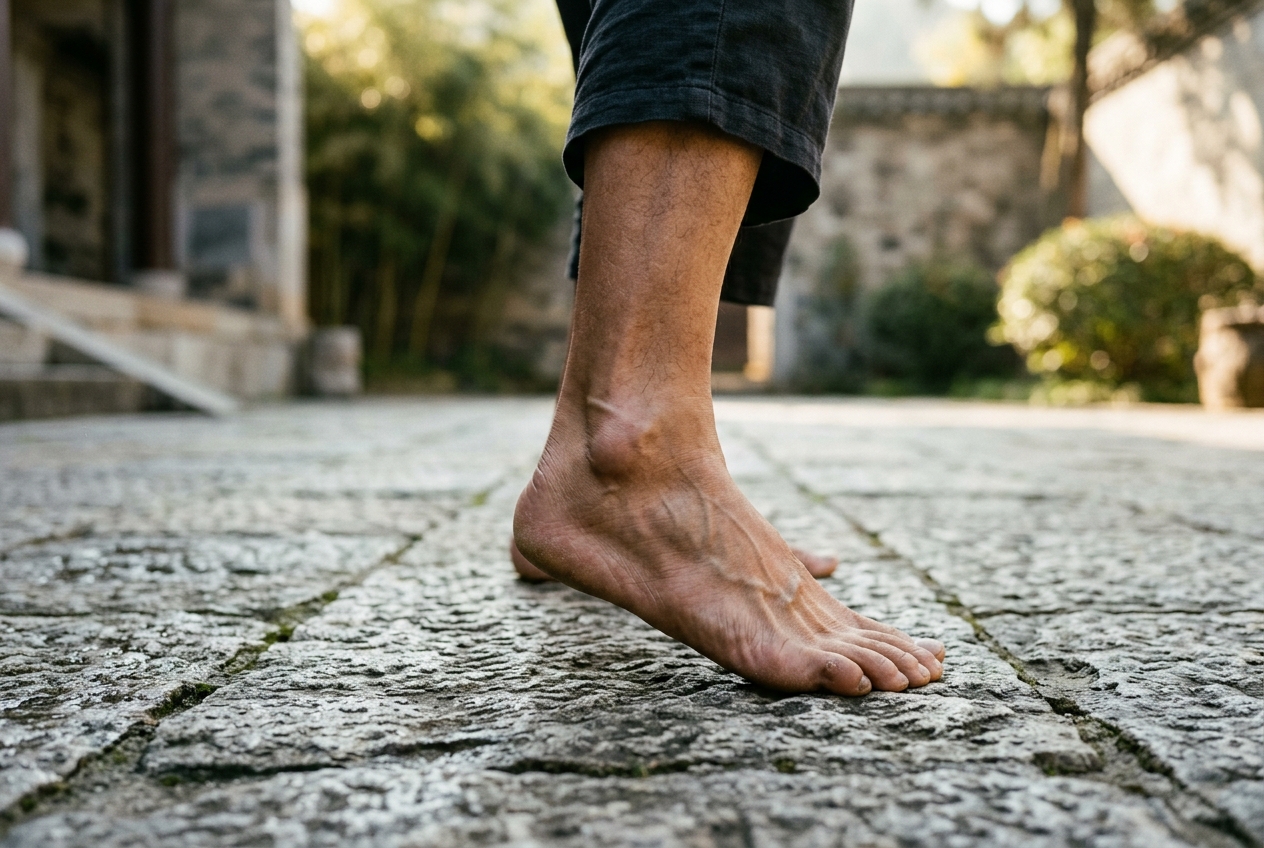
                  MEDIAL ANKLE ARCHITECTURE (KI6)
                  ================================

[ Tibia / Lower Leg ]
                                |
                    ( Medial Malleolus )
                          /            \
  Flexor Retinaculum --->[ * ZHAOHAI * ]<--- [KI6 Depressive Cavity]
                         [    (KI6)    ]
                          \            /
                    [ Sustentaculum Tali ]
                                |
                     [ Calcaneus / Heel ]
                              /    \
                 (Plantar Fascia)  (Tripod Root)
In East Asian somatic medicine, this anatomical hollow is catalogued as Zhaohai (Kidney 6 or KI6), translated literally as the "Shining Sea" or "Luminous Sea." When modern individuals stand or walk with poor alignment, this hollow is crushed beneath the collapsing arch of the foot, pinching local blood vessels and dulling sensory feedback. When properly aligned through meditative standing (Zhan Zhuang), the inner ankle opens, creating physical space that allows fluid, muscular relaxation, and energetic circulation to rise smoothly through the inner leg, into the lower belly, and up through the throat.
STEP-BY-STEP PRACTICE GUIDE
This meditative standing exercise, derived from classical Neigong (internal skill training) and Daoyin (guiding and stretching), can be practiced in any quiet space without specialized equipment. Follow these sequential somatic adjustments to open the Zhaohai cavity and connect your lower body into a single, resilient kinetic spring.
================================================================================
                    SOMATIC ALIGNMENT AT A GLANCE
================================================================================
  1. FOUNDATION    : Calcaneal Tripod (Heel, 1st Metatarsal, 5th Metatarsal)
  2. INNER ANKLE   : Decompress Zhaohai (KI6) beneath Medial Malleolus
  3. KNEE & HIP    : Micro-flex Knees, Fold Inguinal Crease (Kua), Suspend Sacrum
  4. RESPIRATION   : 360-Degree Lower Abdominal Expansion (Dantian Respiration)
  5. VERTICAL AXIS : Suspend Crown (Baihui), Relax Shoulders, Tuck Chin
================================================================================
1. Establishing the Calcaneal Tripod
Begin by standing with your feet parallel, pointing directly forward rather than flared outward. Establish a balanced three-point contact on the bottom of each foot: * The center of your calcaneus (heel bone); * The broad base of your first metatarsal (the ball under your big toe); * The base of your fifth metatarsal (the ball under your little toe).
Ensure your weight is evenly distributed between the left and right foot (50/50) and balanced between your forefoot and heel (60% over the rear calcaneus, 40% over the forefoot metatarsals). Avoid curling your toes; allow them to spread wide and rest flat against the surface like soft roots penetrating deep soil according to standard principles documented by the National Qigong Association.
2. Sub-Malleolar Decompression (Opening Zhaohai)
With your tripod firmly anchored, direct your internal sensory awareness to the hollow beneath your medial malleolus. * Without lifting the ball of your big toe off the floor, gently spiral your knees outward by a millimeter. * Feel how this subtle spiral lifts the medial longitudinal arch of your foot and draws the ankle bone slightly upward and away from the heel bone. * Imagine a small pocket of air expanding inside the groove between your inner ankle bone and your heel. This physical expansion releases the flexor retinaculum, creating an open conduit for blood, nerve signaling, and bioenergetic flow.
3. Pelvic Sinking and Lower Belly Breathing
Allow your hips to sit back slightly by creasing the front of your hips at the inguinal folds (Kua). * Let your tailbone drop vertically toward the space between your heels, flattening the excessive arch in your lower back. * Inhale smoothly through your nose for a count of four, directing the breath downward into your lower belly—about two inches beneath your navel, an area known in traditional somatic arts as the Dantian. * Feel the lower abdominal wall, the lower back, and the pelvic floor gently expand in a 360-degree circumference on inhalation. * As you exhale for a count of six, visualize the physical tone in your chest and shoulders melting downward through your thighs, calves, and ankles, dropping deep into the earth.
4. The Ascending Siphon and Crown Suspension
Gently lift the crown of your head (Baihui) as though suspended from above by a delicate silk thread, while tucking your chin by a fraction of an inch to elongate the back of your neck. * On every inhalation, feel a light, buoyant suction rising from the center of the sole (Yongquan, KI1) through the decompressed Zhaohai (KI6) cavity, up the medial seam of your legs, and collecting in the lower belly. * On every exhalation, feel the heavy physical weight of your body anchoring through the calcaneus into the ground, while your spine remains elongated, buoyant, and free of compression. * Maintain this static posture for 5 to 15 minutes, breathing in unbroken, silent rhythms.
                    ENERGY & FORCE VECTOR DIAGRAM
                    =============================

( Crown / Baihui - Suspended Upward )
                                        ^
                                        |
                          [ Cervical Inlet & Throat ]
                                        ^
                                        |  (Fluid & Yin Qi Siphon)
                                        |
                            [ Lower Belly / Dantian ]
                                        ^
                                        |
                                [ Pelvic Floor ]
                                   /         \
                             [ Medial Kinetic Seam ]
                                 /             \
                   [ Decompressed KI6 ]   [ Decompressed KI6 ]
                           /                         \
            [ Ground Root / Tripod ]         [ Ground Root / Tripod ]
Beginner Mistakes and Corrections
| Common Mistake | Somatic Symptom | Biomechanical Correction |
|---|---|---|
| Medial Arch Collapse | Inner ankle rolls inward; tenderness in the medial knee; pinched sub-malleolar space. | Press the base of the big toe firmly into the floor while simultaneously rotating the knee caps outward by a millimeter to elevate the arch. |
| Toe Clenching (Gripping) | Toes curl white; severe tension in plantar fascia; rigid calves. | Lift all ten toes off the floor, spread them wide like a fan, and place them down smoothly without gripping. |
| Knee Hyperextension | Joint capsules locked backward; lumbar spine over-arched; breath stuck in high chest. | Unlock the knee joints with an intentional micro-bend; sink the weight into the center of the heel. |
| Pelvic Tucking (Posterior Tilt) | Flattened spine; tension across front hip flexors; restricted abdominal expansion. | Release the pelvis naturally downward without forcing the tailbone forward; fold gently at the inguinal crease (Kua). |
Somatic Sensations: Diagnostic Feedback
As you practice decompressing the Zhaohai cavity during standing meditation, observe the following somatic indicators: * Warmth and Micro-Pulsation: A distinct, spreading heat or tingling sensation in the inner ankle groove indicates the release of chronic tension around the posterior tibial artery and the restoration of microvascular perfusion. * Spontaneous Salivation: As documented in classical Neigong literature, decompressing Zhaohai activates the Yin Qiao Mai meridian vessel, which connects to the throat. A sweet, abundant pooling of saliva under the tongue indicates parasympathetic activation and fluid balance. * Rooted Heaviness with Upper Buoyancy: Feeling as if your feet are set in deep wet sand while your rib cage and head float effortlessly upward confirms the correct distribution of structural tension (Tensegrity).
WHY IT WORKS — THE BODY SCIENCE
Modern biomechanics and neurophysiology provide robust frameworks for understanding why decompressing this precise ankle region yields profound systemic benefits across the human organism, corroborating principles catalogued by the World Health Organization Traditional Medicine.
1. Somatotopy and Tarsal Tunnel Decompression
Anatomically, Zhaohai (KI6) is located directly inferior to the tip of the medial malleolus in the depression between the lower edge of the malleolar bone, the calcaneus, and the shelf-like bony projection of the calcaneus known as the sustentaculum tali. This precise anatomical locus is bounded externally by the thick fibrous band of the flexor retinaculum of the foot (the laciniate ligament), which forms the roof of the tarsal tunnel.
Running directly beneath this retinaculum are critical neurovascular structures: the tendon of the tibialis posterior, the flexor digitorum longus, the posterior tibial artery and vein, the tibial nerve, and the flexor hallucis longus. When an individual suffers from chronic foot pronation (flat arches), the medial malleolus drops inward and downward, shearing the flexor retinaculum and mechanically compressing the tarsal tunnel.
By actively decompressing this sub-malleolar space through the tripod rooting mechanics of Zhan zhuang standing meditation, the mechanical impingement on the posterior tibial nerve and microvasculature is relieved. This enhances peripheral blood perfusion and prevents localized ischemia.
2. The Deep Front Line Kinetic Chain
In the anatomical model of myofascial meridians developed by modern fascial researchers, the tissues surrounding Zhaohai form the essential anchor point for the Deep Front Line (DFL), a continuous web of deep investing fascia that stabilizes the human core. The pathway runs continuously through the body:
$$\text{Plantar Fascia / Tarsal Retinaculum} \longrightarrow \text{Tibialis Posterior} \longrightarrow \text{Popliteal Fascia} \longrightarrow \text{Adductor Hiatus} \longrightarrow \text{Pelvic Floor} \longrightarrow \text{Psoas Major} \longrightarrow \text{Crura of Diaphragm} \longrightarrow \text{Pericardium / Prevertebral Fascia} \longrightarrow \text{Longus Colli / Cranium}$$
When Zhaohai is opened and the medial arch is actively supported, tension is transmitted upward along the deep posterior compartment of the lower leg into the adductor group of the inner thigh. This tension stabilizes the pelvic floor (levator ani) without muscular gripping, providing a stable foundation for the respiratory diaphragm. This unbroken fascial continuum confirms the classical Chinese medical observation that opening the inner ankle directly influences fluid and breathing dynamics in the throat and thoracic cavity. Comprehensive reviews of connective tissue mechanics can be explored through the National Center for Biotechnology Information and ongoing research in myofascial kinetic chains.
3. Autonomic Regulation and Diaphragmatic Hydrodynamics
The dense connective tissue of the ankle joint and plantar fascia possesses one of the highest concentrations of mechanoreceptors (Ruffini endings, Pacinian corpuscles, and Golgi tendon organs) in the musculoskeletal system. When the calcaneal tripod is properly aligned, these mechanoreceptors transmit high-fidelity afferent signals through the spinocerebellar tracts to the central nervous system, reducing chronic postural tone in the spinal extensors.
Simultaneously, the slow, rhythmic intra-abdominal pressure changes generated during deep belly breathing create an internal visceral pump. During diaphragmatic descent, venous blood and interstitial fluid are drawn upward from the deep plantar veins and femoral vessels toward the inferior vena cava and thoracic duct. This hydrodynamic siphon reduces venous pooling in the lower limbs, stimulates cardiac baroreceptors, elevates heart rate variability (HRV), and triggers a swift shift toward parasympathetic nervous system dominance.
CLASSICAL LINEAGE & CONTEXT
The systematic cultivation of the inner ankle cavity belongs to a lineage of psychosomatic development stretching back over two millennia in Chinese civilization.
Historical Origins in Han and Jin Dynasties
The earliest physical records of grounding and breath regulation appear in the famous Daoyin Tu ("Guiding and Pulling Chart"), a silk manuscript recovered from the Mawangdui tombs in Hunan Province, dating to 168 BCE during the Western Han dynasty. In these ancient illustrations, practitioners are depicted performing postures with low stances and rooted heels to channel vital breath (Qi) from the earth into the vital organs.
The specific anatomical localization and clinical indications of Zhaohai were rigorously formalized during the Jin dynasty by the scholar-physician Huangfu Mi in his seminal medical treatise, the Zhen Jiu Jia Yi Jing ("The Systematic Classic of Acupuncture and Moxibustion," c. 282 CE). Huangfu Mi classified Zhaohai as a primary point on the Kidney Meridian of Foot-Shaoyin and documented its specific efficacy in treating throat constrictions, insomnia, lower abdominal masses, and biomechanical imbalances of the medial lower limb, as indexed across the List of acupuncture points.
The Eight Extraordinary Vessels and the Master-Couple Matrix
During the Song and Jin-Yuan medical renaissances (10th–13th centuries), medical theorists including Dou Hanqing systematized the theory of the Ba Mai Jiao Hui Xue—the Eight Confluent Points of the Extraordinary Meridians. Within this advanced energetic map: * Zhaohai (KI6) was recognized as the Master Point of the Yin Qiao Mai (the Yin Heel or Yin Motility Vessel). The Yin Qiao Mai originates precisely at the calcaneus, ascends the medial ankle directly through Zhaohai, tracks the inner thigh to the genitalia, traverses the abdomen and chest, passes the throat, and terminates at the inner eye corner (Jingming, BL1). * Zhaohai was classical paired in a master-couple matrix with Lieque (LU7, the master point of the Ren Mai or Conception Vessel).
================================================================================
              CLASSICAL ENERGETIC SYNERGY: THE KI6 - LU7 CIRCUIT
================================================================================
  [ Master Point: ZHAOHAI (KI6) ]  <=========>  [ Coupled Point: LIEQUE (LU7) ]
    * Governs Yin Qiao Mai (Yin Heel)             * Governs Ren Mai (Conception)
    * Source: Water (Kidney / Root)               * Source: Metal (Lung / Canopy)
    * Function: Anchors & Ascends Fluids          * Function: Descends Qi & Clears
  ------------------------------------------------------------------------------
  CLINICAL & SOMATIC SYNTHESIS:
  Together, this pair regulates the "Throat, Chest, and Diaphragm" (Yan Hou,
  Xiong, Ge). In Neigong internal alchemy, opening KI6 beneath the ankle draws
  cool Kidney Water upward to temper cardiac heat, while opening LU7 allows clear
  breath to descend, creating a self-renewing thermodynamic loop of vital fluids.
================================================================================
In the internal alchemy (Neidan) traditions of Mount Wudang and the Complete Reality (Quanzhen) school of Daoism, this physical and energetic conduit became known as the ascending pathway of the "Water Wheel" (Heche). By decompressing the inner heel in standing meditation, the practitioner prevents the dissipation of vital vitality, anchoring the body's physical root while allowing clear, refined energetic fluids (Jin Ye) to nourish the brain, eyes, and higher nervous system.
PRACTICE SUMMARY & BIOMECHANICAL EVIDENCE
- Primary Anatomical Target: Sub-malleolar space inferior to the medial malleolus, between the flexor retinaculum and the sustentaculum tali.
- Kinetic Function: Elevates the medial longitudinal arch, aligns the calcaneal tripod, and engages the Deep Front Line (DFL) myofascial chain.
- Autonomic Outcome: Relieves tarsal tunnel compression, enhances lower-limb venous return, and stimulates parasympathetic tone via diaphragmatic synchrony.
- Energetic Action: Opens the Yin Qiao Mai (Yin Heel Vessel) to ascend nourishing fluids to the throat, chest, and lower abdominal Dantian.
TODAY'S PRACTICE COMMITMENT
To translate this understanding from theoretical anatomy into direct somatic reality, commit to the following brief routine tomorrow morning before consuming caffeine or checking digital devices:
+------------------------------------------------------------------------------+
|                     MORNING 5-MINUTE ZHAOHAI PROTOCOL                        |
+------------------------------------------------------------------------------+
| [0:00 - 1:00] : Establish Calcaneal Tripod barefoot on a firm floor.         |
| [1:00 - 2:00] : Micro-spiral knees; palpate & decompress both Zhaohai spaces.|
| [2:00 - 4:00] : Perform 10 deep 360-degree lower belly breaths (Dantian).    |
| [4:00 - 5:00] : Stand in still suspension; observe throat moisture & warmth.|
+------------------------------------------------------------------------------+
Notice the state of your mental clarity, the stability of your lower back, and the ease of your breathing over the following hour. With consistent daily alignment of this single, half-inch cavity beneath your ankle bone, you establish an indestructible physical foundation that anchors the mind and revitalizes the whole living organism from the ground up.