Zhangmen Cavity Chapter Gate: Costal Margin Fascial Decompression, Visceral Zang Harmonization, and Lateral Core Kinetic Tensegrity in Classical Neigong
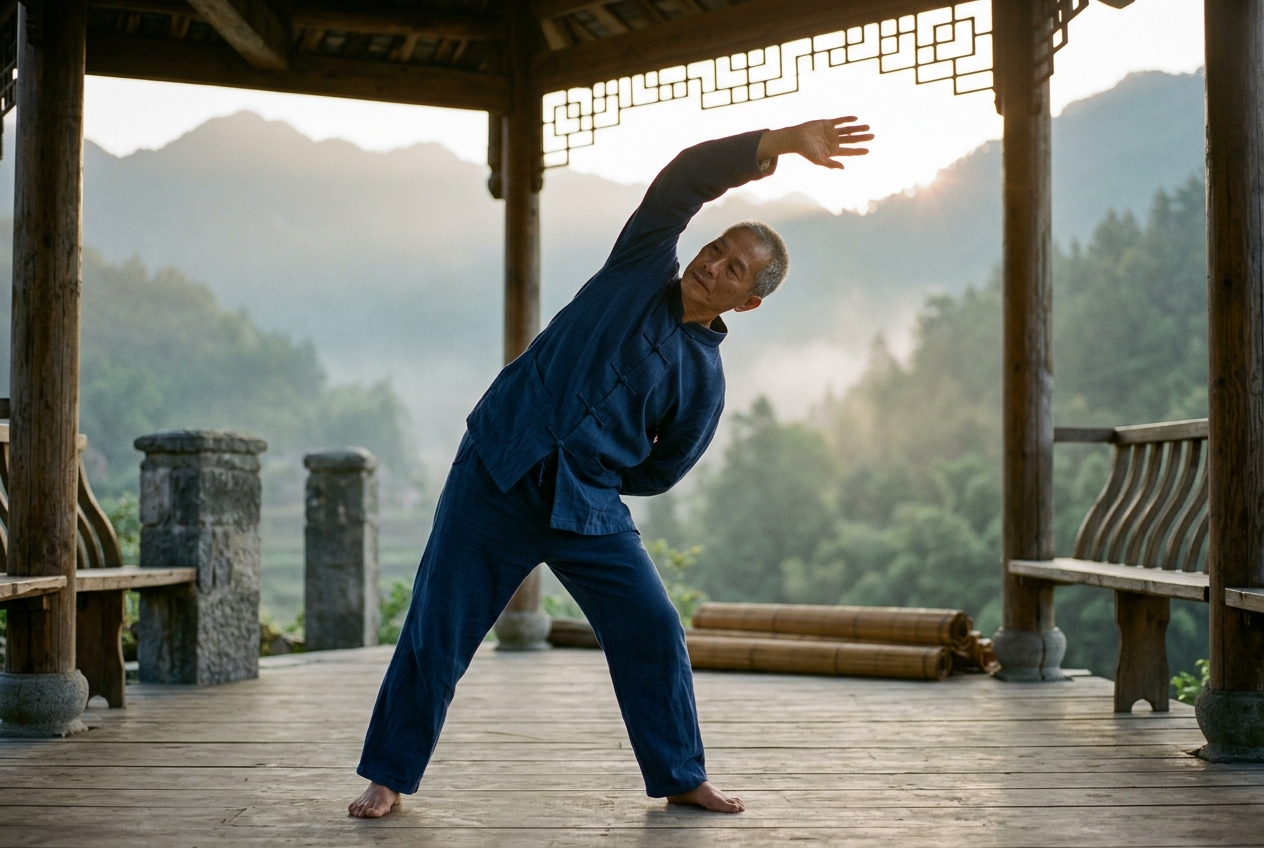
In everyday life, chronic mental stress and prolonged sedentary posturing force the human body into a defensive, contracted state. This chronic tension causes the lateral floating ribs to clamp tightly inward, compressing the respiratory diaphragm and choking off fluid circulation to the stomach, liver, and intestines. By applying specific standing postures (Zhan Zhuang), helical torso rotations, and lateral diaphragmatic breathwork, you systematically decompress this costal hinge. In traditional terms, opening this gate harmonizes the energetic dynamic between the Liver (Wood element) and the Spleen (Earth element), permitting vital vitality to cascade without impedance between your middle core (the solar plexus area) and your lower abdominal reservoir (Dantian, located approximately two inches below the navel).
Classical Etiology & Channel Energetics
Within the canonical taxonomy of East Asian medicine, few acupuncture cavities possess the structural and energetic authority conferred upon Zhangmen (LR13). Classical literature designates this point with three foundational energetic identities:
- The Hui-Meeting Point of the Five Zang Viscera (Wu Zang Hui, 五臟會): Formally codified in Chapter 45 of the Nan Jing (Classic of Difficulties), Zhangmen is identified as the singular energetic confluence governing all five solid yin organs: the Liver, Heart, Spleen, Lung, and Kidney. The classical text asserts: “The Zang viscera gather at the Chapter Gate.” Because the Zang organs are responsible for manufacturing, storing, and regulating pure essence (Jing) and vital energy (Qi), unlocking LR13 acts as a systemic regulator for whole-body visceral homeostasis.
- The Front-Mu (Alarm) Point of the Spleen (Pi Mu, 脾募): As delineated in Chapter 67 of the Nan Jing, Front-Mu cavities are specific sites on the ventral-lateral surface of the trunk where the energetic essence of a particular organ collects and manifests directly. As the Front-Mu point of the Spleen, Zhangmen serves as the diagnostic and therapeutic nexus for the body's digestive and transformative engine—governing the transmutation of food into nutritive essence (Gu Qi) and fluid metabolism.
- The Confluence of the Jueyin and Shaoyang Channels with the Dai Mai: Zhangmen represents a critical junction point where the Foot-Jueyin (Liver) meridian intersects with the Foot-Shaoyang (Gallbladder) meridian, while maintaining intimate anatomical and energetic ties to the Dai Mai (帶脈, Girdling Vessel). The Dai Mai is the sole horizontal channel in the human energetic anatomy, binding all vertical meridians like a sash around the waist.
+-----------------------------------------------------------------------------------+
|               CLASSICAL CORRESPONDENCES OF ZHANGMEN (LR13, 章門)                  |
+===================================================================================+
| Meridian System        | Foot Jueyin Liver Meridian (足厥陰肝經)                  |
+------------------------+----------------------------------------------------------+
| Point Classification   | Hui-Meeting Point of the 5 Zang; Spleen Front-Mu Point   |
+------------------------+----------------------------------------------------------+
| Channel Intersections  | Liver Meridian, Gallbladder Meridian, Dai Mai Vessel     |
+------------------------+----------------------------------------------------------+
| Five-Element Phase     | Wood-Earth Regulatory Axis (Liver Wood / Spleen Earth)   |
+------------------------+----------------------------------------------------------+
| Energetic Functions    | Deconstricts Liver Qi, Fortifies Spleen, Opens Dai Mai   |
+------------------------+----------------------------------------------------------+
In classical Daoist Neigong commentaries—most notably within the transmission lineages of internal alchemical treatises (Neidan)—the "Chapter Gate" derives its name from its function as a portal marking the end of one cycle and the beginning of another, analogous to the closing and opening of chapters in a book. When an individual experiences psycho-emotional distress, Liver Qi becomes constrained (Gan Qi Yu Jie). Under Five-Phase dynamics, hyperactive Wood energy overacts upon Earth (Mu Ke Tu), resulting in digestive collapse, abdominal distension, hypochondriac pain, and emotional irritability.
Opening the Chapter Gate clears this hypochondriac stagnation. It establishes a fluid bio-mechanical conduit between the Middle Dantian (governing digestion, respiration, and post-natal vitality) and the Lower Dantian (governing pre-natal essence and structural stability), allowing unified energetic oscillation across the entire axial skeleton, as cataloged in standard references for Acupuncture Points.
Applied Functional Anatomy & Myofascial Biomechanics
To appreciate the somatic power of Zhangmen, one must examine its exact anatomical localization and the rich myofascial matrix underlying its surface topography:
Topographical Localization
Zhangmen is positioned on the lateral aspect of the abdomen, directly at the inferior border of the free extremity of the eleventh rib (costa fluctuans XI). In a standard clinical or somatic examination, locating this point involves dropping the practitioner's or subject's elbow down to the flank while the arm is adducted against the torso; the tip of the olecranon process frequently points toward or rests directly over the eleventh costal tip.
The Myofascial Tensegrity System
Directly beneath the dermal and subcutaneous layers of LR13 lies a complex, multi-laminar intersection of muscular and fascial structures: * The Abdominal Muscular Trilaminar Sheet: The site is governed by the overlapping fibers of the external abdominal oblique (traveling inferomedially), the internal abdominal oblique (traveling superomedially), and the deepest layer, the transversus abdominis (traveling horizontally). * The Lateral Raphe of the Thoracolumbar Fascia (TLF): The transversus abdominis and internal oblique fuse laterally into the middle and anterior lamellae of the thoracolumbar fascia. This fascial junction anchors directly into the lateral borders of the quadratus lumborum and the transverse processes of the lumbar spine. * The Intercostal Muscular Webbing: The external and internal intercostal muscles of the tenth and eleventh intercostal spaces interlace directly with the superior slips of the abdominal obliques, creating a continuous kinetic suspension system for the lateral ribcage.
Neurovascular Pathway
The neuro-anatomical matrix of Zhangmen is innervated primarily by the tenth and eleventh intercostal nerves, alongside the subcostal nerve (ventral ramus of T12). These lower thoracic spinal nerves provide motor innervation to the anterolateral abdominal wall and cutaneous sensory branches to the hypochondriac region. Deep to the muscular plane lies the terminal distribution of the eleventh intercostal artery and vein, connecting with the subcostal vessels and branches of the superior and inferior epigastric arterial systems.
Pathomechanics of Hypochondriac Constriction
Under sustained psychosocial stress or postural collapse (such as habitual slumped sitting), the human sympathetic nervous system triggers continuous protective hypertonicity in the quadratus lumborum, external obliques, and psoas major. This muscular contraction pulls the eleventh floating rib inferiorly and medially, effectively locking the costal margin.
This costal lock produces three severe biomechanical impairments: 1. Diaphragmatic Impingement: The lateral crus and peripheral muscular fibers of the respiratory diaphragm become tethered, preventing normal eccentric expansion during inhalation. 2. Mesenteric and Lymphatic Stasis: The rhythmic mechanical pumping of the liver, spleen, stomach, and splenic flexure of the colon is abolished. This reduces fluid return through the portal vein and stalls upward lymphatic propulsion toward the cisterna chyli and thoracic duct. 3. Fascial Adhesion: The continuous fascial sheets of the lateral kinetic chain lose their glide plane, cementing poor thoracic rotation and shearing the lumbar vertebrae during lateral movements.
Neigong Cultivation & Kinetic Transmission
In the rigorous physical disciplines of internal martial arts (Neijiaquan—including Taijiquan, Baguazhang, and Xingyiquan) and meditative Daoyin, the release of the hypochondriac margin represents an absolute prerequisite for authentic internal power (Neijin).
Sinking the Chest (Han Xiong) and Relaxing the Waist (Song Yao)
Two foundational aphorisms govern internal biomechanics: Han Xiong Ba Bei (含胸拔背, "Sink the chest and pluck up the back") and Song Yao Luo Kua (鬆腰落胯, "Relax the waist and settle the hips"). When an untrained practitioner attempts to stand upright, they routinely flare the anterior lower ribcage, hyperextending the thoracolumbar junction (T12–L1) and compressing Zhangmen into the posterior back musculature.
By gently hollowing or sinking the sternum inward without collapsing the thoracic cage, the anterior ribs soften downward. Concurrently, releasing the lordotic tension of the lumbar spine (Song Yao) allows the sacrum to drop naturally. This dual action releases the pincer-like grip on the eleventh rib, allowing the Zhangmen cavity to blossom open laterally, creating what classical masters described as "wrapping the ribs" (Guo Xie).
The Spiral Myofascial Sling and Kua Force Transmission
Human rotational motion does not occur along isolated planar axes; it is transmitted diagonally across the body through the anatomical Spiral Line and the Anterior Functional Sling (connecting the pectoralis major, rectus abdominis, contralateral external oblique, internal oblique, and the adductor musculature of the opposite thigh).
When Zhangmen is compressed, this spiral line suffers a functional break at the eleventh rib; rotational shear forces cannot transfer through the soft tissue, forcing the lumbar facet joints to absorb dangerous torsional loads. Conversely, when Zhangmen is mobilized and structurally suspended: * Rotational torque generated by the feet against the earth is captured at the inguinal crease (Kua, 胯). * The torque spirals through the relaxed internal and external obliques at the level of LR13. * The open Chapter Gate acts as a low-friction biomechanical universal joint, transferring kinetic force directly into the latissimus dorsi, serratus anterior, and out through the upper extremities without structural dissipation.
Step-by-Step Daoyin Practice
The following sequence—termed Opening the Chapter Gate to Harmonize Earth and Wood—provides an exacting, repeatable protocol for decompressing LR13, mobilizing the floating ribs, and restoring lateral diaphragmatic compliance. Practice this sequence in a quiet environment free from draft or distraction.
Phase 1: Stance Setup & Somatosensory Localization
- Stand with your feet parallel, precisely hip-width to shoulder-width apart. Distribute your weight evenly across the tripod of each foot (the base of the big toe, the base of the little toe, and the center of the calcaneus), allowing the Yongquan (KI1) cavity at the sole to feel open and receptive.
- Soften your knees by three to five degrees, ensuring they track directly over your second toes.
- Release your pelvis into a neutral tilt by releasing muscular tension in the gluteal fold, allowing the coccyx to hang downward like a plumb line.
- Elevate the vertex of your head (Baihui, GV20) as if lightly suspended from a silk thread, tucking the chin slightly to lengthen the suboccipital region.
- Bring your index and middle fingers to the tip of your eleventh ribs on both flanks. Apply a light, static pressure of approximately 100 to 200 grams. Close your eyes, direct your mental focus (Yi) to the points of contact, and internally visualize the space beneath your fingertips softening from dense stone into warm, pliable wax.
Phase 2: Lateral Costal Diaphragmatic Awakening
- Inhale slowly through your nose over a count of four to five seconds.
- Instead of allowing your breath to push your anterior chest or upper abdomen outward, consciously steer the volume of the incoming air laterally and posteriorly into your fingertips resting on Zhangmen.
- Feel the eleventh and twelfth floating ribs physically expand outward to the left and right like the gills of a fish or the opening of a hand fan.
- Pause at the top of the inhalation for two seconds without closing your glottis; maintain a soft, open throat (open throat retention), observing the elastic fascial pre-stretch at the hypochondrium.
- Exhale smoothly through your nose over a count of six to eight seconds. As the air leaves your body, feel the eleventh ribs gently recoil inward and slightly downward toward your spine. Simultaneously, consciously soften the tissues of your liver on the right and your spleen on the left.
- Execute 12 complete, uninterrupted breath cycles.
Phase 3: Helical Torso Unwinding ("Coiling Dragon Opens the Gate")
- From the stable Wuji foundation, release your hands from your flanks and let the arms float upward to chest height, forming an open, rounded circle as if lightly embracing the trunk of a broad tree (Cheng Bao Zhuang).
- Begin a slow, grounded weight shift: transfer 70 percent of your body weight into your right foot, allowing your right inguinal fold (Kua) to sink and fold inward.
- As the right hip settles, initiate a gentle spiral rotation of your torso to the right (maximum 30 to 45 degrees). Crucially, ensure that your knees remain completely stationary and do not twist; the rotational movement must originate from the pelvic Kua and transfer through the thoracic spine.
- As your torso turns right, draw your left elbow slightly forward and outward while allowing your right elbow to draw slightly backward. This helical counter-pull creates an intentional, long-axis eccentric stretch across your left flank, completely opening and decompressing the left Zhangmen point.
- Inhale deeply into the expanded left Zhangmen cavity, directing your somatic awareness (Yi Dao Qi Dao, 意到氣到—"where the intent goes, the Qi follows") directly into the opened costal tip.
- Exhale, release the spiral rotation, and return to center, allowing both flanks to balance.
- Repeat the sequence symmetrically on the opposite side: shift 70 percent weight to your left foot, sink the left Kua, spiral the torso 30 to 45 degrees to the left, and expand the right Zhangmen cavity with a profound, lateral costal inhalation.
- Perform 9 repetitions per side (18 total rotations), maintaining continuous, slow, fluid velocity.
Phase 4: Integration and Lower Dantian Settling
- Return to the bilateral, neutral Wuji stance.
- Slowly lower your hands, placing both palms flat over your Lower Dantian (left palm over right for men; right palm over left for women), situated two inches below the umbilicus.
- Allow the respiratory cycle to return to natural, unforced abdominal breathing.
- Visualize the vibrant, deconstricted energetic current generated at both hypochondriac flanks gathering like luminous mist, descending through the lateral abdomen along the course of the Dai Mai, and condensing into a warm, concentrated point of vital potential deep within the pelvic core.
- Remain motionless in this state for three to five minutes, absorbing the somatic changes.
Somatosensory Roadmap & Diagnostic Self-Checks
As you cultivate this practice, look for distinct physiological milestones that signal authentic structural and energetic decompression: * The Sensation of Lateral Warmth and Tingling: A spreading warmth across the hypochondrium indicates the re-establishment of microvascular perfusion and the relief of chronic sympathetic vasoconstriction. * Acoustic Digestive Feedback (Borborygmi): Spontaneous stomach gurgling and rumbling sounds indicate activation of the parasympathetic nervous system, inducing peristalsis in the stomach, duodenum, and colon. * The Costal Spring Diagnostic Check: When palpating the eleventh rib tip pre-practice, the bone feels rigid, tender, and resistant to mobilization. Following successful practice, gentle inward pressure on the eleventh rib reveals a supple, spring-like elastic recoil (costal compliance) with a significant reduction in localized tenderness.
Neurophysiological & Autonomic Correlations
Modern medical physiology and neurobiology provide rigorous explanatory frameworks that illuminate the mechanisms behind classical Daoist Neigong:
Somato-Visceral Reflex Arcs via T10–T11
The somatic sensory nerves supplying the skin, fascia, and muscles around the eleventh rib are derived from the anterior rami of the T10 and T11 spinal nerves. These same spinal segments house the sympathetic preganglionic neurons that project to the celiac ganglion and the superior mesenteric ganglion via the greater and lesser splanchnic nerves.
Under habitual physical compression or mental anxiety, persistent afferent nociceptive input from hypertonic hypochondriac muscles enters the dorsal horn of the T10–T11 spinal segments. This creates a chronic reflex arc that maintains sympathetic overdrive to the stomach, liver, gallbladder, and pancreas. By releasing the myofascial tension at Zhangmen through targeted Daoyin, this aberrant somatic reflex is silenced, terminating the sympathetic constriction of the abdominal viscera. Clinical research hosted by the NCBI PubMed Database confirms that targeted somato-autonomic reflex stimulation produces measurable alterations in splanchnic blood perfusion.
Vagal Tone Modulation and Heart Rate Variability (HRV)
The respiratory diaphragm is pierced by the esophagus, through which the anterior and posterior trunks of the vagus nerve (Cranial Nerve X) travel to innervate the abdominal organs. When the lateral diaphragmatic crura are locked by rib compression, the natural rhythmic mechanical stretching of these subdiaphragmatic vagal fibers is significantly inhibited.
Lateral costal respiration directly restores full excursions to the diaphragm. This deep mechanical movement stimulates mechanosensitive vagal afferents, sending inhibitory signals to the nucleus tractus solitarii (NTS) in the brainstem. The systemic outcome is a rapid up-regulation of parasympathetic tone, marked by a rise in high-frequency Heart Rate Variability (HRV), a reduction in systemic arterial blood pressure, and a downregulation of circulating cortisol and pro-inflammatory cytokines.
Enteric Stimulation and Splanchnic Hemodynamics
Beneath the right Zhangmen cavity lies the right lobe of the liver and the hepatic flexure of the colon; beneath the left Zhangmen lies the spleen, stomach fundus, and splenic flexure of the colon.
The alternating compression and decompression created during the helical Daoyin sequence exerts a dynamic physical pumping action on these encapsulated organs. This mechanical displacement: 1. Decompresses the hepatic sinusoidal beds, accelerating the clearance of metabolic byproducts through the hepatic vein. 2. Stimulates the myenteric (Auerbach's) plexus and submucosal (Meissner's) plexus of the enteric nervous system, restoring healthy gastrointestinal motility. 3. Compresses and releases the cisterna chyli (the primary lymphatic reservoir situated at the L1–L2 level anterior to the vertebral bodies), accelerating the passive return of intestinal lymph and dietary lipids into the systemic venous circulation via the thoracic duct.
Classical Lineage & Historical Context
The systematic cultivation of the hypochondriac region and the specific recognition of Zhangmen as an internal crossroad possesses a lineage stretching back over two millennia in Chinese medical and alchemical history:
Canonical Medical Treatises
- Huangdi Neijing (The Yellow Emperor’s Classic of Internal Medicine, c. 200 BCE): In both the Suwen and Lingshu, the hypochondriac and costal regions (Xie Tong) are identified as the primary zones where emotional stagnation directly impairs physical function. The texts repeatedly warn that when the Liver is diseased, the patient suffers acute fullness beneath the ribs.
- The Nan Jing (Classic of Difficulties, c. 100 CE): Chapters 45 and 67 cemented Zhangmen’s place in medical history by identifying it as the Hui-Meeting point of the Five Zang and the Front-Mu of the Spleen, establishing the structural framework used in clinical acupuncture worldwide, as documented by the World Health Organization Traditional Medicine Strategy.
- Zhenjiu Jia Yi Jing (The Systematic Classic of Acupuncture and Moxibustion, 282 CE): Authored by the Jin Dynasty scholar Huangfu Mi, this text provided the first standardized topographical location of LR13 relative to the eleventh rib, recommending its needle puncture and moxibustion for severe abdominal fullness, epigastric masses (Ji Ju), and extreme lethargy.
- Sun Simiao’s Qianjin Yaofang (Essential Prescriptions Worth a Thousand Gold Pieces, 652 CE): The renowned Tang Dynasty Daoist physician Sun Simiao integrated physical Daoyin exercises with the stimulation of Zhangmen, prescribing specific lateral rotational movements to treat metabolic wasting and digestive stagnation.
- Yang Jizhou’s Zhenjiu Dacheng (The Great Compendium of Acupuncture and Moxibustion, 1601 CE): Published during the late Ming Dynasty, this work compiled classical clinical formulas, celebrating Zhangmen as the ultimate point of harmonizing the Middle Burner (Zhong Jiao) and treating emotional distress that disrupts digestion.
The Daoist Alchemical and Martial Transmission
Beyond institutional clinical medicine, the release of Zhangmen was preserved within the esoteric traditions of Daoist Internal Alchemy (Neidan), particularly within the Quanzhen Longmen (Dragon Gate) tradition. In alchemical physiology, the practitioner must weave together the Pre-Heaven Essence (Xian Tian Qi) stored in the Kidneys with the Post-Heaven Vitality (Hou Tian Qi) generated by the Spleen and Stomach.
Because the Dai Mai passes directly through the lateral flanks at LR13, any constriction at this gate was seen as a barrier that bifurcated the human body, trapping fire in the upper chest and leaving cold in the lower abdomen. Opening the Chapter Gate restored the harmonious circulation of the Water-Fire axis (Kan-Li).
This understanding passed directly into the 18th- and 19th-century internal martial traditions of Wudang, Chen-style Taijiquan, and Dong Haichuan’s Baguazhang. In Baguazhang, the fundamental practice of "Turning the Torso while Walking the Circle" (Zhuan Zhang) relies on holding the lateral costal margin open while coiling the waist into the center of the circle. This motion constantly wrings, stretches, and pumps the Zhangmen cavity, transforming the practitioner's torso into an elastic, bio-mechanical spring. Modern instructional standards for these movements are curated by bodies such as the National Qigong Association.
Today's Practice Commitment
To translate this classical theory and structural biomechanics into tangible, somatic reality, commit to the following structured protocol tomorrow morning:
- When: Tomorrow morning, immediately after waking and before your first cup of coffee or tea.
- Step 1: Somatic Check-In (1 Minute): Stand in neutral alignment. Place your fingertips on the tips of your eleventh ribs at LR13. Inhale three times, noting any costal stiffness, tenderness, or lack of lateral excursion.
- Step 2: Lateral Rib Expansion Breathing (2 Minutes / 12 Breaths): Breathe deeply into your fingertips at your flanks. Expand the floating ribs laterally like a hand fan, holding for two seconds with an open throat, and exhale slowly while relaxing your liver and spleen.
- Step 3: Helical Torso Unwinding (3 Minutes / 12 Rotations): Assume the rounded arm posture (Cheng Bao Zhuang). Sink 70% of your weight into one Kua, gently spiral your torso 30 to 45 degrees, and inhale into the opened, stretched flank. Alternate smoothly between left and right sides.
- Step 4: Lower Dantian Integration (1 Minute): Rest both palms over your lower belly, close your eyes, and allow your breath to settle naturally, observing the sensations of spreading warmth, acoustic digestive activity, and clear mental focus.
Self-Reflection: Throughout the morning, observe your posture, breath depth, and emotional equilibrium. Notice whether releasing the Chapter Gate alters how you manage stress and hold your physical core.
Summary of Somatic and Clinical Discoveries
By consciously understanding, locating, and releasing the Zhangmen cavity, you bridge classical Daoist Neigong with cutting-edge functional anatomy. You reclaim the innate resilience of your respiratory diaphragm, release accumulated emotional tension across the Wood-Earth axis, and open the somatic gateway to deep, unified physical vitality. Further research on the underlying fascial mechanisms is available through the National Center for Biotechnology Information PMC.