Yuan Dang Rounding the Crotch: Pelvic Arch Tensegrity, Adductor Elastic Recoil, and Lower-Limb Kinetic Rooting in Classical Neigong
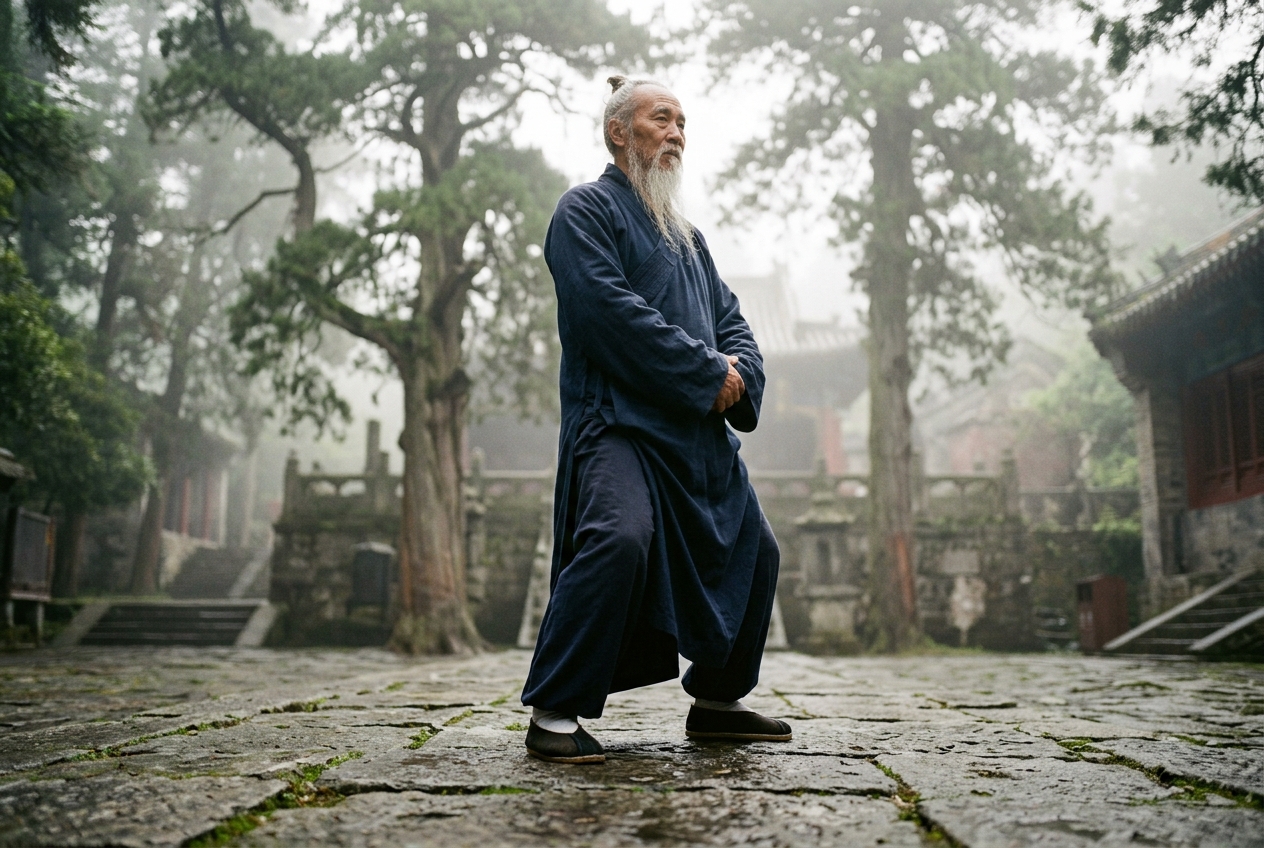
Within traditional movement systems such as Qigong and classical internal martial arts (Neijiaquan), this physical shape is considered indispensable for cultivating Song Kua (relaxing the inguinal folds) and regulating the perineal gate (Huiyin). Only when the crotch is vaulted into a round parabola can the body cultivate Dang Jin (crotch force)—an elastic, torsional spring power that roots the practitioner into the earth while preserving total freedom of mobility in the upper torso.
                  PARABOLIC PELVIC ARCH (YUAN DANG)

                         [ Sacral Keystone ]
                        /                   \
               [ Acetabulum ]           [ Acetabulum ]
                  /                               \
             (Femur)                             (Femur)
                /   <--- Eccentric Adductor --->   \
               /              Tension               \
          [ Patella ]                           [ Patella ]
              |                                     |
           (Tibia)                               (Tibia)
              |                                     |
      [ Plantar Vault ]                     [ Plantar Vault ]
       (Yongquan KD-1)                       (Yongquan KD-1)
The Biomechanical Architecture: Ground Force Vectors and the Parabolic Vault
To understand why classical masters insisted that the pelvic arch must be round rather than angular, one must examine the laws of structural engineering and lower-extremity biomechanics. In architectural engineering, a parabolic arch distributes vertical compressive loads outward and downward along its curves, resolving destructive shearing forces into pure axial compression that transfers seamlessly into the foundations.
When applied to human somatic anatomy, the apex or keystone of this living arch is formed by the sacrum and the pubic symphysis. The two descending curved arms of the arch correspond to the femoral shafts angling outward through the coxofemoral (hip) joints, continuing down across the bicondylar plateaus of the knees, traveling through the tibiae, and terminating at the bilateral medial longitudinal arches of the feet.
================================================================================
                    BIOMECHANICAL ARCHITECTURE COMPARISON
================================================================================
Feature               Jia Dang (Clamped)     Kua Dang (Collapsed)   Yuan Dang (Vaulted)
--------------------------------------------------------------------------------
Knee Vector           Dynamic Valgus         Excessive Varus        Neutral Plumline
Adductor Status       Concentric Spasm       Overstretched/Slack    Eccentric Preload
Pelvic Diaphragm      Hyper-constricted      Atonic / Sagging       Dynamic Tensegrity
Inguinal Folds (Kua)  Pinched/Locked         Over-splayed/Rigid     Song (Hydrated/Free)
Ground Force Trans.   Fragmented / Shearing  Broken at Pelvis       Unified Kinetic Wave
================================================================================
1. Prevention of Dynamic Knee Valgus Collapse
The primary structural vulnerability in both athletic training and meditative standing is knee valgus—a dysfunctional alignment where the knees collapse medially toward the midline under gravitational load. Dynamic knee valgus exerts severe shearing forces on the anterior cruciate ligament (ACL) and compresses the lateral meniscus while overstretching the medial collateral ligament.
Yuan Dang completely eliminates this mechanical failure mode. By demanding that the apex of the knees track directly above the second and third metatarsals while the hip joints sink, the femur undergoes an external rotational vector that counteracts medial collapse. A clinical analysis published in NCBI PubMed on Taiji biomechanics and ground reaction forces confirms that maintaining balanced lower-extremity joint moments dramatically reduces lateral shear strain across the knee joint while optimizing axial load transmission.
2. Eccentric Preload of the Medial Adductor Chain
In an uncultivated stance, the adductor group—adductor longus, adductor brevis, adductor magnus, pectineus, and gracilis—tends to react in one of two dysfunctional extremes: chronic concentric contraction (pulling the knees together) or passive structural slackening.
Rounding the crotch places the entire adductor muscle group under a state of responsive eccentric tension. As the femoral heads externally rotate and the knees expand laterally, the adductors are lengthened across their origin at the pubic ramus to their insertions along the linea aspera of the femur. This eccentric preload acts precisely like an internal elastic bowstring. It prevents the legs from splaying uncontrollably while simultaneously generating a sustained inward-drawing kinetic tone that stabilizes the entire pelvic ring without muscular gripping.
3. Tri-Planar Ground Reaction Force Resolution
When an external force strikes the human frame or when gravity acts upon the mass of the torso, that force must be absorbed and grounded. In a collapsed or squared pelvic stance, kinetic energy halts abruptly at the hip sockets, causing compressive pinching in the acetabular labrum.
Through the geometry of Yuan Dang, the descending kinetic vector splits symmetrically at the sacrum, travels down the spiral fascial pathways of the legs, and sinks through the tripod of the foot: the calcaneus (heel), the first metatarsal head, and the fifth metatarsal head. This tripartite foot placement activates the medial plantar vault, aligning directly with the acupuncture point Yongquan (涌泉, Kidney-1). The plantar vault acts as the bottom abutment of the arch, rebounding ground reaction force (GRF) back up the skeletal framework as an effortless upward buoyancy.
Tensegrity, Fascia, and Energetic Reciprocity
The physical geometry of the parabolic arch is merely the mechanical scaffolding for a deeper physiological and bioenergetic phenomenon. Within contemporary myofascial science, the body is recognized not as a stack of compressive bones like bricks, but as a continuous Tensegrity structure—a network of rigid compression struts (bones) suspended within a continuous sea of dynamic tension elements (muscles and fascia).
================================================================================
                     MYOFASCIAL & ENERGETIC INTERPLAY
================================================================================
Anatomical Layer         Classical Neigong Concept        Physiological Function
--------------------------------------------------------------------------------
Deep Front Line (DFL)    Yin Qiao Mai (阴跷脉)            Stabilizes inner leg line,
                                                          lifts medial arch & pelvic floor.
Levator Ani / Diaphragm  Huiyin Gate (会阴 / CV-1)        Regulates intra-abdominal pressure
                                                          and energetic seal.
Femoral-Acetabular Gap   Song Kua (松胯)                  Unweights hip capsule, allows
                                                          unhindered femoral articulation.
Anterior Core Line       Ren Mai (Conception Vessel)      Permits downward sinking of breath
                                                          and parasympathetic calm.
================================================================================
The Synergy of Song Kua (Releasing the Inguinal Folds)
One cannot achieve Yuan Dang without Song Kua (松胯). The Kua refers to the inguinal crease, the pelvic basin, and the surrounding coxofemoral musculature (including the iliopsoas, piriformis, and obturator complexes). If the Kua is rigid, the hips cannot sink; if the hips cannot sink, the crotch becomes an unyielding triangle rather than a flexible arch.
When the practitioner releases the tension across the inguinal folds, the pelvis settles downward as if sitting lightly upon a high barstool. This creates a functional decompression within the hip sockets. As detailed in biomedical research on fascial tensegrity and pelvic floor kinematics on NCBI PubMed, releasing the anterior hip flexors allows the pelvis to align in neutral equilibrium, permitting the pelvic diaphragm to expand laterally and horizontally rather than becoming pinched in anterior tilt.
Huiyin and the Dynamic Pelvic Diaphragm
At the lowest geographic center of this pelvic vault lies the perineum, known in Chinese medicine and Neigong as Huiyin (会阴, Conception Vessel 1)—the "Meeting of Yin." The state of the pelvic floor muscles—specifically the levator ani (pubococcygeus, puborectalis, and iliococcygeus) and the coccygeus—is dictated entirely by the curvature of the crotch:
- When the knees pinch inward (Jia Dang), the ischial tuberosities are pulled medially, creating hypertonic spasm in the pelvic floor and clamping Huiyin shut.
- When the stance is over-widened and flattened (Kua Dang), the pelvic floor is pulled taut and descends flaccidly, causing the energetic and physical base to leak vitality downward.
- When Yuan Dang is mastered, the ischial tuberosities maintain an optimal, living distance. The pelvic floor assumes a natural, domed dome-like recoil, acting in harmonic reciprocity with the thoracic respiratory diaphragm.
With every inhalation, the thoracic diaphragm descends, and the vaulted pelvic diaphragm receives the intra-abdominal pressure wave with elastic resilience; with every exhalation, both diaphragms lift in synchronized ascent.
Clearing the Meridian Pathways: Yin Qiao Mai and Ren Mai
From the perspective of traditional Chinese medicine recognized by organizations such as the National Qigong Association and documented within the World Health Organization Traditional Medicine Strategy, the mechanical openness of the pelvic arch directly governs the circulation of Qi through the Extraordinary Meridians.
The Yin Qiao Mai (Yin Motility Vessel) originates beneath the medial malleolus at Zhaohai (Kidney-6), ascends along the medial aspect of the lower leg and the inner adductor canal of the thigh, penetrates the perineal floor at Huiyin, and travels upward along the torso to the throat and inner eye canthus. If the crotch is angular or compressed, this meridian pathway is mechanically constricted, causing energetic stagnation, sluggish lymphatic clearance in the groin, and heavy, cold legs.
By maintaining a continuous, open parabolic curve through Yuan Dang, the Yin Qiao Mai remains uninhibited, drawing cool, grounding Earth Qi upward into the lower Dantian (the body's physical center of mass). Simultaneously, the Ren Mai (Conception Vessel), running along the anterior midline from Huiyin up to the lower lip, relaxes completely, allowing excessive chest tension and ungrounded emotional stress to sink effortlessly back into the lower abdomen.
Step-by-Step Somatic Protocol
Cultivating Yuan Dang requires progressive, mindful somatic calibration. Perform this practice within the foundational standing meditation posture known as Zhan Zhuang (Standing Like a Post).
================================================================================
                       STEP-BY-STEP SOMATIC PROTOCOL
================================================================================
Phase     Key Action                   Primary Interoceptive Anchor
--------------------------------------------------------------------------------
Phase 1   Stance & Tripod Grounding    Equal pressure on heel, 1st & 5th metatarsals;
                                       hollow center at Yongquan (KD-1).
Phase 2   Tibial Torque & Spiral       Outward outward spiral of thighs;
                                       knees plumb with 2nd/3rd toes.
Phase 3   Song Kua & Sacral Settling   Sacrum drops like a weighted plumb-line;
                                       inguinal creases soften and hollow.
Phase 4   Pelvic Vault Activation      Perineum (Huiyin) floats buoyantly;
                                       adductors engage in broad, spacious embrace.
Phase 5   Dynamic Stepping Transition  Weight shifts without collapsing the arch;
                                       empty foot glides without hip swaying.
================================================================================
Phase 1: Establishing the Stance Width and Foot Base
- Stand with your feet parallel, separated by a distance roughly 1.5 times the width of your shoulders (measured from the outer edges of the acromion processes). Ensure the outer borders of your feet are aligned parallel to one another.
- Distribute your body weight evenly across the biological tripod of each foot: 60% of the pressure across the heel pad and 40% balanced between the base of the big toe and the base of the little toe.
- Consciously sense the center of the sole—Yongquan (KD-1)—relaxing and hollowing slightly upward, as if creating a subtle suction cup against the floor.
Phase 2: Generating the External Tibial and Femoral Torque
- Soften both knees, allowing them to bend forward slightly until they are vertically aligned over your shoelaces.
- Without moving your feet on the floor, generate a micro-spiral outward from your hips: gently screw your heels down into the floor while your knees expand outward laterally.
- Verify that your knee caps track strictly in the direction of your second and third toes. Under no circumstances should the knees drift inward toward the big toes or flare so wide that the inner soles of your feet lose contact with the earth.
Phase 3: Sinking the Kua and Dropping the Sacral Plumb-Line
- Place your index fingers into the deep diagonal creases of your groin (the inguinal folds).
- Draw your hip joints back by millimeters and soften the groin muscles until you feel your fingers sink into the folds. Imagine your pelvis is a heavy porcelain bowl settling directly onto a low horizontal stool.
- Relax the lumbar spine (Mingmen or "Gate of Life"), allowing the coccyx and sacrum to drop vertically toward the earth like a heavy iron plumb-line suspended from the crown of your head (Baihui).
Phase 4: Activating the Parabolic Vault
- Interoceptively visualize an inflated leather exercise ball resting comfortably between your inner thighs. Without squeezing the ball (which causes Jia Dang), expand the circumference of your thighs around it, maintaining a continuous, spherical perimeter from knee to knee across the perineum.
- Sense the perineal center (Huiyin) lifting upward with the lightness of an air bubble resting on water. The lower abdomen will immediately feel supported, spacious, and firm yet yielding (Dantian fullness).
Phase 5: Dynamic Stepping and Kinetic Transfer
- When transitioning from static standing to dynamic stepping (such as in Taiji or Baguazhang footwork), shift 100% of your mass onto the left leg while preserving the parabolic curve of that standing leg's hip and knee.
- Do not let the standing knee collapse inward as it accepts your body weight. Maintain the expansive curve of the crotch even as the right leg steps forward into an empty stance (Xu Bu). The pelvic arch remains unbroken throughout the transfer of weight.
Clinical Diagnostics: Identifying and Correcting Structural Deviations
Even advanced practitioners frequently fall into structural traps that compromise the pelvic arch. The two most prominent deviations documented in classical treatises are Jia Dang and Kua Dang.
================================================================================
                    STRUCTURAL DEVIATION TROUBLESHOOTING
================================================================================
Deviation: JIA DANG (Pinched / Clamped Crotch)
--------------------------------------------------------------------------------
• Somatic Symptom:      Knees knocking inward; inner thighs tight and hard;
                        pelvic floor clenched; breath trapped in upper chest.
• Mechanical Cause:     Dominance of concentric adductors; inactive gluteus
                        medius; weight collapsed onto medial foot arches.
• Corrective Protocol:  Place a light elastic resistance band around outer knees;
                        press gently outward into the band until knees track over
                        toes; mentally relax the inner groin folds.
--------------------------------------------------------------------------------
Deviation: KUA DANG (Collapsed / Sagging Crotch)
--------------------------------------------------------------------------------
• Somatic Symptom:      Knees splayed excessively wide; weight rolling onto
                        outer foot blades; pelvis hanging dead without spring;
                        lower back jammed in compression.
• Mechanical Cause:     Loss of eccentric adductor tone; failure to anchor the
                        tripod of the foot; pelvis dropped below knee capacity.
• Corrective Protocol:  Narrow the stance width by 3 inches; press down firmly
                        through the root of the big toes; draw an imaginary line
                        of energetic connection between the medial knees.
================================================================================
Diagnostic 1: Jia Dang (夹裆 — Pinched or Clamped Crotch)
- Pathology: Jia Dang occurs when the practitioner relies on hyperactive inner-thigh tension to maintain stability. The knees fall inward into dynamic valgus, the inguinal folds become crushed and restricted, and the perineum is squeezed shut.
- Physical Manifestations: Chronic strain along the medial knee ligaments, pain in the patellofemoral tracking groove, tension in the pelvic floor, and an inability to lower the center of gravity without falling forward.
- Somatic Correction: Stand against a wall and place a soft yoga block between your upper thighs. Instead of clamping down on the block with your knees, widen your sitting bones (ischial tuberosities) backward and outward, allowing the block to rest in a broad, open pelvic embrace while your knees open over your second toes.
Diagnostic 2: Kua Dang (垮裆 — Sagging or Collapsed Crotch)
- Pathology: Kua Dang represents the opposite extreme, often born from a misunderstanding of the instruction to "sink low." The practitioner spreads the feet too wide and forces the knees outward beyond the foot borders, causing the pelvic floor to drop below the structural line of support.
- Physical Manifestations: The weight rolls entirely onto the outer lateral edges of the feet, lifting the big toe off the floor; the inner arch of the foot collapses; the hips feel frozen and deadened; the knees experience lateral torque.
- Somatic Correction: Immediately shorten your stance width by several inches. Re-anchor the base of both big toes firmly into the floor. Imagine pulling the earth up through the inner seams of your trousers, creating a dynamic arch that lifts and suspends the pelvic floor several inches higher than the knees.
Classical Lineage, Textual Canon, and Historical Context
The mandate for Yuan Dang is deeply woven into the historical literature of Chinese internal martial arts and Daoyin. During the late Ming and early Qing dynasties, as martial systems transitioned from external, muscular force (Zhuo Li) toward internal kinetic cultivation (Nei Jin), the geometric management of the pelvis became the central demarcation between amateur and master.
================================================================================
                    CLASSICAL LINEAGE & TEXTUAL CANON
================================================================================
Historical Source            Lineage Authority        Core Classical Mandate
--------------------------------------------------------------------------------
Illustrated Explanations of  Chen Xin (陈鑫)          "Dang Gui Yuan" (裆贵圆) —
Chen Family Taijiquan        (1849–1929)              The crotch must be round;
(陈氏太极拳图说)                                      an angular crotch breaks Qi.
--------------------------------------------------------------------------------
Forty Chapters of Yang       Yang Banhou (杨班侯)     "Dang Yuan Kua Song" (裆圆胯松) —
Family Secret Transmissions  (1837–1890)              Round the crotch and loosen
(杨家秘传四十则)                                       the hips to anchor the central pillar.
--------------------------------------------------------------------------------
Taijiquan Treatise           Wang Zongyue (王宗岳)    "Standing like a balanced scale,
(太极拳论)                   (Ming Dynasty)           moving like a carriage wheel."
================================================================================
In his monumental treatise, Illustrated Explanations of Chen Family Taijiquan (Chen Shi Taijiquan Tushuo, 陈氏太极拳图说), the 16th-generation lineage master Chen Xin wrote extensively on the supreme necessity of Dang Jin (crotch force):
"The crotch must be round; it must never be pointed or sharp. If it is pointed, the stance is unstable and the body becomes top-heavy. If the crotch is round, the lower basin is spacious, the root is established deep within the earth, and the waist can turn with the uninhibited freedom of a sphere floating in a vortex."
Chen Xin emphasized that an angular crotch creates an abrupt, broken angle that impedes the transmission of kinetic energy from the legs to the spine. He noted that when the crotch is truly round (Dang Yuan), the force generated from the ground does not get trapped in the thighs; instead, it spirals spirally (Chansi Jin) around the pelvic arch and surges into the central spinal channel.
Similarly, in the Forty Chapters of Yang Family Secret Transmissions attributed to Yang Banhou, the canon Dang Yuan Kua Song (裆圆胯松—"Round the crotch, loosen the hips") is described as the absolute precondition for developing the elusive Zhong Ding (Central Equilibrium). The text warns that without rounding the pelvic arch, any attempt to drop the Qi into the lower abdomen will merely result in stagnation of blood and breath in the lower abdomen, creating chronic sluggishness and physical vulnerability.
Why It Works: Neuromuscular Physiology and Fascial Dynamics
Modern movement sciences provide a compelling validation of the intuitive architectural insights formulated by classical Neigong masters centuries ago.
================================================================================
                   PHYSIOLOGICAL & SCIENTIFIC PATHWAYS
================================================================================
Biological Mechanism             Physiological Outcome
--------------------------------------------------------------------------------
Reciprocal Diaphragmatic Pulse   Thoracic & pelvic diaphragms synchronize,
                                 maximizing intra-abdominal pressure efficiency.
Vagal Nerve Stimulation          Mechanical release of pelvic floor stimulates
                                 vagal efferents, down-regulating cortisol.
Deep Front Line Activation       Connective tissue sheath links the plantar
                                 vault, inner thigh, psoas, and pericardium.
Balanced Joint Moments           Reduces shear strain across knee ligaments
                                 while distributing vertical GRF vectors.
================================================================================
1. Intra-Abdominal Pressure (IAP) and Respiratory Coupling
Optimal core stability does not arise from bracing the abdominal muscles like a rigid corset; it is generated dynamically through balanced Intra-Abdominal Pressure (IAP). When the pelvic arch is maintained through Yuan Dang, the pelvic floor rests at its optimal resting length, enabling it to act as a resilient hydraulic piston that works in perfect opposition to the descending thoracic diaphragm.
This reciprocal relationship creates a continuous, rhythmic pumping action throughout the peritoneal cavity. It gently massages the visceral organs, enhances venous and lymphatic return from the lower extremities back toward the heart, and stimulates the enteric nervous system.
2. Autonomic Regulation and Parasympathetic Activation
Chronic hypertonicity in the pelvic floor and hip flexors is intimately linked with sustained sympathetic nervous system activation (the "fight-or-flight" response). When a person is chronically stressed, the psoas muscles contract defensively, pulling the hips into a protective flex and tightening the groin folds.
By deliberately practicing Song Kua and Yuan Dang, the practitioner mechanically interrupts this chronic defensive feedback loop. Opening the inguinal folds and floating the perineum sends powerful afferent signals through the pelvic splanchnic nerves to the brainstem, triggering a robust increase in parasympathetic tone, elevating heart rate variability (HRV), and promoting profound cellular recovery.
3. Deep Front Line Myofascial Continuity
In Thomas Myers' anatomical model of myofascial meridians, the Deep Front Line (DFL) forms the primary structural core of the human body. This continuous sheath of connective tissue begins deep in the soles of the feet (tibialis posterior and flexor hallucis longus), ascends through the fascial compartment of the calf, traverses the adductor hiatus along the medial femur, envelops the pelvic floor and psoas major, continues up through the anterior longitudinal ligament of the spine, passes through the diaphragm, and terminates at the base of the skull and jaw.
Yuan Dang is quite literally the physical posture that optimizes tension and hydration throughout the entire Deep Front Line. When the arch of the foot lifts, the adductors lengthen eccentrically, and the pelvic floor ascends, the entire DFL is brought into harmonious, elastic resonance, providing an effortless structural suspension that liberates the superficial muscles of the back and shoulders from unnecessary chronic holding patterns.
Today's Practice Commitment
To transform these theoretical and anatomical insights into genuine somatic understanding, integrate this simple, 10-minute structural reset into your daily routine.
================================================================================
                      10-MINUTE DAILY PRACTICE COMMITMENT
================================================================================
Time Window    Protocol Focus              Action
--------------------------------------------------------------------------------
Minutes 00–02  Tripod Foot Calibration     Stand shoulder-width apart; balance
                                           heel, 1st & 5th metatarsals; feel KD-1.
Minutes 02–05  Parabolic Vault Alignment   Micro-spiral knees out over 2nd toes;
                                           drop the sacral plumb-line; soften Kua.
Minutes 05–08  Diaphragmatic Breath Wave   Inhale into the open pelvic bowl;
                                           exhale feeling the effortless rebound.
Minutes 08–10  Dynamic Shift & Walk        Shift weight while preserving the arch;
                                           walk 20 slow steps with open Kua.
================================================================================
Tomorrow morning, immediately upon waking and before checking your phone or drinking your first cup of tea or coffee, step onto a flat surface without shoes:
- Minutes 0–2: Set your feet parallel, roughly 1.5 shoulder-widths apart. Close your eyes, settle your weight evenly across the tripod of each foot, and sense the hollow space of Yongquan lifting in the center of your soles.
- Minutes 2–5: Soften your knees and introduce the subtle outward spiral, aligning your kneecaps over your middle toes. Sink your hips by softening your inguinal folds (Song Kua), and allow your sacrum to hang straight down like a lead weight. Interoceptively construct the smooth, round parabolic arch of Yuan Dang from your feet through your inner thighs to your perineum.
- Minutes 5–8: Rest your attention within your lower abdomen. With every natural breath, feel the rhythmic expansion and recoil of your pelvic floor against the stable, open frame of the arch. Verify that your inner thighs feel spacious, elastic, and warm rather than tightly clenched or limp.
- Minutes 8–10: Slowly shift your weight from left to right, maintaining the structural integrity of the pelvic arch throughout the transition. Step slowly across the room, carrying this newfound sense of pelvic suspension and structural ease into every movement of your day.
By committing to this brief, highly targeted calibration daily, you will steadily re-wire your neuromuscular architecture, converting what was once an elusive internal martial secret into an enduring foundation of resilience, effortless power, and embodied vitality.