Yu Long Fu: Navigating Jade Dragon Classical Point Matrices, Empirical Channel Dynamics, and Precision Acupressure Protocols
If you find yourself finishing a standard workday with a dull, throbbing band of pressure clamped around your temples, an aching tightness locking up your lower lumbar spine, or a persistent flutter of nervous indigestion in the pit of your stomach, you are experiencing the somatic strain of modern physiological dysregulation. We routinely treat these pervasive complaints as isolated mechanical breakdowns or chemically mediated inconveniences, reaching for synthetic analgesics or gastrointestinal suppressants. Yet over six centuries ago, in the fourteenth century, a clinical master of the Yuan Dynasty recognized that these disparate symptoms belong to an interconnected somatic topography.
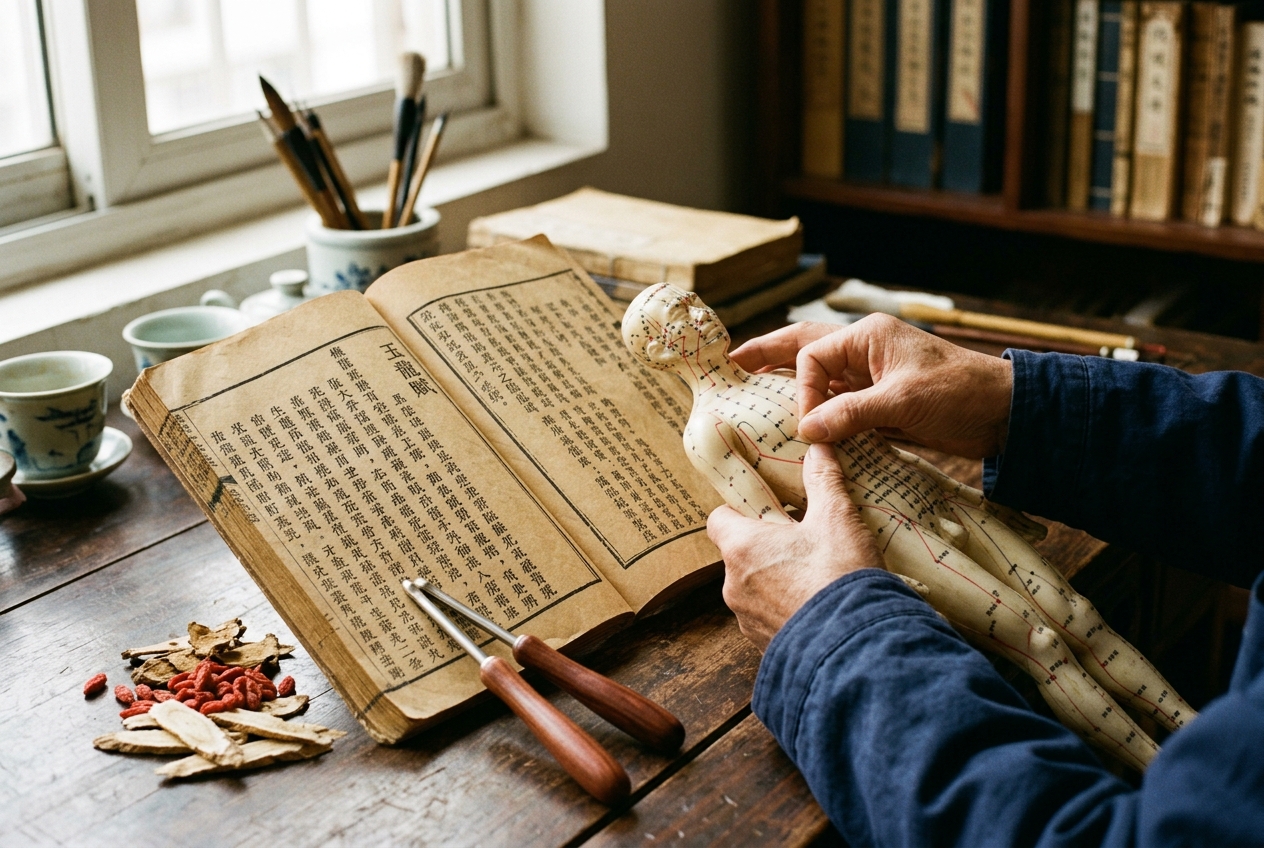
The Yu Long Fu (玉龍賦, The Jade Dragon Ode), authored by the imperial physician Wang Guorui in his 1329 CE treatise Bian Que Shen Ying Zhen Jiu Yu Long Jing and later codified into Yang Jizhou’s foundational 1601 compendium Zhen Jiu Da Cheng, provides an elegant clinical framework for resolving these systemic imbalances. Designed as an oral mnemonic to standardize clinical acupuncture and acupressure formulas, the Jade Dragon Ode pairs distal extremity points with axial, cranial, and trunk regions to modulate pain pathways, restore visceral motility, and reset neuromuscular tension.
By translating these classical Chinese medical pairings through the lens of modern mechanobiology, fascial continuum mechanics, and somatosensory neurobiology, we uncover a practical, non-invasive therapeutic protocol that anyone can apply through precision acupressure.
1. Opening — A Problem This Solves Today: The Ergonomic Crisis of Axial and Visceral Strain
Consider the physical reality of the sedentary professional. Eight to ten continuous hours seated before a digital terminal induces sustained hypertonicity in the suboccipital musculature, upper trapezius, and deep spinal erectors. This static loading generates myofascial trigger points, restricts microcirculation, and sends referred pain patterns cascading across the cranium—a presentation classically termed Tou Feng (頭風, Cranial Wind Cephalalgia). Concurrently, constant sympathetic nervous activation dampens digestive peristalsis and downregulates enteric blood flow, producing sluggish postprandial fullness and gastrointestinal stagnation.
In classical East Asian medicine, these functional disorders are not seen as discrete, unrelated pathologies. They represent disruptions along distinct channel networks (Jing Luo), where energetic and fluid stagnation in one quadrant of the body produces compensatory tension in another. The Jade Dragon Ode addressed this precise diagnostic challenge by establishing standardized, empirical multi-point matrices.
Rather than treating local head pain solely at the scalp or lumbar spasm solely at the sacrum, the Yu Long Fu pairs distal regulating points on the hands, wrists, and feet with localized anatomical regions. Today, somatosensory research published in the National Center for Biotechnology Information (NCBI) demonstrates that sustained mechanical pressure at these specific peripheral loci stimulates deep mechanoreceptors (Merkel discs, Pacinian corpuscles, and interstitial free nerve endings), initiating afferent neural cascades that modulate dorsal horn spinal gating, activate descending serotonergic-noradrenergic inhibitory pathways, and reset aberrant autonomic tone.
2. The Meridian Path — A Journey Through the Body: The Highways of Connective Tissue
To navigate the therapeutic protocols of the Jade Dragon Ode, one does not need specialized equipment—only an intuitive visual understanding of the major channel pathways as living myofascial and neurovascular expressways running beneath the skin.
The Dorsal Conduit: The Bladder Channel (Taiyang)
Imagine a vast sensory conduit that begins at the inner corner of your eye, crests the crown of your head, cascades down the nape of your neck, and branches into two parallel tracks flanking the entire length of your spine. This pathway continues down the center of your hamstrings, dives directly through the crease behind your knee joint, travels down the outside of your calf, and terminates at the tip of your little toe. This is the Bladder Meridian (Foot Taiyang), the longest channel in the body and the primary biomechanical shock absorber for the posterior kinetic chain. When your lower back seizes after heavy lifting or prolonged sitting, tension reverberates along this entire line.
The Frontal-Visceral Corridor: The Stomach Channel (Yangming)
Starting just below the center of your eye socket, this channel descends through the jaw and throat, passes over the collarbone, descends straight down the breastline and abdomen, traces across the front of the hip, and travels down the muscular outer-front ridge of your shinbone before terminating at the second toe. The Stomach Meridian (Foot Yangming) acts as the physiological highway for digestion, nutrient distribution, and muscular vitality across the lower limbs.
The Lateral Kinetic Highway: The Gallbladder Channel (Shaoyang)
Beginning at the outer corner of each eye, this pathway zigzags across the temple and side of the head, wraps over the shoulder crest, traverses the ribcage and flank, runs down the outer seam of the thigh and knee, and reaches the fourth toe. When tension headaches manifest at the temples or stress locks your neck and hips, the Shaoyang pathway is invariably constricted.
The Inner Visceral Axis: Spleen, Liver, and Pericardium (Yin Channels)
Traced along the soft, medial surfaces of the limbs, these pathways run along the inside edge of your shinbone (Spleen Taiyin and Liver Jueyin) and along the midline of the inner forearm (Pericardium Jueyin). These channels interface directly with the autonomic nervous system, enteric plexus, and cardiovascular microcirculation.
3. Key Master Points You Can Press Right Now
The Jade Dragon Ode distills hundreds of acupuncture points down to a vital core of clinically indispensable loci. Below are seven master points celebrated throughout the ode, described with clear body landmarks, somatosensory cues, force calibrations, and clinical applications.
================================================================================
                    KEY SOMATIC ACUPRESSURE MASTER LOCI
================================================================================
 Point Name       Primary Anatomical Reference              Primary Sensation
--------------------------------------------------------------------------------
 LI4 (Hegu)       Webbing between thumb & index finger      Radiating dull ache
 ST36 (Zusanli)   Four finger-widths below knee, outer shin Spreading warmth / zinging
 LV3 (Taichong)   Valley between 1st & 2nd metatarsal bones Tender, sharp distension
 PC6 (Neiguan)    Inner forearm, two thumb-widths up wrist  Deep tingling to palm
 GB34 (Yangling)  Hollow just below head of fibula (knee)   Local myofascial ache
 BL40 (Weizhong)  Exact center of crease behind the knee    Electric, opening release
 SP6 (Sanyinjiao) Four finger-widths above inner ankle      Pronounced tender pressure
================================================================================
1. Hegu (LI4, Large Intestine 4) — "The Great Eliminator"
- Finding the Locus: Open your hand with the palm facing down. Locate the fleshy web of muscle between the base of your thumb and your index finger. Bring your thumb flush against your index finger; a small muscle mound will rise. Place your opposite thumb directly on the peak of that mound, then relax your hand.
- The Sensation (De Qi): As you apply deep, inward pressure angled slightly toward the index finger’s bone, you will feel a characteristic heavy, spreading dull ache, often accompanied by a mild tingling sensation radiating toward the wrist.
- Technique: Use the tip of your thumb to apply firm, steady, circular pressure for 90 to 120 seconds per hand. Maintain an intensity level of 6 out of 10.
- Everyday Benefits: Rapidly alleviates frontal tension headaches, relieves facial and sinus congestion, eases jaw and neck stiffness, and provides systemic stress down-regulation.
2. Zusanli (ST36, Stomach 36) — "Leg Three Miles"
- Finding the Locus: Sit comfortably with your knees bent at 90 degrees. Place the four fingers of your opposite hand horizontally across your shin, directly beneath the bottom edge of your kneecap. ST36 is located at the lower border of your little finger, exactly one finger-width outward from the prominent, sharp crest of your shinbone into the belly of the tibialis anterior muscle.
- The Sensation (De Qi): Deep palpation produces a distinct, localized fullness, followed by a warm, descending sensation traveling down the shin toward the foot.
- Technique: Apply deep, sustained downward pressure using your thumb or knuckles. Perform dynamic, rhythmic kneading for 2 to 3 minutes on each leg.
- Everyday Benefits: Restores sluggish digestion, combats chronic physical exhaustion, stimulates appetite regulation, and calms systemic visceral anxiety.
3. Taichong (LV3, Liver 3) — "Great Rushing"
- Finding the Locus: Place your foot flat on the floor. Slide your finger backward along the top of your foot in the groove between your big toe and second toe until your finger falls into the soft, triangular depression just before the two metatarsal bones meet.
- The Sensation (De Qi): Highly sensitive upon palpation; elicits a sharp, dispersing tenderness that softens into a profound feeling of systemic release.
- Technique: Press vertically with a thumb or rounded knuckle, applying steady, moderate pressure for 1 to 2 minutes while taking slow, deep diaphragmatic breaths.
- Everyday Benefits: Reduces irritability and emotional tension, mitigates throbbing temporal headaches, relieves eye strain, and eases premenstrual discomfort.
4. Neiguan (PC6, Pericardium 6) — "Inner Gate"
- Finding the Locus: Turn your palm upward. Lay the three middle fingers of your opposite hand horizontally across the inside of your wrist crease. The point lies directly beneath your index finger, nestled snugly in the soft valley between the two prominent flexor tendons of the forearm.
- The Sensation (De Qi): A penetrating, spreading warmth with mild tingling that travels toward the center of your palm and upward into the chest.
- Technique: Pinch the wrist between your thumb (resting on PC6) and your index finger (on the back of the forearm). Press firmly inward for 90 seconds while performing slow exhalations.
- Everyday Benefits: Neutralizes acute nausea and motion sickness, slows a racing stress-induced heart rate, alleviates chest tightness, and prepares the mind for deep sleep.
5. Yanglingquan (GB34, Gallbladder 34) — "Mound Spring / Master of Sinews"
- Finding the Locus: Sit with your knees bent. Slide your fingers down the outside of your lower leg, starting just below the knee joint. You will feel a small, distinct bony knob (the head of the fibula). Move your thumb down and slightly forward into the soft muscular depression immediately below and in front of this bony prominence.
- The Sensation (De Qi): A pronounced, radiating dull ache that relaxes the outer calf and travels upward along the lateral thigh.
- Technique: Apply firm, circular pressure angled toward the core of the leg bone for 2 minutes per side.
- Everyday Benefits: Relieves hip and lateral knee stiffness, resolves ribcage tightness, and soothes chronic tendon and ligament strain throughout the body.
6. Weizhong (BL40, Bladder 40) — "Middle of the Crease"
- Finding the Locus: While seated or lying down, feel the soft crease directly behind your knee joint. BL40 sits at the exact midpoint of this transverse crease, midway between the prominent hamstring tendons.
- The Sensation (De Qi): An instant, deep, opening sensation that immediately decompresses the lumbar spine and releases tension across the hamstrings.
- Technique: Hook your fingertips or thumbs into the center of the crease behind both knees. Press upward and inward with moderate, pulsing pressure for 2 minutes.
- Everyday Benefits: The premier distal point for acute and chronic lower back pain, sciatica, lumbar stiffness, and leg heaviness.
4. Classical Multi-Point Matrices: Precision Protocols for Contemporary Malaises
The primary contribution of Wang Guorui’s Yu Long Fu was the systematic pairing of primary and secondary points to create synergistic therapeutic effects. Classical Chinese medicine asserts that pairing a distal "command" point with a local or cross-channel "guide" point amplifies somatic regulation far beyond single-point stimulation.
Protocol A: The "Four Gates" (Si Guan) for High-Stress Tension Headaches & Systemic Anxiety
- The Clinical Syndrome: Throbbing tension headache originating at the forehead and temples, clenched jaw, hyperactive nervous tension, and shallow breathing.
- The Classical Ode Dynamic: Pairing Hegu (LI4) on the hands with Taichong (LV3) on the feet forms the celebrated "Four Gates" combination. LI4 addresses the upper body, cranium, and the circulation of Qi, while LV3 grounds the nervous system, smooths visceral flow, and clears Liver Fire.
- Modern Neurobiology: Functional neuroimaging studies cited in the National Library of Medicine (PubMed) demonstrate that co-stimulating LI4 and LV3 significantly down-regulates the default mode network (DMN), attenuates hyperactive amygdala activity, and induces widespread parasympathetic dominance via the vagus nerve.
Step-by-Step "Do This Tonight" Sequence:
- Posture: Recline comfortably in a semi-recumbent position or sit upright in a quiet, dimly lit room with your feet uncrossed.
- Phase 1 (The Upper Gate): Press LI4 (Hegu) on your left hand with your right thumb. Maintain firm, steady pressure angled toward the metacarpal bone for 90 seconds. Switch and repeat on the right hand for 90 seconds.
- Phase 2 (The Lower Gate): Move down to LV3 (Taichong) on your left foot. Press firmly into the soft valley between the metatarsal bones for 90 seconds, breathing deeply. Switch and repeat on the right foot for 90 seconds.
- Phase 3 (The Cranial Guide): Place your middle fingertips into the soft hollows at the base of your skull on either side of the spine—GB20 (Fengchi)—and apply upward, angled pressure for 60 seconds while rolling your head gently backward.
Protocol B: The Distal Lumbar Decompression Protocol for Acute Low-Back Stiffness
- The Clinical Syndrome: Severe lumbar tightness, postural fatigue from prolonged chair sitting, and acute spasm across the erector spinae muscles.
- The Classical Ode Dynamic: Yu Long Fu dictates: "For lumbar pain so severe one cannot stand erect, immediately seek Weizhong (BL40) in the popliteal crease to clear the obstruction, supported by Yanglingquan (GB34) to relax the tendons."
- Modern Neurobiology: Applying pressure to BL40 targets the tibial nerve and deep popliteal neurovascular bundle, triggering afferent inhibitory signals that travel along the S1–L4 dermatomal pathways. This directly interrupts the spinal reflex arc of local lumbar spasm through reciprocal motor unit inhibition and release of endogenous beta-endorphins.
Step-by-Step Sequence:
- Posture: Lie flat on your back on a firm mat, bending your knees with your feet flat on the floor to take strain off your lower back.
- Step 1 (Distal Neural Release): Reach both hands behind your knees. Place your index and middle fingertips directly into the center of the popliteal crease at BL40 (Weizhong). Pull gently upward and perform small, pulsing circles with firm pressure for 2 full minutes.
- Step 2 (Fascial Sinew Regulation): Sit up slowly with knees bent. Locate GB34 (Yanglingquan) below the head of the fibula on the outer side of both legs. Press firmly with your thumbs for 90 seconds per side to release lateral myofascial tension.
- Step 3 (Integration): Remain seated, take three slow breaths, and gently tilt your pelvis forward and backward to experience restored range of motion.
Protocol C: The "Middle Jiao Harmonizer" for Bloating, Indigestion, and Visceral Discomfort
- The Clinical Syndrome: Abdominal distension after meals, epigastric discomfort, nausea, sluggish digestion, and anxiety-induced digestive spasms.
- The Classical Ode Dynamic: The ode pairs PC6 (Neiguan) with ST36 (Zusanli) and SP6 (Sanyinjiao). This tri-point synergy regulates both the upper stomach/esophageal tract and the lower bowel motility.
Step-by-Step Sequence:
- Posture: Sit comfortably or recline on your side with the abdominal wall completely relaxed.
- Step 1: Press PC6 (Neiguan) on the inner forearm for 2 minutes per wrist to relax the diaphragmatic sphincter and ease nausea.
- Step 2: Apply deep, circular kneading to ST36 (Zusanli) on the outer shin for 2 minutes per leg to promote gastrointestinal motility.
- Step 3: Conclude by pressing SP6 (Sanyinjiao), four finger-widths above the inner ankle bone, for 90 seconds per leg to harmonize pelvic and abdominal circulation.
5. Neurofascial Translation: Bridging Classical Channel Mechanics and Modern Neurobiology
Why does firm, sustained pressure applied to the fleshy webbing between the thumb and forefinger (LI4) reliably relieve throbbing vascular and muscular tension in the forehead and jaw?
For centuries, classical treatises explained this phenomenon through the conduit of Qi moving along the Yangming channel network. Over the past three decades, biomedical investigations into connective tissue physiology and somatosensory neurology have validated the physiological foundations of these classical roadmaps.
Fascial Continuity and Interstitial Fluid Dynamics
Dr. Helene Langevin and colleagues at the National Center for Complementary and Integrative Health have shown that acupuncture points consistently correlate with cleavage planes within the subcutaneous connective tissue matrix. When manual pressure or needle rotation is applied to an acupoint: 1. Fibroblasts and collagen fibrils undergo mechanical deformation. 2. This cellular strain activates mechanotransduction pathways, releasing intracellular adenosine triphosphate (ATP). 3. The extracellular ATP degrades into adenosine, a potent local analgesic and vasodilator that binds to A1 adenosine receptors to dampen peripheral nerve excitation.
The Gate Control Theory and Central Pain Processing
Classical distal points are located primarily along high-density sensory zones of the distal extremities. Stimulating these areas recruits low-threshold, myelinated A-beta and A-delta sensory nerve fibers.
As established in the classical Melzack-Wall Gate Control Theory, these rapid afferent signals arrive at the substantia gelatinosa in the dorsal horn of the spinal cord ahead of slower, unmyelinated C-fibers carrying dull, chronic pain signals. The incoming mechanical input closes the presynaptic gate, suppressing nociceptive transmission up the spinothalamic tract.
Concurrently, this somatosensory stimulation projects rostrally to the periaqueductal gray (PAG) matter in the midbrain and the rostral ventromedial medulla (RVM). This triggers the release of endogenous opioid peptides—such as beta-endorphins, dynorphins, and enkephalins—which descend the dorsolateral funiculus to extinguish pain perception across corresponding spinal segments.
Autonomic Regulation via Enteric and Vagal Modulation
When points like ST36 (Zusanli) or PC6 (Neiguan) are manually stimulated, sensory inputs travel via the somatic spinal nerves to the nucleus tractus solitarius (NTS) in the brainstem. The NTS directly regulates vagal motor nuclei, modulating parasympathetic outflow to the gastrointestinal tract and cardiovascular system. The resulting increase in vagal tone enhances mesenteric microcirculation, normalizes gastric motility rhythms, and reduces systemic inflammatory cytokines.
6. Safety & Sense: Clinical Boundaries, Precautions, and Contraindications
Acupressure is an extraordinarily safe, non-invasive therapy, but precision application requires clear clinical boundaries, respect for physiological limits, and adherence to established medical safety standards.
Strict Contraindications During Pregnancy
Certain acupoints possess potent descending and oxytocic actions that can stimulate uterine contractions and pelvic blood flow. Pregnant individuals must strictly avoid deep, vigorous stimulation on the following points: * LI4 (Hegu): Promotes downward movement and uterine tone. * SP6 (Sanyinjiao): Strongly stimulates the pelvic floor and uterine muscle beds. * BL60 (Kunlun) & BL67 (Zhiyin): Classical descending and labor-inducing loci. * All points on the lower abdomen and sacral region.
Calibration of Force: Understanding "Good Hurt" vs. Harm
When practicing acupressure: * The Target Sensation: Seek De Qi—a sensation often described as a dull ache, slight numbness, spreading warmth, or localized fullness. This confirms you have engaged the deep mechanoreceptors and muscular fascia. * What to Avoid: The sensation should never feel sharp, piercing, excruciating, or electric-like shock pain (which indicates direct compression of a superficial nerve trunk). * Dosage & Force: Always begin with light tactile palpation, increase pressure gradually over 10 to 15 seconds to a subjective intensity of 5 to 7 out of 10, hold steadily, and release slowly. Never press directly onto bruised, inflamed, infected, or broken skin, or over areas of active deep vein thrombosis (DVT).
When to Seek Biomedical Medical Care
Acupressure is a powerful modality for functional regulation and musculoskeletal tension, but it does not replace urgent biomedical diagnosis. You should consult a qualified physician immediately if you experience: * Sudden, catastrophic headache ("thunderclap" onset). * Unexplained unilateral limb weakness, facial drooping, or slurred speech. * Acute, radiating chest pain, pressure, or shortness of breath. * Unremitting abdominal pain accompanied by high fever or persistent vomiting. * Severe low back pain accompanied by loss of bowel or bladder control (Cauda Equina Syndrome).
7. Today's Takeaway: A Two-Minute Somatosensory Reset
You do not need to master all 361 classical points today. You only need one precise locus, a clear intention, and two uninterrupted minutes to reset your nervous system right at your desk.
By connecting the clinical wisdom of Wang Guorui's fourteenth-century masterpiece with modern neurofascial science, the Jade Dragon Ode transforms from an ancient relic into an enduring, evidence-informed map for human vitality, balance, and somatic self-mastery.
Authoritative References & Scientific Reading
- World Health Organization (WHO) Standard Acupuncture Point Locations — Standardized global anatomical location definitions for human acupoints.
- National Center for Biotechnology Information (NCBI): Neuromodulatory Mechanisms of Acupuncture — Peer-reviewed analysis of somatosensory pathways, endogenous opioids, and neural networks.
- Zhen Jiu Da Cheng (The Great Compendium of Acupuncture and Moxibustion) Overview — Historical context, compilation, and preservation of classical Yuan and Ming Dynasty acupuncture treatises.
- National Library of Medicine (PubMed): Fascial and Connective Tissue Mechanotransduction in Acupoint Stimulation — Clinical studies exploring connective tissue deformation and purinergic signaling.
- Gate Control Theory of Pain — Structural & Neurophysiological Principles — Foundations of spinal cord dorsal horn nociceptive gating and sensory fiber activation.