Yinlingquan Cavity Yin Mound Spring: Medial Tibial Fascial Decompression, Spleen Fluid Transformation, and Deep Kinetic Chain Integration in Classical Neigong
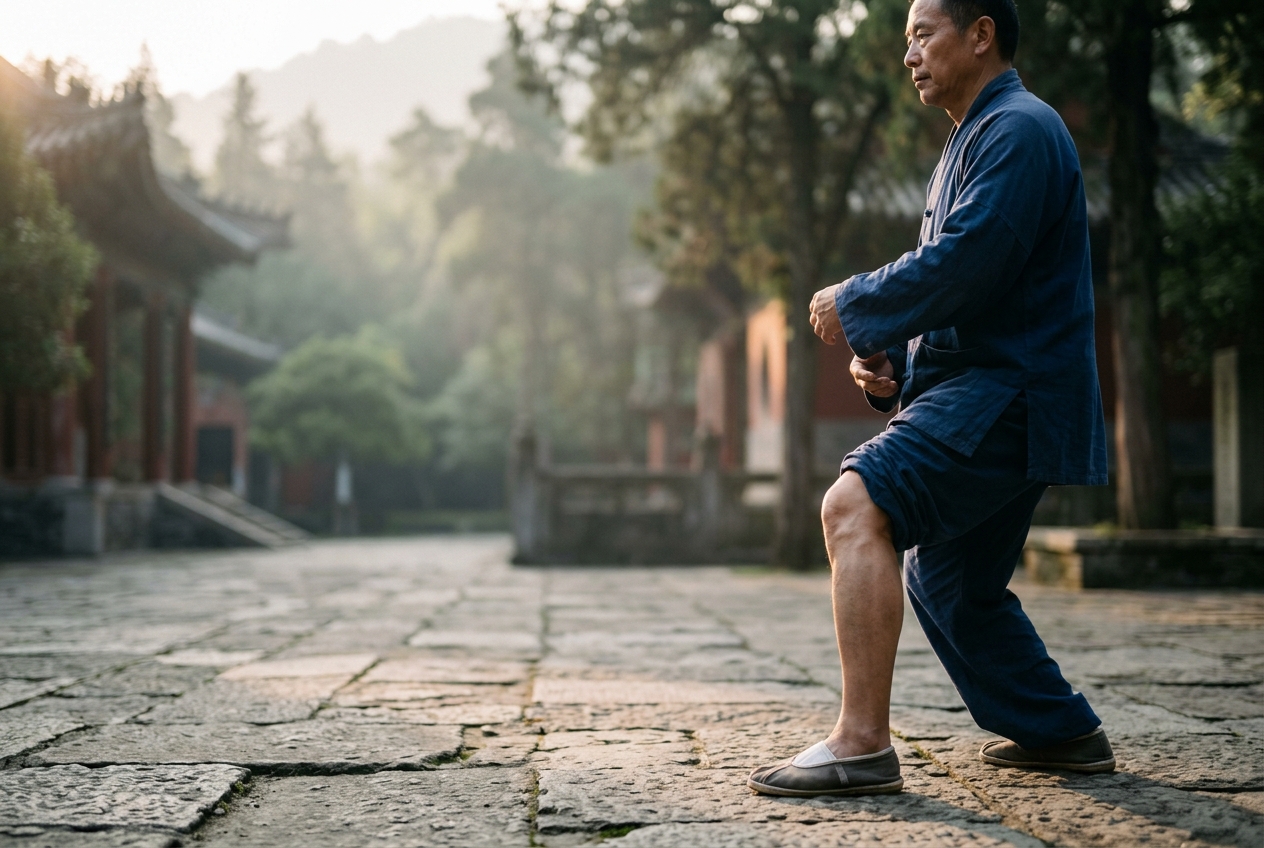
To modern somatic practitioners, this point represents far more than an abstract energetic coordinate. It is the vital structural keystone of the medial kinetic chain—the continuous line of connective tissue, fascia, and muscle that ascends along the inner arch of the foot, travels up the inner calf and knee, threads through the inner thigh adductors, and anchors into the pelvic floor and deep abdominal core. In plain terms, Yinlingquan is the shock-absorbing hydraulic valve of your lower body. When it is compressed—as occurs during functional knock-knee collapse (genu valgum)—the entire lower body loses its structural integrity, dampening fluid circulation and creating a chronic sense of heaviness and fatigue in the legs and lower abdomen. Conversely, when this inner knee gateway is mindfully decompressed and bioenergetically opened through postural alignment and breathwork, it restores buoyant fluid drainage, relieves pelvic congestion, and establishes an unshakable physical root.
Functional Taxonomy: The Water Gate of Spleen Earth
In Classical Chinese Medical theory, as systematized in the foundational canon of the Huangdi Neijing, Yinlingquan occupies a unique functional classification as the He-Sea (合穴) and Water point of the Spleen Foot-Taiyin channel. To understand the profound depth of this designation, one must examine the Five-Phase (Wu Xing) relationship between Earth (Tu) and Water (Shui).
The Spleen organ-meridian network corresponds to the Earth element, which governs the physiological functions of transformation and transportation (Yunhua)—the extraction of refined nutrients and the systemic distribution of clear fluids throughout the interstitial matrix. However, SP9 is the specific Water-phase resonance point situated on this Earth meridian. In classical hydrodynamics and agricultural metaphors, Earth builds the banks and dykes that contain, direct, and guide Water. When Spleen Earth is deficient or structurally compromised, it fails to govern fluid transformation; the internal waterways overflow, stagnate, and precipitate pathological internal dampness (Shishi), fluid retention (Shuizhong), and turbid phlegm accumulations (Tanyin).
+-----------------------------------------------------------------------------------+
|                        CLASSICAL TCM TAXONOMY: SP9 (YINLINGQUAN)                 |
+------------------------------------+----------------------------------------------+
| Channel Designation                | Spleen Foot-Taiyin (足太陰脾經)              |
| Five-Phase / Five-Shu Element      | He-Sea Point (合穴) / Water Element (水)     |
| Primary Somatic Actions            | Transforms Pathological Dampness, Regulates  |
|                                    | Lower Burner Fluid Gates, Unbinds Pes Anser. |
| Kinetic Anchor                     | Intermediary Node: Yongquan (KI1) -> Kua     |
+------------------------------------+----------------------------------------------+
As a He-Sea point—the site where channel Qi is said to deepen, coalesce, and plunge inward into the organ system like a river entering the sea—Yinlingquan acts as the premier drainage valve of the Lower Burner (Xia Jiao). Clinical research indexed on NCBI PubMed demonstrates that stimulation of He-Sea acupoints on the lower leg exerts measurable regulatory effects on autonomic tone, peripheral blood perfusion, and lymphatic clearance. By activating Yinlingquan, the internal martial artist or Daoyin practitioner clears metabolic waste, relieves urogenital and pelvic heaviness, and harmonizes the warming, transformative fire of Spleen Earth with the fluid filtration dynamics of Kidney Water.
Anatomical Topography: The Pes Anserinus and Crural Fascia
To fully appreciate why Yinlingquan is so physiologically potent, one must look closely at the underlying Western musculoskeletal anatomy. Located at the anteromedial aspect of the proximal tibia, SP9 sits precisely adjacent to the insertion zone of the pes anserinus (Latin for "goose's foot").
The pes anserinus is the conjoined tendon formed by the union of three distinct muscles originating from three separate compartments of the pelvis and thigh: 1. Sartorius (innervated by the femoral nerve): Originates at the anterior superior iliac spine (ASIS), spiraling across the anterior thigh to facilitate hip flexion, abduction, and external rotation while flexing the knee. 2. Gracilis (innervated by the obturator nerve): Originates at the pubic symphysis and inferior pubic ramus, descending along the medial thigh to provide powerful hip adduction and medial knee stability. 3. Semitendinosus (innervated by the tibial division of the sciatic nerve): Originates at the ischial tuberosity, forming the medial hamstring that drives hip extension and knee flexion.
These three dynamic muscular slings converge into a broad, web-like aponeurosis that wraps over the superficial medial collateral ligament (MCL) and anchors into the medial surface of the proximal tibia. Beneath this conjoined tendon lies the bursa anserina, a fluid-filled synovial sac that cushions the tendons against friction during locomotion. Surrounding and investing the entire complex is the dense deep crural fascia (fascia cruris), which acts as an unyielding retinacular sleeve regulating compartment pressure and venous pump efficiency in the lower leg.
When structural alignment is lost—such as when the foot pronates and the knee collapses medially—excessive shear stress is placed on the pes anserinus and its bursa. This mechanical friction creates fascial densification, cross-linking of collagen fibers, and local micro-ischemia. In classical terms, this physical binding manifests as Qi stagnation and damp accumulation. Decompressing the Yinlingquan cavity restores the physiological glide planes between the sartorius, gracilis, and semitendinosus, liberating the saphenous nerve and facilitating smooth interstitial fluid dynamics. Detailed anatomical reviews on Wikipedia's Pes Anserinus entry emphasize how this tri-tendinous junction functions as a primary dynamic stabilizer preventing rotational knee trauma.
Kinetic Biomechanics: Decompressing the Knee in Zhan Zhuang
In the internal martial arts—most notably Taijiquan, Baguazhang, and the standing meditation practice of Zhan Zhuang (Standing Stake)—the preservation of the medial knee space is considered an inviolable structural rule.
When an untrained individual stands with slightly bent knees, a subtle structural failure almost universally occurs: the inner arches of the feet collapse inward, the talus bone rotates medially, and the knees drop toward the midline in functional genu valgum. Biomechanically, this valgus drift causes the medial joint compartment of the knee to compress while placing the pes anserinus and medial collateral ligament under severe tensile traction. Energetically and myofascially, this collapse crushes Yinlingquan, severing the elastic connection between the foot and the pelvis.
+-----------------------------------------------------------------------------------+
|               BIOMECHANICAL CONTRAST: COLLAPSED VS. DECOMPRESSED KNEE             |
+------------------------------------+----------------------------------------------+
| Collapsed Alignment (Genu Valgum)  | Decompressed Alignment (Neigong "Song")      |
+------------------------------------+----------------------------------------------+
| • Inner foot arches flatten        | • Plantar tripod engaged (KI1 open)          |
| • Femurs rotate internally         | • External spiral torque through hip sockets |
| • SP9 cavity pinched & compressed  | • SP9 cavity expanded, hollow, and buoyant   |
| • Adductors tight and exhausted    | • Adductor group elastically suspended       |
| • Pelvic floor collapsed downwards | • Kua folded; pelvic diaphragm tone balanced |
+------------------------------------+----------------------------------------------+
To decompress Yinlingquan, Neigong masters teach the principle of Song (鬆)—conscious, active structural release through micro-spiral alignment. Instead of simply pushing the knees outward with muscular force (which creates lateral tension), the practitioner executes a subtle, reciprocal torque: 1. The Foot Foundation: The base of the big toe, the base of the little toe, and the center of the heel (the plantar tripod) grip the earth softly, creating suction at the central bubbling spring cavity (Yongquan, KI1). 2. The Tibial Upright: The inner ankle bone floats upward, keeping the lower-leg junction of Sanyinjiao (SP6) uncompressed. 3. The Femoral Counter-Spiral: The thighs engage a micro-rotational external spiral that originates from the deep hip socket (Kua), causing the patellae to track directly over the second and third toes. 4. The Knee Cavity Expansion: This dual action—grounding the first metatarsal while spiraling the femur externally—mechanically pulls the medial joint space open, creating an expansive, hollow feeling behind and below the medial tibial condyle.
The Yinlingquan cavity is transformed from a pinched bottleneck into a wide, spring-loaded hydrodynamic conduit. This structural integrity allows kinetic energy generated from the ground to travel unimpeded up the deep front myofascial line, through the adductor magnus, and into the pelvic diaphragm and lower abdominal center (Dantian).
Step-by-Step Somatic Cultivation Protocol
The following experiential protocol synthesizes tactile palpation, myofascial unwinding, and breath-directed intention (Yi Dao Qi Dao, 意到氣到—"Where the mind goes, the Qi follows") to open Yinlingquan and ground the lower body.
Phase 1: Interoceptive Seated Palpation and Location
- Sit upright on the edge of a firm chair or meditation cushion with your feet flat on the floor and knees bent at 90 degrees.
- Slide the pads of your thumbs up the inner side of your left shin bone (the medial crest of the tibia), moving upward from the ankle toward the knee.
- As your thumb approaches the knee, feel how the narrow bone suddenly widens into a prominent rounded flare (the medial tibial condyle).
- Allow your thumb to hook directly into the soft, deep hollow immediately below and behind this bony overhang. This is Yinlingquan (SP9).
- Apply gentle, sustained pressure perpendicular to the tissue. If the area feels tender, bruised, dense, or slightly swollen, this confirms the presence of fascial restriction and localized fluid stagnation. Maintain soft pressure for 60 seconds while taking slow nasal breaths, feeling the tissue soften beneath your contact. Repeat on the right leg.
Phase 2: Micro-Rotational Myofascial Unwinding
- Transition to a standing position with your feet parallel, spaced precisely hip-socket width apart.
- Place your index and middle fingers lightly upon both SP9 cavities on the inside of your knees.
- Slowly shift your body weight 60% into your heels while maintaining light contact through the balls of your big toes.
- Initiate a micro-rotation: without moving your feet on the floor, imagine gently rotating your knees outwards by 2 millimeters from the deep hip creases (Kua), while simultaneously pressing the root of your big toe into the floor.
- Feel the sudden change under your fingertips: the deep hollow of Yinlingquan will instantly expand, deepen, and feel "spacious" as the pes anserinus tendons glide smoothly across the tibial surface without pinch or binding.
Phase 3: Breath-Directed Intention (Yi Dao Qi Dao)
- Rest your hands over your lower belly, approximately two inches below your navel (the Lower Dantian).
- On your slow, silent inhalation through the nose, allow your pelvic floor to soften and expand downward, drawing your breath into the deep lower abdomen.
- On your slow exhalation, do not push the breath out; instead, gently engage the lower abdominal wall and send your mental awareness (Yi) down the inside of your thighs, directly through the spacious hollows of both Yinlingquan points, down the calves, and into the soles of your feet at Yongquan (KI1).
- Visualize warm, crystalline spring water washing through the inner knee hollows, flushing away cold, stagnant heaviness and draining it deep into the earth. Perform 18 complete breath cycles.
Phase 4: Dynamic Integration in Zhan Zhuang
- Raise your arms into the classical "Embracing the Tree" (Cheng Bao Zhuang) posture, with fingers pointing toward each other at chest height, elbows heavy and sinking.
- Verify your medial knee architecture: check that your knees are not drifting inward toward one another. Maintain the rounded, arch-like structure of the inner legs—known in Chinese internal arts as the Dang (骻) or "crotch arch."
- Remain in this rooted stillness for 10 to 15 minutes.
+-----------------------------------------------------------------------------------+
|                      PRACTICE TROUBLESHOOTING & CORRECTIONS                       |
+------------------------------------+----------------------------------------------+
| Common Error                       | Structural & Sensory Correction              |
+------------------------------------+----------------------------------------------+
| Knees bowing too far outwards      | Re-anchor the base of the big toe; prevent   |
| (excessive varus tension)          | outer edge foot-rolling; soften outer hips.  |
| Weight collapsing onto inner arch  | Lift the medial malleolus; spiral femur      |
| (over-pronation)                   | externally from the deep Kua socket.         |
| Breath trapped in upper chest      | Relax solar plexus; allow exhalations to     |
|                                    | settle into the lower pelvic bowl.           |
| Clenching toes into the floor      | Spread the toes wide; let the foot pad       |
|                                    | suction naturally like a soft plunger.       |
+------------------------------------+----------------------------------------------+
Sensory Feedback Markers: What to Expect
As Yinlingquan decompresses and the medial kinetic chain awakens, you will experience several distinct somatic benchmarks: * Thermal Shifts: A distinct wave of warmth spreading from the medial knee down into the inner ankle and foot, signaling the release of microvascular constriction and sympathetic tone. * Tingling and Pulsation: A mild, rhythmic throbbing or buzzing sensation in the SP9 hollow, indicating enhanced microcirculation and interstitial fluid mobilization. * Sensory Lightness vs. Grounded Heaviness: While the physical legs feel anchored and heavy like rooted trees, the knee joints themselves feel weightless, open, and buoyant, free from the pinching friction of bone-on-bone compression.
Western Physiology: Fascial Fluid Dynamics and Neurovisceral Integration
When we translate the classical concepts of "clearing dampness" and "opening channel gates" into modern biomedical terminology, we uncover profound alignments with contemporary fascial science, autonomic neurophysiology, and hemodynamic regulation.
1. Fascial Mechanotransduction and Hyaluronan Viscosity
Fascia is not an inert wrapping tissue; it is a dynamic, fluid-filled metamembrane rich in mechanoreceptors (specifically Ruffini endings and Pacini corpuscles). Research highlighted by the World Health Organization on Traditional Medicine and independent biomedical literature confirms that acupuncture points frequently correspond to major fascial cleavages and tendinous intersections.
At Yinlingquan, the deep fascia cruris and the pes anserinus tendon glide across the periosteum via a specialized lubricating layer rich in hyaluronic acid (hyaluronan). Under conditions of physical immobility, poor posture, or chronic knee valgus, hyaluronan transitions from a fluid (sol) state to a dense, sticky (gel) state, trapping metabolic waste and restricting interstitial fluid shearing. The micro-rotational alignments and breath-directed intention of Neigong apply multi-directional shear forces to this junction. This mechanical stimulation reduces hyaluronan viscosity (thixotropy), unbinding the fascia and restoring the free flow of interstitial fluid and cellular nutrients.
2. The Diaphragmatic Visceral Piston and Lymphatic Clearance
Classical texts state that opening Yinlingquan regulates the fluid pathways of the Triple Energizer (San Jiao). In modern physiology, fluid return from the lower extremities—both venous blood via the great saphenous system and lymphatic fluid through the popliteal and inguinal nodes—relies entirely on two mechanical engines: * The skeletal muscle pump of the calf and thigh. * The thoraco-pelvic respiratory pump.
During deep, slow diaphragmatic respiration (such as that practiced during Zhan Zhuang at roughly 6 breaths per minute or 0.1 Hz), the synchronized descent of the thoracic diaphragm and pelvic floor generates rhythmic fluctuations in Intra-Abdominal Pressure (IAP). This periodic pressure oscillation acts as a powerful vacuum siphon, pulling venous blood and interstitial lymph upwards from the lower leg through the saphenous opening into the thoracic duct. Decompressing the inner knee at SP9 removes a primary mechanical constriction along this pathway, preventing the dependent edema and heavy leg sensations characteristic of internal dampness.
3. Autonomic Regulation and Heart Rate Variability (HRV)
Slow, mindful postural alignment in standing meditation engages deep interoceptive pathways via unmyelinated C-fiber afferents embedded throughout the crural fascia. As the practitioner eliminates mechanical strain at the knee, afferent signals of safety are transmitted to the insular cortex, shifting autonomic balance from sympathetic fight-or-flight arousal into deep parasympathetic dominance. As published in somatic research indexed on NCBI PMC, this neurovisceral integration increases high-frequency Heart Rate Variability (HRV), enhances baroreflex sensitivity, down-regulates systemic inflammatory cytokines, and optimizes homeostatic organ perfusion.
Classical Lineage and Historical Context
The systematic cultivation of Yinlingquan is rooted in a rich historical lineage that bridges ancient clinical acupuncture, Han Dynasty medical treatises, and esoteric Daoist longevity regimens.
+-----------------------------------------------------------------------------------+
|                       CHRONOLOGICAL LINEAGE OF YINLINGQUAN                        |
+---------------------+-------------------------------+-----------------------------+
| Era / Period        | Foundational Text / Tradition | Somatic & Clinical Focus    |
+---------------------+-------------------------------+-----------------------------+
| Warring States /    | *Huangdi Neijing Lingshu*     | Establishes SP9 as He-Sea   |
| Han Dynasty         | (黃帝內經·靈樞)               | Water point on Foot-Taiyin. |
+---------------------+-------------------------------+-----------------------------+
| Jin Dynasty         | *Zhen Jiu Jia Yi Jing*        | Codifies clinical formulas  |
| (282 CE)            | (Huangfu Mi, 針灸甲乙經)      | for fluid stasis & edema.   |
+---------------------+-------------------------------+-----------------------------+
| Tang & Song         | Shangqing Daoist Daoyin       | Integrates knee decompression|
| Dynasties           | & Maoshan Lineages            | into seated & standing yoga.|
+---------------------+-------------------------------+-----------------------------+
| 20th Century        | Yiquan / Dachengquan          | Wang Xiangzhai systemizes   |
| Post-Classical      | (Wang Xiangzhai, 王諶齋)      | Zhan Zhuang kinetic spirals.|
+---------------------+-------------------------------+-----------------------------+
The earliest written record of Yinlingquan appears in Chapter 2 of the Lingshu (靈樞·本輸 - "Fundamental Points"), compiled during the late Warring States and Han Dynasty periods. Here, the text poetically describes the Qi of the Spleen Foot-Taiyin channel emerging at the big toe (Yinbai, SP1), accelerating through the stream points, and finally entering its deep, oceanic reservoir at Yinlingquan:
"The Spleen emerges at Yinbai... and enters at Yinlingquan. It is the He-Sea; it corresponds to Water."
In 282 CE, during the Jin Dynasty, the physician-scholar Huangfu Mi authored the landmark Zhen Jiu Jia Yi Jing (The Systematic Classic of Acupuncture and Moxibustion). Huangfu Mi was the first to explicitly articulate SP9’s clinical dominance over disorders of fluid metabolism, noting its capacity to treat severe abdominal distension, cold dysuria, intractable diarrhea, and lower extremity swelling.
Simultaneously, within the esoteric Daoist hermetic traditions of the Maoshan and Shangqing lineages, early masters recognized that manual needle insertion was only one way to stimulate this gateway. Through the internal arts of Daoyin (guiding the breath and stretching the limbs) and Tuna (deep resonant breathing), adepts developed standing and moving sequences specifically designed to open the Jingjin (the sinew channels or myofascial pathways). Practitioners of Hua Tuo's legendary Five Animal Frolics (Wu Qin Xi) utilized the deep crouching and winding movements of the Bear and Deer forms to alternately compress and expand the medial tibial angle, milking stagnant fluids from the lower body.
In the early 20th century, the martial genius Wang Xiangzhai (creator of Yiquan/Dachengquan) stripped away ornate choreographies to distill internal cultivation down to its absolute essence: silent, static Zhan Zhuang. Wang emphasized that without the buoyant expansion of the inner knee space—preventing the collapse of the Dang arch—true explosive power (Fajin) could never be rooted in the ground or transmitted through the spine. Today, organizations such as the National Qigong Association (NQA) preserve and propagate these classical cultivation methods, making this ancient somatic wisdom accessible to contemporary practitioners worldwide.
Daily Practice Commitment: The Five-Minute Awakening
To transform these theoretical and anatomical principles into lasting somatic reality, intellectual comprehension must be replaced by daily neuromuscular habit. Reading about the medial kinetic chain will not decompress your fascia; direct, consistent physical engagement will.
Commit to the following five-minute routine tomorrow morning before your first cup of tea or coffee: 1. Minute 0:00 to 1:00: Sit down and palpate both Yinlingquan cavities. Locate the tender depression behind the tibial flare and perform 60 seconds of gentle, circular thumbs-on softening. 2. Minute 1:00 to 2:30: Stand with feet parallel, shoulder-width apart. Set your plantar tripod, micro-spiral the thighs outward from the hip sockets, and feel both SP9 hollows expand and breathe. 3. Minute 2:30 to 4:30: Hold the Zhan Zhuang posture for two uninterrupted minutes. Coordinate slow, six-second nasal inhalations with pelvic floor softening, and six-second exhalations with the downward mental guidance of warm, clear fluid through the inner knees to the floor. 4. Minute 4:30 to 5:00: Lower your hands over your navel, take three grounding breaths, and notice the sensations in your legs—the tingling warmth, the lightness in the knee joints, and the solid, effortless connection to the ground beneath you.
By consciously cultivating this single, profound anatomical gateway, you bridge the gap between ancient Eastern energetic mastery and contemporary Western somatic science, grounding your posture, clearing stagnant fluids, and reclaiming the resilient, spring-loaded vitality innate to your physical structure.