Yanglingquan Cavity Yang Mound Spring: Peroneal Fascial Decompression, Sinew Meridian Modulation, and Lateral Kinetic Chain Integration in Classical Neigong
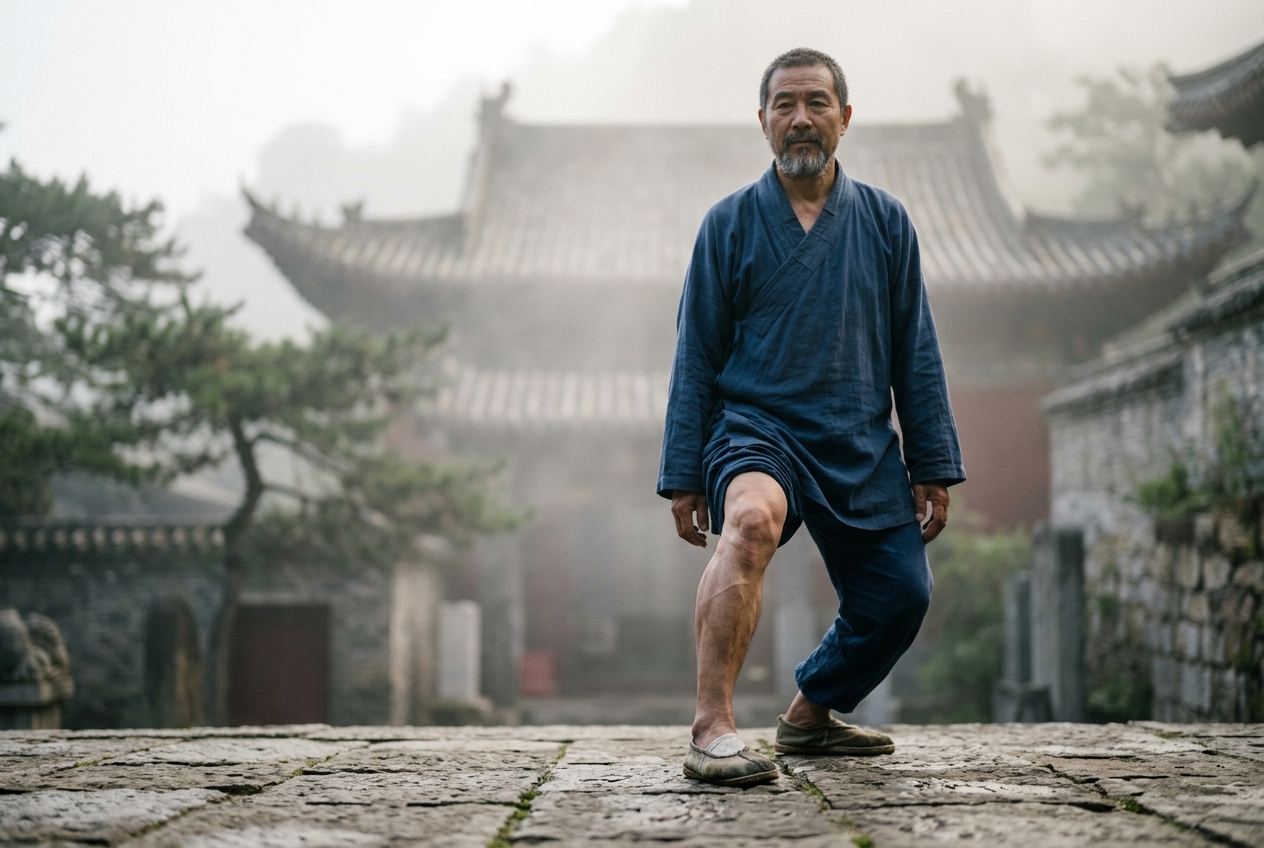
Stripped of esoteric obscurities, this practice is a method of structurally unlocking the lateral hinge of the human body. Classical texts identify Yanglingquan as the Jin Hui (筋會)—the singular "Hui-Meeting Point" or master confluence governing every tendon, ligament, and connective tissue sheath (Jin) in the human organism. By making millimeter-level postural corrections during standing meditation (Zhan Zhuang) and dynamic moving forms (Daoyin), a practitioner decompresses the tight connective tissue wrapping the knee and outer lower leg. This physical decompression relieves structural friction along the body’s lateral line, restores fluid pelvic-ankle balance, and triggers a systemic release of chronic neuromuscular tension from the crown of the head down to the toes.
In classical energetic terms, clearing this aperture vents stagnant, overheated metabolic energy—termed pathologically trapped Yang Qi—downward along the Gallbladder channel (Zu Shao Yang Dan Jing), harmonizing the nervous system and grounding the practitioner's physical structure into the earth.
        LATERAL KINETIC & FASCIAL CONTINUITY (SHAO YANG AXIS)
        ====================================================

          [ GB20: Fengchi ]  <--- Suboccipital Fascia & Cranial Pivot
                 |
                 | (Splenius capitis / Sternocleidomastoid)
                 v
          [ GB21: Jianjing ] <--- Superior Trapezius Ridge
                 |
                 | (Lateral Thoracoabdominal Myofascial Sheath)
                 v
          [ GB30: Huantiao ] <--- Deep Gluteal / Piriformis Fulcrum
                 |
                 | (Iliotibial Tract / Tensor Fasciae Latae)
                 v
       ==>[ GB34: Yanglingquan ]<== MASTER SINEW CONFLUENCE (Jin Hui)
                 |                   [Anterior-Inferior to Fibular Head]
                 | (Peroneus Longus & Brevis / Common Fibular Nerve)
                 v
          [ Lateral Malleolus & Outer Foot Webbing (GB40–GB44) ]
Step-by-Step Practice Guide
The following didactic sequence outlines the precise somatic methodology for decompressing Yanglingquan, optimizing lateral kinetic load distribution, and descending trapped Shao Yang Qi through static standing and dynamic stepping.
Part 1: Static Decompression in Zhan Zhuang (Standing Posture)
- Establish the Stance Foundation: Stand with feet perfectly parallel, separated by the width of your acetabula (hip joints). Distribute 60 percent of your body weight across the posterior calcaneus (heel) and 40 percent across the metatarsal triangle (the balls of the first and fifth toes).
- Engage the Foot Springs (Yongquan Vectoring): Without curling your toes, gently draw the transverse and lateral arches of your feet upward. Feel the outer blade of each foot establish firm contact with the floor, creating a stable platform for the lateral kinetic chain.
- Micro-Align the Knee Aperture: Flex the knee joints between 5 and 10 degrees. Crucially, do not allow the patellae to collapse medially (valgus) or push excessively outward (varus). Direct the center of each kneecap along the precise directional vector of your second toe.
- Spiral the Femur and Decompress the Fibular Head: Initiate a subtle, five percent external rotation from deep within the acetabulofemoral (hip) sockets while keeping your feet firmly adhered to the floor. Imagine creating a physical space between the lateral tibial condyle and the head of the fibula. Mentally direct your breath into the soft depression of Yanglingquan (GB34).
- Suspend the Spine and Drop the Sacrum: Lift the crown of the head gently from the vertex (Baihui / GV20) while relaxing the coccyx downward as if weighted by a plumb line. Breathe into the lower abdominal cavity (Xia Dantian), approximately two inches below the navel. Hold this position for 10 to 15 minutes, feeling the lateral compartments of your calves expand and soften.
Part 2: Dynamic Stepping Daoyin (Zou Bu Daoyin)
- Shift and Release: From the neutral standing alignment, shift your body mass smoothly into the left leg without tilting the pelvic crest. Feel the left Yanglingquan sink and bear load while maintaining its structural open space.
- The Crescent Step (Xuan Bu): Slowly peel the right foot off the floor, drawing the right knee upward along the midline. As the right leg advances, step forward at a 30-degree lateral angle, touching the floor heel-first with zero initial weight commitment.
- Weight Transfer and Lateral Fascial Transmission: Gradually glide your body mass forward into the right foot. As the midfoot and forefoot plant, consciously stabilize the right fibular head, refusing to let the right knee wobble inward. Feel the tension transmit seamlessly from the lateral hip through Yanglingquan into the outer foot.
- Breath and Qi Sinking Coordination: Inhale softly through the nose as the leg lifts; exhale smoothly as the foot lands and the body weight descends. Pair the exhalation with the mental intention (Yi) of draining heat, tension, and excess excitation down the lateral leg and out into the earth. Perform 24 alternating steps in total.
Common Mistakes and Somatic Corrections
- Mistake: Medial Knee Valgus (Inward Buckling)
Correction: When the knees collapse inward, the fibular head is compressed against the lateral tibial condyle, severely pinching the soft tissue at GB34. Immediately re-anchor the outer edge of the foot, engage the gluteus medius, and rotate the knee outward until it tracks directly over the second toe. - Mistake: Hyper-Extension and Joint Locking
Correction: Hyperextending the knee traps the common peroneal nerve and locks the surrounding fascial compartments into a state of chronic ischemic strain. Maintain a micro-bend in the knees at all times to preserve dynamic elastance across the connective tissue network. - Mistake: Pelvic Anterior Tilt (Ducking the Tailbone)
Correction: Arching the lumbar spine pulls the iliotibial band taut and locks the lateral pelvic rotators, transmitting excessive structural stress down to Yanglingquan. Settle the sacrum vertically and allow the lower belly to fill with each inhalation.
Somatic Sensations and Diagnostic Indicators
- Radiating Warmth or Heat: Indicates localized microvascular vasodilation and the restoration of blood flow through the lateral crural compartment.
- Tingling or Piezocurrent Sensations: Reflects neuro-fascial decompression along the pathways of the common and superficial peroneal nerves, signaling the release of chronic entrapment.
- Heavy, Sinking Density: A hallmark sign of descending turbid Yang Qi and the functional down-regulation of the sympathetic nervous system.
- Spontaneous Fasciculations or Tremors: Represents the neurological "unwinding" of deep motor unit tension within the peroneus longus and lateral kinetic chain.
Why It Works: Modern Functional Anatomy and Biotensegrity
The remarkable therapeutic efficacy attributed to Yanglingquan across two millennia of classical literature is directly corroborated by modern clinical anatomy, neurobiology, and fascial research.
================================================================================
                    BIOMECHANICAL & NEUROLOGICAL SPECTRUM OF GB34
================================================================================
  ANATOMICAL STRUCTURE       NEUROLOGICAL INTERACTION       BIOMECHANICAL OUTCOME
--------------------------------------------------------------------------------
  Head of the Fibula         Deep Proprioceptive            Skeletal Anchor for the
  (Caput Fibulae)            Mechanoreceptors               Lateral Kinetic Chain
--------------------------------------------------------------------------------
  Common Peroneal            Superficial & Deep             Restores Motor & Sensory
  (Fibular) Nerve Bifurc.    Fibular Nerve Conduction       Signaling to Crural Fascia
--------------------------------------------------------------------------------
  Proximal Peroneus          Reciprocal Motor-Unit          Eliminates Subtalar Eversion
  Longus & Brevis Muscle     Inhibition Loop                and Ankle Vector Shear
--------------------------------------------------------------------------------
  Lateral Crural Fascial     Biotensegrity / Lateral        Global Myofascial Force
  Compartment & IT Band      Myofascial Kinetic Line        Transmission to Pelvis
================================================================================
The Neurovascular Micro-Anatomical Architecture
Anatomically, Yanglingquan sits precisely in the soft tissue sulcus situated anterior and inferior to the head of the fibula (caput fibulae), penetrating the proximal origin of the fibularis longus (peroneus longus) muscle and the dense lateral crural fascia.
Crucially, the common fibular nerve (common peroneal nerve)—a major terminal branch of the sciatic nerve—winds directly around the neck of the fibula immediately adjacent to GB34 before bifurcating into the superficial and deep peroneal nerves.
When a practitioner adopts a faulty, collapsed stance (such as knee valgus or ankle pronation), the lateral compartment experiences mechanical shear, compressing this neurovascular bundle against the osseous fibular margin. This micro-trauma induces localized ischemia, restricts peripheral neural gliding, and generates upstream reflex spasm throughout the lateral leg, hip, and lumbar spine.
Somatic decompression of GB34 liberates this nerve pathway, immediately relieving neural tension and restoring optimal motor and sensory signaling to the entire lower extremity.
Biotensegrity and the Lateral Kinetic Line
Contemporary fascial science views the musculoskeletal system not as an assembly of isolated levers, but as a continuous, self-stabilizing biotensegrity structure. In the structural mapping formulated by modern movement researchers, Yanglingquan represents an indispensable functional anchor along the Lateral Line.
This myofascial continuum connects the plantar fascia and peroneal tendons at the foot, ascends through the lateral crural sheath, incorporates the head of the fibula and the iliotibial (IT) band, merges into the tensor fasciae latae and gluteus maximus, spans the lateral abdominal obliques and intercostal musculature, and terminates at the splenius capitis and sternocleidomastoid muscles of the cranium.
Because tension in a tensegrity matrix distributes globally, any unresolved contracture at the fibular head restricts the entire lateral chain. Micro-adjusting the joint angle at Yanglingquan instantly alters the resting tone of the IT band, freeing the greater trochanter of the femur and unloading the sacroiliac joint.
Clinical research indexed in databases like the National Center for Biotechnology Information (NCBI) increasingly demonstrates that electro-acupuncture and somatic stimulation at GB34 modulate motor cortex plasticity, attenuate central pain sensitization, and accelerate the rehabilitation of tendon and ligament injuries across the entire kinetic system.
Autonomic and Hemodynamic Synchronization
From a neuro-visceral perspective, the intentional postural stabilization of GB34 engages the deep mechanoreceptors (Ruffini endings and Golgi tendon organs) embedded in the proximal tendon of the peroneus longus.
When loaded with slow, mindful diaphragmatic respiration, these receptors transmit afferent regulatory signals to the central nervous system, triggering a surge in vagal tone and down-regulating sympathetic arousal.
This functional shift increases heart rate variability (HRV), normalizes intra-abdominal and intra-fascial hydrostatic pressure gradients, and encourages smooth peripheral perfusion, mirroring the classical Daoist principle of sinking agitated emotional fire and grounding the body's internal power.
Harmonizing the Shao Yang Apertures: The Lateral Axis
In the clinical and meditative curriculum of classical Neigong, Yanglingquan is never trained as an isolated point. It operates as the foundational anchor of the Shao Yang (Lesser Yang) kinetic axis, working in direct synergy with three other major apertures along the Gallbladder meridian:
+-----------------------------------------------------------------------------+
|               THE FOUR PRIMARY SHAO YANG BIOKINETIC APERTURES               |
+-------------------+--------------------+------------------------------------+
| ACUPOINT          | LOCATION           | BIOMECHANICAL & ENERGETIC FUNCTION |
+-------------------+--------------------+------------------------------------+
| Fengchi (GB20)    | Suboccipital base  | Unlocks cranial hinge; drains      |
| "Wind Pool"       | below the occiput  | intracranial vascular congestion   |
+-------------------+--------------------+------------------------------------+
| Jianjing (GB21)   | Midpoint of the    | Releases cervical-thoracic tension;|
| "Shoulder Well"   | trapezius ridge    | directs descending somatic descent |
+-------------------+--------------------+------------------------------------+
| Huantiao (GB30)   | Postero-lateral hip| Pelvic rotational fulcrum; liberates|
| "Jumping Circle"  | behind trochanter  | sciatic and deep gluteal pathways  |
+-------------------+--------------------+------------------------------------+
| Yanglingquan(GB34)| Anterior-inferior  | Master confluence of sinews;       |
| "Yang Mound Spring| to fibular head    | anchors lateral biotensegrity line |
+-------------------+--------------------+------------------------------------+
- Fengchi (GB20 - "Wind Pool"): Located in the bilateral depressions at the base of the skull between the trapezius and sternocleidomastoid attachments. This point governs intracranial pressure, suboccipital release, and visual-vestibular coordination.
- Jianjing (GB21 - "Shoulder Well"): Positioned at the highest midpoint of the superior trapezius muscle. It acts as the primary biomechanical funnel for releasing descending force down through the torso.
- Huantiao (GB30 - "Jumping Circle"): Situated on the postero-lateral aspect of the hip joint in the deep gluteal fascia behind the greater trochanter. It serves as the master pelvic gate for the sciatic pathway and hip rotational mechanics.
- Yanglingquan (GB34 - "Yang Mound Spring"): The inferior grounding terminus and the structural regulator of the entire chain.
The Shao Yang Hinge Mechanism (Shao Yang Wei Shu)
In Chinese medical philosophy, the Shao Yang system functions as the metabolic and structural "hinge" (Shu 樞) connecting the body’s exterior surface (Tai Yang) with its deep interior core (Yang Ming). When emotional stress, postural distortion, or chronic hyper-sympathetic activation occurs, biological heat and metabolic tension pool in the upper body, resulting in suboccipital constriction at GB20, trapezius rigidity at GB21, and ischemic hip gripping at GB30.
By decompressing GB34 through correct ankle-pelvic vectoring, the practitioner effectively "opens the bottom drain of the system."
The kinetic line drops, the pelvic rotators at GB30 lengthen, the shoulders at GB21 release their chronic upward holding pattern, and the suboccipital space at GB20 expands. The congested Yang Qi cascades downward along the lateral sheath and anchors harmlessly into the earth, producing profound mental stillness and full-body structural coherence.
Classical Lineage, Treatises, and Historical Context
The systematic cultivation of the lateral kinetic chain and Yanglingquan is deeply embedded in the historical evolution of Daoist somatic culture, spanning over two millennia of documented lineage development.
Ancient Origins: The Mawangdui and Warring States Roots
The earliest physical records of deliberate channel-opening exercises appear in the 4th-century BCE Xingqi Ming (Circulating Qi Inscription) and the famed 2nd-century BCE Daoyin Tu (Daoyin Illustrations) excavated from the Han Dynasty tombs at Mawangdui.
These silk manuscripts depict ancient practitioners executing deep, angled lunges, unilateral weight shifts, and lateral rotations explicitly designed to clear obstruction from the outer limbs.
Early Daoist self-cultivation masters observed that chronic disease, emotional irritability, and premature physical degeneration were invariably accompanied by stiffness along the flanks, hips, and outer lower legs.
       HISTORICAL EVOLUTION OF SINEW & MERIDIAN CULTIVATION
       ====================================================

       [ 4th c. BCE: Xingqi Ming Inscription ]
            |  (Earliest principles of breath guidance & physical sinking)
            v
       [ 2nd c. BCE: Mawangdui Daoyin Tu Silk Manuscripts ]
            |  (Illustrations of lateral kinetic lunges & sinew stretching)
            v
       [ 1st c. BCE: Huangdi Neijing (Lingshu & Suwen) ]
            |  (Codification of the 12 Sinew Channels [Jing Jin] & Shao Yang Hinge)
            v
       [ 2nd c. CE: Nan Jing (Classic of Difficulties) ]
            |  (Chapter 45 designates GB34 as the Master Sinew Confluence: Jin Hui)
            v
       [ 4th c. CE: Shangqing Daoist Tradition & Mount Mao Lineages ]
            |  (Integration of meditative Zhan Zhuang and internal sinew transformation)
            v
       [ Modern Era: Biotensegrity, Fascial Science & Integrative Medicine ]
Foundational Codification in Classical Treatises
The definitive theoretical underpinnings of Yanglingquan were established in two classical canons that remain the foundational authorities for global acupuncture and internal martial practices:
- The Huangdi Neijing (Yellow Emperor's Inner Classic):
In the Lingshu (Spiritual Pivot, Chapter 13: Jing Jin - The Sinew Meridians), the text describes the Gallbladder Sinew Channel as a sweeping fascial network that binds the lateral toes, wraps the lateral ankle, connects to the head of the fibula, ascends the lateral thigh, links the ribs and breast, and anchors into the side of the cranium. The treatise states:"When the Shao Yang Sinew Channel is diseased, there is cramping of the outer toes, pulling pain along the lateral aspect of the knee, inability to bend or extend the joint, and spasm of the lateral pelvic and sacral regions."
In the Suwen (Basic Questions, Chapter 9), the text establishes that "The Gallbladder is the pivot of the Yang mechanisms," affirming that the entire balance of active kinetic motion depends upon the unobstructed patency of this single channel. Further historical and textual context on this pivotal canon can be explored via Wikipedia's Huangdi Neijing documentation.
- The Nan Jing (Classic of Difficulties):
Compiled during the late Han Dynasty, Chapter 45 of the Nan Jing introduced the definitive doctrine of the Ba Hui Xue (Eight Confluence Points), establishing the immortal physiological axiom:「筋會陽陵泉」
"Jin Hui Yanglingquan" — "The Sinews and Tendons of the entire body assemble and unite at Yang Mound Spring."
This singular sentence transformed Yanglingquan from a localized knee point into the preeminent systemic regulator of the human fascial matrix.
Lineage Transmission: From Shangqing Meditation to Internal Martial Arts
During the Jin and Tang dynasties, the master cultivators of the Shangqing (Supreme Clarity) Daoist tradition on Mount Mao incorporated the conscious focus on GB34 into their internal visualization and static standing methods. They realized that physical stability during deep meditation required the structural sinew network to remain supple and unobstructed.
In later centuries, this knowledge was absorbed directly into the internal martial arts lineages (Neijiaquan)—most notably Taijiquan, Baguazhang, and Xingyiquan.
Lineage masters strictly warned their disciples against using brute muscular tension (Li), demanding instead the development of an elastic, spring-like connective tissue force (Jin). To unlock this unified power, an apprentice spent years mastering the alignment of Yanglingquan, ensuring that the kinetic force generated from the feet could travel unimpeded through the lateral fascia into the spine and extremities.
Today, global health and martial organizations, such as the National Qigong Association and the World Health Organization Traditional Medicine initiative, continue to document and preserve these ancient somatic systems, bridging historical experiential wisdom with evidence-based integrative physiology.
Today's Practice Commitment
To experience the immediate neuro-fascial and energetic benefits of decompressing Yanglingquan, commit to the following structured seven-minute somatic protocol:
+-----------------------------------------------------------------------------+
|                  7-MINUTE DAILY YANG SINEW PROTOCOL                         |
+-------------+---------------------------------------------------------------+
| DURATION    | SOMATIC DIRECTIVE & BIOMECHANICAL FOCUS                       |
+-------------+---------------------------------------------------------------+
| 0:00 - 1:30 | Palpation & Warmth Stimulation                                |
|             | • Palpate GB34 anterior-inferior to both fibular heads.       |
|             | • Perform 30 circular friction rubs until warmth emerges.     |
+-------------+---------------------------------------------------------------+
| 1:30 - 4:30 | Zhan Zhuang Static Decompression                              |
|             | • Stand feet parallel; soften knees 5-10 degrees.             |
|             | • Spiral thighs slightly outward; track knees over 2nd toes.  |
|             | • Inhale into lower belly; sink sacrum; drop shoulder tension.|
+-------------+---------------------------------------------------------------+
| 4:30 - 7:00 | Dynamic Stepping Daoyin & Grounding Sinks                     |
|             | • Execute 12 slow crescent steps with deliberate heel strike. |
|             | • Exhale and mentally route trapped heat down into the earth. |
|             | • Close by standing quietly for three deep abdominal breaths. |
+-------------+---------------------------------------------------------------+
Somatic Benchmark: Notice your subjective state after completion. Are your jaw and shoulders looser? Has the distribution of weight under your feet shifted toward a more grounded, balanced contact? By engaging this master sinew confluence daily, you systematically reprogram your body's structural architecture, trading chronic fascial strain for effortless internal buoyancy.