Xun Fa: Navigating Longitudinal Channel Stroking Mechanics, Qi Induction Conduction, and Precision Acupressure Protocols
1. Opening — A Problem This Solves Today
Consider the physiological state of modern work: six consecutive hours seated before a screen, the cervical spine angled forward, the thoracic diaphragm compressed, and the enteric nervous system subtly clamped under low-grade, persistent sympathetic arousal. By late afternoon, this posture manifests not merely as muscular soreness, but as a systemic constellation of distress—a tight band around the temples, post-prandial epigastric bloating, coldness in the distal extremities, and an ambient, restless anxiety that resists cognitive reassurance.
Standard biomedical frameworks frequently categorize these complaints under functional, non-structural diagnoses: tension-type headaches, functional dyspepsia, or general autonomic dystonia. While pharmacotherapies offer acute symptom suppression, they rarely resolve the underlying neuromuscular and vascular stagnation produced by prolonged immobility and chronic stress.
+-----------------------------------------------------------------------------------+
| CLINICAL PHENOMENOLOGY: THE DUAL EMBODIMENT OF STAGNATION                         |
+-----------------------------------------------------------------------------------+
| Modern Symptom Profile             Classical TCM Classification                   |
| ----------------------             ----------------------------                   |
| Epigastric fullness / dyspepsia -> Stomach-Spleen Qi Stagnation (脾胃氣滯)        |
| Cervical & temporal tension     -> Gallbladder / Bladder Channel Binding (經筋攣急) |
| Sympathetic hyperarousal        -> Liver Qi Constraint & Shen Disturbance (肝鬱神煩)|
| Extremity vasoconstriction      -> Defensive-Nutritive Qi Disharmony (營衛不和)   |
+-----------------------------------------------------------------------------------+
In the diagnostic paradigm of Traditional Chinese Medicine (TCM), this ubiquitous modern malaise is understood as Qi Zhi (氣滯)—a mechanical, energetic, and hydraulic stagnation within the primary meridian conduits (Jing Luo). When the kinetic propulsion of vital circulation falters, tissues starve of microvascular perfusion, interstitial fluids pool, and somatic tension crystallizes.
Rather than resorting immediately to aggressive interventions, classical acupuncture traditions developed a gentle, non-invasive therapeutic modality designed specifically to resolve this stasis: Xun Fa (循法, Meridian Stroking Manipulation). By applying rhythmic, directional cutaneous stroking along specific meridian pathways, combined with targeted acupoint compression, Xun Fa provides a clinically reproducible method for clearing channel resistance, mobilizing interstitial fluid, and restoring autonomic parasympathetic balance.
2. Canonical Lineage and Biophysical Mechanisms
The Classical Foundations: Ling Shu and the Jin Zhen Fu
The practice of Xun Fa is rooted in the foundational texts of East Asian medicine. In the Huangdi Neijing Ling Shu (黃帝內經·靈樞, c. 1st century BCE), the ancient physicians recognized that the therapeutic efficacy of channel therapy depended not on mechanical force, but on the precise guidance of somatic responsiveness, termed Qi (氣). Chapter 10 of the Ling Shu (Jing Mai / 經脈篇) and Chapter 1 (Jiu Zhen Shi Er Yuan / 九針十二原) emphasize that before, during, and after any channel intervention, the practitioner must "stroke and follow the vessel" (xun er dao zhi / 循而導之) to awaken dormant circulation and invite the smooth arrival of De Qi (得氣)—the vital sensation of therapeutic connection.
Centuries later, during the Yuan dynasty, master physician Quan Zhenheng codified this technique in his seminal fourteenth-century treatise, the Jin Zhen Fu (金針賦, Ode to the Gold Needle, later anthologized in the Ming dynasty compendium Zhen Jiu Da Cheng). In the Jin Zhen Fu, Xun Fa was elevated into one of the canonical Fourteen Auxiliary Manipulations (Shi Si Fa / 十四法).
“循者,按也。持針欲刺,先按其穴,或循其經,使氣調勻,令經絡宣通。”
"To stroke (Xun) is to trace and press. Prior to inserting or manipulating the needle, one presses the point or strokes along the course of its conduit, causing the Qi to harmonize evenly and ensuring the meridians are unblocked and open."
— Quan Zhenheng, Jin Zhen Fu (金針賦, 14th Century)
Where aggressive needle reductions (Xie Fa) force open acute obstructions through high-intensity mechanical stimulation, Xun Fa operates as an auxiliary Qi-induction method. It cultivates the physiological terrain, lowers tissue resistance, disperses defensive muscular guarding (Wei Qi contraction), and gently coaxes circulation along its designated topological vector.
Biophysical Mechanisms: Neurobiology, Fascia, and Nitric Oxide
Modern physiological investigations over the past two decades have begun to elucidate the biophysical correlates of Xun Fa, transforming our understanding of this ancient touch modality from mystical abstraction into concrete mechanobiology.
+---------------------------------------------------------------------------------------+
| NEUROBIOLOGICAL AND MECHANICAL TRANSLATION OF XUN FA                                  |
+---------------------------------------------------------------------------------------+
| TCM Concept               Biomedical Substrate                Physiological Effect    |
| -----------               --------------------                --------------------    |
| Channel Path (經絡)       Fascial Cleavage Planes & Inter-    Hydraulic continuity &  |
|                           muscular Interstitial Conduits      piezoelectric signaling |
|                                                                                       |
| Qi Induction (導氣)       Low-threshold C-Tactile (CT)        Insular cortex mapping; |
|                           Afferent Fiber Depolarization       sympatholytic shift     |
|                                                                                       |
| Channel Opening (宣通)    Endothelial Shear Stress & Local    Microvascular perfusion |
|                           Nitric Oxide (NO) Synthase Up-reg.  & smooth muscle relax.  |
|                                                                                       |
| Propagated Sensation      Mechanotransductive Integrin-       Systemic vagal tone     |
| (De Qi / 得氣)            Cytoskeletal Signaling Networks     elevation & analgesia   |
+---------------------------------------------------------------------------------------+
1. Low-Threshold Unmyelinated C-Tactile (CT) Afferents
When Xun Fa is performed according to classical parameters—applying light-to-moderate cutaneous pressure gliding at an optimal velocity of 1 to 10 centimeters per second—it selectively activates a specialized class of nerve endings in hairy skin known as C-tactile (CT) afferents.
Unlike myelinated A-beta fibers, which transmit discriminative tactile data rapidly to the primary somatosensory cortex, unmyelinated CT fibers respond specifically to gentle, slow, warm stroking. As documented in neuroimaging literature available on NCBI PubMed, CT afferents project directly to the posterior insular cortex, the cerebral epicenter for interoception and homeostatic autonomic processing.
This pathway bypasses emotional hyper-vigilance, suppresses amygdaloid stress reactivity, and stimulates the dorsal motor nucleus of the vagus nerve. The result is an immediate down-regulation of the sympathetic nervous system, precipitating a drop in peripheral vascular resistance, reduction in heart rate variability stress metrics, and an increase in visceral blood flow.
2. Interstitial Fluid Dynamics along Myofascial Planes
Connective tissue research led by Dr. Helene Langevin and colleagues (documented extensively on NCBI PMC) demonstrates that acupuncture points and meridian pathways demonstrate an 80% spatial concordance with intermuscular and intramuscular fascial cleavage planes.
Fascia is not an inert packing wrap; it is a fluid-rich, continuous extracellular matrix composed of cross-linked collagen bundles, elastins, and hydrated glycosaminoglycans.
Xun Fa introduces directional mechanical shear stress along these fascial planes. This mechanical deformation produces three distinct physical events: * Thixotropic Gel-to-Sol Phase Shift: The ground substance within the interstitial matrix decreases in viscosity under rhythmic mechanical glide, freeing restricted fascial sliding surfaces. * Piezoelectric & Streaming Potentials: Mechanical compression of the collagen matrix generates tiny electrical potentials that stimulate cellular remodeling and align fibroblastic collagen synthesis. * Interstitial Fluid Propagation: Rhythmic stroking acts as a low-pressure hydrodynamic pump, driving interstitial fluid through microvascular pre-lymphatic channels along lines of lowest mechanical resistance—the exact trajectories documented as primary meridians.
3. Shear-Induced Nitric Oxide (NO) Synthesis
Directional manual friction over the cutaneous and subcutaneous layers imposes laminar shear stress on vascular and lymphatic endothelial cells. This mechanical stimulus directly activates endothelial nitric oxide synthase (eNOS), catalyzing the production and release of nitric oxide (NO) into the adjacent microenvironment.
Nitric oxide diffuses rapidly into vascular smooth muscle, activating soluble guanylyl cyclase, increasing cyclic GMP, and causing immediate local vasodilation. This biochemical cascade explains why classical Xun Fa produces a visible, warm erythema along the traced channel, relieves ischemic muscular spasm (Ashi tenderness), and facilitates the propagated channel sensation (De Qi) throughout the limb.
3. The Meridian Path — A Journey Through the Body
To practice Xun Fa effectively, one does not require memorization of abstract charts. The primary meridians follow distinct physical pathways that align with anatomical landmarks easily located through touch.
                                 MERIDIAN TOPOGRAPHY

       [ ARM MERIDIANS ]                              [ LEG MERIDIANS ]

       Large Intestine (Yang)                        Stomach Meridian (Yang)
       • Radial index finger                         • Below eye -> Jaw angle
       • Wrist tendon anatomical snuffbox            • Down shin (lateral to tibial crest)
       • Lateral elbow crease (outer bend)           • Extends to 2nd/3rd toe web
       • Anterolateral shoulder
                                                     Liver Meridian (Yin)
       Pericardium (Yin)                             • Dorsal web 1st/2nd metatarsal
       • Center of palm                              • Anterior to medial ankle
       • Between two central forearm tendons         • Medial thigh -> Inguinal groove
       • Inner crease of elbow
                                                     Spleen Meridian (Yin)
                                                     • Medial big toe nail edge
                                                     • Behind medial malleolus (shin bone)
                                                     • Posterior tibial border up medial leg
The Yangming Axis: Digestion, Structural Tone, and Vital Clearance
The Yangming ("Bright Yang") system is the most microvascularly rich channel circuit in the body, composed of the Stomach and Large Intestine meridians.
- The Large Intestine Pathway (Arm Yangming): Begins at the outer tip of the index finger, traverses the webbed mound between the thumb and first finger, ascends the firm muscular ridge along the outside of the forearm, crosses the lateral elbow crease at the prominent tendon, and climbs the front edge of the shoulder muscle to terminate near the contralateral nostril.
- The Stomach Pathway (Leg Yangming): Originates below the eye, courses across the angle of the jaw, descends the anterior neck and trunk, plunges through the groin, travels straight down the anterior-lateral muscular compartment of the thigh, passes over the outer border of the kneecap, tracks down the outer muscular ridge of the shinbone (the fleshy strip that aches after prolonged walking), crosses the front of the ankle, and terminates at the outer tip of the second toe.
The Jueyin/Shaoyang Axis: Emotional Modulation and Stress Clearance
This axis, comprising the Pericardium (Arm Jueyin) and Liver (Leg Jueyin) channels, acts as the primary somatic governor of smooth blood flow and emotional homeostasis.
- The Pericardium Pathway (Arm Jueyin): Emerges near the chest, descends the inner arm along the exact midline, passes through the soft crease of the inner elbow, runs down the center of the inner forearm between two prominent ropy tendons, crosses the middle of the wrist crease, enters the hollow center of the palm, and exits at the tip of the middle finger.
- The Liver Pathway (Leg Jueyin): Commences on the dorsal surface of the big toe, travels along the webbing between the first and second toes, ascends just in front of the inner ankle bone, climbs the inner edge of the calf muscle, winds through the medial knee, and ascends the inner thigh to terminate in the intercostal spaces below the ribcage.
The Taiyin Axis: Fluid Balance, Grounding, and Nourishment
The Spleen Pathway (Leg Taiyin) governs nutrient assimilation, tissue hydration, and structural fascial integrity.
- The Spleen Pathway: Starts at the medial nail base of the big toe, skirts the inner curve of the foot, ascends directly behind the inner ankle bone, hugs the rear inner edge of the shinbone, ascends through the inner thigh, enters the lower abdomen, and branches broadly across the lateral ribcage.
4. Key Anchor Points: Landmarking, Sensation, and Clinical Utility
While Xun Fa utilizes linear stroking along the meridian lines, the technique achieves therapeutic grounding when combined with sustained, rhythmic acupressure at critical nodal intersections, known in classical texts as Yuan-Source (原穴), He-Sea (合穴), or Luo-Connecting (絡穴) points.
+---------------------------------------------------------------------------------------------------------+
| FIVE PRIMARY ANCHOR ACUPOINTS: ANATOMICAL LANDMARKS & SOMATOSENSORY SIGNALS                             |
+---------------------------------------------------------------------------------------------------------+
| Point Name  Location Landmark                       Somatic De Qi Signal    Target Clinical Profile     |
| ----------  -----------------                       --------------------    -----------------------     |
| ST36        Four fingers below kneecap;             Deep, dull, radiating   Dyspepsia, chronic fatigue, |
| (Zusanli)   one thumb-width lateral to shin ridge   heaviness into foot     burnout, metabolic fatigue  |
|                                                                                                         |
| LV3         Dorsal foot; valley between 1st & 2nd   Sharp, expanding ache;  Tension headaches, anger,   |
| (Taichong)  metatarsal bones, 1.5 in above webbing  release of constriction visual strain, bruxism      |
|                                                                                                         |
| LI4         Webbing mound of hand; highest point    Broad, pulsing, dense   Cervicofacial tension, sinus|
| (Hegu)      when thumb is pressed against index     throbbing ache          pressure, sympathetic tone  |
|                                                                                                         |
| SP6         Four fingers above inner ankle bone;    Warm, spreading ache    Pelvic congestion, anxiety, |
| (Sanyinjiao)tight depression behind shinbone        along inner leg         insomnia, restless legs     |
|                                                                                                         |
| PC6         Three fingers above inner wrist crease; Electric tingling /     Nausea, anxiety, cardiac    |
| (Neiguan)   deep channel between two tendons        expanding chest ease    palpitations, panic states  |
+---------------------------------------------------------------------------------------------------------+
1. ST36 (足三里, Zusanli — "Leg Three Miles")
- Anatomical Landmarking: Sit with your knees bent at 90 degrees. Place the palm of your hand over your patella (kneecap) with fingers pointing downward. Your ring finger will naturally rest on a small, soft muscular depression roughly four finger-widths below the bottom of the kneecap, and one thumb-width lateral (outward) from the sharp edge of the shinbone (tibialis anterior muscle belly).
- The De Qi Sensation: When deep, sustained perpendicular pressure is applied, you will not feel a sharp surface pain, but rather a profound, expanding dull ache, a feeling of structural heaviness, or a faint, warm electrical buzz radiating downward along the shin toward the foot.
- Pressure Vector and Duration: Apply firm, constant perpendicular pressure with the pad of the thumb or a reinforced knuckle, angled slightly toward the shinbone. Maintain for 2 to 3 minutes with steady, rhythmic micro-oscillations.
- Everyday Utility: The premier tonification point in TCM. Indicated for profound physical and mental exhaustion, sluggish digestion, post-prandial abdominal distension, and poor nutrient assimilation.
2. LV3 (太衝, Taichong — "Great Surge")
- Anatomical Landmarking: On the top of your bare foot, place your finger in the soft webbing between your big toe and second toe. Slide your finger upward along the groove between the two long bones (the first and second metatarsals) toward your ankle for approximately one to one-and-a-half inches, until your finger naturally drops into a distinct, sensitive valley right before the two bones converge.
- The De Qi Sensation: Highly sensitive in modern individuals. Yields an immediate, sharp-yet-satisfying ache that quickly broadens into a releasing, cool, or pulsating sensation that travels up the inner ankle.
- Pressure Vector and Duration: Press downward and slightly angled toward the heel using the tip of the thumb. Apply moderate pressure for 1 to 2 minutes while taking long, smooth exhalations.
- Everyday Utility: The ultimate decongestant for chronic stress. Calms irritability, dissolves tension headaches across the temples and behind the eyes, relieves jaw clenching (bruxism), and counters physical sensations of anger or frustration.
3. LI4 (合谷, Hegu — "Joining Valley")
- Anatomical Landmarking: Look at the back of your hand. Bring your thumb firmly against the side of your index finger. A fleshy muscular mound will pop up between them. Place your opposite thumb on the highest apex of this muscular mound. Then, relax the hand; your thumb will now be resting on the sensitive edge where the first and second metacarpal bones meet.
- The De Qi Sensation: A pronounced, dense, throbbing tenderness that radiates into the palm, up the forearm, or into the jawline.
- Pressure Vector and Duration: Direct the pressure inward and under the second metacarpal bone (angled toward the index finger bone, not straight down into the soft flesh). Hold firmly for 2 minutes, pairing pressure with slow shoulder drops.
- Everyday Utility: Clears craniofacial stagnation, frontal headaches, neck rigidity from desk work, sinus congestion, and acts as a powerful systemic analgesic and autonomic regulator.
4. SP6 (三陰交, Sanyinjiao — "Three Yin Intersection")
- Anatomical Landmarking: Place the pinky edge of your four fingers horizontally across the prominent bone on the inside of your ankle (the medial malleolus). The top edge of your index finger now marks the vertical level: four finger-widths above the tip of the inner ankle bone, resting in the soft, tight groove directly behind the inner edge of the shinbone (tibia).
- The De Qi Sensation: A tender, heavy, deeply settling ache that often generates a sensation of warmth ascending the medial leg into the lower pelvis.
- Pressure Vector and Duration: Angle your thumb pad forward against the posterior surface of the tibia, hooking gently beneath the bone edge. Apply steady, moderate, non-jolting pressure for 2 to 3 minutes.
- Everyday Utility: The intersection of the Spleen, Liver, and Kidney channels. Indicated for hormonal dysregulation, menstrual cramps, chronic insomnia, pelvic floor tension, and deep autonomic exhaustion.
5. PC6 (內關, Neiguan — "Inner Pass")
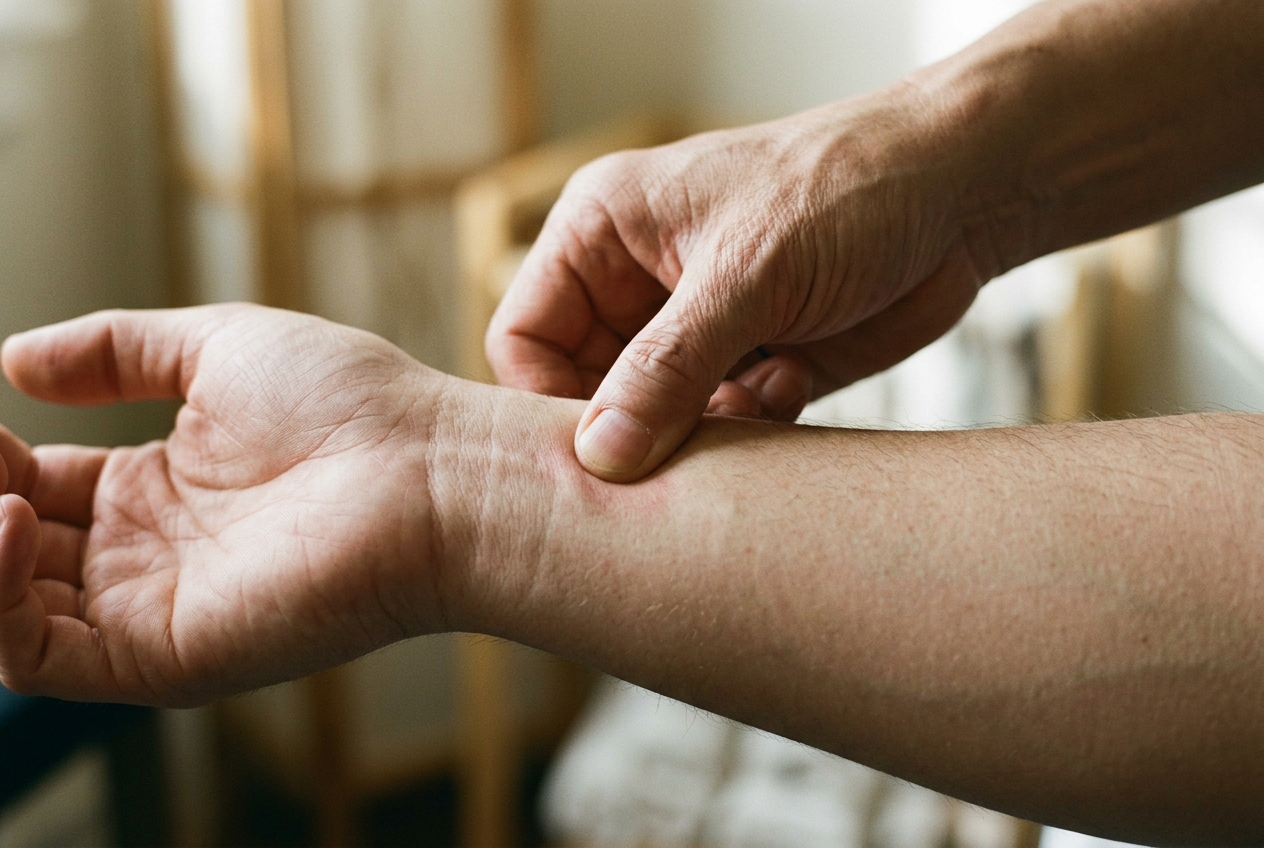
- Anatomical Landmarking: Turn your hand palm-up. Place three finger-widths across your inner wrist crease. Right at the level of the top finger, identify the central groove running between the two prominent, cord-like tendons (flexor carpi radialis and palmaris longus). Press into the center of this groove.
- The De Qi Sensation: A distinct, subtle, spreading numbness or tingling sensation that disperses into the middle fingers and upwards through the inner forearm into the center of the chest.
- Pressure Vector and Duration: Apply perpendicular, rhythmic pressing using the thumb pad for 1 to 2 minutes, gradually sinking deeper into the inter-tendon fascial bed.
- Everyday Utility: The premier anti-nausea and psycho-emotional regulator. Arrests motion sickness, acid reflux, chest tightness, palpitations associated with acute anxiety, and panic-driven hyperventilation.
5. Integrated Clinical Protocol: The Evening Somatosensory Reset
This step-by-step clinical protocol synthesizes directional Xun Fa (meridian stroking) with sustained anchor acupressure. Designed specifically for the modern individual suffering from "screen-burn" syndrome—a triad of sympathetic hyperarousal, tension headache, and digestive arrest—this 12-to-15 minute sequence can be performed comfortably at home before sleep.
+---------------------------------------------------------------------------------------+
| 15-MINUTE SOMATOSENSORY PROTOCOL: MERIDIAN GLIDE & ANCHOR INTEGRATION                 |
+---------------------------------------------------------------------------------------+
| Phase                     Actions & Pathways                         Target Timing    |
| -----                     ------------------                         -------------    |
| 1. Grounding & Warming    Friction rub of palms; warm abdominal      Minutes 00 - 02  |
|                           diaphragmatic breathing                                     |
|                                                                                       |
| 2. Upper Channel Glide    Linear Xun Fa along Large Intestine &      Minutes 02 - 06  |
|    & Anchoring (LI4, PC6) Pericardium -> Static compression                           |
|                                                                                       |
| 3. Lower Channel Glide    Linear Xun Fa along Stomach & Spleen ->    Minutes 06 - 12  |
|    & Anchoring (ST36,     Static compression on dual Yin-Yang                         |
|    LV3, SP6)              anchor points                                               |
|                                                                                       |
| 4. Propagated Sensation   Full-leg downward sweeping; still hand     Minutes 12 - 15  |
|    Integration & Rest     placement over Dantian (Lower Abdomen)                      |
+---------------------------------------------------------------------------------------+
===================================================================================
STEP-BY-STEP CLINICAL INSTRUCTIONS
===================================================================================

PREPARATION:
• Environment: Dim lighting, warm room, silence or low ambient sound.
• Position: Seated comfortably on the floor with back supported or propped up on a bed.
• Medium (Optional): A drop of neutral oil (jojoba or sesame) on the hands to eliminate
  abrasive friction during cutaneous linear glide.

PHASE 1: PREPARATORY LINEAR XUN FA (Upper Extremities)
1. Pericardium Channel Stroking (Centrifugal Glide / Outward):
   - Place the palm of your right hand flat over the inner left elbow crease.
   - With light to moderate pressure (approximately 2–4 cm/sec velocity), glide your hand
     down the center of the inner forearm, passing through the two tendons, across the
     wrist, and off the tips of the fingers.
   - Repeat this smooth, linear stroke 9 times.
2. Anchor on PC6 (Neiguan):
   - Sink your thumb pad directly into PC6. Apply sustained, pulsing pressure for 90 seconds.
   - Inhale for 4 seconds, expand the belly; exhale for 6 seconds, allowing the shoulders to drop.
3. Large Intestine Channel Stroking (Centripetal Glide / Inward):
   - Using your right hand, stroke firmly from the left index finger, over the back of the hand,
     up the muscular outer edge of the forearm to the outer elbow crease.
   - Repeat this upward linear stroke 9 times.
4. Anchor on LI4 (Hegu):
   - Hook your right thumb under the metacarpal bone at LI4. Hold with firm, deep pressure
     for 90 seconds while gently rotating your neck from side to side.
5. Symmetrical Switch:
   - Repeat the entire sequence on the opposite arm.

PHASE 2: LOWER EXTREMITY XUN FA & ANCHOR INTEGRATION
1. Stomach Channel Stroking (Downward Propulsion):
   - Place both palms flat on the lateral aspect of the thighs, just below the hips.
   - Glide firmly downward over the outer kneecaps, down the outer muscular ridge of the
     shins (tibialis anterior), across the front of the ankles, and out through the toes.
   - Repeat this sweeping, downward stroke 12 times with continuous, flowing momentum.
2. Anchor on ST36 (Zusanli):
   - Place both thumbs into ST36 on both legs simultaneously.
   - Lean your upper body slightly forward to utilize body weight. Maintain deep, rhythmic
     pressure for 2 minutes. Feel the heavy, dull ache sink into the shins.
3. Liver & Spleen Channel Stroking (Upward Medial Guidance):
   - Place your fingers at the inner borders of the big toes.
   - Glide upward across the inner arch of the foot, behind the inner ankle bones, up the
     medial calves along the rear border of the shinbones, and over the medial knees.
   - Repeat this warming, ascending stroke 9 times.
4. Dual Anchor on LV3 (Taichong) and SP6 (Sanyinjiao):
   - Compress LV3 on the top of the foot with your thumb for 60 seconds.
   - Move your thumb up to SP6 on the inner calf; hold with warm, hooking pressure for 90 seconds.
5. Symmetrical Switch:
   - Perform on both legs.

PHASE 3: INTEGRATION AND AUTONOMIC GROUNDING
• Conclude by placing both warm palms over your lower abdomen (two inches below the navel,
  the classical Lower Dantian).
• Close your eyes and remain completely still for 2 to 3 minutes.
• Notice the altered somatic landscape: the sensation of warmth in the feet, the release of
  mandibular tension, and the resurgence of spontaneous peristalsis (gurgling in the gut),
  signaling an unequivocal transition into parasympathetic recovery.
6. Safety, Precautions, and Clinical Red Lines
While manual Xun Fa and acupressure are non-invasive and exceptionally safe when practiced correctly, strict biological boundaries and clinical precautions must be maintained.
+-----------------------------------------------------------------------------------------+
| CLINICAL SAFETY & CONTRAINDICATION MATRIX                                               |
+-----------------------------------------------------------------------------------------+
| Condition / Domain        Contraindicated Points / Actions     Clinical Rationale       |
| ------------------        --------------------------------     ------------------       |
| Pregnancy (All Trimesters) LI4, SP6, LV3 (Deep acupressure);   Strong downward/oxytocic |
|                           Vigorous lower abdominal stroking    stimulus; uterine reflex |
|                                                                                         |
| Local Vascular Pathology  Avoid direct stroking over varicose  Risk of endothelial      |
| (DVT, Phlebitis)          veins, inflamed sites, aneurysms     dislodgement or thrombus |
|                                                                                         |
| Cutaneous Lesions / Skin  Avoid broken skin, open wounds,      Prevents infection and   |
| Disorders                 active dermatological eruptions      further tissue trauma    |
|                                                                                         |
| Systemic Red Flags        Replace self-care with emergency     May indicate acute, life-|
| (Acute Abdomen / Neuro)   biomedical evaluation                threatening pathology    |
+-----------------------------------------------------------------------------------------+
1. Absolute Pregnancy Contraindications
Certain acupoints possess potent down-bearing, oxytocic, and uterine-contractile actions in classical literature. Under no circumstances should deep, sustained acupressure be applied to LI4 (Hegu), SP6 (Sanyinjiao), or the lower abdominal channel pathways during pregnancy, as these points are traditionally indicated for promoting labor and resolving delayed delivery. Gentle, non-compressive, superficial skin stroking on distal extremities is permissible, but point anchoring must be avoided without licensed supervision.
2. Differentiating "Good De Qi" from Mechanical Tissue Trauma
Acupressure must never be confused with brute-force deep tissue bruising. * The Therapeutic Target (De Qi): A dull, heavy, spreading, warm ache, or a localized "sweet tenderness" that dissipates immediately when pressure is removed. The tissue should feel supported, not injured. * Nociceptive Warning Signs: Sharp, piercing, lancinating, or burning pain, or involuntary muscle guarding (the body flinching away from touch). If the recipient tenses up or holds their breath, you have exceeded the physiological threshold; reduce pressure immediately by 50%.
3. Red Flags: When to Seek Immediate Biomedical Evaluation
Xun Fa and acupressure are restorative, functional interventions. They are not substitutes for emergency medicine. Do not attempt self-treatment if experiencing: * Sudden, severe "thunderclap" headaches unlike any previously experienced. * Acute, rigid, tender-to-rebound abdominal pain accompanied by fever or persistent vomiting (suspicion of acute appendicitis, cholecystitis, or bowel perforation). * Unilateral calf swelling, heat, redness, and exquisite pain (suspicion of deep vein thrombosis / DVT—do not massage or stroke the lower extremity). * Radiating chest pain, jaw numbness, or acute shortness of breath.
7. Today's Takeaway: The Two-Minute Parasympathetic Reset
If you have only two minutes right now at your desk before closing this guide, execute this rapid somatic circuit to arrest screen fatigue and reset your autonomic tone:
+---------------------------------------------------------------------------------------+
| TWO-MINUTE AT-YOUR-DESK RESET: PC6 + LV3 RAPID PARASYMPATHETIC ACTIVATION             |
+---------------------------------------------------------------------------------------+
| TIME      ACTION                                                                      |
| ----      ------                                                                      |
| 0:00-0:30 Slide your shoes off. Place your right thumb into the valley of LV3 on the  |
|           top of your left foot. Squeeze with moderate pressure; take three slow,      |
|           audible sighs through an open mouth, releasing the jaw.                      |
|                                                                                       |
| 0:30-1:00 Take your left thumb and press deeply into PC6 on your right inner wrist     |
|           (three finger-widths above the crease, between the two tendons). Close      |
|           your eyes; inhale for 4 seconds, exhale for 7 seconds.                       |
|                                                                                       |
| 1:00-1:30 Switch sides: Press LV3 on the right foot with firm downward intent.        |
|                                                                                       |
| 1:30-2:00 Switch sides: Press PC6 on the left inner wrist while dropping the shoulders |
|           down and back.                                                              |
+---------------------------------------------------------------------------------------+
As your fingers release the points, observe the shift: the subtle deepening of your resting breath, the release of facial muscular tension, and the quiet return of somatic equilibrium. The meridians are not abstract lines etched upon ancient bronze statues; they are living, responsive highways within your own living connective tissue—waiting to be awakened by touch.
Authoritative References & Academic Resources
- World Health Organization. (2008). WHO Standard Acupuncture Point Locations in the Western Pacific Region. WHO Publications
- Langevin, H. M., & Yandow, J. A. (2002). Relationship of acupuncture points and meridians to connective tissue planes. The Anatomical Record, 269(6), 257-265. Accessible via NCBI PMC
- McGlone, F., Wessberg, J., & Olausson, H. (2014). Discriminative and affective touch: Sensing and feeling. Neuron, 82(4), 737-755. Available on NCBI PubMed
- Classical Nomenclature and Channel Topography: Acupuncture Point Classifications and Channels. Wikipedia: Acupuncture Point & Wikipedia: Qi Concepts
- Ma, S. X. (2004). Neurobiology of Acupuncture: Nitric Oxide and Microvascular Perfusion along Meridian Pathways. Evid Based Complement Alternat Med. Indexed on NCBI PubMed