Xinshu Cavity Heart Shu: Interscapular Fascial Decompression, Cardiac Shen Tranquilization, and Upper-Thoracic Kinetic Tensegrity in Classical Neigong
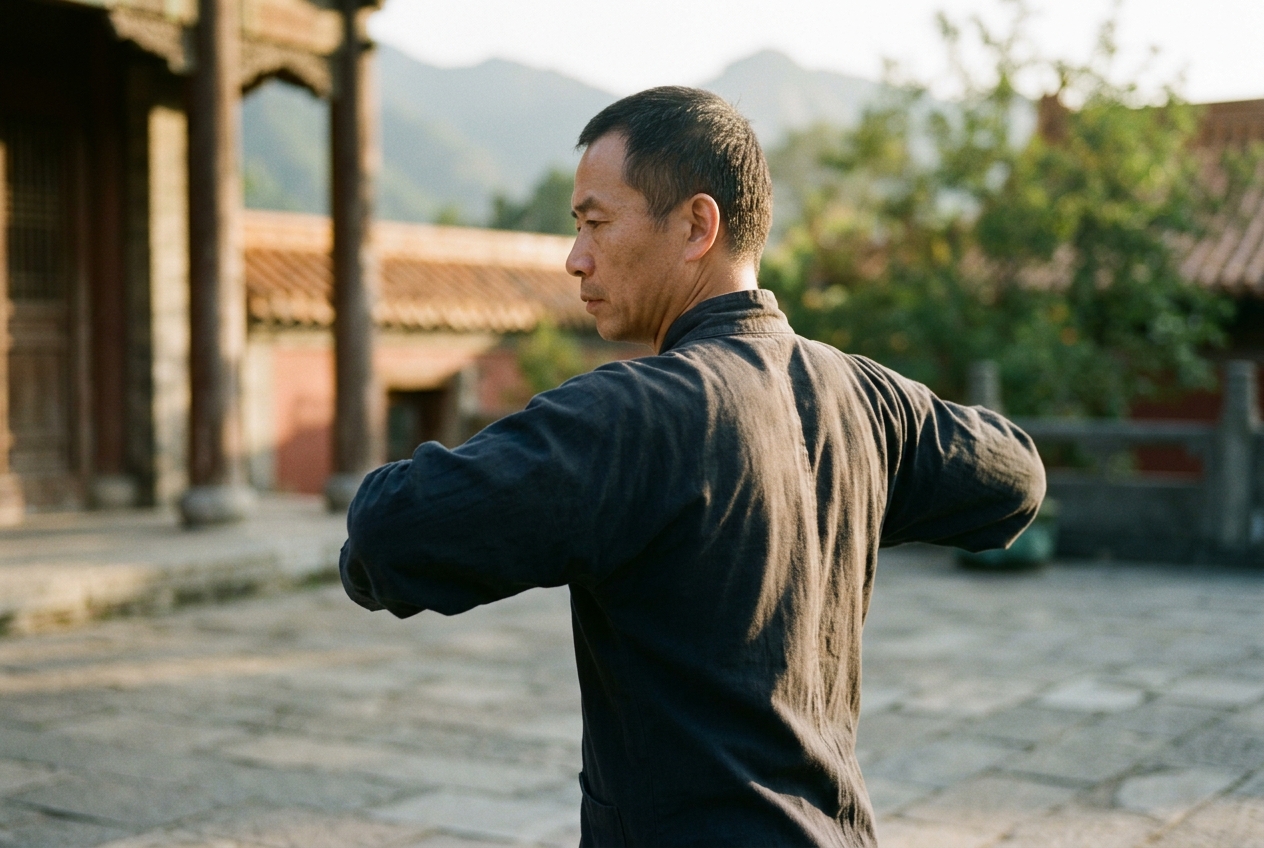
In the language of traditional Chinese medicine and classical Daoist internal cultivation (Neigong), this central interscapular region is home to an essential energetic aperture known as Xinshu (心俞, conventionally cataloged in modern acupuncture as BL15 or "Heart Shu"). The term Xin translates to the Heart—which in classical thought encompasses both the physical circulatory pump and the seat of conscious awareness—while Shu signifies a "transporting" or "dorsal conduit" point through which vital physiological energy (Qi) is conducted directly into its corresponding internal organ system. When we unlock Xinshu through conscious movement, we are clearing the dorsal gateway that bridges the physical heart, the autonomic nervous system, and the subtle mental clarity that Daoist masters termed Shen (spirit or emotional-cognitive presence).
             DORSAL VIEW: THE XINSHU (BL15) ARCHITECTURE
             ===========================================

                     C7 (Vertebra Prominens)
                              |
                     T1 -----[ ]----- T1
                             / \
           Scapula          /   \          Scapula
          +-------+   T3 --[     ]-- T3   +-------+
          |       |        |  |  |        |       |
          | Medial|   T5 --[  *  ]-- T5   | Medial|
          | Border|        |  |  |        | Border|
          +-------+        |  |  |        +-------+
                     T7 --- \   / --- T7  (Inferior Angle)
                             \ /
                              |
                    BL15 (Heart Shu / 心俞)
               [*] = 1.5 cun lateral to lower border
                     of T5 spinous process
The Neuro-Anatomical and Energetic Topography of Xinshu
To understand why this specific anatomical point exerts such profound control over systemic calm, one must appreciate its precise physical coordinates and structural mechanics. Modern anatomical reference places Xinshu precisely 1.5 cun lateral to the inferior border of the spinous process of the fifth thoracic vertebra (T5). In clinical measurement, one cun is roughly the width of the practitioner’s interphalangeal joint of the thumb; 1.5 cun equates to approximately two finger-widths from the midline of the vertebral column.
+----------------------------------------------------------------------------------------------------+
|                                    ANATOMICAL CROSS-SECTION AT T5                                  |
+--------------------------+------------------------------------------+------------------------------+
| Layer                    | Primary Musculoskeletal Structures       | Neurovascular Supply         |
+--------------------------+------------------------------------------+------------------------------+
| Superficial Fascial Tier | Trapezius (middle/lower horizontal band) | Spinal accessory nerve (CNXI)|
| Intermediate Tier        | Rhomboid major                           | Dorsal scapular nerve (C5)   |
| Deep Intrinsic Tier      | Erector spinae (longissimus/iliocostalis)| Medial branch dorsal rami    |
| Deepest Segmental Tier   | Multifidus thoracis & Rotatores          | Posterior primary rami T5    |
+--------------------------+------------------------------------------+------------------------------+
When an individual succumbs to chronic psychological distress or habitual postural collapse—such as the ubiquitous forward-head, internally rotated shoulder posture of computer-bound desk workers—the interscapular corridor suffers chronic mechanical stress. The middle and lower fibers of the trapezius and the rhomboid major are placed under unremitting eccentric strain. Over weeks and years, this sustained tension restricts local capillary micro-circulation, initiating an ischemic cascade that dehydrates the surrounding fascia. The sliding surfaces between the thoracolumbar fascia, the rhomboids, and the deeper erector spinae adhere to one another, forming dense myofascial cross-links.
Crucially, this structural constriction sits directly over the posterior primary rami of the fifth thoracic spinal nerve, lying in immediate proximity to the sympathetic chain ganglia spanning T1 through T5. These thoracic sympathetic segments provide the primary autonomic innervation to the cardiac plexus. When the dorsal corridor surrounding T5 is locked in mechanical spasm, continuous afferent nociceptive and biomechanical distress signals bombard the spinal cord. This sustained sensory input fuels a feedback loop of sympathetic nervous system hyperarousal: baseline resting heart rate climbs, peripheral vascular resistance increases, and autonomic regulatory balance is degraded, as thoroughly documented across modern biomedical literature in resources like PubMed and the National Center for Biotechnology Information (NCBI).
Within classical Chinese medical theory as synthesized in the Huangdi Neijing (The Yellow Emperor’s Inner Classic), Xinshu serves as the specific transport portal where Heart Blood (Xin Xue) is nourished and pathogenic heat is vented. The Heart is designated the "Sovereign Monarch" (Jun Zhu Zhi Guan), housing the Shen. When emotional strain, unprocessed grief, or mental overexertion causes the internal fire of the heart to flare uncontrollably (Jun Huo), the heat rises, manifesting somatically as palpitations, insomnia, chest tightness, and cognitive agitation. By physically decompressing and energetically venting Xinshu, the practitioner cools this sovereign flame, nourishes the Heart Blood, and anchors the buoyant Shen safely back down into the chest and abdomen (Zhong Dantian).
Step-by-Step Practice Guide: Decompressing the Dorsal Gateway
This gentle Neigong exercise sequence, rooted in classical Daoyin (guiding and stretching) traditions, systematically releases the connective tissues surrounding T5, opens the interscapular space, and restores fluid energy circulation through the upper back.
       =====================================================================
                      THREE PHASES OF THE XINSHU MOBILIZATION
       =====================================================================

        Phase 1: Neutral Stance         Phase 2: Scapular Glide         Phase 3: Spiral Unwinding
              (Wuji Base)               (Embracing the Tree)             (Restoring Central Axis)

                 O                              O                                O
                /|\                            /|\                              /|\
                 |                            ( | )                            / | \
                / \                            / \                              / \
           [Rooted Feet]               [Broaden Upper Back]             [Spine Elongation]
       =====================================================================
1. Foundational Posture (Ziran Wuji Zhuang)
- Base: Stand with your feet parallel, precisely hip-to-shoulder-width apart. Weight is distributed evenly across the tripod of each foot: the ball of the big toe, the base of the little toe, and the center of the heel.
- Pelvic Alignment: Slightly release the tailbone as if resting on a high stool. This softly flattens the lumbar curve without tucking the pelvis aggressively forward.
- Crown Elevation: Gently suspend the crown of the head (Baihui, GV20) toward the ceiling, creating subtle axial traction through the cervical and thoracic vertebrae while letting the chin tuck slightly.
- Arm Hang: Allow the arms to hang with the armpits slightly hollowed (Hu Kou), as if holding a soft quail egg in each axilla.
2. The Preparatory Breath: Lower Belly Awakening
- Place both palms flat over the lower abdomen, roughly two inches below the navel (the lower Dantian).
- Inhale softly through the nose for four counts, feeling the lower belly, lower ribs, and lumbar spine expand outward three-dimensionally like an inflating balloon.
- Exhale through the nose for six counts, feeling the abdominal wall gently recoil inward toward the spine.
- Perform six complete cycles, establishing relaxed diaphragmatic movement and shifting your baseline state into parasympathetic ease.
3. Dynamic Movement: "Spreading the Wings to Clear the Heart Gate"
- Initial Engagement (Inhale - 4 Counts):
- Slowly float both arms forward and upward to mid-chest height, elbows softly bent, forming a wide, gentle circle as though lightly embracing the trunk of a broad cedar tree.
- Maintain soft elbows slightly lower than your wrists, with palms facing inward toward the sternum (Tanzhong, CV17).
- The Scapular Glide and Dorsal Opening (Exhale - 6 Counts):
- Without moving your hips or bending your lower back, subtly round the upper back between T3 and T7 by reaching the fingertips forward a mere half-inch.
- Concurrently draw your shoulder blades outward and away from the spine (scapular protraction), consciously widening the interscapular muscular channel.
- Mentally direct your focus (Yi) into the T5 region (BL15). Visualize the space between your fifth thoracic vertebra and your shoulder blades spreading open like a pair of unfolding silk fans.
- Micro-Thoracic Spinal Rolling (Inhale - 4 Counts):
- Gently draw the shoulder blades back toward the spine without pinching or hiking them up.
- Allow the sternum to lift softly upward at a 45-degree angle, extending the thoracic spine by a fraction of an inch while keeping the lower back neutral.
- Feel the front ribs open while breathing fresh vitality into the center of the chest.
- Intention-Directed Breath Circulation (Yi Dao Qi Dao):
- Execute 12 continuous, unbroken repetitions of this gentle forward-and-backward glide.
- Apply the classical maxim Yi Dao, Qi Dao ("Where intention goes, the vital breath follows"). On every forward reach and exhalation, imagine warm mist washing directly out through the Xinshu points on your back, dissolving all stagnation.
+----------------------------------------------------------------------------------------------------+
|                                    TROUBLESHOOTING & CORRECTIONS                                   |
+------------------------------------+--------------------------------+------------------------------+
| Common Beginner Error              | Somatic Risk / Consequence     | Precise Micro-Correction     |
+------------------------------------+--------------------------------+------------------------------+
| Hiking shoulders toward ears       | Tightens upper trapezius       | Drop elbows down; widen      |
|                                    | and restricts vagal tone       | armpits with relaxed hollows |
+------------------------------------+--------------------------------+------------------------------+
| Arching the lumbar spine           | Bypasses thoracic spine;       | Keep tailbone anchored down; |
|                                    | causes lower-back compression  | isolate movement to T4-T6    |
+------------------------------------+--------------------------------+------------------------------+
| Aggressively pinching scapulae     | Compresses dorsal rami of T5;  | Retract scapulae gently to   |
| during retraction phase            | triggers muscular guarding     | neutral without clenching    |
+------------------------------------+--------------------------------+------------------------------+
| Shallow apical chest breathing     | Keeps sympathetic nervous      | Anchor breath down into the  |
|                                    | system in chronic fight-or-flight| lower abdomen on each inhale|
+------------------------------------+--------------------------------+------------------------------+
4. Interpreting Somatic Sensations During Release
As the myofascial bands and vascular structures around BL15 release, practitioners commonly encounter distinct somatic cues: * Pervasive Warmth: Indicates the resumption of arterial micro-perfusion and the clearing of stagnant blood flow (Xue Yu) within the deep spinal musculature. * Fine Tingling or "Electric" Sensations: Signifies the release of mechanical nerve irritation on the lateral branches of the posterior thoracic rami and local dermal nerves. * Heaviness Dissolving into Lightness: A subjective marker of lowering baseline sympathetic tone and reducing muscular hypertonicity across the rhomboid-erector complex. * Spontaneous Sighing or Yawning: A reliable indicator of autonomic shifting, showing that the parasympathetic vagal circuit is actively down-regulating central nervous system hyperarousal.
Why It Works: The Physiology of Neuro-Fascial Decompression
The physiological effects of mobilizing the Xinshu area align remarkably well with contemporary autonomic neuroscience, fascial biology, and cardiac physiology.
       =====================================================================
                      THE MECHANISM: FROM T5 TO CALM
       =====================================================================

         [Postural Strain / Stress]  ---> [Ischemic Knotting at T5 / BL15]
                     |                                   |
                     v                                   v
         [Sympathetic Overdrive]     <--- [Sustained Nociceptive Input]
                     |
         +-----------+-----------+
         |                       |
         v                       v
   [Elevated Heart Rate]   [Flattened HRV / Anxiety]

                                ||
                    (Apply Xinshu Mobilization)
                                ||
                                v
         [Fascial Decompression & Parasympathetic Vagal Tone]
                     |
         +-----------+-----------+
         |                       |
         v                       v
   [Optimal Cardiac Rhythm]  [Lowered Cortisol & Calm Shen]
       =====================================================================
1. Autonomic Balancing and Heart Rate Variability (HRV)
The heart is not an isolated mechanical engine; it operates as a dynamic, responsive node wired directly into both branches of the autonomic nervous system. The thoracic sympathetic outflow originating from T1–T5 accelerates sinoatrial node pacing, increases myocardial contractility, and elevates blood pressure. Conversely, the vagus nerve (Cranial Nerve X) acts as the primary parasympathetic brake, decelerating cardiac pacing through the release of acetylcholine.
When the interscapular region is chronically locked in spasm, mechanical tension irritates the spinal pathways, perpetuating sympathetic overdrive. By mobilizing the T5 segmental axis and engaging slow, diaphragmatic breathing with lengthened exhalations, the practitioner stimulates the pulmonary mechanoreceptors. This input travels to the solitary tract in the brainstem, which enhances cardiac vagal outflow and dampens excessive sympathetic discharge.
The immediate result is an increase in Heart Rate Variability (HRV)—specifically the High-Frequency (HF) power band, which serves as the gold-standard clinical marker for resilient autonomic regulation and emotional adaptability, as detailed across the global medical standards of the World Health Organization.
+----------------------------------------------------------------------------------------------------+
|                               AUTONOMIC BALANCE COMPARISON AT A GLANCE                             |
+--------------------------+-------------------------------------+-----------------------------------+
| Physiological Marker     | Constricted Xinshu (Sympathetic)    | Decompressed Xinshu (Vagal Mode)  |
+--------------------------+-------------------------------------+-----------------------------------+
| Dominant Autonomic Mode  | Sympathetic flight-or-fight bias    | Parasympathetic rest-and-digest   |
| Heart Rate Variability   | Low / Inflexible variability        | High / Resilient dynamic baseline |
| Interscapular Perfusion  | Ischemia, fascial cross-linking     | Hydrated, supple collagen matrix  |
| Breathing Mechanics      | Rapid, shallow apical chest pattern | Smooth, diaphragmatic expansion   |
| Subjective Mental State  | Restlessness, anxiety, brain fog    | Centered clarity, tranquil Shen   |
+--------------------------+-------------------------------------+-----------------------------------+
2. Mechanotransduction and Fascial Shear Hydration
Fascia is an active, richly innervated organ of proprioception populated by millions of Ruffini endings, Pacinian corpuscles, and interstitial mechanoreceptors. When you practice the gentle gliding movements of Daoyin, the sliding of the trapezius over the rhomboid major and the erector spinae generates mechanical shear strain.
Through a cellular process called mechanotransduction, local fibroblasts detect this mechanical shear and respond by adjusting extracellular matrix synthesis. This movement helps break down pathological fascial cross-links and stimulates the production of lubricating hyaluronic acid, restoring fluid hydration between the muscular layers. As fascial gliding returns, the continuous baseline sensory irritation fed into the spinal cord drops, helping down-regulate central nervous system hyperarousal.
3. Hemodynamics and the Coronary Axis
In traditional Chinese medicine, it is said that "The Heart governs the Blood and vessels" (Xin Zhu Xue Mai). Modern hemodynamics confirms that mechanical decompression of the thoracic cage reduces intrathoracic pressure resistance.
Rhythmic, full excursion of the diaphragm acts as an internal pump, optimizing venous return through the inferior vena cava directly into the right atrium of the heart. By smoothing the work of the circulatory pump and freeing the mechanical pathways of the upper thorax, oxygen consumption within the myocardium becomes more efficient, relieving the subjective sensation of pressure or constriction across the chest.
Classical Lineage, Historical Context, and Energetic Philosophy
The practice of regulating internal states through the back-shu transport points forms a central foundation of classical Daoist health preservation (Yangsheng) and internal martial arts.
       =====================================================================
                    THE HISTORICAL CONTINUUM OF THE PRACTICE
       =====================================================================

        Warring States Period  -->  Han Dynasty           -->  Tang Dynasty
        ---------------------       -----------                ------------
        "Zhuangzi" Daoist           "Huangdi Neijing"          Sun Simiao's Formulations
        Spinal Breathing            Systematization of BL15    Mind-Body Integration

                                           ||
                                           v
                                   Song / Ming Eras
                                   ----------------
                                   Integration into internal Neigong lineages
                                   and standing meditation (Zhan Zhuang)
       =====================================================================
The Canonical Roots
The earliest systematic categorization of the back-shu points appears in the foundational text of Chinese medicine, the Huangdi Neijing Ling Shu (Spiritual Pivot, c. 1st century BCE). In chapter 51, the text explains that the interior organ networks (Zang-Fu) project their essential energetic matrices directly onto the bilateral corridors of the Bladder Meridian along the spine. The Nan Jing (Classic of Difficult Issues, chapter 67) further notes that Yin conditions of the organs manifest as reactive changes along the dorsal Yang surfaces of the back, establishing the Back-Shu points as primary diagnostic and therapeutic conduits.
               THE CENTRAL AXIS: FRONT-MU AND BACK-SHU

                 Anterior (Yin)              Posterior (Yang)
               -----------------            ------------------
               CV17 (Tanzhong)   <=======>   BL15 (Xinshu)
               [Heart Front-Mu]              [Heart Back-Shu]
                       \                            /
                        \                          /
                         \                        /
                          v                      v
                       [THE SOVEREIGN HEART & SHEN]
Later, the renowned Tang Dynasty physician and Daoist master Sun Simiao (581–682 CE), author of Beiji Qianjin Yaofang (Essential Prescriptions Worth a Thousand Pieces of Gold), expanded on the clinical use of Xinshu. Sun Simiao recognized that physical manipulation and conscious breath guidance directed into the interscapular region could treat not only chest pain and palpitations, but also emotional disorders such as deep melancholy, sudden fright, and chronic insomnia.
In the Daoist internal alchemy tradition (Neidan), the region between the scapulae along the spine is traditionally referred to as the Jiaji Pass (夹脊关) or the "Dorsal Gate." In classic texts such as the Daozang (Daoist Canon), the Jiaji Pass is identified as the middle of the "Three Narrow Passes" (San Guan) along the spine through which vital energy must rise during internal circulation.
When the Jiaji Pass is blocked by tension, physical stiffness, or unexpressed emotions, internal energy becomes trapped in the upper chest and head, causing agitation, restlessness, and an overactive mind. Gentle physical mobilizations and mindful breathing dissolve this blockage, allowing energy to settle smoothly along the spine and establishing an energetic circuit that calms both body and mind, as explored in historical surveys on Wikipedia's Directory of Acupuncture Points and resources from the National Qigong Association.
+----------------------------------------------------------------------------------------------------+
|                              THE "THREE PASSES" (SAN GUAN) OF NEIDAN                               |
+--------------------------+-----------------------------+-------------------------------------------+
| Pass Name                | Anatomical Location         | Energetic Function                        |
+--------------------------+-----------------------------+-------------------------------------------+
| Lower Pass (Weilü Guan)  | Base of the tailbone/coccyx | Roots primal physical vitality            |
| Middle Pass (Jiaji Guan) | Interscapular spine (T5/BL15) Transports Heart Blood & harmonizes Shen   |
| Upper Pass (Yuzhen Guan) | Occiput / base of the skull | Clears the mind and nourishes brain tissue|
+--------------------------+-----------------------------+-------------------------------------------+
Somatic Self-Assessment, Safety Guidelines, and Daily Practice
+----------------------------------------------------------------------------------------------------+
|                               SOMATIC SELF-ASSESSMENT PROGRESSION                                  |
+--------------------------+-------------------------------------+-----------------------------------+
| Assessment Step          | Target Observation                  | Positive Outcome Indicator        |
+--------------------------+-------------------------------------+-----------------------------------+
| 1. Resting Breath Check  | Feel where breath naturally lands   | Deep, spontaneous descent into    |
|                          | before starting the movements       | the lower belly and lumbar ring   |
| 2. Shoulder Blade Reach  | Measure tension between the blades  | Fluid glide without grinding,     |
|                          | during gentle forward rounding      | pain, or muscular knotting        |
| 3. Sternum Elevation     | Check comfort when opening the      | Free thoracic extension without   |
|                          | chest upward at a 45-degree angle   | pinching the lower back (lumbar)  |
| 4. Post-Session State    | Observe calm, warmth, and heart rate| Slower resting pulse, quiet mind, |
|                          | after completing the full sequence  | warm sensation between the blades |
+--------------------------+-------------------------------------+-----------------------------------+
Self-Assessment Criteria
To gauge your progress in releasing tension across the Xinshu region, perform this simple assessment before and after each practice session: 1. Interscapular Palpation: Reach your right hand across the opposite shoulder and gently press your fingertips into the space between your left shoulder blade and spine (around T5). Compare the tissue texture before and after practice: does the area feel soft and yielding rather than stiff and rope-like? 2. Thoracic Mobility Check: Sit tall and slowly rotate your shoulders left and right while keeping your hips steady. Notice whether the mid-spine moves smoothly and evenly across both sides. 3. Resting Heart Rhythm Awareness: Sit quietly with your eyes closed for one minute, focusing gently on your heartbeat. Notice whether your pulse feels steady, calm, and unhurried.
Safety and Contraindications
- Avoid Aggressive Forcing: Never force your spine into deep twists or aggressive backbends. All movements should remain within a comfortable, pain-free range of motion.
- Acute Medical Care First: If you experience acute, radiating chest pain, shortness of breath, left-arm numbness, or dizziness, seek emergency medical care immediately to rule out acute cardiovascular conditions.
- Spinal Considerations: Individuals with acute thoracic disc herniations, severe osteoporosis, or recent spinal trauma should practice the breathwork in a supported seated position, avoiding dynamic spinal flexing until cleared by a healthcare professional.
Today's Practice Commitment
Tomorrow morning, before reaching for your phone or pouring your first cup of coffee, set aside eight uninterrupted minutes to explore this practice:
- Stand in the relaxed Wuji posture for one minute, grounding your weight through your feet.
- Take six slow, diaphragmatic breaths, letting the breath fill your lower abdomen and lower back.
- Perform twelve slow repetitions of the "Spreading the Wings" movement, pairing each forward reach with a smooth exhalation and your focus resting gently on the T5 area.
- Finish by standing quietly for two minutes with your hands resting gently over your lower belly.
Notice the subtle changes throughout your morning: whether your breath drops naturally deeper into your body, your shoulders sit lower and wider, and your mind feels grounded, steady, and clear.