Xie Bu Resting Stance Qigong: Spiral Pelvic Torsion, Lateral Fascial Kinetic Loading, and Shaoyang Gallbladder Meridian Activation in Classical Daoyin
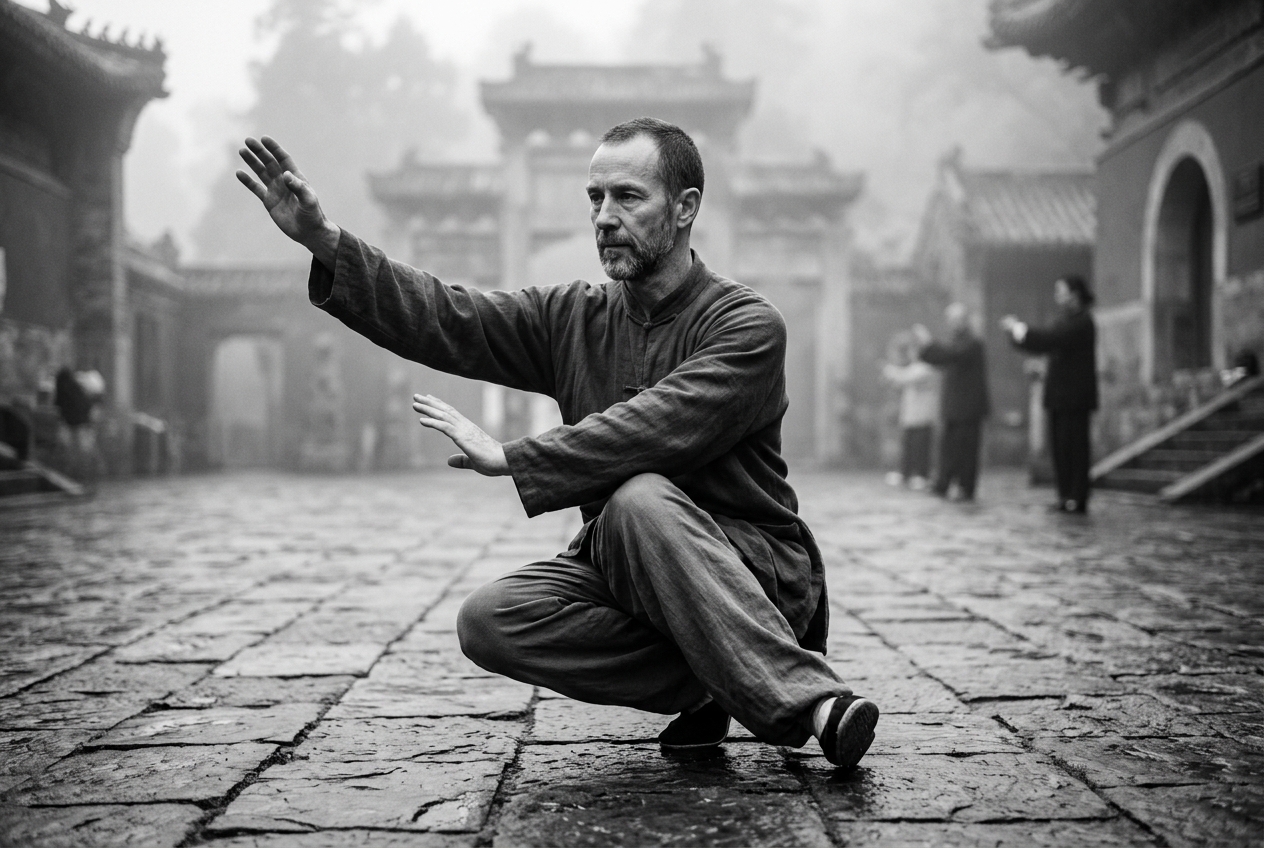
When practiced as internal cultivation (Neigong), this stance transforms the lower body into a helical accumulator of elastic energy. Practitioners utilize it to gently compress and stimulate the pelvic floor, regulate the autonomic nervous system through diaphragmatic breathing into the lower abdomen (the lower Dantian, located approximately two inches below the navel), and unlock rotational mobility in the hips that modern sedentary lifestyles systematically erode.
Step-by-Step Somatic Practice Guide
To safely experience the structural and energetic benefits of Xie Bu, approach the stance with mindfulness of your joint alignment, particularly around the knees and lumbar spine.
          [ Crown Suspended: Baihui GV-20 ]
                        |
                 (Spinal Axis)
                        |
            [ Song Kua: Sunk Pelvis ]
                 /             \
    (Front Leg: Flat Foot)   (Rear Leg: Knee Nestled)
           |                         |
     [ Plantar Base ]         [ Rear Ball / Metatarsals ]
1. The Setup and Stance Ingress
- Neutral Preparation: Begin in a standard shoulder-width stance (Wuji), with your feet parallel, knees soft, and shoulders dropped away from the ears. Inhale smoothly through your nose, letting your belly expand.
- The Step-Behind (Cross Step): Shift seventy percent of your weight onto your left foot. Step your right foot diagonally behind your left leg, placing the ball of the right foot on the ground roughly twelve to eighteen inches behind and slightly to the left of your front heel. Keep the rear right heel lifted high off the floor throughout.
- Pelvic Sinking (Song Kua): As you exhale, fold at the inguinal creases—the deep hip joints (Kua)—and sink your pelvis vertically downward. Do not pitch your torso forward. Descend until your right knee nests snugly into the popliteal fossa (the hollow back crease) of your left knee.
- Arm Positioning: Bring your palms together at heart level in a relaxed prayer position, or place your palms gently over your lower abdomen to feel the breath expanding against your thighs.
2. Breath and Dynamic Integration
- Descent Phase (Inhalation / Compression): As you sink into the crossed stance, inhale deeply into your lower abdomen and pelvic floor over a count of four seconds. Feel the spiraling compression around the hip rotators and the gentle pressurization of the lower belly against the crossed thighs.
- Static Coiling (Holding the Root): Remain anchored in the low stance for three to five full breath cycles. Keep the crown of your head lifted as if suspended by an invisible thread from the ceiling—a classical alignment cue known as Xu Ling Ding Jin (虚领顶劲)—while allowing your tailbone to sink heavily toward the earth (Chen Kua).
- Ascent Phase (Exhalation / Elastic Release): Press firmly into the floor through the ball of the rear foot and the entire tripod of the front foot (heel, first metatarsal, fifth metatarsal). Exhale smoothly as you unwind the spiral, rising back up to the neutral standing position. Repeat on the opposite side.
Common Postural Misalignments and Somatic Corrections
| Postural Fault | Biomechanical & Energetic Consequence | Anatomical Correction |
|---|---|---|
| Front Knee Valgus Collapse | Dangerous lateral shearing force across the medial collateral ligament (MCL) and meniscus. | Externally rotate the front hip; track the front kneecap directly over the second and third toes. |
| Rear Calcaneus Dropping | Collapses the plantar arch, destroys torsional spring loading, and jams the rear ankle joint. | Keep the rear heel elevated vertically; drive down exclusively through the metatarsophalangeal joints. |
| Lumbar Hyperextension (Anterior Pelvic Tilt) | Pinches the lumbar facet joints and breaks intra-abdominal pressure connection with Mingmen. | Relax the sacrum downward (Chui Wei Lu); draw the lower abdomen slightly inward and upward to neutralize the pelvis. |
| Knee Separation Gap | Dissipates helical tension across the fascia lata and destabilizes the pelvic foundation. | Nest the rear patella directly into the front popliteal fossa, creating a unified cross-thigh brace. |
Somatic Sensations: What to Look For
As you sustain the coiled architecture of Xie Bu, observe the following somatic benchmarks: * Deep Thermal Warming in the Lateral Gluteals: A spreading warmth across the outer hips indicates active microvascular perfusion and the release of chronic tension in the deep hip rotators. * Elastic Spring-Tension along the Outer Thigh: Rather than muscular burning, aim to feel a taut, rubber-band sensation spanning from the iliac crest down the lateral leg to the ankle. * Abdominal Gravitational Rootedness: A distinct feeling of heavy, grounded fullness in the lower belly, accompanied by a natural slowing of the resting heart rate. * Pulsing Release upon Rising: When uncrossing the legs, a sudden flush of cool lightness followed by rushing warmth through the calves and feet signifies meridian and vascular decompression.
Why It Works — The Biomechanical Science and Fascial Tensegrity
To understand why Xie Bu holds such a revered place in somatic traditions, we must look beyond classical metaphors and examine the mechanical architecture of human movement. Modern orthopedic and fascial science, documented across research indexed on the National Center for Biotechnology Information (NCBI PubMed), reveals that human posture operates on the principle of biotensegrity—a structural model where rigid compressive struts (bones) are suspended within a continuous, tensioned network of fascia, tendons, and muscles.
       [ Lateral Myofascial Line (TFL & IT Band) ]
                          \
                           \  (Helical Pelvic Wringing)
                            \
        [ Spiral Line Coiling: Gluteus Medius / Piriformis ]
                            /
                           /  (Metatarsal Ground Rooting)
                          /
        [ Deep Plantar Fascia & Triceps Surae Loading ]
1. Coxofemoral Rotation and Deep Rotator Loading
Xie Bu forces the pelvis into asymmetrical, closed-chain coxofemoral rotation. The front leg undergoes relative flexion, adduction, and external rotation, while the rear leg undergoes extreme plantarflexion and relative internal rotation under compressive load. This unique joint configuration places the deep external rotators of the hip—including the piriformis, obturator internus, obturator externus, superior and inferior gemelli, and quadratus femoris—into an elongated, eccentric loading state. Concurrently, the gluteus medius and tensor fasciae latae (TFL) are stretched across the lateral border of the ilium. This eccentric stretch under load stimulates the Golgi tendon organs, signaling the central nervous system to downregulate chronic hypertonicity in the deep hip stabilizers.
2. The Spiral and Lateral Myofascial Kinematics
In the framework of fascial anatomy, Xie Bu directly winds the Lateral Line and the Spiral Line of the body. When the thighs cross and the rear knee nests into the front popliteal space, the iliotibial (IT) band and the vastus lateralis are pulled taut like a bowstring. This coiling action recruits the dense, multi-layered sheets of the thoracolumbar fascia (TLF) in the lower back. The pelvic twist tensions the posterior layer of the TLF against the latissimus dorsi and the contralateral gluteus maximus, creating a dynamic kinetic helix. When rising out of the stance, this stored elastic strain energy is returned via passive recoil, training the neuromuscular system to generate power without relying solely on metabolic muscular contraction.
3. High-Compression Metatarsal Rooting
The elevation of the rear calcaneus places the rear foot into active terminal metatarsophalangeal extension. This activates the windlass mechanism of the plantar fascia, stiffening the longitudinal arch of the foot and transferring compressive ground reaction forces directly through the first and second metatarsal heads. This high-compression rooting stimulates the deep intrinsic muscles of the foot, enhancing proprioceptive feedback loops that calibrate balance and spatial awareness in the cerebellum.
4. Autonomic Regulation and Intra-Abdominal Dynamics
Because the crossed thighs press lightly into the lower anterior abdominal wall during the bottom phase of the stance, diaphragmatic breathing creates a rhythmic modulation of intra-abdominal pressure (IAP). When the respiratory diaphragm descends against the compressed visceral bowl, it exerts a gentle massaging pressure on the abdominal aorta, the inferior vena cava, and the celiac nerve plexus. This rhythmic pumping increases vagal nerve tone, promoting parasympathetic dominance, lowering systemic cortisol, and optimizing heart rate variability (HRV).
Traditional Chinese Medicine Meridian Energetics & Organ Dynamics
In classical Chinese medical theory and the foundational texts of the World Health Organization Traditional Medicine guidelines, physical postures are not merely muscular exercises; they are specific energetic conduits designed to regulate the flow of Qi (vital energy) and blood (Xue) through the channel network (Jing Luo).
         [ Gallbladder Meridian: Lateral Descent ]
                            |
                     (Huantiao GB-30)
                            |
                     (Fengshi GB-31)
                            |
                     (Zulinqi GB-41)
                            |
      <====== Reciprocal Flushing of Liver Jueyin ======>
                            |
          [ Heel Vessels: Yin & Yang Qiao Mai ]
1. Foot Shaoyang Gallbladder Meridian Activation
Xie Bu is regarded as the primary postural activator of the Foot Shaoyang Gallbladder Meridian (Zú Shàoyáng Dǎnjīng 足少阳胆经), a pathway that traverses the lateral aspects of the head, torso, hips, thighs, and lower legs. The deep lateral stretch of the stance specifically targets three critical acupuncture points along this vessel: * Huantiao (GB-30, 环跳): Located in the posterosuperior aspect of the greater trochanter. The profound coxofemoral rotation opens this major gateway, dissipating stagnant "Wind-Damp" pathogens and relieving chronic sciatic tension. * Fengshi (GB-31, 风市): Located on the lateral midline of the thigh. The tensioning of the iliotibial band stimulates this point, reinforcing the strength of the sinews (Jin) and dispelling latent neuromuscular fatigue. * Zulinqi (GB-41, 足临泣): Located on the dorsum of the foot in the depression distal to the junction of the fourth and fifth metatarsal bones. As the rear foot extends and roots, this stream-wood point and confluence point of the Dai Mai (Girdle Vessel) is activated, harmonizing the lateral kinetic chain.
2. Reciprocal Flushing of the Liver Jueyin Vessel
The Gallbladder Meridian forms an interior-exterior functional pairing with the Foot Jueyin Liver Meridian (Zú Juéyīn Gānjīng 足厥阴肝经), which courses along the inner inseam of the thighs and wraps around the external genitalia. As Xie Bu powerfully stretches the lateral Shaoyang pathway, it simultaneously compresses and stabilizes the medial Jueyin pathway. When the stance is held, blood flow through the medial femoral vessels is momentarily restricted; upon rising and releasing the posture, a sudden hemodynamic surge flushes the Liver channel. In Chinese medical epistemology, this action relieves Liver Qi stagnation, smooths emotional irritability, and nourishes the ocular and tendon tissues governed by the Wood element.
3. Integration with the Heel Vessels (Qiao Mai)
The asymmetrical weighting of the feet—with the front foot rooted flat and the rear foot balanced on the metatarsals—directly engages two of the Eight Extraordinary Vessels (Qi Jing Ba Mai): the Yang Qiao Mai (Yang Motility/Heel Vessel) and the Yin Qiao Mai (Yin Motility/Heel Vessel). The elevated rear heel charges the Yang Qiao Mai, which governs muscular tone along the lateral and posterior aspects of the leg, promoting vigilance, structural alertness, and upward spring. Meanwhile, the grounded front foot anchors the Yin Qiao Mai along the medial malleolus, cultivating grounded calmness and stability. Xie Bu harmonizes these opposing polarities, balancing the kinetic and energetic equilibrium between the inner and outer leg.
Classical Lineage & Historical Context
To truly understand Xie Bu, one must view it within the overarching taxonomy of classical Chinese physical culture. In the canon of Chinese martial arts and therapeutic Daoyin, stances are not static poses; they are dynamic manifestations of the Five Elements (Wu Xing) embodied through the Wu Bu (五步, the Five Classical Stances):
- Ma Bu (马步, Horse Stance): Earth Element — Symmetrical lateral rooting and pelvic stabilization.
- Gong Bu (弓步, Bow Stance): Wood Element — Linear forward propulsion and sagittal drive.
- Pu Bu (仆步, Crouching/Drop Stance): Water Element — Deep medial descent and hip abduction.
- Xu Bu (虚步, Empty Stance): Fire Element — Evasive lightness, deceptive weight shifting, and rapid kicking.
- Xie Bu (歇步, Resting/Crossed Stance): Metal/Transitional Element — Torsional compression, low-profile evasion, coiled elastic energy, and joint consolidation.
       [ Gong Bu: Forward Expansion ] <=======> [ Pu Bu: Medial Drop ]
                                    \   /
                                  [ Ma Bu ]
                                    /   \
        [ Xu Bu: Front Emptiness ] <=======> [ Xie Bu: Torsional Root ]
Lineage Evolution: From Daoyin to Neijia
The crossed-leg seated posture traces its roots back to ancient medical manuscripts discovered in the Han Dynasty tomb at Mawangdui (circa 168 BCE), known as the Daoyin Tu (Guide to Guiding and Pulling). These early silk illustrations depicted figures crossing their limbs to guide breath into the lumbar region and alleviate hip ailments.
During the Ming (1368–1644 CE) and Qing (1644–1912 CE) dynasties, the posture was codified into martial systems such as Shaolin Northern Long Fist, Baguazhang (Eight Trigram Palm), and Chaquan. In the internal martial traditions (Neijiaquan), master practitioners recognized that Xie Bu was the ultimate mechanism for developing Song Kua (the ability to release and mobilize the hip sockets). In Baguazhang, where constant spiraling and circular stepping are paramount, Xie Bu became the essential posture for dropping the body's center of mass beneath an opponent's guard while storing elastic torque for sudden rotational strikes.
In therapeutic Daoyin lineages preserved by institutions like the National Qigong Association and documented in broad historical surveys on Wikipedia: Meridian (Chinese medicine), the posture was prescribed to scholars and sedentary officials to counteract the debilitating stagnation caused by prolonged sitting, restoring vitality to the lumbar spine and pelvic basin.
Daoyin Breath Mechanics and Alchemical Integration
The internal efficacy of Xie Bu relies upon the exact coordination of breath (Tu Na, 吐纳) and the intention (Yi) directing the movement of energy through the lower abdomen.
[ Ingress: Tu (Exhale) / Sinking ] ===> Pelvic Floor Drops, Tailbone Settles
                                            |
[ Static Hold: Shun Fu Shi Breathing ] ===> Mingmen Opens, Dantian Pressurized
                                            |
[ Egress: Na (Inhale) / Rising ]   ===> Helical Recoil, Crown Ascends (Baihui)
1. Abdominal Respiration (Shun Fu Shi Hu Xi)
During the static phase of Xie Bu, practitioners practice Natural Abdominal Respiration: * The Inhalation: As air enters through the nose, the respiratory diaphragm contracts downward, expanding the lower abdomen three-dimensionally—anteriorly against the crossed thighs, laterally into the flanks, and posteriorly into the lumbar region (Mingmen, Gate of Life). * The Exhalation: As the diaphragm ascends, the abdominal wall gently recoils, drawing the navel slightly toward the spine while maintaining grounded weight in the pelvic floor.
2. Wringing the Lower Dantian
Because the crossed-leg geometry torques the pelvic bowl, each breath cycle exerts a rotational wringing effect upon the Lower Dantian. In Daoist internal alchemy (Neidan), this rotational pressure is described as "wringing the silk cloth," a process that squeezes out energetic turbidity from the lower abdominal organs and consolidates original essence (Jing) into refined vital breath (Qi).
Today's Practice Commitment: A 5-Minute Daily Regimen
To integrate the restorative and structural benefits of Xie Bu into your modern routine, commit to the following five-minute micro-session every morning before starting your workday:
+-------------------------------------------------------------------------+
|                  FIVE-MINUTE DAILY XIE BU PROTOCOL                      |
+-------------------------------------------------------------------------+
|  Minute 1: Warm-up standing hip circles and ankle rotations.            |
|  Minute 2: Right-leg forward Xie Bu — Hold for 5 deep, slow breaths.    |
|  Minute 3: Neutral Wuji standing pause — Observe the energetic flush.   |
|  Minute 4: Left-leg forward Xie Bu — Hold for 5 deep, slow breaths.     |
|  Minute 5: Concluding Wuji stance — Palms over navel, 6 settling breaths.|
+-------------------------------------------------------------------------+
- Warm-Up (1 Minute): Stand in a comfortable stance. Perform five gentle hip circles in each direction, followed by rolling the ankles to prepare the metatarsals and Achilles tendons.
- Right-Lead Xie Bu (1 Minute): Step the left foot behind the right, descend smoothly into the crossed stance, and hold the position for five full, diaphragmatic breaths (approximately 45 to 60 seconds). Focus your intention on sinking your tailbone while keeping the crown of your head lifted.
- Standing Transition (1 Minute): Rise smoothly, uncross the legs, and stand quietly in neutral Wuji posture. Close your eyes and observe the profound sensation of heat and tingling coursing through the outer hips, knees, and feet.
- Left-Lead Xie Bu (1 Minute): Step the right foot behind the left, sink down into the posture, and repeat the five breath cycles on the opposite side, ensuring equal torsional balance across both hips.
- Integration and Closing (1 Minute): Return to standing, place your right palm over your lower abdomen with your left palm resting on top, and take six slow, grounding breaths into your center. Notice the enhanced clarity of mind, the grounded stability in your legs, and the feeling of light, spacious ease along your spine.
By anchoring this ancient, spiraling stance into your daily physical practice, you bridge thousands of years of classical internal wisdom with cutting-edge movement science—unlocking a resilient, energized, and gracefully balanced body.