Weizhong Cavity Supporting Middle: Popliteal Fascial Decompression, Posterior Kinetic Chain Unwinding, and Lumbosacral Ground Force Transmission in Classical Neigong
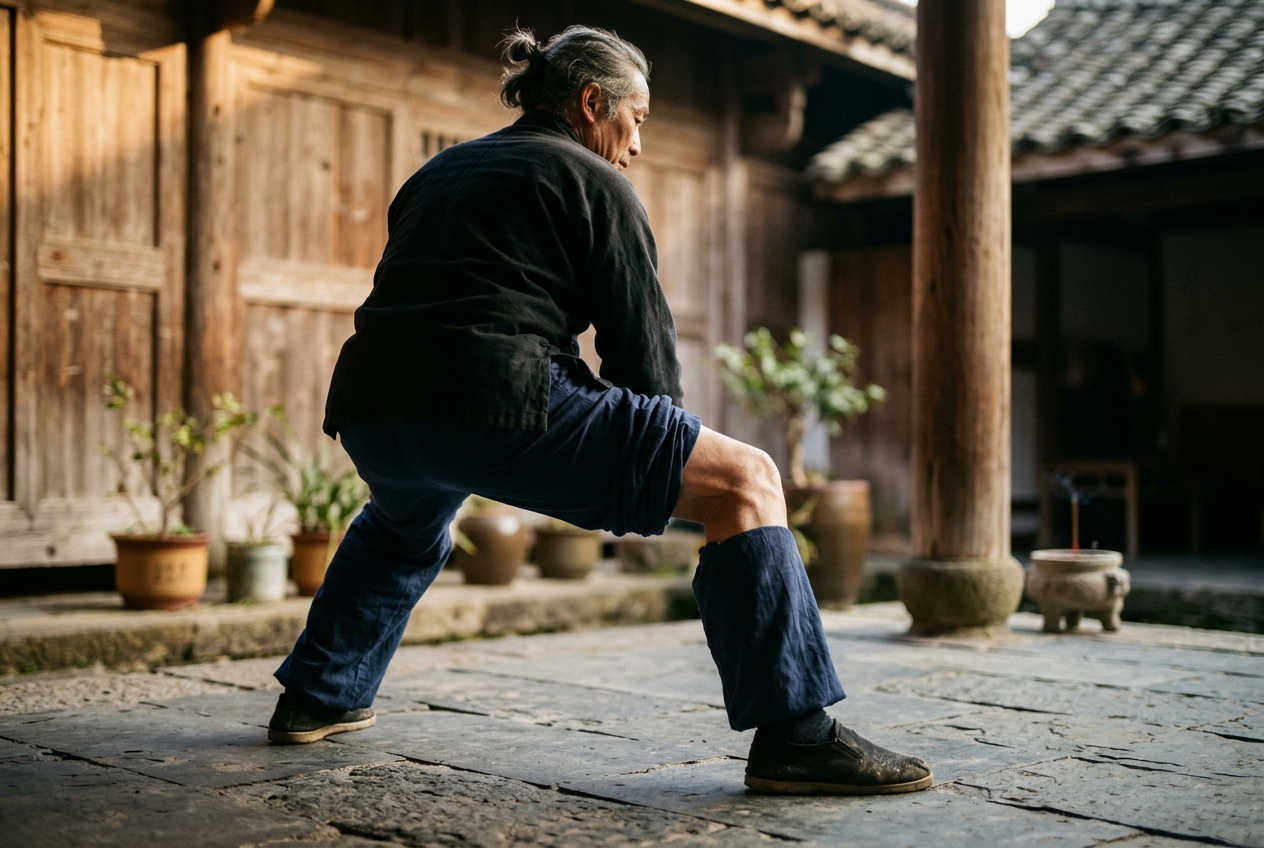
That subtle posterior knee hollow is the physical locus of one of the most critical structural and energetic gateways in somatic practice: the Weizhong cavity (委中, BL40), known traditionally as the "Supporting Middle." In the disciplines of classical Neigong, Daoyin, and internal martial arts (Neijiaquan), this precise anatomical crossroads is revered not merely as an acupuncture point, but as the master mechanical fulcrum governing whole-body structural integration, lumbosacral liberation, and bi-directional kinetic transmission.
What Is This Practice? — Plain English First
At its core, this practice is the deliberate, conscious release and structural expansion of the soft tissue space located directly behind the knee crease. In traditional Chinese medicine and Daoist internal cultivation, this anatomical site is designated as Weizhong (BL40), the 40th point on the Foot Taiyang Bladder Channel. In plain anatomical terms, it corresponds precisely to the center of the popliteal fossa—the diamond-shaped diamond formed by the intersection of the hamstring tendons above and the calf muscles below.
When practitioners of internal movement systems like Taijiquan, Baguazhang, or Zhan zhuang (standing meditation) speak of "sinking the weight" or "loosening the waist," they are describing a somatic chain reaction that begins with the micro-unwinding of this single posterior hinge. For millennia, classical treatises have preserved a foundational clinical and martial aphorism: Yao Bei Wei Zhong Qiu (腰背委中求)—"For disorders and blockages of the lumbar spine and back, seek Weizhong."
Rather than treating lower back pain, chronic postural collapse, or restricted martial power at the site of the spine itself, internal cultivation systems manipulate the tension envelope of the popliteal space. Opening this posterior knee gateway relieves tension along the continuous elastic myofascial sheet running from the soles of your feet to the crown of your head, restoring pelvic neutrality, relieving nerve compression, and establishing an unbroken bridge of force with the earth.
Step-by-Step Practice Guide: Popliteal Unwinding and Kinetic Rooting
The following progressive somatic protocol is designed for self-directed integration without external mechanical apparatus. Practice in bare feet or flat, thin-soled shoes on a stable surface.
1. Structural Architecture and Baseline Alignment
- Foot Placement: Position your feet parallel, precisely hip-to-shoulder width apart. Ensure the lateral borders of your feet are parallel to one another, which places the second toes pointing directly forward.
- Tripod Grounding: Distribute your plantar pressure evenly across the three structural pillars of each foot: the tuberosity of the calcaneus (heel), the base of the first metatarsal (ball of the foot), and the base of the fifth metatarsal (outer ball).
- Ascending Awareness: Scan upward. Note whether your knee joints are locked backward in extension (genu recurvatum). If they are, consciously acknowledge the compressive force running across your anterior patellofemoral joints and the corresponding pinching in your lower back.
2. The Popliteal Expansion Protocol (Opening Weizhong)
- The Micro-Softening Cue: Do not bend your knees into a forward squat. Instead, initiate a subtle, micro-fractional softening at the exact horizontal crease behind the knee. Visualize the two vertical tendon boundaries—the biceps femoris on the outside and the semimembranosus/semitendinosus on the inside—widening horizontally away from each other.
- Filling the Hollow: As the tendons soften, cultivate the somatic sensation of "filling" or "inflating" the popliteal fossa from the inside out. In classical Neigong, this is described as making the back of the knee round, buoyant, and cavernous (Song Xi).
- Plumbline Vectoring: Ensure your patellae remain positioned directly above the bubbling spring point (Yongquan, KD1), located in the depression between the second and third metatarsal-phalangeal joints, never migrating forward past the toes.
3. Pelvic Suspension and Lumbar Liberation (Song Kua and Song Yao)
- Releasing the Inguinal Crease (Song Kua): With the popliteal space expanded, allow the bilateral inguinal folds at the front of your hips to soften and fold inward, as if preparing to sit lightly on the edge of a tall barstool.
- Dropping the Sacral Plummet (Song Yao): Allow your tailbone and sacrum to drop vertically under the influence of gravity. Avoid the common error of aggressively tucking your pelvis under via rectus abdominis tension; simply let the posterior myofascial release at BL40 permit the sacrum to hang freely, flattening excessive lumbar lordosis and opening the Mingmen (GV4, Gate of Life) intervertebral space between L2 and L3.
4. Micro-Spiral Rooting and Bi-Directional Ground Reaction Force
- Bilateral Helical Engagement: While maintaining parallel foot placement, generate an internal, isometric rotational torque: gently screw the femoral heads outward (Kua Kai) while maintaining firm grounding through the medial base of the big toes.
- Dynamic Kinetic Pathway: Feel this micro-spiral travel through the opened popliteal diamond, down the tibia and fibula, through the calcaneus, and anchoring into Yongquan (KD1).
- Bi-Directional Elasticity: As vertical gravitational mass drains downward through the decompressed tibial nerve corridor, experience the reciprocal upward elastic rebound (Ground Reaction Force) ascending from the earth, through the calves, across the unconstrained Weizhong cavity, up the hamstrings, through the thoracolumbar fascia, and elevating the vertex of the skull (Baihui, GV20).
Common Beginner Mistakes and Precision Corrections
- Mistake 1: Confusing Knee Softening with Quadriceps Overload. Beginners often collapse the knees forward, turning a fascial release into an exhausting isometric quadriceps exercise.
- Correction: Maintain vertical shins. The kneecaps should not push forward over the toes; rather, the pelvis drops vertically because the back of the knee opens backward and widens.
- Mistake 2: Forced Posterior Pelvic Tucking. Clinicians frequently observe students clamping the gluteal muscles and pulling the pubic bone upward, reversing the lumbar curve artificially.
- Correction: Keep the gluteal muscles completely flaccid. The leveling of the pelvis must be an effortless gravitational consequence of hamstring lengthening and popliteal decompression.
- Mistake 3: Medial Knee Collapse (Valgus Strain). Softening the joint without helical torque often causes the knees to cave inward toward the midline.
- Correction: Actively engage the lateral boundary of the popliteal fossa (biceps femoris tendon) by cueing the knees to track precisely over the middle toes, preserving arch integrity.
Somatic Markers and Biomarkers of Correct Execution
- Thermal Waves (Vasodilation): A distinctive, spreading warmth radiating down the calf into the sole of the foot and up the posterior thigh, indicating the release of mechanical compression on the popliteal artery.
- Micro-Pulsations and Tingling (Neuromobilization): A fine, vibrational sensation traveling along the path of the tibial nerve, reflecting the elimination of perineural tethering.
- Somatic "Weightlessness" of the Lumbar Spine: An instantaneous sensation of relief across the L4-L5-S1 junction, often described as if a compressed mechanical spring in the lower back has suddenly expanded.
- Plantar Suction: The sensation of the arch of the foot (Yongquan) drawing upward while the heel and forefoot grip the earth like the roots of an ancient cedar tree.
Why It Works — The Body Science
To understand the profound somatic and martial efficacy of unlocking the Weizhong cavity, we must bridge the gap between classical channel theory and contemporary biomechanics, functional fascial anatomy, neurodynamics, and hemodynamics.
                  ANATOMICAL DIAMOND OF THE POPLITEAL FOSSA

                         Superomedial Boundary:
  Superolateral Boundary:      Semimembranosus &
   Biceps Femoris Tendon       Semitendinosus Tendons
             \                       /
              \                     /
               \   [WEIZHONG / BL40]
                \  • Tibial Nerve  /
                 \ • Popliteal Vein
                  \• Popliteal Art./
                  /                 \
                 /                   \
                /                     \
  Inferolateral Boundary:      Inferomedial Boundary:
   Lateral Gastrocnemius       Medial Gastrocnemius
   & Plantaris Muscles         Muscle
1. Topographical Anatomy of the Popliteal Diamond
The popliteal fossa is a structurally complex, fat-filled, diamond-shaped inter-muscular space situated on the posterior aspect of the knee joint. Its anatomical boundaries comprise: * Superolateral border: The tendon of the biceps femoris (the lateral hamstring). * Superomedial border: The tendons of the semimembranosus and semitendinosus (the medial hamstrings). * Inferolateral border: The lateral head of the gastrocnemius, supplemented by the slender, vestigial plantaris muscle. * Inferomedial border: The robust medial head of the gastrocnemius. * Anatomical Floor: Formed superiorly by the popliteal surface of the femur, centrally by the oblique popliteal ligament, and inferiorly by the dense investing fascia of the popliteus muscle.
Passing longitudinally straight through the central axis of this diamond—precisely where BL40 is mapped—lies the vital neurovascular bundle: the tibial nerve (the major terminal branch of the sciatic nerve), situated most superficially; the intermediate popliteal vein; and the deepest, intimate to the bony floor, the popliteal artery.
2. Fascial Tensegrity and the Superficial Back Line
In the paradigm of myofascial meridians developed by modern researchers such as Thomas Myers in Anatomy Trains, the body operates not as an assembly of isolated motors, but as a continuous, tensionally integrated network (biotensegrity). The entire posterior kinetic chain is organized along the Superficial Back Line (SBL), which corresponds with near-total anatomical fidelity to the classical Foot Taiyang Sinew Channel (Zu Taiyang Jingjin).
The SBL connects the plantar fascia and short toe flexors, wraps under the calcaneus, ascends via the Achilles tendon through the gastrocnemius-soleus complex, crosses the popliteal space into the hamstrings, anchors into the sacrotuberous ligament, traverses the thoracolumbar fascia and erector spinae, and continues over the epicranial aponeurosis to attach at the frontal ridge of the skull.
Within this continuous tensegral loop, the knee is the only joint capable of substantial flexion and extension that interrupts an otherwise planar sheet. When the knee is locked in hyperextension, the gastrocnemius heads and hamstring insertions approximate and cross-bind under severe compressive tension. This functional shortening locks the entire kinetic line.
Because the hamstrings attach to the ischial tuberosities, chronically shortened popliteal tissue forces the pelvis into posterior torsion or, when compensated along the kinetic chain, precipitates an exaggerated anterior pelvic tilt. By consciously widening and softening BL40, the practitioner eliminates this focal snag in the myofascial fabric. The hamstrings are permitted to lengthen eccentrically without active strain, instantly liberating the sacrotuberous ligament and allowing the pelvic bowl to find its neutral center of gravity (Song Kua).
3. Neurodynamic Mobilization of the Sciatic-Tibial Neural Tract
Chronic low-back pathology and sciatica are frequently rooted in impaired neural mobility. As the sciatic nerve emerges from the infrapiriform foramen of the greater sciatic notch, it traverses the posterior compartment of the thigh before bifurcating at the superior apex of the popliteal fossa into the tibial and common fibular nerves.
When the popliteal fossa is subjected to chronic structural compression—as seen in prolonged sedentary sitting or habitual standing with hyperextended knees—the dense popliteal fascia adheres to the neural epineurium. This creates mechanical tethering. Whenever the spine moves, the tibial and sciatic nerves cannot glide freely within their physiological excursion corridors. This retrograde mechanical tension pulls directly on the L4, L5, and S1 nerve roots as they exit the intervertebral foramina, provoking local inflammation, protective muscular spasm of the lumbar erectors, and radiating pain.
Decompressing the Weizhong cavity is an organic form of neurodynamic flossing (neuromobilization), as validated across modern orthopedic literature indexed on NCBI PubMed. Expanding the popliteal space increases the volume of the fossa, releases perineural adhesions, eliminates distal tethering, and permits the L4-S1 nerve roots to rest unencumbered within their spinal canals. This provides the direct, elegant physiological proof for the classical mandate Yao Bei Wei Zhong Qiu.
4. Hemodynamics, Drainage of Metabolic Stasis, and Parasympathetic Tonus
Deep within the popliteal fossa, the popliteal artery provides critical collateral circulation to the knee joint via five genicular branches. When the knee is hyperextended or hyper-constricted, these vascular conduits are pinched against the firm fibrous floor of the popliteus muscle and oblique popliteal ligament. This creates localized hemodynamic resistance, elevating systemic vascular tone and impairing venous return via the popliteal vein.
Releasing this joint cavity restores unobstructed laminar blood flow through the lower extremity. In traditional Chinese energetic mechanics, this is described as the downward clearing of pathogenic Heat, Wind, and stagnant Blood (Xue Yu) from the upper body and back into the earth gateway of Yongquan (KD1). Clinically, this transition is accompanied by a marked activation of the parasympathetic nervous system: the baroreceptors detect normalized peripheral resistance, heart rate variability (HRV) increases, intra-abdominal pressure regulates, and the practitioner experiences a profound state of relaxed, alert groundedness (Song).
Classical Lineage & Historical Context
The mastery of the Weizhong cavity is not a modern anatomical innovation; it is the preserved culmination of over two millennia of rigorous clinical observation and internal somatic cultivation.
The Canonical Foundations: Huangdi Neijing
The theoretical foundations of Weizhong are first articulated in the foundational canon of Oriental medicine, the Huangdi Neijing (Yellow Emperor's Inner Classic), composed between the 3rd and 1st centuries BCE. In the Lingshu (Miraculous Pivot, Chapter 10), the Foot Taiyang Bladder channel is delineated as the longest, most extensive conduit in the human body, possessing 67 classical points that begin at the inner canthus of the eye (Jingming, BL1), ascend over the cranium, traverse the occiput, split into dual bilateral pathways flanking the entire spinal column, and converge precisely in the popliteal fossa at Weizhong (BL40) before descending through the calf to the little toe.
Within the Five Phase (Wu Xing) taxonomy, BL40 is classified as the He-Sea (合穴) and Earth Point of the Bladder Water Channel. The Nan Jing (Classic of Difficult Issues) establishes that He-Sea points are the energetic convergences where the qi of the channel plunges deeply inward to unite with the internal organs (Zang-Fu), making them the primary drainage hubs for counterflow qi, internal heat, and profound systemic stagnation.
Gao Wu and the Four Command Points
During the Ming Dynasty (1368–1644 CE), the renowned physician Gao Wu codified centuries of clinical wisdom into the rhythmic, memorizable verses of the Si Zong Xue Ge (Four Command Points Song), published in his 1529 treatise Zhengjiao Zhizhen Fu (Ode to the Standard Clarification of Acupuncture). In this seminal work, four points were selected as possessing unconditional dominance over specific anatomical quadrants: 1. Zusanli (ST36) for the abdomen and gastrointestinal tract. 2. Lieque (LU7) for the head and posterior neck. 3. Hegu (LI4) for the face and sensory orifices. 4. Weizhong (BL40) for the lumbar region, sacrum, and back (Yao Bei Wei Zhong Qiu).
This clinical attribution was recognized not merely as a local neurological reflex, but as a systemic truth: any energetic or structural pathology manifesting along the dorsal axis of the body—from occipital headaches and chronic thoracic tightness to acute lumbago and sciatica—finds its ultimate mechanical and energetic relief valve at the popliteal center. The World Health Organization Traditional Medicine guidelines continue to recognize the canonical role of BL40 in managing dorsal musculoskeletal conditions globally.
Integration into Daoist Daoyin and the Internal Martial Arts
Parallel to the clinical medical tradition, Daoist hermits and martial adepts incorporated popliteal awareness into somatic movement and meditative arts. In the Mawangdui Daoyin Tu (silk scrolls excavated from Han Dynasty tombs dating to 168 BCE), several exercises illustrate deep, unweighted knee softening designed to stretch the posterior kinetic chain and drain turbid pathogenic factors (Zhuo Qi) out of the spine and into the ground.
With the development of internal martial arts (Neijiaquan)—most notably Taijiquan, Xingyiquan, and the stationary standing methods of Zhan zhuang popularized by Wang Xiangzhai in the 20th century—the Weizhong cavity was transformed from a passive treatment site into an active engine of kinetic power. In internal martial mechanics, martial energy (Jin) must be "rooted in the feet, developed in the legs, directed by the waist, and expressed through the fingers."
If the Weizhong cavity is locked, compressed, or collapsed, this continuous kinetic stream is instantly severed at the knee joint. Opening BL40 acts as an uninterrupted hydraulic sleeve that allows the ground reaction force generated by the foot's contact with the earth to rebound smoothly through the posterior myofascial chain, charging the dantian and discharging explosive power (Fajin) through the spine with zero mechanical drag.
Today's Practice Commitment: The 7-Minute Popliteal Decompression Protocol
To convert the theoretical and anatomical foundations of this treatise into permanent neuroplastic and myofascial adaptations, commit to the following structured 7-minute protocol each morning before consuming stimulants or sitting at a workspace:
- Minutes 0:00 – 2:00: Static Interoceptive Calibration. Stand barefoot in parallel stance. Close your eyes. Spend two full minutes actively releasing habitual knee hyperextension. Breathe down to the lower abdomen (Dantian), consciously visualizing the diamond of the popliteal fossa widening, hydrating, and filling with warm, buoyant space.
- Minutes 2:00 – 5:00: Micro-Spiral Standing Meditation (Zhan Zhuang). Bring the arms into a rounded embrace in front of the chest as if holding a large paper lantern. Maintain the popliteal expansion while subtly engaging the outward helical torque of the thighs (Kua Kai). Feel the pelvic floor and sacrum suspend downward while the spine lengthens upward. Observe the thermal waves radiating down your calves and into your heels.
- Minutes 5:00 – 7:00: Dynamic Stepping and Kinetic Transfer. Transition into slow, deliberate walking. With every step, ensure that as the heel strikes and the foot rolls to the tripod base, the popliteal fossa behind that knee remains spacious, soft, and uncompressed. Refuse to lock the knee joint as your bodyweight transitions over the leg.
Notice how your lumbar spine feels over the subsequent four hours of your day. By returning repeatedly to the popliteal fulcrum, you dismantle chronic postural strain, unlock the deep energetic reservoirs of the Bladder and Kidney channels, and anchor your somatic structure in effortless, resilient alignment with the earth.