Warm Needle Therapy: Navigating Trans-Needle Thermal Conduction, Deep Articular Bi Remodeling, and Precision Acupressure Protocols
If you wake in the morning to find your knees stiff, recalcitrant, and resistant to motion until the room warms, or if damp winter rain brings a dull, gnawing ache deep within your lumbar spine that ordinary heating pads cannot reach, you are confronting what Traditional Chinese Medicine (TCM) defines as Cold-Damp Bi (impediment) syndrome. In clinical practice, millions of individuals experiencing degenerative knee osteoarthritis, chronic lumbar spondylosis, or post-traumatic joint contracture describe an identical sensation: a coldness that feels as though it has physically lodged within the marrow and cartilage.
Standard topical thermal remedies—such as warm towels, electric blankets, or transdermal patches—frequently fail because human cutaneous adipose tissue possesses a high insulating capacity. Thermal energy applied to the skin surface diffuses laterally across the stratum corneum and subcutaneous vascular plexus, losing the vast majority of its caloric power before reaching deep intra-articular structures.
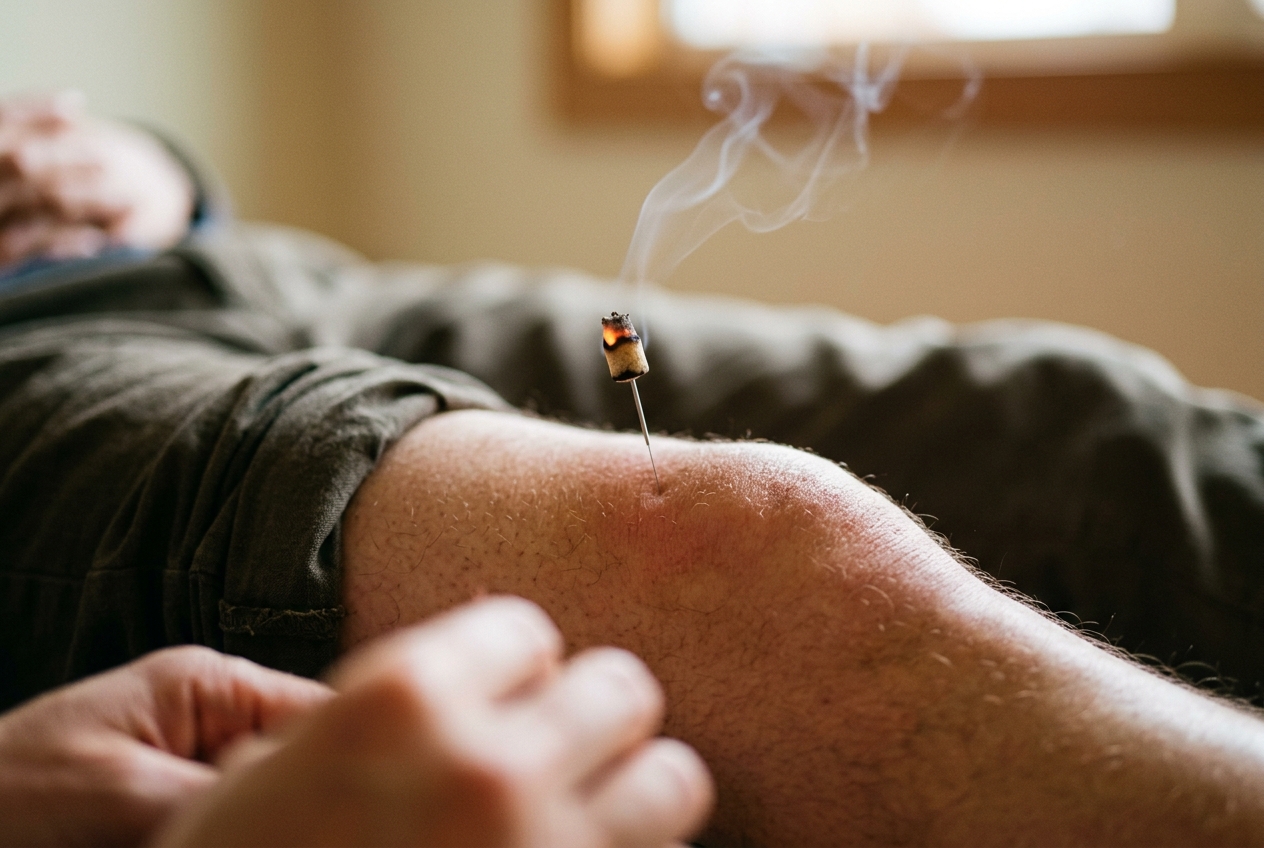
Warm Needle Therapy (Wen Zhen Jiu, 温针灸)—an ingenious synthesis of metallic filiform needle insertion and combusting Artemisia vulgaris (moxa)—solves this thermodynamic dilemma. By turning a surgical-grade stainless steel needle into an invasive thermal conductor, this classical modality bypasses the thermal resistance of the skin barrier, delivering focused, deep-tissue hyperthermia directly to the synovial capsules, periosteum, and myotendinous junctions.
+----------------------------------------------------------------------------------------------------+
|                                    THERMODYNAMIC HEAT TRANSFER                                     |
|                                                                                                    |
|  Superficial Heat Pack:                                                                            |
|  [Heat Source] ===> [Skin (Stratum Corneum)] ===> (Lateral Capillary Dissipation 85-90%)          |
|                                                     \---> Deep Joint Capsule (< 1°C elevation)     |
|                                                                                                    |
|  Warm Needle Therapy (Wen Zhen Jiu):                                                               |
|  [Combusting Moxa Sphere]                                                                          |
|            |                                                                                       |
|            v (Conductive Fourier Transfer via Metallic Core, k ≈ 15-45 W/m·K)                      |
|  [Needle Shaft] ===> Transpierces Cutaneous Adipose Insulation Barrier                             |
|            |                                                                                       |
|            +===> Intracapsular & Periosteal Hyperthermia (38.5°C - 41.0°C Target)                 |
|                  - Local Vasodilation & Synovial Fluid Viscosity Reduction                         |
|                  - Downregulation of IL-1β, TNF-α & Substance P                                    |
|                  - Activation of Transient Receptor Potential Vanilloid (TRPV1) Desensitization   |
+----------------------------------------------------------------------------------------------------+
Classical Lineage & Thermodynamic Mechanics: From the Shanghan Lun to Fourier's Conduction
The Classical Lineage
The therapeutic concept of combining acupuncture with thermal stimulation originated during the late Eastern Han Dynasty. Master Zhang Zhongjing documented the rudimentary mechanics of applying heat to needles in his seminal clinical treatise, the Shanghan Lun (Treatise on Cold Damage Diseases, c. 200 CE). Zhang cautioned against inappropriate heating in acute febrile states while identifying its profound restorative utility in systemic Yang depletion and pathogenic cold stagnation.
During the Ming Dynasty, the methodology achieved clinical maturity. Physician Yang Jizhou, in the monumental Zhenjiu Dacheng (The Great Compendium of Acupuncture and Moxibustion, 1601), codified Wen Zhen Jiu as a distinct sub-discipline. Yang detailed how affixing a small cylinder or sphere of refined aged moxa wool (Artemisia argyi) to the needle handle allowed the "vital warmth to penetrate through the steel directly to the source of cold stagnation," establishing it as the gold-standard protocol for intractable arthralgia, sinew contracture, and visceral vacuity cold.
Biophysical Contrast: Metallic Core Diffusion vs. Superficial Radiative Moxibustion
To understand why warm needle acupuncture produces clinical outcomes unreachable by surface thermal therapy, one must examine the governing biophysical mechanisms. Standard indirect moxibustion operates primarily through non-contact electromagnetic radiation, emitting near-infrared (0.75–1.5 μm) and mid-infrared (1.5–5.0 μm) radiation along with minor convective heat. However, the extinction coefficient of human skin is extremely high; approximately 95% of radiative infrared is absorbed within the initial 0.5 to 2.0 millimeters of the epidermis and dermis.
In contrast, Wen Zhen Jiu leverages direct metallic thermal conduction governed by Fourier’s Law of Heat Conduction:
$$q = -k \nabla T$$
Where: - $q$ is the local heat flux density ($\text{W/m}^2$), - $k$ represents the thermal conductivity coefficient of the needle alloy ($\approx 15\text{--}18\text{ W/(m}\cdot\text{K)}$ for surgical austenitic stainless steel, and up to $400\text{ W/(m}\cdot\text{K)}$ for pure silver needles), - $\nabla T$ is the spatial temperature gradient established between the combusting moxa terminal ($500\text{--}650^\circ\text{C}$ combustion core) and the internal biological tissue ($37.0^\circ\text{C}$).
========================================================================================
                      BIOPHYSICAL COMPARISON: THERMAL MODALITIES
========================================================================================
 PARAMETER                 SUPERFICIAL MOXIBUSTION       WARM NEEDLE THERAPY (WEN ZHEN)
----------------------------------------------------------------------------------------
 Primary Transfer Mode     Radiant Infrared / Convection Metallic Conduction (Fourier)
 Depth of Thermal Peak     0.5 mm – 2.0 mm (Epidermis)   15.0 mm – 50.0 mm (Intra-articular)
 Tissue Target             Cutaneous nociceptors         Synovial membrane, ligaments, bone
 Vascular Reaction         Superficial erythema          Deep arteriolar vasodilation
 Cytokine Modulation       Mild systemic response        Potent local IL-1β/TNF-α inhibition
 Viscosity Impact          Negligible on synovial fluid  Reduces joint fluid shear viscosity
========================================================================================
Clinical trials indexed on NCBI PubMed confirm that the filiform needle shaft creates an efficient thermal bridge. While the cutaneous surface is preserved below the burn threshold ($42.0\text{--}43.0^\circ\text{C}$), the target intra-articular and myofascial zones $20\text{--}40\text{ mm}$ deep experience a sustained, therapeutic temperature elevation to $38.5\text{--}41.0^\circ\text{C}$. This controlled local hyperthermia triggers: 1. Enzymatic & Synovial Fluid Normalization: Lowers the dynamic viscosity of hyaluronic acid in synovial fluid, relieving joint friction and morning stiffness. 2. Biochemical Anti-Inflammation: Downregulates pro-inflammatory markers (Interleukin-1β, Tumor Necrosis Factor-α, Matrix Metalloproteinases-1 and -3) that degrade type-II collagen in osteoarthritis, as highlighted in modern systematic reviews of warm needle acupuncture. 3. Nociceptive Desensitization: Sustained thermal input at $40^\circ\text{C}$ induces temporary desensitization of Transient Receptor Potential Vanilloid-1 (TRPV1) receptors and accelerates the metabolic clearance of Substance P and bradykinin.
The Meridian Pathways: A Journey Through the Articular Matrix
To apply these principles effectively, whether via clinical needles or non-invasive home thermal acupressure, one must follow the anatomical terrain of the three primary meridian pathways that command the structural integrity of the lower back, hips, and knees.
                    THE LOWER LIMB MERIDIAN HIGHWAYS

   [ Anterolateral Matrix ]                  [ Posterolateral Axis ]
      Stomach Pathway                           Bladder Pathway
      (Foot-Yangming)                           (Foot-Taiyang)
             |                                         |
             v                                         v
   Along the rectus femoris                  Down the paraspinal muscles,
   and quadriceps tendon                     through the sacroiliac joint,
             |                               crossing the gluteal fold
             v                                         |
   ST35 (Dubi / Lateral Knee Eye)                      v
   (Soft hollow lateral to patellar tendon)  BL23 (Shenshu / Kidney Shu)
             |                               (1.5 cun lateral to L2 spine)
             v                                         |
   Descends the anterior shinbone                      v
   along the tibialis anterior               Popliteal fossa down through
             |                               the gastrocnemius belly
             v                                         |
                                             Gallbladder Pathway
                                             (Foot-Shaoyang)
                                                       |
                                                       v
                                             GB34 (Yanglingquan)
                                             (Depression anterior/inferior
                                              to the fibular head)
1. The Stomach Meridian of Foot-Yangming: The Anterior Structural Shield
The Stomach channel governs the anterior kinetic chain, muscular flesh (Ji Rou), and the nourishing biomechanics of the lower extremities. Originating below the orbit of the eye, it descends across the jaw, neck, thorax, and abdomen, passing over the inguinal region into the anterior thigh. It travels directly down the belly of the rectus femoris muscle, crosses the suprapatellar bursae, and penetrates the knee joint through the soft indentations on either side of the patellar tendon.
From the knee, the channel traces the outer edge of your shinbone—precisely along the tibialis anterior muscle that grows taut and fatigued after hours of standing—before traversing the dorsal crest of the foot and terminating at the lateral nail bed of the second toe. Pathologically, when Cold-Damp invades Yangming, the anterior knee locks, the quadriceps mechanism weakens, and fluid accumulates within the suprapatellar pouch.
2. The Gallbladder Meridian of Foot-Shaoyang: The Lateral Pivot & Governor of Sinews
The Gallbladder channel dictates lateral stability, rotational movement, and the global flexibility of the bodily sinews (Jin). It weaves down the side of the cranium and neck, flows over the shoulder crest, zigzags across the lateral rib cage, and plunges through the deep gluteal musculature behind the greater trochanter.
It descends along the lateral aspect of the thigh along the iliotibial tract, entering the knee region through the prominent bony landmark of the fibular head. It runs down the lateral compartment of the lower leg, passes in front of the lateral ankle bone, and finishes at the fourth toe. When Cold-Damp settles into Shaoyang, the lateral ligaments turn rigid, hip rotation is compromised, and the connective bands of the leg lose their elasticity.
3. The Bladder Meridian of Foot-Taiyang: The Great Dorsal Anchor
The Bladder meridian represents the longest, most extensive protective channel in the body, commanding the entire posterior myofascial chain. Starting at the inner corner of the eyes, it vaults over the crown of the head and divides into two parallel paraspinal columns running down the back. These tracks run along the strong spinal erector muscles, cross the sacrum and buttocks, track through the exact center of the hamstring muscles on the back of the thigh, pass through the middle of the knee crease, descend the calf muscles, curve around the outer ankle bone, and end at the little toe.
Because Taiyang presides over the body's exterior defensive boundary (Wei Qi), an invasion of pathogenic cold directly strikes this channel, locking the lumbar spine in spasm, chilling the paraspinal tissues, and causing radiating sciatic discomfort.
3 Key Points for Clinical Warm-Needling and Home Thermal Acupressure
Understanding point location and needle depth according to the World Health Organization Standard Acupuncture Point Locations allows both practitioners and self-care users to target tissue with structural precision.
========================================================================================
                      ANATOMICAL TARGETING & THERMAL DOSIMETRY
========================================================================================
 POINT CODE / NAME     DEEP ANATOMICAL TARGET         DEQI SENSATION      THERMAL GOAL
----------------------------------------------------------------------------------------
 ST35 (Dubi)           Infrapatellar fat pad,         Dull distension,    Melt intra-articular
                       Synovial joint capsule         spreading warmth    cold effusions
----------------------------------------------------------------------------------------
 GB34 (Yanglingquan)   Common peroneal nerve arbor,   Tingling heaviness, Release tendon spasm,
                       Peroneus longus tendon         lateral radiation   restore sinew glide
----------------------------------------------------------------------------------------
 BL23 (Shenshu)        Quadratus lumborum,            Deep grounding,     Tonify renal Yang,
                       Erector spinae, L2 nerve root  visceral warmth     expel axial cold
========================================================================================
1. Dubi (ST35) — "Calf’s Nose" / Lateral Knee Eye
- Everyday Physical Landmark: Sit comfortably on a chair with your knee bent at a 90-degree angle. Place your hands on the sides of your kneecap and slide your fingers downward until you feel the thick, rope-like tendon connecting the bottom of your kneecap to your shinbone (the patellar tendon). Immediately to the outside edge of this tendon, you will sink into a deep, distinct, soft depression that resembles an eye or a calf's nostril.
- The Sensation (Deqi): When properly located and engaged, you will experience a deep, dull ache that spreads under the kneecap, accompanied by a subtle feeling of pressure or spreading warmth inside the joint cavity.
- Clinical & Thermal Application:
- Clinical Needle Depth: Perpendicular or slightly oblique-medial insertion, $25\text{--}35\text{ mm}$ deep into the joint space beneath the patella. A 2-centimeter section of high-density pure moxa wool is secured to the needle handle and ignited at its base, transferring thermal energy directly to the infrapatellar fat pad.
- Home Thermal Acupressure Protocol: Warm a smooth jade or basalt stone in hot water ($45\text{--}48^\circ\text{C}$), dry it thoroughly, and press the rounded tip firmly into ST35. Maintain a firm, inward and upward angled pressure for 2 to 3 minutes while performing gentle micro-rotations.
- Daily Indications: Relieves osteoarthritic knee grinding (crepitus), dispels morning joint stiffness, reduces fluid swelling, and alleviates deep weather-related knee pain.
2. Yanglingquan (GB34) — "Yang Mound Spring" / Hui-Meeting Point of the Sinews
- Everyday Physical Landmark: Slide your hand down the outside of your lower leg, starting from the side of your knee. About one inch below the joint line, you will encounter a distinct, hard, marble-sized bony knob (the head of the fibula). Move your finger slightly forward and downward into the soft muscular hollow resting just below this bony head.
- The Sensation (Deqi): Produces an electric, tingling heaviness that often radiates along the outer side of the calf down toward the ankle.
- Clinical & Thermal Application:
- Clinical Needle Depth: Perpendicular insertion, $25\text{--}40\text{ mm}$ deep, traversing the proximal fibers of the peroneus longus muscle adjacent to the common peroneal nerve branches. Combusting moxa affixed to the handle transmits continuous warmth that relaxes hypertonic tendon insertions.
- Home Thermal Acupressure Protocol: Using your thumb reinforced by your index finger, apply sustained, direct pressure into the depression. While maintaining steady inward pressure, perform small, deep circular motions at a tempo of roughly two rotations per second for 2 minutes until a clear sensation of muscular softening emerges.
- Daily Indications: Alleviates stiffness and tight bands in the legs, eases iliotibial (IT) band friction, supports recovery from ankle and knee sprains, and calms chronic lower-body tension.
3. Shenshu (BL23) — "Kidney Back-Shu Point"
- Everyday Physical Landmark: Place your hands on your hips with your thumbs pointing around toward your spine. Your thumbs will naturally rest on your lower back at roughly the level of your navel. Slide your thumbs inwards toward the center of your back until you hit the firm columns of muscle on either side of the spine. BL23 is located directly in the groove of those muscular columns, about two finger-widths (1.5 inches) away from the central backbone, directly level with the lower edge of the second lumbar vertebra.
- The Sensation (Deqi): A broad, deep, grounding soreness that can radiate outward across the lower back and deep into the pelvic basin.
- Clinical & Thermal Application:
- Clinical Needle Depth: Perpendicular-medial insertion, $20\text{--}30\text{ mm}$ deep into the erector spinae and quadratus lumborum muscle planes. Warm-needle combustion here warms the physiological root of systemic Yang, dispersing deep core coldness.
- Home Thermal Acupressure Protocol: Form your hands into loose fists and use the flat, heated surface of your knuckles to press into both sides of the spine simultaneously. Apply firm, sustained forward pressure while rocking your pelvis slowly forward and back for 3 minutes, generating deep friction warmth.
- Daily Indications: Counteracts chronic dull lower back ache, mitigates physical exhaustion and cold lumbar fatigue, supports vitality, and warms cold extremities.
Complete Restorative Protocol: The "Cold-Stiff Joint Decompression" Sequence
This integrated sequence combines directional acupoint activation with sustained thermal conduction to clear joint congestion, restore synovial flow, and relieve spinal tension.
+----------------------------------------------------------------------------------------------------+
|                         CHRONIC COLD-DAMP DECOMPRESSION PROTOCOL                                  |
|                                                                                                    |
|  Step 1: Axial Core Activation                                                                     |
|  [BL23 / Shenshu] ======> 3 Minutes Heated Palm/Knuckle Friction                                   |
|                           Posture: Seated or Prone with Lumbar Towel Support                       |
|                           Goal: Ignite Systemic Core Yang and Relax Erector Spinae                 |
|                                                                                                    |
|  Step 2: Sinew Release & Kinetic Channeling                                                        |
|  [GB34 / Yanglingquan] => 2 Minutes Firm Rotary Friction per Leg                                   |
|                           Goal: Decongest Peroneal Nerve Arbor & Release Iliotibial Tension        |
|                                                                                                    |
|  Step 3: Intra-Articular Thermal Infusion                                                          |
|  [ST35 / Dubi] =========> 3 Minutes Sustained Heated Jade/Compress Infiltration                    |
|                           Goal: Dissolve Infrapatellar Gel Stagnation & Restore Synovial Glide     |
|                                                                                                    |
|  Total Treatment Window: 8–10 Minutes | Optimal Frequency: Daily in Evening or on Cold Mornings    |
+----------------------------------------------------------------------------------------------------+
Step-by-Step Instructions
- Ergonomic Positioning & Preparation: Sit comfortably on the edge of a supportive chair with feet flat on the floor, or lie supine with a rolled bolster placed beneath your knees to relax tension in the sciatic nerve and hamstring tendons. Ensure the room is warm and free from direct drafts.
- Phase 1 — Igniting the Lumbar Core at BL23 (3 Minutes): - Rub your palms vigorously together for 15 seconds until intense friction heat builds in the skin. - Immediately place your heated palms over BL23 (Kidney Back-Shu) on your lower back. - Press firmly with your knuckles into the paraspinal muscular groove, performing vigorous up-and-down scrubbing motions across the L2–L4 region. Continue for 3 minutes until a sustained, deep radiant glow spreads across your lumbar region.
- Phase 2 — Mobilizing the Sinews at GB34 (2 Minutes Per Leg): - Shift your focus to the outer knee. Locate GB34 in the depression beneath the head of the fibula. - Apply direct, steady, perpendicular thumb pressure. Once you feel a deep, dull ache, introduce slow, circular friction. - Maintain pressure for 2 full minutes on each leg, breathing deeply to encourage the relaxation of the lateral myofascial chains.
- Phase 3 — Decompressing the Articular Capsule at ST35 (3 Minutes Per Knee): - Locate ST35 (Dubi) in the lateral indentation beside your patellar tendon. - Using a warmed stone, thermal herbal compress, or your reinforced thumb, press into the soft depression with an inward and slightly upward vector toward the center of your kneecap. - Maintain firm, uninterrupted pressure for 3 minutes per knee, visualizing the warmth penetrating deep behind the patella to melt stagnant fluid and ease structural friction.
Thermodynamic Safety Parameters, Burn Mitigation & Clinical Sense
While Wen Zhen Jiu and its non-invasive thermal analogues offer remarkable relief for chronic conditions, working with thermal therapy requires clear boundaries, precise temperature control, and a disciplined approach to safety.
========================================================================================
                      SAFETY MATRIX: HEAT & PRESSURE DOSIMETRY
========================================================================================
 PARAMETER                 SAFE PARAMETERS               DANGER ZONE / CONTRAINDICATED
----------------------------------------------------------------------------------------
 Skin Surface Temp         39.0°C – 42.0°C               > 43.5°C (Epidermal protein denaturation)
 Pressure Intensity        Dull, grounding ache (4-6/10) Sharp, lancinating, bruising (> 7/10)
 Moxa Ash Control          Protective silver shield used Direct exposed drop risk on skin
 Joint Presentation        Pale, cold, stiff, achy       Red, swollen, hot, acute inflammation
 Sensation Integrity       Intact thermal feedback       Peripheral neuropathy / loss of sensation
 Obstetric Boundaries      Local points safe             Strong pelvic downbearing points (BL60, LI4)
========================================================================================
1. Clinical Ash Management and Burn Prevention
In clinical warm needle therapy, the temperature of the combusting moxa terminal ranges between $500^\circ\text{C}$ and $650^\circ\text{C}$. To eliminate the risk of falling ash burning the patient's skin, practitioners employ specialized protective measures: - Protective Thermal Disks: A non-flammable, aluminum-lined or silver-cardboard shield is positioned around the base of the needle, resting directly above the skin to catch stray embers. - Moxa Density & Cohesion: Moxa wool must be compressed into a uniform, high-density cylinder or sphere and ignited at the base closest to the needle handle. This ensures the combustion front moves outward, preventing structural collapse during treatment. - Cutaneous Thresholds: The skin surface beneath the needle must not exceed $42.5^\circ\text{C}$ to prevent thermal injury and epidermal protein denaturation.
                      CLINICAL NEEDLE HEAT-SHIELD ASSEMBLY

                            ( ( ( Moxa Smoke ) ) )
                               [====== Moxa ======]  <-- Combusting Moxa Wool ($500-650°C$)
                                    ||======||
                                    ||  ||  ||
                              ======||======||======
                             /                      \
                            |   [ Metallic Handle ]  | <-- Heat Enters Shaft
                            |                        |
                             \======================/
                                        ||
                                        ||  <-- Filiform Needle Shaft ($k \approx 15\text{-}18\text{ W/m}\cdot\text{K}$)
                         ________________|________________
                        [=== Thermal Cardboard Shield ===] <-- Intercepts Falling Ash
                        ==================================
                        ---------------------------------- <-- Skin Surface ($T \le 42.5^\circ\text{C}$)
                                     |  ||  |
                                     |  ||  |  <-- Invasive Conduction (Fourier Law)
                                     |  ||  |
                                     \__||__/
                                        \/

                              [ Deep Joint Capsule ]   <-- Intracapsular Hyperthermia ($38.5\text{-}41.0^\circ\text{C}$)
2. Sensation Feedback and Acupressure Safety
When practicing self-care thermal acupressure, pressure should remain comfortably firm and produce a pleasant, grounding sensation (rated 4 to 6 out of 10 on a discomfort scale). If you experience sharp, lancinating, pinching, or bruising pain, you are pressing too aggressively or compressing a superficial cutaneous nerve against bone. Always ease back to a sustainable, dull pressure.
3. Red Flags & Absolute Contraindications
- Acute Inflammatory Flare-ups vs. Cold-Damp Bi: Never apply warm needle therapy or heated acupressure to a joint that is hot to the touch, visibly red, shiny, and acutely inflamed (such as during an acute gouty arthritis flare or septic joint infection). Heat applied to an active hot condition increases vascular effusion, accelerates tissue swelling, and worsens pain.
- Peripheral Neuropathy: Individuals with advanced diabetic peripheral neuropathy or impaired thermal sensation must not undergo home thermal self-treatment without professional supervision, as their protective sensory feedback loops are blunted.
- Pregnancy Precautions: While local knee points like ST35 are benign, intense thermal stimulation and deep acupressure on powerful descending points (such as LI4, SP6, or BL60) are strictly contraindicated during pregnancy due to their capacity to stimulate pelvic circulation and induce uterine downbearing.
- Professional Referral: If you experience sudden joint locking, visible deformities, unremitting nocturnal pain, or systemic symptoms such as fever, seek immediate evaluation from an orthopedic physician or licensed acupuncturist rather than relying on self-treatment.
Today's Takeaway: The Two-Minute Desk-Side Knee Restoration
You do not need an entire acupuncture clinic or hours of preparation to break up cold-damp stagnation. Before closing this guide, take two minutes right now to restore joint comfort and circulation.
+----------------------------------------------------------------------------------------------------+
|                         YOUR 2-MINUTE THERMAL RESTORATION RITUAL                                   |
|                                                                                                    |
|  1. Find the Hollow (0:00 - 0:20):                                                                 |
|     Sit down, bend your knee at 90°, and feel for the outer indentation                            |
|     beside the patellar tendon (ST35 / Dubi).                                                      |
|                                                                                                    |
|  2. Build the Friction Heat (0:20 - 0:40):                                                         |
|     Rub the side of your index finger against your thumb until the skin warms.                     |
|                                                                                                    |
|  3. Apply Sustained Pressure (0:40 - 2:00):                                                        |
|     Press firmly into ST35 with an inward, upward angle.                                           |
|     Take three slow, deep breaths, letting the ache turn into a gentle, spreading warmth.          |
+----------------------------------------------------------------------------------------------------+
- Find the Hollow (20 Seconds): While seated at your desk, bend your knee to a 90-degree angle. Place your finger directly into ST35 (Dubi)—the soft indentation on the outer side of the tendon just below your kneecap.
- Generate Friction Heat (20 Seconds): Rub your thumb and index finger together rapidly until your fingertips feel warm.
- Engage and Decompress (80 Seconds): Press your warm thumb firmly into the center of the soft indentation, angling slightly inward and upward under the kneecap. Maintain steady, continuous pressure while taking three slow, deep diaphragmatic breaths. Within 60 seconds, notice how the cold, tight sensation deep within your joint begins to give way to a cleaner, looser, and more comfortable range of motion.