Waiguan Cavity Outer Pass: Dorsal Antebrachial Fascial Decompression, Yang Wei Mai Activation, and Distal Upper-Limb Kinetic Vectoring in Classical Neigong
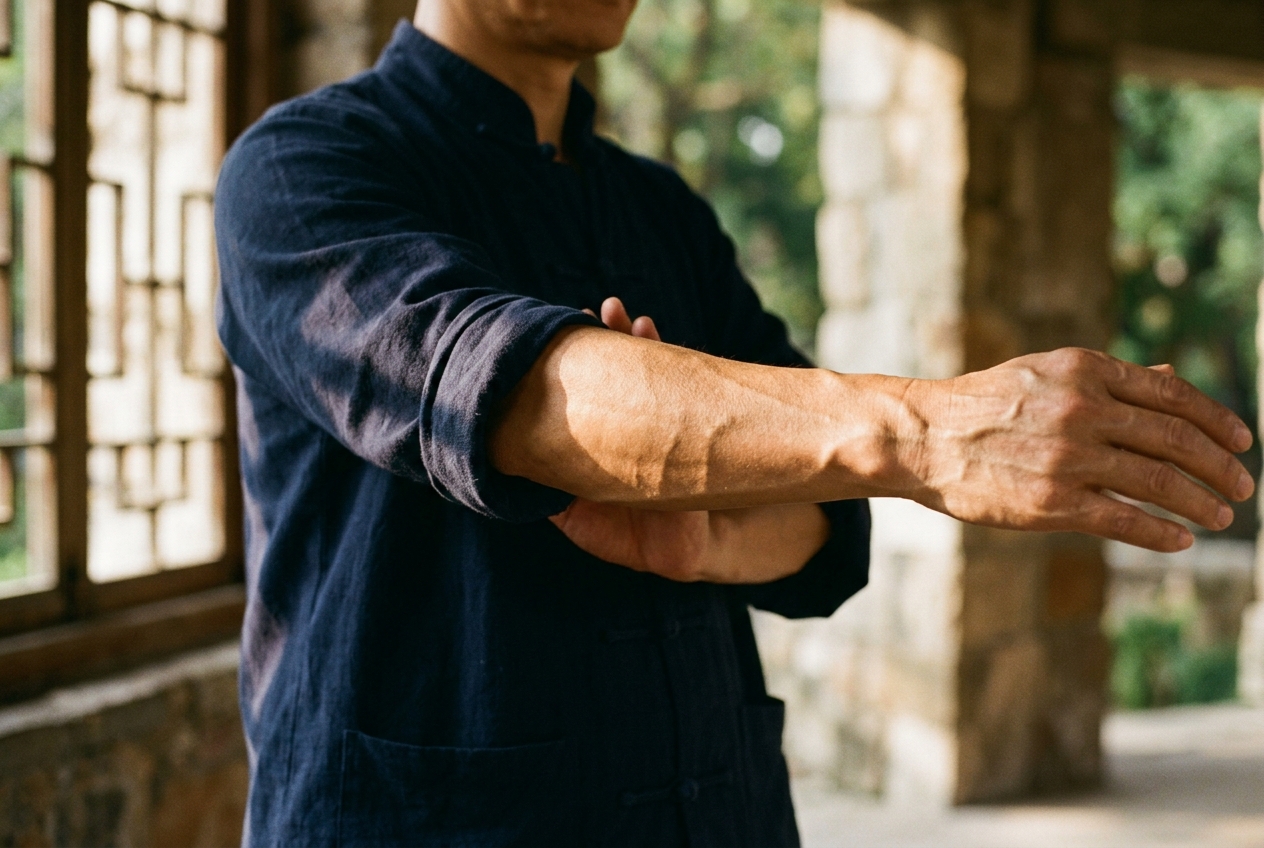
In the classical traditions of Chinese movement and internal cultivation, the human body is understood not as an assembly of isolated levers, but as an unbroken web of connective tissue, fluid channels, and neural pathways. Within this framework, specific anatomical junctures act as master control switches for whole-body coordination and vitality. One of the most vital of these switches is Waiguan (外關), traditionally translated as the "Outer Pass" or "Outer Gate," cataloged in contemporary acupuncture nomenclature as Triple Energizer 5 (TE5 or SJ5).
At its most fundamental level, opening the Outer Pass is a physical and meditative practice of spiraling the forearm, decompressing the wrist, and aligning the shoulder girdle to release deeply held tension along the dorsal (rear) chain of the upper limb. While modern anatomy categorizes the body into distinct muscle groups, traditional Chinese medicine identifies functional energetic conduits known as meridians. Waiguan is the Luo-connecting (network-linking) point of the Sanjiao (Triple Burner) channel—a systemic network governing fluid metabolism, thermoregulation, and fascial elasticity—and the master confluent gateway to the Yang Wei Mai, or the "Yang Linking Vessel."
==========================================================================
                     THE FOREARM AXIS IN PROFILE
==========================================================================
      DORSAL (POSTERIOR) ASPECT - YANG WEI MAI & SANJIAO
                   [ WAIGUAN (TE5 / SJ5) ]
                          |  (2 cun proximal to crease)
     ====================[•]========================  <-- Dorsal Crease
     |   RADIUS           :           ULNA         |
     |   (Lateral Bone)   :           (Medial Bone)|
     |                    :                        |
     |              [INTEROSSEOUS]                 |
     |                [MEMBRANE]                   |
     |                    :                        |
     ====================[•]========================  <-- Volar Crease
                          |  (2 cun proximal to crease)
                   [ NEIGUAN (PC6) ]
      VOLAR (ANTERIOR) ASPECT - JUEYIN PERICARDIUM
==========================================================================
To understand the Outer Pass, one must also understand its anatomical and energetic mirror: Neiguan (PC6), the "Inner Pass," situated directly opposite on the inside of the wrist along the Jueyin Pericardium channel. Together, these two cavities form a trans-fascial axis across the antebrachial interosseous membrane. When the Outer Pass is consciously opened through precise postural alignment and breathwork, it relieves the dorsal myofascial web, regulates our Wei Qi (the body's external defensive and thermoregulatory energy), and frees the neck and shoulders from chronic postural strain.
For contemporary scientific and clinical contexts on these meridian systems, researchers frequently consult the World Health Organization Traditional Medicine Strategy and ongoing peer-reviewed biomedical indices on PubMed Central.
PRACTICAL EMBODIMENT
Step-by-Step Practice Guide: Opening the Outer Pass
The following sequence—the Golden Spiral of the Outer Gate—is a classical Daoyin (guided somatic stretching and breath integration) exercise designed to decompress the dorsal antebrachial fascia, open the interosseous space, and establish functional kinetic continuity from the fingertips to the thoracic spine.
+-------------------------------------------------------------------------+
|                       KEY PRINCIPLES AT A GLANCE                        |
+-------------------------------------------------------------------------+
| 1. Crown Suspended (Baihui)    --> Cranio-sacral elongation             |
| 2. Chest Sunk, Back Rounded    --> Scapular broadness (Han Xiong Ba Bei)|
| 3. Spiral Tendon Vectoring     --> Torsional fascial loading            |
| 4. Antagonist Balance          --> Equal tone between TE5 and PC6       |
+-------------------------------------------------------------------------+
1. Postural Setup: The Wuji Foundation
- Stand with your feet parallel, hip-width apart. Rest your weight evenly across the tripod of each foot (base of the big toe, base of the little toe, and the center of the calcaneus/heel).
- Soften your knees by releasing the inguinal crease (kua), allowing your tailbone to sink gently toward the earth as though resting on the edge of a high stool.
- Suspend the crown of your head from above, drawing the chin slightly inward to lengthen the cervical spine. Let your arms hang effortlessly at your sides with soft space inside the axillae (armpits), as if holding a small bird's egg under each arm.
- Take three slow, unforced diaphragmatic breaths through your nose, expanding the lower abdomen (Dantian) in a complete 360-degree circumference on inhalation, and letting it gently rebound on exhalation.
2. The Movement Sequence: Rhythmic Spiral Vectoring
- The Inward Chambering (Inhale): On a slow, 4-second inhalation through the nose, float both forearms upward to mid-chest height. Bend the elbows at approximately 90 degrees, turning the palms toward your chest. Keep the wrists soft and spacious. Focus your internal awareness on the anterior forearm points, Neiguan (PC6).
- The Torsional Expansion (Exhale): Over a smooth 6-second exhalation, slowly press both palms forward and outward in an arc. As your arms extend to roughly 85% of full reach, initiate a continuous spiral (Chan Si Jin or "Silk Reeling"): gently pronate your forearms so the palms rotate downward and slightly outward, while extending through the knuckles of the index and middle fingers.
- The Micro-Opening of Waiguan: At the apex of the extension, do not lock the elbows or hyper-extend the wrists. Instead, imagine a gentle, buoyant thread lifting the dorsal point of the wrist (Waiguan, TE5) upward toward the ceiling, while your palms remain level and grounded. Feel the interosseous space between the radius and ulna gently widen.
- Scapular Rooting: Simultaneously draw your shoulder blades flat across your ribcage, sinking the inferior angles of the scapulae toward your back pockets. This grounds the kinetic chain through the serratus anterior and latissimus dorsi.
- The Retraction (Inhale): Soften the wrists, allow the forearms to naturally supinate as you draw the hands back toward the chest, refilling the lower abdominal reservoir.
- Repetition: Repeat this continuous cyclical wave for 8 to 12 smooth repetitions, maintaining absolute fluidity without mechanical stops or starts.
TROUBLESHOOTING
Common Beginner Deviations and Structural Corrections
+-----------------------------+-------------------------------------------+
| COMMON FAULT                | BIOMECHANICAL CORRECTION                  |
+-----------------------------+-------------------------------------------+
| 1. Dorsal Wrist Creasing    | Float the dorsal cavity; maintain a       |
|    (Hyper-extending wrist)  | rounded arch across the carpal joints.    |
+-----------------------------+-------------------------------------------+
| 2. Scapular Hitching        | Depress and protract the shoulder blades; |
|    (Trapezius gripping)     | keep the axilla hollow and open.          |
+-----------------------------+-------------------------------------------+
| 3. Muscular Forcing         | Shift intention to fascial glide and      |
|    (Over-contracting arms)  | hydraulic expansion; use 60% effort.      |
+-----------------------------+-------------------------------------------+
| 4. Severing the Axis        | Keep PC6 softly receptive as TE5 expands; |
|    (Collapsing anterior)    | maintain front-to-back volumetric balance.|
+-----------------------------+-------------------------------------------+
- Dorsal Wrist Jamming: Many beginners crank the hand backward into extreme extension, creating a sharp crease at the wrist joint. This compresses the dorsal carpal ligaments and pinches the radial and posterior interosseous nerves. Correction: Maintain a continuous, gentle dome over the back of the hand. The opening of Waiguan occurs via longitudinal elongation and axial rotation of the forearm bones, not backward bending.
- Trapezius Elevation: When extending the arms, the shoulders frequently hike up toward the ears, transferring the load to the upper trapezius and levator scapulae. Correction: Before initiating arm movement, consciously drop the clavicles and engage the lower lateral ribcage. The power must originate from the spine and lower abdomen, passing unobstructed through an unencumbered shoulder girdle.
- Hyper-tonic Muscular Clenching: Attempting to "push" with forearm muscle contraction strangles the local microcirculation and impedes neural glide. Correction: Reduce physical effort to roughly 60% of maximum. Internal martial arts prioritize Song (active structural relaxation and open elasticity) over brute muscular tension.
- Isolating the Forearm: Treating the arm as an independent appendage disconnected from the torso breaks the continuous tendon line (Jin Jing). Correction: Anchor the movement in the pelvic floor and lower abdomen. Every millimeter of forearm rotation must correspond to an equal integration across the dorsal thoracic spine.
SOMATOSENSORY MARKERS
Sensations to Look For and Their Functional Meaning
- Hydraulic Distension and Fullness (De Qi): A sensation of warm fluid filling the forearm and the back of the hand. This indicates capillary vasodilation, smooth muscle relaxation in the blood vessel walls, and the functional engagement of interstitial fluid pressure within the antebrachial compartment.
- Fine Effervescence or Tingling: A gentle, bubbly micro-vibration traversing the dorsal aspect of the ring finger, climbing past the Outer Pass, and moving along the triceps toward the acromion process. This reflects uncompressed neural conduction along the radial nerve pathway and the mobilization of Wei Qi.
- Heavy Rootedness in the Scapulae: The feeling that the arms are supported from behind by buoyant cushions, removing all dead weight from the neck. This signals that the serratus anterior and deep postural stabilizers have assumed load-bearing duty from the superficial neck muscles.
- Spontaneous Thermal Shift: A noticeable rise in skin temperature at the palms and dorsal wrists, often accompanied by a calm, clear mental state. This marks a physiological shift from sympathetic fight-or-flight dominance to parasympathetic restoration.
Further details on the validation of De Qi somatosensory phenomena can be explored via biomedical reviews cataloged on the National Center for Biotechnology Information.
==========================================================================
              MYOFASCIAL TENSEGRITY & KINETIC LINKAGE
==========================================================================
  OCCIPUT / BASE OF SKULL (GB20 / Fengchi)
     |
  UPPER THORACIC SPINE (C7-T3 Axis)
     |
  SCAPULAR STABILIZERS (Rhomboids <--> Serratus Anterior)
     |
  POSTERIOR INTERMUSCULAR SEPTUM & TRICEPS TENDON
     |
  LATERAL EPICONDYLE OF HUMERUS
     |
  ANTEBRACHIAL EXTENSOR COMPARTMENT
  (Extensor Digitorum, Extensor Pollicis Longus, Interosseous Membrane)
     |
  [ WAIGUAN / TE5 CAVITY ] (2 cun proximal to dorsal carpal crease)
     |
  DORSAL TENDON HOODS --> RING & MIDDLE DIGITS
==========================================================================
SOMATIC SCIENCE & WESTERN BIOMECHANICS
Why It Works — The Physiological Mechanics
To understand why a micro-adjustment at the wrist yields dramatic therapeutic effects throughout the neck, chest, and autonomic nervous system, we must examine the intersection of fascial tensegrity, neuroanatomy, and functional kinetic chains.
+-------------------------------------------------------------------------+
|                  BIOMEDICAL CORRELATES OF WAIGUAN (TE5)                 |
+-------------------------------------------------------------------------+
| Structure / Pathway        | Physiological Function                     |
+-------------------------------------------------------------------------+
| Antebrachial Interosseous  | Syndesmotic shock absorption, torsional    |
| Membrane                   | force transmission, radio-ulnar glide.     |
| Extensor Digitorum & EPL   | Myofascial recoil, dorsal kinetic conduit. |
| Posterior Interosseous     | Motor innervation to extensors, somatic    |
| Nerve & Radial Chain       | proprioceptive feedback.                   |
| Reciprocal TE5-PC6 Axis    | Antagonist-agonist myofascial balance and  |
|                            | median-radial neural decompression.        |
| Serratus-Rhomboid Sling    | Dynamic scapulothoracic anchoring and      |
|                            | cervical decompression.                    |
+-------------------------------------------------------------------------+
1. The Antebrachial Interosseous Membrane and Fascial Shear Planes
The radius and ulna are linked along their entire length by the antebrachial interosseous membrane—a dense, highly organized collagenous syndesmosis whose fibers run obliquely downward and medially from the radius to the ulna. The Waiguan cavity lies directly over the dorsal aspect of this membrane, in the fascial cleft between the extensor digitorum communis and extensor pollicis longus muscles.
When we engage in linear, repetitive tasks—such as typing, driving, or gripping tools—the forearm muscles remain held in chronic, static shortening. This creates micro-adhesions across the fascial sheaths, binding the extensor tendons to the interosseous membrane and restricting the natural sliding movement between the radius and ulna. By applying rotational, spiral loading (Chan Si Jin), the exercise creates a dynamic shear force across these collagen planes. This shearing effect restores fluid hydration to the fascia, releases trapped neurovascular structures, and eliminates ischemic stagnation in the forearm.
==========================================================================
         FOREARM CROSS-SECTION AT 2 CUN PROXIMAL TO WRIST
==========================================================================
                       DORSAL / POSTERIOR (YANG)

                       [ WAIGUAN (TE5) ]
                               v
               Extensor Digitorum / Extensor Pollicis
           +---------------------------------------+
           |       (•)                   (•)       |
           |     RADIUS                 ULNA       |
           |      Bone                  Bone       |
           |        \                     /        |
           |         \=== INTEROSSEOUS ==/         |
           |              [ MEMBRANE ]             |
           |                                       |
           |     Flexor Digitorum Superficialis    |
           |           [ Median Nerve ]            |
           |                   ^                   |
           +-------------------|-------------------+
                               ^
                        [ NEIGUAN (PC6) ]

                        VOLAR / ANTERIOR (YIN)
==========================================================================
2. Reciprocal Antagonist Coupling: The TE5–PC6 Tensegrity Bridge
In classical theory, Waiguan (TE5) and Neiguan (PC6) represent a polar functional pair: Yang on the exterior, Yin on the interior. Western biomechanics explains this through the principle of reciprocal inhibition and biotensegrity.
The anterior compartment of the forearm is dominated by the powerful finger and wrist flexors (flexor carpi radialis, flexor digitorum superficialis/profundus) alongside the median nerve. Chronic stress, anxiety, and physical strain cause habitual hyper-tonicity in this anterior flexor group, pulling the hand into a clenched, defensive posture, collapsing the chest, and causing internal rotation of the shoulders.
When Waiguan is actively opened and elongated, the dorsal extensor compartment undergoes gentle, eccentric activation. Through reciprocal neuromuscular pathways, this eccentric tone prompts the tight anterior flexors at Neiguan to reflexively lengthen and release. This rebalances tissue tension across the median and radial nerve beds, equalizes compartment pressure, and restores three-dimensional volumetric balance to the entire arm.
3. Kinetic Vectoring to the Axial Skeleton
The muscular and fascial structures of the forearm do not terminate at the elbow. As detailed in contemporary anatomical research on myofascial meridians (such as Thomas Myers' Anatomy Trains), the dorsal antebrachial extensor compartment integrates directly into the lateral epicondyle of the humerus, continues along the lateral intermuscular septum and triceps tendon, traverses the posterior deltoid and infraspinatus, and anchors into the scapula.
From the scapula, this kinetic force is transferred to the axial skeleton via the serratus anterior and rhomboid sling, stabilizing the ribcage between C7 and T6. Opening Waiguan with proper scapular depression creates an unbroken line of elastic tension (pre-stress) throughout this entire dorsal chain. This mechanical continuity lifts compressive loads off the vulnerable cervical spine and upper trapezius, providing immediate relief for chronic tension headaches and neck stiffness.
4. Neurovascular Regulation and Autonomic Tone
Beneath the Waiguan point runs the posterior interosseous neurovascular bundle, accompanied by a dense network of sympathetic perivascular nerves and mechanoreceptors (Ruffini and Pacinian endings). Slow, mindful, rotational mobilization of these tissues stimulates these deep mechanoreceptors, sending afferent inhibitory signals to the spinal cord and down-regulating sympathetic vasomotor tone.
This local neuromuscular easing links directly into whole-body physiology: through synchronized diaphragmatic breathing and fascial unwinding, the body down-regulates systemic cortisol production, enhances Heart Rate Variability (HRV), and promotes restorative parasympathetic vagal activity.
For clinical overviews and classical taxonomy regarding these meridian pathways, see the Wikipedia Entry on the Triple Burner Meridian.
LINEAGE & HISTORICAL CONTEXT
Classical Roots: From Ancient Tombs to Internal Martial Mastery
The systematic study of the body's energetic pathways and their mechanical manipulation extends back over two millennia, recorded across fundamental medical treatises and esoteric cultivation lineages.
+-------------------------------------------------------------------------+
|                  HISTORICAL EVOLUTION OF WAIGUAN (TE5)                  |
+-------------------------------------------------------------------------+
| ERA / TEXT                     | HISTORICAL & THEORETICAL CONTRIBUTION  |
+-------------------------------------------------------------------------+
| Han Dynasty (c. 100 BCE)       | Systematic mapping of the Sanjiao      |
| *Huangdi Neijing Lingshu*      | channel and Luo-connecting pathways.   |
+-------------------------------------------------------------------------+
| Han/Jin Dynasty (c. 200 CE)    | Categorization of the Eight            |
| *Nanjing* (Difficult Issues)   | Extraordinary Vessels & Yang Wei Mai.  |
+-------------------------------------------------------------------------+
| Jin Dynasty (282 CE)           | Comprehensive clinical topography and  |
| *Zhenjiu Jiayi Jing*           | needle-depth parameters for TE5.       |
+-------------------------------------------------------------------------+
| Song-Ming Dynasties            | Integration of TE5 spiraling into      |
| Daoist Daoyin & Neidan         | internal alchemical energy circulation.|
+-------------------------------------------------------------------------+
| Qing Dynasty to Present        | Torsional Silk Reeling (*Chan Si Jin*) |
| Taijiquan & Baguazhang         | in internal martial arts kinetic arts. |
+-------------------------------------------------------------------------+
1. The Foundation in the Canon of the Yellow Emperor
The earliest systematic description of the Sanjiao conduit and its Luo connection appears in the foundational text of Chinese medicine, the Huangdi Neijing (The Yellow Emperor’s Inner Canon), specifically in the Lingshu (Spiritual Pivot, c. 100 BCE), Chapter 10 (Jingmai). Here, the Sanjiao Hand-Shaoyang vessel is characterized as managing the body's irrigation systems, mediating between internal organ function and the exterior musculoskeletal envelope.
The Lingshu identifies the Luo-connecting point at Waiguan as a pivotal distribution valve: when energy stagnates in this pathway, the text notes symptoms of elbow stiffness, muscular spasm along the lateral neck and throat, and vulnerability to external climatic factors (such as wind-cold pathogens). Opening this gate was prescribed as the sovereign method to clear the exterior and restore smooth circulation.
2. The Nanjing and the Eight Extraordinary Confluences
In the Nanjing (Classic of Difficult Issues, c. 2nd Century CE), Chapters 27 through 29 expand classical energetic theory by introducing the Qi Jing Ba Mai (Eight Extraordinary Vessels)—deep ancestral energy reservoirs that regulate and buffer the twelve primary meridians. Within this advanced system, Waiguan was recognized as the Master Opening Point (Ba Mai Jiao Hui Xue) for the Yang Wei Mai (Yang Linking Vessel).
==========================================================================
                     THE YANG WEI MAI ARCHITECTURE
==========================================================================
  CONNECTIVE ROLE:
  Binds together ALL Yang channels (Taiyang, Shaoyang, Yangming).

  PATHWAY TRAJECTORY:
  Originates near lateral heel (BL63) --> Ascends lateral leg (GB35)
  --> Crosses hip and flank --> Ascends posterior axillary fold (SI10)
  --> Traverses shoulder and neck (TE13, GB21) --> Enters forehead & scalp
  --> Terminates at the base of the skull / Occiput (DU16, GB20).

  MASTER REGULATOR:
  [ WAIGUAN (TE5) ] -- Opens, links, and tensions this entire matrix.
==========================================================================
Because the Yang Wei Mai binds all external Yang channels together, opening Waiguan does not merely treat the wrist; it recalibrates the entire lateral and posterior fascial posture of the body. Historically, practitioners used this point to treat systemic chills and fevers, deep-seated spinal stiffness, and disorders characterized by disharmony between the exterior (Biao) and interior (Li).
For additional historical and theoretical documentation on these primary energetic conduits, explore the Wikipedia Entry on the Eight Extraordinary Meridians.
3. The Shao Yang Pivot: The Hinged Door of Energy
In classical Chinese medical philosophy, the twelve primary channels are organized into three Yin and three Yang layers. The Shaoyang (Lesser Yang) layer, comprising the Sanjiao and Gallbladder channels, represents the "Pivot" (Shu). While Taiyang represents the fully open exterior and Yangming the deep interior, Shaoyang acts as the hinge of a door, facilitating smooth transitions between outside and inside, activity and rest, defense and digestion.
Waiguan serves as the primary physical access point to this somatic hinge. When a person is stuck in persistent physiological tension, their Shaoyang pivot becomes jammed, leading to a feeling of being neither fully rested nor fully active—a state familiar to anyone experiencing modern chronic fatigue or high stress. Opening the Outer Pass unbinds this hinge, allowing the nervous system to regain its natural balance.
               +----------------------------------+
               |      THE THREE YANG LAYERS       |
               +----------------------------------+
               | TAIYANG  | The Open Door         |
               |          | (Exterior Defense)    |
               +----------+-----------------------+
               | SHAOYANG | The Hinge / Pivot     |
               | (TE / GB)| [ WAIGUAN / TE5 ]     |
               +----------+-----------------------+
               | YANGMING | The Closed Door       |
               |          | (Interior Processing) |
               +----------------------------------+
4. Internal Martial Arts and Daoist Daoyin
During the Song, Ming, and Qing Dynasties, these classical medical insights were adopted and refined by Daoist monastic communities (Neidan alchemical practitioners) and internal martial artists (Neijiaquan). Masters of Taijiquan, Baguazhang, and Xingyiquan realized that mechanical striking power and elastic defensive shielding depended on spiral tendon loading rather than localized muscular contraction.
In Baguazhang (Eight Trigram Palm), foundational circle-walking postures require the practitioner to maintain a continuous, spiraling torsion through the forearms—specifically holding the "Dragon Palm" or "Cow-Tongue Palm." This posture deliberately tensions the Waiguan cavity, stretching the Yang Wei Mai across the shoulder blades to create an elastic, shock-absorbing fascial frame around the upper body.
Similarly, in Chen-style Taijiquan, the foundational dynamic of Chan Si Jin (Silk Reeling Energy) uses the reciprocal relationship between Waiguan and Neiguan to transmit ground force from the heels, through the spine, and out to the fingertips without energetic interruption.
Contemporary instructional frameworks and classical curriculum preserving these traditions are maintained by international professional bodies such as the National Qigong Association.
DAILY INTEGRATION
Today's Practice Commitment: The Seven-Minute Calibration
Theory gains true value through consistent, embodied experience. To ground these physiological and classical principles in your daily life, commit to the following short routine for the next seven days.
+-------------------------------------------------------------------------+
|                  SEVEN-MINUTE DAILY CALIBRATION ROUTINE                 |
+-------------------------------------------------------------------------+
| Minute 0:00 - 1:30 | Standing Wuji alignment & 360-degree lower         |
|                    | abdominal breathing.                               |
| Minute 1:30 - 3:00 | Bilateral palpation and circular thumb massage     |
|                    | of Waiguan (TE5) with wrist micro-rotations.       |
| Minute 3:00 - 6:00 | Nine continuous repetitions of the *Golden Spiral  |
|                    | of the Outer Gate* dynamic Daoyin sequence.        |
| Minute 6:00 - 7:00 | Still standing integration; resting palms at lower |
|                    | belly, observing full-body warmth and ease.        |
+-------------------------------------------------------------------------+
How to Execute Your Daily Practice:
- The Morning Window: Tomorrow morning, before checking your phone or drinking your first coffee, stand in an open, quiet space.
- Setup (90 Seconds): Settle into the basic Wuji stance. Relax your jaw, drop your shoulders, and complete five deep, unhurried abdominal breaths.
- Point Activation (90 Seconds): Gently palpate Waiguan on your left arm. Massage the point with small, circular motions for 45 seconds while slowly flexing and rotating the left wrist. Switch and repeat on the right arm.
- The Movement Practice (3 Minutes): Perform nine slow, rhythmic repetitions of the Golden Spiral of the Outer Gate sequence described in Section 3. Focus entirely on feeling the spiraling connection from the interosseous space of your forearms back into your shoulder blades.
- Stillness & Observation (1 Minute): Rest both hands softly over your lower abdomen. Stand quietly, breathing naturally, and observe the sensations in your body: the warm pulse of blood through your forearms, the open space across your upper back, and the quiet clarity in your mind.
Somatic Tracking Journal:
Over the next week, take note of subtle changes in your everyday physical patterns: * Does your neck feel looser during prolonged desk work or driving? * Do your hands and fingers feel warmer and less prone to fatigue? * Are you able to transition more smoothly from workday stress into evening rest?
By opening the Outer Pass each morning, you are not merely doing an exercise; you are participating in a two-thousand-year-old tradition of somatic engineering, keeping your joints resilient, your fascia supple, and your energy centered, balanced, and free.