External Application Herbs (Wai Yong Yao) Pharmacodynamics: Governing Topical Toxin Drawing, Antipruritic Parasiticidal Actions, Necrotic Tissue Debridement, and Epithelial Regeneration in Traditional Chinese Medicine
You wake in the middle of the night to a sharp, maddening itch along your forearm or ankle. The skin is hot to the touch, visibly raised, and weeping an amber exudate that crusts at the margins. Or perhaps you have observed a slow, persistent fissure on the heel of an elderly relative—a dull, purplish ulcer that has stubbornly refused to close for months despite standard sterile dressings. In conventional biomedical terms, these presentations are classified as acute eczematous dermatitis and chronic microcirculatory stasis ulcers.
In the conceptual framework of Traditional Chinese Medicine (TCM), these cutaneous crises represent profound physiological disturbances: the furious outward eruption of pathogenic Damp-Heat (Shi Re) seeking an exit through the pores, or the localized collapse of Yang-Qi and Blood flow failing to nourish the flesh, resulting in a cold "Yin sore" (Yin Ju).
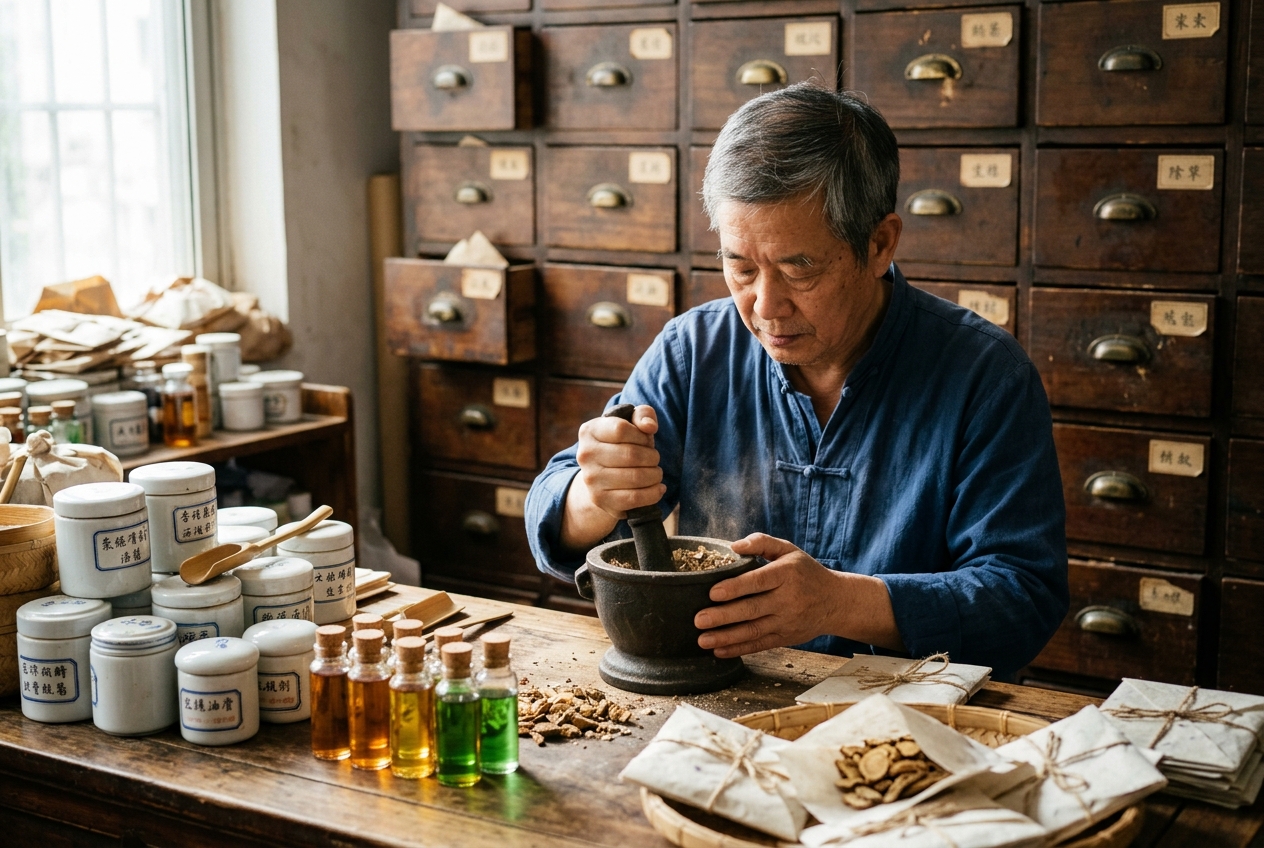
Long before the advent of synthesized topical corticosteroids and antimicrobial dressings, classical physicians confronted these identical dermal pathologies. Rather than relying solely on systemic decoctions, they developed an intricate, highly specialized branch of dermatological pharmacology known as External Application Herbs (Wai Yong Yao, 外用药). Applied directly to the affected stratum corneum, these botanical, mineral, and resinous compounds execute sophisticated cellular debridement, suppress recalcitrant pruritus, sterilize fungal and bacterial colonies, and kickstart angiogenesis in dormant tissue.
Topical Chinese medicine does not merely mask surface symptoms. It engages in a biochemical and biophysical dialogue with the body’s largest organ—the skin—modulating microvascular perfusion, regulating pro-inflammatory cytokines, and restoring epidermal homeostasis.
2. What This Organ System Does: The Cutaneous Barrier and the Pharmacology of Wai Yong Yao
In traditional Chinese medical theory, the skin is not an inert wrapper; it is the physical manifestation of the Lung Organ System (Fei), which governs the exterior (Fei Zhu Pi Mao — "The Lung Governs the Skin and Body Hair").
The Lung disperses Defensive Qi (Wei Qi)—the body’s innate energetic and immunological shield—throughout the subcutaneous space and pores (Cou Li). When Wei Qi is robust and unobstructed, the skin remains supple, adequately hydrated, and resilient against environmental invaders. When systemic disharmony or localized trauma breaches this boundary, pathogens lodge in the cutaneous matrix.
Topical pharmacology operates along five defined therapeutic axes:
- Toxin-Drawing (Ba Du, 拔毒): The extraction of metabolic waste, cellular debris, and microbial pyrogens from deep dermal layers toward the surface for evacuation.
- Swelling-Dispersing (Xiao Zhong, 消肿): The resolution of local edema, capillary hyperpermeability, and inflammatory induration.
- Parasite-Killing and Antipruritic Action (Sha Chong Zhi Yang, 杀虫止痒): The eradication of scabies mites, dermatophytes, and opportunistic bacteria, alongside the immediate inhibition of neural pruritic signaling.
- Necrotic Tissue Debridement (Qu Fu, 去腐): The enzymatic and chemical dissolution of non-viable, necrotic slough and biofilm without injuring healthy marginal tissue.
- Flesh-Generating Regeneration (Sheng Ji, 生肌): The stimulation of fibroblast proliferation, collagen synthesis, and neovascularization to close chronic wounds.
Modern scientific research, documented extensively across NCBI PubMed dermatological databases, has begun to identify the biochemical mechanisms underpinning these traditional actions. Let us examine five primary representative herbs that anchor the topical pharmacopoeia:
Key Representative Topical Herbs
========================================================================================================
HERB (PINYIN / LATIN)   ACTIVE CONSTITUENTS       PRIMARY BIOCHEMICAL ACTIONS      TCM FUNCTION
========================================================================================================
She Chuang Zi           • Osthole                 • TRPM8/TRPV1 channel modulation  • Sha Chong Zhi Yang
(Cnidii Fructus)        • Imperatorin             • Downregulates NF-κB / TNF-α      (Kills Parasites,
                        • Bergapten               • Destabilizes fungal ergosterol    Relieves Itch)
--------------------------------------------------------------------------------------------------------
Bai Fan                 • Aluminium potassium    • Precipitates surface proteins   • Lian Chuang / Qu Fu
(Alumen)                  sulfate dodecahydrate   • Local astringency & hemostasis   (Astringes Sores,
                                                  • Lowers wound micro-pH            Clears Putrefaction)
--------------------------------------------------------------------------------------------------------
Lu Gan Shi              • Refined Zinc Oxide      • Stimulates zinc-dependent MMPs  • Sheng Ji Lian Chuang
(Calamina)              • Zinc carbonate /        • Accelerates re-epithelialization (Regenerates Flesh,
                          silicate                • Neutralizes exudative fluids     Dries Dampness)
--------------------------------------------------------------------------------------------------------
Bing Pian               • d-Borneol               • Modulates stratum corneum lipids• Tou Pi / Zhi Tong
(Borneolum Syntheticum) • Isoborneol              • Terpene penetration enhancer    (Transdermal Enhancer,
                                                  • Local GABAergic analgesia        Alleviates Pain)
--------------------------------------------------------------------------------------------------------
Liu Huang               • Elemental Sulfur (S8)   • Forms keratolytic polysulfides  • Sha Chong Jie Du
(Sulfur)                                          • Acaricidal / Scabicidal         (Eradicates Scabies,
                                                  • Degrades fungal cell walls       Clears Severe Toxins)
========================================================================================================
1. She Chuang Zi (Cnidii Fructus)
Derived from the dried ripe fruits of Cnidium monnieri, this herb is the premier botanical agent for intractable pruritus and fungal invasion. Its dominant bioactive constituent is the coumarin derivative osthole (7-methoxy-8-(3-methyl-2-butenyl)coumarin). * Mechanism: Pharmacological investigations indexed via NCBI PubMed research on Osthole demonstrate that osthole suppresses histamine-induced mast cell degranulation and downregulates the expression of interleukin-4 (IL-4), interleukin-31 (IL-31), and tumor necrosis factor-alpha (TNF-α). * Furthermore, osthole exhibits potent fungistatic and fungicidal properties against Trichophyton rubrum, Trichophyton mentagrophytes, and Candida albicans by destabilizing fungal cell membrane integrity and inhibiting spore germination.
2. Bai Fan (Alumen)
A natural mineral composed of potassium aluminium sulfate dodecahydrate ($KAl(SO_4)_2 \cdot 12H_2O$), detailed historically in mineralogical and pharmacopoeial studies (see Wikipedia's entry on Alum). * Mechanism: When applied topically to ulcerated or weeping skin, Bai Fan acts as a potent protein precipitant and astringent (Lian Chuang). Trivalent aluminium ions cross-link with proteins on exposed ulcer beds, forming a coagulated protective albuminous membrane. * This barrier halts minor capillary bleeding, decreases exudative transudation, compresses cellular junctions, and creates an acidic, hyperosmolar microenvironment hostile to bacterial colonization (especially Staphylococcus aureus and Pseudomonas aeruginosa).
3. Lu Gan Shi (Calamina)
Naturally occurring zinc spar (smithsonite) consisting predominantly of zinc carbonate ($ZnCO_3$). In clinical practice, it undergoes strict calcination (Duan) and water-levigation (Shui Fei) to yield a micro-fine powder rich in amorphous zinc oxide ($ZnO$). * Mechanism: Zinc is an essential cofactor for over 300 metalloenzymes, including matrix metalloproteinases (MMPs) and RNA polymerases that regulate keratinocyte migration. As demonstrated in NCBI PMC literature on zinc in cutaneous wound repair, topical application of calamine directly stimulates fibroblast proliferation, promotes early granulation (Sheng Ji), and neutralizes excessive proteolytic enzymes that otherwise keep chronic ulcers in a persistent inflammatory arrest.
4. Bing Pian (Borneolum / d-Borneol)
A bicyclic monoterpenoid obtained from the resin of Dryobalanops aromatica or synthesized from turpentine. * Mechanism: While possessing mild antiseptic, antipruritic, and transient TRPM8-mediated cooling analgesic properties, Bing Pian's primary pharmacological value lies in its role as a natural transdermal penetration enhancer (Tou Pi, 透皮). As documented in transdermal drug delivery literature on Borneol's permeation enhancement mechanisms, borneol reversibly disrupts the highly organized intercellular lipid lamellae of the stratum corneum. It temporarily fluidizes the cholesterol, ceramide, and free fatty acid matrices, allowing larger, co-administered polar and non-polar botanical compounds to penetrate the dermal-epidermal junction.
5. Liu Huang (Sulfur)
Native elemental sulfur ($S_8$), processed and purified. * Mechanism: When applied topically, elemental sulfur interacts with cutaneous cysteine residues and epidermal keratinocytes to form small quantities of hydrogen sulfide ($H_2S$) and pentathionic acid ($H_2S_5O_6$). * These compounds exert a dual therapeutic effect: they act as a potent keratolytic agent, softening the stratum corneum and clearing hyperkeratotic plaques, while functioning as a broad-spectrum acaricide and fungicide. It remains the gold standard in traditional dermatology for eradicating Sarcoptes scabiei (scabies) and treating severe seborrheic dermatitis.
Delivery Vehicles and Preparation Vectors
The therapeutic efficacy of these raw substances depends directly upon the pharmaceutical vehicle (Ji Xing) chosen to deliver them:
- Plasters (Gao Yao, 膏药): Thick, resinous, or lead-oxide-matrix dressings applied warm. They provide sustained, occlusive drug release, trap endogenous moisture, and drive active herbal constituents into deep tissues for chronic, indurated stasis.
- Liniments and Tinctures (Jiu Ji / Cha Ji, 酒剂/搽剂): Alcohol- or vinegar-extracted solutions that evaporate rapidly. Alcohol provides a dual benefit: it extracts lipophilic coumarins (like osthole) and rapidly cools the skin, making it ideal for non-exudative, fiercely pruritic lichenified lesions.
- Dusting Powders (San Ji, 散剂): Micronized mineral-botanical compounds dusted directly onto the flesh. They absorb copious fluid, eliminate maceration in intertriginous areas (skin folds), and provide an immediate protective layer.
- Oil-Infused Ointments (You Gao, 油膏): Formulated with a base of purified sesame oil (Sesami Oleum) and beeswax (Cera Flava). The lipid base hydrates chronic fissures, softens necrotic eschar to facilitate painless enzymatic debridement, and ensures prolonged contact time.
- Decocted Washes and Compresses (Xi Ji / Ta Xi, 洗剂/溻渍): Aqueous decoctions applied as warm or cool compresses. Highly effective for acute, weeping, vesicular dermatitis, where they gently irrigate crusts, reduce capillary dilation, and deliver water-soluble tannins and flavonoids without clogging open pores.
3. How You Can Feel It: Signs of Balance and Imbalance in the Cutaneous System
Because the skin is the direct external expression of your internal Lung-Spleen axis and circulating Blood, subtle shifts in your health manifest clearly across your dermal landscape.
Use the self-assessment matrix below to understand the dialogue taking place across your epidermal barrier:
========================================================================================================
CLINICAL PRESENTATION     TCM PATTERN IDENTIFICATION     PATHOPHYSIOLOGY & UNDERLYING MECHANISM
========================================================================================================
Clear, resilient skin;    • Balanced Lung Qi (Fei Qi)    • Intact lipid barrier; balanced ceramide
prompt wound healing;       & Harmonious Wei Qi            synthesis; optimal microvascular perfusion
no spontaneous itching.   • Abundant, circulating Blood
--------------------------------------------------------------------------------------------------------
Violent itching; bright   • Toxic Damp-Heat              • Vasodilation; mast cell hyper-degranulation;
red erythema; weeping       (Shi Re Du)                    extravasation of serous exudate; bacterial
amber vesicles; crusts.                                    colonization (Staphylococcus / Candida)
--------------------------------------------------------------------------------------------------------
Chronic lichenified       • Blood Deficiency with        • Stratum corneum dehydration; neurogenic
plaques; severe dryness;    Wind-Dryness                   hyper-innervation; impaired lipid matrix;
scaling; relentless itch.   (Xue Xu Feng Zao)              prolonged substance P signaling
--------------------------------------------------------------------------------------------------------
Indolent, pale-purple     • Qi & Blood Stagnation with   • Microcirculatory thrombosis; hypoxia;
open ulcer; thin, watery    Toxic Cold Accumulation        senescent fibroblasts; excessive local MMPs;
discharge; non-healing.     (Yin Ju / Yin Sore)            arrested granulation tissue
========================================================================================================
Dermal Balance Check: 3 Everyday Tests
- The Capillary Refill & Hydration Rebound: Gently pinch the skin on the back of your hand for three seconds and release. It should snap back instantly within one second without leaving a dry, ash-colored crease. A sluggish rebound reflects a systemic depletion of Yin and Body Fluids (Jin Ye), leaving the cutaneous barrier brittle and prone to micro-fissuring.
- The Exudate Temperature Test: Touch the skin surrounding an inflamed flare. If the surrounding tissue radiates palpable heat and the exudate feels hot or stinging, Heat-Toxicity (Re Du) is actively damaging the microcapillary network. If the area feels cool, boggy, and numb, local metabolic fire has collapsed into a Cold-Damp (Han Shi) stagnation pattern.
- The Nocturnal Itch Trigger: Take note of when skin itching peaks. Itch that intensifies under warm bedclothes points to Blood Heat (Xue Re) agitating cutaneous nerve endings. Itch that worsens in humid weather or after eating rich foods points to internal Dampness (Shi) migrating outward to the epidermal interface.
4. Qigong & Movement Practice: The Lung-Boundary Clearing Routine (Fei Wei Pai Du Gong)
To reinforce topical treatments and stimulate the dispersion of Wei Qi to the periphery, this targeted, five-minute medical Qigong sequence clears stagnant heat from the upper body while stimulating microvascular flow across the extremities.
Step-by-Step Instructions
- Starting Position & Setup: Stand barefoot or in flat shoes with feet shoulder-width apart, parallel to each other. Soften your knees slightly and drop your tailbone toward the floor to release lumbar tension. Relax your shoulders, rest your tongue against the upper palate behind your front teeth, and take two deep abdominal breaths.
- Movement Phase 1 (The Gathering Inhale — 4 Seconds): As you begin a slow, silent inhalation through your nose, cross your wrists in front of your mid-chest over the Central Treasury (LU1, Zhongfu) acupoint. Draw your shoulder blades gently back to broaden the pectoral region, feeling the breath expand the upper lateral chest wall.
- Movement Phase 2 (The Dispersing Exhale — 6 Seconds): Exhale smoothly through your mouth with a soft, whispered "Ssssss" sound (the classical healing sound for the Lung Organ System). Slowly extend both arms outward horizontally to your sides. As your arms extend, flex your wrists backward so your palms face outward and your fingertips point toward the ceiling. Focus your mental intention on the web space between your thumb and index finger.
- Movement Phase 3 (The Boundary Sweep — Inhale & Exhale): Inhale, relax the wrists, and gently sweep your arms in a wide, circular embrace back toward your centerline, bringing your palms facing down toward your lower abdomen (Dan Tian). Exhale, pressing the palms down toward the earth as if smoothing a layer of protective silk over your skin.
- Duration and Repetitions: Perform this cycle 8 to 12 complete repetitions (approximately 4–5 minutes) once or twice daily, ideally in the morning or when you feel cutaneous tension rising.
- What Sensation to Look For: Within 4 to 6 repetitions, you should feel a subtle tingling, buzzing, or warm sensation across your palms, fingertips, and the surface of your forearms. In TCM physiology, this signifies the arrival of De Qi and the activation of Wei Qi, indicating that microcirculatory blood flow is re-engaging the sub-epidermal capillary networks.
5. Acupressure Points You Can Try Today: The Dermatological Triad
Acupressure offers a non-invasive, accessible method to clear inflammatory Heat, soothe hypersensitive cutaneous nerves, and enrich blood perfusion to sluggish tissue. Apply direct pressure to these three clinical acupoints:
1. Large Intestine 11 (Quchi, 曲池) — "Pool at the Crook"
- Location: Bend your elbow to a clean 90-degree angle. Look at the outer crease of your elbow joint. Quchi is located in the depression right at the lateral end of the transverse cubital crease, midway between the biceps tendon and the lateral epicondyle of the humerus.
- How to Press: Use the tip of your opposite thumb. Apply firm, perpendicular pressure while making small, localized clockwise circles. Maintain pressure for 2 to 3 minutes on each arm. The sensation should be a dull, aching, slightly radiant soreness.
- Clinical Purpose: Quchi is the premier systemic clearing point in Chinese medicine for cutaneous Heat, acute erythema, and severe pruritus. It downregulates systemic inflammation, reduces histamine flare, and calms acute allergic responses.
2. Spleen 10 (Xuehai, 血海) — "Sea of Blood"
- Location: Sit comfortably with your knee bent at a 90-degree angle. Place your right palm over your left kneecap with your fingers pointing upward; your thumb will naturally rest on the inside of the thigh, approximately two finger-widths (two cun) above the superior-medial border of the patella, over the bulge of the vastus medialis muscle.
- How to Press: Press your thumb tip deeply into the muscle belly until you locate a sensitive, tender node. Apply sustained, pulsing pressure (3 seconds on, 1 second off) for 2 minutes per leg.
- Clinical Purpose: An ancient TCM maxim states: "To treat wind and itching, first treat the blood; when the blood harmoniously flows, wind naturally disappears" (治风先治血,血行风自灭). Xuehai clears Blood Heat in acute rashes and enriches Blood Deficiency in dry, cracked, lichenified eczema.
3. Lung 5 (Chize, 尺泽) — "Cubit Marsh"
- Location: On the inner bend of the elbow (the cubital crease), located in the distinct soft depression on the radial (outer/thumb) side of the thick, prominent biceps brachii tendon.
- How to Press: With your forearm relaxed and slightly bent, hook your thumb into the tendon groove. Press firmly backward toward the humerus bone for 90 seconds to 2 minutes per side.
- Clinical Purpose: As the Water point on the Metal (Lung) meridian, Chize clears excess Heat and inflammation directly from the Lung and Skin. It is invaluable for clearing hot, weeping rashes, pustular breakouts, and dry, cracked dermatitis aggravated by respiratory or environmental allergies.
6. Pharmacognosy, Transdermal Safety, and Food & Lifestyle Synergies
Strict Safety Guidelines and Mineral Toxicity Mitigation
Topical mineral pharmacology (Kuang Wu Yao) requires meticulous quality control and strict processing to prevent systemic heavy metal poisoning.
- The Water-Levigation Protocol (Shui Fei, 水飞): Minerals such as Lu Gan Shi (Calamina) or historically utilized ores must never be pulverized dry. They are ground underwater; the coarse, irritating, and toxic sediment sinks, while the ultra-fine, non-irritating particles remain suspended. The supernatant suspension is collected and dried, producing a safe, velvety powder with a particle size below 5–10 micrometers.
- Exclusion of Systemic Heavy Metals: Classical preparations historically made use of minerals containing cinnabar (Zhu Sha - mercury sulfide) or realgar (Xiong Huang - arsenic sulfide). Contemporary clinical standards strictly avoid these compounds on open, ulcerated skin surfaces. Absorption through denuded dermis can cause systemic bioaccumulation and renal/hepatic injury.
- Application Surface Constraints: Never apply mineral-based or sulfur-heavy preparations over more than 10–15% of the total body surface area at one time. Avoid application to freshly deep-excised tissue, extensive third-degree burns, or mucus membranes unless explicitly indicated by a qualified specialist.
Comparative Clinical Formulation Matrix
To see how these principles combine in practice, consider these two clinical protocols for common, difficult-to-treat dermatological conditions:
=======================================================================================================================
PATHOLOGY            PATTERN             EXTERNAL FORMULATION & CONSTITUENTS       VEHICLE & DELIVERY MECHANISM
=======================================================================================================================
Intractable          Toxic Damp-Heat     • She Chuang Zi (Cnidii Fructus) 30g     • Compresses / Wash (Xi Ji)
Damp-Heat Eczema     (Shi Re Du)         • Ku Shen (Sophorae Flavescentis) 30g    • Decocted in 1000ml water for 25 min;
(Acute Shi Zhen)                         • Bai Fan (Alumen) 10g                   strained through micro-filter.
                                         • Huang Bai (Phellodendri Cortex) 20g    • Apply cooled sterile gauze compresses
                                         • Bing Pian (Borneolum) 2g (added last)  for 15 minutes, 2–3 times daily.
-----------------------------------------------------------------------------------------------------------------------
Chronic Non-Healing  Cold-Damp & Blood   • Lu Gan Shi (Calamina, levigated) 30g   • Oil-Infused Ointment (You Gao)
Ulcers / Yin Sores   Stasis / Qi Def.    • Dang Gui (Angelicae Sinensis) 20g      • Slow-fry herbs in unrefined sesame
(Yin Ju / Stasis)    (Xue Yu Han Ning)   • Xue Jie (Daemonorops Resin) 10g        oil (200ml) until crisped; strain;
                                         • Ru Xiang (Olibanum) 10g                melt 30g beeswax; stir in powders.
                                         • Mo Yao (Myrrha) 10g                    • Pack onto ulcer base under sterile
                                         • Bing Pian (Borneolum) 1.5g             non-adherent dressing every 48 hours.
=======================================================================================================================
Practical Food and Lifestyle Adjustments for Cutaneous Health
Topical therapies work best when supported by internal dietary habits that keep inflammation down and support the skin's moisture balance:
- Add Damp-Draining and Heat-Clearing Whole Foods: Introduce pearled barley (Job’s Tears / Yi Yi Ren), adzuki beans (Chi Xiao Dou), and mung beans (Lü Dou) into weekly soups and stews. These accessible grains act as mild internal diuretics, clearing sub-epidermal edema and calming weeping eruptions without stripping essential bodily fluids.
- Incorporate Barrier-Building Healthy Fats: Nourish Blood and replenish ceramides by consuming moderate daily amounts of lightly toasted black sesame seeds (Hei Zhi Ma), raw walnuts, wild-caught fatty fish (mackerel, sardines), and cold-pressed flaxseed oil.
- Reduce Flare-Triggering "Fa Wu" (发物 — Trigger Foods): In classical Chinese dermatology, Fa Wu refers to foods that stimulate inflammation, cause itching, and accelerate exudation. Sharply reduce consumption of shell-bearing crustaceans (shrimp, crab, lobster), deep-fried foods, heavy chili oils, and refined alcohol during active skin flares.
- Bathing and Temperature Hygiene: Avoid scalding hot showers, which strip the protective acid mantle, accelerate trans-epidermal water loss (TEWL), and trigger rebound mast-cell degranulation. Opt for brief, lukewarm showers. Pat—do not rub—the skin dry, and apply topical barrier emollients within three minutes while the skin remains slightly damp.
7. Today’s Takeaway: The Five-Minute Cutaneous Reset
If you take only one practical step today to protect and balance your cutaneous barrier, do this:
Brew a simple, soothing skin compress using widely available chamomile flowers and peppermint leaves (a kitchen-cabinet analog to classical heat-clearing botanicals).
Steep two tea bags in 300 ml of boiling water for 10 minutes, let it cool completely in your refrigerator, soak a clean cotton washcloth in the infusion, and lay it across irritated, itching, or hot skin for five quiet minutes.
As the cool compress calms local capillary dilation and soothes hyperactive nerve endings, spend those five minutes practicing the Lung-Boundary clearing breaths (Section 4) while gently massaging the Quchi (LI11) point on your elbow.
This simple daily pairing bridges ancient transdermal pharmacology and modern barrier care—calming your skin from both the outside in and the inside out.