Ling Shu Twelve Needling Methods: Navigating Twelve-Channel Pathological Topography, Multi-Vector Structural Dynamics, and Precision Acupressure Protocols
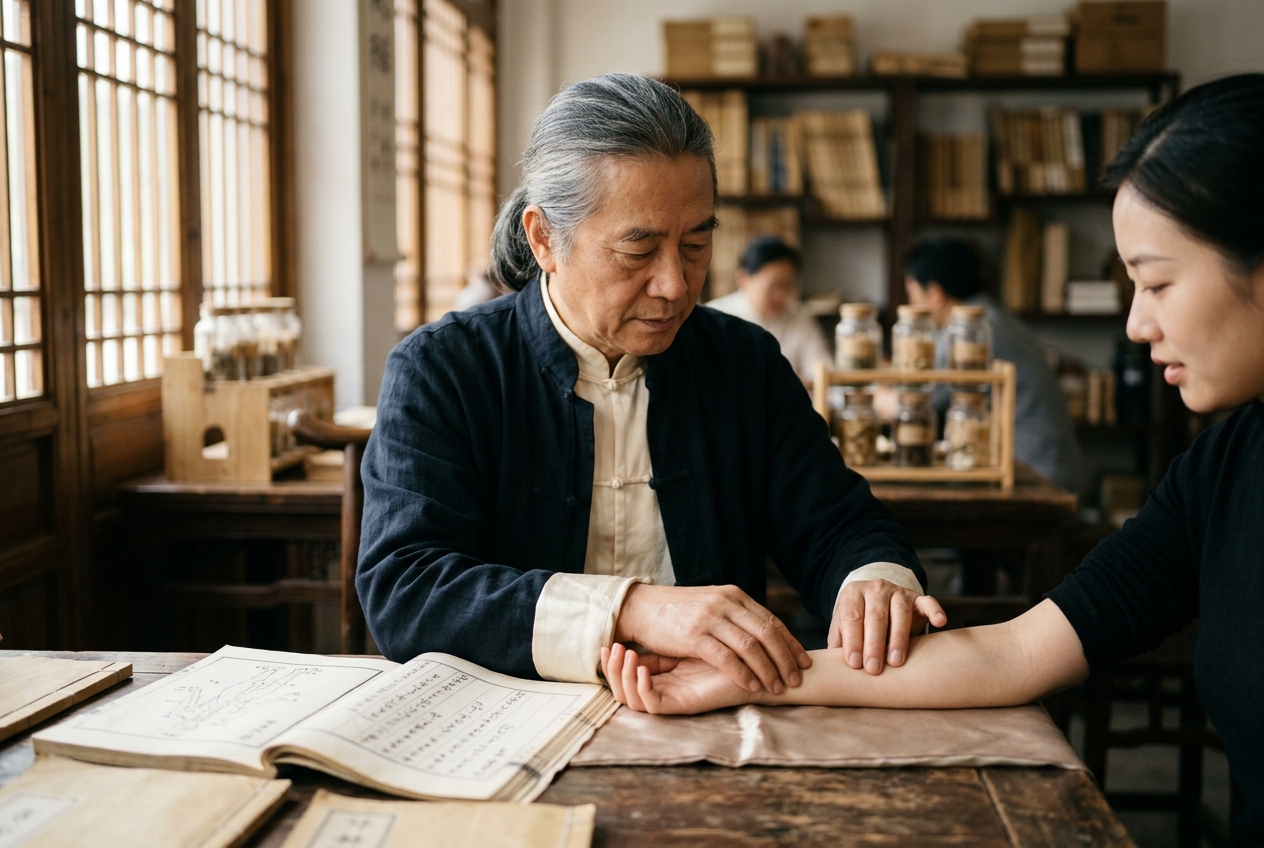
1. Opening — A Problem This Solves Today
If you spend your daylight hours anchored to a desk, staring into the blue-lit glare of a screen while juggling cognitive deadlines, your body is likely holding a quiet, cumulative tension. It begins as a dull tightness at the occipital ridge where the skull meets the spine, migrates downward into the levator scapulae as an immovable knot, and culminates in the mid-afternoon as a distended, sluggish sensation in the epigastrium. By nightfall, your nervous system remains trapped in a low-grade sympathetic hum—your brain feels hyper-stimulated, yet your physical tissue feels dense, dehydrated, and mechanically exhausted.
In contemporary clinical terms, this state represents a convergence of myofascial trigger-point development, microcirculatory stasis, and autonomic dysregulation. Yet more than two millennia ago, the foundational canon of East Asian medicine, the Huangdi Neijing (The Yellow Emperor’s Classic of Internal Medicine), mapped this exact matrix of somatic distress. The authors did not view these symptoms as disparate complaints requiring isolated pharmaceutical suppression; they understood them as disruptions within a continuous, responsive bio-network: the meridian system (Jing-Luo).
The medical scholars of the Han dynasty recognized that tissue dysfunction occurs at distinct structural depths and architectural angles. In Chapter 7 of the Ling Shu (The Spiritual Pivot), titled Guan Zhen (官针, "The Official Needles"), they codified the Twelve Needling Methods (Shi Er Ci, 灵枢·官针十二刺), specifically engineered to address pathologies across the twelve primary meridians (以应十二经). Rather than relying on simple, indiscriminate puncturing, they developed a sophisticated geometric grammar of depth, vector, pairing, and cadence.
Today, as modern research published via the NCBI PubMed Central Repository on Mechanotransduction reveals how mechanical strain on connective tissue translates into cellular signaling, these ancient vector dynamics offer a powerful blueprint. You do not need steel filiform needles to harness these principles. By translating classical needle vectors into non-invasive, high-precision manual acupressure, anyone can dismantle chronic muscular tension, stimulate visceral motility, and recalibrate the nervous system from the comfort of their home.
2. The Meridian Path — A Journey Through the Living Body
To master these manual vectors, one must first discard the misconception that meridians are mystical, invisible conduits floating through empty space. Modern histological and anatomical inquiries demonstrate that the classical meridian pathways map with striking fidelity onto intermuscular cleavage planes, neurovascular bundles, and sheets of deep fascial connective tissue. As documented in studies on Connective Tissue and Meridian Networks, the body's fascial system functions as an unbroken, liquid-crystalline tensegrity network.
Consider the primary pathways as somatic highways that link distant limbs directly to your central organs:
- The Leg Yangming (Stomach) Meridian: Begins beneath the orbits of the eyes, descends along the jaw and throat, cascades down the chest and abdomen along the rectus abdominis, travels through the quadriceps, and runs down the outer-front edge of your shinbone—the precise muscular ridge that aches after an exhausting day on your feet—terminating at the second toe. When digestion stalls or mental worry causes the stomach to knot, this entire anterior chain becomes taut and tender.
- The Leg Jueyin (Liver) Meridian: Rises from the web of the big toe, courses across the arch of the foot, ascends along the inside of the lower leg behind the shinbone, travels up the inner thigh, wraps around the external genitalia, and enters the lower ribs and diaphragm. This pathway governs the smooth expansion of the ribcage, vascular circulation, and neuro-emotional reactivity under stress.
- The Arm Yangming (Large Intestine) Meridian: Originates at the tip of the index finger, traverses the muscular web of the hand between thumb and forefinger, tracks along the lateral edge of the forearm and elbow, crosses the apex of the shoulder, and ascends the neck to the opposite side of the nose. It is the primary conduit for clearing tension from the jaw, face, neck, and sinuses.
- The Hand Jueyin (Pericardium) Meridian: Arises in the chest, passes through the diaphragm to communicate with the gastrointestinal tract, and emerges down the inner arm. It runs down the exact centerline of the inner forearm—nestled between two prominent flexor tendons that stand out when you make a fist—and terminates at the middle fingertip. This pathway acts as the master regulator of cardiac rhythm, diaphragmatic expansion, and the gut-brain axis.
By understanding these somatic trajectories through natural physical landmarks rather than abstract measurements, we transform the living body into an intuitive, accessible map for physiological restoration.
3. The Classical Vector Engine: Systematic Exegesis of the Ling Shu Twelve Needling Methods (Shi Er Ci)
In Chapter 7 (Guan Zhen) of the Ling Shu, the classical text asserts: "The twelve methods of needling correspond to the twelve channels; each has its specific target, structural layer, and dynamic intent" (凡刺有十二节,以应十二经). Below is a systematic exegesis of these twelve classical methodologies, detailing their original Han-dynasty rationale, modern neurofascial and mechanotransductive parallels, and their direct conversion into manual acupressure protocols.
+==================================================================================================+
|                       THE TWELVE CLASSICAL NEEDLING METHODS (SHI ER CI)                          |
+==================================================================================================+
|  Method (Classical / Pinyin)  | Structural Layer & Target       | Acupressure Vector Equivalent  |
+-------------------------------+---------------------------------+--------------------------------+
|  1. Ou Ci (偶刺)              | Ventral-Dorsal Pairing          | Anterior-Posterior Compression |
|  2. Bao Ci (报刺)             | Wandering Bi / Migratory Pain   | Sequential Nociceptive Pursuit |
|  3. Hui Ci (恢刺)             | Tendon / Muscular Bundles       | Dynamic Pin-and-Stretch Glide  |
|  4. Qi Ci (齐刺)              | Deep Focal Cold Stasis          | Three-Point Tripod Compression |
|  5. Yang Ci (扬刺)            | Broad Superficial Cold          | Center-Surround Dispersal      |
|  6. Zhi Zhen Ci (直针刺)      | Shallow Muscular Layer          | Axial Perpendicular Sustained  |
|  7. Shu Ci (输刺)             | Visceral / Deep Heat Stasis     | Rhythmic Piston Pumping        |
|  8. Duan Ci (短刺)            | Osseous / Periosteal Pain       | Deep Micro-Oscillatory Contact |
|  9. Fu Ci (浮刺)              | Acute Muscle Spasm / Cold       | Tangential Subdermal Rolling   |
| 10. Yin Ci (阴刺)             | Bilateral Cold Vacuity          | Synchronized Bilateral Mirror  |
| 11. Bang Zhen Ci (傍针刺)     | Stubborn Chronic Myofascial Knot| Dual-Angle Shear Compression   |
| 12. Zan Ci (赞刺)             | Microvascular Sanguineous Stasis| Rapid Cutaneous Percussion     |
+==================================================================================================+
1. Ou Ci (偶刺, Coupled Needling)
- Classical Rationale: Designed for visceral disorders of the chest, epigastrium, and heart. The physician places one hand on the anterior chest/abdomen (Ventral/Mu point) and one needle in the corresponding dorsal paraspinal region (Dorsal/Shu point) to treat reciprocal interior disharmonies without overloading a single locus.
- Neurofascial Mechanism: Activates the somato-visceral and viscero-somatic reflex arcs across the spinal cord segment. Simultaneous ventral-dorsal mechanical stimulation balances sympathetic output from the sympathetic chain ganglia with parasympathetic afferents.
- Acupressure Translation: Bimanual Anterior-Posterior Clamp. Place one palm or thumb on an anterior landmark (e.g., CV17 on the sternum or CV12 on the epigastrium) and the fingers of the other hand on the corresponding thoracic paraspinal erector muscles (e.g., BL14, BL15, or BL21). Apply synchronized, compressive pressure during slow exhalations.
2. Bao Ci (报刺, Reported / Sequential Needling)
- Classical Rationale: Engineered for "wandering Bi syndrome" (Xing Bi, 行痹), where pain migrates unpredictably along muscular channels. The needle is inserted, retained briefly, withdrawn upon relief, and immediately re-applied to the newly emerged locus of discomfort.
- Neurofascial Mechanism: Tracks the shifting threshold of peripheral nociceptive field sensitization and secondary myofascial trigger-point recruitment across dynamic kinetic chains.
- Acupressure Translation: Sequential Kinetic Tracking. Apply sustained perpendicular thumb pressure (60 seconds) to the primary pain locus. As the primary point softens and the somatic tension migrates along the fascial track (e.g., from the upper trapezius down toward the rhomboids), immediately transfer your point of pressure to follow the leading edge of tension without breaking mechanical contact.
3. Hui Ci (恢刺, Restorative / Tendinous Needling)
- Classical Rationale: Indicated for severe muscular contractures, tendon spasms (Jin Bi, 筋痹), and restricted joint articulation. The needle is inserted directly adjacent to the tendon, manipulated while the patient actively flexes and extends the affected joint, freeing bound connective tissue.
- Neurofascial Mechanism: Stimulates the Golgi tendon organs and Ruffini endings, inducing autogenic inhibition and ungluing densified hyaluronic acid between sliding fascial sheaths.
- Acupressure Translation: Pin-and-Stretch Mobilization. Secure a deep, focused thumb pressure directly into the belly of the affected muscle or its tendinous insertion (e.g., the wrist flexors at PC6 or ankle flexors at SP6). While maintaining continuous mechanical entrapment of the tissue, slowly articulate the adjacent joint through its full range of motion for 10 to 12 cycles.
4. Qi Ci (齐刺, Tri-Aligned Needling)
- Classical Rationale: Indicated for deep, localized, stubborn cold accumulation (Shen Bi, 深痹) occupying a narrow footprint. One needle is driven perpendicularly into the center, flanked immediately by two oblique needles converging on the same deep base.
- Neurofascial Mechanism: Creates a concentrated trilateral shear field within the deep interstitial matrix, maximizing collagen fiber alignment and triggering localized release of adenosine and nitric oxide.
- Acupressure Translation: Tripod Focal Compression. Place the tip of your thumb directly onto the central nidus of the trigger point. Position the index and middle fingertips of the opposite hand 1 centimeter on either side, angling their vector inward at 45 degrees so all three vectors converge beneath the skin. Compress firmly for 90 seconds.
5. Yang Ci (扬刺, Center-Surround / Five-Point Needling)
- Classical Rationale: Formulated for broad, superficial cold stagnation and cutaneous numbness over large surface areas. One needle is placed in the center, encircled shallowly by four flanking needles around its perimeter.
- Neurofascial Mechanism: Broad-spectrum recruitment of low-threshold mechanoreceptors (Merkel discs and Meissner corpuscles) across a wider dermatome, down-regulating dorsal horn central sensitization.
- Acupressure Translation: Five-Point Circular Dispersal. Position your thumb at the central point (e.g., ST36). Use the four fingertips of your other hand to press simultaneously around it in a 3-centimeter radius. Maintain moderate pressure while performing subtle, synchronised circular friction to re-perfuse the cutaneous envelope.
6. Zhi Zhen Ci (直针刺, Direct Perpendicular / Axial Needling)
- Classical Rationale: Used for shallow muscular and superficial fascial afflictions (Jian Ji, 浅疾). The needle pinches the superficial tissue and drives straight in without deep periosteal penetration.
- Neurofascial Mechanism: Modulates the superficial adipose-fascial membrane, stimulating subcutaneous interstitial fluid dynamics and unburdening the superficial lymphatic channels.
- Acupressure Translation: Sustained Perpendicular Axial Hold. Elevate the superficial tissue between thumb and forefinger slightly, then direct a firm, non-deviating perpendicular vector directly into the center of the acupoint. Hold without oscillation or rotation for 120 seconds, allowing the tissue to melt under steady load.
7. Shu Ci (输刺, Transport Needling)
- Classical Rationale: Indicated for deep internal heat patterns, visceral distension, and acute systemic blockages. The needle is inserted deeply and perpendicularly into the transport points (Shu points) to purge pathogenetic heat and drain internal congestion directly into the deep circulation.
- Neurofascial Mechanism: Deep fascial mechanical transduction stimulating deep somatic and sympathetic efferent pathways, accelerating microvascular drainage and lowering visceral vascular resistance.
- Acupressure Translation: Rhythmic Piston Pumping. Apply deep, perpendicular thumb pressure into deep muscular landmarks (e.g., ST36 or GB34). Gradually increase pressure over 4 seconds, maintain maximum sustainable pressure for 4 seconds, then smoothly release over 4 seconds without leaving the skin surface. Repeat this cycle 10 to 15 times.
8. Duan Ci (短刺, Short Deep Needling)
- Classical Rationale: Specifically targeted at deep bone Bi (Gu Bi, 骨痹), arthritic deterioration, and periosteal joint pain. The needle is advanced gradually, gently nudging down to the bone surface, accompanied by subtle axial oscillations.
- Neurofascial Mechanism: Activates the richly innervated periosteum (dense in nociceptive and sympathetic fibers), promoting osteogenic mechanotransduction, local calcitonin gene-related peptide (CGRP) release, and micro-remodeling of subchondral tissue.
- Acupressure Translation: Periosteal Micro-Oscillation. Position the thumb or a smooth blunt tool directly against the bony margin of an acupoint (e.g., the posterior border of the tibia at SP6 or the interosseous cleft at LV3). Press through the muscle until the firm resistance of the periosteum is felt. Maintain this depth while delivering subtle, rapid micro-vibrations (2–3 Hertz) for 60 seconds.
9. Fu Ci (浮刺, Floating Superficial Needling)
- Classical Rationale: Designed for acute muscle spasms, cold-induced cramping, and superficial vascular stiffness. The needle is inserted tangentially, gliding shallowly between the skin and muscle layers without puncturing the deep muscle belly.
- Neurofascial Mechanism: Targets the superficial fascial plane (fascia superficialis), deforming subcutaneous elastin and collagen without activating deep high-threshold nociceptive alarms, inducing reflexive muscular relaxation via C-tactile afferents.
- Acupressure Translation: Tangential Skin Rolling and Shearing. Grasp a fold of skin and superficial subcutaneous tissue directly over the tight meridian segment. Gently roll the fold between thumb and fingers, or apply a tangential, sliding shear vector across the skin without pressing into the deep muscle. Continue for 2 minutes until localized hyperemia (a healthy pink flush) appears.
10. Yin Ci (阴刺, Bilateral Yin Needling)
- Classical Rationale: Indicated for internal cold vacuity patterns, visceral deficiency, and deep bilateral stagnation. It requires simultaneous, identical puncturing of bilateral Yin points on both left and right limbs (e.g., bilateral SP6 or bilateral KI3).
- Neurofascial Mechanism: Bilateral symmetrical somatosensory input coordinates cross-spinal interneuronal communication and normalizes bilateral cerebral cortical processing in the somatosensory cortex (S1/S2).
- Acupressure Translation: Synchronized Bilateral Mirror Compression. Sit comfortably with both limbs relaxed. Place your left thumb on the left acupoint and your right thumb on the right acupoint (e.g., both SP6 points on the medial legs). Exert identical, slowly deepening pressure simultaneously, synchronizing the compression with deep, four-second abdominal inhalations and six-second exhalations.
11. Bang Zhen Ci (傍针刺, Adjacent Needling)
- Classical Rationale: Designed for localized, chronic, unyielding focal pain (Liu Bi, 留痹) that refuses to disperse under a single needle. One needle is driven perpendicularly into the core, while a second needle enters adjacently at an oblique angle.
- Neurofascial Mechanism: Creates a dual-vector biomechanical shear force that disrupts refractory myofascial cross-linking and breaks up dense fibrotic fascial adhesions.
- Acupressure Translation: Dual-Finger Cross-Shear Compression. Press your primary thumb firmly and perpendicularly into the core trigger point. Place the index or thumb of your other hand 1.5 centimeters away, pressing obliquely into the base of the primary point. Squeeze the two contact points gently toward each other to create an internal fascial pinch. Maintain for 90 seconds.
12. Zan Ci (赞刺, Repeated Superficial Puncture / Assisting Needling)
- Classical Rationale: Formulated for microvascular congestion, local edema, acute inflammation, and dark venous engorgement (Yong Zhong, 痈肿). The needle performs rapid, shallow, multiple punctures to purge stasis and encourage the release of stagnant microvascular blood.
- Neurofascial Mechanism: Stimulates local endothelial nitric oxide synthase (eNOS), clears extravasated erythrocytes, relieves compartment pressure in micro-vessels, and flushes metabolic waste from inflamed interstitial spaces.
- Acupressure Translation: Rapid Cutaneous Percussion (Pai Da / Tapotement). Form a relaxed, loose cluster with your fingertips. Deliver rapid, rhythmic, elastic tapping over the affected cutaneous zone or around congested venous landmarks (such as the popliteal fossa at BL40 or the cubital fossa at LU5) at a rate of 3 to 4 taps per second for 30 to 45 seconds. The sensation should be spring-like, vibrant, and invigorating.
4. Key Landmark Points You Can Press Right Now
To convert these twelve classical vector dynamics into immediate physical relief, we focus on five primary command points validated extensively in the World Health Organization Acupuncture Benchmarks and standard neurological mapping.
====================================================================================================
                              LANDMARK ACUPRESSURE ANATOMY
====================================================================================================

LI4 (Hegu)                                            PC6 (Neiguan)
   [Web of Thumb/Forefinger]                             [2 Finger-Widths Above Wrist Crease]
   Vector: Bang Zhen Ci (Oblique Shear)                  Vector: Ou Ci (Coupled Anterior-Posterior)
   Relief: Craniofacial & Tension Headaches              Relief: Nausea, Palpitations & Diaphragm

                     ST36 (Zusanli)                       SP6 (Sanyinjiao)
             [4 Finger-Widths Below Knee,         [4 Finger-Widths Above Ankle,
              One Finger-Width Outside Shin]       Behind Medial Tibial Border]
             Vector: Shu Ci (Piston Pumping)      Vector: Yin Ci (Bilateral Synchronization)
             Relief: Fatigue, Bloating & Stamina  Relief: Pelvic Tension & Sleep Latency

                                      LV3 (Taichong)
                              [Dorsum of Foot, Valley Between
                               1st & 2nd Metatarsal Bones]
                              Vector: Hui Ci (Pin-and-Stretch Glide)
                              Relief: Irritability, Eye Strain & Stress
====================================================================================================
1. ST36 (Zusanli, 足三里 — "Leg Three Miles")
- How to Find It: Sit with your knees bent at 90 degrees. Place the palm of your hand over your kneecap; your four fingers will rest naturally along your shinbone. ST36 is located roughly four finger-widths below the bottom of the kneecap, and one finger-width outward (toward the little toe) from the sharp crest of the shinbone, nestled in the soft muscular groove of the tibialis anterior.
- The Sensation (De Qi): A profound, dull, spreading ache that radiates downward toward the ankle or upward into the knee joint.
- Vector Execution: Apply the Shu Ci (Transport / Piston) mechanic. Press your thumb perpendicularly deep into the muscle belly. Pump steadily: 4 seconds increasing depth, 4 seconds maximum hold, 4 seconds release. Continue for 2 to 3 minutes per leg.
- What It Helps: Post-prandial bloating, digestive fatigue, physical exhaustion, brain fog, and systemic inflammatory sluggishness.
2. LI4 (Hegu, 合谷 — "Joining Valley")
- How to Find It: Look at the back of your hand. Bring your thumb and index finger tightly together; a small muscle mound will rise in the web between them. LI4 sits at the highest crest of this mound. Alternatively, spread your thumb and index finger wide; the point lies in the valley on the bone line of the second metacarpal (index finger bone).
- The Sensation (De Qi): An unmistakable, sharp, heavy spreading sensation that travels along the back of the forearm toward the jaw.
- Vector Execution: Apply the Bang Zhen Ci (Adjacent / Oblique Shear) mechanic. Direct your thumb vector not straight down, but angled obliquely toward the bone of the index finger. Maintain continuous firm pressure while making micro-shearing oscillations for 90 seconds per hand.
- What It Helps: Tension headaches, jaw clenching (bruxism), sinus pressure, neck stiffness, and acute cognitive fatigue.
3. LV3 (Taichong, 太冲 — "Great Surge")
- How to Find It: On the top of your bare foot, place your index finger in the web space between your big toe and second toe. Slide your finger upward toward your ankle along the groove between the two long bones (metatarsals). Your finger will drop into a distinct, sensitive depression just before the bones converge into a "V" shape.
- The Sensation (De Qi): A sharp, tender, electric or deeply radiating ache that surges upward along the inside of the leg.
- Vector Execution: Apply the Hui Ci (Restorative / Pin-and-Stretch) mechanic. Press your thumb deep into the depression. While maintaining steady downward pressure, slowly flex and extend your toes, spreading them wide and curling them downward for 10 to 12 slow cycles.
- What It Helps: Emotional irritability, ocular strain from screen exposure, temporal headaches, visceral tension, and sleep-onset insomnia.
4. SP6 (Sanyinjiao, 三阴交 — "Three Yin Intersection")
- How to Find It: On the inside of your lower leg, locate the prominent, rounded tip of your inner ankle bone (medial malleolus). Lay your four fingers flat across your inner leg, with your pinky resting on the peak of the ankle bone. SP6 is located directly above your index finger, just behind the posterior border of the shinbone.
- The Sensation (De Qi): A deep, warm, bruised-like tenderness that often reflects up the inner calf toward the knee.
- Vector Execution: Apply the Yin Ci (Bilateral Yin) mechanic. Sit with your legs crossed or bent so both SP6 points are accessible. Place your left thumb on the left SP6 and your right thumb on the right SP6. Compress simultaneously with steady, sustained force, breathing slowly and deeply into the lower abdomen for 2 full minutes.
- What It Helps: Menstrual cramps, pelvic congestion, lower abdominal bloating, restlessness, and nighttime awakening.
5. PC6 (Neiguan, 内关 — "Inner Pass")
- How to Find It: Turn your palm upward. Lay the three middle fingers of your opposite hand across your wrist crease (with the ring finger right on the crease). PC6 sits directly below your index finger, in the center of the inner forearm, nestled between the two prominent cord-like tendons (flexor carpi radialis and palmaris longus).
- The Sensation (De Qi): A tingling, soothing sensation radiating into the palm or running up the inner arm toward the chest.
- Vector Execution: Apply the Ou Ci (Coupled Anterior-Posterior) mechanic. Place your thumb on PC6 on the inner forearm, and place your index finger directly opposite it on the outer forearm (SJ5 Waiguan). Pinch the two points together like a clamp, applying steady pressure while breathing deeply for 90 seconds on each arm.
- What It Helps: Motion sickness, post-meal nausea, shallow breathing, chest tightness, palpitations, and situational anxiety.
5. A Precision Combination Protocol for Modern Dysfunction
To illustrate how these classical vectors integrate into daily life, consider the ubiquitous clinical syndrome of the "Desk-Bound Hyperarousal State": characterized by an occipital tension headache, tight neck and shoulders, shallow diaphragmatic excursion, and sluggish digestion after a long work day.
The Evening Protocol: Step-by-Step Instructions
- Preparation: Sit comfortably in a quiet space with your spine unsupported but upright, feet flat on the floor, and shoes removed. Take three long, deep diaphragmatic breaths through your nose, letting your belly expand fully on the inhalation.
- Phase 1: Craniofacial Clearance (LI4)
- Vector: Bang Zhen Ci (Adjacent Oblique Shear).
- Execution: Anchor your thumb against the second metacarpal bone of your left hand. Squeeze firmly at a 45-degree angle. Hold for 60 seconds while gently rolling your head from side to side to release the upper cervical vertebrae. Switch hands and repeat on the right.
- Phase 2: Autonomic Reset & Diaphragmatic Release (PC6)
- Vector: Ou Ci (Coupled Anterior-Posterior Clamp).
- Execution: Clamp your left forearm between your right thumb (on PC6) and right index finger (on SJ5). Exert firm, steady compressive force for 90 seconds while performing prolonged, audible exhalations through pursed lips. Feel the diaphragm release its upward tension. Repeat on the right forearm.
- Phase 3: Visceral & Metabolic Transport (ST36)
- Vector: Shu Ci (Transport Piston Pumping).
- Execution: Place your thumbs on ST36 on both legs. Apply rhythmic pumping pressure: 4 seconds sinking deep, 4 seconds holding maximum pressure, 4 seconds releasing. Repeat for 10 complete cycles (90 seconds). Notice the warmth developing along the anterior tibial chain and the subtle gurgling indicating returning gut motility.
- Phase 4: Somatic Down-Regulation (LV3 to SP6)
- Vector: Hui Ci combined with Yin Ci.
- Execution: Press deeply into LV3 on your left foot and articulate your toes for 60 seconds; repeat on the right foot. Conclude by applying synchronized bilateral thumb pressure to both SP6 points for 60 seconds, closing your eyes and allowing your breath to settle into a calm, effortless rhythm.
6. Safety, Neurovascular Anatomy, and Sensory Boundaries
Acupressure is an inherently safe, non-invasive therapeutic modality, but its efficacy depends on anatomical precision and an intelligent understanding of tissue limits.
+--------------------------------------------------------------------------------------------------+
|                                    CRITICAL SAFETY GUIDELINES                                    |
+--------------------------------------------------------------------------------------------------+
|  1. PREGNANCY CONTRAINDICATIONS:                                                                 |
|     * Points LI4, SP6, BL60, and GB21 must NOT be stimulated firmly during pregnancy, as they     |
|       exert strong downward vectors that promote uterine contractility.                          |
|                                                                                                  |
|  2. THE BOUNDARY OF SENSATION:                                                                   |
|     * Authentic De Qi feels like a dull, heavy ache, warmth, or a spreading pressure wave.       |
|     * SHARP, piercing, or electric burning pain indicates you are compressing a superficial      |
|       nerve trunk directly against bone. Immediately ease pressure and adjust your angle.        |
|                                                                                                  |
|  3. VASCULAR AND CUTANEOUS INTEGRITY:                                                            |
|     * Never apply deep vector pressure over open wounds, varicose veins, acute skin lesions, or  |
|       inflamed thrombophlebitic cords.                                                           |
|                                                                                                  |
|  4. CLINICAL REFERRAL THRESHOLDS:                                                                |
|     * If pain is accompanied by sudden numbness, loss of motor control, unexplained fever,       |
|       radiating chest pressure, or severe persistent headaches, seek immediate evaluation from a  |
|       licensed healthcare provider.                                                              |
+--------------------------------------------------------------------------------------------------+
As highlighted in the NCBI PubMed Review of Acupuncture Neurobiology, manual point stimulation should induce a mild inhibitory sensory gating response rather than high-threshold distress. If you notice localized bruising or petechiae after self-treatment, you have used excessive brute force rather than precise, sustained tension. Precision always outperforms force.
7. Today's Takeaway: A Two-Minute Somatic Reset
You do not need an hour of free time to experience the physiological power of classical vector mechanics. Right now, before you navigate away from this page, perform this single, two-minute reset to release screen-induced strain and clear mental fog:
By understanding the geometric wisdom of the Ling Shu, we restore agency over our own living architecture—one precise, mindful vector of touch at a time.
Authoritative References & Further Reading
- World Health Organization: WHO Benchmarks for Training in Traditional Chinese Medicine / Acupuncture
- World Health Organization: Standard Acupuncture Point Locations in the Western Pacific Region
- NCBI PubMed Central: Mechanotransduction in Acupuncture — Connective Tissue and Cellular Signaling
- NCBI PubMed Central: Fascia and Meridian Networks — Physiological and Anatomical Correlates
- NCBI PubMed: Neurobiological Mechanisms of Acupuncture and Somatosensory Integration
- Wikipedia: Huangdi Neijing (The Yellow Emperor's Classic of Medicine)