Tuina Therapy: Navigating Biomechanical Oscillatory Dynamics, Myofascial Channel Mobilization, and Precision Acupressure Protocols
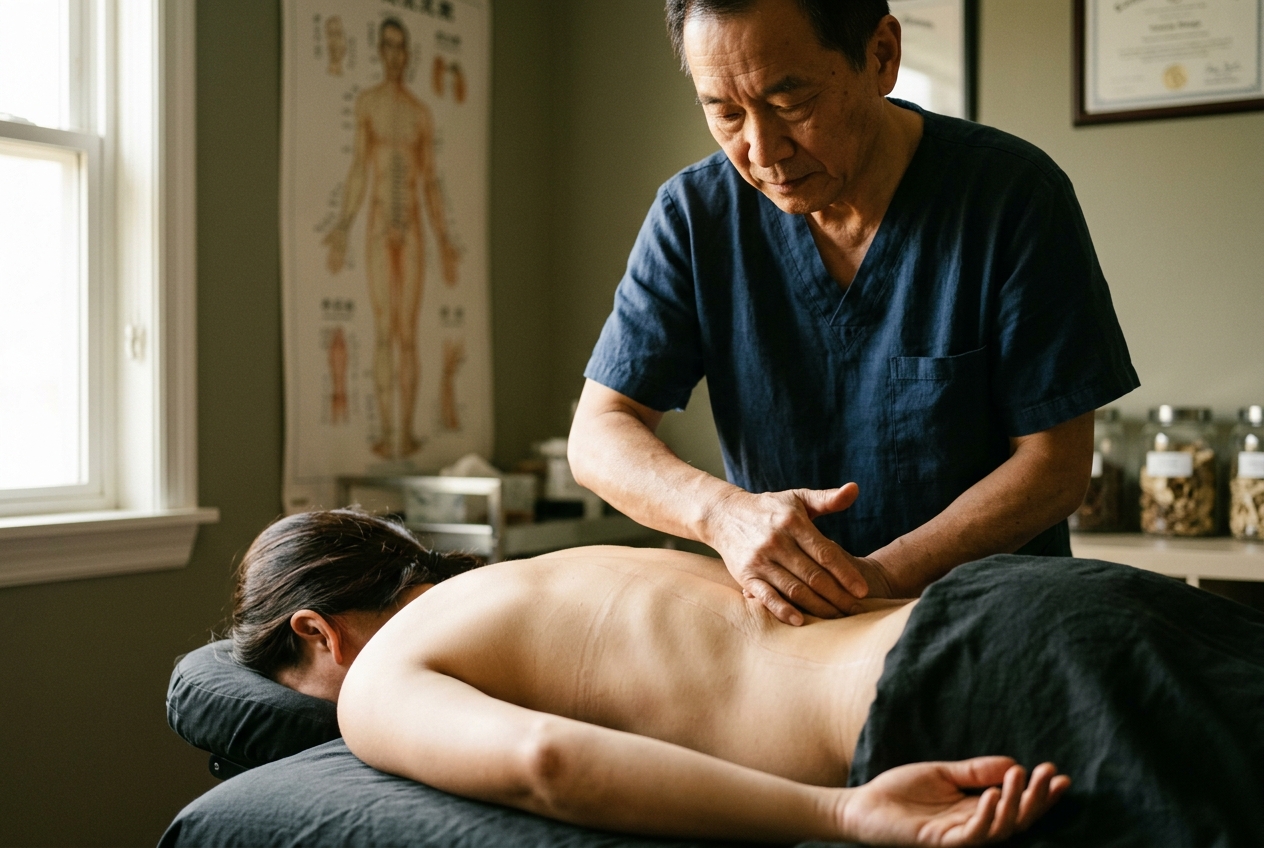
CLINICAL PARADIGM & SYSTEM OVERVIEW
Therapeutic Domain: Classical East Asian Manual Medicine (Tuina 推拿 / Anmo 按摩)
Core Biomechanical Vectors: Rolling (Gun), Kneading (Rou), Oscillating Pushing (Yi Zhi Chan), Traction-Distraction (Ba Shen), Structural Articulation (Ban)
Primary Physiological Correlates: Mechanosensitive ion-channel activation, microvascular reperfusion, interstitial fluid dynamics, somato-autonomic reflex modulation, neurofascial collagen realignment
Diagnostic & Target Systems: Twelve Primary Channels (Jingmai), Twelve Sinew Vessels (Jingjin), Acupoint Micro-Architectures, Autonomic & Central Neural Pain Networks
1. Opening: Modern Somatic Pathologies and the Mechanical Restorative Paradigm
In contemporary clinical neurology and orthopedics, few presentations are as pervasive as the triad of postural decompensation, myofascial pain syndrome, and chronic visceral dysregulation. Consider the desk-bound professional presenting with bilateral suboccipital tension, persistent cervical spine stiffness radiating into the scapular margin, dull thoracolumbar fatigue, and concurrent postprandial epigastric bloating. Conventional management frequently fragments this presentation into discrete diagnoses—cervicogenic cephalalgia, postural strain, and functional dyspepsia—managing each symptomatically with analgesics, muscle relaxants, or prokinetic pharmacotherapy.
Traditional Chinese Medicine (TCM), through the sophisticated manual science of Tuina (推拿), conceptualizes this clinical picture not as disconnected organ pathologies, but as an integrated mechanical and bioenergetic breakdown along defined kinetic chains: the Jingjin (Sinew Channels) and Jingmai (Primary Meridians). Tuina therapy applies calculated physical force vectors—shear, compressive, tensile, and oscillatory loads—directly to the soft tissues and articular complexes. In doing so, it restores normal biomechanical alignment and stimulates endogenous neurohumoral and microvascular cascades, converting external mechanical work into physiological self-repair.
+---------------------------------------------------------------------------------------+
|                                TUINA THERAPEUTIC CASCADE                              |
+---------------------------------------------------------------------------------------+
|  EXTERNAL MECHANICAL INPUT     -->  LOCAL TISSUE DEFORMATION  -->  SYSTEMIC MODULATION |
|  • Cyclic Shear (Gun Fa)            • Extracellular Matrix Fluid    • Central Pain    |
|  • Point Compression (Dian Fa)        Shear Stress                     Gating (A-beta)|
|  • Focal Oscillation (Yi Zhi Chan)  • Integrin / Piezo Activation   • Vagal Reflexes  |
|  • Articular Traction (Ba Shen)     • Inflammatory Cytokine Washout • Kinetic Chain   |
|                                       (TNF-alpha, IL-1beta)            Re-alignment   |
+---------------------------------------------------------------------------------------+
2. Historical Foundations and Classical Taxonomy
The origins of manual therapy in Chinese medicine are documented in the foundational texts of the Han Dynasty. In the Huangdi Neijing (Inner Canon of the Yellow Emperor), specifically Chapter 12 of the Suwen (Plain Questions), therapeutic modalities are mapped to geographical and ecological conditions:
"The Central Region is flat and damp... its people suffer from muscular weakness, chills, and fevers; their treatment is appropriately Daoyin (guiding breath and movement) and Anmo (pressing and rubbing)."
— Huangdi Neijing Suwen, Chapter 12
Historically designated as Anmo (按摩) or Anqiao (按蹺), the discipline evolved from instinctual folk remedies into an institutionalized branch of imperial medicine. During the Sui (581–618 CE) and Tang (618–907 CE) Dynasties, the Imperial Medical Bureau (Tai Yi Shu) established an official Anmo Department, appointing Master Practitioners (Anmo Boshi) to treat musculoskeletal injuries, internal disorders, and surgical trauma.
During the Ming Dynasty (1368–1644 CE), the nomenclature shifted definitively toward Tuina (推拿)—literally "Push and Grasp"—reflecting a broader repertoire of manipulative actions. This era produced specialized pediatric texts, including Gong Tingxian’s Xiao’er Tuina Mizhi (Secret Keys to Pediatric Tuina) and Zhou Yufan’s Xiao’er Tuina Mijue, establishing distinct energetic maps for the infantile forearm and palmar surfaces.
By the late Qing Dynasty and the modern clinical era, Tuina stratified into distinct lineages: - The One-Finger Meditation School (Yi Zhi Chan Tuina 一指禪推拿), emphasizing refined, high-frequency focal oscillation over specific acupoints to treat internal and neuromusculoskeletal conditions. - The Rolling Technique School (Gun Fa Tuina 滾法推拿), developed by Ding Jifeng in mid-20th-century Shanghai, utilizing high-contact cyclic rolling across broad myofascial regions to address complex motor-neuron deficits, spasticity, and severe orthopedic injuries. - The Internal Strength School (Nei Gong Tuina 內功推拿), combining martial grounding postures with dynamic manual vectors. - Bonesetting and Articular Realignment (Zheng Gu Tuina 正骨推拿), resolving articular subluxations through joint distraction and lever-arm manipulations.
The foundational paradigm across all lineages remains consistent: applying calibrated external mechanical force (Wai Li) to regulate endogenous Qi and Blood circulation (Qi Xue Liu Tong), disperse pathological stagnation (Yu), and re-establish dynamic balance between Yin and Yang.
3. Biomechanical and Kinetic Manipulation Categories
Tuina manipulations (Shou Fa 手法) are grouped into four primary biomechanical classes, each defined by unique force vectors, contact dynamics, wave profiles, and target depths:
+----------------------------------------------------------------------------------------------------+
|                             CLASSIFICATION OF TUINA MANIPULATIONS                                  |
+--------------------------+----------------------------+--------------------------------------------+
| CATEGORY                 | CLASSICAL TECHNIQUES       | BIOMECHANICAL PROFILE & ACTION             |
+--------------------------+----------------------------+--------------------------------------------+
| 1. Oscillatory           | • Gun Fa (Rolling)         | High contact area, continuous sinusoidal   |
|                          | • Rou Fa (Kneading)        | shear deformation (120–160 cpm); deep fas- |
|                          | • Yi Zhi Chan Tui Fa       | cial mobilization; focal resonance.        |
|                          |   (One-Finger Push)        |                                            |
+--------------------------+----------------------------+--------------------------------------------+
| 2. Frictional / Warming  | • Mo Fa (Rubbing)          | Planar circular or linear shear;           |
|                          | • Ca Fa (Wiping)           | high surface friction; rapid cutaneous     |
|                          | • Cuo Fa (Twisting)        | thermal output & capillary dilation.       |
+--------------------------+----------------------------+--------------------------------------------+
| 3. Vibrational / Percussive | • Zhen Fa (Trembling)   | High-frequency isometric micro-vibration;  |
|                          | • Dou Fa (Shaking)         | acoustic shockwaves; rapid spindle         |
|                          | • Pai Fa (Patting)         | proprioceptive reset.                      |
+--------------------------+----------------------------+--------------------------------------------+
| 4. Structural Articulation | • Ba Shen Fa (Traction)  | Vector-guided axial distraction;           |
|                          | • Ban Fa (Rotary Lever)    | zygapophyseal joint gapping; rotational    |
|                          |                            | lever-arm realignment of subluxations.     |
+--------------------------+----------------------------+--------------------------------------------+
A. Oscillatory Methods
Rolling Technique (Gun Fa 滾法)
Gun Fa is executed using the dorsolateral surface of the hand, focusing across the hypothenar eminence and the dorsal aspects of the fourth and fifth metacarpophalangeal joints. The practitioner maintains a relaxed shoulder, while the forearm alternates rhythmic pronation and supination combined with wrist flexion and extension at 120 to 160 cycles per minute (cpm).
Biomechanically, Gun Fa produces a travelling peristaltic compression wave across muscle bellies. The contact surface transitions smoothly from the hypothenar region to the dorsum of the hand, generating both downward perpendicular force and horizontal shear stress. This shear wave mobilizes interstitial fluids, reduces viscoelastic muscle resistance, and relieves regional myospasm without traumatizing superficial cutaneous nerve endings.
Kneading (Rou Fa 揉法)
Rou Fa utilizes the palmar heel, thenar eminence, or the pulp of the thumb/fingers adhering firmly to the cutaneous surface without sliding. The practitioner drives circular, undulating revolutions that displace the underlying subcutaneous, fascial, and muscular planes relative to deeper structures at 100 to 120 cpm. Its primary action is circular shear deformation, mobilizing sticky or fibrotic planes between the superficial and deep investing fascia.
One-Finger Meditation Pushing (Yi Zhi Chan Tui Fa 一指禪推法)
The technical benchmark of the Yi Zhi Chan tradition, this technique focuses force entirely through the interphalangeal pad or tip of the thumb, while the remaining digits are loosely curled into a hollow fist (Xu Quan). With the elbow dropped, the shoulder relaxed, and the wrist completely loose, dynamic forearm oscillation drives rapid thumb-tip rocking at 120 to 160 cpm. This generates an isolated, deep-penetrating kinetic micro-vector suited for small, high-density acupoints (such as Yingxiang LI20 or Taiyang M-HN-9).
B. Frictional and Warming Methods
Rubbing (Mo Fa 摩法)
Mo Fa applies gentle, planar contact with the palm (Zhang Mo) or finger pads (Zhi Mo) over visceral areas, most commonly the anterior abdominal wall. Unlike Rou Fa, the contact interface slides across the skin in smooth, continuous, clockwise or counter-clockwise orbits at 80 to 120 cpm. It stimulates superficial cutaneous thermoreceptors and gently mobilizes abdominal viscera without provoking protective abdominal guarding.
Wiping (Ca Fa 擦法)
Ca Fa uses the palmar surface, thenar eminence, or hypothenar edge to apply rapid, linear bidirectional friction along a defined anatomical line until noticeable heat is generated. Operating at 100 to 140 cpm, the high coefficient of friction produces localized thermal changes (increasing skin temperature by 1.5–3.5°C), leading to local arteriole dilation and sustained microvascular hyperemia.
Twisting (Cuo Fa 搓法)
Cuo Fa uses both palms held parallel on opposing sides of an extremity or torso section. The hands move rapidly back and forth in opposing directions while gradually advancing along the limb's longitudinal axis. This creates a twisting, torsion-shear stress around the neurovascular bundle and muscular sheath, relaxing tight kinetic chains at the conclusion of a treatment session.
C. Vibrational and Percussive Methods
Trembling (Zhen Fa 振法)
Zhen Fa is an isometric technique where the practitioner stabilizes the thumb pulp or palm over a specific acupoint or visceral region and deliberately induces high-frequency, low-amplitude muscular micro-tremors (exceeding 300 to 600 cpm / 5–10 Hz). This oscillatory compression penetrates deeply into the somatic or visceral target, altering local cell membrane potentials and reducing neurogenic hyper-excitability.
Shaking (Dou Fa 抖法)
Dou Fa applies passive axial traction to an extremity (e.g., holding the patient's wrist or ankle) followed by small-amplitude, high-velocity sinusoidal undulations. This sends a rippling mechanical wave through the entire kinetic chain, relieving intra-articular pressure and resetting resting tone across multi-joint muscle groups.
Patting and Percussion (Pai Fa 拍法 / Kou Fa 叩法)
Pai Fa uses a cupped palm to deliver rhythmic percussive strikes across broad muscular planes (such as the upper back and gluteal zones). The trapped air pocket creates an acoustic shockwave that transfers kinetic energy deep into the muscle bellies and lungs, promoting the clearance of respiratory secretions and interrupting myofascial pain signaling. Kou Fa uses finger-tip or ulnar fist percussion to stimulate regional proprioceptors.
D. Structural Mobilization and Joint Adjustments
Joint Distraction (Ba Shen Fa 拔伸法)
Ba Shen Fa applies controlled, vector-aligned manual traction along the physiological axis of a joint complex (cervical, glenohumeral, lumbar, or interphalangeal). By counteracting gravitational axial load and reactive spasm, it widens the intervertebral foramina, relieves impingement on spinal nerve roots, reduces intradiscal hydrostatic pressure, and stretches tightened periarticular ligaments.
Rotational Joint Manipulation (Ban Fa 扳法)
Ban Fa employs short-lever or long-lever rotational adjustments across an articulated segment (such as the cervical, thoracic, or lumbar spine). The practitioner guides the joint to its physiological barrier, stabilizes the axis, and applies a controlled, low-amplitude, high-velocity impulse (Overpressure / Cavitation Vector). This separates the zygapophyseal (facet) joints, releases entrapped synovial folds or meniscoids, and restores normal passive range of motion.
4. Modern Neurofascial Mechanotransduction and Physiology
Contemporary clinical research has clarified the physiological mechanisms through which manual forces translate into cellular, vascular, and neural changes within human tissue:
+----------------------------------------------------------------------------------------------------+
|                      NEUROFASCIAL MECHANOTRANSDUCTION PATHWAYS IN TUINA                            |
+------------------------------------+---------------------------------------------------------------+
| PHYSIOLOGICAL MECHANISM            | BIOLOGICAL & CELLULAR EVENTS                                  |
+------------------------------------+---------------------------------------------------------------+
| Cellular Mechanotransduction       | • Cyclic shear stress deforms cell membranes.                 |
|                                    | • Activates Piezo1/2 ion channels & integrin-FAK complexes.   |
|                                    | • Downregulates TNF-alpha, IL-1beta, IL-6, and COX-2.         |
|                                    | • Upregulates local anti-inflammatory IL-10 and TGF-beta.     |
+------------------------------------+---------------------------------------------------------------+
| Neuroreceptor Activation           | • Pacinian & Meissner corpuscles: high-frequency vibration.   |
| & Pain Modulation                  | • Ruffini endings: sustained planar shear.                    |
|                                    | • Golgi Tendon Organs (GTOs): tensile tendon stretch.         |
|                                    | • Primary A-beta afferents stimulate inhibitory interneurons  |
|                                    |   in Substantia Gelatinosa (Gate Control Mechanism).          |
+------------------------------------+---------------------------------------------------------------+
| Fascial & Connective Tissue        | • Remodels collagen cross-links along the Jingjin chains.     |
| Remodeling                         | • Stimulates hyaluronan production; reduces fluid viscosity.  |
|                                    | • Inactivates Myofascial Trigger Points (MTrPs).              |
+------------------------------------+---------------------------------------------------------------+
| Somato-Autonomic Reflex Arcs       | • Attenuates sympathetic outflow (lowers SMR & vasospasm).    |
|                                    | • Increases parasympathetic (vagal) tone via vagus nerve      |
|                                    |   and dorsal motor nucleus modulation.                        |
+------------------------------------+---------------------------------------------------------------+
A. Cellular Mechanotransduction and Fluid Dynamics
The mechanical forces delivered during Tuina—such as cyclic shear stress from Gun Fa and compressive loads from An Fa—trigger cellular mechanotransduction pathways within the extracellular matrix (ECM). Deforming the fibroblast cell membrane activates mechanosensitive ion channels (including Piezo1, Piezo2, and TRPV4) along with integrin-mediated Focal Adhesion Kinase (FAK) signaling cascades.
Research published in NCBI PMC musculoskeletal studies shows that cyclical compressive loading clears inflammatory mediators from the interstitial matrix. Locally elevated concentrations of pro-inflammatory cytokines—including tumor necrosis factor-alpha (TNF-α), interleukin-1beta (IL-1β), and substance P—are reduced through enhanced microvascular perfusion and lymphatic drainage, while tissue concentrations of transforming growth factor-beta (TGF-β) and interleukin-10 (IL-10) increase, supporting tissue remodeling.
B. Mechanoreceptors and Afferent Neuroreflexive Pain Gating
The manual methods of Tuina selectively engage sensory mechanoreceptors in both superficial skin layers and deep connective tissues: 1. Pacinian Corpuscles: High-frequency oscillatory inputs (100–300 Hz) from Yi Zhi Chan Tui Fa and Zhen Fa activate rapidly adapting Pacinian units, saturating sensory channels and blocking ascending nociceptive inputs. 2. Ruffini Endings: Sustained, low-velocity planar shear stresses from Ca Fa and Rou Fa activate slowly adapting Type II Ruffini mechanoreceptors, downregulating baseline sympathetic tone and reducing regional vasospasm. 3. Golgi Tendon Organs (GTOs): Sustained longitudinal traction (Ba Shen Fa) and deep tendon pressing stimulate GTOs, inducing autogenic inhibition in hypertonic muscle groups by inhibiting alpha motor neuron output.
These large-diameter, myelinated A-beta (Aβ) afferent fibers project directly into the substantia gelatinosa (Lamina II) of the spinal cord dorsal horn. By exciting inhibitory GABAergic interneurons, they suppress the transmission of nociceptive signals carried by unmyelinated C fibers and lightly myelinated A-delta (Aδ) axons. This interaction forms the neurobiological foundation of the classical Gate Control Theory of pain, interrupting pain-spasm-ischemia cycles before nociceptive input reaches thalamic and cortical centers.
C. Connective Tissue Remodeling in the Jingjin (Sinew Meridian) Network
The classical TCM Jingjin (Sinew Channels) map precisely to modern functional myofascial kinetic chains. Chronic repetitive strain and postural decompensation cause pathological collagen cross-linking, densification of hyaluronic acid, and formation of myofascial trigger points.
Tuina uses focal compression, transverse friction, and longitudinal stretching to: - Mechanically uncouple locked actin-myosin cross-bridges within contracted sarcomere cores. - Restore shear mobility between the epimysium, perimysium, and deep investing fascia. - Rehydrate the ground substance matrix by stimulating local hyaluronan synthesis, restoring normal viscoelastic gliding along the kinetic chain.
5. Clinical Acupressure and Channel Treatment Protocols
Below are structured clinical protocols demonstrating how to combine manual techniques, anatomical localization, and acupoint vectoring for common clinical presentations:
+----------------------------------------------------------------------------------------------------+
|                               CLINICAL ACUPRESSURE & TUINA PROTOCOLS                               |
+--------------------------+----------------------------+--------------------------------------------+
| CONDITION                | PRIMARY TARGET ACUPOINTS   | SEQUENTIAL TREATMENT PROTOCOL              |
+--------------------------+----------------------------+--------------------------------------------+
| 1. Cervical Spondylosis  | • Fengchi (GB20)           | 1. Warm-up: Gun Fa along trapezius (5 min) |
|    (Cervicobrachial      | • Tianzhu (BL10)           | 2. Point Compression: Dian-An GB20, BL10,  |
|     Syndrome)            | • Jianwaishu (SI14)        |    GV14, SI14 (1–2 min each)               |
|                          | • Dazhui (GV14)            | 3. Myofascial Release: Na Fa on trapezius  |
|                          |                            | 4. Decompression: Ba Shen Fa (Traction)    |
|                          |                            | 5. Mobilization: Controlled Ban Fa         |
+--------------------------+----------------------------+--------------------------------------------+
| 2. Lumbar Strain &       | • Shenshu (BL23)           | 1. Warm-up: Gun Fa over Erector Spinae     |
|    Intervertebral Stress | • Dachangshu (BL25)        | 2. Point Focus: Dian-An BL23, BL25,        |
|                          | • Weizhong (BL40)          |    Huatuojiaji (L2–L5)                     |
|                          | • Huatuojiaji (L1–L5)      | 3. Deep Release: Tan Bo (Plucking)         |
|                          |                            | 4. Distal Clear: Deep An-Rou on BL40       |
|                          |                            | 5. Realignment: Yaobu Xie Ban Fa           |
+--------------------------+----------------------------+--------------------------------------------+
| 3. Gastrointestinal      | • Zhongwan (CV12)          | 1. Somatovisceral Balancing: Rou Fa on     |
|    Dysregulation         | • Tianshu (ST25)           |    BL20 (Pishu) & BL21 (Weishu) (3 min)    |
|    (Spleen-Stomach Qi    | • Zusanli (ST36)           | 2. Abdominal Mobilization: Clockwise       |
|     Deficiency)          | • Pishu (BL20)             |    Zhang Mo Fa across CV12 & ST25 (5 min)  |
|                          | • Weishu (BL21)            | 3. Focal Stimulation: Zhen Fa on CV12      |
|                          |                            | 4. Distal Activation: Yi Zhi Chan on ST36  |
+--------------------------+----------------------------+--------------------------------------------+
Protocol 1: Cervical Spondylosis and Suboccipital Neuralgia
Clinical Presentation
The patient presents with suboccipital throbbing, restricted cervical rotation and lateral flexion, hypertonicity across the upper trapezius and levator scapulae, and paresthesias radiating along the radial dermatome (Foot Shaoyang and Hand Taiyang channel stagnation).
Key Target Acupoints
- Fengchi (GB20): Located in the depression between the upper trapezius and the sternocleidomastoid muscle, at the base of the occiput. Releases suboccipital spasms, improves vertebrobasilar perfusion, and relieves cervicogenic headaches.
- Tianzhu (BL10): Located 1.3 cun lateral to the midline (Yamen GV15), on the lateral border of the trapezius muscle. Relieves axial cervical tension and clears the Foot Taiyang channel.
- Dazhui (GV14): Located on the posterior midline, in the depression below the spinous process of the seventh cervical vertebra (C7). Acts as the confluence of all Yang meridians, dispelling pathogenic wind-cold and regulating the autonomic nervous system.
- Jianwaishu (SI14): Located 3 cun lateral to the lower border of the spinous process of the first thoracic vertebra (T1), on the medial border of the scapula. Decompresses the dorsal scapular nerve and levator scapulae attachments.
Step-by-Step Treatment Sequence
- Initial Soft-Tissue Prep: With the patient prone or seated, apply Gun Fa (Rolling) along the upper trapezius, supraspinatus, and cervical paraspinal muscles for 5 minutes (140 cpm) to reduce resting muscle tone.
- Acupoint Pressure Vectors: Transition to Dian-An Fa (Thumb Point Compression) at GB20, angling the vector superior-medially toward the contralateral orbit for 90 seconds per side until a de-qi sensation (distending ache) radiates over the vertex. Apply deep perpendicular An-Rou Fa (Press-Knead) to BL10, GV14, and SI14 for 2 minutes each.
- Grasping Manipulation: Apply Na Fa (Five-Finger Grasping) to the upper trapezius muscle belly, lifting and squeezing perpendicular to the fiber direction at 20 to 30 cpm for 3 minutes.
- Axial Decompression: Place the patient supine. Cradle the occiput in one hand while the other stabilizes the chin. Lean back to apply smooth, sustained Ba Shen Fa (Axial Traction) along the longitudinal plane for 60 seconds, widening the intervertebral foramina.
- Joint Mobilization: Perform Cervical Ban Fa (Controlled Rotary Lever Adjustment) only when indicated and safe: gently rotate the cervical spine to its end-range barrier, then apply a low-amplitude, high-velocity rotational impulse through the articular pillar to restore facet gliding.
Protocol 2: Lumbar Strain and Discogenic Low Back Pain
Clinical Presentation
The patient presents with dull, aching lumbosacral pain, paraspinal muscle splinting, restricted forward flexion, and radiating stiffness down the posterior thigh (Foot Taiyang and Foot Shaoyang Sinew Channel stagnation).
Key Target Acupoints
- Shenshu (BL23): Located 1.5 cun lateral to the lower border of the spinous process of the second lumbar vertebra (L2). Tonifies Kidney Qi, strengthens the lumbar spine, and supports deep core stability.
- Dachangshu (BL25): Located 1.5 cun lateral to the lower border of the spinous process of the fourth lumbar vertebra (L4). Regulates the Large Intestine, clears local Qi-Blood stagnation, and eases lumbosacral stiffness.
- Huatuojiaji (EX-B2 at L1–L5): Located 0.5 cun lateral to the lower borders of the lumbar spinous processes. Directly modulates the medial branches of the posterior spinal nerve rami and the deep multifidus musculature.
- Weizhong (BL40): Located at the midpoint of the transverse crease of the popliteal fossa, between the biceps femoris and semitendinosus tendons. Serves as the primary distal command point for the back ("Four Command Points"), clearing stagnant Qi and Blood along the entire Foot Taiyang channel.
Step-by-Step Treatment Sequence
- Broad Structural Preparation: With the patient prone, apply deep Gun Fa (Rolling) bilaterally along the erector spinae, lumbosacral junction, and gluteus medius for 6 to 8 minutes (120–140 cpm).
- Deep Paraspinal Compression: Use the palmar heels or reinforced thumbs to apply An-Rou Fa along the Huatuojiaji (L1–L5) line, applying downward perpendicular force (150–250 N) held for 10 to 15 seconds per segment, followed by slow circular kneading.
- Targeted Acupoint Pressure: Apply reinforced thumb pressing (Dian-An Fa) directly into BL23 and BL25 for 2 minutes each, establishing a deep aching sensation that radiates toward the sacrum.
- Deep Fiber Plucking: Apply Tan Bo Fa (Plucking) transversely across the taut paraspinal bands and the origin of the quadratus lumborum, strumming the muscle fibers at 40 to 60 cpm for 2 minutes to break up fibrotic adhesions.
- Distal Decompression: Compress BL40 with the thumb tip for 2 minutes, alternating between steady perpendicular pressure and micro-kneading to engage distal neuroreflexive pathways.
- Lumbar Rotational Mobilization: Position the patient in a lateral recumbent posture with the lower leg extended and the upper leg flexed at the hip and knee. Place one hand on the anterior shoulder and the other forearm over the posterior iliac crest. Rotate the segments in opposite directions to the end-range barrier, then apply a controlled impulse (Yaobu Xie Ban Fa) to gap the lumbar facet joints.
Protocol 3: Gastrointestinal Dysregulation and Spleen-Stomach Disharmony
Clinical Presentation
The patient presents with epigastric distension, postprandial fullness, fatigue, loose stools, or irregular bowel motility, reflecting Spleen-Stomach Qi deficiency with damp stagnation (Pi Wei Qi Xu).
Key Target Acupoints
- Zhongwan (CV12): Located on the anterior midline of the abdomen, 4 cun superior to the umbilicus. Serves as the Front-Mu point of the Stomach and Hui-Meeting point of the Fu (Yang) organs, tonifying Middle Jiao Qi and harmonizing gastric descent.
- Tianshu (ST25): Located 2 cun lateral to the center of the umbilicus. Acts as the Front-Mu point of the Large Intestine, regulating intestinal motility, clearing damp-heat, and relieving abdominal distension.
- Zusanli (ST36): Located 3 cun inferior to Dubi (ST35), one finger-breadth lateral to the anterior crest of the tibia. As the He-Sea and Earth point of the Stomach meridian, it provides powerful systemic tonification for digestive, immune, and neuromuscular function.
- Pishu (BL20) and Weishu (BL21): Located 1.5 cun lateral to the lower borders of the spinous processes of T11 and T12. The Back-Shu points for the Spleen and Stomach, providing direct somatovisceral autonomic access to upper GI function.
Step-by-Step Treatment Sequence
- Posterior Somatovisceral Balancing: With the patient prone, apply warm, gentle Zhang Rou Fa (Palmar Kneading) over BL20 and BL21 for 3 minutes, followed by rapid, light Ca Fa (Linear Wiping) over the lower thoracic spine until the skin feels warm.
- Abdominal Warming and Mobilization: Place the patient supine with knees comfortably supported in slight flexion. Apply slow, clockwise Zhang Mo Fa (Palmar Circular Rubbing) over the entire abdomen for 5 minutes (60–80 cpm), tracking the anatomical pathway of the ascending, transverse, and descending colon.
- Front-Mu Point Compression: Apply Zhi Rou Fa (Finger-Kneading) using the middle three fingers over CV12 and bilaterally over ST25 for 2 to 3 minutes each, timing compressive pressure with exhalation to encourage diaphragmatic relaxation.
- Visceral Vibration: Place the flat palm over CV12 and perform Zhen Fa (Isometric Micro-Trembling) at 300 to 400 cpm for 90 seconds, transmitting micro-mechanical vibrations through the abdominal wall into the celiac plexus and gastric smooth muscle.
- Distal Channel Activation: Apply Yi Zhi Chan Tui Fa (One-Finger Meditation Pushing) directly to ST36 bilaterally for 3 minutes (140 cpm), using firm perpendicular pressure to elicit a heavy, distending sensation along the anterior shin.
6. Practical Directives, Dosimetry, Meridian Vectoring, and Clinical Safety
Effective and safe Tuina requires precise control over mechanical dosage, energetic directionality (Bu vs. Xie), and thorough screening for structural contraindications:
+----------------------------------------------------------------------------------------------------+
|                                    MANUAL DOSIMETRY PARAMETERS                                     |
+--------------------------+----------------------------+--------------------------------------------+
| DOSAGE COMPONENT         | RECEPTIVE / TONIFYING (BU) | DRAINING / DISPERSING (XIE)                |
+--------------------------+----------------------------+--------------------------------------------+
| Force Magnitude          | Light to moderate (10–30 N)| Deep to intense (40–80+ N)                 |
| Oscillation Frequency    | Slow & steady (60–100 cpm) | Rapid & vigorous (140–180 cpm)             |
| Meridian Vectoring       | With the channel pathway   | Counter to channel pathway                 |
| Duration per Acupoint    | 2 to 4 minutes             | 30 to 90 seconds (high intensity)          |
| Total Session Exposure   | 30 to 45 minutes           | 15 to 30 minutes                           |
+--------------------------+----------------------------+--------------------------------------------+
A. Manual Dosimetry and Energetic Vectoring (Bu vs. Xie)
In TCM manual medicine, the clinical effect of a technique depends on force, frequency, duration, and directional vector relative to the meridian: - Tonifying (Bu Fa 補法): Employs light to moderate pressure, gentle rhythms, slower frequencies (60–100 cpm), and movements directed along the anatomical pathway of the channel. Bu Fa supports deficient Qi and Blood, warms cold patterns, and calms an overactive nervous system. - Sedating/Draining (Xie Fa 瀉法): Uses deeper force, higher frequencies (140–180 cpm), and movements directed against the anatomical pathway of the channel. Xie Fa clears excess heat, breaks up blood stasis, and resolves acute myofascial knots. - Harmonizing (He Fa 和法): Balances moderate force, intermediate frequency (100–120 cpm), and alternating directional vectors to restore overall homeostasis between the interior and exterior.
B. High-Risk Acupoints in Pregnancy
Certain acupoints produce strong descending or oxytocic-like physiological actions that can stimulate uterine contractions. These points are strictly contraindicated during pregnancy:
+----------------------------------------------------------------------------------------------------+
|                             HIGH-RISK ACUPOINTS DURING PREGNANCY                                   |
+--------------------------+----------------------------+--------------------------------------------+
| ACUPOINT                 | ANATOMICAL LOCATION        | MECHANISM OF CONTRAINDICATION              |
+--------------------------+----------------------------+--------------------------------------------+
| Hegu (LI4)               | 1st/2nd metacarpal web     | Strong descending Qi; induces uterine      |
|                          | space                      | contraction & labor cascades.              |
+--------------------------+----------------------------+--------------------------------------------+
| Sanyinjiao (SP6)         | 3 cun above medial         | Confluence of 3 Lower Yin; stimulates      |
|                          | malleolus, posterior tibia | pelvic blood flow & uterine contractility. |
+--------------------------+----------------------------+--------------------------------------------+
| Jianjing (GB21)          | Trapezius muscle belly     | Strong downward-directing Qi vector;       |
|                          | midpoint                   | risks precipitating early labor.           |
+--------------------------+----------------------------+--------------------------------------------+
| Kunlun (BL60)            | Between lateral malleolus  | Clears back; promotes downward descent     |
|                          | and Achilles tendon        | and labor induction.                       |
+--------------------------+----------------------------+--------------------------------------------+
| Ciliao (BL32) &          | Posterior sacral foramina  | Directly stimulates the pelvic parasym-    |
| Sacral Base Points       | (S1–S4)                    | pathetic outflow & uterine innervation.    |
+--------------------------+----------------------------+--------------------------------------------+
C. Clinical Red Flags and Strict Contraindications
- Vascular Vulnerabilities: Patients with known or suspected deep vein thrombosis (DVT), unmanaged abdominal aortic aneurysms, severe carotid atherosclerosis, or arteritis must never receive vigorous friction or compressive rolling over the affected vessels.
- Structural Fragility: Severe osteopenia, osteoporosis (T-score < -2.5), active bone metastases, and acute ligament tears contraindicate high-velocity Ban Fa and deep, heavy compression due to fracture and dislocation risks.
- Acute Cutaneous & Infectious Lesions: Avoid all local friction (Ca Fa) and kneading (Rou Fa) over open wounds, burns, cellulitis, active herpes zoster eruptions, or localized abscesses.
- Inflammatory Arthropathies: During acute inflammatory flares of rheumatoid arthritis, ankylosing spondylitis, or gouty arthritis, avoid joint manipulation (Ban Fa) and heavy local work, keeping manual therapy gentle, distal, and focused on draining excess heat.
For broader international standards on manual medicine safety and traditional therapies, consult the World Health Organization Guidelines on Traditional and Complementary Medicine.
7. Synthesis and Bedside Translation: A 2-Minute Daily Neuro-Somatic Reset
For clinicians and individuals seeking an efficient, evidence-informed acupressure sequence to reset postural tension and autonomic equilibrium at the end of a demanding day:
+----------------------------------------------------------------------------------------------------+
|                               THE 2-MINUTE AUTONOMIC & CERVICAL RESET                              |
+------------------------------------+---------------------------------------------------------------+
| PARAMETER                          | INSTRUCTIONS & EXECUTION                                      |
+------------------------------------+---------------------------------------------------------------+
| Target Focus                       | • Fengchi (GB20) — Suboccipital Cranio-Cervical Junction      |
| Total Duration                     | • 2 minutes (120 seconds) continuous application              |
| Body Position                      | • Seated upright; spine elongated; shoulders relaxed          |
| Hand Placement                     | • Interlock fingers behind occiput; place thumbs into the     |
|                                    |   suboccipital hollows at the base of the skull (GB20)        |
| Force & Vector Angle               | • Apply firm, sustained upward-inward pressure (20–30 N)      |
|                                    |   angled toward the opposite eye orbit                        |
| Micro-Oscillation                  | • Perform slow, small circular kneading motions (60 cpm)      |
| Breathing Pattern                  | • Inhale deeply through nose (4s); smooth exhalation (6s)     |
| Sensation Profile                  | • Distinct, pleasant dull ache/warmth radiating over skull    |
| Primary Clinical Outcome           | • Decreases suboccipital tension; stimulates vagal tone;      |
|                                    |   attenuates sympathetic eye strain and cervicogenic ache     |
+------------------------------------+---------------------------------------------------------------+
Through this focused integration of historical manual taxonomy, modern fascial mechanobiology, and precise neuroreflexive localization, Tuina bridges classical meridian concepts with contemporary physical medicine—providing a safe, non-pharmacological system for restoring functional movement and physiological balance.
Authoritative References & Clinical Resources
- World Health Organization Traditional Medicine Benchmarks: WHO T&CM Strategy
- Tuina Manual Therapy Foundations: Wikipedia — Tui Na
- Mechanobiology & Cytokine Regulation: NCBI PMC Article on Manual Therapy Mechanotransduction
- Sensory Gating in Manual Medicine: Wikipedia — Gate Control Theory
- Myofascial Trigger Point Pathophysiology: Wikipedia — Myofascial Trigger Point