Tonifying Formulas (Bu Yi Ji) Prescription Dynamics: Governing Qi-Blood Replenishment, Yin-Yang Restoration, Adaptive Immunomodulation, and Visceral Exhaustion in Traditional Chinese Medicine
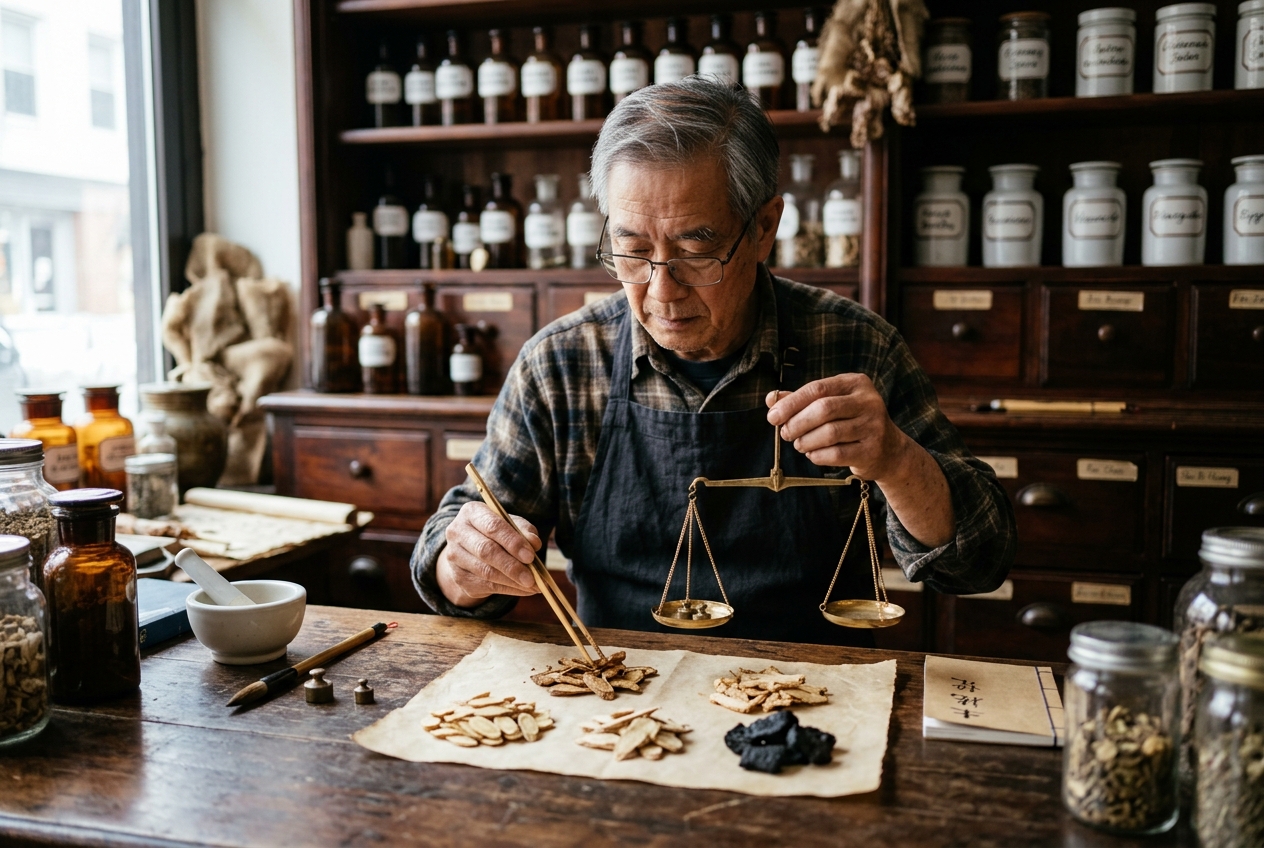
You sit at your desk at three in the afternoon, overwhelmed by an inexplicable, heavy lethargy. It is not merely the mild drowsiness of a long workday, but a profound, hollow exhaustion that seems to emanate from the marrow of your bones. Your limbs feel as though they are weighted with wet sand; your breathing is shallow, your voice lacks its customary resonance, and even the simplest cognitive task demands monumental effort. You might notice a subtle chill creeping into your lower back and knees, or perhaps a persistent dry heat flushing your cheeks while your palms and soles feel uncomfortably warm. You reach instinctively for a cup of coffee or a sugary snack, yet the resulting burst of energy is brittle, brief, and followed by an even deeper physical collapse.
In the conceptual architecture of Traditional Chinese Medicine (TCM), this state is neither a mysterious anomaly nor an inevitable consequence of aging. It represents Xu (vacuity or deficiency)—a systemic depletion of the body's fundamental physiological substrates: Qi (vital bioenergy), Xue (blood), Yin (structural fluids and cooling reserve), or Yang (metabolic warmth and functional propulsion). Rather than relying on temporary stimulants that deplete biological reserves further, classical Chinese medicine deploys an intricate therapeutic discipline known as Bu Yi Ji (Tonifying Formulas). These formulations do not merely substitute missing substances; they systematically recalibrate the body's self-sustaining metabolic and immunological networks.
2. What This Organ System Does: The Architectural Physiology of Post-Heaven and Pre-Heaven Energies
To comprehend how tonifying formulas operate, one must first examine the two cardinal physiological engines of the human body in Chinese medical theory: the Spleen (Pi) and Stomach (Wei) axis, known as the Root of Post-Heaven Essence (Hou Tian Zhi Ben), and the Kidney (Shen) system, designated the Root of Pre-Heaven Essence (Xian Tian Zhi Ben).
In classical physiology, the Stomach is likened to a great vat responsible for receiving and decomposing food and fluids, while the Spleen functions as the primary metabolic catalyst, responsible for transformation (Yun) and transportation (Hua). The Spleen extracts the subtle, pure essence of nutrition—termed Gu Qi (Food Grain Essence)—and ascends it to the Heart and Lungs, where it interacts with inhaled atmospheric air (Tian Qi) to forge the circulating Qi and nourishing Blood that sustain all biological functions. When the Spleen thrives, digestion is effortless, muscle tone is robust, the immune perimeter is impermeable, and cognitive focus is sharp.
Simultaneously, the Kidneys house the ancestral Essence (Jing), inherited at conception. Kidney Essence bifurcates functionally into Kidney Yin and Kidney Yang. Kidney Yin constitutes the fundamental structural moisture, lubricating the joints, nourishing the brain and spinal cord (Marrow), and preventing metabolic hyper-reactivity. Kidney Yang, or the "Minister Fire" (Ming Men Huo), serves as the biological hearth, supplying the primordial thermogenic energy required for cellular respiration, hormonal cascade activation, and enzymatic digestion.
Tonifying formulations are structured across four fundamental functional tiers designed to nourish these specific deficits:
- Qi-Tonifying Formulas (Bu Qi Ji): Target Spleen and Lung vacuity, restoring enzymatic digestion, vital capacity, tissue lifting, and immunological defence.
- Blood-Tonifying Formulas (Bu Xue Ji): Replenish volume, iron-carrying capacity, cellular nutrition, and tissue moisture, primarily targeting the Liver and Heart networks.
- Yin-Tonifying Formulas (Bu Yin Ji): Restore depleted intracellular fluid, hormonal precursors, and cellular hydration, pacifying interior vacuity heat (Deficiency Fire).
- Yang-Tonifying Formulas (Bu Yang Ji): Rekindle mitochondrial thermogenesis, neuroendocrine vitality, and adrenal competence.
3. How You Can Feel It: Signs of Balance and Imbalance
A clinical assessment in Chinese medicine evaluates the balance between physical vitality, thermal regulation, fluid balance, and psycho-emotional stamina. Because tonifying formulas must be matched with absolute precision to specific biological patterns, recognizing your systemic state is paramount.
+------------------+-----------------------------------------+-----------------------------------------+
| Vacuity Pattern  | Primary Physical & Emotional Signs      | Diagnostic Tongue & Pulse Markers       |
+------------------+-----------------------------------------+-----------------------------------------+
| Qi Vacuity       | Chronic post-prandial fatigue, shallow  | Pale, swollen tongue with tooth marks;  |
| (Qi Xu)          | breath, spontaneous sweating, weak voice| soft, empty, deflated pulse (Xu Mai)    |
+------------------+-----------------------------------------+-----------------------------------------+
| Blood Vacuity    | Dull pale complexion, brittle nails,    | Pale, thin, dry tongue body;            |
| (Xue Xu)         | dizziness, dry skin, unrefreshing sleep | fine, thready, wire-thin pulse (Xi Mai) |
+------------------+-----------------------------------------+-----------------------------------------+
| Yin Vacuity      | Late-day hot flushes, night sweats,     | Crimson/red tongue, absence of coat;    |
| (Yin Xu)         | dry throat, malar flush, restless mind  | rapid, thready, floating pulse (Xi Shu) |
+------------------+-----------------------------------------+-----------------------------------------+
| Yang Vacuity     | Severe cold intolerance, cold knees,    | Pale, enlarged, wet/slippery tongue;    |
| (Yang Xu)        | dawn diarrhea, lethargy, low libido     | deep, slow, faint pulse (Chen Chi Mai)  |
+------------------+-----------------------------------------+-----------------------------------------+
Self-Assessment: Evaluating Systemic Depletion vs. Excess Stagnation
To determine whether your system requires tonification or clearing, assess the following diagnostic criteria:
- Thermal Balance: Do you crave warm beverages and feel continually chilled, particularly around the lower back and feet (Yang Vacuity)? Or do you experience a low-grade internal heat in the evenings, with hot palms, hot soles, and night sweats (Yin Vacuity)?
- Response to Food: Does eating a moderate meal leave you exhausted and bloated, indicating a sluggish Spleen Qi? Or does skipping a meal cause profound trembling, mental confusion, and faintness, indicating combined Qi and Blood exhaustion?
- The Tongue Body and Coat: Stand before a mirror in natural morning light. A healthy tongue is fresh pink with a thin, translucent white coat. A pale, enlarged tongue with scalloped edges (tooth marks) reflects Spleen Qi deficiency and systemic fluid accumulation. A glossy, bright red tongue with complete absence of coating (peeled tongue) indicates deep Yin exhaustion.
- Crucial Diagnostic Differentiation (Vacuity vs. Excess Mimicry): Fatigue is not always a sign of vacuity. If your exhaustion is accompanied by a thick, greasy yellow tongue coating, a sensation of chest oppression, bad breath, and irritability that improves with vigorous exercise, you are suffering from Damp-Heat Stagnation or Food Stagnation (Shi Zheng), not true vacuity. Administering rich tonics to an excess condition is a critical clinical error, as it exacerbates stagnation.
4. Sovereign-Minister-Assistant-Courier Architecture & Movement Practice
The Jun-Chen-Zuo-Shi Hierarchical Dynamics
Chinese polyherbal prescribing relies on the Jun-Chen-Zuo-Shi structural model, an ancient architectural philosophy that organizes herbal formulas into a unified pharmacological synergy:
- Sovereign (Jun): The chief herb targeting the primary pathological root at the highest therapeutic concentration.
- Minister (Chen): Potentiates the actions of the Sovereign herb or treats co-existing secondary manifestations.
- Assistant (Zuo): Modulates toxicity, counterbalances excessive thermal or physical properties of the Sovereign, or assists from an opposing vector.
- Courier (Shi): Guides the formula to specific target meridians or anatomical regions and harmonizes the overall blend.
Counteracting Cloyingness (Ni Ge 腻膈)
The cardinal challenge in designing tonifying prescriptions is the phenomenon of Ni Ge (cloying stagnation). Rich, gelatinous blood and yin-tonifying substances—such as Shu Di Huang (steamed Rehmannia glutinosa) and E Jiao (colla corii asini)—are dense, heavy, and inherently difficult for a weakened Spleen to digest. If administered alone, they impair digestion, generate internal dampness, and induce nausea or loose stools.
To resolve this, classical pharmacopeias pair dense tonics with acrid, aromatic, Qi-regulating assistants. For example, pairing Shu Di Huang with Sha Ren (Amomum villosum) or Chen Pi (Citrus reticulata) disperses gastric congestion, promotes digestive motility, and enables the deep assimilation of nourishing constituents without digestive stagnation.
Mind-Body Practice: "Drawing the Bow to Harmonize Spleen and Kidney"
This classical Qigong sequence from the Ba Duan Jin (Eight Brocades) stimulates both the Spleen-Stomach and Kidney-Adrenal energetic meridians, optimizing internal digestive fire and invigorating the spine.
- Setup: Stand upright with feet shoulder-width apart, knees softly bent, tailbone slightly tucked, and shoulders relaxed. Rest your palms facing upward in front of your lower abdomen (Dan Tian).
- Step-by-Step Movement:
- Inhale: Slowly float both hands upward along the midline of the torso to the level of the Heart.
- Exhale: Turn your left palm toward the sky and press it directly overhead, fingers pointing inward toward the right. Simultaneously, press your right palm downward beside your right hip, fingers pointing forward. As your arms extend fully, gently turn your head to look upward toward your raised left palm.
- Hold: Maintain the fully extended posture for 2–3 seconds while retaining relaxed breath, feeling a longitudinal stretch through the ribcage, spleen, stomach, and flanks.
- Inhale: Slowly bring both palms back to the center of the chest, settling your gaze forward.
- Exhale: Alternate sides by pressing the right palm to Heaven and the left palm to Earth, looking up toward the right hand.
- Repetitions and Duration: Perform 8 complete cycles (4 on each side), taking approximately 5 to 7 minutes.
- Target Sensation: You should experience a distinct warming sensation radiating across the epigastrium and lower back, accompanied by abdominal relaxation, subtle gurgling sounds (peristaltic activation), and deepened diaphragmatic breathing.
5. Acupressure Points You Can Try Today
Targeted stimulation of classical acupoints acts on physiological reflex arcs, promoting local microcirculation and modulating autonomic nervous system tone.
1. Zu San Li (ST-36 — "Leg Three Miles")
- Anatomical Location: Sit with your knees bent at 90 degrees. Locate the depression directly below the outer edge of your kneecap (the lateral "eye" of the patella). Measure four finger-widths (3 cun) downward from this depression, and one thumb-width lateral to the sharp anterior crest of the shinbone (tibia). You will feel a subtle notch in the tibialis anterior muscle.
- Application Technique: Use the tip of your thumb to apply firm, deep, perpendicular pressure in small, clockwise circular motions. Maintain firm pressure that induces a distinct, heavy sensation (De Qi) without sharp pain. Massage for 2 to 3 minutes on each leg.
- Clinical Utility: The foremost point for supplementing Spleen-Stomach Qi, resolving digestive fatigue, elevating systemic physical endurance, and enhancing immune defense.
2. San Yin Jiao (SP-6 — "Three Yin Intersection")
- Anatomical Location: Place the width of four fingers along the inside of your lower leg, starting from the prominence of the medial ankle bone (medial malleolus). The point sits just behind the posterior border of the tibia bone.
- Application Technique: Apply steady, sustained compression using your thumb pad. Press inward toward the bone, holding for 60 to 90 seconds while practicing deep diaphragmatic breathing. Repeat 3 times per limb.
- Clinical Utility: Harmonizes the intersection of the Spleen, Liver, and Kidney channels. Renowned for nourishing blood, soothing mental agitation, combating insomnia, and alleviating menstrual irregularities. (Note: Contraindicated during pregnancy).
3. Guan Yuan (CV-4 — "Gate of Origin")
- Anatomical Location: Located on the anterior abdominal midline, exactly four finger-widths (3 cun) below the center of the navel.
- Application Technique: Place the flat palm or stacked fingers of both hands over the point. Apply gentle, warm, continuous pressure inward and slightly downward, or perform gentle palm friction until a soothing warmth penetrates into the lower abdomen. Hold for 3 to 5 minutes.
- Clinical Utility: Direct access point for the Primary Qi (Yuan Qi); nourishes Kidney Yin and Yang, warms the lower burner, and counteracts profound chronic exhaustion.
6. Food, Herbal Pharmacology & Modern Biomedical Correlates
Classical Formulas Across the Four Restorative Tiers
========================================================================================
TIER 1: QI TONIFICATION (Bu Qi)
========================================================================================
• Si Jun Zi Tang (Four Gentlemen Decoction)
  Composition: Ren Shen (Ginseng), Bai Zhu (Atractylodes), Fu Ling (Poria), Zhi Gan Cao (Licorice).
  Action: Establishes base metabolic transformation; restores Spleen Qi and eliminates mild dampness.
• Bu Zhong Yi Qi Tang (Tonify the Middle to Augment Qi Decoction)
  Composition: Huang Qi, Ren Shen, Bai Zhu, Zhi Gan Cao, Dang Gui, Chen Pi, Sheng Ma, Chai Hu.
  Action: Elevates sunken Spleen Qi, resolves organ prolapse, counteracts chronic fatigue and subfebrile heat.
• Sheng Mai San (Generate the Pulse Powder)
  Composition: Ren Shen, Mai Men Dong, Wu Wei Zi.
  Action: Concurrent restoration of Qi and Yin; preserves myocardial function, arrests profuse sweat.

========================================================================================
TIER 2: BLOOD TONIFICATION (Bu Xue)
========================================================================================
• Si Wu Tang (Four Substances Decoction)
  Composition: Shu Di Huang, Bai Shao, Dang Gui, Chuan Xiong.
  Action: Archetypal blood-nourishing matrix; mobilizes stagnant blood while rebuilding volume.
• Gui Pi Tang (Restore the Spleen Decoction)
  Composition: Ren Shen, Huang Qi, Bai Zhu, Fu Shen, Suan Zao Ren, Long Yan Rou, Dang Gui, etc.
  Action: Dual Spleen-Heart supplementation; remedies chronic cognitive fatigue, palpitations, and insomnia.
• Dang Gui Bu Xue Tang (Tangkuei Decoction for Tonifying Blood)
  Composition: Huang Qi (30g), Dang Gui (6g) [5:1 Classical Ratio].
  Action: Utilizes heavy Qi tonification to generate blood rapidly following acute hemorrhage.

========================================================================================
TIER 3: YIN TONIFICATION (Bu Yin)
========================================================================================
• Liu Wei Di Huang Wan (Six-Ingredient Rehmannia Pill)
  Composition: Shu Di Huang, Shan Zhu Yu, Shan Yao, Ze Xie, Mu Dan Pi, Fu Ling.
  Action: Classical "Three Tonics, Three Drainers" formulation nourishing Kidney-Liver-Spleen Yin.
• Zuo Gui Wan (Restore the Left Kidney Pill)
  Composition: Shu Di Huang, Shan Yao, Shan Zhu Yu, Gou Qi Zi, Tu Si Zi, Huai Niu Xi, Gui Ban Jiao, Lu Jiao Jiao.
  Action: Pure, heavy replenishment of primordial Essence and structural Marrow without draining agents.
• Yi Guan Jian (Linking Decoction)
  Composition: Bei Sha Shen, Mai Men Dong, Dang Gui, Sheng Di Huang, Gou Qi Zi, Chuan Lian Zi.
  Action: Enriches Liver-Kidney Yin while dredging stagnant Liver Qi and resolving hypochondriac pain.

========================================================================================
TIER 4: YANG TONIFICATION (Bu Yang) & DUAL RESTORATION
========================================================================================
• Jin Gui Shen Qi Wan (Kidney Qi Pill from the Golden Cabinet)
  Composition: Liu Wei Di Huang Wan + Gui Zhi (Cinnamon Twig) and Fu Zi (Prepared Aconite).
  Action: Micro-dosed warming herbs stimulate transformation within a large reservoir of Yin fluids.
• You Gui Wan (Restore the Right Kidney Pill)
  Composition: Shu Di Huang, Shan Yao, Shan Zhu Yu, Gou Qi Zi, Tu Si Zi, Du Zhong, Rou Gui, Fu Zi, etc.
  Action: Direct, robust warming of Ming Men Fire, treating systemic coldness, impotence, and severe fatigue.
• Dual Qi-Blood Integration: Ba Zhen Tang (Eight Treasures) & Shi Quan Da Bu Tang (All-Inclusive Great Tonifying Decoction)
  Composition: Seamless fusion of Si Jun Zi Tang + Si Wu Tang (+ Huang Qi, Rou Gui in Shi Quan Da Bu Tang).
  Action: Total biological resuscitation for severe multi-system depletion, surgical recovery, and cachexia.
========================================================================================
Modern Biomedical Correlates and Pharmacological Mechanisms
Contemporary molecular biology has uncovered the concrete pharmacological foundations of these ancient clinical formulas:
- Hypothalamic-Pituitary-Adrenal (HPA) Axis Regulation: Formulas such as Bu Zhong Yi Qi Tang and Si Jun Zi Tang contain ginsenosides (from Panax ginseng) and astragalosides (from Astragalus membranaceus). These adaptogenic compounds cross the blood-brain barrier to modulate corticotropin-releasing hormone (CRH) synthesis in the hypothalamus, optimizing adrenocorticotropic hormone (ACTH) and circulating serum cortisol levels, thereby mitigating chronic adrenal exhaustion as documented in NCBI PubMed research on adaptogenic neuroendocrine regulation.
- Mitochondrial ATP Synthesis and Bioenergetics: Key constituents of Qi-tonifying herbs upregulate mitochondrial oxidative phosphorylation complexes (Complex I, III, and IV) and enhance expression of peroxisome proliferator-activated receptor gamma coactivator 1-alpha (PGC-1α), directly promoting cellular ATP output in cardiac and skeletal myocytes.
- Erythropoiesis and Hematopoietic Stem Cell Proliferation: In Si Wu Tang and Dang Gui Bu Xue Tang, ferulic acid (Angelica sinensis) combined with Rehmannia polysaccharides upregulates hepatic and renal erythropoietin (EPO) gene transcription and enhances bone marrow microenvironment vascularity, stimulating erythrocyte lineage differentiation according to NCBI research on Si Wu Tang hematopoiesis.
- Immunomodulation via Botanical Polysaccharides: High-molecular-weight polysaccharides derived from Astragalus, Poria, and Atractylodes act as ligands for toll-like receptors (TLR4) on macrophages and dendritic cells, stimulating natural killer (NK) cell cytotoxicity, balancing helper T-cell ratios (Th1/Th2), and modulating interferon-gamma (IFN-γ) and interleukin profiles as detailed in NCBI investigations on Astragalus polysaccharides.
- Neuroendocrine and Epigenetic Preservation in Yin Formulas: Classical research into Liu Wei Di Huang Wan demonstrates its capacity to upregulate central brain-derived neurotrophic factor (BDNF), protect against hippocampal synaptic loss, and modulate estrogen receptor beta (ER-β) sensitivity, providing neuroprotection and metabolic homeostasis as validated in PubMed studies on Liu Wei Di Huang Wan.
The global integration and safety validation of these botanical interventions remain a core objective of the World Health Organization (WHO) Traditional Medicine Strategy.
Dietary Therapy: Everyday Whole-Food Tonification
To sustainably nourish your biological foundations, emphasize readily available whole foods that reinforce the Spleen and Kidney networks:
- Warm, Cooked Foods for Spleen Qi: Shift away from cold, raw salads and iced drinks, which force the Spleen to expend internal metabolic heat to warm ingestions to core body temperature. Prioritize slow-simmered grain porridges (such as steel-cut oats or brown rice congee cooked with ginger slices), roasted squash, sweet potatoes, parsnips, and carrots.
- Deep-Nourishing Foods for Blood and Jing: Integrate nutrient-dense foods including slow-simmered bone broths, organic eggs, black sesame seeds, walnuts, dark leafy greens (steamed spinach, chard), and iron-rich lentils or grass-fed liver.
- Hydrating Foods for Yin: To replenish cellular fluids, consume stewed pears with honey, black beans, goji berries, and mineral broths.
- What to Reduce: Eliminate refined white sugar, ultra-processed industrial seed oils, excessive dairy products, and high doses of caffeine, all of which deplete Kidney Yin, generate dampness (Shi), and weaken Spleen digestive transformation.
Diagnostic Contraindications & Safety Warnings
[!CAUTION] Severe Damp-Phlegm and Food Stagnation Contraindication Administering tonifying prescriptions to patients presenting with a thick, greasy tongue coat, acute abdominal distension, severe nausea, or foul belching will exacerbate internal stagnation and heat. The digestive terrain must first be cleared and regulated with acrid, dispersing agents before initiating deep tonification.
7. Today's Takeaway
If you do only one thing today to rebuild your vital reserves, spend five minutes immediately after your midday meal practicing the Post-Prandial Spleen Restoration Routine: Sit comfortably upright, set aside all digital screens, take three deep diaphragmatic breaths, and use your thumb to firmly massage point Zu San Li (ST-36) on each leg for 90 seconds. Follow this with a small cup of warm water or ginger tea. This simple practice relieves post-meal lethargy, stimulates your digestive fire, and anchors your vital energy for the remainder of the day.