Teishin Therapy: Navigating Non-Invasive Cutaneous Resonance, Superficial Meridian Polarization, and Precision Acupressure Protocols
1. Opening — A Problem This Solves Today
If you regularly finish a working day with your shoulders hitched toward your ears, your stomach tight and distended after lunch, and an underlying hum of sympathetic nervous exhaustion that prevents deep sleep, you are experiencing the biological toll of modern autonomic dysregulation. When the human nervous system is continuously bathed in glucocorticoids and catecholamines, the body undergoes a predictable cascade: peripheral microcirculation contracts, the smooth muscle of the gastrointestinal tract freezes in dysmotility, and the fascia—the vast, uninterrupted web of collagenous connective tissue wrapping every muscle fibre and nerve bundle—tightens into rigid, bioelectrically resistive holding patterns.
For millions of individuals living with chronic stress, visceral hyperalgesia, fibromyalgia, or post-viral fatigue, the standard therapeutic interventions present a dilemma. Pharmaceutical muscle relaxants and anxiolytics often introduce systemic cognitive clouding or habituation, while invasive modalities such as filiform acupuncture can overwhelm a hyper-sensitised, needle-phobic, or profoundly exhausted nervous system. When the baseline physiological reserve (Zheng Qi) is depleted, the micro-trauma of piercing steel can trigger protective autonomic guarding rather than somatic release.
+-----------------------------------------------------------------------------------+
| CLINICAL PARADIGM SHIFT: INVASIVE VS. NON-INVASIVE SOMATIC REGULATION             |
+-----------------------------------------------------------------------------------+
| Modality: Filiform Needling (Invasive)                                            |
| * Primary Mechanism: Mechanical micro-injury, focal tissue winding, local cell    |
|   lysis, and substantive inflammatory cascade (histamine, substance P).           |
| * Nervous System Impact: Potent sensory threshold challenge; high risk of        |
|   sympathetic guarding in hyperesthetic or needle-phobic populations.             |
|                                                                                   |
| Modality: Teishin Contact Therapy (Non-Invasive)                                  |
| * Primary Mechanism: Surface mechanotransduction, piezoelectric fascial           |
|   polarisation, purinergic A1-receptor signaling, and CT-afferent activation.     |
| * Nervous System Impact: Immediate vagal up-regulation, parasympathetic shift,   |
|   and zero micro-injury; optimal for pediatric, geriatric, and frail patients.  |
+-----------------------------------------------------------------------------------+
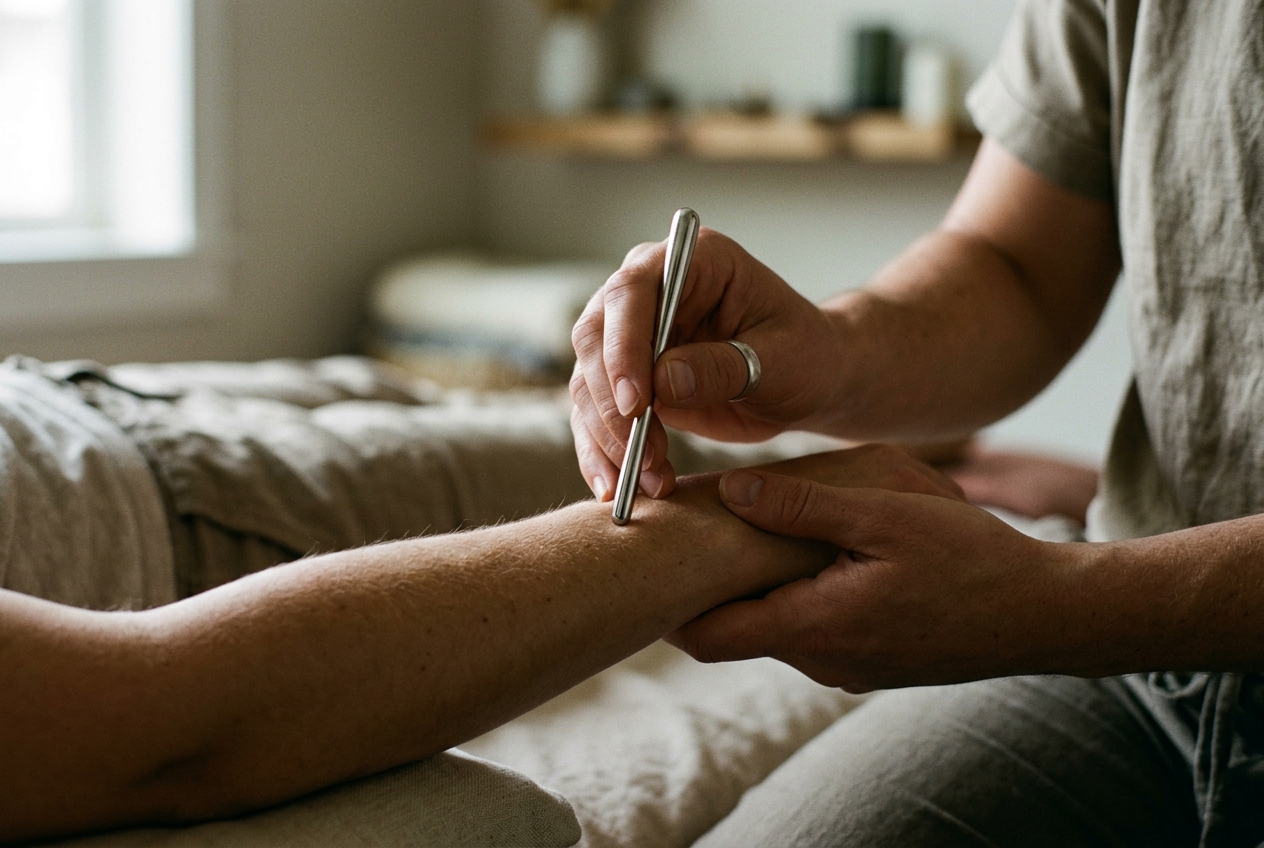
This therapeutic impasse was anticipated millennia ago in classical East Asian medicine. In the foundational text of acupuncture theory, the Huangdi Neijing Ling Shu (The Yellow Emperor’s Classic of Medicine – Spiritual Pivot, circa 1st century BCE), Chapter 1 outlines the Nine Classical Needles. Prominently positioned as the third instrument is the Teishin (Chinese: Chizhen 鍉針)—a blunt, non-penetrating stylus specifically engineered to press the superficial cutaneous zones and channel pathways without rupturing the dermis.
While invasive filiform needles (Haozhen) came to dominate twentieth-century institutionalised Traditional Chinese Medicine (TCM), Japanese master practitioners of the mid-twentieth century—pioneers of Japanese Meridian Therapy (Keiraku Chiryo) such as Sorei Yanagiya, Kodo Fukushima, and later Denmei Shudo—engineered a clinical renaissance of the Teishin. They recognised that gentle, targeted mechanical and bioelectrical contact at precise somatic loci could recalibrate internal visceral dynamics with exquisite safety. Today, modern cellular biophysics and mechanobiology are finally illuminating the underlying science: touch without piercing is not merely a psychological placebo, but a sophisticated interface with the body's largest bioelectric and mechanosensitive network.
2. The Meridian Path — A Journey Through the Body
To understand how a non-invasive instrument resting on the skin's surface can ease a knot in the epigastrium or dissolve an occipital headache, one must move past the abstract concept of meridians as invisible mystical lines. In living anatomy, the meridian channels (Jingluo) closely correspond to the continuous planes of loose connective tissue, interstitial fluid cleavage channels, and neurovascular tracts that traverse the musculoskeletal frame.
       [ Craniofacial Senses & Cortical Regulation ]
                             |
                   (Vagus / Phrenic Axes)
                             |
         +-------------------+-------------------+
         |                                       |
  [ ARM PATHWAYS ]                        [ LEG PATHWAYS ]
  * Pericardium (Inner Arm Midline)       * Stomach (Anterior Shin Furrow)
  * Large Intestine (Radial Forearm)      * Spleen (Medial Tibial Border)
         |                                * Liver (Medial Arch to Groin)
         +-------------------+-------------------+
                             |
       [ Central Bioelectrical / Fascial Liquid Crystal Matrix ]
When mapped to the surface of the body, these pathways follow prominent topographical landmarks that anyone can locate by direct touch:
The Frontline Highway: The Stomach Meridian (Foot Yangming)
The Stomach channel represents the primary somatic route governing digestion, motor vitality, and anterior postural balance. It begins directly beneath the eye, travels across the hinge of the jaw, descends the neck beside the carotid artery, moves down the chest and abdomen parallel to the midline, and enters the leg. On the lower limb, it follows the muscular furrow immediately to the outside of your prominent shinbone (tibia). It runs straight down through the fleshy belly of the tibialis anterior muscle—the exact structure that aches after a day of walking on hard concrete—travels across the front crevice of the ankle joint, and terminates at the tip of the second toe. Palpating this pathway often reveals tender, grain-like fascial densities when digestive transit is sluggish or systemic inflammation is present.
The Inner Stabiliser: The Spleen Meridian (Foot Taiyin)
Running in direct structural counterbalance to the Stomach channel, the Spleen pathway begins at the inner corner of the big toenail, tracks along the boundary where the soft sole of the foot meets the firmer skin of the foot's inner edge, rises across the inner ankle, and hugs the posterior inner edge of the shinbone. As it ascends toward the inner knee, inner thigh, and lower abdomen, it tracks the deep fascial compartment housing the posterior tibial neurovascular bundle. This channel governs fluid distribution, lymphatic clearance, and tissue tone; tenderness along the inner edge of the shinbone routinely correlates with systemic water retention, chronic physical fatigue, and metabolic lethargy.
The Structural Spring: The Liver Meridian (Foot Jueyin)
Beginning on the dorsal aspect of the great toe, the Liver pathway runs across the top of the foot through the depression between the bones of the first and second toes, passes in front of the inner ankle bone, and tracks up the inner calf toward the groin and rib cage. Anatomically, this path mirrors the deep fascial chain that anchors the pelvic floor to the medial leg musculature. When emotional frustration, chronic stress, or visual strain from digital screens locks the body in prolonged tension, this channel exhibits sharp, hypertonic resistance to the touch.
The Upper Gateways: Large Intestine (Hand Yangming) and Pericardium (Hand Jueyin)
On the upper extremity, two primary pathways mediate autonomic tone and craniofacial comfort. The Large Intestine channel starts at the index fingernail, crosses the fleshy muscular web between the thumb and index finger on the back of the hand, tracks along the outer ridge of the forearm to the point of the elbow, and ascends to the shoulder and opposite nostril. The Pericardium channel starts on the chest, tracks down the dead centre of the inner arm, passes directly between the two prominent cord-like tendons of the inner wrist (the flexor carpi radialis and palmaris longus), and terminates at the middle fingertip. This inner forearm route acts as a direct somatic reflex zone for the central vagal complex, heart rate variability, and diaphragm mobility.
3. Mechanotransduction, Bioelectricity, and Key Points You Can Press Right Now
The clinical efficacy of Teishin therapy lies at the intersection of cellular mechanobiology and solid-state biophysics. When a polished metal tip is brought into contact with an acupoint, it does not rely on cutting tissue; instead, it delivers a precise vector of shear stress and static pressure to specialized cutaneous mechanoreceptors:
+-----------------------------------------------------------------------------------+
| BIOELECTRICAL MECHANOTRANSDUCTION CASCADE AT THE TEISHIN INTERFACE                |
+-----------------------------------------------------------------------------------+
| 1. CUTANEOUS INDENTATION (Non-Invasive Contact)                                   |
|    * Sustained static pressure activates Merkel cell-neurite complexes (SA-I).    |
|    * Micro-vibratory contact excites Meissner corpuscles (RA-I) & CT-afferents.   |
|                                                                                   |
| 2. MOLECULAR TRANSDUCTION (Piezo1 / Piezo2 Ion Channels)                          |
|    * Mechanical tension opens Piezo channels -> Intracellular Ca2+ influx.        |
|    * Release of extracellular Adenosine Triphosphate (ATP) -> Cleaved to A1       |
|      Adenosine -> Local analgesia & profound microvascular dilation.              |
|                                                                                   |
| 3. SOLID-STATE COLLAGEN POLARISATION (Extracellular Matrix Liquid Crystals)       |
|    * Shear force generates Streaming Potentials and Piezoelectric currents.      |
|    * Gold (Cathodic: electron donor) enhances resting potential in vacuity.       |
|    * Silver (Anodic: electron sink) drains toxic charge accumulation in repletion.|
+-----------------------------------------------------------------------------------+
- Slowly Adapting Type I (SA-I) Afferents / Merkel Cell-Neurite Complexes: Located in the basal layer of the epidermis, these receptors respond to sustained perpendicular indentation. Sustained Teishin contact triggers the opening of Piezo2 mechanosensitive cation channels, driving calcium influx and the sustained release of purinergic signals (ATP, rapidly metabolized to adenosine), which suppress local nociceptive firing and dilate deep capillary beds.
- Rapidly Adapting Type I (RA-I) Afferents / Meissner Corpuscles & C-Tactile (CT) Fibers: Gentle, sweeping touch or feather-light rhythmic contact selectively excites unmyelinated C-tactile afferents in hairy and glabrous skin, sending direct projections through the spinothalamic tract to the posterior insular cortex. This induces an immediate down-regulation of central sympathetic arousal and elevates vagal-parasympathetic outflow.
- Piezoelectricity and Streaming Potentials in the Fascial Matrix: As demonstrated in biophysical studies of connective tissue, collagen is an anisotropic, semi-crystalline dielectric structure. Applying focused mechanical force generates piezoelectric currents and streaming potentials as mobile electrolytes in the interstitial fluid flow across fixed negative charges on glycosaminoglycan chains.
- Metallurgic Polarity: Classical Japanese Meridian Therapy leverages the galvanic potential between dissimilar metals. Gold (with a high standard electrode reduction potential of +1.50V) acts as an electron acceptor/cathode relative to tissue fluid, concentrating bioelectrical charge and stimulating tissue vitality—a technique termed Tonification or Supplementation (Bu / Hoju). Conversely, Silver (reduction potential +0.80V) or copper acts as an electron source/anode, dispersing hyper-concentrated electrical charge, clearing stagnation, and sedating inflammation—termed Dispersion or Drainage (Xie / Shaho).
+------------------------------------------------------------------------------------+
| PALPATORY DIAGNOSTIC CRITERIA (KEIRAKU CHIRYO MERIDIAN ASSESSMENT)                |
+------------------------------------------------------------------------------------+
| State: Vacuity / Deficiency (Xu / Kyo)                                             |
| * Palpatory Sensation: Pitted depression, flaccid cutaneous tone, cool to touch,   |
|   slackness in subcutaneous fascia, non-resilient "empty hole" feeling.            |
| * Teishin Technique: Gold instrument; 90-degree light non-moving contact; breath  |
|   synchronised on inhalation; slow, supportive withdrawal; immediate hole sealing. |
|                                                                                    |
| State: Repletion / Excess (Shi / Jitsu)                                            |
| * Palpatory Sensation: Taut muscular guarding, ropiness, sharp localized heat,     |
|   hyperalgesic rebound tenderness, palpable fascial nodule or grain.               |
| * Teishin Technique: Silver instrument; angled contact (45 degrees against flow);  |
|   dispersive feathering or gentle tapping on exhalation; leave channel open.       |
+------------------------------------------------------------------------------------+
The Five Primary Regulatory Acupoints
To apply these principles clinically or in self-regulation, locate the following five master acupoints verified in the World Health Organization Standard Acupuncture Point Locations.
                  ========================================
                  LOCATIONS OF THE FIVE MASTER ACUPOINTS
                  ========================================

UPPER BODY (Forearm & Hand):

         [ LI4 (Hegu) ]                  [ PC6 (Neiguan) ]
     Dorsal Web Space between        Palmar Forearm, 2 inches above
     Thumb & Index Metacarpals       wrist crease, between 2 tendons
            |                                       |
          ( o )                                   ( o )
           \ \                                     / /
            \ \___________________________________/ /
             \______ Radial side     Ulnar side ___/

--------------------------------------------------------

LOWER BODY (Knee, Shin & Foot):

[ ST36 (Zusanli) ]              [ SP6 (Sanyinjiao) ]
     4 finger-widths below kneecap,  4 finger-widths above tip of
     1 finger-width lateral to shin  inner ankle, behind tibia bone
            |                                       |
          ( o )                                   ( o )
           |                                       |
           |                                       |
           +-------------------+-------------------+
                               |
                        [ LV3 (Taichong) ]
                    Dorsum of Foot, depression
                    between 1st & 2nd metatarsals
                               |
                             ( o )
1. Zusanli (ST36) – "Leg Three Miles"
- Location via Landmarks: Sit with your knees bent at 90 degrees. Place the palm of your hand over your kneecap; your four fingers will rest naturally along the outer side of your shinbone. ST36 lies four finger-widths down from the bottom of your kneecap, in the soft muscular valley about one thumb-width outward from the prominent ridge of the shinbone (within the tibialis anterior muscle).
- Tactile / Deqi Cue: When pressed, you will not feel a sharp bone contact, but a deep, spreading ache that occasionally radiates downward into the third toe or upward toward the knee.
- Application: Apply steady, perpendicularly oriented pressure using a rounded Teishin tip (or the pad of your thumb). Maintain firm, non-piercing contact for 2 to 3 minutes.
- Daily Clinical Indications: Resolves postprandial gastric bloating, chronic lower extremity fatigue, general malaise, and dysregulated gastrointestinal motility.
2. Taichong (LV3) – "Great Surge"
- Location via Landmarks: On the top of your bare foot, locate the space between the big toe and the second toe. Slide your finger backward along the groove between the two long bones (the first and second metatarsals) toward your ankle until your finger naturally drops into a distinct, sensitive hollow just before the junction of the bones.
- Tactile / Deqi Cue: This point is exceptionally rich in free nerve endings; correct location produces an immediate, sharp, resonant tenderness or mild electric zing, even under moderate pressure.
- Application: Angle your contact slightly upward toward the ankle joint. Maintain continuous, gentle-to-medium static contact for 90 seconds while breathing slowly out through the mouth.
- Daily Clinical Indications: Relieves tension-type headaches centered behind the eyes or temples, temporal jaw clenching (bruxism), acute emotional irritation, and PMS-related mood swings.
3. Hegu (LI4) – "Joining Valleys"
- Location via Landmarks: On the back of the hand, bring your thumb and index finger close together. A small muscular mound will rise between them. Place your opposing thumb on the highest point of this mound, then relax your hand. The point lies in the deep valley between the first and second metacarpal bones, closer to the midpoint of the second (index finger) metacarpal bone.
- Tactile / Deqi Cue: A pronounced, dull, diffuse ache that permeates through to the palm.
- Application: Direct the pressure vector inward and slightly underneath the second metacarpal bone, rather than pressing straight down into the web space. Maintain sustained pressure for 1 to 2 minutes per hand.
- Daily Clinical Indications: Frontal sinus pressure, dental discomfort, tension in the upper trapezius and neck, and mental fog after long hours at a screen.
4. Sanyinjiao (SP6) – "Three Yin Intersection"
- Location via Landmarks: Place the little finger of your four-finger width on the highest peak of your inner ankle bone (medial malleolus). Directly above this measurement, four finger-widths up your leg, immediately behind the posterior border of the shinbone (tibia), lies SP6.
- Tactile / Deqi Cue: A tender, bruise-like sensitivity accompanied by a warm or heavy spreading sensation along the inner calf.
- Application: Press the rounded Teishin or thumb tip directly against the inner bone edge, holding static, supportive contact for 2 minutes.
- Daily Clinical Indications: Alleviates menstrual cramping, heavy leg sensation, lower abdominal chill, insomnia caused by racing thoughts, and systemic fluid stagnation.
5. Neiguan (PC6) – "Inner Gate"
- Location via Landmarks: Turn your hand palm-side up. From the primary skin crease at your wrist joint, measure three finger-widths (index, middle, ring) up your forearm toward the elbow. PC6 is located dead centre, nestled directly between the two prominent, rope-like tendons that stand out when you make a tight fist and flex your wrist.
- Tactile / Deqi Cue: A distinct, spreading sensation that travels down into the middle palm or radiates softly up the inner arm toward the chest.
- Application: Apply calm, deep, perpendicular pressure without friction. Maintain for 2 minutes while practicing extended diaphragmatic exhalations.
- Daily Clinical Indications: Rapidly counteracts motion sickness, acute nausea, epigastric tightness, palpitations associated with performance anxiety, and shallow chest breathing.
4. A Point Combination for One Common Issue: The Autonomic-Visceral Reset Protocol
+------------------------------------------------------------------------------------+
| CLINICAL CASE FORMULATION: AUTONOMIC DYSREGULATION & HYPERESTHESIA                 |
+------------------------------------------------------------------------------------+
| Patient Profile: 42-year-old corporate director presenting with functional         |
| dyspepsia, epigastric bloating, severe insomnia, and generalized hyperalgesia.     |
| Diagnostic Assessment: High sympathetic tone; exquisite needle phobia; palpation   |
| reveals marked flaccidity (Kyo) at bilateral ST36 and acute ropiness (Jitsu) at    |
| bilateral LV3.                                                                     |
|                                                                                    |
| Intervention Strategy: Non-invasive Teishin Protocol without filiform puncture.   |
| * Sequence: PC6 (Dispersion) -> LI4 (Balancing) -> ST36 (Gold Tonification) ->     |
|   LV3 (Silver Dispersion) -> SP6 (Harmonization).                                  |
| * Outcome: Complete absence of needle distress; cutaneous erythema observed over  |
|   ST36 within 60 seconds; post-session heart rate decreased from 86 bpm to 64 bpm;|
|   gastrointestinal borborygmi (audible peristalsis) resumed within 8 minutes.     |
+------------------------------------------------------------------------------------+
Consider the ubiquitous clinical presentation of Post-Workday Sympathetic-Visceral Lock: a condition characterised by late-afternoon epigastric bloating, an inability of the brain to disengage from work tasks, severe tension in the suboccipital and trapezius regions, and difficulty initiating restorative sleep.
       ===============================================================
       ACTIONABLE PROTOCOL: THE 10-MINUTE AUTONOMIC-VISCERAL RESET
       ===============================================================

[ STEP 1: Calibrate Diaphragmatic Arc ]
         -> Point: PC6 (Inner Wrist)
         -> Tool / Hand: Gold or Smooth Thumb
         -> Duration: 90 Seconds per side
         -> Action: Modulates cardiac-vagal axis; opens respiratory field.
                        |
                        v
       [ STEP 2: Clear Craniofacial Resistance ]
         -> Point: LI4 (Thumb-Index Web)
         -> Tool / Hand: Silver or Index Knuckle
         -> Duration: 90 Seconds per side
         -> Action: Down-regulates trigeminal spinal nucleus; drops shoulders.
                        |
                        v
       [ STEP 3: Ignite Gastrointestinal Motility ]
         -> Point: ST36 (Outer Shin Valley)
         -> Tool / Hand: Gold or Teishin Stem
         -> Duration: 120 Seconds per side
         -> Action: Vagal efferent activation of gastric smooth muscle.
                        |
                        v
       [ STEP 4: Vent Neuroendocrine Irritation ]
         -> Point: LV3 (Foot Dorsum)
         -> Tool / Hand: Silver or Rounded Probe
         -> Duration: 60 Seconds per side
         -> Action: Releases smooth muscle tension & pelvic fascial strain.
                        |
                        v
       [ STEP 5: Anchor Systemic Yin & Fluid Homeostasis ]
         -> Point: SP6 (Inner Ankle / Shin)
         -> Tool / Hand: Gold or Warm Palm Contact
         -> Duration: 120 Seconds per side
         -> Action: Parasympathetic consolidation; initiates sleep architecture.
Protocol Execution Details
- Positioning: Lie supine on a firm, comfortable surface with a bolster or pillow placed underneath your knees to slacken the psoas and rectus abdominis muscles. Keep the room dimly lit and warm.
- Step 1 — PC6 (Left Arm first, then Right): Apply 90 seconds of steady, non-moving perpendicular Teishin contact on Neiguan. Inhale for a count of 4, hold for 2, and exhale through relaxed lips for a count of 6. This resets vagal cardiac pacing.
- Step 2 — LI4 (Bilateral): Transition to Hegu. Apply firm, circular micro-pressures angled inward toward the second metacarpal bone for 90 seconds per hand. You will notice an involuntary drop in the elevation of your shoulder girdle.
- Step 3 — ST36 (Bilateral): Seat the Teishin tip into the tibialis anterior muscle belly. Hold firm, continuous pressure for a full 2 minutes per side. Within 60 to 90 seconds, you should perceive audible stomach gurgling (borborygmi), signaling the reactivation of digestive peristalsis as the gastrointestinal tract shifts out of sympathetic stasis.
- Step 4 — LV3 (Bilateral): Anchor gentle, calming contact into the metatarsal junction of each foot for 60 seconds. This step disperses residual vascular tension and clears cranial heat.
- Step 5 — SP6 (Bilateral): Conclude with 2 minutes of gentle, warming contact on the inner lower leg to support systemic hydration, pelvic circulation, and sleep preparation.
5. Safety & Sense
While non-invasive Teishin and acupressure protocols avoid the risks of tissue transfixion, pneumothorax, or hematoma associated with filiform needles, strict physiological boundaries must be respected:
+------------------------------------------------------------------------------------+
| SAFETY AND CONTRAINDICATION MATRIX                                                 |
+------------------------------------------------------------------------------------+
| CLINICAL CONDITION     | CONTRAINDICATED SITES    | RATIONALE / PROTOCOL           |
+------------------------+--------------------------+--------------------------------+
| Pregnancy              | LI4, SP6, BL60, GB21,    | Risk of inducing oxytocin-like |
| (All trimesters)       | Lower Abdominal/Sacral   | uterine contractility and      |
|                        | points                   | downward Qi mobilization.      |
|                        |                          |                                |
| Localized Lesions /    | Direct sites of active   | Risk of mechanical irritation, |
| Phlebitis / DVT        | inflammation, open cuts, | microbial translocation, or    |
|                        | or vascular thrombosis   | thrombus dislodgement.         |
|                        |                          |                                |
| Acute Medical          | Substitution for medical | Requires emergency clinical or |
| Emergencies            | triage in appendicitis,  | surgical intervention.         |
|                        | cardiac events, stroke   |                                |
+------------------------+--------------------------+--------------------------------+
- Obstetric Cautions: Acupoints that strongly promote downward bioelectrical and biomechanical vector clearance—most notably LI4 (Hegu) and SP6 (Sanyinjiao)—are strictly contraindicated for moderate-to-deep stimulation during pregnancy due to their clinically proven ability to augment uterine contractility and cervical ripening.
- Pressure Titration: Non-invasive contact should never produce sharp, tearing pain or result in dermal ecchymosis (bruising). If the patient exhibits autonomic withdrawal, breath-holding, or localized tissue flinching, the mechanical load has exceeded the physiological threshold and must be reduced. The sensation of Deqi should be an agreeable, heavy, warm ache, not an intolerable sharp spike.
- Clinical Triage Boundaries: Non-invasive self-regulation is designed for functional, nervous-system-mediated dysregulations. Acute chest pain, sudden unilateral neurological deficits, severe unexplained abdominal rigidity, active infection, or deep vein thrombosis require immediate medical evaluation by emergency physicians, rather than home somatic intervention.
6. Today's Takeaway: The Two-Minute Parasympathetic Reset
Before moving on from this article, perform this two-minute bioelectrical self-regulation exercise:
+------------------------------------------------------------------------------------+
| YOUR TWO-MINUTE TAKEAWAY PRACTICE: NEIGUAN (PC6) VAGAL PACING                      |
+------------------------------------------------------------------------------------+
| 1. LOCATE: Turn your left palm up. Measure 3 finger-widths up from your wrist      |
|    crease. Place your right thumb directly between the two central tendons.        |
| 2. ENGAGE: Press straight down until you feel a firm, deep, spreading ache.        |
| 3. BREATHE: Inhale smoothly for 4 seconds -> Exhale slowly for 6 seconds.          |
| 4. TIME: Maintain steady, motionless contact for exactly 120 seconds.             |
|                                                                                    |
| PHYSIOLOGICAL RESULT: Instant down-regulation of cardiac sympathetic activity,     |
| release of diaphragm tension, and restoration of centered autonomic equilibrium.   |
+------------------------------------------------------------------------------------+
By understanding the body as a continuous, mechanosensitive, bioelectrically polarized matrix, Teishin therapy bridges ancient wisdom from the Ling Shu with contemporary neuroscience. Through gentle, non-piercing cutaneous contact, you hold the capacity to regulate your nervous system, harmonize visceral motility, and reclaim somatic ease at any moment.
Authoritative Scholarly References & Further Reading
- Classical Framework: Huangdi Neijing Ling Shu (The Spiritual Pivot)
- Standardized Anatomical Locations: World Health Organization Standard Acupuncture Point Locations in the Western Pacific Region
- Cellular Mechanotransduction: Coste et al., Piezo1 and Piezo2 are essential components of distinct mechanically activated cation channels, Nature / PubMed
- Fascial Piezoelectricity & Interstitial Matrix: Langevin et al., Dynamic fibroblast response to subcutaneous tissue stretch, American Journal of Physiology / PubMed
- Cutaneous C-Tactile Afferents & Autonomic Regulation: Olausson et al., The role of unmyelinated C-tactile afferents in human touch and autonomic control, Neuroscience Biobehavioral Reviews / PubMed
- Acupoint Purinergic Signaling Mechanisms: Burnstock, G., Physiological and Pathophysiological Roles of Purinergic Neurotransmission and Neuromodulation in Acupuncture, NCBI PMC
- Japanese Meridian Therapy (Keiraku Chiryo): Traditional Japanese Medicine & Non-Invasive Needle Lineages