Tan Fa: Navigating Percussive Vibration Dynamics, Acoustic Qi Resonance, and Precision Acupressure Protocols
1. Opening — A Problem This Solves Today: Dissolving the Heavy Limb Syndrome and Sensory Numbness
If you spend your working hours anchored to a desk, navigating the cognitive demands of a modern screen-mediated life, you are likely intimately acquainted with a distinct, insidious physical malaise. It begins as a dull heaviness deep within the musculature of the forearms and shoulders, settles as a chronic ache around the lateral edges of the knees, and eventually manifests as a pervasive, stubborn numbness—a feeling as though entire anatomical sectors of your body have drifted into a state of metabolic hibernation.
Standard stretching rarely touches this condition, and conventional massage frequently offers only transient relief. The tissue feels dense, non-responsive, and perceptually disconnected from conscious neuromuscular control. In the classical taxonomies of East Asian medicine, this presentation is categorized as Bi (impediment or stagnation) syndrome—a functional stasis where the circulating matrix of protective and nutritive vitality has stalled within the intermuscular fascial planes.
+-----------------------------------------------------------------------------+
|                          CLINICAL PROFILE: BI SYNDROME                      |
|                                                                             |
|  * Etiology: Prolonged postural stasis, microvascular constriction, ECM     |
|    densification, and mechanical uncoupling of fascial sheets.              |
|  * Clinical Manifestation: Deep limb heaviness, unresponsive tissue tone,   |
|    perceptual "deadness," and sluggish neuromuscular recruitment.           |
|  * Therapeutic Target: Rapid shear-wave mobilization of interstitial fluid  |
|    and high-threshold mechanoreceptor recruitment.                          |
+-----------------------------------------------------------------------------+
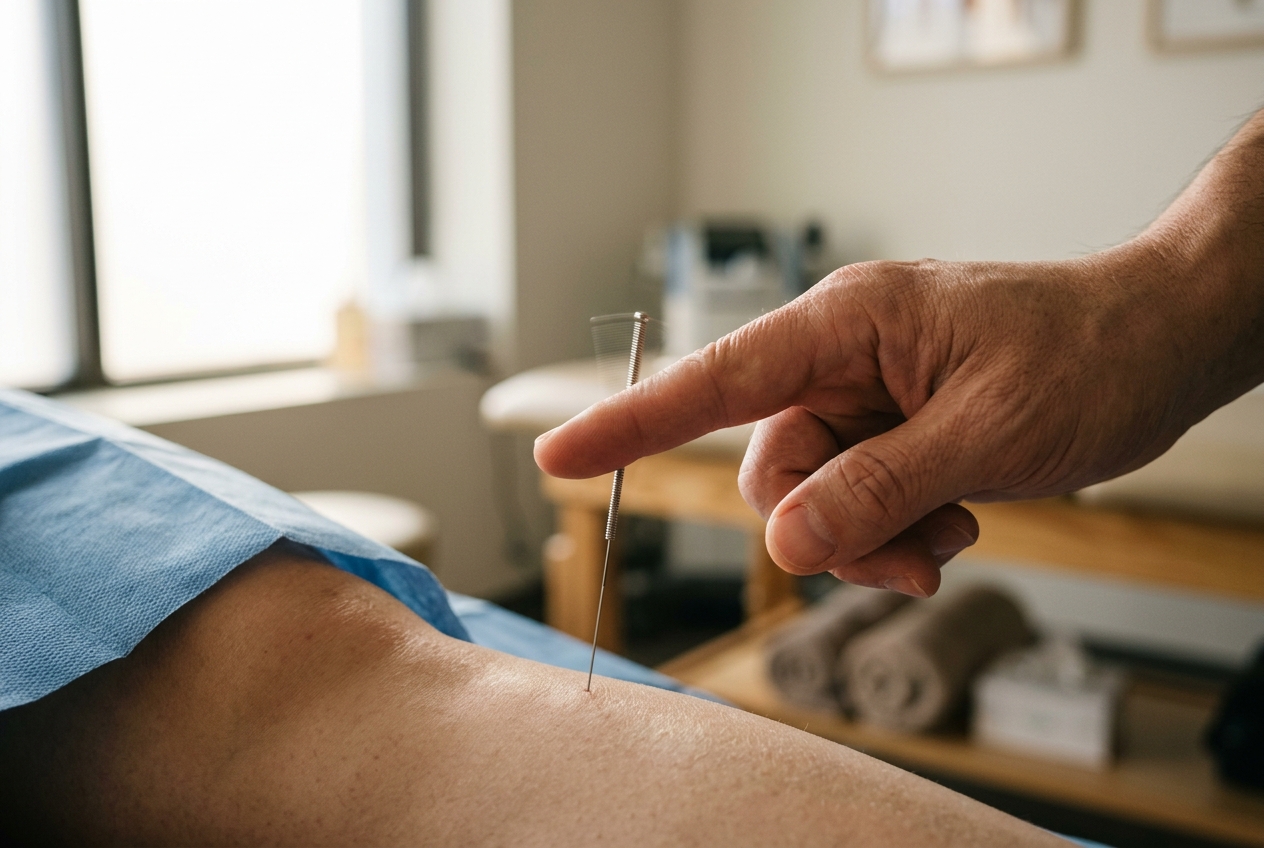
Traditional Chinese Medicine (TCM) approaches this stubborn physical state not with brute force, but through resonant mechanical dynamics. Foremost among these is Tan Fa (彈法)—the classical "flicking" technique. By deploying high-frequency, elastic percussion directly over pivotal nodal points, Tan Fa initiates acoustic shear waves that travel along connective tissue planes, shaking loose obstinate stagnation, waking dormant mechanoreceptors, and restoring functional vitality to desensitized tissues.
2. Historical and Textual Foundations: Awakening the Channel in Classical Epics
The conceptualization of Tan Fa as a sophisticated manual and needle-stimulation dynamic occupies an illustrious position within classical acupuncture literature. While simple insertion establishes contact with anatomical layers, classical masters understood that dormant, recalcitrant pathologies required energetic amplification to summon the elusive therapeutic sensation known as De Qi (the arrival of vital Qi).
                 +---------------------------------------------------+
                 |           HISTORICAL GENEALOGY OF TAN FA          |
                 +---------------------------------------------------+
                                          |
         +--------------------------------+--------------------------------+
         |                                                                 |
         v                                                                 v
+-------------------------------+                       +-----------------------------------+
|     BIAO YOU FU (c. 1241)     |                       |    ZHEN JIU DA CHENG (c. 1601)    |
|   Master Dou Hanqing (窦汉卿)  |                       |     Master Yang Jizhou (杨继洲)    |
|                               |                       |                                   |
| "Flick the needle to make the |                       | Codified Tan Fa among the         |
| Qi travel along the channel;  |                       | "Fourteen Auxiliary Techniques"   |
| awaken sluggish circulation." |                       | for tonification and dispersion.  |
+-------------------------------+                       +-----------------------------------+
In the seminal Jin-Yuan dynasty didactic poem Biao You Fu (標幽賦, Ode to Elucidate Mysteries), attributed to the master Dou Hanqing (c. 1241 CE), Tan Fa is singled out as an indispensable catalyst when the patient’s vital pulse fails to respond:
"Flick the tail of the needle to awaken the Qi; tap the shaft to guide its passage across the joints."
Dou Hanqing observed that when needles sit inertly within cold, congested, or deficient tissue, the channels remain closed. The rapid, elastic snap of a fingernail against the needle handle or acupoint serves as an auditory and mechanical alarm, prompting the dispersed Qi of the channel to concentrate and propagate toward the diseased organ or joint.
This concept reached its full clinical maturation during the Ming dynasty in the encyclopedic masterwork Zhen Jiu Da Cheng (Compendium of Acupuncture and Moxibustion, 1601 CE), compiled by Dr. Yang Jizhou. Yang codified Tan Fa within the canonical "Fourteen Auxiliary Techniques" (Shi Si Fa), defining it as a specialized percussive maneuver deployed specifically when:
- The patient's De Qi response is sluggish, absent, or delayed due to chronic debility or dense pathogenetic cold.
- Obstinate stasis (Yu) prevents the smooth transit of channel Qi past major structural articulations.
- The practitioner seeks to steer the therapeutic sensation either proximally toward the zang-fu organs or distally toward the extremities without traumatizing the underlying structural bed.
Yang Jizhou articulated that Tan Fa operates on the principle of resonance: the flick does not tear or displace tissue destructively; instead, it introduces a rapid mechanical impulse that pulses through the channel network, effectively dislodging latent pathogenic factors lodged in the deep collateral vessels (Luo Mai).
3. The Biophysical Matrix: Piezoelectricity, Acoustic Resonance, and Fascial Mechanotransduction
Contemporary biomechanics and connective tissue histology provide an illuminating structural bridge to the empirical observations of Yang Jizhou and Dou Hanqing. Rather than operating within an energetic vacuum, the channels described in ancient treatises correlate closely with the continuous anatomical network of deep and superficial fascia, intermuscular septa, and perivascular sheaths documented in modern connective tissue and fascial research on PubMed.
The Extracellular Matrix as an Acoustic Waveguide
Fascia is an uninterrupted, fluid-rich viscoelastic continuum composed predominantly of parallel and cross-linked type I and type III collagen fibrils embedded in a ground substance of glycosaminoglycans (GAGs) and bound water. When Tan Fa is administered—whether via a crisp flick of an acupuncture needle or rhythmic, high-frequency percussive tapotement directly onto an acupoint—it introduces a transverse mechanical shear wave.
Unlike continuous static pressure, which compresses and temporarily dehydrates the local matrix, percussive vibration generates rapid alternating phases of tissue compression and rarefaction. This micro-vibrational shear propagates along fascial cleavage planes with minimal energy dissipation, behaving much like an acoustic wave travelling through an anisotropic viscoelastic waveguide. As documented in studies on the piezoelectric properties of biological tissue, the mechanical deformation of the non-centrosymmetric crystalline structure of collagen triple-helices generates immediate strain-generated electrical potentials (piezoelectricity).
Cellular Mechanotransduction: From Wave to Gene Expression
At the cellular level, these stress-generated electrical fields and shear forces trigger mechanotransduction pathways within embedded fibroblasts, telocytes, and endothelial cells. Mechanosensitive ion channels, particularly Piezo1 and Piezo2, open in direct response to matrix deformation. This triggers an influx of extracellular calcium ($Ca^{2+}$), prompting: - Rapid cytoskeletal reorganization via actin-filament alignment. - The release of adenosine triphosphate (ATP) and nitric oxide (NO) into the interstitial space. - A sudden reduction in extracellular matrix viscosity (thixotropic liquefaction), transforming dense, gel-like stagnation into a freely flowing sol state.
This biophysical cascade provides an exact material analogue to the classical description: Tan Fa liquefies stagnant phlegm-dampness and re-establishes the open conductive pathway of the channel.
4. Neurophysiological Architecture: Selective Recruitment of Mechanoreceptors and A-Delta Fibers
Beyond its structural matrix effects, Tan Fa exerts a precise, selective modulating action upon the peripheral and central nervous systems. The perceptual signature of De Qi—traditionally characterized as a composite sensation of soreness, numbness, heaviness, distension (Suan, Ma, Zhang, Zhong), and radiating warmth—corresponds to the co-activation of specific populations of primary sensory afferents, as detailed in research on neurophysiological mechanisms of acupuncture.
+-----------------------------------------------------------------------------+
|                 SENSORY RECEPTOR RECRUITMENT PROFILE IN TAN FA              |
+----------------------+--------------------+---------------------------------+
| Receptor Type        | Optimal Frequency  | Functional / Clinical Outcome   |
+----------------------+--------------------+---------------------------------+
| Pacinian Corpuscles  | 100–300 Hz         | Detects deep percussive shear;  |
|                      |                    | drives central sensory gating   |
| Meissner's Corpuscles| 20–50 Hz           | Reads surface tapotement speed; |
|                      |                    | enhances somatic awareness      |
| Merkel Discs         | 0.3–3 Hz (Static)  | Encodes sustained compressive   |
|                      |                    | baseline pressure               |
| A-Delta (Aδ) Fibers  | Mechanical pulses  | Transmits dull De Qi ache;      |
|                      |                    | initiates spinal gating in      |
|                      |                    | substantia gelatinosa           |
| C-Fibers             | Slow/Noxious       | Down-regulated; avoids sharp    |
|                      |                    | burning pain sensations         |
+----------------------+--------------------+---------------------------------+
Mechanoreceptor Subtypes and Vibrational Frequency Tuning
Human subcutaneous tissue and fascial adventitia are densely populated by specialized low- and high-threshold mechanoreceptors:
- Pacinian Corpuscles (Lamellar Corpuscles): Positioned deep in the hypodermis and periosteum, these rapidly adapting receptors are exquisitely sensitive to high-frequency micro-vibrations (optimal sensitivity between 100 and 300 Hz). The crisp, percussive impact of Tan Fa creates harmonic transients that stimulate Pacinian end-organs, which project through large-diameter, rapidly conducting $A\beta$ (Group II) nerve fibers to the dorsal columns of the spinal cord.
- Meissner's Corpuscles: Situated within dermal papillae, these receptors respond dynamically to low-frequency percussive tapotement (20–50 Hz), providing continuous somatic feedback regarding the velocity and rhythm of the flick.
- Ruffini Endings and Merkel Discs: Slowly adapting mechanoreceptors that register directional tissue stretch and baseline pressure, establishing the background receptive tone over which the percussive impulses register.
Differential Fiber Activation and Central Pain Gating
Crucially, Tan Fa modulates the sensory gateway. By pairing high-velocity percussive impulses with controlled, non-injurious mechanical displacement, Tan Fa selectively recruits myelinated $A\delta$ (Group III) and $A\beta$ sensory afferents while minimizing the prolonged, unmyelinated C-fiber discharges associated with sharp, tissue-damaging pain.
When these $A\delta$ and $A\beta$ impulses arrive at the dorsal horn of the spinal cord, they activate inhibitory interneurons within the substantia gelatinosa (Rexed lamina II). According to the classic Melzack-Wall Gate Control Theory, this surge of low-threshold mechanoreceptive input effectively closes the presynaptic gate against incoming nociceptive signals transmitted by unmyelinated fibers. Concurrently, ascending signals via the spinothalamic tracts engage the periaqueductal gray (PAG) and rostral ventromedial medulla (RVM), orchestrating a top-down release of endogenous $\beta$-endorphins, dynorphins, and 5-hydroxytryptamine (serotonin), replacing stubborn local distress with systemic calm and deep analgesia.
5. The Vector of Intention: Differentiating Tonifying (Bu) and Sedating (Xie) Flicking Dynamics
In classical Chinese medicine, a technique derives its clinical potency not merely from its physical execution, but from the intentional modulation of its vectors, speeds, and rhythms. Yang Jizhou’s Zhen Jiu Da Cheng draws a definitive line between tonification (Bu Fa)—designed to nourish, warm, and consolidate deficient, sluggish systems—and sedation or dispersion (Xie Fa)—designed to purge, scatter, and mobilize acute fullness, heat, and stubborn physical adhesions.
+-----------------------------------------------------------------------------+
|                      DYNAMIC COMPARISON: BU FA VS. XIE FA                   |
+------------------------+--------------------------+-------------------------+
| Biomechanical Variable | Tonifying (Bu Fa)        | Sedating / Dispersing   |
|                        |                          | (Xie Fa)                |
+------------------------+--------------------------+-------------------------+
| Vector & Direction     | Centripetal; along the   | Centrifugal; counter to |
|                        | natural channel pathway  | channel or outward-radi- |
|                        | (pro-flow orientation)   | ating (perpendicular)   |
| Percussive Frequency   | Slow, rhythmic, stable   | Rapid, sharp, staccato  |
|                        | (1 to 2 Hz; 60–120 bpm)  | (3 to 5 Hz; 180–300 bpm)|
| Mechanical Amplitude   | Gentle, elastic, shallow | Firm, deep, high-impact |
|                        | resonant impulse         | shear impulse           |
| Duration per Point     | 2 to 3 minutes of        | 30 to 60 seconds of     |
|                        | sustained pacing         | brisk, intense burst    |
| Primary Physiological  | Cellular recruitment,    | Thixotropic breakdown,  |
| Target                 | piezoelectric charge     | mechanoreceptor reset,  |
|                        | accumulation, micro-     | endorphin-driven pain   |
|                        | vascular vasodilation    | gate suppression        |
+------------------------+--------------------------+-------------------------+
Tonifying Dynamics (Bu Fa): The Nourishing Wave
When addressing constitutional fatigue, neuromuscular weakness, or chronic digestive hypofunction, Tan Fa is applied with a gentle, harmonious, and directional rhythm.
- The Vector: The practitioner or self-care user aligns the mechanical flick directly along the anatomical pathway of the meridian's natural flow (for example, moving downward along the leg along the Stomach meridian).
- The Rhythm: The percussive frequency remains slow, steady, and metronomic—approximately 1 to 2 beats per second (60–120 beats per minute).
- The Biomechanical Effect: This moderate, rhythmic vibration avoids triggering protective muscular guarding. Instead, it generates a steady, cumulative piezoelectric charge across the collagenous matrix, stimulating localized microvascular vasodilation via continuous endothelial nitric oxide release, warming the tissue, and coaxing sluggish Qi to gather and ascend.
Sedating Dynamics (Xie Fa): The Dispersing Shockwave
Conversely, when confronting stubborn physical stagnation, acute tension headaches, myofascial trigger points, or severe emotional agitation, Tan Fa is transformed into an assertive, dispersing intervention.
- The Vector: The percussion is directed either perpendicularly deep into the structural node or angled counter to the meridian’s trajectory, scattering outward from the epicenter of tension.
- The Rhythm: The flicking action shifts to a high-frequency, staccato cadence—between 3 to 5 Hz (180–300 percussions per minute)—executed with rapid fingertip snaps.
- The Biomechanical Effect: This rapid-fire application introduces high mechanical shear strain across bound fascial sheets. It breaks microscopic cross-links within densified ground substance, down-regulates chronically hyperactive muscle spindles, and saturates local mechanoreceptors, instantaneously shattering the neuromuscular feedback loop maintaining the chronic spasm.
6. The Meridian Pathways: A Tactile Journey Through Living Anatomy
To apply Tan Fa effectively, one must understand the physical terrain through which these vibrational waves travel. Rather than viewing meridians as abstract geometric lines, we can navigate them as distinct anatomical corridors—palpable fascial pathways and intermuscular clefts that anyone can locate on their own body.
       [ THE FOUR CORRIDORS OF PERCUSSIVE TRANSMISSION ]

1. THE LEG ANTERIOR COMPARTMENT (Stomach Meridian)
     Lateral to tibial crest -> Tibialis anterior muscle belly -> Ankle joint
     [Key Anchor: ST36 - Zusanli]

2. THE FIRST INTEROSSEOUS CORRIDOR (Large Intestine Meridian)
     Web space between 1st & 2nd metacarpals -> Radial margin of forearm
     [Key Anchor: LI4 - Hegu]

3. THE DORSAL INTERMETATARSAL VALLEY (Liver Meridian)
     Between 1st & 2nd metatarsal bones -> Medial ankle -> Inner knee
     [Key Anchor: LV3 - Taichong]

4. THE INTERTENDINOUS FOREARM CHANNEL (Pericardium Meridian)
     Between flexor carpi radialis & palmaris longus -> Deep median nerve bed
     [Key Anchor: PC6 - Neiguan]
1. The Stomach Meridian: The Leg Anterior Corridor
Originating beneath the orbits of the eyes, cascading down the facial musculature and across the chest and abdomen, this meridian's primary functional conduit traverses the front of the leg. As it passes the knee, it enters the muscular groove just outside your shinbone—the fleshy muscular crest of the tibialis anterior that works tirelessly whenever you walk, run, or stand upright. It continues down the front of the ankle, terminating at the lateral tip of the second toe. This is the body’s highway of metabolic stamina, postural endurance, and digestive power.
2. The Large Intestine Meridian: The Forearm Radial Highway
Beginning at the radial corner of the index fingernail, this pathway ascends along the fleshy dorsal web of the hand between your thumb and first finger. It tracks directly along the outer edge of the forearm, riding the ridge of the brachioradialis muscle, climbs past the lateral crease of the elbow, scales the crest of the shoulder (deltoid), and ascends the side of the neck to wrap around the lips. This is the master corridor for discharging heat, relieving cranial tension, and clearing systemic stagnation from the head, face, and gut.
3. The Liver Meridian: The Medial Foot and Inner Leg Concourse
Commencing at the medial nail bed of the great toe, this channel runs across the top of the foot through the valley between the first two long foot bones (metatarsals). It climbs anterior to the inner ankle bone, ascends the medial surface of the lower leg along the posterior border of the tibia, traverses the inner thigh through the adductor musculature, and wraps around the external genitalia before cresting beneath the ribcage at the sixth intercostal space. This pathway governs the smooth, uninhibited flow of emotional equilibrium, neuroendocrine regulation, and fascial elasticity.
4. The Pericardium Meridian: The Volar Deep Neurovascular Highway
Arising within the thoracic cavity adjacent to the heart, this channel emerges into the armpit, courses down the absolute center of the inner arm, and dives straight down the midline of the inner forearm. Here, it sits precisely in the structural valley between two prominent, palpable tendons—the flexor carpi radialis and palmaris longus—directly overlying the median nerve trunk, before crossing the center of the palm and exiting at the tip of the middle finger. This corridor serves as the body’s primary autonomic circuit breaker, stabilizing cardiac rhythm, regulating gastric motility, and soothing psycho-emotional distress.
7. Pivotal Acupoints: Adapting Tan Fa into Non-Invasive Clinical Acupressure Protocols
While Tan Fa is classically executed by flicking the metal handle of an inserted acupuncture needle, its mechanical principles translate seamlessly into non-invasive clinical acupressure and manual therapy. In manual practice, Tan Fa is adapted as high-frequency rhythmic fingertip percussion (tapotement) and resonant micro-vibration, executed by cocking the middle or index finger against the thumb and releasing it with an elastic, spring-loaded snap directly over the target point.
Detailed location standards can be verified through the World Health Organization Standard Acupuncture Point Locations. Below are four pivotal nodal points where Tan Fa yields transformative clinical results.
       ST36 (Zusanli)                  LI4 (Hegu)
       [Outer Shin Valley]             [First Dorsal Interosseous]
       * 4 fingers below kneecap       * Highest mound of web space
       * 1 finger outside shinbone     * Deep, spreading ache
       * Focus: Stamina, Digestion     * Focus: Cranial Tension, Pain

LV3 (Taichong)                  PC6 (Neiguan)
       [Dorsum Foot Junction]          [Between Forearm Tendons]
       * Web space 2 fingers up foot   * 3 fingers above wrist crease
       * Distinct, tender hollow       * Between two taught cords
       * Focus: Stress, Smooth Flow    * Focus: Nausea, Heart, Calming
ST36 (Zusanli / 足三里) — "Leg Three Miles"
+-----------------------------------------------------------------------------+
|                           ACUPOINT PROFILE: ST36                            |
+-------------------+---------------------------------------------------------+
| Channel           | Stomach Channel of Foot-Yangming                        |
| Classical Actions | He-Sea point, Earth point; fortifies Spleen and         |
|                   | Stomach, tonifies Qi and Blood, dispels dampness        |
| Anatomical Layer  | Tibialis anterior muscle, deep fibular nerve bed        |
+-------------------+---------------------------------------------------------+
1. Everyday Body-Reference Location
Sit comfortably on a chair with your knees bent at a 90-degree angle. Place the palm of your right hand over your right kneecap, fingers pointing downward. The tip of your ring finger will naturally rest in a distinct depression about four finger-widths below the lower edge of your kneecap, and one thumb-width outward (lateral) from the sharp, bony ridge of your shinbone (anterior crest of the tibia). When you flex your foot upward toward your shin, you will feel the tibialis anterior muscle contract right under your fingertip.
2. The De Qi Sensory Signature
When you locate the precise anatomical point, moderate inward pressure will elicit a profound, dull, spreading ache, often accompanied by a mild, warm tingling sensation that radiates downward along the muscular crest toward the outer ankle and dorsal foot.
3. How to Apply Adapted Tan Fa
- Method: Anchor your thumb against the inner edge of your shinbone for stabilization. Cock your middle finger against your thumb, then release it in an elastic, spring-loaded snap against ST36.
- Direction: Angle the percussive flick downward, following the natural downward flow of the Stomach meridian.
- Cadence & Firmness: Apply a steady, rhythmic tapotement of 2 flicks per second (moderate firmness, tonifying dynamic) for 2 to 3 minutes per leg.
- Everyday Relief: Profoundly counteracts physical exhaustion, chronic brain fog, post-meal bloating, sluggish gastric motility, and general lower-limb heaviness.
LI4 (Hegu / 合谷) — "Union Valley"
+-----------------------------------------------------------------------------+
|                           ACUPOINT PROFILE: LI4                             |
+-------------------+---------------------------------------------------------+
| Channel           | Large Intestine Channel of Hand-Yangming                |
| Classical Actions | Yuan-Source point, Gao Wu Command Point for Face & Mouth|
|                   | Clears exterior pathogens, regulates autonomic tone     |
| Anatomical Layer  | First dorsal interosseous muscle, radial nerve branch   |
+-------------------+---------------------------------------------------------+
1. Everyday Body-Reference Location
Bring your thumb and index finger flat together against each other. Look at the back of your hand: a prominent muscular mound will bulge upward between the base of your thumb and the long bone of your index finger (first dorsal interosseous muscle). Place the thumb of your opposite hand at the highest peak of this muscular bulge. Now, relax your hand; your thumb is resting right on LI4, snug against the midpoint of the second metacarpal bone.
2. The De Qi Sensory Signature
Deep pressure or percussive contact at LI4 triggers an unmistakable, highly sensitive radiating sensation—a dense, electric, slightly heavy ache that travels upward into the wrist or across the palm.
3. How to Apply Adapted Tan Fa
- Method: Support the palm of the target hand with your index and middle fingers beneath. Using the thumb or cocked index finger of your working hand, deliver crisp, elastic percussive flicks against the radial margin of the bone.
- Direction: Deliver the flick with a perpendicular to slightly proximal (upward) vector.
- Cadence & Firmness: For acute headaches or neck tension, employ a rapid, sedating staccato tempo (3 to 4 flicks per second) for 60 to 90 seconds. For general fatigue, use a gentler, metronomic tapotement for 2 minutes.
- Everyday Relief: Rapidly disperses tension headaches, jaw clenching (TMJ discomfort), acute sinus pressure, cervical stiffness, and general stress-induced muscular guarding.
LV3 (Taichong / 太衝) — "Great Surge"
+-----------------------------------------------------------------------------+
|                           ACUPOINT PROFILE: LV3                             |
+-------------------+---------------------------------------------------------+
| Channel           | Liver Channel of Foot-Jueyin                            |
| Classical Actions | Shu-Stream point, Yuan-Source point; smooths Liver Qi,  |
|                   | subdues Liver Yang, unbinds emotional constraint        |
| Anatomical Layer  | Between 1st & 2nd metatarsal bones, deep fibular nerve  |
+-------------------+---------------------------------------------------------+
1. Everyday Body-Reference Location
Sit barefoot. Place your finger in the soft skin web between your big toe and second toe. Slide your finger straight up the top of your foot toward your ankle, moving along the narrow valley between the two long foot bones (the first and second metatarsals). Approximately two finger-widths up from the web space, your finger will drop into a distinct, tender, V-shaped bony junction before the bones converge. That hollow is LV3.
2. The De Qi Sensory Signature
This point is exceptionally sensitive in individuals experiencing high stress. A light-to-moderate touch produces a sharp, piercing tenderness that blossoms into a wide, diffusing sensation spreading through the entire arch of the foot.
3. How to Apply Adapted Tan Fa
- Method: Stabilize the sole of your foot with your four fingers. Using your thumb or cocked index finger, execute crisp, rhythmic elastic flicks directly into the V-shaped hollow.
- Direction: Direct the percussion slightly outward and toward the toes (dispersing vector) to vent constrained pressure.
- Cadence & Firmness: Apply brisk, moderate-to-firm percussive taps at a rate of 2 to 3 per second for 1 to 2 minutes per foot.
- Everyday Relief: Alleviates emotional irritability, PMS-related emotional volatility, ocular strain from excessive screen exposure, throbbing temple headaches, and systemic muscular tension.
PC6 (Neiguan / 內關) — "Inner Pass"
+-----------------------------------------------------------------------------+
|                           ACUPOINT PROFILE: PC6                             |
+-------------------+---------------------------------------------------------+
| Channel           | Pericardium Channel of Hand-Jueyin                      |
| Classical Actions | Luo-Connecting point, Confluent point of Yin Wei Mai;   |
|                   | unbinds the chest, calms the Shen, harmonizes Stomach   |
| Anatomical Layer  | Flexor digitorum superficialis, median nerve trunk      |
+-------------------+---------------------------------------------------------+
1. Everyday Body-Reference Location
Extend your arm with the palm facing upward toward the ceiling. Locate the primary flexure crease at the base of your wrist. Place the combined width of your opposite index, middle, and ring fingers across your wrist, aligning the outer edge of your ring finger with the wrist crease. The target depth sits directly below the edge of your index finger (approx. 2 inches up your arm). Now, clench your fist slightly and flex your wrist upward: two prominent, cord-like tendons will stand out in relief (flexor carpi radialis and palmaris longus). PC6 lies dead center between these two cords.
2. The De Qi Sensory Signature
Percussive stimulation here registers as a distinct, sweet ache, often accompanied by a mild, traveling warmth that radiates up the center of the forearm toward the inner elbow or downward into the middle finger and palm.
3. How to Apply Adapted Tan Fa
- Method: Wrap your thumb around the back of the forearm to serve as a solid base. Cock your middle finger against your thumb and deliver resonant, elastic flicks directly into the intertendinous groove.
- Direction: Direct the vibration perpendicularly inward, allowing the acoustic wave to penetrate toward the deep median nerve bed without aggressive structural digging.
- Cadence & Firmness: Maintain a calm, gentle, rhythmic tempo (approx. 1 to 1.5 flicks per second) for 2 to 3 minutes per arm.
- Everyday Relief: Acts as an immediate antidote to motion sickness, morning nausea, stress-induced palpitations, chest tightness, shallow breathing, and pre-sleep autonomic insomnia.
8. Clinical Protocol: The Evening Neuromuscular & Stagnation Reset
To translate these individual techniques into an evidence-based clinical routine, we combine these points into a synergistic sequence known classically as the integration of the Four Gates (Si Guan — bilateral LI4 and LV3) augmented by the systemic anchors of ST36 and PC6.
This protocol is engineered specifically to dissolve the full-body muscular bracing, postural fatigue, and cognitive congestion accumulated after long hours of seated cognitive labor.
Preparation and Posture
Sit in a supportive, comfortable chair with your feet resting flat on the floor, barefoot or in thin socks. Unbutton any restrictive collar or waistband. Take three slow, expansive diaphragmatic breaths: inhale through the nose for 4 seconds, allowing the belly to expand, and exhale slowly through slightly parted lips for 6 seconds. Maintain this calm respiratory baseline throughout the protocol.
Step-by-Step Sequence
1. Disperse Cranial and Cervical Tension: Bilateral LI4
- Action: Begin with your right hand. Locate LI4 on your left hand.
- Technique: Cock your right index finger against your right thumb. Deliver crisp, spring-loaded percussive flicks onto LI4 at a rapid, dispersing tempo of approximately 3 flicks per second.
- Duration: Continue for 90 seconds, then switch hands and repeat on the opposite LI4 for 90 seconds.
- Sensation: Notice how the heavy, pressurized feeling behind your eyes, temples, and neck begins to diffuse and soften.
2. Vent Constrained Stress and Subdue Overthinking: Bilateral LV3
- Action: Shift attention to your feet. Place your right hand over your right LV3 (on the top of the foot).
- Technique: Execute firm, outward-directed percussive taps into the intermetatarsal hollow at a steady cadence of 2 flicks per second.
- Duration: Maintain for 90 seconds on the right foot, then switch to the left foot for 90 seconds.
- Sensation: Feel the downward drainage of built-up somatic tension, grounding your focus into the lower extremities.
3. Recharge Systemic Vitality and Clear Leg Heaviness: Bilateral ST36
- Action: Place your hands over ST36 on both outer lower legs.
- Technique: Using your middle fingers, deliver simultaneous or alternating rhythmic percussive tapotement (2 beats per second) along the tibialis anterior groove, driving the vibrational wave downward toward your ankles.
- Duration: Continue this steady, tonifying rhythm for 2 full minutes.
- Sensation: A warm, spreading relaxation should permeate your shins, knees, and upper digestive tract.
4. Calibrate the Autonomic Nervous System: Bilateral PC6
- Action: Conclude the sequence on your forearms. Locate PC6 on your left inner arm.
- Technique: Apply gentle, deeply resonant micro-vibrations and elastic flicks between the two tendons at a calm, soothing rhythm of 1 flick per second.
- Duration: Spend 2 minutes on the left arm, then switch and complete 2 minutes on the right arm.
- Sensation: Experience the dropping of your shoulders, an effortless deepening of your breath, and a profound shift into parasympathetic (rest-and-digest) dominance.
9. Safety, Sense, and Clinical Contraindications
While non-invasive Tan Fa is an exceptionally safe manual modality, the potent mechanosensory and neurovascular cascades it induces demand clear clinical discernment. Respecting physiological boundaries ensures therapeutic efficacy while eliminating the risk of adverse events.
+-----------------------------------------------------------------------------+
|                         CRITICAL SAFETY MATRIX                              |
+-------------------+---------------------------------------------------------+
| Absolute          | Pregnancy (Avoid LI4, LV3 due to oxytocic uterine-      |
| Contraindications | downbearing effects; avoid lower abdominal/sacral zones)|
|                   | Deep vein thrombosis (DVT) or phlebitis                 |
|                   | Over active skin lesions, open wounds, burns, infection |
+-------------------+---------------------------------------------------------+
| Relative          | Severe anticoagulant therapy or bleeding diathesis       |
| Precautions       | Peripheral neuropathy with advanced sensory loss        |
|                   | Areas of acute fracture, joint dislocation, or bursitis |
+-------------------+---------------------------------------------------------+
| Sensation Rule    | Benign De Qi = dull, heavy, spreading, aching, warm.    |
|                   | Stop Immediately = sharp, stabbing, burning, lancinating|
+-------------------+---------------------------------------------------------+
Essential Guidelines
- Pregnancy Caution: Points LI4 (Hegu) and LV3 (Taichong) possess powerful downward-bearing kinetic actions (Poxue/Tiaojing) and are classically utilized to promote labor. They are strictly contraindicated during all trimesters of pregnancy, as strong mechanical stimulation may induce unwanted uterine contractions. During pregnancy, focus self-care exclusively on gentle, harmonizing points like PC6 and ST36 under professional guidance.
- Pressure and Impact Limits: The flicking action of Tan Fa must remain elastic and resonant, never blunt or bruising. If a technique produces localized ecchymosis (bruising), superficial skin abrasions, or persistent, sharp neuralgic pain, the applied force is excessive and the frequency is uncalibrated. The goal is acoustic resonance through the extracellular matrix, not mechanical contusion of underlying muscle fibers.
- Vascular and Neuropathic Precautions: Avoid percussive tapotement directly over inflamed veins, varicose complexes, regions with known arterial stenosis, or suspected deep vein thrombosis (DVT), as mechanical shear waves can destabilize fragile endothelial walls or dislodge thrombi. In patients with advanced diabetic peripheral neuropathy, sensory feedback is compromised; reduce impact intensity and inspect skin before and after treatment.
- When to Seek Professional Medical Care: Acupressure-adapted Tan Fa is a supportive self-care and adjunctive clinical modality. It is not a substitute for formal medical intervention. If you experience sudden, unexplained limb numbness, unilateral facial drooping, intractable chest pain, radiating left arm pain, severe acute abdominal rigidity, or progressive motor deficits, seek immediate emergency medical evaluation.
10. Today's Takeaway: A Two-Minute Somatic Reset You Can Do Right Now
You do not need an entire evening to experience the restorative biophysics of Tan Fa. If you are sitting at your desk right now feeling the creeping onset of mid-day cognitive fatigue, eye strain, or forearm tension, execute this simple two-minute somatic reset before returning to your work.
+-----------------------------------------------------------------------------+
|                     THE 2-MINUTE DESK RESET: PC6 + LI4                      |
|                                                                             |
|   1. Locate PC6 on your inner left forearm (three finger-widths above the   |
|      wrist crease, centered between the two prominent tendons).             |
|   2. Cock your right middle finger and snap it rhythmically against PC6 at  |
|      a cadence of 1 flick per second for exactly 60 SECONDS.                |
|   3. Move your right hand immediately to LI4 on the left hand (the web     |
|      space mound between the thumb and index finger).                       |
|   4. Deliver brisk, elastic percussive flicks for another 60 SECONDS.       |
|                                                                             |
|   RESULT: Immediate decompression of cervical tension, clearance of visual  |
|   strain, and a grounded, clear-headed baseline for the rest of your day.   |
+-----------------------------------------------------------------------------+
By understanding the anatomical pathways beneath your skin and mastering the resonant art of the classical flick, you transform your own hands into precise instruments of neurofascial renewal—reclaiming the ancient wisdom of Yang Jizhou to dissolve the stagnant stresses of modern life.
Scholarly References & Authoritative Reading
- World Health Organization: WHO Traditional Medicine Strategy
- World Health Organization: Standard Acupuncture Point Locations in the Western Pacific Region
- Langevin, H. M., et al. Relationship of Acupuncture Points and Meridians to Connective Tissue Planes (PubMed)
- Mechanisms of Acupuncture and Fascial Tensegrity in PubMed
- Neurobiological Foundations of Acupuncture and De Qi in NCBI PMC
- Piezoelectric Signaling in Connective Tissue on PubMed
- Compendium of Acupuncture and Moxibustion (Zhen Jiu Da Cheng) Historical Overview