Taiyuan Cavity Supreme Abyss: Radial Carpal Fascial Decompression, Vascular Hui Dynamics, and Distal Upper-Limb Kinetic Transmission in Classical Neigong
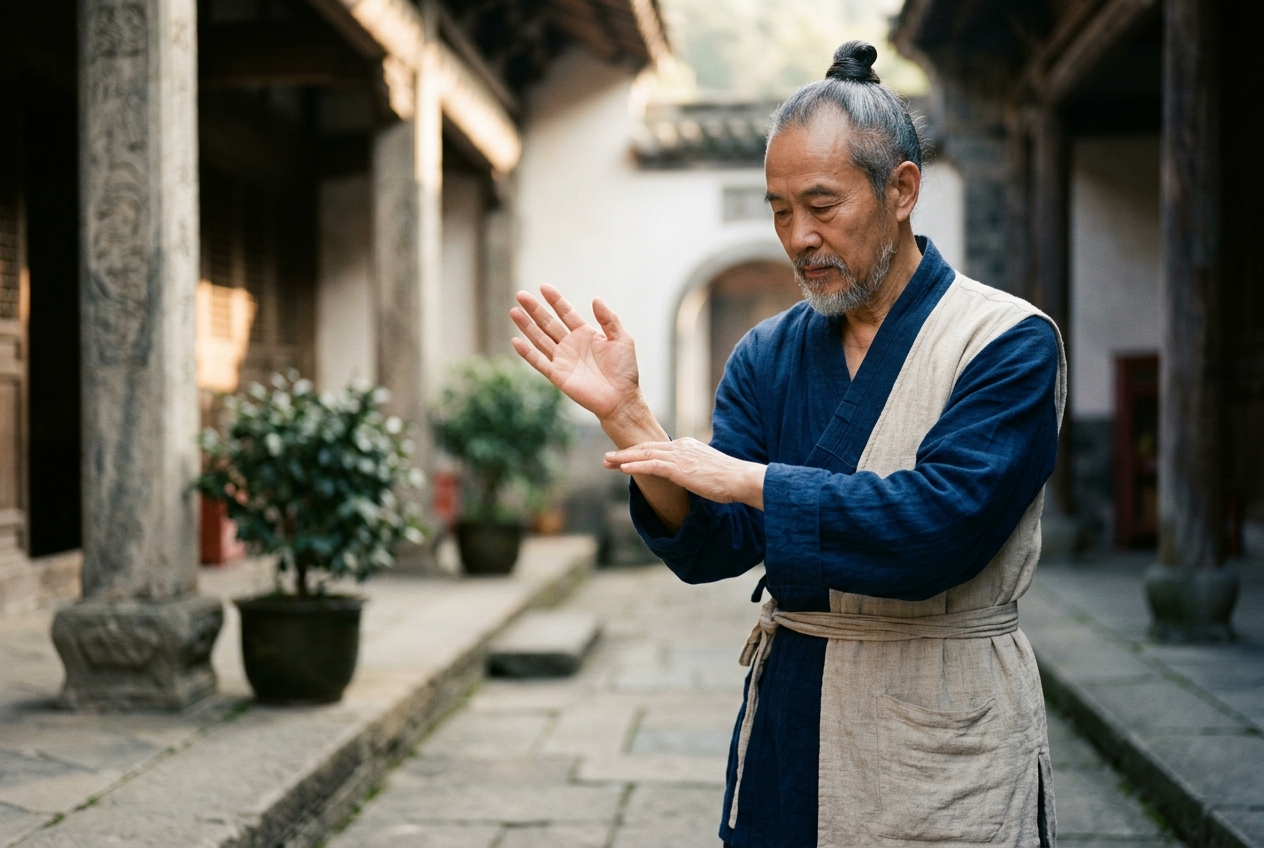
Feel the quiet, rhythmic pulse beneath your skin. Now, consciously relax your left shoulder, drop the left elbow by half an inch, and imagine a gentle string drawing the tip of your middle finger outward while the base of your palm settles downward. Within two or three deliberate breath cycles, notice what occurs under your right fingertips: the pulse softens yet broadens, the local tissue releases its gripped compression, and a subtle wave of warmth begins to wash across the thenar eminence into the thumb and index finger. That exact anatomical juncture is where our inquiry begins.
What Is This Practice? — Plain English First
In the classical traditions of Daoist body cultivation (Neigong) and therapeutic movement (Daoyin), movement is not initiated through muscular clenching or isolated joint rotation. Instead, bodily power and vitality are cultivated through the conscious opening, decompression, and alignment of vital anatomical junctions known as acupuncture cavities (xue). Among the hundreds of energetic gateways mapped across the human somatic landscape, few possess the profound systemic influence of Taiyuan (designated in modern clinical nomenclature as LU9, or "Supreme Abyss").
Located at the radial crease of the wrist, Taiyuan functions as the structural and hemodynamic hinge of the upper extremity. In plain terms, practicing the opening of Taiyuan means learning how to organize the hands, wrists, elbows, and thoracic diaphragm so that the major blood vessels and nerve pathways entering the hand remain completely uncompressed during movement. When modern practitioners sit at keyboards or grip steering wheels, they habitually hold their wrists in chronic, static dorsiflexion or collapsed pronation. This muscular micro-tension creates an invisible dam across the wrist, constricting microcirculation and generating compensatory strain all the way up into the neck and chest.
By mastering the classical alignment known as "sitting the wrist and extending the fingers" (Zuo Wan Shu Zhi, 坐腕舒指), the practitioner releases this peripheral constriction. The result is an immediate, measurable increase in blood flow to the fingers, a marked reduction in upper-body muscular tension, and an integrated neurofascial connection bridging the breath in the chest directly to the palms.
Classical Daoist Foundations & Canonical TCM Theory
In the canonical literature of Traditional Chinese Medicine, Taiyuan is celebrated as a multidimensional energetic crossroad. According to the foundational text Huangdi Neijing Lingshu (The Yellow Emperor's Classic of Internal Medicine: Spiritual Pivot), Taiyuan serves as both the Yuan-Source Point (Yuanxue, 原穴) and the Shu-Stream Earth Point (Shuxue, 輸穴) of the Arm Taiyin Lung Meridian (Shou Taiyin Feijing).
========================================================================================
CLASSICAL TAXONOMY OF TAIYUAN (LU9 / SUPREME ABYSS)
========================================================================================
Meridian Designation : Arm Taiyin Lung Meridian (手太陰肺經)
Five-Phase Phase     : Earth (Tu, 土) — The Mother Node of Lung Metal (Jin, 金)
Primary Category     : Yuan-Source Point (原穴) & Shu-Stream Point (輸穴)
Systemic Category    : Hui-Meeting Point of the Hundred Vessels (Mai Hui, 脈會)
Canonical Reference  : Nan Jing (Classic of Difficult Issues), Chapter 45
Functional Mandate   : Harmonization of Zong Qi, Vasomotor Homeostasis, Microvascular Flux
========================================================================================
As the Earth point of a Metal meridian, Taiyuan represents the physiological principle of Pei Tu Sheng Jin (培土生金, "Nourishing Earth to Generate Metal"). In traditional somatic taxonomy, Earth embodies stability, structural integrity, and the assimilative capacity of the spleen-stomach digestive axis, whereas Metal governs respiration, boundary regulation, and the downward dispersal of life energy. By anchoring the Earth phase at the wrist, Taiyuan provides the foundational stability required for the lungs to govern respiration and regulate the systemic waterways of the body.
Critically, the 45th Difficult Issue of the Nan Jing (Classic of Difficult Issues) classifies Taiyuan as the singular Hui-Meeting Point of the Vessels (Mai Hui, 脈會). The classical text proclaims:
"The vessels gather at the Supreme Abyss; it is the master regulator of the ten thousand arterial paths and the treasury of Gathering Qi."
In Daoist somatic theory, Zong Qi (宗氣, Gathering or Pectoral Qi) is forged in the thoracic cavity through the dynamic synthesis of clear air (Qing Qi) inhaled by the lungs and refined grain essence (Gu Qi) transformed by the digestive organs. Zong Qi accumulates in the chest (Dan Zhong, CV17), drives the rhythmic pulsation of the heart, and circulates through the entire arterial and venous tree. Because Taiyuan sits precisely where the radial artery surfaces between the bones of the forearm and the carpus, classical clinicians and martial adepts recognized it as the primary gateway for assessing and optimizing the dynamic interaction between respiration, arterial pulse, and physical movement.
For further scholarly insight into classical acupuncture point taxonomies, explore the World Health Organization Traditional Medicine Strategy, which standardizes these anatomical and therapeutic classifications.
Functional Anatomy, Fascial Tensegrity, and Biomechanical Derivations
To understand the transformative power of Taiyuan in movement, one must examine its exact topographic and fascial anatomy. Modern somatic sciences have verified that traditional acupuncture meridians correspond closely with continuous lines of tension and collagen fibers termed myofascial meridians. The Arm Taiyin Lung Meridian maps with precision to the Deep Front Arm Line, a continuum extending from the pectoralis minor and subclavius muscles, traversing the biceps brachii, brachialis, and pronator teres, coursing through the antebrachial investing fascia and the radial flexor compartments, and terminating at the thenar eminence and the ungueal border of the thumb.
Exact Topographic Anatomy
Taiyuan is situated on the anterolateral aspect of the wrist crease: 1. Osseous Landmarks: It lies in the distinct depression between the styloid process of the radius proximally and the scaphoid (os scaphoideum) and trapezium bones distally. 2. Tendinous Boundaries: It is located immediately lateral (radial) to the tendon of the flexor carpi radialis muscle, and medial to the tendon of the abductor pollicis longus. 3. Neurovascular Bundles: Deep within this anatomical cleft rests the main trunk of the radial artery (arteria radialis) and the accompanying radial veins, cushioned by the superficial branch of the radial nerve (nervus radialis) and terminal filaments of the lateral antebrachial cutaneous nerve.
Biomechanical Derivation of Arterial Hemodynamics Under Fascial Tension
When an untrained practitioner hyperextends or rigidly breaks the wrist (carpal collapse), the antebrachial investing fascia undergoes severe torsional shearing. This mechanical deformation exerts extrinsic transverse pressure on the lumen of the radial artery.
The fluid dynamics of blood flowing through the radial vessel can be modeled mathematically via the Hagen-Poiseuille Law for steady, laminar flow through a cylindrical vessel of radius $r$, length $L$, and dynamic blood viscosity $\mu$:
$$Q = \frac{\pi \Delta P \, r^4}{8 \mu L}$$
Where: - $Q$ represents volumetric flow rate ($\text{m}^3/\text{s}$). - $\Delta P$ represents the hydrostatic pressure gradient across the wrist segment ($\text{Pa}$). - $r$ is the internal radius of the radial artery ($\text{m}$). - $\mu$ is the dynamic fluid viscosity of whole blood ($\approx 3.5 \times 10^{-3} \text{ Pa}\cdot\text{s}$). - $L$ is the functional length of the carpal passage ($\text{m}$).
The wall shear stress ($\tau_w$) exerted on the endothelial lining of the vessel is given by:
$$\tau_w = \frac{4 \mu Q}{\pi r^3} = \frac{r \Delta P}{2 L}$$
========================================================================================
HEMODYNAMIC TRANSFORMATION MATRIX AT THE CARPAL GATE
========================================================================================
Condition            Carpal Angle    Radial Lumen ($r$)    Flow Rate ($Q \propto r^4$)  Shear Stress ($\tau_w$)
----------------------------------------------------------------------------------------
Collapsed Wrist      $\theta > 45^\circ$  $r_0 \times 0.70$     $Q_0 \times 0.24$           Elevated / Turbulent
Rigid Hyperextension $\theta < -20^\circ$ $r_0 \times 0.65$     $Q_0 \times 0.18$           Vascular Stenosis
Neigong Suspension   $0^\circ \le \theta \le 10^\circ$ $r_0 \times 1.00$     $Q_0 \times 1.00$           Optimal Laminar Flow
========================================================================================
Because volumetric flow $Q$ scales with the fourth power of the radius ($r^4$), even a nominal $20\%$ reduction in arterial radius caused by fascial constriction decreases microvascular perfusion distal to the wrist by over $59\%$ ($0.8^4 \approx 0.4096$).
Conversely, when the practitioner executes Zuo Wan Shu Zhi—settling the carpus while elongating the extensor tendons—the radial-carpal joint cavity distracts microscopically by $0.5\text{ to }1.2\text{ mm}$. This decompresses the retinacular fibers, maximizes $r$, and restores full laminar perfusion. For comprehensive clinical research on vascular mechanics, consult the National Center for Biotechnology Information (NCBI) on Radial Artery Hemodynamics and Microcirculation.
Fascial Tensegrity & Vector Mechanics
Within a living human body, the fascial network operates as a prestressed biotensegrity system. Rigid compression members (bones) float within an unbroken continuum of flexible tension elements (fascial sheaths, tendons, and aponeuroses). When the wrist is aligned correctly through Taiyuan, the tensile force vector $\vec{F}_{\text{total}}$ generated by the thoracic core splits cleanly across the superficial and deep front arm lines without localized stress concentration:
$$\vec{F}{\text{total}} = \vec{F}{\text{thenar}} + \vec{F}{\text{carpi}} + \vec{F}{\text{fascia}} = \oint_{\partial \Omega} \boldsymbol{\sigma} \cdot \hat{n} \, dA$$
Where $\boldsymbol{\sigma}$ is the Cauchy stress tensor across the antebrachial fascia $\Omega$, and $\hat{n}$ is the unit normal vector across the carpal surface. Proper postural alignment ensures that the deviatoric (shearing) component of $\boldsymbol{\sigma}$ approaches zero, preventing entrapment of the superficial radial nerve and allowing unimpeded mechanotransduction across connective tissues. To review the underlying biophysics of fascia, see the NCBI PubMed Central on Fascial Mechanotransduction and Interstitial Flow.
Cardiovascular & Bioenergetic Dynamics
The anatomical alignment of Taiyuan exerts a profound downstream effect on whole-body cardiovascular mechanics and autonomic balance. When an individual engages in mindful Neigong breathing, the descent of the thoracic diaphragm creates a rhythmic oscillation in intra-thoracic and intra-abdominal pressures. This diaphragmatic piston actively modulates venous return to the right atrium and induces oscillatory pressure waves known as Traube-Hering-Mayer waves within the systemic arterial tree.
When Taiyuan is opened and the wrist is suspended, the resistance along the radial outflow tract drops significantly. Endothelial cells lining the radial artery detect the restored laminar shear stress and stimulate the enzymatic activity of endothelial nitric oxide synthase (eNOS). This releases nitric oxide ($\text{NO}$), triggering vascular smooth muscle relaxation and microvascular vasodilation throughout the palmar arches.
This hemodynamic state establishes an energetic and somatic bridge between the Arm Taiyin Lung Meridian at Taiyuan and the Arm Jueyin Pericardium Meridian at the Laogong cavity (PC8, 勞宮), situated in the center of the palm. In Daoist internal alchemy, opening this pathway allows the cooling, receptive essence of the lungs (Metal/Water) to temper the metabolic heat of the heart (Fire), cultivating a profound state of autonomic tranquility characterized by heightened heart rate variability (HRV) and dominant parasympathetic vagal tone. Detailed studies on this neurovisceral integration can be found in the NCBI Study on Heart Rate Variability and Diaphragmatic Respiration.
Step-by-Step Practice Guide: Sitting the Wrist and Extending the Fingers
This foundational Neigong exercise, known classically as Zuo Wan Shu Zhi (坐腕舒指), can be performed standing in the Wuji posture or seated on a firm chair. It systematically decompresses the Taiyuan cavity and establishes whole-body fascial tensegrity.
Step 1: Foundational Stance and Scapular Depression
- Stand with your feet parallel and shoulder-width apart.
- Soften your knees by unlocking the joint capsules without dropping into a deep squat.
- Let the tailbone sink vertically as if resting on a high stool, flattening the lumbar curve slightly to open the Mingmen (GV4) gate in the lower back.
- Suspend the crown of your head from above (Baihui, GV20), tucking the chin gently so the back of the neck remains long and unwrinkled.
- Rest your tongue against the upper palate behind the incisors, closing the energetic circuit between the Conception and Governing vessels.
Step 2: Arm Elevation and Elbow Suspension
- On a slow, 5-second nasal inhalation, let your arms float upward in front of your body until the hands reach the level of your chest.
- As the arms rise, consciously ensure that the shoulders do not elevate toward the ears. Maintain wide, open armpits as if holding a soft bird's egg beneath each axilla.
- Allow the elbows to sink slightly below the plane of the wrists and shoulders. The elbow joint must maintain a gentle, obtuse arc of approximately $120^\circ\text{ to }135^\circ$. Never lock the joint straight, and never allow the elbow to collapse into the ribs.
Step 3: Engaging Taiyuan (Sitting the Wrist)
- As you initiate a slow, 6-second exhalation into the lower abdomen, execute the physical movement of "sitting the wrist" (Zuo Wan): 1. Let the heel of the palm sink downward and forward, settling the carpal bones without pulling the hand backward into extreme dorsiflexion. 2. Maintain a straight, continuous line of tension from the lateral forearm into the scaphoid notch. 3. Create an intentional microscopic hollow at the radial crease—the Taiyuan cavity should feel like a soft, receptive basin rather than a creased pinch. 4. Imagine the scaphoid bone moving away from the radial styloid process by a fraction of a millimeter.
Step 4: Extending the Fingers (Shu Zhi) and Concaving the Palm
- Concurrently with sitting the wrist, subtly spread and elongate the five digits:
- The thumb must gently extend outward and downward, opening the Hukou (Tiger's Mouth / LI4 web space).
- The index and middle fingers extend along their longitudinal axes as if soft light were streaming through the fingertips.
- Draw the center of the palm (Laogong, PC8) slightly inward, forming a subtle hollow dome ("concave palm").
- The wrist angle relative to the forearm should stabilize between $10^\circ\text{ and }15^\circ$ of gentle extension—never exceeding $20^\circ$.
Step 5: Breath Synchronization and Circulatory Pulse Cycling
- Maintain this structural configuration for 8 to 12 complete breath cycles.
- Inhalation (5 seconds): Draw the breath down to the lower Dantian. Feel the back ribs expand three-dimensionally; feel the fascia along the inner arm gently stretch without tightening.
- Exhalation (7 seconds): Soften the sternum (Dan Zhong), settle the weight down into the bubbling springs of the feet (Yongquan, K1), and mentally project the sensation of expansion through the open Taiyuan cavities into the fingertips.
========================================================================================
STEP-BY-STEP NEIGONG PRACTICE CHECKLIST
========================================================================================
Phase 1: Setup       [ ] Feet parallel   [ ] Crown suspended  [ ] Axillae hollowed
Phase 2: Elevation   [ ] Inhale 5s       [ ] Elbows dropped   [ ] Obtuse arm arc (135°)
Phase 3: Engagement  [ ] Exhale 7s       [ ] Settle carpus    [ ] Open Taiyuan hollow
Phase 4: Extension   [ ] Open Tiger Mouth[ ] Concave palm     [ ] Fingers elongated
Phase 5: Retention   [ ] 12 Breath cycles[ ] Warmth in thenar [ ] Throbbing at LU9
========================================================================================
Five Production-Grade Biomechanical & Lineage Applications
The mastery of Taiyuan is not an abstract concept; it forms the functional core of every major classical internal martial art and Daoyin lineage. Below are five detailed, production-grade movement applications analyzed from historical, kinetic, and neurofascial perspectives.
1. Standing Pole Meditation (Zhan Zhuang Wuji Stance)
- Lineage & Tradition: Foundational to all internal systems, notably codified in the modern era by Grandmaster Wang Xiangzhai in Yiquan (Dachengquan).
- Kinetic & Fascial Breakdown: In the classic "Embracing the Tree" (Cheng Bao Zhuang) posture, the practitioner maintains the arms in an expansive circle at chest level.
- Line-by-Line Mechanics: By actively depressing the scapulae and sitting the wrists at Taiyuan, the entire myofascial sleeve of the Deep Front Arm Line is held in uniform, low-amplitude isometric tension.
- Internal Mechanism: This continuous fascial loading activates muscle spindles and Golgi tendon organs without causing muscular fatigue. The open Taiyuan cavity prevents venous pooling in the distal extremities during prolonged standing sessions (20 to 60 minutes), converting the arms into resilient, shock-absorbing springs.
2. Chen Style Taijiquan Silk Reeling (Chansijin Helical Spiraling)
- Lineage & Tradition: Chenjiagou internal martial lineage, originating with Chen Wangting in the late Ming / early Qing dynasty.
- Kinetic & Fascial Breakdown: During positive (outward) and negative (inward) Silk Reeling exercises, the arm moves through continuous, three-dimensional spiraling trajectories.
- Line-by-Line Mechanics: The movement initiates from the rotation of the Dantian and hips, travels through the helical winding of the spine and latissimus dorsi, and expresses through the forearm via alternating pronation and supination.
- Internal Mechanism: If the wrist is allowed to collapse or stiffen, the spiral wave breaks at the carpus. By maintaining Taiyuan as an open, floating pivot point, the rotational torque generated by the torso is transmitted without energy dissipation directly through the thenar eminence into the contact point (Fajin), creating devastating martial power coupled with effortless fluid dynamics.
3. Cloud Hands (Yunshou) Wave Mechanics
- Lineage & Tradition: Yang and Wu Style Taijiquan, historically traced through Yang Luchan.
- Kinetic & Fascial Breakdown: In Cloud Hands, the practitioner steps laterally while the upper body alternates sweeping circular arcs across the frontal plane.
- Line-by-Line Mechanics: As the upper hand sweeps across the face at eye level, the forearm moves from an inward-facing ward-off (Peng) into a downward wiping motion.
- Internal Mechanism: Throughout this transit, the practitioner maintains the Taiyuan cavity open and oriented toward the central axis of the body. This prevents the elbow from flaring and keeps the chest muscles relaxed. The continuous smooth perfusion through the radial artery produces a characteristic sensation of dense, magnetic resistance between the moving hands.
4. Baguazhang Dragon Palm Spiraling (Single Palm Change)
- Lineage & Tradition: Dong Haichuan lineage of Baguazhang (Eight Trigrams Palm).
- Kinetic & Fascial Breakdown: During circle walking, the inner arm extends toward the center of the circle while the torso twists dramatically toward the central pole.
- Line-by-Line Mechanics: The palm is held in the "Dragon Claw" formation (Long Zhao Zhang), with the thumb turned out and the fingers separated like curved hooks.
- Internal Mechanism: This posture generates extreme torsional shear across the arm. Opening the Taiyuan cavity by depressing the scaphoid-radial junction prevents the radial nerve from being pinched between the pronator teres and the bicipital aponeurosis. It anchors the extreme twisting of the limb into the ground via the back fascial chains, protecting the delicate carpal ligaments from rotational injury.
5. Classical Daoyin Pulmonary Restoration (Six Healing Sounds: 'Si' Breath)
- Lineage & Tradition: Early Daoist Daoyin exercises codified by Master Tao Hongjing (456–536 CE) in Yangxing Yanming Lu (Record of Nourishing Nature and Prolonging Life).
- Kinetic & Fascial Breakdown: In the Lung Sound (Si, 呬) practice, the hands rise along the chest to the throat, rotate palms upward, push skyward while uttering a sibilant sub-vocalized "Sssss" sound, and then trace the lung meridian downward as the hands sink.
- Line-by-Line Mechanics: As the hands push upward and outward, the wrists sit deeply, expanding the Taiyuan cavity to its maximal open excursion.
- Internal Mechanism: The acoustic vibration of the sound vibrates the bronchial tree, while the physical opening of the Taiyuan gateway creates an axial stretch along the Deep Front Arm Line. This combination expedites the clearance of pulmonary mucus, improves alveolar gas exchange, and stimulates pulmonary lymphatic drainage. For classical movement references, explore the National Qigong Association Guidelines for Neigong Alignment.
Diagnostic Somatosensory Markers & Error Correction
In authentic Neigong pedagogy, energetic activation is always accompanied by verifiable, subjective neurovascular markers. Practitioners should evaluate their practice against clear somatic benchmarks while actively diagnosing and correcting postural faults.
========================================================================================
SOMATOSENSORY MARKER MATRIX
========================================================================================
Somatic Benchmark            Physiological Correlate               Instructional Action
----------------------------------------------------------------------------------------
Thenar Warmth (Re, 熱)       Arteriolar Vasodilation (eNOS)        Maintain steady alignment
Rhythmic Thrumming (Dong, 動) Radial Artery Resonant Laminar Flow   Deepen abdominal breath
Electric Tingling (Ma, 麻)   Axonal Micro-Depolarization           Do not force; relax fascia
Heavy Fullness (Zhang, 脹)   Interstitial Fluid Pressurization     Sustain structural dome
----------------------------------------------------------------------------------------
FAULT: Sharp Crease Pain     Carpal Bone Impingement / Stenosis    Reduce dorsiflexion angle
FAULT: Numb Thumb/Index      Radial Nerve Branch Compression       Soften abductor pollicis
FAULT: Cold Fingertips       Axillary / Scapular Hypertonicity     Drop elbows; sink shoulders
========================================================================================
Verified Somatosensory Markers
- Thenar Warmth (Re, 熱): Within 3 to 5 minutes of opening Taiyuan, a distinct sensation of radiating warmth develops across the fleshy base of the thumb (thenar eminence). This indicates successful smooth muscle relaxation and microvascular filling of the palmar arterial arches.
- Rhythmic Microvascular Thrumming (Dong, 動): A practitioner will perceive the arterial pulse at Taiyuan not as a localized, tapping beat, but as a broad, fluid wave that pulsates through the entire wrist and travels into the thumb and index finger.
- Distal Electric Tingling (Ma, 麻): A gentle, sparkling sensation—resembling a benign, non-painful micro-current—often manifests at the corner of the thumb nail bed (Shaoshang, LU11). This somatosensory marker confirms the unobstructed flow of bioelectric signals along the peripheral nerve sheaths.
- Interstitial Fullness (Zhang, 脹): The palm and fingers feel pressurized, dense, and inflated like a soft leather glove filled with warm water. This is the physiological expression of optimized fascial hydration and interstitial fluid equilibrium.
Diagnostic Error Correction & Troubleshooting
- Error 1: Carpal Pinching and Tendon Strain
- Symptom: Sharp discomfort or creasing pain at the dorsal or volar wrist joint.
- Biomechanical Cause: The practitioner is pulling the hand backward too far, exceeding $20^\circ$ of dorsiflexion and compressing the carpal tunnel.
- Correction: Settle the wrist by dropping the heel of the palm downward rather than pulling the fingers backward. Ensure the dorsal surface of the wrist forms a smooth, gentle incline.
- Error 2: Radial Nerve Impingement
- Symptom: Burning sensation or loss of tactile sensitivity across the dorsal web between the thumb and index finger.
- Biomechanical Cause: Excessive muscular tension in the abductor pollicis longus and extensor pollicis brevis tendons, compressing the superficial branch of the radial nerve against the radial styloid.
- Correction: Soften the base of the thumb. The thumb should be extended gently, not pulled rigidly backward into hyperextension.
- Error 3: Cold Hands and Collapsed Flow
- Symptom: Hands remain cold, pale, or clammy despite prolonged practice.
- Biomechanical Cause: The practitioner is lifting the shoulders or pulling the elbows back, pinching the subclavian artery and brachial plexus under the pectoralis minor.
- Correction: Drop the scapulae down the ribcage. Widen the dorsal thoracic region (Han Xiong Ba Bei, "Contain the Chest and Pull Up the Back") to ensure an open vascular conduit from the aorta to the hands. Review the anatomical pathways via Wikipedia on the Radial Artery and Carpal Anatomy.
Historical Lineage & Epistemological Transmission
The pedagogical framework surrounding Taiyuan represents an unbroken lineage of empirical somatic research stretching across more than two millennia of Chinese civilization.
========================================================================================
CHRONOLOGICAL TRANSMISSION OF TAIYUAN SOMATIC PEDAGOGY
========================================================================================
Era / Dynasty        Primary Text / Artifact              Key Somatic Advancement
----------------------------------------------------------------------------------------
Warring States       Mawangdui Medical Silk Texts         Mapping of the Arm Taiyin Meridian
(c. 168 BCE)         (Yinyang Shiyi Mai Jiujing)          as the primary breathing channel.
----------------------------------------------------------------------------------------
Han Dynasty          Huangdi Neijing (Lingshu & Suwen)    Establishment of Taiyuan as the
(c. 200 BCE–200 CE)                                       Yuan-Source & Shu-Stream Earth point.
----------------------------------------------------------------------------------------
Eastern Han Dynasty  Nan Jing (Classic of Difficult       Codification of Taiyuan as the
(c. 100–200 CE)      Issues), Chapter 45                  Hui-Meeting Point of all Vessels (Mai Hui).
----------------------------------------------------------------------------------------
Ming Dynasty         Zhenjiu Dacheng (Great Compendium    Detailed clinical mapping of radial
(1601 CE)            of Acupuncture and Moxibustion)      artery diagnostics & needle mechanics.
----------------------------------------------------------------------------------------
Late Qing / Modern   Chen & Yang Style Taijiquan,         Integration of Zuo Wan Shu Zhi
(1850 CE–Present)    Yiquan Zhan Zhuang Treatises         into internal martial kinetic chains.
========================================================================================
The earliest historical records of meridian pathways, unearthed in 1973 from the Han Dynasty tomb at Mawangdui (dating to 168 BCE), document the Arm Taiyin Meridian on silk manuscripts (Yinyang Shiyi Mai Jiujing). In these archaic treatises, the meridian was described not merely as an acupuncture pathway, but as a dynamic vascular channel that pulsed in direct synchrony with the seasons and the cosmic movements of Heaven and Earth.
During the Han Dynasty, the codification of the Huangdi Neijing and the Nan Jing formalized the doctrine of the Cun Kou (寸口)—the radial pulse palpation method. Prior to this innovation, classical physicians palpated pulses across twelve distinct regions of the body (including the temples, neck, and feet). The masters of the Nan Jing revolutionized medical diagnostics by asserting that the entirety of systemic organ health, blood circulation, and Qi distribution could be accurately diagnosed entirely at the radial wrist crease—specifically centered on Taiyuan.
During the late Ming and early Qing dynasties, masters of the internal martial arts recognized that the diagnostic mastery of the radial wrist had a direct martial counterpart. In the foundational treatises of Chen Style Taijiquan and later in Yang Banhou’s internal manuals, the posture of "sitting the wrist and opening the abyss" became a closely guarded secret. It was understood that an adept who could maintain an uncompressed Taiyuan during the chaos of combat would never experience fatigue in the arms, could withstand tremendous impacts through elastic fascial tensegrity, and could transmit striking force through the opponent’s skeletal structure with fluid efficiency.
Today's Daily Practice Protocol & Somatic Commitment
To integrate the profound physiological and energetic benefits of Taiyuan into your daily life, commit to the following structured 7-minute morning protocol before your first meal or screen interaction.
========================================================================================
THE 7-MINUTE MORNING TAIYUAN DECOMPRESSION PROTOCOL
========================================================================================
Duration : 7 Minutes Daily (Morning, Fasted State)
Target   : Restoration of Arterial Flow, Diaphragmatic Balance, Fascial Unwinding

Minute 0:00 - 2:00 : POSTURAL ALIGNMENT & STATIC PALM SUSPENSION
                     - Establish Wuji stance; suspend crown; sink tailbone.
                     - Raise arms to chest level; settle the wrists into Zuo Wan.
                     - Focus awareness entirely on softening the scaphoid-radial hollow.

Minute 2:00 - 5:00 : SYNCHRONIZED BREATH & CIRCULATORY EXPANSION
                     - Inhale 5 seconds (expand lower abdomen); exhale 7 seconds (soften chest).
                     - Track the emergence of warmth at the thenar eminence.
                     - Feel the pulse broaden beneath the wrist crease into the fingers.

Minute 5:00 - 7:00 : THREE-DIMENSIONAL SPIRAL INTEGRATION
                     - Gently cycle through slow, small-radius forearm spirals (Silk Reeling).
                     - Inward winding (supination) on inhalation; outward settling (pronation) on exhalation.
                     - Preserve the open Taiyuan hollow throughout the entirety of the arc.
========================================================================================
Notice your somatic state over the subsequent two hours. You should observe a marked reduction in neck and shoulder tension, warm and agile hands, improved mental clarity born of balanced vagal tone, and a grounded sense of physical presence that anchors your entire day.
Comprehensive Practice Summary
+---------------------------------------------------------------------------------------+
|                             TAIYUAN (LU9) MASTERY SUMMARY                             |
+---------------------------------------------------------------------------------------+
| 1. ANATOMICAL KEY  : Radial styloid-scaphoid notch, lateral to flexor carpi radialis.  |
| 2. ENERGETIC KEY   : Yuan-Source, Shu-Stream Earth Point, Hui-Meeting of all Vessels. |
| 3. BIOMECHANICS    : Maximizes arterial radius (r) to optimize laminar flow (Q ~ r^4). |
| 4. NEIGONG POSTURE : "Sitting the Wrist and Extending the Fingers" (Zuo Wan Shu Zhi).|
| 5. SENSORY SIGNS   : Thenar warmth, radial thrumming, electric tingling at thumb tip. |
+---------------------------------------------------------------------------------------+