Taixi Cavity Supreme Stream: Medial Malleolar Fascial Decompression, Renal Essence Anchoring, and Calcaneal Kinetic Rooting in Classical Neigong
                    MEDIAL ANKLE TOPOGRAPHY (TAIXI / KI3)
               =============================================

Tibia (Medial Malleolus)
                          \       /
                           \     /     <--- Retromalleolar Groove
                            \   /           [ TAIXI / KI3 ]
                             \ /            (Tibial Nerve & Artery)
                              o
                             / \
                            /   \
          Plantar Arch <---/     \---> Tendocalcaneus (Achilles)
          (Yongquan / KI1)             (Calcaneal Insertion)
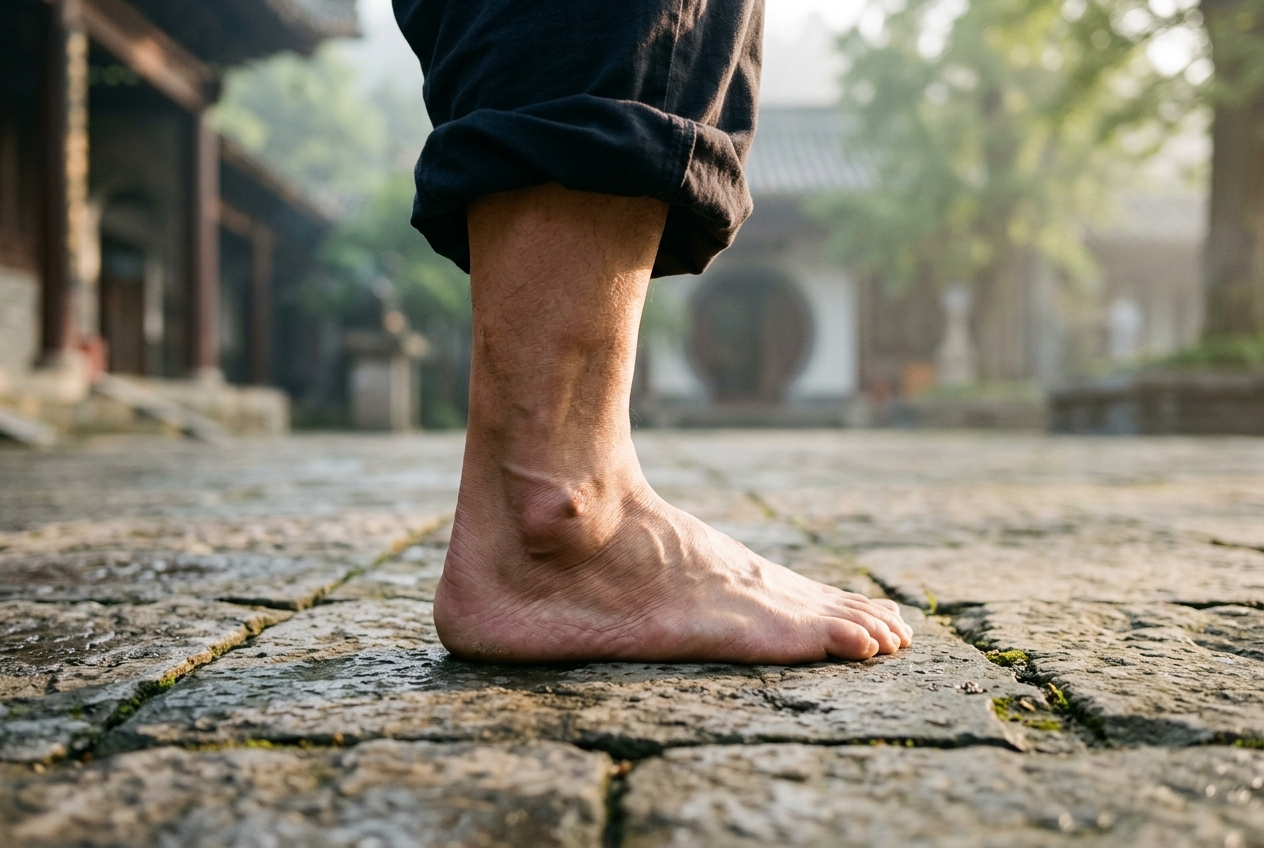
To the modern practitioner, working with the Taixi cavity means learning to decompress the inner ankle so that the foot does not roll inward (pronation), the Achilles tendon does not seize with chronic tension, and the major nerves and blood vessels traveling into the sole remain completely unimpinged. In classical terms, Taixi serves as the primary gateway for Kidney energy—the foundational physiological reservoir that traditional practitioners believed governed structural integrity, hormonal vitality, and the deep anchoring of breath within the body. When this cavity is closed through poor posture or muscular strain, our physical root is compromised; when it is systematically opened through mindful alignment, the entire body discovers an effortless, buoyant stability known in internal arts as Song (鬆, active fascial release).
Step-by-Step Somatic Practice Guide
The following protocol guides practitioners through the micro-biomechanical alignment, fascial decompression, and interoceptive activation of the Taixi cavity within the foundational Wuji (emptiness) posture of classical Zhan Zhuang.
Phase 1: Establishing the Kinetic Tripod Foundation
- Stance Geometry: Position the feet parallel, aligned with the outer edges of the hips. Ensure the second toe of each foot points directly forward to prevent external or internal hip torque.
- Plantar Tripod Weight Distribution: Distribute your weight across three anatomical landmarks on each sole: the base of the big toe (first metatarsal head), the base of the little toe (fifth metatarsal head), and the center of the heel bone (calcaneus).
- Knee and Pelvic Release: Soften the knee joints without allowing them to drift forward beyond the toes. Relax the inguinal creases (the Kua), allowing the sacrum to drop vertically toward the earth while maintaining the natural, unflattened curvature of the lumbar spine.
Phase 2: Micro-Alignment of the Subtalar Joint and Taixi Expansion
- Locating the Ravine: Place your somatic attention in the medial retromalleolar groove—the depression between the medial malleolus (inner ankle prominence) and the anterior border of the tendocalcaneus (Achilles tendon).
- Preventing Medial Collapse: Without lifting the ball of the big toe, gently elevate the medial longitudinal arch of the foot. Sense the inner ankle bone lifting subtly upward and outward away from the midline of the body.
- Achilles Softening: Ensure the back of the heel does not grip. The Achilles tendon must transition from a rigid, overstretched cable into a pliable, suspended elastic band. Imagine creating a spacious, circular dome inside the retromalleolar groove, allowing the Taixi cavity to "bloom" open three-dimensionally.
Phase 3: Synchronized Diaphragmatic Breath and Energy Routing
- Inhalation (Ground-to-Core Ascent): As you inhale slowly through the nose, expand the lower abdomen, lateral ribs, and lower back (Mingmen). Simultaneously visualize drawing a clean, buoyant current of ground force upward from Yongquan (KI1, the "Bubbling Well" located behind the ball of the foot), channeling it directly into the open chamber of Taixi (KI3).
- Exhalation (Descending Anchorage): As you exhale, allow the breath to sink smoothly into the pelvic basin (Dantian). Maintain the architectural space inside the Taixi cavity, feeling your weight cascade effortlessly through the calcaneus into the earth without compressing the inner arch.
+----------------------------------------------------------------------------------------------------+
|                                    SOMATIC TROUBLESHOOTING MATRIX                                  |
+------------------------------------+------------------------------------+--------------------------+
| BIOMECHANICAL DEVIATION            | SOMATOSENSORY INDICATOR            | CORRECTIVE SOMATIC CUE   |
+------------------------------------+------------------------------------+--------------------------+
| Calcaneal Valgus (Medial Collapse) | Sharp pinch or dead weight at KI3; | "Suspend the inner ankle |
|                                    | flattened medial foot arch.        | ceiling toward the sky." |
+------------------------------------+------------------------------------+--------------------------+
| Posterior Heel Back-Loading        | Rigid Achilles tendon; balance     | "Drift the center of mass|
|                                    | tipping backward; toes lifting.    | toward the foot tripod." |
+------------------------------------+------------------------------------+--------------------------+
| Isometric Ankle Clenching          | Coldness or numbness in toes;      | "Melt the Achilles into  |
|                                    | burning calf muscle fatigue.       | pliable, warm silk."     |
+------------------------------------+------------------------------------+--------------------------+
Phase 4: Interoceptive Milestones and Somatosensory Indicators
As the tarsal tissues decompress and neural transmission normalizes, practitioners should observe several progressive physiological markers: * Thermal Waves: A distinct, spreading sensation of warmth radiating from the retromalleolar space across the plantar fascia and upward along the inner calf. * Micro-Pulsation: The clear proprioceptive perception of the posterior tibial artery pulsing gently within the decompressed groove. * Structural Buoyancy: A profound shift from heavy muscular holding to an effortless, floating suspension across the subtalar joint, as the musculoskeletal framework aligns with gravity.
Why It Works: Functional Anatomy, Fascial Tensegrity, and Somatic Science
To understand why classical masters placed such extraordinary emphasis on decompressing the Taixi cavity, one must examine the intersection of orthopedic micro-anatomy, myofascial kinetic chains, and autonomic neurophysiology.
                KINETIC CHAIN & NEUROVASCULAR PATHWAY AT KI3
 =========================================================================
   [Diaphragm & Pelvic Basin]
               |
   [Deep Posterior Line / Fascia] (Tibialis Posterior / Long Flexors)
               |
   [Tarsal Tunnel / Flexor Retinaculum] <--- Decompressed via Taixi (KI3)
               |
   [Neurovascular Bundle] (Tibial Nerve + Posterior Tibial Artery)
               |
   [Plantar Vault / Yongquan KI1] <--- Ground Reaction Force Transmission
The Retromalleolar Groove and the Tarsal Tunnel Complex
Anatomically, Taixi (KI3) resides directly over the tarsal tunnel, an unyielding fibro-osseous canal situated on the medial aspect of the ankle. The floor of this canal is formed by the medial surfaces of the tibia, talus, and calcaneus, while its roof is anchored by the dense, fibrous flexor retinaculum (also known historically as the laciniate ligament).
Running beneath this retinaculum is the critical neurovascular bundle of the lower extremity, alongside the deep extrinsic flexor tendons—traditionally memorized by anatomists through the mnemonic "Tom, Dick, And Very Nervous Harry": 1. Tibialis posterior tendon 2. Flexor digitorum longus tendon 3. Posterior tibial artery 4. Posterior tibial vein 5. Tibial nerve 6. Flexor hallucis longus tendon
When an individual stands with dysfunctional mechanics—specifically calcaneal valgus, in which the heel bone tilts outward and the medial ankle sags inward—the volume of the tarsal tunnel is drastically reduced. This mechanical deformation exerts chronic shear and compressive strain upon the flexor retinaculum, impinging the posterior tibial artery and the tibial nerve.
By actively "opening" Taixi through neutral subtalar alignment, the practitioner lifts the laciniate ligament, decompresses the tarsal tunnel, and restores unimpeded vascular perfusion to the deep plantar intrinsic muscles. Concurrently, unimpinged tibial nerve conduction optimizes sensory feedback from the mechanoreceptors embedded in the sole, enhancing static balance and neuromuscular recruitment.
Fascial Tensegrity and the Deep Posterior Line
Modern biomechanics and fascial research—documented extensively across peer-reviewed publications indexed in the National Center for Biotechnology Information—demonstrate that muscular force is not transmitted solely from origin to insertion along isolated levers, but distributed through continuous, full-body sheets of connective tissue, or fascia.
In Thomas Myers' anatomical taxonomy, the tendons traversing the Taixi cavity constitute the primary distal anchor of the Deep Front Line (or Deep Posterior Myofascial Chain). The tibialis posterior, flexor digitorum longus, and flexor hallucis longus ascend the deep posterior compartment of the lower leg, cross the knee capsule behind the medial condyles, merge into the adductor magnus and pelvic floor musculature, and continue directly into the psoas major, respiratory diaphragm, pericardial fascia, and cervical spine.
       DEEP MYOFASCIAL TENSEGRITY CONTINUITY
+---------------------------------------------------+
| Cervical Fascia & Cranial Base                    |
|                        ^                          |
| Pericardium & Endothoracic Fascia                 |
|                        ^                          |
| Respiratory Diaphragm & Psoas Complex             |
|                        ^                          |
| Pelvic Floor (Huiyin / CV1) & Adductor Magnus     |
|                        ^                          |
| Deep Posterior Calf (Tibialis Posterior)          |
|                        ^                          |
| TAIXI (KI3) / Retromalleolar Fascial Fulcrum      |
|                        ^                          |
| Plantar Fascia & Yongquan (KI1)                   |
+---------------------------------------------------+
When Taixi is compressed by collapsed ankles or rigid muscular gripping, this entire deep kinetic chain suffers mechanical tension and postural distortion. Conversely, when the Taixi cavity is opened through tensegrity-driven Song, the deep fascial line decompresses from the ankle to the base of the skull. This allows the respiratory diaphragm and the pelvic floor (Huiyin, CV1) to oscillate in effortless harmonic resonance, stabilizing intra-abdominal pressure without pathological spinal loading.
Ground Reaction Force and Autonomic Regulation
The transition of ground reaction forces across the foot must follow a precise vector to protect the joints of the lower kinetic chain. When ground forces enter through the ball of the foot at Yongquan (KI1), an open Taixi cavity allows these forces to be buffered across the talocalcaneal (subtalar) articulation rather than shearing into the medial collateral (deltoid) ligament.
From a neurological perspective, the sensory branches of the tibial nerve within the retromalleolar groove communicate directly with the spinal cord's autonomic reflex arcs. Gentle, uncompressed standing combined with diaphragmatic breathing down-regulates sympathetic tone, increases vagal nerve stimulation, and optimizes heart rate variability (HRV), as recognized in contemporary research synthesized by the World Health Organization.
Classical Lineage & Energetic Alchemy: Pre-Heaven Jing and Kan-Li Harmonization
While contemporary science articulates the mechanics of Taixi through the lenses of neurology and fascial tensegrity, classical Chinese medical literature and Daoist internal alchemical (Neidan) treatises preserve a parallel, sophisticated energetic framework developed across centuries of empirical inquiry.
                    KAN-LI CARDIORENAL HARMONIZATION
 =========================================================================

FIRE (Li / Heart)             Descending Celestial Fire
             [ Shen / Spirit ]            (Heart Fire drawn downward
                   |                       via Kidney Channel suction)
                   v
             ================= [ Middle Dantian ] =================
                   |
                   v                       Ascending Vital Vapor
           WATER (Kan / Kidneys)          (Yin Fluids vaporized by
             [ Jing / Essence ]           Mingmen Fire to nourish Heart)
                   |
             TAIXI (KI3) <--- Yuan-Source Anchorage at Foot Shaoyin
The Foot Shaoyin Channel and Constitutional Source Qi
In the canonical taxonomy of Chinese medicine, Taixi is classified as both the Yuan-Source point (Yuan Xue, 原穴) and the Shu-Stream point (Shu Xue, 输穴) of the Foot Shaoyin Kidney Meridian (Zu Shao Yin Shen Jing). The Huangdi Neijing (Yellow Emperor’s Inner Classic, compiled circa 2nd century BCE) notes in the Lingshu (Spiritual Pivot) that when the five Zang organs are diseased, one must select their respective twelve Yuan-Source points.
As the Yuan-Source point of the Water element, Taixi possesses direct resonance with the Yuan Qi (Original or Primary Qi) stored in the Kidneys. In traditional physiology, the Kidneys are the constitutional reservoir of Pre-Heaven Jing (先天之精, Congenital Essence)—the finite biological blueprint and vitality inherited from one's parents. Taixi holds a unique therapeutic status because it possesses the dual capacity to: 1. Nourish Kidney Yin: Replenishing the fluid foundation, cooling systemic inflammation, and lubricating connective tissues. 2. Ignite Kidney Yang: Awakening metabolic fire, warming the lower extremities, and fueling the transformative power of the Mingmen (Life Gate).
As a Shu-Stream point, classical doctrine describes its energetic movement as a place where the channel Qi "pours" like a broad, deep river, making it the primary cavitation on the lower limb for expelling pathogenic cold and dampness while anchoring rebellious, upward-surging energy back to its terrestrial root.
The Kan-Li Alchemical Dynamics: Harmonizing Fire and Water
Within Daoist internal alchemical traditions—cultivated within Mount Wudang monasteries and codified during the Song and Ming dynasties—Taixi is recognized as the physical and energetic anchor for the profound alchemical process of Kan-Li (坎离, Water and Fire) harmonization.
In classical cosmology: * Li (☲, Fire) represents the Heart, consciousness (Shen), emotional volatility, and upper-body heat. * Kan (☵, Water) represents the Kidneys, essence (Jing), somatic grounding, and lower-body vital fluids.
In standard, degenerate physiology, Fire naturally flares upward—manifesting as racing thoughts, insomnia, hypertension, and anxiety—while Water naturally drains downward, manifesting as cold knees, lumbar weakness, and metabolic exhaustion.
+----------------------------------------------------------------------------------------------------+
|                                    CLASSICAL ENERGETIC TAXONOMY                                    |
+--------------------------+------------------------------------+------------------------------------+
| ATTRIBUTE                | CLASSICAL TERMINOLOGY              | CLINICAL & SOMATIC SIGNIFICANCE    |
+--------------------------+------------------------------------+------------------------------------+
| Channel Classification   | Foot Shaoyin (足少阴肾经)          | Primary Water channel of the body. |
+--------------------------+------------------------------------+------------------------------------+
| Point Category           | Yuan-Source & Shu-Stream (Earth)   | Direct access to Pre-Heaven Jing.  |
+--------------------------+------------------------------------+------------------------------------+
| Vessel Continuity        | Yin Qiao Mai (Yin Heel Vessel)     | Controls lower limb muscular tone. |
+--------------------------+------------------------------------+------------------------------------+
| Alchemical Role          | Kan-Li Anchor                      | Draws Heart Fire down to Kidneys.  |
+--------------------------+------------------------------------+------------------------------------+
Through the standing alignment of Zhan Zhuang, opening the Taixi cavity creates an energetic siphon. By rooting the physical posture through the Foot Shaoyin channel, the practitioner draws the celestial fire of the Heart downward into the lower Dantian and Kidneys.
This descending fire warms the cold Kidney Water; the heated Water transforms into a delicate, cooling vapor that ascends along the spinal axis to nourish the Heart and calm the spirit. Without the structural and fascial decompression of the Taixi cavity, this alchemical loop breaks at the ankle, leaving the practitioner ungrounded and energetically top-heavy.
Historical Lineage and Internal Martial Arts
The systematic integration of the Taixi cavity into standing meditation reached its martial and somatic peak through the emergence of Yiquan (Dachengquan), founded by Master Wang Xiangzhai (1885–1963). Wang distilled the essence of Xingyiquan, Baguazhang, and Daoist meditation into Zhan Zhuang, stripping away ornamental forms to focus purely on internal tensegrity, neurological intention (Yi), and micro-fascial alignment.
Wang taught that true rooting is never an act of pressing into the floor with force, but rather a state of total structural suspension in which the joints—most notably the inner ankles and hips—remain hollow, buoyant, and resiliently open. Modern organizations such as the National Qigong Association continue to preserve and teach these nuanced postural principles as foundational practices for holistic health, balance, and athletic longevity.
Daily Practice Commitment: The Five-Minute Morning Decompression
To translate this theoretical knowledge into concrete neuromuscular memory, commit to the following five-minute cultivation routine each morning before checking your digital devices or drinking your first cup of coffee:
+----------------------------------------------------------------------------------------------------+
|                                   DAILY FIVE-MINUTE INTEGRATION                                    |
+-------------+-----------------------------------------------------+--------------------------------+
| DURATION    | PRACTICE FOCUS                                      | PRIMARY INTENTION              |
+-------------+-----------------------------------------------------+--------------------------------+
| Minute 1    | Plantar Tripod Grounding & Stance Setup             | Neutralize subtalar angle.     |
+-------------+-----------------------------------------------------+--------------------------------+
| Minutes 2–3 | Palpation & Breath-Directed Taixi Decompression     | Soften Achilles; decompress.   |
+-------------+-----------------------------------------------------+--------------------------------+
| Minutes 4–5 | Static Wuji Standing with Whole-Body Song Release   | Siphon fire down; anchor root. |
+-------------+-----------------------------------------------------+--------------------------------+
- Minute 1 (The Neutral Ground): Stand barefoot on a firm, flat surface. Align your feet parallel and hip-width apart. Spend sixty seconds gently rocking forward and backward until you find the exact center of the plantar tripod, ensuring the medial arches are actively domed and the toes are long and relaxed.
- Minutes 2–3 (The Breath in the Ravine): Place your fingertips lightly onto the Taixi cavities behind your inner ankle bones. Take ten slow, diaphragmatic breaths. With each inhalation, visualize cool, clear water expanding the retromalleolar groove beneath your fingers; with each exhalation, feel all residual tension in your calves and lower back dissolve into the floor.
- Minutes 4–5 (The Suspended Posture): Release your hands to your sides, resting them in soft curves as if holding light silk cushions. Stand in stillness. Track the gentle sensation of warmth rising from the soles while the mind settles into the lower abdomen.
By maintaining this brief, daily somatic inquiry, you progressively retrain the deep myofascial network of the lower limbs, safeguard the neurovascular architecture of the feet, and establish an unshakeable, rooted foundation capable of sustaining physical vitality and mental clarity throughout the demands of modern life.